Abstract
BACKGROUND:
While literature includes a number of studies about burnout in teaching, investigations on teaching field-specific perspective remain limited. Research is needed to improve practical implications based on structured theoretical models and methodological basis that focusses on the unique environment of PE teaching field and causal factors behind burnout.
OBJECTIVE:
The present study aimed to examine burnout among physical education (PE) teachers based on the job demands-resources (J-DR) model.
METHODS:
A sequential explanatory mixed design was conducted in the study. 173 teachers replied to questionnaires, of which 14 teachers thereafter participated in semi-structured interviews. Demographic information form, Maslach Burnout Inventory, and J-DR scale for PE teachers were used, as well as an interview form. 173 teachers were first asked to report demographic information, and score Maslach Burnout Inventory and J-DR scale. Then a subsample group (n = 14) was identified/sampled for a semi-structured interview. Canonical correlation and constant comparative analysis were used to unpack the data.
RESULTS:
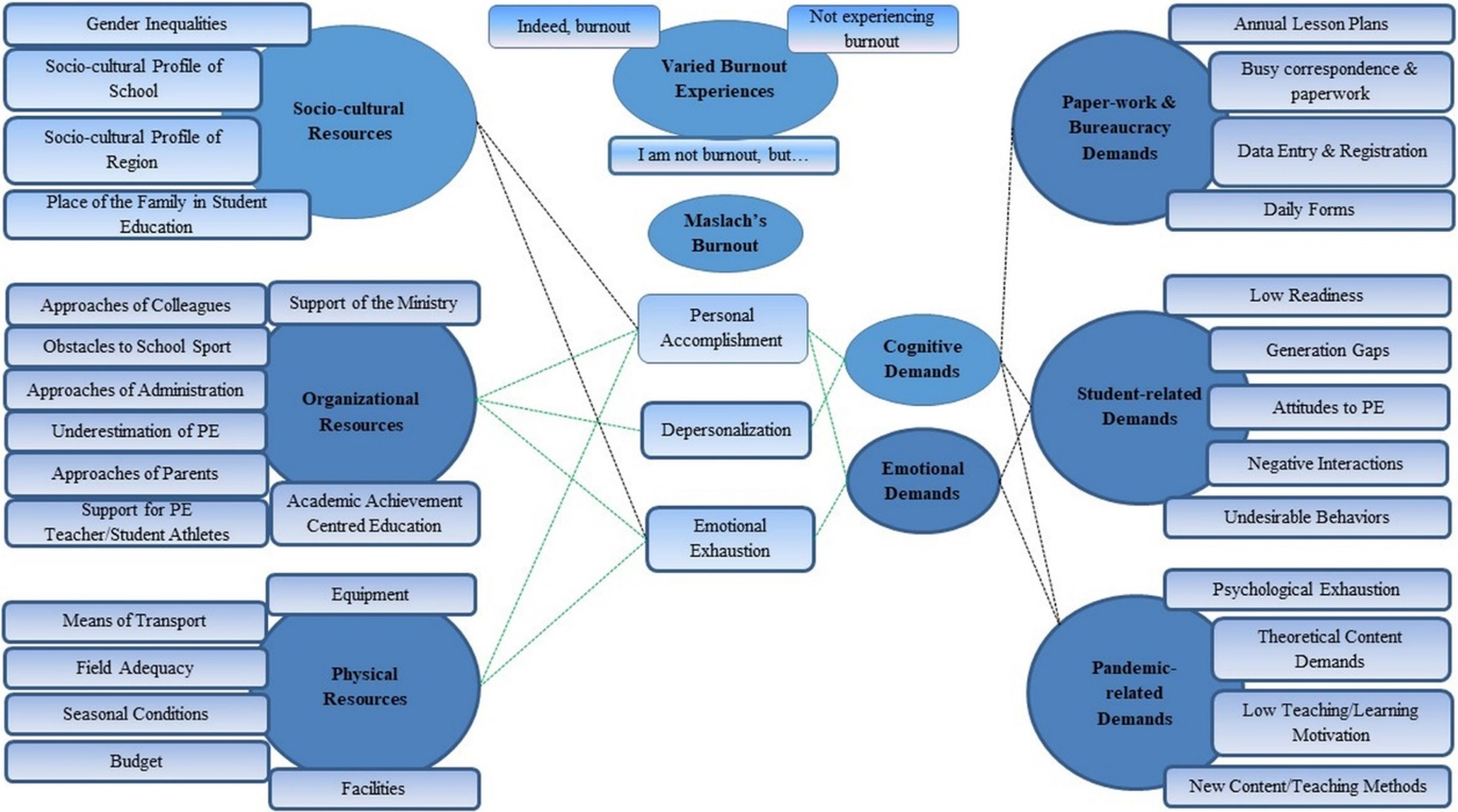
Teachers’ states of burnout varied, and physical, organisational, and socio-cultural resources were closely related with burnout levels. Demands that cause pressure on burnout were determined as paperwork and bureaucracy, student-related factors, and pandemic-related experiences. In addition to supporting the general model, specific J-DR factors for PE teaching were observed that is linked with burnout.
CONCLUSION:
J-DR factors that might lead to negative conditions in the teaching environment should be considered, and field-specific factors should be focused on through arrangements to increase teaching efficiency and improve the quality of PE teachers’ professional life.
Introduction
Theoretical background: Burnout in teaching and job demands-resources model
Teachers’ tendency to continue their profession has recently declined along with a decrease in professional motivation [1, 2]. This decrease is associated with such factors as the stress in the school environment, job satisfaction expectations, poor organisational relationships, heavy demands, and insufficiency of resources [3, 4], which has also brought the concept of burnout to the forefront. Burnout in teaching results from individual, social and organizational factors such as insufficient personal rights, the need for autonomy, limited organisational resources, as well as class management demands and behavioural issues of students [5]. Moreover, depending on social interaction within the organisational structure, teachers’ energy and abilities might be affected during professional activities [6]. Overcrowded classrooms, bureaucratic pressures, work overload, inadequate physical conditions, poor organisational support, conflict among colleagues, being unrewarded, and lack of participation in decision-making, may lead to burnout in teaching [7, 8]. Madigan and Kim [9] reported that burnout is more effective factor than job satisfaction on teachers’ intention to quit job. In addition, attrition risk in teaching may be increased over time because of intensive burnout factors [9]. Teachers who have social and ethical responsibilities, are prone to experience burnout in a stressful environment [10]. Therefore, qualified and responsible teachers should be protected from burnout factors for their professional continuity and keeping quality in educational process.
“Job burnout syndrome”, which appears as the stress experienced at a chronic level in the professional environment, is still discussed by studies in educational sciences [2, 12]. According to Maslach [13], burnout is a psychological syndrome that comes out as the last reaction of individuals’ resistance to chronic stressors and causes incompatibility and tension between an individual and his/her job. Maslach’s inventory defines and measure the multi-dimensional psycho-social components of burnout as emotional exhaustion, depersonalisation, and personal accomplishment [14]. In the context of the teaching profession, “emotional exhaustion” defines the state of being unable to respond to the affective and psychological demands at the school; “depersonalisation” refers to estrangement from the professional social circle and the negative tendency in inter-personal relationships; and “personal accomplishment” is associated with a decreased sense of accomplishment in the profession and moving away from achievement goals [15]. Maslach’s burnout inventory and its dimensions are the most frequently used in educational studies and maintains its place in up-to-date research [16]. In a recent literature review [17], it was reported that three dimensions of burnout well understood and became stable in studies while personal, organizational factors, overloads, lack of resources and control threaten teachers to experience burnout in these dimensions [17].
Burnout and engagement states of individuals in the workplace are formed through interaction between the opportunities and tasks offered to them as well as the quantitative and qualitative structure of the job environment. This interaction is explained by an inverse relational model between the resources and demands in the job demands-resources (J-DR) model [18]. Job demands refer to the tasks for which employees put an effort to fulfil within the organisation that put pressure on employees [19]. On the other hand, resources include all abstract and concrete tools that are provided by an organisation to its employees [18]. In the context of the teaching profession, dealing with undesirable student behaviour and planning curriculum are examples of job demands, while participation in decision-making processes, adequacy of teaching materials, and support from colleagues can be taken as an example of job resources. Zhang and Chen [20] initially studied J-DR factors conceptualization in the context of PE teaching specific environment. According to their study, demands were described by three dimensions: “physical”, “cognitive”, “emotional” while resources were described under two dimension as “physical” and “organizational”. Accordingly, “physical demands” defines the load on the muscular and skeletal systems of the individual while doing his tasks in job; “cognitive demands” refers to effort in attention, decision-making, problem solving; and “emotional demands” covers stress and affective experiences at work. On the other hand, job resources are categorised as “physical resources” including opportunities such as equipment, facilities, and budget, while “organisational resources” describes management, cooperation with others, and participation in decision-making [20]. According to the interactional structure of J-DR, an adequate quantity and quality of resources positively affect employees’ motivation and performance, whereas pressure and stress caused by demands have a negative effect such as burnout and exhaustion [21]. Demerouti et al. [22] report that job demands have primarily relationship with exhaustion dimension of burn out while lack of resources have relationship with disengagement at job. During the Covid-19 pandemic, job demands found strongly correlated with initial exhaustion stage of burnout while pandemic-specific resources associated with burnout in teachers [23]. In the meta-analysis by Alorcon [24], on the other hand, it was reported that lower adaptive organizational attitudes are related with burnout, arised from high job demands and insufficient job resources.
Research gap
Van Droogenbroeck and Spruyt [25] found that exhaustion levels varied according to J-DR factors in seven different professions, including teaching. Drawing on this fact, the differences between structures of different work fields may cause varieties in J-DR and display features specific to the field. Physical education (PE), which involves job demands such as movement, sport development, and special ability, can be considered to have a unique teaching environment compared to other teaching fields in addition to different characteristics in resources such as the classroom environment, arrangements, and teaching materials. Along with the equipment, budget, facilities [26], intra/extra-curricular practices, unique classroom climate, and movement-based content may cause differences in J-DR and psychological factors (burnout, motivation, disengagement etc.) in PE teaching experiences. Studies reported that mattering of PE and being perceived as dispensable class affect teachers’ role stress, emotional exhaustion and marginalization in professional processes [27, 28]. On the other hand, Covid-19 pandemic brought up-to-date changes, demands and needs in PE specific environment such as need of tangible support, plans for curricular changes, new student-teacher relationships, uncertainty and emotional labor that affect PE teachers’ well-being and emotional fragility [29]. In the light of all, while burnout among teachers generally entails a risk for professional continuity, it is also important to investigate teaching field specific factors behind burnout to improve specific implications and actions in accordance with unique environment of PE field. Therefore, research needs to investigate teaching field specific factors with structured theoretical grounds and methodological basis.
The literature includes a number of studies on PE teachers’ professional socio-psychological conditions and burnout [e.g. 30–32]. However, there is a limited number of studies examining J-DR model in PE teaching related with burnout, although the model has a unique multi-dimensional framework and up to date perspective [e.g. 20, 33]. Zhang [33] states that the J-DR model can offer a well-organised and reasonable framework to examine PE teachers’ professional environment. In this respect, both the systematic structure of J-DR and the fact that it defines the professional circle with a multi-dimensional perspective may directly contribute to practical implications by describing substantial psycho-social factors and lacks in professional environment. In addition, due to the dominance of either quantitative or qualitative methods, the use of mixed methods that can provide a pluralistic methodological basis is rather limited in the literature [e.g. 30–32]. However, mixed method studies may provide to understand factors behind burnout in PE teaching environment with a broader sense and strong methodological basis that may contribute to the theoretical studies and educational implications. The aim of the present study was to examine job burnout among PE teachers on the basis of J-DR model and mixed method design.
Research questions
As the present study was designed on the basis of mixed method-sequential explanatory design, the main problem of the study was specified in accordance with quantitative and qualitative phases as follow: “What are linkages between job demands-resources and burnout in PE teaching?” Based on the main problem, sub-questions of the research were specified as follow: What are job resources that linked with PE teachers’ burnout experiences? What are job demands that linked with PE teachers’ burnout experiences?
Materials and method
Research model
The mixed method-sequential explanatory design [34] sets the methodological basis of the study, which follows a two-step process; the data obtained from quantitative methods were explained and expanded by associating with qualitative methods. The study was epistemologically based on pragmatism, which claims that different types of knowledge should be implemented according to practices in life, and appropriate data types and tools should be employed accordingly [35]. The role of pragmatism in mixed-methods research is related with the search for ways of receiving knowledge by acting appropriately with the nature of a scientific problem [36]. On an ontological basis of pragmatism, the truth is consistently renegotiated and debated in accordance with practical usefulness and the study assumes that truth is observation-based and objective, but individuals’ subjective opinions, perceptions, and experiences also reflect the realities in the external world [34].
Sampling and study group
While specifying quantitative sample size, G*Power statistical programme was used to represent population validly. The quantitative size of the sample was determined as n = 101, the significance of the difference between two dependent groups was determined by t-test while the effect size indicator was taken as 0.25, with 80% power and 0.05 significance level [37]. In addition, the assumption criteria for canonical correlation analysis was taken into account that number of samples should be 20 times greater than the number of total variables (n = 8) in the study. In this regard, simple random sampling was used in the quantitative dimension, and e-mails were sent to 256 teachers from 94 schools located in 39 randomly selected cities in Turkey. A total of 191 teachers from 62 different schools in 28 different cities responded to the invitation. The response rate of teachers were calculated as % 74.61 (n = 191 out of 256). The final sample consisted of 173 teachers after exclusion of outliers and biased data.
Purposeful maximum variation sampling was used in the qualitative phase [38], which aims to include various characteristics of a population to prevent bias [35]. In this regard, sampling was applied to ensure representation of different characteristics of sample considering all seven regions in Turkey, school locations, gender, age, professional experience, educational level, and number of students. Fourteen PE teachers participated in semi-structured interviews of qualitative phase. In addition to considering maximum variation of sample characteristics, saturation was provided considering repeated expressions of PE teachers while no additional data were found to emerge new codes and categories [39, 40].
Ethics, data collection, and procedures
Upon receiving permission to use scales from corresponding authors via email, ethical approval was obtained from Ege University’s Scientific Research and Publication Ethics Committee (Protocol no. 369). Data collection e-surveys and interview forms include the study ID, instructions, ethics, consent, demographic form, and questionnaires. Data collection was conducted between October and December 2020 in the quantitative phase and between February and May 2021 in the qualitative phase. Questions included in the semi-structured interview [38] were developed by researchers based on the research problem, methodology, and theoretical framework. However, additional questions were also asked according to teacher discourses during the semi-structured interviews. Interviews held as video-meetings by the second researcher were recorded. Each interview was observed by the other two researchers to evaluate consistency and examined for course of interview, paths taken, and standardisation [41]. Additional interviews were held before and after qualitative analyses to have transcripts read and confirmed, get deep information-feedback and ask for addition-exclusion by teachers.
Instruments
Demographic information form
The form included descriptions about gender, age, professional experience, region, city, number of students, educational level of school, number of PE teachers at school, and administrative positions.
Job demands-resources scale for physical education teachers
Zhang and Chen [20] developed the scale to examine J-DR in PE teaching, and the scale was adapted to the Turkish language by Engür et al. [42]. The scale consists of 21 items and 5 dimensions: physical resources [3 items], organisational resources [6 items], cognitive demands [4 items], emotional demands [4 items], and physical demands [4 items]. The items on the 5-point Likert type scale are responded to as “completely disagree: 1” to “completely agree: 5”. According to psychometric measurement results, reliability coefficients were calculated between .62 and .74. Fit indices were found as 2/DF=1.62, RMSEA = 0.050, SRMR = 0.070, CFI = 0.90, GFI = 0.91, and IFI = 0.90 [42].
Maslach burnout inventory (education)
The inventory was developed for teachers by Maslach and colleagues [14, 43] and adapted to the Turkish language by İnce and Şahin [44]. It consists of 22 items, a 7-point Likert construct (“0 = never” to “6 = always”), and three sub-scales: emotional exhaustion [9 items], depersonalisation [5 items], and personal accomplishment [8 items]. Internal consistency coefficients ranged between.74 and.88. Fit indices were calculated as x2/DF=4.30, RMSEA = 0.07, CFI = 0.94, NFI = 0.93, GFI = 0.87, and AGFI = 0.84. The burnout level increases with increased scores on emotional exhaustion (max. 54 points) and depersonalisation (max. 30 points) and decreased scores on personal accomplishment (max. 48 points) [44].
Semi-structured interviews
The semi-structured interview form to identify the participants’ opinions, perceptions, and experiences [38] included information about consent, ethics, study ID, demographic data, and questions. In order to achieve consistency [39], pre-specified steps were followed for such concerns as the standardisation of interviews in asking questions, settings, and participant–researcher interaction. Moreover, questions were developed in relation to the theoretical model and research problem to achieve content validity and consistency [45] (Table 1). In addition to the main questions presented in Table 1, specific follow-up and probing questions were asked to obtain more clear, varied, and in-depth information [46].
Semi-structured interview: Main questions
Semi-structured interview: Main questions
Quantitative data were analysed using the G*Power Statistical programme and IBM® SPSS 21.0 programme. Eighteen participants were excluded due to unanswered questions, contradictions, and outliers. Exclusion criteria for outliers were z scores beyond±3.29 for univariates and significance of Mahalanobis values for multivariate outliers [47]. Canonical correlation was conducted for quantitative data to estimate multidimensional relations and weights of the sub-scales including total of eight variables as follow physical resources, organizational resources, cognitive demands, emotional demands, physical demands, emotional exhaustion, depersonalisation and personal accomplishment [48]. Canonical correlation, which examines relational spirals in a holistic way and controls type-1 errors, reduces the risk of accepting insignificant relations as significant [49]. While considering assumptions, the number of samples to be analysed (173) was ensured to be at least 20 times greater than the number of total variables (n = 8) in the study [50]. In addition, multicollinearity was tested [51], and it was found that all correlation coefficients were lower than .80 and had tolerance values greater than .10 and VIF values smaller than 10. Statistical significance was evaluated considering Wilk’s Lambda, chi square, and effect sizes. The contribution rate of variables to the canonical pairs was determined with linear and cross-canonical loadings as well as the rate of variance explained and redundancy analysis [47].
In qualitative data analysis, several trustworthiness techniques were applied to provide validity and reliability. Methodological triangulation was firstly used involving the use of quantitative and qualitative methods together [52]. Moreover, transcripts were examined by participant teachers both before and after analysis, and confirmation was obtained by repeating the interviews (prolonged engagement, member checking/informant feedback/peer debriefing) for accuracy of data and any changes [38]. Multiple researchers (investigator triangulation) participated in the data analysis [53], and inter-coder reliability was employed in coding [45]. Transferability was provided by describing the process and sampling/sample characteristics in detail[41].
Constant comparative analysis was conducted, which involves three steps (open coding, axial coding, and selective coding) [53]. The open coding in the first step was conducted by two blinded researchers, and one of the researchers previously examined quantitative findings, while findings were not shown to the other researcher. Thus, risk of bias that might be caused by knowledge about pre-results was controlled with checking researcher effect/bias [38]. The inter-coder reliability [45] score was calculated as .84 over open coding. Contradictory codes were resolved in a joint meeting participated in by the third researcher. In the axial coding, the categories were abstracted into general themes, and inter-thematic relationships were evaluated. The researchers conducted repeated readings on the expressions and categories in this process and grouped the categories under themes according to significance and integrity. In addition, integrity of the categories and themes was compared with the J-DR model and structure of Maslach’s Burnout. The selective coding step identified the core and remarkable themes and inter-thematic relationships at final. Within the scope of the sequential explanatory design, findings were reported through comparison with the quantitative data, association, exemplification, verification, or falsification, and objectivity was achieved [34]. “Informed grounded theory” [54, 55] was used in all steps of constant comparative analysis similar to Zhang’s [33] study by comparing obtained categories and themes with the existing theoretical framework constantly. The process was finalised by searching for negative cases and making contrast comparisons [38].
Results
Considering demographic variables in quantitative phase, PE teachers were distributed as 32.9% (n = 57) female, 67.1% (n = 116) male and 49.7% (n = 86) of teachers work at secondary schools while 50.3% (n = 87) of teachers work at high schools. Seventeen teachers (9.82%) were in administrative position at their school as they reported. According to school location variable, participant PE teachers’ schools were distributed as % 54.34 (n = 94) urban schools, 24.27% (n = 42) district schools and 21.39% (n = 37) rural schools. The average school size (number of students at school) was
Descriptive statistics of quantitative study group
Descriptive statistics of quantitative study group
In the qualitative phase, fourteen teachers that participated to interviews distributed as 7 male (50%), 7 female (50%) according to gender variable. Seven teachers (50.0%) from urban schools, 4 teachers from rural schools schools (28.57%) and 3 teachers from district schools (21.43%) participated in the study. The school level where teachers work distributed as secondary schools (n = 7, 50%), high schools (n = 7, 50%). Fourteen teachers were equally distributed to all seven regions Turkey which is equivalent to 2 teachers (14.29%) per a region. The age of the teachers in qualitative phase was calculated as
Descriptive characteristics of qualitative study group
| Teacher Nu. | Gender | Age | Experience | Region | City | Urban/District/Rural | Educational level | App. number of student |
| 1 | M | 38 | 13 | Marmara | İstanbul | District | High School | 700 |
| 2 | F | 53 | 30 | Marmara | İstanbul | Urban | High School | 1500 |
| 3 | F | 33 | 9 | Aegean | İzmir | Urban | Secondary | 500 |
| 4 | M | 45 | 20 | Aegean | İzmir | Urban | High School | 590 |
| 5 | M | 38 | 13 | Black Sea | Bartın | Rural | Secondary | 230 |
| 6 | F | 39 | 13 | Black Sea | Bartın | Rural | Secondary | 135 |
| 7 | M | 56 | 27 | Central Anatolia | Ankara | Urban | Secondary | 1100 |
| 8 | F | 49 | 19 | Central Anatolia | Ankara | Urban | Secondary | 1800 |
| 9 | M | 42 | 16 | Mediterranean | Antalya | Urban | High School | 1200 |
| 10 | F | 59 | 27 | Mediterranean | Antalya | Urban | High School | 750 |
| 11 | F | 27 | 2 | Eastern Anatolia | Erzurum | District | High School | 150 |
| 12 | M | 27 | 3 | Eastern Anatolia | Erzurum | District | High School | 108 |
| 13* | M | 29 | 4 | Southeastern Anatolia | Şanlıurfa | Rural | Secondary | 284 |
| 14 | F | 28 | 4 | Southeastern Anatolia | Gaziantep | Rural | Secondary | 180 |