



Abstract
BACKGROUND:
Previous research has demonstrated that the personal use of social media, i.e., social cyberloafing, is associated with employee mental health. However, the underlying mechanism through which social cyberloafing is related to mental health has received limited attention.
OBJECTIVE:
Drawing on conservation of resource theory and work/nonwork enhancement literatures, we developed and tested a model that examines health effect of social cyberloafing. As such, employees’ social cyberloafing is posited as positively related to psychological detachment and personal life enhancement of work, which in turn would act as mediators that explain why social cyberloafing improves mental health.
METHODS:
Data from 375 Chinese employees were analyzed to test research hypotheses using the structural equation modeling and bias-corrected bootstrap method with Mplus 7.4.
RESULTS:
The results found that social cyberloafing is positively related to psychological detachment, but not with personal life enhancement of work. Social cyberloafing was positively related to employees’ mental health through both psychological detachment and through psychological detachment and personal life enhancement of work serially.
CONCLUSION:
Psychological detachment alone and alongside personal life enhancement of work form part of the mechanisms explaining how and why engaging in social cyberloafing is positively associated with employees’ mental health. These mechanisms offer insights to organizations into how the mental health of employees can be improved in the digital workplace.
Introduction
Research background
In general terms, mental health (MH) refers to “a state of well-being in which every individual realizes his or her potential, can cope with the normal stresses of life, can work productively and fruitfully, and is able to make a contribution to her or his community” [1]. MH is critical to employees’ productivity and the organizational stability [2]. Employees’ MH largely depends on the work environment, although work and nonwork contexts are intimately connected [3, 4]. Research has found that some factors from the workplace context, such as self-management and organizational management [5], flexible working hours, rich communication, and management practices [6], have positive implications for employee MH. Nevertheless, recent management studies have paid little attention to whether some factors experienced beyond the work domain can be carried over to the workplace and improve MH. One factor experienced beyond the work domain that may be in an optimal position to foster connections and spillover between work and nonwork settings is cyberloafing activities or the personal use of private organizational IT resources [7]. Yet, it is unclear whether the enhancement that cyberloafing builds up in the nonwork domain is helpful to the workplace in terms of personal life enhancement of work and MH.
With the popularity of mobile devices, a larger number of employees use the Internet for nonwork-related activities at work, a practice known as cyberloafing in organizational behavior literature [7]. Existing studies have demonstrated that cyberloafing is a counterproductive work behavior (e.g., Blanchard and Henle [8]) that, framed within so-called ‘job neglect’, reduces organizational citizenship behavior [9] and job performance [10]. However, the emphasis of previous research has mainly been on overall cyberloafing activities and their effect on employee outcomes, thus ignoring the detailed impact of specific types of cyberloafing activities. Because different types of cyberloafing activities can produce different, even opposite effects on employees’ emotional states [11], studies have revealed that a compensation effect can exist in some forms of cyberloafing in managing resources to reduce job burnout (via job stress) [12]. As such, it has been argued that this compensation effect occurring in certain types of cyberloafing may balance work and personal life and relax the individual’s body and mind [13]. This could be the case of ‘social’ cyberloafing, which, by focusing on social media activities, may be in an optimal position to create a social environment conducive to the improvement in MH. The popularity of social cyberloafing has recently increased inexorably. For example, a recent survey holds that social media users account for 93.33% of Internet users worldwide [14]. Furthermore, because social media such as WeChat and Facebook continues to grow in the workplace, the widespread and frequent use of social media has led conventional cyberloafing to be performed as ‘social’ cyberloafing [15], with even more significant blurring of the nonwork-work boundary among employees.
The present study aims to reveal the life enhancement effect of social cyberloafing on employee MH by integrating the conservation of resources (COR) theory and insights from work/nonwork enhancement literature. COR theory states that social activities in the workplace can help employees to cope with stress by helping them recover from resource loss and/or acquire new resources [16–18]. Previous work has found that social cyberloafing improves MH by eliciting psychological detachment in employees [19]. Therefore, psychological detachment (hereinafter, PD) may be involved in the underlying mechanism that makes possible that cyberloafing influences MH through personal life enhancement of work. Psychological detachment (PD) is defined as an experience that individuals are psychologically disengaged from job-related demands and tasks [20]. Further, grounded on COR theory, work/nonwork enhancement literature has suggested that personal resources may be renewed or generated by participating in actions in one domain that could then be helpful for successful engagement in another role in another domain [21]. Therefore, the activities of individuals in nonwork domains may provide opportunities for resource gaining that, rather than exhaust energy, energize them for work [22]. Drawing on COR theory and work/nonwork enhancement literatures, we propose that PD and personal life enhancement of work results in two mechanisms that can explain why social cyberloafing affects MH; these are, a) demand-shielding process for PD, and b) resource-building process for personal life enhancement of work.
To summarize, the present study seeks to answer the following two questions: a) Is social cyberloafing positively related to employees’ MH? and b) Is the positive relationship between social cyberloafing and employees’ MH mediated by PD and personal life enhancement of work? Responding to these two questions this paper aims to enrich the occupational health literature by providing insights about the mechanisms linking social cyberloafing to MH.
Research hypotheses
Psychological detachment usually leads individuals to be away from work on a physical and mental level [20], allowing them to better control their stress and stress responses [23]. Compared to highly stressful tasks, employees have a greater chance of experiencing PD from work when performing relaxing and leisure activities, such as ‘social’ cyberloafing activities. Previous research has shown the promotional effect of PD on employees’ MH [24–26]. Employees engaging in social cyberloafing activities are less likely to have work-related thoughts, thus increasing their PD. Allowing them to delay the depletion of resources, PD can shield employees from job demands, temporarily alleviating the stress and fatigue caused by these demands. In the end, through PD, social cyberloafing may reduce or eliminate stress responses to job demands and prevent harm to employees’ MH [25]. Therefore, we predict that social cyberloafing can function as a shield against job demands in the work process by leading employees to experience immediate PD, keeping them away from work temporarily through a demand-shielding process. Accordingly, we proposed that:
Social cyberloafing may also increase MH through other processes, i.e., resource building, which can be acquired in both work and nonwork domains. Personal life enhancement of work refers to the fact that the positive emotions, experiences, and skills individuals acquire beyond the work field are transferred to and experienced within the work field [27]. In this regard, social cyberloafing would replenish employees by providing new positive emotions, supporting experiences, and social skills, which are available in the workplace through personal life enhancement of work. Resources building process occurs because social cyberloafing at work enhances employees’ opportunities to socially interact with friends and family, thus allowing them to enjoy their own relaxing and leisure time and then enhance their work. Moreover, personal life enhancement of work has been found to help employees gain new resources from the nonwork domain that replenish the resources they lose due to job demands [28–30]. In the end, social cyberloafing may affect the personal life enhancement of work and provide employees with new job resources to meet job demands, thus reducing their likelihood of experiencing burnout and stress. Therefore, we proposed that:
Prior studies have indicated that employees with high levels of PD are not only cognitively distant from work-related thoughts, but they also experience more positive emotions and fewer negative ones [31], thus boosting work motivation and pro-organizational behavior [29]. Furthermore, additional recent research shows that PD helps employees to recover from the workload in a timely way, providing them with increased work engagement [32], resources, and an energy base to cope with subsequent job demands [33] and combat burnout [32]. This means that PD, a demand-shielding process, may not only influence employees’ MH independently, but may also influence MH by interacting with the resource-building processes (i.e., personal life enhancement of work). Thus, we proposed:
Methods
Participants
Because an online survey protects their privacy better and, thus, generates higher reliability in collecting data on deviant behaviors (e.g., social cyberloafing in this study) [34], we did not ask them to fill out a paper questionnaire due to the risk that they may not be willing to report real data out of a desire for self-protection [35]. Therefore, this study designed and distributed questionnaires through an online survey company, i.e., Wenjuanxing (www.wjx.cn), covering more than 30,000 companies and 90% of Chinese universities. We asked the online survey company to collect data through a paid service and use random sampling to distribute online questionnaire links or QR codes to its 2.6 million Internet users from Chinese companies. A total of 470 online questionnaires were distributed, and eight days later, 375 of them were fully completed and retained, representing a valid response rate of 79.79%. In line with Ren, Chadee and Wang [36], we compared the first and the last 10% of respondents to test nonresponse bias, and found no significant differences between the two groups on focal and demographic variables.
The sample comprises 206 (54.9%) female and 169 (45.1%) male employees. Specifically, 108 (28.8%) of them were single, 45 (12.0%) were married without children, and 222 (59.2%) were married with children. Moreover, 209 (55.7%) were 27– 37 years old, 99 (26.4%) were under 27 years old, 55 (14.7%) were 37– 47 years old, and 12 (3.2%) were 47 or older. Regarding their positions, 149 (39.7%) were frontline employees, 126 (33.6%) were line managers, 87 (23.2%) were middle managers, and 13 (3.5%) were senior managers. The participants were evenly distributed among different income and work experience groups: less than 3000 Yuan (36(9.6%)), between 3001 and 5000 Yuan (100(26.7%)), between 5001 and 10000 Yuan (191(50.9%)), and more than 10000 Yuan (48(12.8%)); less than 3 years (88 (23.5%)), between 4 and 6 years (97(25.9%)), between 7 and 9 years (88(23.5%)), and more than 10 years (102(27.2%)). The most common educational level was university or Junior college (325 (86.7%)), followed by Master or above (34 (9.1%)) and Junior high school or below (16 (4.3%)). In terms of time spent on social media per day, 20(5.3%) spent no more than 1 hour, 106(28.3%) spent 1– 2 hours, 143(38.1%) spent 2– 3 hours, 81(21.6%) spent 3– 5 hours, and 25(6.7%) spent more than 5 hours. In terms of frequency of social media usage per day, 2(0.5%) were never, 98(26.1%) were 1– 5 times per day, 150(40.0%) were 6– 10 times per day, 78(20.8%) were 11– 20 times per day, 47(12.5%) were more than 20 times per day.
Measures
Social cyberloafing
Following Wu, Mei and Liu [19], we used a 5-item and 5-point Likert scale ranging from 1 (never) to 5 (always) adapted from Andreassen, Torsheim and Pallesen [37] to measure social cyberloafing. Sample items of social cyberloafing include “I would use social media to ‘post’ pictures, videos, and comments during working hours”. Higher scores indicated higher degrees of social cyberloafing. The Cronbach’s α of the scale in our sample is 0.840.
Psychological detachment
We used three items from Sonnentag and Fritz [20] to evaluate PD. A sample item for PD is “I forget about work when I use social media". Participants responded to the items on a 5-point Likert scale ranging from 1 (strongly disagree) to 5 (strongly agree). The responses with higher scores demonstrated high degrees of psychological detachment. The Cronbach’s α of this scale is 0.759.
Personal life enhancement of work
We measured personal life enhancement of work with three items developed by Fisher, Bulger [27]. A sample item for personal life enhancement of work is “My personal life gives me the energy to do my job". Items responses were designed from 1 (strongly disagree) to 5 (strongly agree). The Cronbach’s α of the scale in our sample is 0.805.
Mental health
The 5-item measure of MH in this study was derived from the general well-being scale developed by McDonald-Miszczak and Wister [38], which is consistent with prior research [19]. The scale asks individuals if they have “everything to look forward to”; if they feel “positive”; “satisfied with life” and “emotionally stable”; and if “life has been interesting”. Items responses were designed from 1 (never) to 5 (always). The Cronbach’s α of the scale in our sample is 0.821.
Control variables
We used eight demographic variables including gender, age, education, time and frequency of Internet access, years of experience, position, income, and marital status in this study as control variables, because they were included as control variables in prior studies on mental health, or found to be related to mental health [19, 39– 41]. For example, prior work has found gender differences in mental health [40], and that age has been used as control variable in previous research on individuals’ mental health [19]. The time and frequency of Internet access is another variable that has also been found related to mental health [39].
Analysis strategy
We conducted Harman’s one-factor test and a confirmatory factor analysis (CFA) to check the existence of common method bias [42, 43]. If the variance explained by the first principal component is less than 50%, and the fit indices of our hypothesized model are better than those of the single-factor model, it shows that common method bias in this study is acceptable [44]. We performed structural equation modeling using Mplus 7.4 to test Hypothesis 1 and Hypothesis 3, that is, whether social cyberloafing has a positive relationship with PD and personal life enhancement of work.
In addition, we followed Preacher and Hayes’ recommended approach and bootstrapped the sampling distribution of the indirect effect [45] to test two separate indirect effects (Hypothesis 2 and Hypothesis 4) and serial indirect effects (Hypothesis 5) using Mplus 7.4. More specifically, we conducted bias-corrected bootstrapping with 2,000 iterations. Furthermore, 95% confidence intervals are evaluated to confirm the indirect effect: If the 95% confidence interval (CI), that is, the lower 2.5% and upper 2.5% confidence interval for the indirect effect, does not contain 0, the indirect effect is supported.
Results
Common method bias test
Harman’s one-factor test showed that the first component only explained 29.32% of the variance, suggesting that common method bias does not significantly contaminate our results. The CFA results showed that the hypothesized four-factor measurement model (χ2/df = 1.858, RMSEA = 0.048, CFI = 0.964, TLI = 0.956, SRMR = 0.041) was significantly better than the single-factor measurement model (χ2/df = 11.75, RMSEA = 0.169, CFI = 0.520, TLI = 0.446, SRMR = 0.169), thus indicating a minimal presence of common method bias.
Preliminary analysis
Table 1 displayed the means, standard deviations (SD), and correlations of all study variables. Overall, respondents reported moderate perceptions of social cyberloafing (M = 2.93, SD = 0.81) and PD (M = 3.00, SD = 0.85). They showed positive evaluations of personal life enhancement of work (M = 3.95, SD = 0.67) and MH (M = 3.80, SD = 0.64). Correlation analysis suggests that social cyberloafing was positively correlated with PD (r = 0.417, p < 0.001) and MH (r = 0.098, p < 0.05). PD showed positive correlations with personal life enhancement of work (r = 0.125, p < 0.01) and MH (r = 0.204, p < 0.001). Personal life enhancement of work was positively correlated with MH (r = 0.693, p < 0.001), but not with social cyberloafing (r = 0.038, p > 0.05).
Descriptive statistics and correlations (N = 375)
Descriptive statistics and correlations (N = 375)
Note: *p < 0.05, **p < 0.01, ***p < 0.001.
The results showed a good overall fit of structural model (χ2/df = 1.791, RMSEA = 0.043, CFI = 0.938, TLI = 0.924, SRMR = 0.048). The standardized betas for the final model, shown in Fig. 1, indicate that our hypothesized model explains 49.5% of the variance in MH. After accounting for the control variables, the results showed that the relationship between social cyberloafing and PD was significant and positive (β= 0.417, p < 0.001), which supported Hypothesis 1. Furthermore, PD was positively related to personal life enhancement of work (β= 0.132, p < 0.05) and MH (β= 0.107, p < 0.05). Personal life enhancement of work was positively and significantly related to MH (β= 0.679, p < 0.001). However, the positive relationship between social cyberloafing and personal life enhancement of work was insignificant (β= – 0.017, p > 0.10), rejectingHypothesis 3.
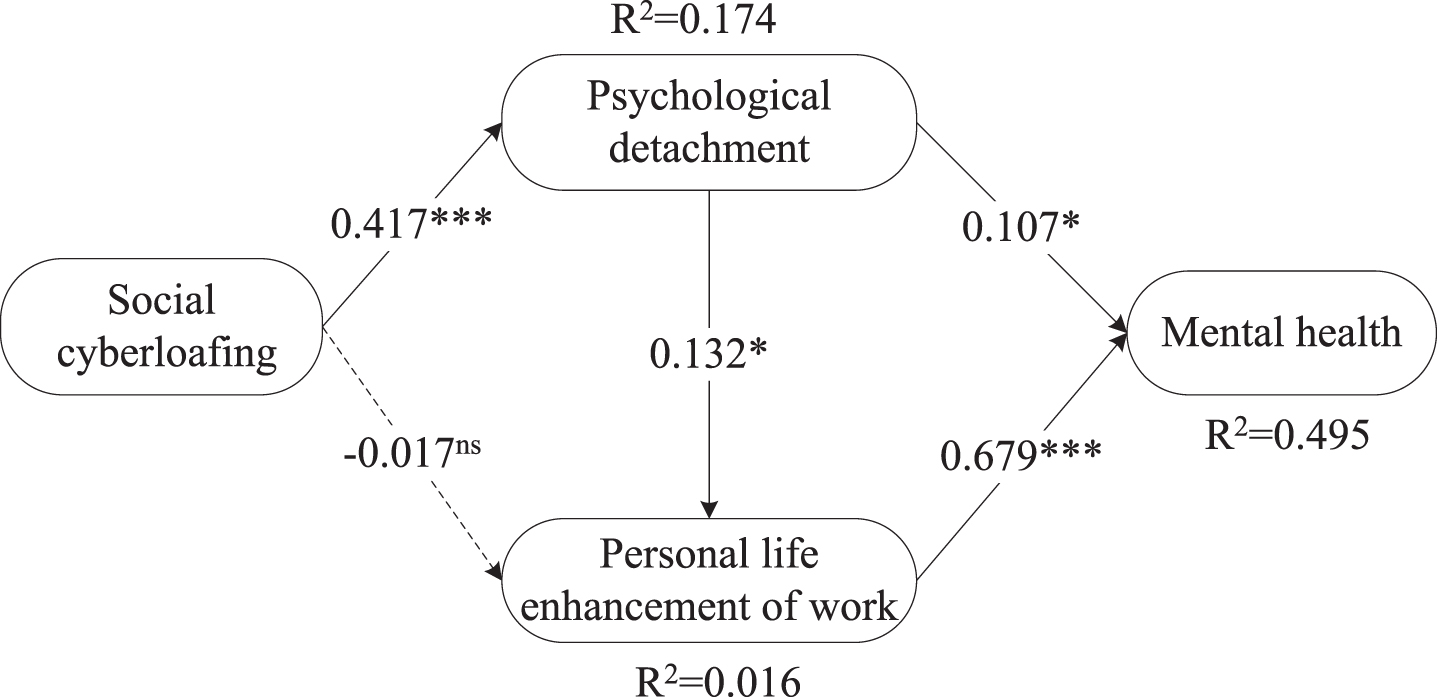
Results of the hypothesized model. Note: *p < 0.05, **p < 0.01, ***p < 0.001.
In addition, we tested the mediation effect of PD and personal life enhancement of work on the cyberloafing-MH link using the Bias-Corrected Bootstrap method with Mplus 7.4, and reported the results in Table 2. The findings suggested that social cyberloafing was related to MH through the mediation of PD because the bias-corrected 95% confidence interval [0.012, 0.067] did not contain 0, thus supporting Hypothesis 2. However, personal life enhancement of work was not found to mediate the relationship between social cyberloafing and MH because the 95% confidence interval [– 0.062, 0.045] contains 0, thus leaving Hypothesis 4 unsupported. Further, social cyberloafing was related to MH through a serial mediation of PD and personal life enhancement of work, given that the 95% confidence interval [0.009, 0.058] did not contain 0, thus supporting Hypothesis 5.
Results of the mediating effect
Note: Bootstrap = 2000. R2 for psychological detachment, personal life enhancement of work, and mental health are 0.174, 0.016, and 0.495. SC, social cyberloafing; PD, psychological detachment; PS, personal life enhancement of work; MH, mental health.
This study integrated COR theory and work/nonwork enhancement literature to justify the mediations of PD and personal life enhancement of work in the relationship between social cyberloafing and employees’ MH. Consistent with prior work [19], we confirmed the positive relationship between social cyberloafing and PD, and PD mediated this relationship. Furthermore, we empirically examined that social cyberloafing was positively related to MH through PD and personal life enhancement of work serially. More specifically, employees who socially cyber loaf were posited to return to work more refreshed and engaged after they take a break at work doing something tied to their personal life, and tested this relationship through quantitative analysis, thus providing empirical evidence for future research. Contrary to our expectations, however, social cyberloafing was not related to personal life enhancement of work, and the indirect effect of social cyberloafing on MH through PD was not significant. One reasonable cause for these unexpected results could be an unexpected non-linear relationship between social cyberloafing and personal life enhancement of work. Different amounts of net resources generated by engaging in social cyberloafing activities probably led the cyberloafing-enhancement relationship to be insignificant. In this regard, ego depletion theory states that individuals consume limited psychological resources when performing both self-control and volitional activities [46]. Thus, when employees engage in social cyberloafing during work time, they achieve psychological satisfaction, but they consume the time and attention allocated for work, which means that social cyberloafing is a “temptation” to satisfy employees’ short-term psychological demands. It is pretty likely that only moderate social cyberloafing creates high levels of net psychological resources and energy [33], whereas when the level of social cyberloafing is high or low, employees may experience a low level of personal life enhancement of work.
Theoretical implications
Our research makes several theoretical contributions. First, because PD was used as a marker for demand shielding and resource-building, this study finding the positive correlation between cyberloafing and MH may suggest correlation with demand shielding and resource-building. Accordingly, this finding enriches the social cyberloafing literature by suggesting research avenues capable of providing more profound insight into the two underlying mechanisms (i.e., demand-shielding and resource-building) in explaining how social cyberloafing correlates with MH. Although the mediating effect of personal life enhancement of work alone was not significant, combined with PD in the serial mediation, personal life enhancement of work was supported as a significant mediator. These findings suggest that PD may be able to shield work demands and then repair and rebuild resources, thus enhancing work recovery [47] and positive experiences of personal life enhancement of work. Indeed, because PD activates personal life enhancement of work, it allows employees to have more energy and motivation to devote to subsequent work. Hence, this study found that, in the social cyberloafing-MH link, the mutual presence of demand-shielding and resource-building processes of social cyberloafing can provide a richer understanding of why social cyberloafing positively affects MH. This is a significant contribution that extends previous findings by Wu, Mei and Liu [19] that only focused on the demand-shielding mechanism of PD. Our study, however, extends these findings by showing that PD is not only a mediator that explains why cyberloafing improves employees’ MH, but it is also an ‘activator’ of personal life enhancement of work. In other words, it is a stimulus that can lead the enrichment outside work domains to influence the cyberloafing-MH link in the workplace.
Second, employee health has been discussed as a critical factor affecting long-term organizational success and stability [48]. Unfortunately, however, existing management research has focused more on organizational performance and individual work outcomes, paying little attention to employee health outcomes [49]. In this research, we contribute to the occupational health and wellness literature by increasing the understanding of how social cyberloafing promotes employee MH. Furthermore, in doing so, our findings highlight that the polyhedral nature of cyberloafing activity means that it can be counterproductive, but it can also allow employees to cope better with work stressors, thus responding to a number of calls for studies on managing employee stress and health [48].
Third, the present research also contributes to the literature on job recovery based on PD during work time. Considering that work demands take up most employees’ time, until now it has been critical to increase employee health by focusing on immediate rather than off-job recovery. This excessive focus on immediate recovery has motivated scholars to focus on the possibility of recovery occurring during work breaks [16, 50]. Due to this concern, Sonnentag and Fritz [51] called for examining the effects of PD during working time in the digital age. This study investigates the effect of social cyberloafing at work on PD, and it is also a response to the call. And it helps managers to have a broader and richer positive recovery strategy in the workplace by extending its effects to personal life enhancementof work.
Practical implications
Given that a growing number of employees all over the world are facing poor MH [19, 52], which contributes to disability and diminished work functioning [19, 53], lower performance and productivity [54], and increased economic burden for society [55], these study findings can have practical implications for organizations and employees. In current workplaces, job demands are increasingly stressful, and although managers are aware of these stressors, they cannot solve them overnight. The present research suggests a novel and effective way to deal with this issue. We found that social cyberloafing can promote MH by increasing personal life enhancement of work subsequent to PD. However, as previous studies have suggested, being too strict about cyberloafing may reduce access to potential benefits, while being too lenient can be costly [11]. To reduce the costs of poor MH, managers can allow employees to engage in appropriate social cyberloafing activities during workplace. Precisely, managers should go beyond the continuing debates about whether social cyberloafing should be strongly restricted, and instead increase employees’ job autonomy regarding whether to engage in social cyberloafing activities [56]. Appropriate social cyberloafing activities can be a vital non-work activity that helps employees replenish resources, thusimproving MH.
Limitations and future directions
This study makes contributions to better understanding the relationship between social cyberloafing and employee MH. However, we acknowledge that there are several limitations that should be considered. First, the data in this study are cross-sectional, which may not accurately reflect the dynamic characteristics of the variables. Future research could consider collecting data through multiple measurement methods (e.g., experimental study, experience sampling, and diary observation). Moreover, the dramatic changes in the work environment at digital workplace also raise new issues for future research on the impact of social cyberloafing, such as activities identified as minor cyberloafing may be considered as normal behavior in this context [57]. Thus, future research could conceptualize the definition of cyberloafing with the combination of semi-structured interviews (e.g., employees and employers reconcile their consensus about the definition of cyberloafing) and quantitative research to develop our study [58]. Future research can also examine other mediators that embody the demand-shielding and resource-building processes, in addition to PD and personal life enhancement of work. In this regard, follow-up studies can benefit from identifying mediators such as other types of recovery experiences [20] and basic psychological needs [59]. Finally, considering that the linear relationship between social cyberloafing and personal life enhancement of work is not significant in this study, future studies can examine the potential non-linear relationship.
Conclusions
In conclusion, the findings of this study found that social cyberloafing can help employees achieve psychological detachment from work demands, and that positively correlates with MH by the single mediation of psychological detachment and the serial mediation of employees’ psychological detachment and personal life enhancement of work (i.e., the psychological benefits of cyberloafing in nonwork domains). The critical involvement of PD in this relationship enables the important mediating role of personal life enhancement of work in the relationship between social cyberloafing and mental health, because this involvement of PD activates personal life enhancement of work when they both act as serial mediators. Thus, these findings add support to and enrich COR theory by showing that personal life enhancement of work and psychological detachment can act as demand-shielding and resource-building processes, which can help to balance demands and resources within the social cyberloafing context.
Ethical approval
The study was conducted according to the guidelines of the Declaration of Helsinki and approved by the Research Ethics Committee of School of Business at Anhui University of Technology (SB-AHUT-REC-2017-12-HS01).
Informed consent
Informed consent was obtained from all subjects involved in the study prior to the survey.
Footnotes
Acknowledgments
The authors particularly appreciate all survey participants. They are also very grateful to the two anonymous reviewers for their valuable comments and suggestions.
Conflict of interest
The authors declare that they have no conflict of interest.
Funding
This paper was supported by the National Natural Science Foundation of China (Grant no. 72172002), the Humanity and Social Science Major Foundation of Education Committee of Anhui Province (Grant no. SK2019ZD07), and the Philosophical and Social Science Key Foundation of Anhui Province (Grant no. AHSKZ2020D19).