



Abstract
BACKGROUND:
Modern medical education has flourished with an emergent interest in a variety of assessment approaches that entails direct observation of performance and provision of feedback. Workplace-based assessment (WPBA) has been embraced into specialty training in the United Kingdom (UK) within National Health Service (NHS). In Pakistan, this educational framework is incorporated to gauge the clinical proficiency of trainees at the postgraduate and undergraduate levels. The present study was done to identify how WPBA is perceived by dental field postgraduate trainees in Pakistan.
OBJECTIVE:
The study explored and ascertained trainees’ perceptions, attitudes, and preferences considering their experiences with the systematic organization and execution of WPBA in dental educational settings.
METHODS:
This cross-sectional study design involved the clinical trainees of various cadres in a tertiary care hospital in Multan. A structured and validated questionnaire previously used for another analysis was administered among 90 trainees at the institute. The results were analyzed and tabulated using SPSS-21. Influential statistics (Pearson’s Chi-Square Test) was performed and the confidence interval was set at 95% (P≤0.05).
RESULTS:
The response rate was 88%. Opinions were more positive compared to the former surveys. The majority of the respondents (65.8%) have shown a positive attitude towards WPBA and preferred it to be a valuable assessment system as it fosters reflective practices in educational settings. In addition, it was shown that WPBA has the potential to improve clinical training (72.2%) and aid in the effective implementation of clinical practice (68.4%). As the system of digital education has been introduced ever since the pandemic, the highest percentage of participants (56%) preferred a combination of on-paper and online assessment systems.
CONCLUSION:
The study reported that WPBA proposes the opportunity to associate teaching, learning, and assessment. The faculty training program is a significant input to upholding the quality of WPBA. Empirical research on WPBA is essential to be carried out to overcome the inadequacies thus endorsing its application universally.
Introduction
Over years, assessment has played a crucial role in the educational process as it has exhibited an irrefutable and persuasive steering effect on curricula and learning processes. Medical educators, however, have accentuated the robust relationship between learning and assessment due to the inevitable fact that assessment drives learning [1].
Current trends have shown that medical education among postgraduates has been imperiled by radical changes. With modern medical education, the workplace-based assessment (WPBA) system is reflected as a prerequisite, productive, and the most pertinent method of assessing the clinical skills of trainees [2]. Therefore, contextual changes may be implemented within undergraduate as well as postgraduate curricula [3]. The primary goal of WPBA is to assess the competence level of trainees including all cognitive, psychomotor, and affective domains in the working environment along with the integration of feedback and reflection [4]. Evidence also suggests that postgraduate trainees perceive WPBA as a formative assessment system that identifies the strengths and weaknesses of individuals to bridge the gap between the desired and actual performance in clinical settings [5]. WPBA tools, for instance, directly observed procedural skills (DOPS), mini-clinical evaluation exercises (mini-CEXs), reflections and case-based discussions (CBDs) are being widely implemented in postgraduate curricula to foster learning in the workplace [6]. Each year, trainees are expected to undertake a definite number of work-based assessments.
Several assisting arguments may be placed in favor of WPBA like it coincides with the highest level of Miller’s Pyramid and has the potential to evaluate the individuals’ performance at all four levels; i.e., knows, knows how, shows, and does. It involves the direct observation of procedural skills on real patients associated with 360-degree evaluation. WPBA complements the traditional assessments where evaluation is entirely knowledge-based (written or oral examinations) and summative (based on a supervisor’s report) or maybe simulation-based (Objective Structured Clinical Examination [OSCE]) [7]. It also intends to unveil the performance gaps of individual trainees in the form of documented evidence. In Pakistan, several workshops for the training of supervisors have been organized by the College of Physicians and Surgeons (CPSP) for the introduction of WPBA in various medical and dental fields [8]. Thus, this competency-based system affords a more holistic and comprehensive ideology of in-training assessment [9].
However, concerns have also been raised regarding the inappropriate administration of WPBA with an emphasis on minimum acceptable standards and factors e.g., the environment in which it is employed, nature and range of competencies to measure, biasness, and compatibility with other assessment programs, etc., influencing the intrinsic validity and reliability of this system [10]. It is also related that this assessment system needs standardization and is not entirely understood by trainees. Additionally, lack of time and resources are other major aspects impeding the effective application of WPBA.
Based on the above assumptions and recognition of challenges faced while implementing WPBA, a survey has been designed to explore the trainees’ attitudes, perceptions, and preferences towards WPBA in dental education and suggestions to introduce and effectively implement it at Bakhtawar Amin Medical and Dental College (BAMDC), Multan.
Method
Study design and location
This was an observational study with a cross-sectional research design conducted among the trainees employed at College of Dentistry (COD), BAMDC.
Sampling method technique and size
The present study recorded responses from the whole target population which came out to be n = 90 dental trainees employed at COD, BAMDC. Recruiting n = 79 trainees (88%) were realistically achievable after multiple reminders from 1st September 2021 to 30th September 2021, and represented enough sample for this preliminary study.
Inclusion and exclusion criteria
The inclusion criteria were all dental trainees including Dental House Officers, Demonstrators, Postgraduate Residents, and other University / College Lecturers, currently employed at COD, BAMDC, with a valid practicing license. Participants who did not agree to sign the consent form were excluded.
A validated and reliable questionnaire previously used [11] was employed with slight modifications that were deemed necessary for the target population [12]. Cronbach’s alpha value was calculated as 0.751.
Ethical approval and informed consent
Ethical approval was provided by the Institutional Review Board (IRB), Bakhtawar Amin Medical and Dental College (Ref. no. IRB/904/21). After clearance from IRB, the online questionnaire developed via Google Forms, in addition to the consent form attached on the first page, has been distributed via several social media platforms (e.g. email, WhatsApp, text messages) to all trainees currently employed at COD, BAMDC. The survey consisted of three sections. The objectives of the study were clearly explained in detail to all participants and participation was completely voluntary.
Study variables and data
The first segment of the survey contained the information about demographic characteristics of the participants. The second segment consisted of more positive statements concerning the perception and attitude of trainees towards WPBA. Respondents were asked to affirm their agreement or otherwise, on a five-point Likert Scale (i.e., 1-strongly agree, 2-agree, 3-uncertain, 4-disagree, 5-strongly disagree). In a few of the multiple-choice questions, respondents were required to select the appropriate answer. The last part included the structured and unstructured questions regarding preference for the WPBA system and trainees’ future suggestions or recommendations for the system’s effective implementation.
Statistical analysis
Results were compiled using Microsoft Excel and SPSS-21 for Windows. Descriptively, the data has been displayed as numbers and percentages (n%), graphs, and figures. Inferential statistics were performed using Pearson’s Chi-Square Test. The confidence interval was set at 95% and the results were considered statistically significant where p≤0.05 is obtained.
Results
A total of 90 trainees at COD, BAMDC were invited and 79 trainees participated in the study, with a response rate of 88%. There were 62 trainees out of 79 (78.5%) who disclosed their age from 21–30 years and 17 trainees revealed their age group from 31–40 years (Table 1). The most frequently observed groups from the current designation were postgraduate residents (n = 25, 31.6%), house surgeons (n = 21, 26.6%), and demonstrators (n = 20, 25.3%) whereas, university/college lecturers (n = 13, 16.5%) were comparatively less in count.
The demographic characteristics and familiarity of trainees with WPBA
The demographic characteristics and familiarity of trainees with WPBA
While determining the familiarity of respondents with WPBA, a majority responded they have already been familiar with this system (n = 52, 65.8%). However, a smaller proportion of participants were not familiar (n = 12, 15%) and a little fraction has shown uncertainty about it (n = 15, 19%), respectively (Table 2).
Familiarity and perception of trainees towards workplace-based assessment (WPBA)
Familiarity and perception of trainees towards workplace-based assessment (WPBA)
a) Important driving forces behind the introduction of WPBA
The trainees’ perception of the introduction of WPBA was important to take into account. The majority reflected that WPBA has been introduced to improve clinical training (n = 45, 57%). Whereas, a smaller fraction of participants (n = 15, 19%) stated that this system has been introduced to improve patient care, while some respondents (n = 19, 24%) asserted it solely replaces the traditional training system (Table 2).
b) Improvements brought about by WPBA
The two most projecting perceptions obtained were that WPBA has improved training (72.2%) and clinical practice (68.4%). However, the statistics have shown that 59.5% of the participants agreed that WPBA in its existing form has improved supervision, and 58.2% agreed with the concept that WPBA has enhanced confidence levels (Fig. 1).
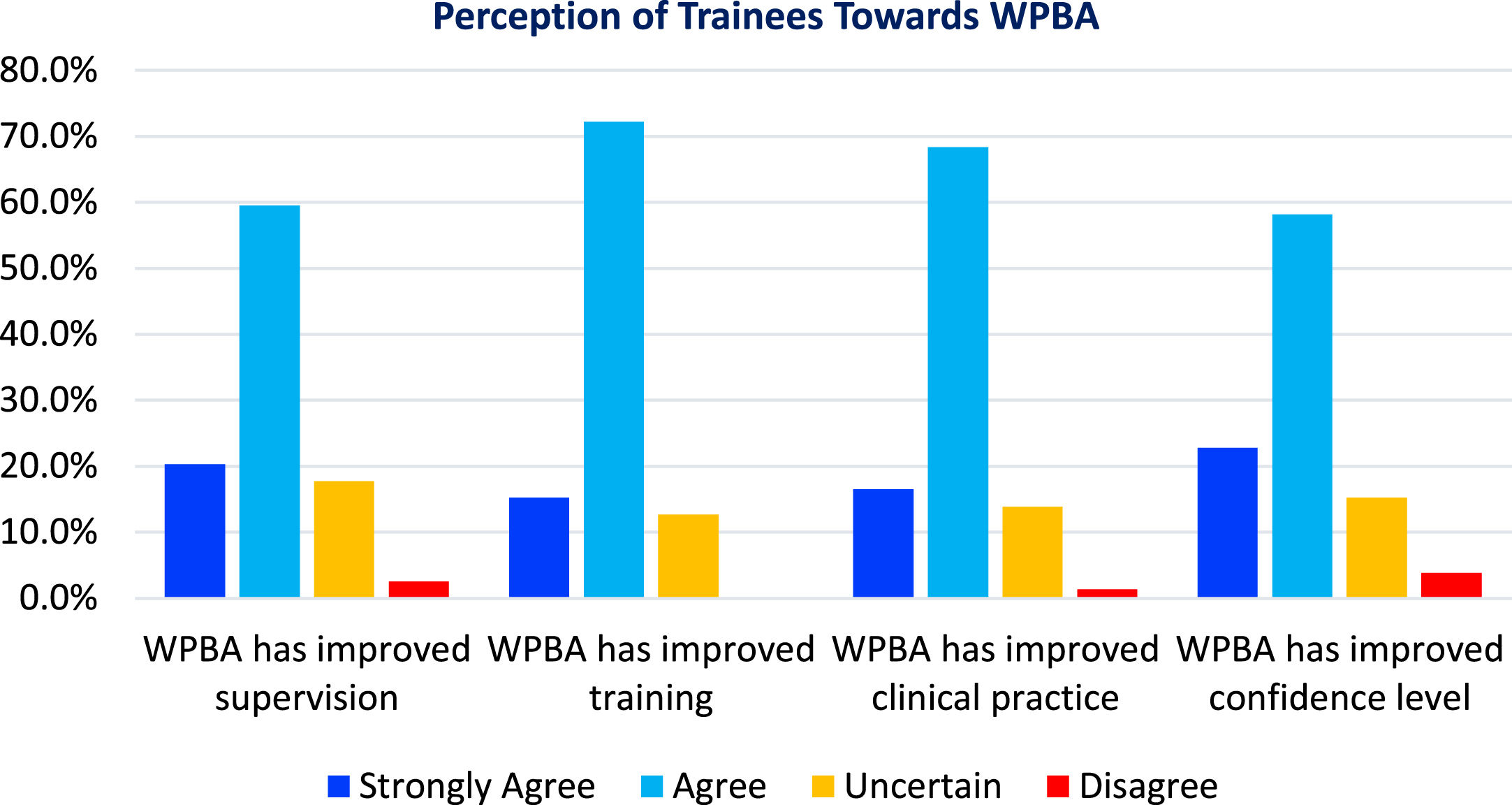
Response rate regarding perception of trainees towards WPBA.
The present study also revealed the attitude of respondents about WPBA and its use in future practice (Fig. 2). The highest proportion of participants (73.4%) agreed that the WPBA system is more valuable and acceptable to trainees in its existing form. The impression that “WPBA is the way forward and should be retained” has been acquiesced by 65.8% of respondents. The notions “WPBA accurately reflects trainees’ progress” and “WPBA is better than the traditional system” were affirmed by 46.8% of participants respectively. However, the statement that WPBA is being used appropriately has been consented by 41.8% and the same fraction of participants declared uncertainty about it.
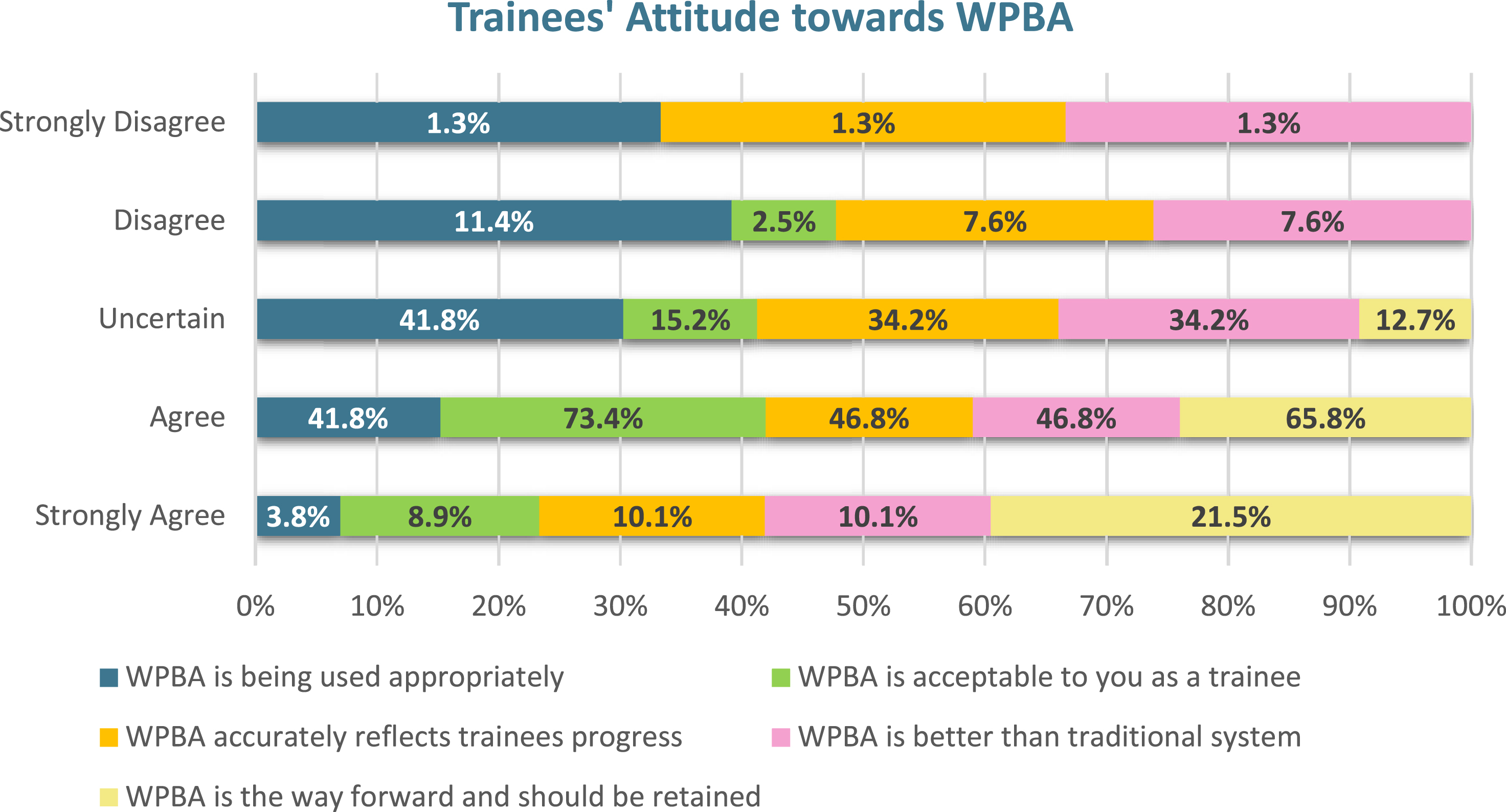
Response rate regarding attitudes of trainees about WPBA.
Overall, the highest percentage of respondents (56%) were in favor of a combination of on-paper and online recording of WPBA. An additional 33% of people preferred online while only 11% stayed with the manual recording system (Fig. 3).
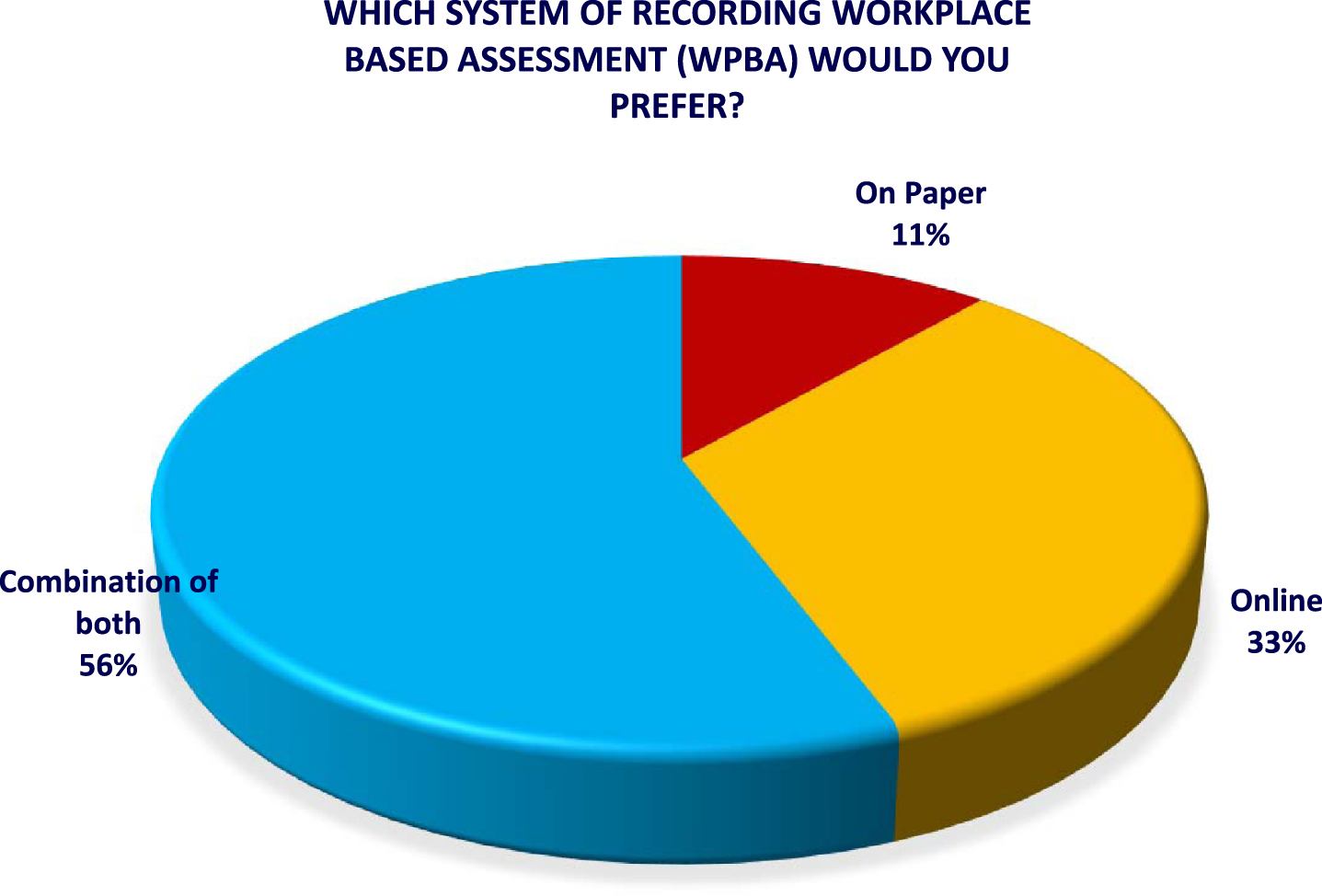
Responses to preferable recording system of workplace-based assessment (WPBA).
An association of various characteristics was made against the participants’ responses regarding perception and attitude towards WPBA (Table 3). First, the responses of trainees were evaluated against their age group. The notion (WPBA has improved clinical practice) exhibited a significant relationship with participants’ age group (p = 0.05) while others have expressed a statistically non-significant relationship indicating that the level of mastery in clinical skills varied among various age groups.
Relationship between participants’ characteristics and their responses
Relationship between participants’ characteristics and their responses
The relationship of overall perception of trainees about workplace-based assessment (WPBA) to the characteristics of participants. <0.05 = significant (s), >0.05 = not significant (ns), <0.01 = highly significant (hs).
Second, the participants’ responses were analyzed against their current position/designation. While stating the preference for the WPBA recording system, the current position/designation stands different with a highly significant value (p = 0.03), while others have recorded non-significant results in this regard. Thus, signifying the preferred system of recording WPBA varies among participants experiencing diverse designations.
Likewise, we can see a statistically significant relationship (p = 0.05) between the familiarity of trainees with WPBA and the impression that “WPBA has improved the confidence level of the trainees,” has been declared while other impressions have been non-significant relatively, revealing that confidence level of an individual trainee depends on his/her level of familiarity with WPBA.
The survey also presented for participants to express the remedial measures that might improve the WPBA system (Table 4). Of the total, 12.7% recommended the regular implementation of WPBA, 5.1% believed that proper feedback is needed to ascertain its practice in the future and faculty training is obligatory for the proper implementation. However, a minor fraction of 3.8% responded that WPBA needs further research. 1.3% acclaimed that there is a need for control of biasness and also E-portfolios should be added.
Recommendations/suggestions of trainees about workplace-based assessment (WPBA)
Recommendations/suggestions of trainees about workplace-based assessment (WPBA)
Currently, we are living in the 21st century where the trend has been shifted to competency-based medical education [13]. During the entire educational process, the competencies of healthcare professionals are constantly developed and enhanced as they learn basic and complex procedural skills [14]. Thus, there is a need to analyze and assess the skills and competencies of healthcare professionals. Assessment has become an integral part of competency-based medical education (CBME) [15].
CBME has placed a great emphasis on workplace-based assessment (WPBA) as a formative performance assessment method [16]. Most of the medical universities have revised the percentages of formative assessment as 80% and summative assessment as 20% for various courses [17]. WPBAs are designed to assess the day-to-day performances of healthcare professionals in real-life situations at the workplace [18]. In 2007, Norcini and Burch described the advantages of WPBA as: They provide a holistic approach towards comprehensive evaluation and assessment of trainees’ progress. They provide information about the trainees’ actual performance in real-life situations at the workplace. At the same time, they tend to improve clinical training as well as aim to improve patient care thus replacing the traditional training system. They also offer multi-source feedback which is considered its special strength. They provide documented evidence of individuals’ performance and also identify the strengths and weaknesses of the participants.
It is perceived from the findings that most of the participants have shown a great deal of interest in workplace-based assessment. Results have shown that a substantial number of respondents (65.8%) have already been familiar to WPBA and a proportion of 15.2% are not familiar with this system whereas, another survey of psychiatric trainees in Wales [11] revealed that 79% of the total participants have undergone training system based on WPBA while 17% had not undergone WPBA during their training period.
A total of 57% of the trainees believe that WPBA has been introduced to improve clinical training, whereas, in the previous study 43% of trainees agreed with this statement [11]. In a similar study conducted among psychiatric trainees in Wales, it has been revealed that 43% of the trainees and 44% of the trainers believed that WPBA is introduced to improve clinical skills and only a smaller percentage 19% of trainees deemed that the driven force behind introduction of WPBA is to improve patient care. In contradiction to the current study, 41% of the trainees considered it to be politically driven [10]. The possible reasons might be a lack of awareness, information, knowledge, and training regarding WPBA. Strikingly, 19% of the trainees claim that this system has been introduced to improve patient care while previously in another survey, 9% of the trainees reflected this statement to be true [9].
The results indicated that trainees have an overall positive perception of WPBA system and its implementation. Current study has shown that majority of the participants (72.2%) agreed that WPBA has improved its training system whereas, 13% of the psychiatric trainees agreed with the same impression [11]. Formerly, 17% of the trainees affirmed the concept “WPBA is acceptable as a trainee” but the present study implies 73.4% of participants agreed and accepted this system. Moreover, compared to the previous study in Wales where only a minimum fraction (9%) agreed to retain the WPBA system, this study has greater respondents (65.8%) in favor that this system should be retained and implemented at the workplace in dental education. The possible reason for the acceptance of WPBA may be due to clarity of concepts, amplifying validity and reliability of the developing system and its escalating benefits over other traditional assessment methods.
Majority of the trainees (51%) in the former study preferred the traditional system of recording assessments. The reason might be that persistent anxiety caused by unfamiliarity with the digital system results in poor academic performance [19], whereas, the present study shows the highest percentage (73.4%) of the respondents voted for the combination of on-paper and online system for recording WPBA. The logical reason might be the innovations in digital learning during the COVID-19 pandemic have enabled many students/trainees to acquire technical expertise.
Largely, WPBA has a significant impact on the trainees’ confidence and morale [20]. The study also confirmed that trainees appreciated the benefits of WPBA and its augmentation in postgraduate as well as the undergraduate curriculum was supported. It is evident from the current study that quality assurance measures should be taken to optimize the objectivity and validity of WPBA and structured training of assessors will address the fundamental weaknesses of this system. Workplace-based assessment tools have an auspicious prospect in bringing up the novelty, objectivity, acceptability, and holistic approach in assessment.
Strengths and limitations
Encouragingly, the study shows that there is a need for further educational research on WPBA, which will intensify learning, aid in the implementation of procedural skills to improve clinical training and patient care, and determine its feasibility. The fundamental approach to address other weaknesses in the provision of structured training to supervisors/assessors for the smooth execution of the WPBA system. Quality assurance measures are to be taken for constant review and uniform implementation.
Due to a lack of logistics, support and time, the present study included samples from only one dental institute. However, frequent reminders via emails, WhatsApp, and texts messages aided in the collection of final responses included in the study.
Conclusion
This study identifies the perception, attitude, and thoughts (preference) of trainees about WPBA and its practice in dental education. The study has shown that WPBA, as compared to the traditional training system, measures the competencies of dental trainees in a very precise manner and is a good fit for future practice in procedure-based disciplines. In this era of hybrid learning, the combination of both on-paper and online recording of WPBA is proposed. Therefore, advanced acknowledgement and awareness have encouraged WPBA to be considered an appropriate system for practicing various competencies in workplace among postgraduate and undergraduate studies.
However, there appears to be an ambiguity regarding its appropriate use among trainees due to inadequate training of faculty members, ill-defined standards, and biasness. Otherwise, if used properly, WPBA has proven itself to be a substantiated tool to bring improvements in clinical training and patient care.
Ethical approval
Ethical approval was provided by the Institutional Review Board (IRB), Bakhtawar Amin Medical and Dental College (Ref. no. IRB/904/21).
Informed consent
The objectives of the study were clearly explained in detail to all participants and participation was voluntary.
Conflict of interest
The authors declare no conflict of interest.
Author contributions
Conceptualization: HAR, AAS & SWG; Methodology: HAR, AAS, FFSK & SWG;
Investigation: SF, ZA, FFSK, MWH & MKA; Project administration: MWH, AAS & MKA;
Writing original draft: SF, ZA, FFSK & MKA; Supervision: HAR, AAS, MWH & SWG;
Writing review & editing: HAR, AAS, FFSK, MKA & SWG.