



Abstract
BACKGROUND:
Although some research has been done in the Mexican manufacturing industry regarding mental workload, none has explored its association with physical fatigue, body weight gain, and human error simultaneously.
OBJECTIVE:
This research examines the association between mental workload and physical fatigue, body weight gain, and human error in employees from the Mexican manufacturing systems through a mediation analysis approach.
METHODS:
A survey named Mental Workload Questionnaire was developed by merging the NASA-TLX with a questionnaire containing the mental workload variables mentioned above. The Mental Workload Questionnaire was applied to 167 participants in 63 manufacturing companies. In addition, the mental workload was used as an independent variable, while physical fatigue and body weight gain were mediator variables, and human error was a dependent variable. Six hypotheses were used to measure the relationships among variables and tested using the ordinary least squares regression algorithm.
RESULTS:
Findings indicated that mental workload significantly correlates with physical fatigue and human error. Also, the mental workload had a significant total association with human error. The highest direct association with body weight gain was provided by physical fatigue, and body weight gain had an insignificant direct association with human error. Finally, all indirect associations were insignificant.
CONCLUSION:
Mental workload directly affects human error, which physical fatigue does not; however, it does affect body weight gain. Managers should reduce their employees’ mental workload and physical fatigue to avoid further problems associated with their health.
Introduction
Currently, scientific and technical breakthroughs are assisting in improving the quality of life in the workplace by reducing physical risk factors such as manual materials handling, vibration, repetitive movements, force application, and awkward body postures [1]. However, mental tasks have taken more relevance in today’s industrial sectors. According to several authors, the mental workload is defined as the level of effort involved in executing a specific activity [2, 3].
Some research points out that mental workload can cause negative effects on employees’ performances, such as degradation in decision-making quality in plane pilots [4–6], communication conflicts and accidents in aviation [7, 8], errors in the use of agricultural vehicles [9], low workability and bad quality of life in school teachers [10, 11], to mention a few.
Currently, the manufacturing industry is demanding high levels of the mental workload from employees, which in turn affects operators and managers by reducing their attention to the task, resulting in distractions and human errors that are manifested in injuries to employees and economic costs for companies [12]. Sometimes, employees are involved in different projects, and to ensure their success, they must analyze, process, and use too much information at a specific time, which may lead employees to suffer mental workload. Furthermore, employees are frequently under pressure to deliver results at a specific time, which increases the mental workload [4, 13–16].
Some research regarding mental workload has been reported and its effects on employees in the manufacturing industry, as shown by Barajas-Bustillos et al. [12], that report a literature review on mental workload in the manufacturing industry and found that only 105 researches have been published from 1981 to 2017 (i.e., less than three researches by year) on this industry sector. In addition, Zoaktafi et al. [17] note that assessing mental workload is an important part of developing human-machine interfaces (HMIs) for the manufacturing industry.
Although several authors have performed research on mental workload in manufacturing companies in Mexico [18–20], most of the operators, managers, supervisors, engineers and other employees unknow the methods and techniques to assess and evaluate the mental workload level and their effects on them.
Particularly, the mental workload can cause physical fatigue [21], body weight gain [22], and human error [23] in manufacturing employees. In the case of physical fatigue represents a challenging ergonomic/safety “issue” since it negatively impacts employees’ health and safety and decreases productivity [24]. Also, some authors mention that obesity is linked to absenteeism and reduced performance [25], while human error facilitates the appearance of quality defects and accidents, negatively affecting system reliability [26]. Therefore, managers should pay attention to these variables.
Mexico’s manufacturing sector is significant because it supports over 2,280,504 direct jobs [27] and is home to 604,250 maquiladora businesses [28]. A maquiladora industry is an entity that assembles, manufactures, processes, or repairs electronic materials that are imported by the hosting country for eventual re-exportation or shipment to the country of origin [29].
The Mexican maquiladora industry includes manufacturing food, clothing, wood products, chemical substances production, metallic products, machinery, and equipment, to mention a few [30]. But incorporating a variety of machinery and equipment in the maquiladora industry has partially replaced some activities carried out manually. However, most of the products made in this industrial sector require an intensive manual labor force [31].
An employee in the manufacturing sector can expect to put in an average of 521,065,000 hours per month, or 11 hours per day on average [32], which gives some idea of the mental and physical strain that this can entail. In Mexico, obesity is a current problem that has been present for a long time (since 2002 or even before) [33]. Additionally, the nation is ranked number 1 in the world for overweight and obesity [34], and nationwide, in 2018, 75.2% of adults over 20 were overweight (39.1%) or obese (36.1%) [35].
Although some research has been done in the manufacturing industry in the country and worldwide regarding mental workload, none of this research has explored the association of mental workload with physical fatigue, body weight gain, and human error simultaneously. This research represents an exploratory study on the effects of mental workload on other variables, which may act as dependent variables or mediating variables between mental workload and some independent variable(s). In this experiment, only the effects of mental workload on physical fatigue, body weight gain (as mediating variables), and human error (as the independent variable) are analyzed. However, future research, such as overwork, memory loss, depression, or social problems, and our results aim to generate new hypothetical models and investigate their associations.
This paper focuses on measuring mental workload level and its association with the variables mentioned above in senior and middle management from manufacturing companies located in Tijuana, Mexico, where the National Constitution regulates occupational safety and health, the Organic Law of the Federal Public Administration, the Federal Labour Law, the Federal Law on Metrology and Standardization, the Federal Regulations on Occupational Safety and Health, and other regulations [36]. According to article 123, section “A,” section XV of the Supreme Law, an employer must follow the legal precepts on hygiene and safety in the whole establishment and take appropriate measures to prevent accidents and guarantee the health of its employees [36].
In addition, the Mexican Ministry of Health establishes the general conditions for occupational health, declaring that employers and Unions must integrate the Safety and Hygiene Commission to issue guidelines to reduce and prevent occupational hazards and determine the required clothing and equipment for safety [37].
The next subsections present the hypotheses proposed in this research. Findings from this research will allow managers to know and have empirical and statistical evidence that will allow them to justify investment for their workers’ benefit and comply with Mexican regulations and standards that regulate them since, in a study reported by Reyes et al. [38], 62.66% of human errors in maquiladora industry are affecting employee’s health as accidents.
Association of mental workload with physical fatigue, body weight and human error
The mental workload can affect human performance and is considered critical in designing and evaluating complex human-machine systems [39]. In addition, the mental workload is constantly presented in various industrial sectors, resulting in many obvious negative effects on workers. These effects may include physical fatigue, body weight gain, and human error, among others.
Physical fatigue can be defined as a decrease in performance due to physical, mental, or emotional exertion. It can affect many physical abilities, from strength and speed to reaction time and decision-making [40, 41]. As a result of putting in too much physical work for too long, workers may start to feel physically exhausted and lose productivity on the job. [40, 42]. Sarsangi et al. [43] mentioned that mental workload is a factor that often causes physical fatigue. Realyvásquez-Vargas et al. [44] performed a descriptive study among 167 manufacturing employees to know the effects of mental workload, and findings indicate that 74, 15, and 5 declare that sometimes, usually, and always, respectively, they felt physical fatigue due to mental workload.
Mehta and Prasuraman [45] also studied the relationship between mental and physical exhaustion in an experiment with 12 participants. The analysis was performed by measuring the activation of the prefrontal cortex during submaximal fatigue handgrip exercises. The participants carried two types of exhaustion: physical (control) and mental (concurrent). To the point of exhaustion, at 30% of their maximum handgrip strength, both conditions exhibited good behavior. Their results indicated that mental workload contributes to physical fatigue. Based on this result, hypothesis H1 is proposed:
H1: Mental workload has a direct and positive association with physical fatigue in employees from the Mexican maquiladora industry.
Moreover, regarding body weight gain, several authors have found a relationship between mental workload and body weight gain. For instance, Overgaard et al. [46] studied for six years to know the relationship between mental workload and changes in body weight. Their research included 6704 Danish nurses, from 45 to 65 years old, who were both employed in 1993 and 1999. Consequently, nurses who said to be never busy or always busy resulted in significantly more body weight gain (3.5 and 3.1 kg, respectively) than those who said to be occupied only sometimes, who gained 2.5 kg in weight. They mention that labor requires mental work, promoting overeating and obesity in a modern context.
Similarly, Overgaard et al. [22] performed a literature review to know the association of psychological workload with body weight gain in women and men. Their study showed little evidence for the relationship between these two variables and a weak positive relationship between psychological workload and body weight. Specifically, two studies showed a positive association between body fat distribution in men and women, and there was no evidence that this association was consistent. Also, Booth et al. [47] examined the relationship between psychological workload and body weight gain. To do this, these authors performed a literature review of cross-sectional studies and found that these studies reported a weak positive relationship. Based on this background, the hypothesis H2 is proposed:
H2: Mental workload has a direct and positive association with body weight gain in employees from the Mexican maquiladora industry.
In the case of human error, Sheridan [23] defines it as an action that fails to meet some explicit or implicit arbitrary criterion. This author also mentions that mental workload indeed contributes to human error. Roll et al. [48] mention that work-related stress caused by a high mental workload is a significant contributor to human error. Similarly, Qeshmy et al. [49] researched the main causes of human error in assembly production lines, and they discovered that the amount of thinking, deciding, and searching for information were the leading causes of human error, i.e., the leading cause of the human error was mental workload. Other authors mention that high or low physical or cognitive demanding tasks cause human error [50, 51]. In another research, Yan et al. [52] analyzed the correlation between mental workload and the number of mistakes done by a driver. To do this, the authors developed a warning model that helped predict drivers’ mental workload. Their results indicated a positive correlation. Based on these backgrounds, hypothesis H3 is proposed:
H3: Mental workload has a direct and positive association with human error in employees from the Mexican maquiladora industry.
Association of physical fatigue with human error and body weight gain
Several authors have stated that physical fatigue can lead to employees making work errors. For instance, Yu and Wu [53] suggested that physical fatigue can lead to a lack of coordination and flexibility in the employees’ tasks, facilitating human error and negatively impacting product quality and production efficiency.
Similarly, Jamshidi [54] claims that physical fatigue can decrease the human workforce, facilitating human error. Also, Frone and Blais [55] mention that military researchers have focused on physical fatigue results in a Military Non-Deployed Setting, and one of these outcomes is performance errors.
Furthermore, Myszewski [56] showed that human error increases as physical fatigue rises over time. Similarly, Michalos et al. [57] developed a tool to evaluate physical fatigue and another to know the corresponding error rate. Also, Cumber and Greig [58] performed a study in a medical company to determine the effect of physical fatigue caused by changes in shifts on the human error done by doctors. As a result, nearly half of all modifications analyzed in the data demonstrated an increased risk of fatigue-related errors. Sobhani et al. [59] found that human error resulting from insufficient training and other factors inherent to workplace design negatively impacted the efficiency of production and inventory systems. They note that workers in a “in-pain state,” as opposed to a “healthy state,” are more likely to make mistakes, which in turn increases the rate at which defective products are produced.
Therefore, physical fatigue increases the frequency of human error in production-inventory systems. Dantan et al. [60] simulated a manufacturing process that includes the employee’s physical fatigue index and rejected parts due to human error, where a high correlation was found. According to the last paragraph, the hypothesis H4 is proposed:
H4: Physical fatigue is directly and positively associated with human error in employees from the Mexican maquiladora industry.
Few studies evaluate the relationship between physical fatigue on body weight gain. However, some authors have performed research in which these two variables are analyzed. For instance, Yamada et al. [61] tested the impact of implementing a 12-hour shift instead of a traditional 8-hour shift in an electronic part production factory. According to that study, a shift to a 12-hour workday dramatically increased workers’ weariness and led to some of them gaining weight. Workers who stayed on the 8-hour shift did not gain any noticeable weight. Based on these backgrounds, the hypothesis H5 is proposed:
H5: Physical fatigue is directly and positively associated with body weight gain in employees from the Mexican maquiladora industry.
Association of body weight gain with human error
There is a physiological explanation of body weight gain on executive function performance (human error). According to several authors, physiological differences between employees with overweight/obesity usually show worse values in insulin resistance, cholesterol levels, blood pressure [62, 63] and levels of glycolic metabolism activation [64]. Because of these underlying physiological differences, people who are overweight may have difficulty with executive functioning, which can lead to ineffectiveness (human error) in task performance.
Some research has linked obesity to cognitive impairment because it alters cerebrovascular blood flow [65, 66], triggers inflammatory processes due to excess body fat [67], and reduces insulin sensitivity [68]. The regions of the brain responsible for executive functioning may undergo either functional [69] (e.g., reduced functional connectivity of executive networks) or structural changes as a result of these disruptions (e.g., reduced orbitofrontal cortex) [70].
Some studies analyze the relationship between body weight and human error, suggesting weight gain may be associated with executive function errors [71]. One of these studies was performed by Sabia [72], studying these problems in the academic performance of adolescents. With information from the National Longitudinal Study of Adolescent Health, Sabia [72] used ordinary least squares, instrumental variables, and individual fixed-effects models. The results showed a statistically significant inverse association between student weight and academic performance.
Anderson and Good [73] studied the correlation between university students’ body weight and academic performance. These authors provided an optional class survey to 452 students for two consecutive academic years to perform the study. The authors compared the overall final grade for the class to the calculated body mass index (BMI), applying linear regression with unpaired t-tests and Pearson’s R correlation. They found a significantly negative correlation between BMI with students’ final grades. As performance improves, errors decrease. Therefore, it can be stated that these studies found a positive relationship between body weight gain and human error.
In a meta-analysis, Yang et al. [71] compared the executive functions of overweight and obese people to those of normal-weight controls. Overweight and obese participants made more mistakes in executive function tasks, such as those that required inhibition, planning, verbal fluency, cognitive flexibility, working memory, and decision-making, according to a meta-analysis of 72 studies involving 4904 people. In contrast, the overweight participants saw substantial errors in working memory and inhibition.
H6: Body weight gain is directly and positively associated with human error in employees from the Mexican maquiladora industry.
The hypothetical model with the hypotheses mentioned above is shown in Fig. 1.
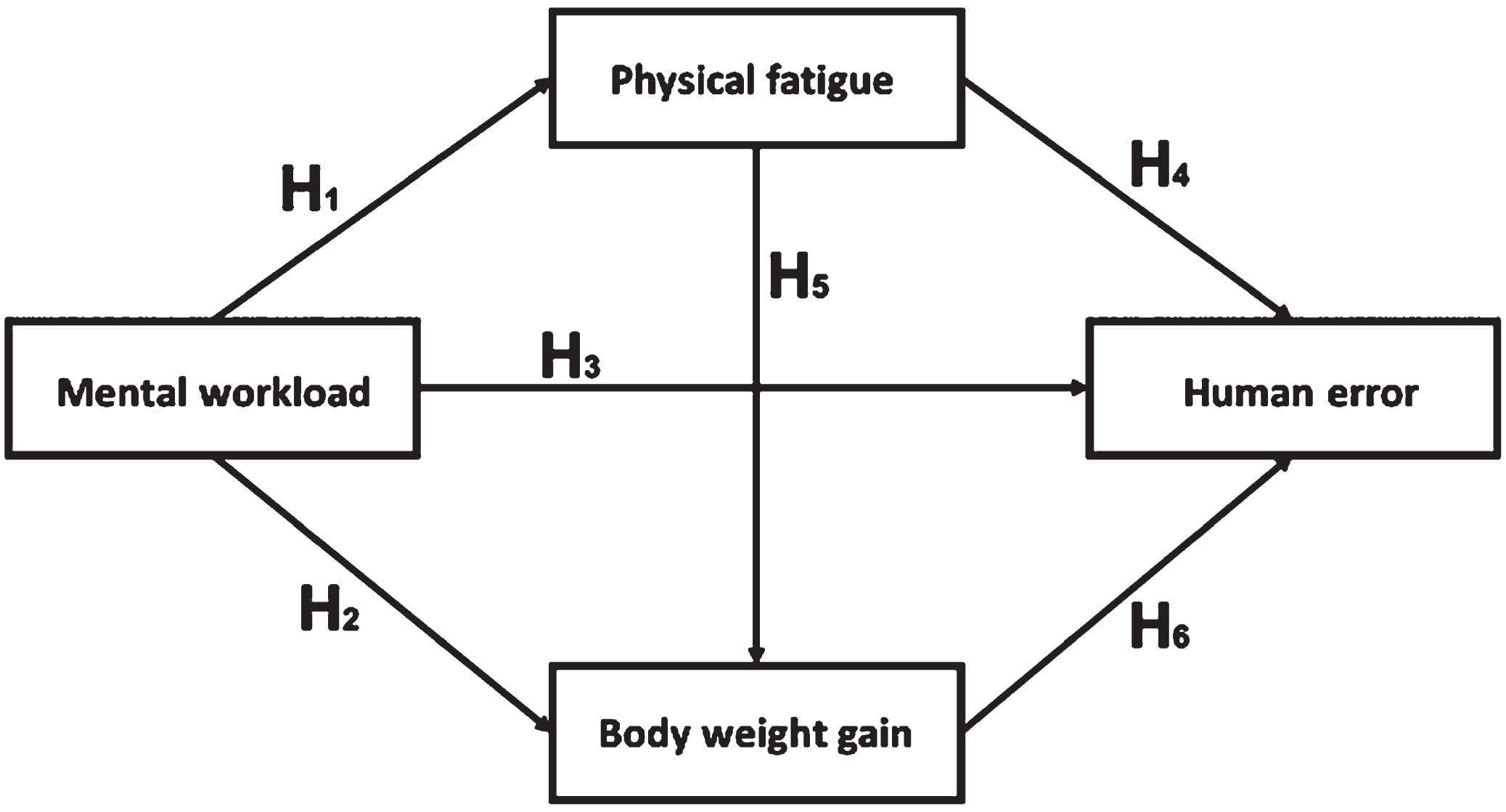
Relationships of the hypothetical causal model.
Stage 1. Mental workload questionnaire (MWLQ) development
Information from the maquiladora industries is required to validate the hypotheses in Fig. 1. According to Stanton et al. [74], the mental workload can be assessed using methods such as Subjective Workload Assessment Technique (SWAT), Modified Cooper Scales (MCH), DRA Workload Scales (DRAWS), Subjective Workload Dominance Technique (SWORD), NASA Task Load Index (NASA-TLX), among others; however, the NASA Task Load Index (NASA-TLX) is the most widely used [75–78]. The NASA-TLX method was developed as a heuristic tool for asses the mental effort required for tasks like air traffic management, maintaining vigilance, and practicing flights. It has been more popular as a subjective verified workload assessment scale used in various fields, including transportation, cognitive psychology, human-computer interaction, janitors [78–80], nuclear energy, transportation, healthcare, and manufacturing [76, 81–85].
The NASA-TLX questionnaire continues being applied in so many recent studies from 2021 and 2022, as those performed by Sharifi et al. [86], Abareshi et al. [87], da Silva et al. [88], Ebrahimi et al. [89], Han et al. [90], and Moertl et al. [91]. NASA-TLX is associated with accuracy [92–98], completion time [92, 99–101], and reaction time [92, 102]. Furthermore, according to a recent study, the overall mental workload scores in the NASA-TLX gradually increase with increasing levels of mental workload, and the overall scores of low mental workload (LMW) were significantly lower than those of medium mental workload (MWL) (p 0.001) and high mental workload (HMW) (p 0.001), and the overall scores of MWL were significantly lower than those of HMW (p 0.001) [103].
Pang et al. [103] discuss the use of electroencephalography (EEG) to measure the level of mental workload, noting that it takes a long time to calculate and train, that cumulative errors can occur, that the algorithms used are difficult to converge, and that it is relatively easy to tend to a local minimum. Furthermore, these authors mention recent studies on assessing mental workload with EEG, but their accuracy was insufficient.
To collect information from industries, the mental workload questionnaire (MWLQ) was applied and uploaded to the Google forms platform, and it comprises three sections. The MWLQ was developed by merging the questions in the NASA-TLX method with questions about descriptive data (age, relationship status, number of children), the number of employees working in the company, job position, years of experience, the industry sector in the company; and the effects of mental load that the participants have experienced. The first section of the MWLQ addresses the demographic data as the number of employees in the company, job position, years of experience, and industry sector.
The second section of the MWLQ aims to assess employees’ mental workload using the NASA-TLX [75–78], and it is divided into two subsections; the first section evaluates each dimension individually (mental demand, physical demand, time demand, performance, effort, and frustration). Employees must select a value between 1 = Low and 20 = High (only for the performance dimension, 1 = Good and 20 = Poor). The second subsection of NASA-TLX contains the paired comparison, in which participants must choose the dimension that contributes the most to increasing mental workload during a specific task for each paired comparison.
Once employees answer the second section of the MWLQ (i.e., the questions corresponding to the NASA-TLX), the individual mental workload is calculated by applying equation (1). Table 1 shows how mental workload levels are converted to an ordinal scale.
Ordinal scale for mental workload levels
Ordinal scale for mental workload levels
Specifically, the overall index is obtained by applying equation (1), which contains the sum of relative contributions of each dimension, representing the mental workload accumulated by a person during a specific event, situation, or time [77, 81]. Equation (1) provides a weighted average representing the final mental workload index based on the subjective rating of each attribute di and the corresponding weights w i for the six dimensions. The weights w i represent the number of preferences (i.e., how many times each dimension was chosen) in the 15 paired comparisons and range from 0 (not significant) to 5 (significantly more significant than any other attribute) [78].
The third section of the MWLQ addresses the association of mental workload with some observed variables on employees and their occurrence. Among the observed variables are physical fatigue, body weight gain, human error, stress, headache, mental fatigue, irritability, depression, memory loss, and social problems. The MWLQ then includes 11 observed variables as well as mental workload. However, the present research only estimates the association of mental workload with the first three observed variables. The reasons to include only these three variables are the following: In Mexico, obesity is a current problem that has been present for a long time (since 2002 or even before) [33]. Moreover, the country ranks first globally in overweight and obesity [34], and nationally, in 2018, the percentage of adults over 20 years old with overweight and obese was 75.2% (39.1% overweight and 36.1% obese) [35]. These statistics show that in Mexico, most employees tend to gain weight easily. Physical fatigue is supposed to reduce physical activity, which in turn is supposed to promote body weight gain. Physical fatigue is supposed to promote human error. Although some research has been done in the Mexican manufacturing industry and worldwide regarding mental workload, none has explored the association of mental workload with physical fatigue, body weight gain, and human error simultaneously. The research aims to discover new things in different contexts (countries, variables (both in quantity and in significance), and work sectors, to name a few). This research represents an exploratory study on the effects of mental workload on other variables, which may act as dependent variables or mediating variables between mental workload and some independent variable(s).
The frequency of occurrence of the observed variables is measured using a Likert-type scale of 5 points (Never = 1, Rarely = 2, Sometimes = 3, Often = 4, Always = 5) since it has been successfully used in other similar studies [104]. In this task, the employee must select a frequency level for each association of mental workload with the observed variables, and all questions are mandatory. Table 2 shows the observed variables and the scale used to measure their association with the mental workload, and a digital version of the MWLQ is available at https://forms.gle/AwxwGzvxz3teVVwb7.
Likert scale for the association of observed variables with mental workload
In this research, we use this subjective scale because it has been reported by Bakker et al. [105] to know the subjective validity measures (they focused only on sedentary behavior) with self-reported measurement tools (including questionnaires). They found that the reliability of measures was moderate-to-good, with the quality of these studies being mostly fair-to-good. It justifies its use to ensure reliability ranges from moderate to good in this study.
The MWLQ was applied using a convenience sample method aimed at middle and senior managers because they have a high cultural level and knowledge about mental workload and its association with the observed variables. Managers were distributed into 63 maquiladora companies established in the north of Mexico. The survey was applied according to the following two steps: The first step is to contact the managers of companies by using the Liaison Office directory of a higher education institution and the National Institute of Statistics, Geography, and Informatics (INEGI). A manager is contacted by telephone or email in each company. Managers know about the MWLQ survey, items, and scales at this step. Therefore, an interview was arranged to respond to it, inviting them to collaborate with the project and informing the research objectives and benefits they may obtain. The identified managers contact their colleagues to inform them about the project and the date, time, and place to respond to the survey. The MWLQ administration was performed for six months, according to the managers’ availability in each maquiladora. All surveyed participants were called to collaborate in the study, willingly respond to the survey, and sign an agreement letter. The total sample includes 167 surveyed employees distributed in the 63 manufacturing companies, as is shown in Table 3.
Employees surveyed by company
Employees surveyed by company
*NES=Number of employees surveyed.
The approval for this research was obtained from the Ethical Committee of Instituto Tecnológico de Tijuana (Technological Institute of Tijuana at Tijuana, Mexico). From all participants, electronic informed consent was obtained following the Helsinki Declaration.
MWLQ statistical debugging and validation
Data analysis comprised two steps. The first step refers to MWLQ statistical validation, whereas in the second step, all hypotheses in Fig. 1 were statistically tested.
Data from questionnaires was entered into a database created with the SPSS® software [106]. Since the data were collected on a Likert scale (ordinal scale), the missing values and outliers were substituted by the median to improve their quality [107–109]. It is important to indicate that all estimations were analyzed with a confidence level of 95%.
The MWLQ is then statistically validated for each variable using Cronbach’s alpha, which occurs when it exceeds 0.7 [107, 110]. According to Tavakol and Dennick [111], Cronbach’s alpha measures the internal consistency of a test or scale. Internal consistency describes the extent to which all items in a test measure the same concept or construct and is thus related to the test’s interrelationship. These authors mention that to avoid this, homogeneity or unidimensionality can help improve alpha use. A measure is said to be unidimensional if its items measure a single latent trait or construct [111]. All observed variables with a corrected total-item correlation value lower than 0.3 are removed from the analysis in this step.
Hypotheses testing
The relationships between the observed variables, as shown in Fig. 1, are tested using mediation analysis because observed variables can act as both antecedent and consequent variables [112]. The PROCESS® macro (model 6) in the SPSS® software is used for the analysis because it analyzes the data of observed variables with sophisticated algorithms based on ordinary least squares (OLS) regression [112, 113] and allows the use of nonlinear models [110]. Several authors widely recommend this software for statistical analysis with small samples, assessments on an ordinal scale, and non-normal distribution [114]. In a regression analysis, the validity of statistical inferences was substantially affected only when the most severe violations of normality occurred or when the sample size was quite small [112, 115].
Some model fit indexes [112] were estimated before model interpretation [112]: R2 and F ratio. R2 is a scale-free metric defined as the proportion of variance in a subsequent variable Y explained by the model [112], with values greater than 0.02 accepted. Finally, the F ratio is used to determine whether the variance explained by the model differed from the variance not explained by the model significantly. It is considered appropriate when a model is statistically significant or when the variance ratio differs significantly from zero [116]. The intraclass correlation coefficient (ICC) is used to analyze data concordance, accepting ICC >0.71 [117]. The analysis is performed in SPSS®, using the two-way mixed model and the absolute agreement type.
The serial multiple mediation model was applied to measure the associations. Hypotheses in Fig. 1 were validated by using direct associations. A generic interpretation of the direct association was when two cases differed by one unit on an antecedent variable X and were estimated to differ by c’ (the value of the direct association) units on a subsequent unit or subsequent variable Y [112].
Three connections are examined in detail. First, a standardized value was obtained as a dependence measure to statistically test the hypothesis that there is a relationship between two observed variables [107]. The null hypothesis is H0: β1 =0 versus the alternative H1: β1 ≠ 0. Evidence of a correlation between the two variables can be inferred statistically if the value is non-zero.
Second, indirect connections manifest themselves throughout more than one segment (i.e., more than one antecedent and more than one subsequent variables) when one or more mediator factors exist between the antecedent and subsequent variables [107]. When an antecedent variable X changes by one unit because of its association with a mediator variable M, which impacts Y, these values were read as the expected change value of the consequent variable Y [118].
Finally, the sum of direct and indirect associations is called the total association. For the validity test of each association, the bootstrap method was used [119]. Several authors have found that the bootstrap technique yield provides the most reliable findings for determining whether or not an indirect relationship is statistically significant. [119, 120]. Finally, the significance of direct, indirect, and total associations was tested with a 95% confidence level and ten thousand bootstrap samples. If zero is not in the 95% confidence interval, all associations are significant at p 0.05 [119, 121].
Results and discussion
This section shows findings derived from the statistical model analysis. The section is structured following the steps of the methodology described above.
Sample description
Of the 167 employees surveyed, 100 were men, while 67 were women, ranging from 19 to 56 years old. Regarding the industrial sector in which they worked, 44 respondents mentioned that they belonged to the medical sector, 42 to the electricity sector, and 43 to the automotive sector. To a lesser extent, other respondents indicated that they belonged to the food, information technology, wood, plastic and rubber, metallic, or textile sector. Finally, regarding the work schedule, results indicated that 139 respondents work more than 35 hours per week, while 28 participants report they work 35 hours or less per week. Table 4 shows the descriptive results of the sample.
Descriptive results of the sample
Descriptive results of the sample
As all variables integrated into the model were observed variables, no items were used to measure them (there were no Cronbach’s alphas for individual scales for each observed variable), but only one scale for the MWLQ. The Cronbach’s alpha value from the MWLQ was 0.759, and no items were removed because Cronbach’s alpha value decreased. This relatively low value is due to the items in the MWLQ measuring different observed variables (physical fatigue, body weight gain, and human error) and not only construct, i.e. but there also is no unidimensionality. But because the test length affects Cronbach’s alpha, a high value does not always mean a high degree of internal consistency [111]. If the test length is too short, the alpha value is reduced [111, 123]. So, to raise alpha, the test should have more related questions that test the same idea [111].
The MWLQ can be reliable based on these results, and the correlation matrix is shown in Table 5.
Correlation matrix
Correlation matrix
Regarding the ICC, a value of 0.82 was obtained at a confidence interval of 95%, then concordance among data was good.
In Fig. 2, the β values represent the direct associations between an independent and dependent variable. Similarly, the p-values represent the significance of the associations used to test the hypothesis. Observe that three p-values are over 0.05 (red arrows). Then, the relationship between mental workload and body weight gain can be rejected. This result is similar to that obtained by Overgaard et al. [22], who conducted a literature review on the association between mental workload and body weight, finding little evidence of a general association between these two variables. The relationship between physical fatigue and human error can also be rejected. The relationship between physical fatigue and human error can also be rejected. This result differs from that mentioned by Kolus et al. [124], who developed a model in which fatigue states represent a mismatch between the technical system and the human operator, resulting in manufacturing errors.
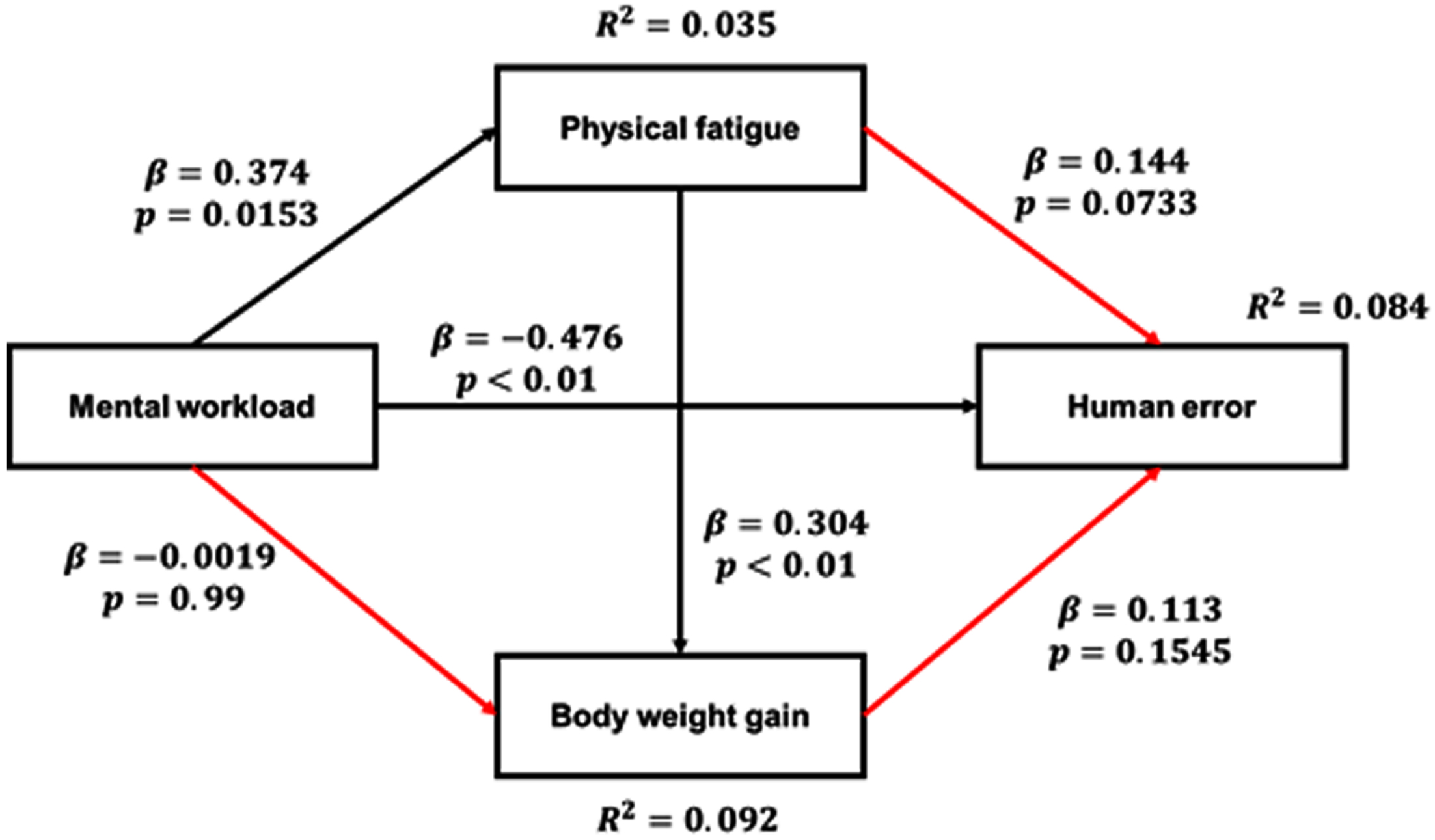
Direct associations.
This difference may be because the Kolus et al. [124] model focuses on operators, not middle and senior management, as in this research. Finally, the relationship between body weight gain and human error can be rejected. This result differs from Yang et al. [71], who state that overweight workers make errors in executive functions. This difference can be because these authors performed a literature review and synthesized it by conducting a meta-analysis of studies that included employees from different countries worldwide, not only from Mexico, as we do in this research.
The p-value for the other three relationships (black arrows) was less than 0.05, so they were significant. Only significant direct associations are shown in Fig. 3. The relationship between mental workload and physical fatigue is similar to the one obtained by Wu et al. [125], who found that a high mental workload increases fatigue in nurses. Also, the result obtained on the relationship between mental workload and human error is similar to the one obtained by Yeow [126], who found that mental workload has a significant relationship with human error in manufacturing employees in Malaysia. Finally, the relation between physical fatigue and body weight gain agrees with that obtained by Yamada et al. [61], who reported that when employees work a 12-hour shift instead of an 8-hour shift, it significantly increases fatigue and body weight gain.
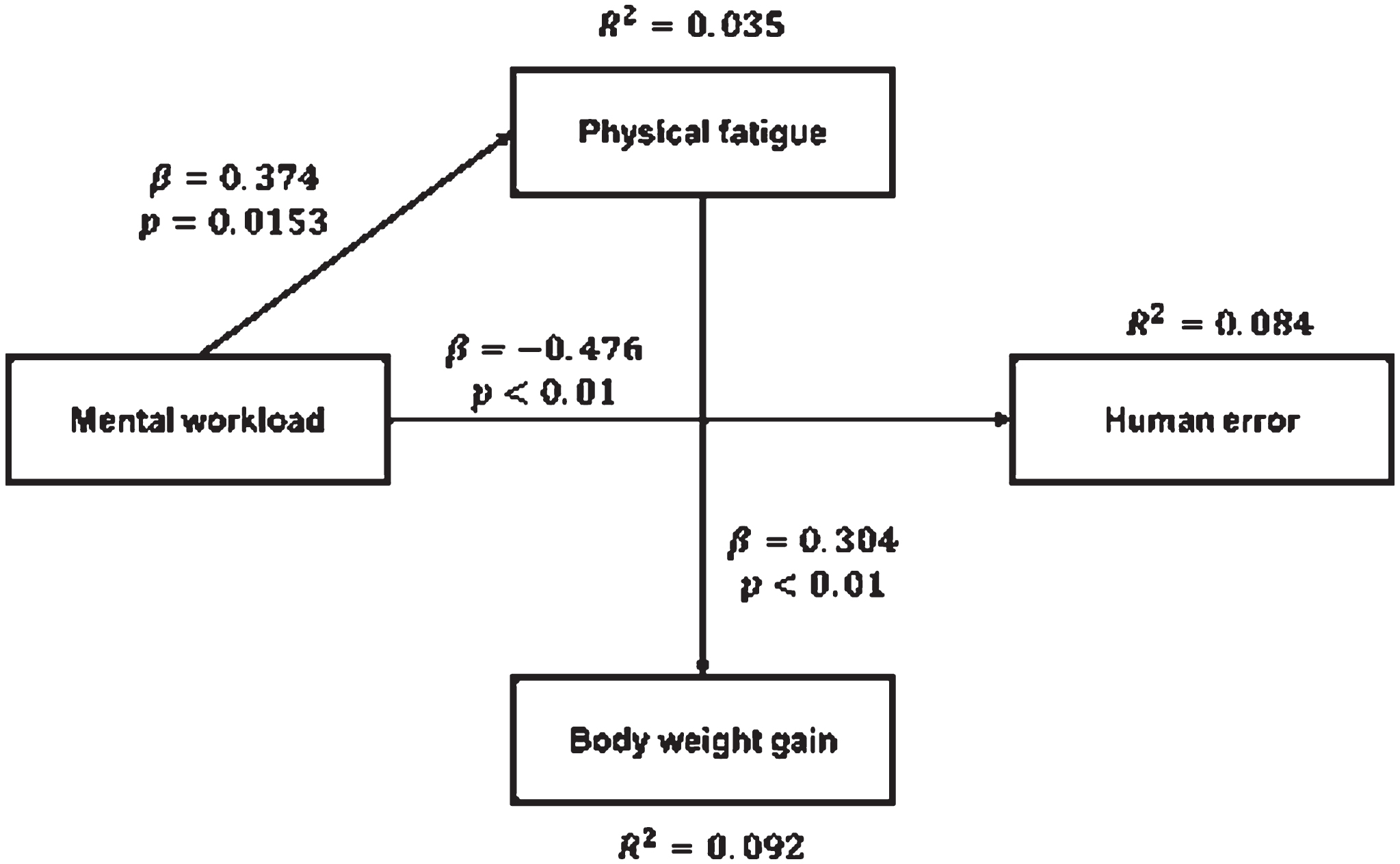
Significant direct associations.
The β values can be seen as measures of how dependent something is. For example, the β values in Fig. 3 show that if the standard deviation of physical fatigue went up by one unit, the standard deviation of body weight gain went up by 0.304 units. Figure 2 shows a serial model with multiple mediators. Table 6 shows the regression coefficients (Coeff.), standard errors (SE), constants, and a summary of the model.
Regression coefficients, standard errors, constant and summary information for the serial multiple mediator model
The R2 values represent the percentage in which antecedent variables explain variance for consequent variables [112].
Take note that the p-value for the F ratios was less than 0.05, and the R2 was greater than 0.02, so the model is suitable. Equations expressing dependent relationships for physical fatigue, body weight gain, and human error can be derived from the values provided in Fig. 3 in equations 2 to 4 and the constant values shown in Table 3 [112]:
The study did not integrate other factors that may contribute to human error in manufacturing, including employees’ physical and mental characteristics, the nature of the work site, the nature of the materials used, the nature of the machinery employed, and the nature of the standards used to pre-program the tasks to be performed [56].
There were three indirect associations between mental workload with human error. The first indirect association (indirect association 1) was passing through the mediator variable of physical fatigue; the second indirect association (indirect association 2) was through the body weight gain; and the third indirect association (indirect association 3) was through the two mediator variables, going first through the physical fatigue and then through the body weight gain variable. The highest indirect association was through the physical fatigue to human error variable.
Since zero fell inside the confidence interval [Lower Limit of Confidence Interval (LLCI), Upper Limit of Confidence Interval (ULCI)], neither the total indirect connection nor the individual indirect associations were statistically significant [112]. Table 7 illustrates the values and confidence intervals for indirect connections between cognitive load and human mistakes.
Indirect associations from mental workload with human error and their confidence intervals
Indirect associations from mental workload with human error and their confidence intervals
The sum of direct and indirect associations is called the total association [112]. The mental workload had a significant negative total association of –0.4095 on human error, with a p-value of 0.0078. Then, this association was significant at the 99.9% confidence level. This total association indicated that when mental workload increases its standard deviation by one unit, the human error decreases by –0.4095 units.
Conclusions and recommendations
Conclusions related to the hypotheses
Figure 2 and Table 3 show that human error is significantly and directly associated only with the mental workload and not with any other variable. It is concluded that mental workload has a positive indirect association but a negative direct and total association with human error. Also, the mental workload has a direct association with physical fatigue. However, the mental workload has no direct association with body weight gain. Then, it can be concluded that mental workload does not cause body weight gain among manufacturing managers. Also, Fig. 2 and Table 3 show that body weight gain has no association with human error. Then, it can be concluded that body weight gain does not negatively affect the employees’ performance.
Similarly, human error is not directly affected by physical fatigue. However, physical fatigue has the highest direct association with body weight gain. It can be concluded that combining mental workload, physical fatigue, and body weight gain there will not negatively affect the efficiency of employees in production systems.
According to the results shown in section 4, the following conclusions are inferred about the hypotheses proposed in section 2:
H1: There is enough statistical evidence to declare that the mental workload on employees of manufacturing systems has a direct positive association with their physical fatigue since when the standard deviation of mental workload increases by one unit, the standard deviation of physical fatigue increases by 0.374 units.
H2: There is not enough statistical evidence to state that the mental workload on employees of manufacturing systems has a direct positive association with their body weight gain.
H3: There is enough statistical evidence to declare that mental workload on employees in the manufacturing system is directly and positively associated with human error, but directly negatively, since if mental workload increases its standard deviation by one unit, the human error decreases by 0.476 units.
H4: There is not enough statistical evidence to declare that physical fatigue in employees of manufacturing systems is positively associated with human error.
H5: There is enough statistical evidence to declare that physical fatigue in employees of manufacturing systems is directly and positively associated with their body weight gain since if the standard deviation of physical fatigue increases by one unit, the standard deviation of body weight gain increases by 0.304 units.
H6: There is not enough statistical evidence to declare that body weight gain in employees of manufacturing systems has a direct positive association with human error.
Meanwhile, the p-values of hypotheses H2 and H6 were over 0.05, and then there is not enough statistical evidence to declare that mental workload has a direct association with body weight gain, nor does this variable on the human error in the sample analyzed. Also, hypothesis H3 was not statistically tested since the direct association was not positive but negative on the sample analyzed. This may be because most values of mental workload were under 50. Then, most surveyed employees did not feel a significant mental workload and did not make human errors.
As all results obtained for R2 were higher than 0.02 (i.e., 0.035, 0.092, 0.084), the variance explained by the model is accepted. Also, for all the F ratios, the p-values were <0.05, then the variance explained by the model differs significantly from the variance not explained by the model. The methodology presented here is original since, according to the literature, no other research has combined the associations of mental workload, physical fatigue, and body weight gain with human error from employees in manufacturing systems. Regarding the MWLQ, statistical analysis shows that it is an effective and reliable new instrument to collect information about mental workload and its effects on employees from the manufacturing system.
Industrial recommendations
First, the authors recommend that companies in any labor sector, including manufacturing, consider their employees’ mental workload, physical fatigue, and body weight when designing tasks since these variables may influence their performance. More specifically, this paper recommends considering employees’ capabilities and limitations to ensure their satisfaction, motivation, and creativity and improve their performance. If tasks are designed based on these recommendations, companies can increase their competitive advantage since a correct mental and physical workload means motivation, creativity, and better performance.
Future research
For future research along the same line, it is suggested to explore mental workload levels and their effects on other industrial sectors, such as supermarkets, construction, education, health, and commerce. Moreover, it is important to determine employees’ mental workload, physical fatigue, and body weight gain and its associations. In addition, it is relevant to apply ergonomic tools to decrease these variables to improve employees’ well-being and performance. Also, the authors recommend improving the MWLQ survey by adding items that help explain the different types of variables, as it is done with mental workload through its six dimensions. Then, as future research, it is suggested to convert the observed variables into latent variables and measure Cronbach’s alpha individually for each latent variable.
Also, the authors suggest researching new variables, such as overwork, loss of memory, depression and social problems, to mention a few. This would allow for the generation of new hypothetical models and research regarding their associations, combining mental workload with overwork to know their associations.
In this line, it is important to mention that the fatigue analyzed in this research is treated as general physical fatigue. However, a specific type of fatigue has recently been relevant: Myalgic encephalomyelitis/chronic fatigue syndrome (ME/CFS). ME/CFS is a long-term disabling, poorly understood illness accompanied by rest-induced fatigue. Currently, there is no universally accepted treatment and pathophysiology for ME/CFS [127]. Then, for future research, the authors suggest analyzing the associations of ME/CFS in manufacturing employees by applying the methods used by Josev et al. [128].
Finally, it is recommend to use reliable self-reported measurement tools to ensure more reliable results of the model. Such tools may include Swedish Occupational Fatigue Inventory (SOFI) [129] and the Multi-dimensional Fatigue Index (MFI) [130] to measure fatigue instances.
Conflict of interest
None to report.
Ethical approval
The study was approved by the Ethical Committee of Instituto Tecnológico de Tijuana (Technological Institute of Tijuana at Tijuana, Mexico) (no. ERN-2020-0001, date 8/4/2020).
Informed consent
Before answering the survey, each participant read the following statement to give her/his consent to use the data she/he provided: “I have read the information and purpose of this research in the academic sector. I understand that my participation is voluntary and I give my consent to take the proposed survey”.
Footnotes
Acknowledgments
The authors want to thank the Instituto Tecnológico de Tijuana (Technological Institute of Tijuana) and the Universidad Autónoma de Ciudad Juárez (Autonomous University of Ciudad Juarez) for the support provided by means of the use of their installations and technology. Also, the authors want to thank to all employees who were surveyed during this research, and the manufacturing companies where they work.
Funding
None to report.