



Abstract
BACKGROUND:
While individuals’ thoughts and behaviors are shaped according to their environment’s cultural characteristics, the managers’ values also shape organizational culture. Therefore, the concepts of person–organization fit and person–job fit can also be affected by the managers’ culture.
OBJECTIVE:
This research aimed to examine the relationships between organization, job fit and cultural values of nurse managers working in university hospitals in Turkey.
METHODS:
This research is a cross-sectional analytical study. The research sample comprised 391 nurse managers working in the 20 university hospitals in Turkey. The research data were collected via an information form, individual cultural values scale, person–organization fit scale (POFS), and person–job fit scale (PJFS). Descriptive statistics were computed to define demographic characteristics. Spearman’s correlation coefficient was used to evaluate the relationship between numeric variables.
RESULTS:
The means of the nurse managers’ power distance, uncertainty avoidance, collectivism, masculinity, long-term orientation scores were 3.03, 5.98, 5.34, 3.02, and 5.60, respectively. The means of the nurse managers’ POFS and PJFS scores were 3.33 and 4.13, respectively. There was a positive relationship among power distance and long-term orientation dimensions and person–organization fit, while there was a negative relationship between the masculinity dimension and person–job fit (p < 0.05).
CONCLUSIONS:
This study found that the nurse managers’ individual cultural values were related to the organization and job fit. In this context, it is worth considering the individuals’ cultural values in nurse recruitment and selection processes.
Introduction
The concept of societal (national) culture has been examined by researchers from various disciplines in the literature, including anthropology and sociology, and different definitions have been offered. The concept of societal (national) culture includes regular, shared, symbol-based learned behaviors and beliefs that are passed down from generation to generation [1]. According to Hofstede, culture is the collective programming of the mind that distinguishes a group of people from others. Hofstede originally defined four basic dimensions regarding differences in cultures: power distance, uncertainty avoidance, individualism versus collectivism, and masculinity versus femininity [2–8]. Power distance reflects the extent to which the individuals of a society accept that power should be distributed unequally [6, 10]. Uncertainty avoidance demonstrates to what extent individuals feel uncomfortable with uncertain, unknown, or unstructured situations [7]. Individualism can be defined as the degree to which people see themselves primarily as autonomous personalities [3]. Masculinity versus femininity refers to the distribution of values—such as performance, success, and competition (masculinity), as opposed to caring for the weak, quality of life, and solidarity (femininity)—between men and women [4, 6]. The long-term versus short-term orientation was added later as the fifth dimension [2, 4–7]. Long-term versus short-term orientation refers to the choice to focus people’s efforts on the past and present or the future. Long-term orientation values are strong perseverance and thrift. By contrast, short-term orientation values are respect for tradition, personal steadiness and stability [6]. In the 2000s, indulgence versus restraint, one of Minkov’s three dimensions, was adopted by Hofstede as the sixth dimension [2, 5–7].
Understanding a patient’s culture and its relationship to healthcare is critical for all healthcare professionals in order to provide optimal care to their patients [11]. The culture care diversity and universality theory was developed to discover diverse cultures’ care and health needs. Most importantly, it is the only theory that focuses on developing new knowledge pertaining to transcultural nursing. The concepts of culture and care were new to most nurses in the 1950s. Moreover, a caring nurse who understands and can provide therapeutic care to patients from diverse cultures is a critical and long-standing need in nursing. Transcultural nursing has emerged as an essential field of study and practice to meet societal and global needs [12]. In this context, transcultural nursing, which focuses on providing appropriate care to patients from different cultures, addresses individuals’ social (national) culture. In the last few years, the idea of providing different types of effective nursing care according to patients’ cultures has gained traction, and initiatives to this end have increased [13]. It is acknowledged globally that in a typical nurse–patient relationship, there is an interplay of three cultural systems, namely, the nurse’s culture, the patient’s culture, and the environmental culture [13–16]. According to these interactions, the nurses’ own traditions, beliefs, and values are also important parts of the transcultural relationship in addition to the patient’s and environment’s cultures. Since nurses’ culturally insensitive negative reactions can lead to cultural conflicts, nurses’ self-awareness can be a starting point for gaining a cultural understanding of the patient [2, 16].
Employees’ perceptions of fit between their individual culture and organizational culture can lead to positive outcomes for both employees and organizations. In this context, the concept of person–environment fit, which includes the fit of an employee with many systems in the work environment, can also be affected by the culture of the employees. The most-used concepts within the scope of person–environment fit are person–organization fit (POF) and person–job fit (PJF) [17–20]. POF refers to how an individual matches the organization’s values, goals, and mission [18]. It can be defined as harmony between people and organizations [18, 19]. This definition focuses on the individual’s fit within the entire organization rather than a specific job, profession, or group [21]. PJF relates to the match between the person’s knowledge, skills and abilities, and job requirements [17, 22]. In the literature, POF and PJF have been examined in the context of topics such as organizational commitment, job satisfaction, trust, intent to leave, work performance, and task performance [18, 23–25]. One study determined that POF influences job satisfaction, contextual performance, and intent to leave, and that PJF influences intent to leave and job satisfaction [18]. Similarly, Leung and Chaturvedi found that POF was related to job satisfaction and organizational commitment [26]. In addition, Hambleton et al. determined that PJF was associated with job satisfaction and organizational commitment [27].
Although culture is created by people, people are also shaped by culture. In this context, the relationship between culture and individuals is complex [9]. Culture shapes the way people view the world, their role in the world, their values (good or evil), collective beliefs (true or false), and artistic expressions (beautiful or ugly). That is, culture is reflected in the meanings people attach to various aspects of their lives [10]. In other words, individuals’ thoughts and behaviors are shaped according to the cultural characteristics of their environment. When harmony between the individual’s and organization’s cultures is perceived, POF should be high. Banaszak-Holl et al. reported that the effect of specific organizational culture value types on staff turnover is mediated by how close nurses are to cultural values or how much culture affects their ability to perform their jobs [28]. In addition, when the individual’s culture is compatible with the requirements of the profession, it is expected that the PJF will be high. Akanni and Oduaran found a positive relationship between PJF and culture competence. Moreover, they concluded that cultural competence has an indirect effect on the relationship between PJF and work–life balance among nurses [29]. This study is important to determine the cultural values of nurse managers working in university hospitals in Turkey and whether there is a relationship between these values and POF and PJF. Furthermore, this study demonstrates why nurse managers should heed organization and job fit and, if necessary, make improvements by considering both their own cultural values and the cultural values of employees.
The research aimed to examine the relationship between organization, job fit and cultural values of nurse managers working in university hospitals in Turkey based on Hofstede’s national cultural model.
Methods
Study design, setting, and sample
This research is a cross-sectional analytical study. The research data were collected from 20 university hospitals in Turkey between May 2019 and December 2019, before the COVID-19 pandemic. The outcomes of institution permits, which were requested from the institutions to collect research data, are given in Fig. 1.
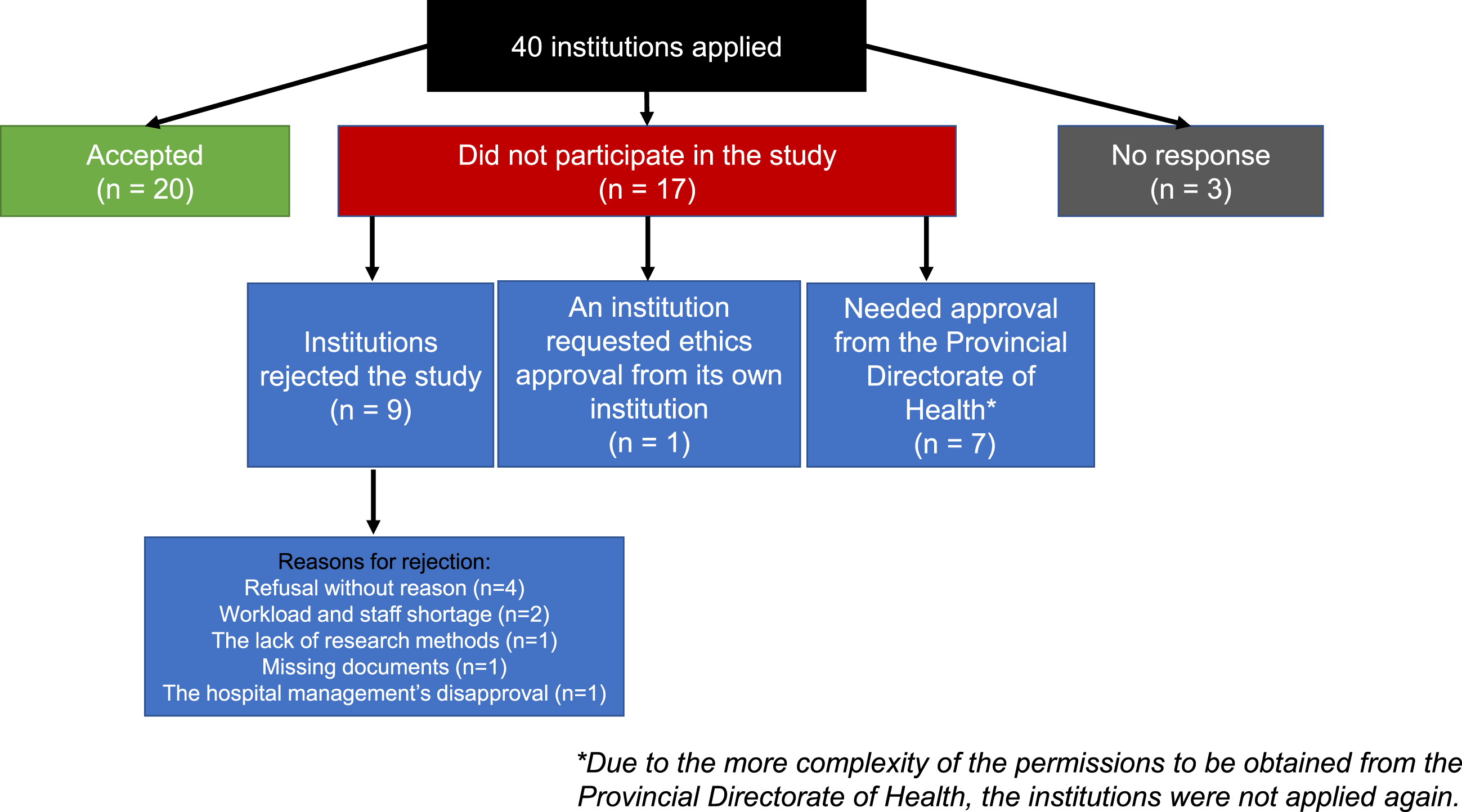
The process of institution permits.
The primary population of the study were nurse managers: 20 participants were nursing services managers, 38 participants were nursing services assistant managers, 24 participants were supervisory nurses, and 406 participants were nursing unit managers (N = 488). The number of hospitals sampled from seven regions in Turkey was determined by the proportionate stratified sampling method. This sampling method was used to obtain an equal distribution of hospitals, and for equal distribution, a quarter of the number of hospitals in each region was calculated. The sampling unit was initially based on the number of hospitals rather than the number of nurses. After the hospitals in each region were identified, the hospitals where the study was conducted were selected by simple random sampling. According to this method, Randomizer (web-based software) was used to randomly select hospitals to eliminate bias. This was done by assigning each hospital a number [30]. There are 79 university hospitals across Turkey’s seven regions, and the research data collection aimed to target 21 of these hospitals. In order to reach the planned number, 40 institutions were applied to in total because some institutions rejected the study. Since three institutions did not respond and 17 institutions did not participate, the research data were collected from 20 hospitals (Table 1). Of the 488 nurse managers working in the 20 institutions, 391 nurse managers agreed to participate in the study (response rate = 80.1%). Furthermore, of the 391 nurses, eight were nursing services managers, 15 were nursing services assistant managers, 10 were supervisory nurses, and 358 were nursing unit managers.
Sampling structure of the research data
Information survey for nurses: The researchers created this survey in accordance with the literature. It consists of sociodemographic and professional characteristics, including age, gender, working hours per week, nursing position, shift, and working conditions.
Individual Cultural Values Scale (CVSCALE): The CVSCALE, developed by Yoo et al. and based on Hofstede’s national cultural model, was used to determine the employees’ individual cultural values [31]. The CVSCALE includes a 26-item survey, and its dimensions were power distance (PD), uncertainty avoidance (UA), collectivism (CO), masculinity (MA), and long-term orientation (LT). The scale was a 7-point Likert-type, and each dimension was scored between 1 and 7. A higher score on the scale means that individuals have high power distance and uncertainty avoidance, have a collectivistic structure and long-term orientation, and adopt masculine values. The reliability and validity of the CVSCALE in Turkey was conducted by Bilgin and Kutlu. As a result of confirmatory factor analysis, Bilgin and Kutlu determined that the model has a good fit and confirmed the scale’s five dimensions. Regarding the scale’s reliability, they found that the Cronbach’s alpha reliability coefficient was 0.55 for power distance, 0.91 for uncertainty avoidance, 0.92 for collectivism, 0.76 for masculinity, and 0.82 for long-term orientation. In the literature, Cronbach’s alpha reliability coefficient value≥0.70 is considered acceptable [32]. In that research, the internal consistencies of subscales, excepting power distance are reliable. Power distance subscale may has been affected by the characteristics of the sample group, specifically the fact that 72.7% were subordinate and 93.4% were female employees. Consequently, that study found that the CVSCALE has acceptable levels of validity and reliability [2]. In the original research, the CVSCALE’s dimensions’ Cronbach’s alpha reliability coefficients for Americans were 0.90 (power distance), 0.88 (uncertainty avoidance), 0.85 (collectivism), 0.84 (masculinity), and 0.79 (long-term orientation) [31]. In this research, the Cronbach’s alpha reliability coefficient was 0.71 for power distance, 0.86 for uncertainty avoidance, 0.82 for collectivism, 0.80 for masculinity, and 0.82 for long-term orientation.
Person–Organization Fit Scale (POFS): The POFS, which was developed by Netemeyer et al. to evaluate the level of employees’ POF, includes a four-item survey. The POFS, a 5-point Likert-type scale, was adapted to the Turkish context by Turunç and Çelik [20, 33]. A higher score indicates that individuals have high POF. In the original study, the internal consistency of the POFS was 0.88. Turunç and Çelik found the internal consistency of the POFS to be 0.81 [20, 33]. In this study, the Cronbach’s alpha reliability coefficient was 0.88.
Person–Job Fit Scale (PJFS): The PJFS, which was developed by Brkich, Jeffs, and Carless to evaluate employees’ levels of PJF, was adapted to the Turkish context by Uçanok [34, 35]. The scale includes a nine-item survey. The scale is a 6-point Likert-type. There are four negative/unfavorable statements (1, 2, 4, 8) in the scale and these statements were reverse coded. An example of a negative/unfavorable statement is “This job is not really what I would like to be doing”, while an example of a positive/favorable statement is “All things considered, this job suits me.” A higher score of the scale indicates that individuals have high PJF. Uçanok found the internal consistency of the PJFS to be 0.92. In this research, the Cronbach’s alpha reliability coefficient was 0.84 [35].
Data collection method
This study’s data were collected by pollsters in Edirne, Kocaeli, Çanakkale, Balikesir, Aydin, Antalya, Diyarbakir, Şanliurfa, Erzurum, Elaziğ, Tokat, Samsun, Konya, and Sivas provinces. Four of the 14 pollsters were nurses, one was working as a staff member at the institution where the data were collected, and nine were nursing students. The reliability of the pollsters was ensured by the fact that most of them worked in healthcare, and the pollsters were paid. The researcher collected the data in Izmir, Manisa, Hatay, Adana, and Ankara provinces.
Data analyses
Statistical analysis was performed using the IBM SPSS Statistics version 23.0 (IBM Corp., Armonk, NY, USA) [36]. Descriptive statistics were computed to define demographic characteristics. The normality distribution of the scale was assessed using the Kolmogorov-Smirnov normality test (PD K-S: 0.076; p = 0.000; UA K-S: 0.206; p = 0.000; CO K-S: 0.151; p = 0.000; MA K-S: 0.105; p = 0.000; LT K-S: 0.182; p = 0.000; POFS K-S: 0.143; p = 0.000; PJFS K-S: 0.088; p = 0.000). Spearman’s correlation coefficient was performed to evaluate the relationship between numeric variables in the study. Correlation coefficients were evaluated as negligible < 0.10, weak between 0.10–0.39, moderate between 0.40–0.69, strong between 0.70–0.89, and showing very strong correlation between 0.90–1.00 [37].
Ethical approval
This study was performed in accordance with the principles of the Declaration of Helsinki. Ethical approval for the research was obtained by the Manisa Celal Bayar University Local Ethics Council (approval number 20.478.486). Permissions for the use of the scales in the study were obtained by email. An informed consent form was used to get nurses’ agreement to participate in the study. In addition, institutional permits were obtained from each institution separately.
Results
Study sample characteristics
The mean age of the nurse managers was 37.08 years (SD = 7.04). The majority of the nurse managers identified themselves as female (89%). Most of the nurse managers (19.4%) were working in the Marmara region and were married (77.2%). The majority of the participating nurse managers had a bachelor’s degree (66.8%), while 15.6% had an associate degree and 17.6% had a postgraduate degree in nursing.
Most of the participating nurse managers had over 15 years’ professional nursing experience (53.7%). The mean professional nursing experience was 15.73 years (SD = 7.32), and the mean number of years working at the current workplace was 13.51 (SD = 7.29). The majority (91.6%) worked as a nursing unit manager for 40 hours a week (72.1%), with most only doing day shifts (74.2%). Most of the nurse managers (61.4%) evaluated their working conditions as moderately good. The majority of the nurse managers (62.7%) had undergone an orientation program recommended for new graduate nurses transitioning to practice. The mean workplace satisfaction and job satisfaction of the nurse managers was 6.06 years (SD = 2.03), and 7.14 years (SD = 2.07), respectively.
Descriptive statistics
The mean of the nurse managers’ power distance scores was 3.03 (SD = 1.18), while the means of their uncertainty avoidance and collectivism scores were 5.98 (SD = 0.99) and 5.34 (SD = 1.04), respectively. Their mean masculinity score was 3.02 (SD = 1.53). The mean of the long-term orientation scores was 5.60 (SD = 0.92). The mean of the POFS was 3.33 (SD = 0.85), and the mean of the PJFS was 4.13 (SD = 0.86) (Table 2).
Distribution of the CVSCALE, POFS and PJFS scores of nurse managers (n = 391)
Distribution of the CVSCALE, POFS and PJFS scores of nurse managers (n = 391)
*IQR: Interquartile range.
Table 3 reports the Spearman’s correlations between CVSCALE, the POFS, and the PJFS. A positive and weak correlation between the power distance dimension and POF was found (r s : 0.130, p = 0.010). In addition, there was a positive and weak correlation between the long-term orientation dimension and POF (r s : 0.309, p = 0.000), and there was a negative and weak correlation between the masculinity dimension and PJF (r s : –0.115, p = 0.028) (Table 3).
Correlations between nurse managers’ individual cultural values and POFS and PJFS (n = 391)
Correlations between nurse managers’ individual cultural values and POFS and PJFS (n = 391)
*p<0.05, **p<0.01, rs: Spearman’s correlation coefficient.
This research aimed to examine the relationships between organization, job fit and cultural values of nurse managers. The research data were collected from 391 nurse managers working in 20 university hospitals in Turkey. All nurses in managerial positions in Turkey have legal powers and actively participate in decision-making processes as well as directing employees, contributing to their education, encouraging and maintaining teamwork, complying with professional standards, and following protocols and regulations [38]. For this reason, different types of nurse managers were included in the study. Then, using the CVSCALE, POFS, and PJFS, Spearman’s correlations were calculated for the five cultural dimensions of the POFS and PJFS. This research found a positive correlation between the power distance and long-term orientation dimensions and POF, and a negative correlation between the masculinity dimension and PJF. Despite the correlations between the two variables, the strength of the Spearman’s correlation coefficients was low. This may be due to the sample size or the sample characteristics.
According to Hofstede’s national cultural model, countries were rated from 0 to 100 points [39]. By this measure, Turkey has the following cultural characteristics: high power distance (66 points), low tolerance of uncertainty (85 points), a collectivist structure (37 points measured as individualism in Hofstede’s model), somewhat feminine attributes (45 points), and relatively long-term orientation (46 points) [2, 39]. The current study’s results for uncertainty avoidance, masculinity, and collectivism are consistent with Hofstede’s model; however, the results for power distance and long-term orientation contravened Hofstede’s model. The nurse managers’ low power distance score may be partially due to the sample group’s characteristics, specifically the fact that 91.6% of the sample were nursing unit managers (low-level nurse managers). Moreover, it can be said that although power, status, and title are important in Turkey and its institutions, nurse managers’ power distance is not affected by their current positions. The current socioeconomic situation in Turkey may have led nurse managers to a long-term orientation due to future concerns. The high level of nurse managers’ uncertainty avoidance may be due to the fact that nurses working in managerial positions have more and different duties, authorities, and responsibilities than clinical nurses, including adopting written rules to guide their staff nurses and complying with professional standards and regulations. Nurse managers’ responsibilities include managing nursing services, clinical nursing practices and patient care, employee empowerment, and facilitating teamwork [40]. In this context, nurse managers should be able to direct their staff nurses, meet the nurses’ needs, ensure trust and in-group harmony, while fulfilling these responsibilities. Collectivist cultural values—such as group membership, teamwork, and integrity of practices [6, 8]—are also important values in the nursing profession, and these values are necessary for nurse managers to fulfill their responsibilities. Therefore, it is natural for nurse managers to adopt collectivist cultural values. Feminine values—such as valuing human relations, helping others, cooperating, and focusing on quality of life [6, 8]—are also among the nursing profession’s values. So, nurse managers’ adoption of feminine values can be associated with the profession. Furthermore, feminine values may be partially attributable to the sample’s characteristics (89% female). As a result, nurse managers’ individual cultural values may have been influenced by national and institutional cultural values, nursing profession values, and their positions as managers. Generally, it can be said that the nursing profession values are more dominant in the nurse managers’ individual cultural values.
In this research, POFS is reported in terms of a 5-point scale where higher scores indicate a higher degree of congruence between the individual and the organization. Nurse managers in this sample were generally “neutral” in that their personal values were congruent with those espoused by the healthcare organization (M: 3.33, SD = 0.85). This result can be interpreted as that the organization and the individual do not fully share similar characteristics or the organization and the individual do not fully contribute to fulfilling the others’ needs. In the literature, there were studies investigating nurses’ organizational fit. Some of these studies have found similar results that nurses’ organizational fit was neutral [39–43]. However, Risman et al. stated that nurses’ POF scores were higher (M: 3.10, SD = 0.43; rated from 1 to 4 points) [44]. Kesen and Peng et al. found lower results than this study regarding nurses’ organizational fit (respectively, M: 2.49 and M: 3.35, rated from 1 to 6 points) [45, 46]. Nurse managers should fulfill their planning and decision-making roles while developing professional practices, regulations and policies. However, the directorate of nursing services in Turkey are hierarchically connected to the chief physician or office of the general director [38]. Therefore, nurse managers’ POF may be affected by hierarchy.
In this research, PJFS is reported in terms of a 6-point scale where higher scores indicate a higher degree of congruence between the individual and the job. Nurse managers in this sample generally “slightly agree[d]” that their abilities were congruent with the demands of the job (M: 4.13, SD = 0.86). Nursing, which is known to be a highly demanding job, is one of the most stressful professions [47]. Job demand is one of the key factors in the nursing work environment that negatively affects the nurses’ ability to function [48]. However, there are studies showing that nurses’ personal characteristics buffer the perception of excessive job demand [47, 49]. Bani-Hani and Hamdan-Mansour claimed that personal characteristics are among the factors that nurse managers need to consider in order to maintain job performance and the quality of nursing care [47]. In this context, it can be said that the participating nurse managers are partially compatible with the nursing profession. There are studies about nurses’ job fit in the literature. Two studies reported similar results to the current study [46, 50]. Laschinger and Read, and Kwon and Kang found that nurses’ PJF scores were slightly above average [41, 51]. However, another study reported that nurses’ PJF was moderate [42].
In this study, nurse managers’ cultural values were evaluated using the CVSCALE, which measures Hofstede’s five cultural dimensions at the individual level [31]. While Hofstede’s five dimensions of culture are applied to the country level, individuals’ cultural orientation should be measured at the individual level [31, 52] because there are variations between individuals within the same country [53]. Furthermore, individuals from the same nation may differ in cultural orientation [52]. In this research, there was a positive correlation between the power distance and long-term orientation dimensions and POF. As nurse managers’ power distance and long-term orientation scores increase, POF scores also increase. According to these results, it can be said that nurse managers who have high power distance and long-term orientation have higher POF. National culture regulates institutions’ organizational culture; therefore, national culture significantly influences organizational culture [54]. Moreover, some researchers have reported that national culture affects organizational culture [54–58]. In this context, since high power distance dominates institutions in Turkey, the higher POF of nurse managers who have high power distance scores at the individual level may be due to their perception of similarity with the cultural values of the institution. Nurse managers adopting long-term orientation values—which include concepts such as focusing on the future and investing—means they are less likely to leave their current institutions than nurses with short-term orientation. Nurses are likely to continue working in their current institutions because of their anxiety about the future; thus, they perceive themselves as more compatible with the organization. Due to the fact that national culture affects organizational culture, the (working) environments in which individuals are located is shaped by the national context. With this in mind, based on the results of this study, it can be said that the nurse managers’ organizational fit may be affected in countries/regions with high power distance and long-term orientation.
In this research, there was a negative correlation between the masculinity dimension and PJF. This finding indicates that nurse managers adopting feminine values have higher job fit. The nursing profession’s core values include altruism, aesthetics, equality, freedom, human dignity, justice and truth, and realism [2, 59–61]. Beyond these values, the American Nurses Association and the International Council of Nurses have stated that the underlying value is “usefulness,” emphasizing that the patient’s well-being is the highest priority [40, 60]. In line with this information, the nursing profession’ values are similar in many respects to the feminine values, which include equality, solidarity, focus on quality of life, providing care and protection to other individuals. Moreover, the fundamental activity of the nursing profession is caring [62]. Caring is culturally a feminine value. In this context, higher PJF for nurses who adopt feminine values may stem from the similarity between feminine values and the values of the nursing profession. Furthermore, this striking result indicates that in countries/regions with feminine cultural values, nurse managers’ job fit may be affected due to the fact that the nursing profession also has feminine values.
This research has several limitations. First, nine institutions declined to participate in the study, and a further eight institutions requested additional permissions, re-application could not be made due to the distance of the institutions and the difficulty of reaching the relevant people in our country. Second, this study was carried out at 20 university hospitals in Turkey, and its results cannot be generalized to other hospital. The results obtained are limited to the respondents’ answers. Third, due to the scarcity of studies on nurse managers, the scales used in this study are a limiting factor when discussing the research.
Conclusion
It was found that nurse managers evaluated power distance and long-term orientation in opposition to the scores in Hofstede’s model, while their uncertainty avoidance, masculinity and collectivism scores were consistent with Hofstede’s model. Nurse managers were generally “neutral” regarding POF, and “slightly agree[d]” regarding PJF. It was concluded that the individual cultural values of the nurse managers are related to the organization and job fit. It may be worth considering individuals’ cultural values and organizational values in recruitment and selection processes. Furthermore, further studies are recommended to examine the effects of individual cultural values of both nurse managers and nurses on organization and job outcomes to reveal concrete data on this subject.
Ethical approval
Ethical approval for the research was obtained by the Manisa Celal Bayar University Local Ethics Council (approval number 20.478.486).
Informed consent
All nurses signed an informed consent form prior to enrollment in the study.
Conflict of interest
None to report.
Footnotes
Acknowledgments
Not applicable.
Funding
Not applicable.