



Abstract
BACKGROUND:
Mountain hiking is an unpredictable activity for firefighters during the search, rescue, and firefighting. Could the quality of the uniform worn by firefighters affect psychophysiological variables?
OBJECTIVE:
The objective of this study was to monitor the responses of perceived exertion (RPE), musculoskeletal pain (MP), and heart rate variability (HRV) responses in firefighters using different uniforms on a 5 km mountain walking activity. The feeling of comfort, safety, and ergonomic adjustment of the two types of uniforms also was verified.
METHODS:
Sixteen firefighters were divided into two groups: 4thRUPM”B2” (33% polyester and 67% cotton) vs. GOLD (50% polyamide and 50% cotton). The GOLD group wore a prototype that had not yet been operationally tested.
RESULTS:
The independent t-test showed that the groups had similar results in RPE at post-march (Omni-Walk/Run = 3.5±0.9 vs. 2.9±0.6 AU). ANOVA Two-way (2x group and 2x time) was used to verify differences in body mass (BM), MP, and HRV. There was a main effect of time (pre- vs. post-march; p < 0.05) for BM, MP, heart rate (HR), mean RR, RMSSD, pNN50, and HF, regardless of group (4thRUPM”B2” vs. GOLD). Rainwater increased post-march BM (92.2±9.8 kg vs. 93.5±9.9 kg). MP (28.9±2.9 vs. 33.2±7.7 AU), HR (71.6±14.2 vs. 99.0±26.3 bpm), RMSSD (74.8±53.7 vs. 126.5±74.4 ms) and HF (48.5±20.2 vs. 60.0±16.7 nu) also increased post-march. The mean RR (875.2±153.3 vs. 673.9±155.3 ms) and pNN50 (33.1±18.6 vs. 46.3±23.9%) reduced post-march. There was a subjective preference for GOLD.
CONCLUSION:
Different uniforms do not compromise psychophysiological variables during the mountain hike but differentiate ergonomic subjectivity.
Introduction
The operational activities carried out by firefighters are among those that cause the greatest risk of injuries and musculoskeletal pain/discomfort (MP). In the United States, military firefighters report about 40,000 work accidents per year caused by abrasion, slips, tripping, falls, and excessive effort [1–3]. Injuries and pain in firefighters may jeopardize the success of an operation, increase the risk of death of the firefighter and the victim, as well as compromising the readiness of the fire department because of restrictions on work, absenteeism, and medical costs and treatment [4, 5]. Studies agree that the occurrence of injuries and MP may be associated with the type of activity, the personal protective equipment used, and the firefighter’s physical fitness [2, 6].
As an activity example, hiking in forests, mountains, and woods can be cited as a routine operation of firefighters for search, rescue, and firefighting [7]. This type of activity is sometimes unpredictable because of environmental aspects (rain, cold, heat, presence of insects, slippery ground, the level of slope, hidden cracks) and operational (distance traveled, the victim’s location, working hours, fire intensity). In turn, firefighting equipment, uniforms, and personal protective equipment increase the weight to be carried during the task, resulting in postural changes [2], increasing the rate of perceived exertion (RPE), onset of fatigue, early exhaustion, musculoskeletal discomfort, and predisposition to the occurrence of injuries in firefighters.
Brazil is a continental country with different biomes (Amazon, Pantanal, Atlantic Forest) that present various geological and climate conditions [8]. Specifically in southern Brazil, firefighters from Paraná use the traditional uniform (4thRUPM“B2”), which involves pants, boots, balaclava, gloves, and helmet for operational activities of search and rescue in the mountains [9]. Recently, the Fire Department of Paraná has adopted a new uniform, called GOLD, which has not been tested in operational activity.
An interesting way to verify the effectiveness of this new uniform is through the monitoring of physiological (autonomic) responses, the firefighter’s RPE, and MP in simulated situations [10]. Use of a lower quality uniform in a hostile environment can compromise thermal balance, hormone release, heart rate (HR), blood pressure, respiratory rate and depth, and blood flow redistribution [10, 11]. Previous studies have revealed that an increase in the RPE is directly associated to the accumulation of metabolites (i.e., lactate, cortisol) and greater activation of the central command indicating the onset of fatigue and early exhaustion [12–14]. In turn, changes in the intensity of MP and discomfort in different parts of the body can incapacitate firefighters from carrying out their operational activities [15]. Several psychophysiological changes are associated with the sympathovagal balance [16–18]. One of the main inferences of this sympathovagal balance is measured by the heart variability rate (HVR) in the domains of time and frequency [19].
In addition to having a uniform that meets the minimum safety standards, the firefighter’s subjective assessment of the feeling of comfort, safety, and adjustments to their body dimensions is an essential variable to attest to the quality of personal protective equipment [10].
According to the information, the objective of this study was to monitor the responses of RPE, MP, and HRV responses in firefighters using different uniforms on a 5 km mountain walking activity. As a secondary objective, the feeling of comfort, safety, and ergonomic adjustment of the two types of uniforms was verified. We hypothesized that the use of the prototype would generate fewer psychophysiological changes and would provide greater comfort.
Materials and methods
Participants
Sixteen male firefighters were recruited from the local fire department (Table 1). Selection criteria included: a) currently serving in the Group of Tactical Relief Operations of the Firefighters of Paraná State from Brazil, and b) able to engage in physical activity. Exclusion criteria: a) using a continuous treatment of medications that could interfere with the sensation of musculoskeletal pain; b) not completing the mountain hike for any reason.
Characteristics of participating firefighters
Characteristics of participating firefighters
The study was approved by the Ethics Committee of the Federal Technological University of Paraná (opinion no. 4,136,606) and the immediate commander of the firefighters. All participants signed the free and informed consent form.
The models and technical specifications of the 4thRUPM“B2” and the GOLD uniforms can be seen in Fig. 1. The GOLD uniform is 600 grams lighter than the 4thRUPM“B2”. In addition, 4thRUPM“B2” is composed of 33% polyester and 67% cotton, while GOLD is composed of 50% polyamide and50% cotton.

Technical specification of 4thRUPM“B2” and GOLD uniforms.
To assess the quality of the new prototype, five questions were asked to firefighters who had already used the 4thRUPM“B2” and GOLD uniforms. The questions were: 1) Which uniform do you prefer to wear during operational activities? 2) Which uniform offers greater comfort during operational activities? 3) Which uniform offers greater personal security? 4) Which uniform fits best with the dimensions of your body? Which uniform allows for greater mobility? There were three answer options: A) 4thRUPM“B2”; B) GOLD; orC) Indifferent.
Anthropometric measurements were taken with the firefighters barefoot wearing only shorts and a T-shirt. Height was measured using a portable stadiometer (Sanny, São Paulo, Brazil), while body mass (BM) was recorded by an electronic digital scale (Garmin Scale, São Paulo, Brazil). Body mass index (BMI) was calculated as weight(kg)/height(m2). Body mass also was measured in a uniformed and equipped condition, shortly before starting the hike and immediately after completing the task.
Pain measurement scale
The participants completed a modified Corlett’s Diagram before the start and post-hike [20]. The diagram was a representation of the posterior part of the human body divided into 27 parts and with a pain index on a scale ranging from 1 (no MP) to 5 (extreme MP).
To quantify subjective MP responses, the sum of responses for each of the 27 body segments was calculated. Thus, the scale was created, ranging from 27, if all responses were 1, to 135, if all responses were 5. Answers were recorded and compared before and after the task.
Heart rate variability
The HRV was recorded during the task using a Polar coded belt model T31. The belt transmits the pulses to a wireless charging stations (WCS) wrist receiver 16 [21]. For capture, the receiver was calibrated to detect radiofrequency pulses in the range of 5KHz (+/–100 Hz). Each receiver contained a universal serial bus (USB) cable that transmits the data to a computer containing WCS Pulse software and archives the R-R intervals in milliseconds. All the recommendations of the European Society of Cardiology and North American Society of Pacing and Electrophysiology were followed [19].
HRV Kubios Software was used to determine the temporal and spectral variables of HR. For the time domain, the mean normal interval (mean RR) was calculated as the square root of the square mean of the differences between the adjacent normal RR intervals (RMSSD) and the percentage of adjacent RR intervals with a duration difference greater than 50 ms (pNN50). RMSSD is the root mean square of the successive difference between normal heartbeats. NN50 is the number of pairs of successive NN (R-R) intervals that differ by more than 50 ms, and PNN50 is the proportion of NN50 divided by the total number of NN (R-R) intervals. In turn, the spectral variables analyzed were LF (low frequency = 0.04–0.15 Hz) which is associated with the sympathetic system; HF (high frequency = 0.15–0.40 Hz), which is associated with the parasympathetic system; and the LF/HF ratio (sympathovagal balance).
Rating of perceived exertion
The Omni-Walk/Run scale was used to measure RPE with zero (0) meaning “extremely easy” and ten (10) “extremely difficult” [13]. All firefighters completed the scale shortly after finishing the task.
Physical performance test
Physical performance was quantified through the values registered with the Fire Department of Paraná. Physical tests consist in used the scores: i) an agility test (shuttle test), ii) a strength test (pull up), and iii) an aerobic test (12 minutes of walking and running) as described in Grani et al. [22].
Experimental procedures
Still in the Fire Department, all firefighters had their anthropometric measurements taken with shorts and a T-shirt. At the foot of the mountain, firefighters were randomly divided into two groups of eight (08). One group used the current uniform (4thRUPM“B2”) and the second group used the prototype of the new uniform (GOLD). As soon as the firefighters had put on their uniforms and equipment, they were weighed, answered the pain/discomfort scale, and RPE. They also had their HRV measured over five minutes. Immediately, on returning from the trek, the firefighters answered the RPE and were submitted to the same pre-hike test procedures. The firefighters started the hike in subgroups of four volunteers, two firefighters with the 4thRUPM“B2” and the other two with the GOLD. Each subgroup began its walk at fifteen-minute intervals. These enabled better logistics for the post-hike evaluation.
Volunteers performed a mountain hike to simulate a search and rescue situation. All the planning and conduct of this activity was carried out by the firefighters themselves, without any distinction of activities between the groups.
These activities performed during the march were part of the firefighter’s technical-tactical training routine and had no interference from the researchers. The Middle Capivari Mountain was chosen for the hike. The trail was 2300 meters long to the summit, totaling 4600 m of mountain walking. According to the route references described in the Brazilian Association of Technical Standards, NBR15505-2/2019, the chosen trail is considered to have maximum difficulty: severity of the environment, route orientation; terrain conditions, and intensity of physical effort [23]. In addition, it is noteworthy that during the hike, there was torrential rain for 40 min.
Analysis statistics
Data normality and homogeneity were examined using the Shapiro Wilk test. In case of normality, the independent t-test was used to compare the variables characterizing the volunteers (stature, age, working time in the Fire Department, and results of the physical fitness test) and the RPE at the end of the hike (4thRUPM“B2” vs GOLD). The two-way Anova was used to compare BM; MP level and temporal and spectral variables of HRV, taking into account the group factor (4thRUPM“B2” vs GOLD) and time factor (Pre-Hike vs Post-Hike). Bonferroni post hoc was used to identify differences between means. The level of statistical significance considered in all analyses was 5% (p≤0.05). The effect size for the main results was calculated for pain/discomfort suffered in different body parts and temporal and spectral variables of HRV measurements. Effect size was calculated as: Post mean – Pre mean/SD pooled, where pooled =√ [(SDpost2 + SDpre2)/2] (Cohen, 1988). Effect sizes were classified as small (0.0–1.2), moderate (1.2–1.9) or large (>2.0).
Results
The hike had a duration of 2h12 min±0h06 min under an environmental condition of 13°C, 35 mm of precipitation, winds of 10 km/h.
The characteristics of the volunteers are shown in Table 1. G-power predicted 38 firefighters to contemplate sample power. However, our sample had 16 firefighters who represented 35.6% of the total staff of the Operations Group of Tactical Relief of the Firefighters of the State of Paraná. There was no statistical difference between the groups for the variables of age, BM, BMI, length of service, and physical fitness tests.
The firefighters’ answers about the uniforms were 87.5% in favor do GOLD and 12.5% for 4thRUPM“B2” respectively for questions 1, 2, 3, and 5 (Which uniform do you prefer to wear during operational activities? Which uniform offers greater comfort during operational activities? Which uniform offers greater individual security? Which uniform allows for greater mobility? For question 4 (Which uniform fits best with the dimensions of your body?), 75.5% of firefighters were in favor of GOLD, 12.5% in favor of 4thRUPM”B2” and 12.5% indifferent.
The 4thRUPM“B2” uniform increased the firefighter’s BM by 10.5%, while the GOLD increased by 9.4% (+8.5±1.6 kg vs +7.9±2.0 kg, p > 0.05). Two-way Anova demonstrated the main effect for the time factor on weight changes independent of the group factor (p < 0.001). Figure 2 shows that the BM wearing the uniform in the PRE task condition was lower than the POST. The combined values were 92.2±9.8 kg < 93.5±9.9 kg, respectively.
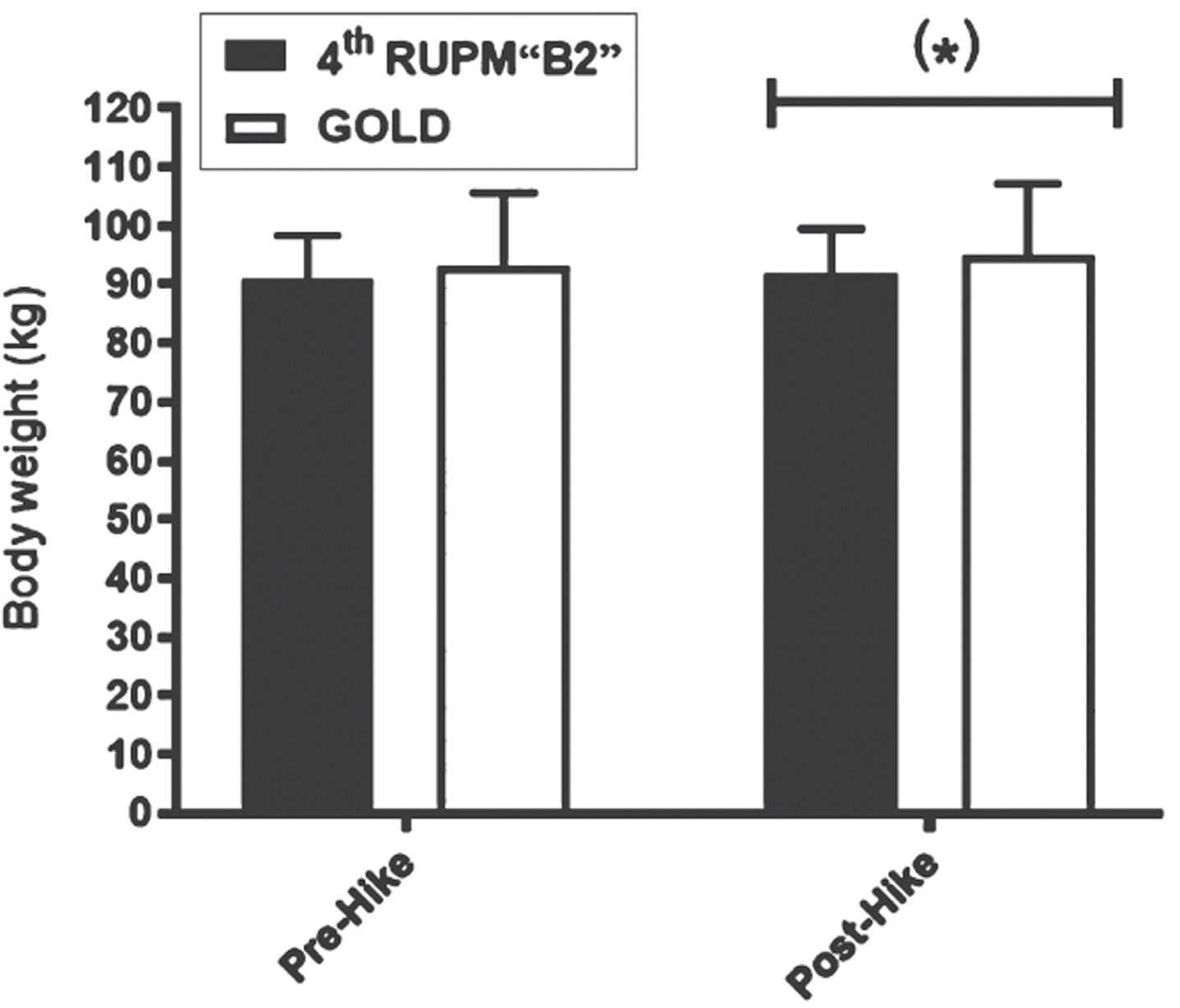
Mean and standard deviation of body weight of firefighters in pre- and post-hike uniforms. * different pre-hike p < 0.05; () main effect Anova.
The responses of subjective perception of effort revealed that the pace was considered between easy and moderate, 4thRUPM“B2” = 3.5±0.9UA vs GOLD = 2.9±0.6UA. The GOLD group had an 18% lower subjective perception of exertion, but the T-test did not reveal any statistical difference between the groups (T = 1.570; p = 0.187).
Figure 3 and Table 2 show the results of general pain/discomfort in different parts of the body, respectively. Two-way Anova showed the main effect for the time factor independent of the group factor (p < 0.05) for general pain; lower back, hip, left knee, right knee, right leg, left ankle, right ankle, and left foot. There were no significant changes in other parts of the body. The effect size was small (0.00–1.2) for pain/discomfort in all parts of the body.
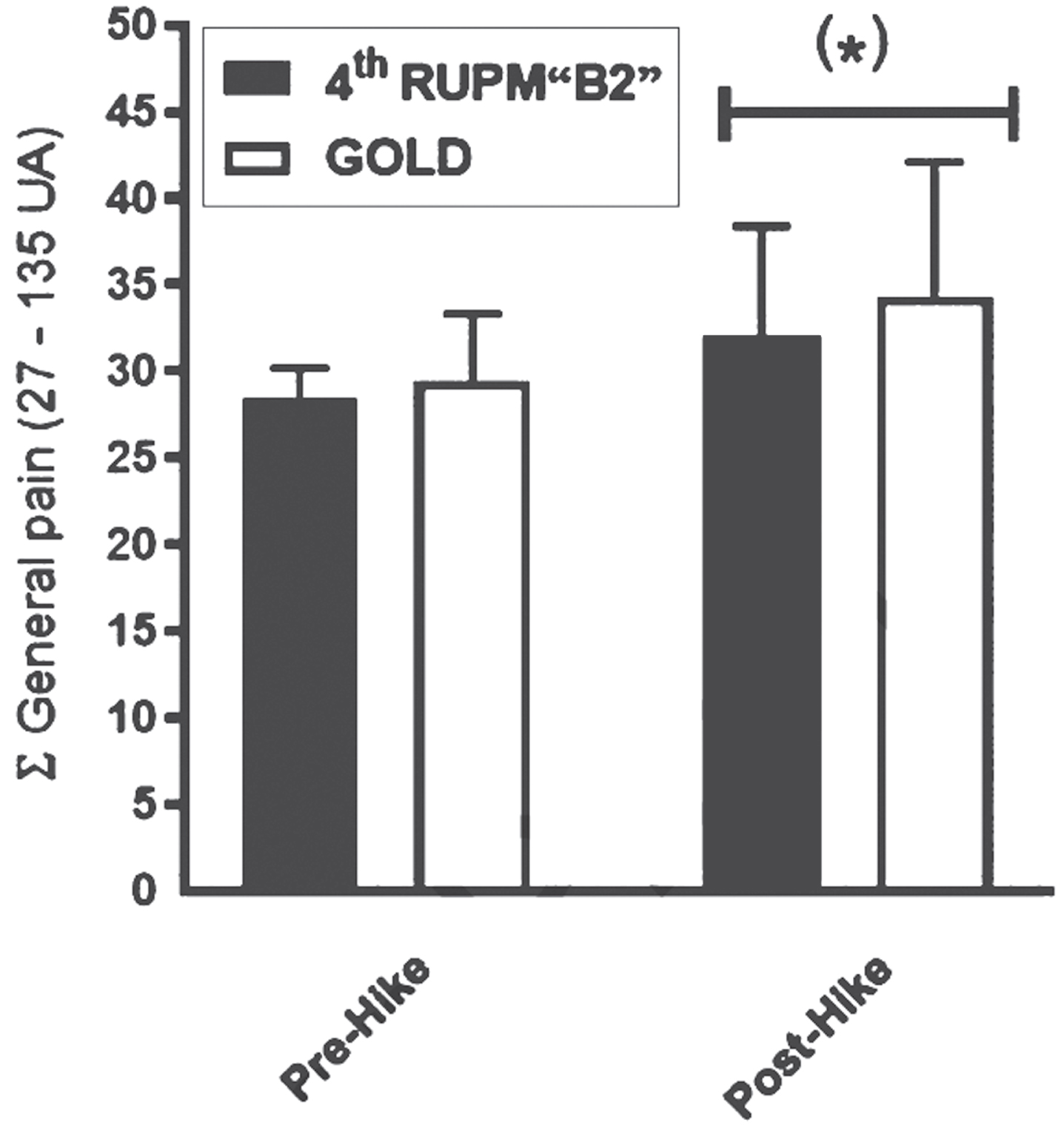
General pain/discomfort suffered by firefighters after 2 hours of mountain walking. * different pre-hike p < 0.05; () main effect Anova.
Pain/discomfort suffered in different body parts of fire department volunteers after 2 hours of mountain walking
* different pre-hike p < 0.05; () main effect Anova; — = SD pooled is equal to zero.
Regarding cardiac variables, Table 3 shows that there was a main effect for the time, independent of the group for HR, mean RR, RMSSD, pNN50, and HF (nu). The other variables had no significant changes. Thus, HR, RMSSD and HF (n.u) increased post-hike, the combined values pre-hike vs. post- hike were respectively: 71.6±14.2 vs 99.0±26.3bpm; 74.8±53.7 vs 126.5±74.4 ms and 48.5±20.2 vs 60.0±16.7nu. In turn, the mean RR and pNN50 reduced post-hike, the combined values pre-hike vs. post-hike were respectively: 875.2±153.3 vs 673.9±155.3 ms and 33.1±18.6 vs 46.3±23.9%.
Heart rate variability of elite firefighters pre- and post-mountain hike
* different pre-hike p < 0.05; () main effect Anova.
In the present study, the responses of subjective perception of exertion, level of musculoskeletal pain/discomfort, and the HRV of firefighters who wore different uniforms on a 5 km mountain hike were measured. Firefighters reported increases in pain/discomfort scales and altered cardiovascular responses regardless of the uniform used. Our initial hypothesis was partially confirmed: the firefighters who wore the new uniform suffered psychophysiological changes similar to those who wore the traditional uniform. However, the new uniform was considered more comfortable, in the users’ perception.
New firefighters’ personal protective equipment needs to be tested to be certified by institutions such as the National Fire Protection Association (NFPA) in the US and the Ministry of Labor and Employment in Brazil. This is an essential practical application, as it measures the psychophysiological changes of tactical personnel. In general, the tests verify the comfort, durability, and resistance specifications provided by the manufacturers or importers of the personal protective equipment, as registered in Fig. 1. According to the specifications, GOLD has greater tear resistance, is lighter, as a polyamide absorbs sweat well, has good elasticity, and is suitable for use in hot, dry weather. However, a subjective evaluation and an operational test as performed in this study can also help the Fire Department’s decision to use or not the new equipment. On the subjective evaluation, more than 75% of firefighters perceived the new uniform as more operational, comfortable, safe, adjustable to the body, and with greater mobility. The firefighters’ opinions about their uniforms must be considered to improve the ergonomic design of their personal protective equipment [24]. Firefighters in other studies have reported problems related to the use of certain uniforms such as reduced neck mobility [25], increased shoulder and back pain, lack of uniform fit for tall firefighters [10] and for women firefighters [24]. For example, female firefighters have already reported greater difficulty in finding uniforms with an appropriate ergonomic design, demanding of them additional physical effort and stress to fulfill an operational task [24].
The GOLD uniform is 600 grams lighter when compared to the 4thRUPM“B2”. The use of heavy clothing causes restriction of body movement, causes injuries, impairs balance, increases the risk of falls [2, 26], reduces physical performance [27], and accelerates the onset of fatigue [28]. It can also compromise the expansion of the rib cage, hindering the volume and respiratory rate, in addition to reducing the maximum oxygen consumption [28]. One study even pointed out a loss of 1% in general physical performance for each additional 1 kg of load in tactical occupations [29]. For the mountain walking activity, the firefighters in this research had an average overload of 8 kg added to their BM. This value is lower than firefighters who wear thermal protective clothing [11]. Thermal protective uniforms include pants, jacket, safety boots, gloves, a fire-resistant hood, and a self-contained breathing apparatus, which increases the load by 18 to 24 kg. For mountain search activities, firefighters need to carry lighter loads since agility, jumps, climbing, and long-distance travel are different demands than those from fire fighting in buildings.
The firefighters in this research did not perform a strenuous activity, but at the end of the mountain march, the GOLD group presented a subjective perception of effort 18% lower than the 4thRUPM“B2” group. The reason for this trend may be associated with the weight of the uniform since the two groups do not differ in terms of physical fitness, age, working time in the Fire Department and all completed the march in a similar time span. Despite the chosen trail in Morro do Capivari being considered of maximum difficulty [23], firefighters had an RPE between easy to moderate effort. The firefighters participating in this study are part of an elite troop of the Brazilian Fire Department and are physically well-conditioned (Table 1). For example, compared with an elite military police force [30], the pull-ups and 12-minute test scores are 22% and 3.7% above the average in our sample. This level of physical fitness may explain the low RPE result.
The results of the present study showed significant increases in pain and musculoskeletal discomfort, regardless of the type of uniform used. Table 2 shows that the increase in pain and discomfort was concentrated in the lumbar region and lower limbs, which is expected because hiking demands more from this body region [31]. Studies have shown that the uniform can cause movement limitations in operational situations, generating pain and/or discomfort for a firefighter [32]. Therefore, compared to the traditional uniform, the new uniform did not make any worse the increase in pain and discomfort that appears after a mountain walking activity.
It was expected that due to sweating, energy expenditure and other variables inherent to the hiking activity, the total weight of the volunteer would decrease in the post-hike [33]. However, sudden climatic and environmental changes, such as a temporary rain, temperature variation, and altimetry of the route are unpredictable in a mountain walking activity. Thus, heavy rain (30 mm) while walking was an intervening factor in our data collection. BM in post-hike was significantly higher than in pre-hike, regardless of the type of uniform. 4thRUPM“B2” is composed of 33% polyester and 67% cotton, while GOLD is composed of 50% polyamide and 50% cotton. Therefore, despite the different compositions of the fabrics, the result suggests that the two uniforms have a similar capacity for water permeability. In hot and dry environments, both polyester and polyamide absorb body sweat well, which helps in thermal balance [34]. Firefighters also save lives in cold and humid environments, and prolonged exposure to cold water with the body could also compromise vital functions [35]. In fact, in this study, firefighters shivered during the post-hikeevaluation.
The pre-hike and post-hike values of HR and HRV are consistent with active and healthy individuals [36]. The pre-hike values of 63 ms (4thRUPM“B2”) and 86 ms (GOLD) for the RMSSD are indicative of a good fitness level. RMSSD measurements are sensitive to improvement in vagal flow, especially in the supine position. A recent study revealed that risk behavior is associated with low vagal flow, while resilience is associated with high vagal flow [18]. As expected, there were significant post-hike cardiovascular changes such as increased HR and reduced median RR. However, the PNN50 increase and the LF/HF ratio did not indicate a predominance of sympathetic activity, as the LF/HF was below 1.0. this indicates that the march activity undertaken served as an activator of the relaxation mechanisms, despite the body tremors caused by rainwater in contact with the firefighters’ skin. Monitoring cardiovascular variables in simulated exercises with new personal protective equipment is essential. There are reports that 45% of the deaths of tactical personnel on duty are caused by cardiovascular problems [37]. Therefore, the new uniform did not make a difference in cardiovascular changes in a mountain walkingactivity.
Limitations
Like any study, the findings have limitations that serve as a starting point for future research. First, the activity proposed for the study was not strenuous, a fact that could be different from group to group with respect to the psychophysiological variables we measured. However, the activity proposed in our research is realistic for operational conditions of search and rescue of missing victims in mountains. Second, heavy rain during the march was an intervening variable that increased the weight carried by firefighters. It is noteworthy that rainwater may have been accumulated in other equipment, such as boots, backpack, and hood. Therefore, further investigations need to test the permeability of the uniforms and other equipment used. Third, the study was conducted by between-subject design and it would be ideal for firefighters to perform another day of hiking on the mountain with their uniforms changed. However, it would be unlikely that on the second day there were rain and temperature changes similar to what was found on the first day. Fourth, the sample consisted only of male firefighters. It is important that future studies test uniforms for female firefighters performing different simulated operating activities. Fifth, the manuscript evaluated two specific sets of gear (33% polyester and 67% cotton versus 50% polyamide and 50% cotton), which limits generalisability. Therefore, the results must be viewed carefully.
Conclusion
Mountain hiking is an operational activity performed in search, rescue, and firefighting. Therefore, the proposed activity was tactically adapted to compare the RPE, level of MP, and HRV in firefighters with different uniforms. It is concluded that different uniforms do not compromise psychophysiological variables during the mountain hike, but differentiate ergonomic subjectivity.
Ethical approval
The Ethics Committee of the Federal Technological University of Paraná approved the study (opinion no. 4,136,606).
Informed consent
All participants signed the free and informed consent form.
Conflict of interest
None to report.
Footnotes
Acknowledgments
The authors thank the Paraná Fire Department for their authorization to carry out the study.
Funding
The work was supported by the Fundo Paraná/SETI and the Programa Universidade Sem Fronteiras (USF).