



Abstract
BACKGROUND:
Street sweepers are reported to suffer from high rates of work-related musculoskeletal discomfort worldwide, especially in their wrists.
OBJECTIVE:
The study aimed to 1) determine the prevalence of musculoskeletal disorders and 2) specifically determine the prevalence of wrist flexor tendonitis and its associated risk factors among street sweepers.
METHODS:
Three hundred and eighty-five sweepers employed by the Faisalabad Waste Management Company (FWMC) participated in this cross-sectional study. A self-structured questionnaire was used to collect data: the first section provided demographic information, the second assessed musculoskeletal disorders, and the third section assessed the wrist flexor tendonitis among street sweepers.
RESULTS:
The mean age of the sweepers was 38.34 years. Out of 385 street sweepers, the prevalence of musculoskeletal discomfort was reported in 265 (68.83%). The prevalence of musculoskeletal discomfort in sweepers reported during COVID-19 according to the past 12 months, the highest three prevalence rates were 46.5% in the wrists/hands, 37.9% in the shoulders and 35.1% in the lower back. The three highest prevalence rates of musculoskeletal discomfort in sweepers according to the last 7 days were 29.6% in the wrists/hands, 24.4% in the lower back and 24.2% in the shoulders. Out of total 385 participants, prevalence of wrist flexor tendonitis was reported in 103 (26.8%) sweepers. Significant association was found (p < 0.05) between wrist flexor tendonitis and gender (p < 0.003), age (p < 0.05), working experience (p < 0.003), street sweeping distance (p < 0.01), number of brooms used per month (p < 0.002) and getting tired at the end of work (p < 0.001).
CONCLUSION:
The prevalence of musculoskeletal discomfort and wrist flexor tendonitis seen during COVID-19 is high among sweepers, with wrist/hand being the most commonly reported region for pain. This study emphasizes the importance of providing guidelines about effective precautionary healthcare measures for street sweepers.
Introduction
Musculoskeletal discomfort refers to pain, soreness, or injury in the muscles, bones, and joints. It can result from repetitive motions, heavy physical work, poor posture, and other factors [1]. Common types of musculoskeletal discomfort include back pain, neck pain, shoulder pain, and knee pain [2]. Sweepers are a main part of Pakistani society and they maintain the hygiene of the society by keeping streets, roads, and other places clean. Street sweepers can experience musculoskeletal discomfort due to repetitive motions and heavy physical work. This can result in conditions such as back pain, shoulder pain, and knee pain. Street sweepers are at risk of Cumulative Trauma Disorder (CTD) directly or indirectly, i.e., wrist tendonitis, which occurs when they exert a lot of force with a broom while cleaning the streets. Additionally, the wrist was the most commonly affected area for musculoskeletal discomfort among sweepers compared to other areas of the body [3]. Sweeping is an arduous job that requires sweepers to clean certain areas assigned to them on a daily basis, including street streets, buildings, market areas, gardens, government offices, and institutions [4]. A broom of particular weight and length is usually used by all of them to sweep. Sweepers are not only required to sweep, but also to place the waste in certain sacks with the assistance of dustpans so that it can later be dumped at a specified location. Performing this work causes MSDs, particularly wrist tendonitis, since the wrist is heavily involved in sweeping. The majority of sweepers in developing countries do their jobs manually, using a broom for cleaning purposes. Sweepers clean many types of areas, including local streets, markets, main roads, footpaths, community towns, colonies, parking lots, buildings, parks, government offices, and institutes. Among the manual labor involved in the sweeping profession is the use of different-sized brooms, dustpans, and pushcarts to collect waste, then dispose of the collected waste at designated dumping sites [5]. Unlike in developed countries, where machines are used to sweep and clean, street sweepers in Pakistan use a broom for this purpose [5] because they lack the resources and technology to sweep properly [6].
Cumulative Trauma Disorder (CTD), also known as overuse syndrome, is a term used to define many different types of injuries, such as musculoskeletal problems that can occur if a person uses certain parts of their body repeatedly (e.g. in performing a repetitive task), while doing exertional activities or if they hold themselves in a certain position for a long period of time [7]. It accounts for 56% of all occupational injuries [8]. In the past few years, the ratio of disorders that are related to repeated trauma is increasing and most of the occupational illness and injuries occur due to repeated trauma disorders [9]. The most common cumulative trauma disorders are work-related musculoskeletal disorders (WRMSDs) like wrist tendonitis, epicondylitis and hand-arm vibration syndrome. Cumulative trauma disorders of the upper extremity can also impact an individual’s ADL performance for activities such as dressing and grooming [10].
A common CTD is wrist tendonitis, a swollen, painful condition of the wrist causing pain, swelling, and warmth [11]. Tendonitis of the wrist occurs in two forms: wrist flexor tendonitis and extension wrist tendonitis [12]. Performing repetitive physical tasks like sweeping with a broom, mopping, chopping wood, and hammering may lead to this problem. Rock climbing, golf, tennis, and other sports that require wrist use are examples of games [13]. Repetitiveness and forceful exertions are the two major occupational risk factors for wrist CTDs as they compromise the integrity and functioning of the soft tissues causing inflammation in the tendons [14]. The inflammation of the tendons due to tendonitis triggers chemical changes that are sensed by nerves and relayed to the brain as pain signals [15].
Since sweeping is a strenuous that requires use of all body parts. Musculoskeletal disorder is basically any sort of irritation, pain or discomfort that occurs in any region of your body [16]. The main causes related to musculoskeletal discomfort among sweepers include prolonged durations of sweeping, frequent use of upper limb while sweeping, removing garbage in an awkward bending position and long street sweeping distance in daily work routine. This discomfort in their musculoskeletal system causes difficulty in performing daily life activities such as maintaining their personal hygiene, lifting heavy objects, fastening shirt buttons, turning door knobs and also effects their everyday job works [4].
Despite the fact that few studies have been conducted among street sweepers around the world. Most studies in Pakistan on musculoskeletal pain and related issues have focused on bank employees, teachers, and health care workers [1]. To the best of authors’ knowledge, no study has been conducted that examined the prevalence of musculoskeletal discomfort and wrist flexor tendonitis and personal and work-related associated risk factors among street sweepers employed by the Faisalabad Waste Management Company (FWMC) before or during COVID-19 pandemic. This study, therefore, seeks to determine the prevalence of musculoskeletal discomfort, prevalence of wrist flexor tendonitis, and which risk factors are associated with wrist flexor tendonitis among street sweepers.
Methods
Participant recruitment
Street sweepers working at FWMC were enrolled from randomly selected 26 Union Councils of Faisalabad City by using purposive sampling technique. Union Council is a term used for areas that are part of cities. The sample size of 385 was calculated using EpiTools which is a web-based sample size calculator [17]. The Senior Manager Operations of the FWMC allowed the Principal Investigator to collect data from street sweepers. After that, researchers collected data from street sweepers working at selected union councils.
Ethical considerations and informed consent
Written consent was taken from each participant before their data collection. the sweepers participation in this study was voluntary. Data were collected from total 385 street sweepers. The participants for the current study were recruited if they had a working experience of at least two years and volunteered to participate in the study by their own free will. Street sweepers below the age of 18 and those with a history of COVID-19 or who had COVID-19 were excluded from this study. Moreover, street sweepers with radiculopathy, myelopathy, or any other disability were also excluded.
Data collection
A face-to-face interview of 385 street sweepers was conducted using a semi-structured questionnaire that included different parts: one including demographic information that was further divided into two parts: personal factors and working factors; part two consisted of a Nordic Musculoskeletal Questionnaire, which was used to report the prevalence of MSK disorders [18]; and a third part included diagnostic tests (test for flexor carpi-ulnar is tendon and test for flexor carpi radialis tendon) to be performed Physical therapist on participants to detect the presence of wrist flexor tendonitis. In order to collect survey responses, the surveys were taken to the specific locations where the sweepers were gathered, and their answers were collected directly on the data collection survey forms during the break times of the participants.
Personal and working factors
During the interview, questions regarding personal factors were asked regarding age, gender, marital status, number of children, their style of living, hand dominance, level of education, and smoking habits. The sweepers were asked about their work experience, type of job, duty shift, number of shifts per day, number of days per week, and whether or not they take a short break and, if they do, how long. In addition, participants were asked about the average rest break time per day, repetition of work, street sweeping distance, broom length, broom weight, working posture, fatigue at the end of the day, and physical exertion.
Screening for musculoskeletal disorders
The two researchers conducted a screening of Nordic Musculoskeletal Questionnaire (NMQ) among sweepers to determine the prevalence of work-related musculoskeletal pain during COVID-19 [18]. There are nine major body regions that the NMQ is commonly used to assess, including the neck, shoulders, upper back, elbows, wrists/hands, lower back, hips/thighs, knees, and ankles/feet [19].
Screening for wrist flexor tendonitis
The study was also designed to determine the prevalence of wrist flexor tendonitis among street sweepers, as well as its association with work-related risk factors. In order to diagnose wrist flexor tendonitis in the sweepers, two diagnostic tests were carried out at the wrists. Pain at wrist when resistance is applied in both tests indicates that the tendon is inflamed, so the test was considered positive, meaning that wrist flexor tendonitis was present. Otherwise, if pain does not occur, the test will be negative.
Statistical analysis
The means and standard deviations of quantitative data, such as the participants’ height, weight, BMI, and level of experience, were calculated for each individual participant. Binary logistic regression was used to see associations of wrist flexor tendonitis with personal and working factors. The odds ratio and the 95% confidence interval were used to determine the risk. In order to identify the association of WMSDs with personal and working factors, a univariate analysis was done on the data. For the analysis of the data, Statistical Package for Social Sciences (SPSS) Version 25 was used (IBM Corp., Armonk, NY, USA) and p-value equal to or less than 0.05 as statistically significant.
Results
Participants
Three hundred and sixty-one (93.8%) males and 24 (6.2%) females participated in this study. The mean of height, weight and BMI was (M = 1.65, SD = 0.09), (M = 69.88, SD = 13.56), (M = 25.94, SD = 5.38), respectively. The majority (n = 360, 93.5%) participants’ have right hand dominance. Participants belonged to different educational levels and the majority (n = 260, 67.5%) participants cannot read and write. Participants have smoking habits (n = 104, 27.0%) participants were current smoker, (n = 2, .5%) were ex-smoker, on the other hand majority 279 (72.5%) was non-smoker (Table 1).
Participants’ demographic information showing their personal characteristics (N = 385)
Participants’ demographic information showing their personal characteristics (N = 385)
The mean score of their working experience was (M = 14.97, SD = 10.16) and the range was 2-42. All 385 (100%) participants have full time job and employed in morning shift. Three hundred and eighty-five (100%) participants were doing 8 hours per day work and 323 (83.9%) participants for 6 days per week and (n = 62,16.1%) for 7 days. All (n = 385,100%) participants take a short break during work and the number of breaks were 1. Average of rest break during work was different. The majority (n = 242, 62.9%) participants have 30 minutes break. The mean score of their average rest break was (M = 46.13, SD = 25.97) and the range was 30-120. One hundred ninety-nine (51.7%) participants have < 2 km distance to sweep and (n = 186, 48.3%) have > 2 km distance to sweep. The mean of streets sweeping distance was (M = 2.69, SD = 1.26) and the range was 1-8. Forty (10.4%) participants change < 2 brooms per month and 345 (89.6%) change > 2 brooms per month. The mean of changing broom was (M = 4.26, SD = 2.23) and the range was 1-16. Three hundred forty-six (89.9%) participant was using < 160 cm long broom and (n = 39, 10.1%) uses > 160 cm long broom for sweeping. The mean score of the length of the broom was (M = 152.64, SD = 10.78) and the range was 120-185. One hundred twenty-nine (33.5%) participants’ broom weight was < 800 gm and (n = 256, 66.5%) participants’ broom weight was > 800. Each of (n = 385, 100.0%) participants have similar bending upper body while standing working posture (Table 2).
Participants’ demographic information showing their work-related characteristics (N = 385)
Participants’ demographic information showing their work-related characteristics (N = 385)
Over the past 12 months, 46.5% of street sweepers reported wrist pain, 37.9% reported shoulder pain, 35.1% reported lower back pain, and 30.1% reported thighs pain. Further, there was a high prevalence of musculoskeletal pain among street sweepers, namely 18.4 % Thigh pain, 29.6 % Wrist pain, and 24.2 % Shoulder pain within seven days (Fig. 1). According to objective assessment of the participants test for flexor carpi radialis tendon were positive in 84 (21.80%) and test for flexor carpi ulnaris tendon was positive in 65 (16.90%). Thus, on the on the basis of both tests 103 sweepers were classified as positive cases for wrist flexor tendonitis (Table 3).
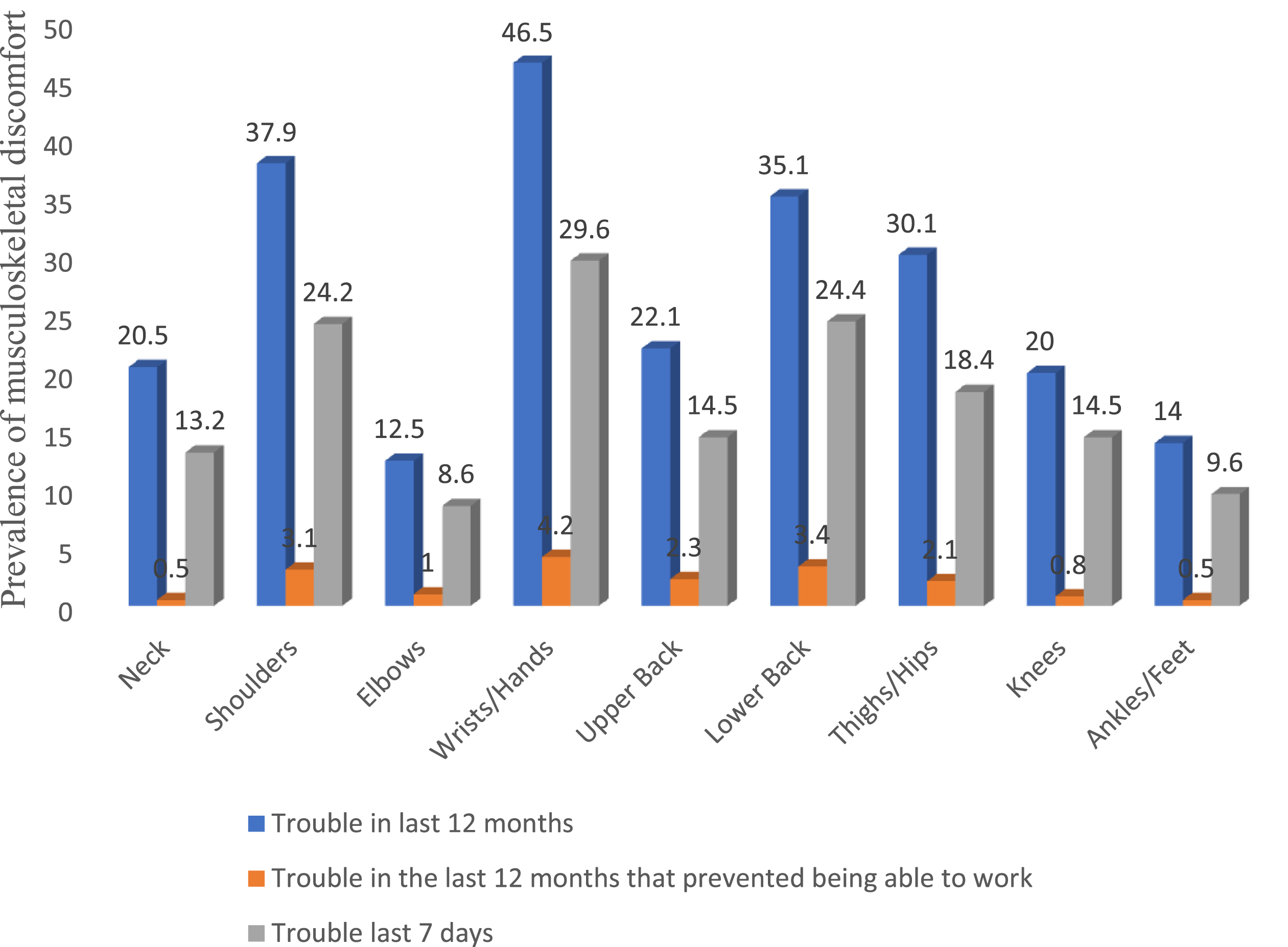
Prevalence of musculoskeletal discomfort among street sweepers during COVID-19 pandemic.
Prevalence of wrist flexor tendonitis
The current study reported a significant association between gender with prevelance of wrist flexor tendonitis. Among males, (n = 90, 24.9%) and females, (n = 13, 54.2%) had wrist flexor tendonitis. Moreover, there was also significant association between age of the participants and wrist flexor tendonitis. There were 13 (17.8%) participants from 18-27 age group and 22 (17.9%) participants from 28-37 age group with wrist flexor tendonitis. Furthermore, the study found no significant association between wrist flexor tendonitis and hand dominance, smoking habits, education level, or body mass index (Table 4).
Association of personal factors with prevalence of wrist flexor tendonitis
Association of personal factors with prevalence of wrist flexor tendonitis
OR-odds ratio, 95% CI – 95% confidence intervals (CI), binary logistics regression (adj). *Significant at p-value<0.05.
Working experience and wrist flexor tendonitis were significantly associated (p = .003). Brooms changing per month and wrist flexor tendonitis were significantly associated (p = .0.002) and length of the street (p = 0.01). It was found that wrist flexor tendonitis prevalence among street sweepers was significantly associated with getting tired at the end of the job (Table 5).
Association of working factors with prevalence of wrist flexor tendonitis
OR-odds ratio, 95% CI – 95% confidence intervals (CI), binary logistics regression (adj). *Significant at p-value<0.05.
The sweepers play an essential role in our society by maintaining the cleanliness of streets, roads, and other areas. There is a direct or indirect risk of CTD exposure for professional street sweepers. The purpose of the study was to find prevalence WRMSDs and wrist flexor tendonitis and risk associated factors in street sweepers working in Faisalabad city.
This study included 385 sweepers of both genders with a majority of males. Other studies have also been conducted among sweepers, including one conducted in Mumbai on sweepers who worked in residential buildings. The mean age of the sweepers included in their study was 39.65±8.875 years (24-60 years) and 50% of them were also not educated [21]. Other research performed by Jayakrishnan and Bhaskar reported a mean age of workers in their study as 42.5±7.2 [22].
Participants in the current study were mostly non-smokers. Several other researchers have also reported the percentages of sweepers in their study who used to smoke. In the study conducted among female building sweepers, 17 of them out of total 60 were smokers and rest of them were addicted to other things like drinking and eating gutka [21]. In a study done by Pradeep and Praveen, it was reported that substance use was more prevalent in sweepers as compared to the comparison group and the descriptive statistics showed that 33.3% street sweepers were not addicted to anything be it smoking, alcohol consumption or tobacco but 68.6% were addicted to at least any one of these [23].
The findings of this study indicate that the most common locations for pain to occur in sweepers are their wrists and shoulders, which is in agreement with Chhaya et al. who found that the most common WRMSDs for sweepers are their shoulders, hands, and fingers [24]. According to Gupta and Mishra among sweepers of the Magh Mela in Allahabad, WRMSDs are a common occupational hazard for sweepers. Females had a higher rate of musculoskeletal problems in various body parts, including 75% for wrists/hands, 62.5% for shoulder, and 45.8% for neck and lower back [16]. In another study of female sweepers, the results showed that they had problems with their arms, shoulders, hands/wrists and low backs, respectively [21]. The findings of this study show that occupational sweepers have a high prevalence of MSDs for wrists and hands, shoulders and low backs, respectively. A survey done by Pradeep and Praveen also indicated that the incidence of musculoskeletal problems was remarkably higher for shoulders and wrists/hands in sweepers, respectively [23]. By far in most of the studies we have seen that prevalence of musculoskeletal disorder is high in sweepers [21] and this is the reason that counts for their health related issues [25]. Shoulders, wrists and hands are mostly involved in causing musculoskeletal discomfort in sweepers as it is also reported in a study done by Pradeep and Praveen [23]. Also, according to the study done among street sweepers in Chiang Rai Province, maximum prevalence rate of musculoskeletal discomfort was seen in wrist/hands (86.7%) [26]. A study by Fitton, Shea, and Goldie found that any problems associated with flexion tendons in the wrist, whether a minor lesion in the tendon or a slight swelling brought on by trauma or injury, can result in pain when the wrist is examined by resisted movement [27].
Study results showed that flexion wrist tendonitis is more common among sweepers with more work experience than those with less experience. According to a recent study, Sweepers who are older and have more work experience are more likely to acquire health issues [28]. Work experience can be a potential cause of musculoskeletal injuries in street sweepers. Street sweeping involves repetitive motions and awkward postures, and over time, the cumulative effects of these movements can take a toll on the muscles and joints. Street sweepers who have been working in the job for a long period of time are at a higher risk of developing musculoskeletal injuries due to the accumulated stress on their bodies.
The findings of this study show that female sweepers are more prone to develop wrist flexor tendonitis as compare to the male sweepers as a result of repetitive stress at their wrist due to sweeping and this is supported by another research study done by Tanaka and colleagues in which they concluded that females are more associated with several kind of hand/wrist problems including tendonitis as compare to the males [29]. The majority of the sweepers, suffering from wrist flexion tendonitis were from old age group as compare to the young sweepers. With the rest of the personal factors no significant association was seen. These results regarding the age groups are supported by a study done by Fitton and his colleagues as it shows that there is very low incidence rate of lesions of the flexor tendons at wrist in the age between 15 to 40 years [27]. Gender is not a direct cause of musculoskeletal disorders in street sweepers, but it can be a risk factor for some types of conditions. For example, women may be at higher risk for certain types of musculoskeletal disorders due to differences in anatomy and hormonal changes. Additionally, some research suggests that women may be at higher risk for repetitive strain injuries due to differences in hand and wrist anatomy [30]. However, it is important to note that anyone, regardless of gender, can develop musculoskeletal disorders as a result of the physical demands of street sweeping, such as repetitive motions, heavy lifting, and awkward postures.
The current study indicates that wrist flexor tendonitis is positively correlated with street sweeping distance and more common among those who sweep farther. Moreover, wrist flexor tendonitis showed a significant association with the number of brooms changed per month, indicating that it has a lower prevalence among sweepers who change more than two brooms per month, and a higher prevalence among those who change less than two brooms per month. Similarly, in a study of WRMSDs among sweepers, broom length, working experience, broom weight, and overall broom and dustpan weight were associated with MSK conditions [26]. The distance traveled while street sweeping can be a potential cause of musculoskeletal disorders in street sweepers. Long distances, particularly when combined with other physical demands of the job such as repetitive motions and heavy lifting, can put increased stress on the body and increase the risk of injury. Moreover compression, shear, and moment forces are caused of WRMSDs in occupational workers [31].
The current study found no significant association between broom length and WRMSDs. This is contrary to literature which reported that the length of brooms used by street sweepers can be a potential cause of musculoskeletal injuries in street sweepers. The repetitive motion and awkward posture required to operate a broom that is too long or too short can put strain on the muscles and joints, leading to conditions such as back pain, shoulder pain, and wrist pain [26]. To minimize the risk of musculoskeletal injuries, it is important for street sweepers to use brooms that are the proper length and weight for their body type and for the type of sweeping they are doing.
This study only tested for pain provocation upon resisted wrist flexor testing. The Nordic Musculoskeletal Questionnaire did indicate that prevalence of musculoskeletal discomfort in street sweepers was highest in the wrist/hands, but because other muscle testing at the wrist was not performed, concluding that wrist flexor tendonitis is most prevalent above other wrist conditions is premature. The cross-sectional research design and only testing for resisted wrist flexion and other wrist directions were not assessed are the limitations of this which needs to address in future studies. Moreover, findings of this study may not be generalizable since it covered only one district of the country i.e., Faisalabad and Recall bias may be possible as the study involves asking the participants about their previous details.
To avoid musculoskeletal disorders, street sweepers are advised to maintain good posture, keep their backs straight, and avoid awkward bending or twisting while working. Take regular breaks to rest and stretch, especially if you have been working for extended periods. When lifting heavy objects, use proper lifting techniques to avoid putting unnecessary stress on your back and other joints. Wear gear that is appropriate for the task at hand, such as gloves to protect your hands and steel-toed shoes to protect your feet. Use equipment that is designed to reduce stress on the joints and muscles, such as adjustable handles and back supports. Moreover, to prevent WRMDs, change brooms regularly to avoid bending, which may cause WRMDs. Additionally, street sweepers’ health should be monitored by themselves and by authorities, and practical programs including stretching, training, and posture adjustment should be considered to reduce musculoskeletal discomfort and before starting work, do some stretching and warm-up exercises to help prepare your muscles and prevent injury.
Conclusion
This study indicates that street sweepers are more prone to develop musculoskeletal disorders due to cumulative trauma. Wrist/hand pain was the most commonly reported, followed by shoulder pain and elbow pain. Further, this study found that wrist flexor tendonitis was associated with gender, age, working experience, street sweeping distance, number of brooms changing per month, and getting tired at the end of work.
Footnotes
Ethical approval
Ethical approval for the study was granted by the Research and Ethics Committee of Riphah International University.
Informed consent
Written consent was taken from each participant before data collection.
Conflict of interest
None to declare.
Acknowledgments
None to declare.
Funding
None to declare.