



Abstract
BACKGROUND:
Acoustic comfort is one of the most critical challenges in the open-plan workspace.
OBJECTIVE:
This study was aimed to assess the effect of irrelevant background speech (IBS) and mental workload (MWL) on staffs’ physiological parameters in open-plan bank office workspaces.
METHODS:
In this study, 109 male cashier staff of the banks were randomly selected. The 30-minute equivalent noise level (LAeq) of the participants was measured in three intervals at the beginning (section A), middle (section B), and end of working hours (section C). The heart rate (HR) and heart rate variability (HRV): low frequency (LF), high frequency (HF), and LF/HF of the staff were also recorded in sections A, B, and C. Moreover, staff was asked to rate the MWL using the NASA-Task load.
RESULTS:
The dominant frequency of the LAeq was 500 Hz, and the LAeq in the frequency range of 250 to 2000 was higher than other frequencies. The LAeq (500 Hz) was 55.82, 69.35, and 69.64 dB(A) in sections A, B, and C, respectively. The results show that the IBS affects staffs’ physiological responses so that with increasing in IBS, the HF power decreases. Moreover, with higher MWL, increasing noise exposure, especially IBS, causes more increases in LF power and LF/HF ratio.
CONCLUSION:
It seems that the IBS can affect physiological responses and increase staff stress in open-plan bank office workspaces. Moreover, the mental workload can intensify these consequences in these working settings.
Introduction
Open-plan offices refer to working settings where more than one person works in the same room, the staff communicates verbally with each other, and there is no wall between them. Today, organizations desire to utilize open-plan workspaces because of the lack of infrastructure for physical workspaces, the optimal use of the existing areas, and economic reasons. Studies have shown that in 2008, more than 60% of companies in France utilized open-plan offices [1]. However, although the staffs’ communication and interaction have improved in open-plan offices compared to private offices but their acoustic comfort has decreased a lot [2–9]. This issue has generated a significant challenge in using open-plan office space.
Banks are one of the working environments which often use open-plan office workspaces. The bank’s staff mental workload (MWL) is high due to cognitive function, financial and accounting activities, and client interactions [10, 11]. On the other hand, interfering unwanted noise had annoyed many staff (95%) in these occupational work settings [3]. It is specified that primary source of noise in the banks are irrelevant background speech (IBS) generated by the client’s conversation [3, 4].
Epidemiological studies have revealed the negative effects of noise on physiological and psychological health and well-being [12–16]. Occupational noise exposure is associated with auditory and non-auditory health effects such as hearing loss, cardiovascular diseases, hypertension, sleep disturbance, and reduced cognitive performance [2, 18]. Based on a review study, it was observed that 10 dB(A) increase in equivalent noise level (LAeq) increases the cardiovascular disease risk between 7 to 17% [13].
According to the general stress theory [19], noise is an auditory stimulus which can alter the endocrine system, homeostasis, and physiological responses [4, 20]. The physiological responses were often used as indicators of stress and changes in the activity of the autonomic nervous system (ANS) [21, 22]. Moreover, MWL also affects physiological responses to different levels of stress [23]. Several studies have used the ANS variation activities to assess individuals’ acoustic comfort [18, 24–26]. Usually, the decrease comfort of individuals has been associated in increasing the ANS response. Recent studies have revealed that psychological processes of an individual can influence his/her comfort rather than characteristics of environmental stimulation [27, 28].
Heart rate (HR) and heart rate variability (HRV) are physiological responses which reveals acute fluctuation in self-regulation and emotional states [18, 30]. HR and HRV can be used for assessing the noise-induced non-auditory effects and MWL in occupational environment settings [21–23, 30–34].
Despite many studies on examining traffic, railroads, airborne noise, and industrial fugitive noise, none have investigated the relationship between IBS and its physiological responses. Though there is extensive research on acoustic comfort in open-plan offices yet few studies have addressed the staffs’ mental workload. Most of the studies were conducted in the laboratory, and very few were carried out in the actual workplace. In most studies, the confounding role of mental workload on HRV were not considered for assessing the relationship between noise exposure and HRV. There is a need for further evidential research in this area. Considering all the shortcomings in the above field, the current study was developed to find suitable answers for the following research questions: To which noise intensity, frequency, and MWL are the staff exposed in open-plan bank workspace? What are the impact of IBS on bank staffs’ HR and HRV changes during working hours throughout the day? Is there any relationship between the HR, HRV of the staff, and their exposure level to IBS as the primary noise source in open-plan bank office space?
This study is aimed to assess the effect of irrelevant background speech and its impact on the mental workload of staffs’ physiological parameters in open-plan bank office workspaces.
Materials and method
Participants
This study was conducted in banks having open-plan office workspace. The Research Ethics Committee of the Institute has approved this study. All questionnaires and human experimental parameters like HR were performed according to the guidelines and regulations approved by the Institutes Ethics Committee. Written consent was obtained from all the participants after briefing them about this research. The consent form had the approval of the ethics committee. One hundred and eighteen healthy male cashier staff were randomly selected as subjects from twenty three banks. Figure 1 shows the working environment of the banks and cashier staffs’ workstations.

a) Working environment of the banks, b) staffs’ workstation.
The work study of bank cashier staff revealed their work on computers in sitting posture, provide face-to-face services to clients, and handle their respective work request. Their job involves processing deposits and withdrawals, opening and closing accounts of clients, carrying out general administrative duties of the bank, helping clients with loan applications, and using banking software for recording clients’ account information. As per ISO 8996 standard, cashier staff have light metabolism.
The eligibility criteria inclusion of participants for this study is based on their self-declaration i.e. good general health without any cardiovascular and autonomic neuronal problems, normal hearing, non-smoker, non-addiction to drugs, and having adequate good quality sleep. The participants were asked to fill the general health questionnaire (GHQ) form along with written consent form. The GHQ is an assessment and screening self-administered instrument for measuring mental health and psychosocial well-being. This questionnaire consists of four subscales: somatic symptoms, anxiety/insomnia, social dysfunction, and severe depression. GHQ score of all participants was less than 23 [35]. The subscales’ scores of all participants’ GHQ were less than 9 [35]. Nine participants were excluded from this study due to poor cardiovascular condition obtained ECG. The final studied population from different banks consists of one hundred nine male cashier staff.
The research team observed that the lighting and climatic conditions were desirable in the studied banks working environment. Workplace illuminance was higher than 300 lux in all the participants’ workstations [36]. The mean air temperature was in the thermal comfort zone of 23.6 °C [37]. As per ANSI/ASHRAE Standards 62.1 and 62.2, the studied banks’ air conditioning and air quality were within acceptable limits.
All participants were briefed regarding the procedure, objective, and recording of electrocardiography (ECG) for this study. The information regarding the recording and filling the NASA Task Load Index (NASA-TLX) questionnaire was explained to each participant. The participants were asked to sign their participation consent form.
The ECG electrodes and noise dosimeters were attached to each participant’s chest and collar, respectively. The participant was asked to perform routine bank work for 30 minutes at his specified regular workstation. During this period, LAeq and ECG were measured for 30 minutes (section A) [38, 39]. The process of the study is shown in Fig. 2.
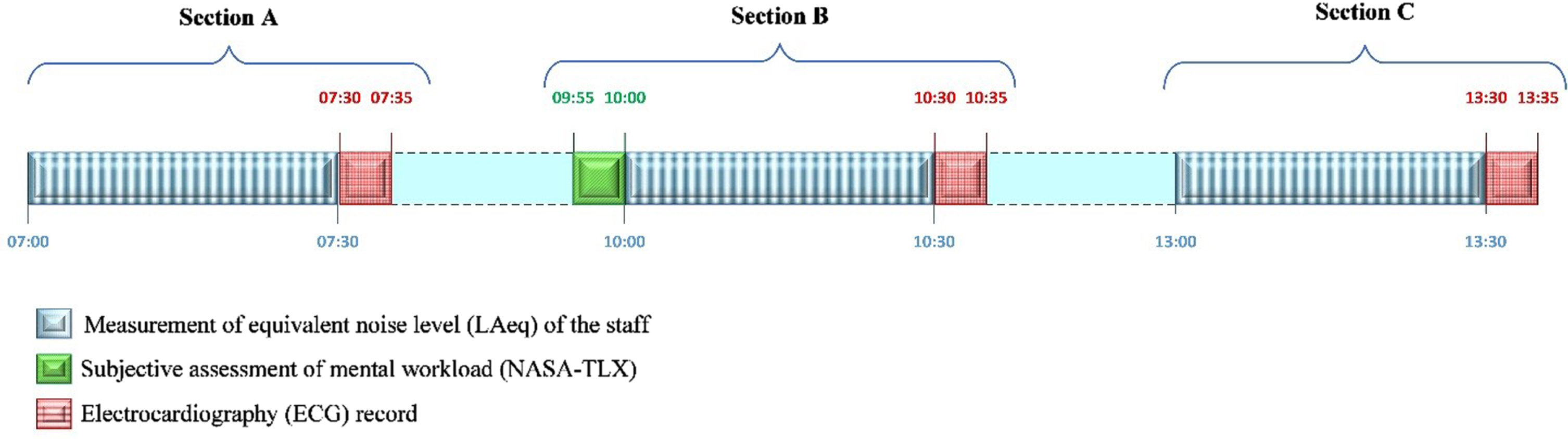
The experimental procedure in a working day in the bank.
The LAeq noise exposure of each participant was measured by using calibrated SVANTEK-104 noise dosimeter. This dosimeter was attached to the participant’s shoulder collar near his ear. The LAeq noise intensity exposure was measured for 30 minutes at the beginning of section A, in the middle of section B, and at the end of the working hours in section C [38, 39]. The LAeq was measured with octave band analysis. The LAeq was also measured with the octave band in the absence of banking staff in open-plan bank workspaces.
The background noise spectrograms were analyzed in detail. The mean of LAeqwas measured at 250, 500, 1000, and 2000 Hz frequencies to assess participants’ exposure to IBS [38, 39]. It was observed that the dominant frequency is 500 Hz in measured LAeq as per IBS index frequency. The noise annoyance scale (NAS) was referred for assessing and evaluating the participants’ noise annoyance [40].
Acoustic analysis of interior spaces in banks
In all the studied banks, the dimensions of the interior space and materials of the floor, walls, and ceiling were recorded. The interior of the banks had an almost uniform rectangular cubical space having mean average length, width, and height of 14±2.25 m, 9±3.67 m, and 3±0.86 m, respectively. In most banks, perforated plaster acoustic tiles on the ceilings and marble or ceramic tiles on the floors. The wall surfaces were combination of marble and polyvinyl chloride panels, and the doors and windows were made of glass embedded in steel frames.
The staffs’ table in all workstations (Fig. 1) of studied banks was identically made of medium-density fiberboard and glass, having length, width, and height of 1.5 m, 0.8 m, and 1.5 m, respectively. As per Fig. 1, the tables were joined, and the average distance between the staff seat space was 1.5 meters. The average number of bank staff was 9, but it varied between 8 to 12 in different banks.
There were three models of chairs for bank staff and clients. The staff uses office chairs with woven fiber covers, whereas the clients’ chairs in front of the staffs’ workstations were made of synthetic foam. The waiting chairs for clients were made of painted metal. The average number of chairs for staff and clients in front of the workstation and waiting areas were 9, 12, and 30, respectively.
The reverberation time in the banks was measured according to the ISO 3382-2 standard. It was measured as per the interrupted noise method by a calibrated device make BSWA Company. According to the standard, measurements were carried out in the center and corner of the inner space in each bank at a frequency range of 125–8000 Hz [3, 4]. The average reverberation time was measured in the frequency range of 250 to 2000 Hz. This was considered as an estimate of the reverberation time in banks [4, 41].
Physiological responses measurement
The physiological response, like ECG signals of the staff, were recorded using a portable recording device, Mind Media B.V. Nexus-4. This device is equipped with Bluetooth, which was connected to a laptop for receiving and analyzing the data on the Bio Trace Ver. V2012 C software. Three AgCl electrodes were used to record ECG signals at a sampling rate of 1024 Hz. The electrodes were attached at the right and left side of the distal part of sternum and sixth rib in the left axilla, as per the directive of Nexus-4 manufacturer’s instructions. The ECG signal artifacts were removed using the Bio Trace software. ECG signals were recorded at three to five-minute intervals; at the beginning of section A, middle of section B, and end of working hours of section C.
The HR and HRV (variation in beat-to-beat intervals in HR) were extracted from ECG signals using Bio Trace software, which includes low frequency (LF: 0.04–0.15 Hz), high frequency (HF: 0.15–0.50 Hz), LF/HF, and the standard deviation of RR intervals (SDNN) [29]. It should be noted that due to the mathematical redundancy of normalized LF power (LFnu) and normalized HF power (HFnu) with the LF/HF ratio, only the LF/HF ratio was evaluated [42, 43]. Moreover, there is a mathematical redundancy between Total Power (TP) and SDNN. Therefore, the SDNN was only assessed [29].
Subjective assessment of mental workload
The NASA Task Load Index (NASA-TLX) questionnaire was used to assess the subjective MWL of each participant. The NASA-TLX is a multidimensional, subjective assessment tool to measure perceived workload that has been widely used in various occupations [44]. The overall workload score of the NASA-TLX questionnaire was calculated based on the weighted average of six sub-scale, including mental demand, physical demand, temporal demand, own performance, effort, and frustration [44].
Assessment of the bank’s work conditions has shown that the most significant number of clients and the highest number of work demands were in the middle hours of the working day. Hence, the participants completed the NASA-TLX questionnaire in the mid-hours of the working day in section B.
Statistical analysis
Since the collected data have a longitudinal nature, the nonparametric Friedman’s test was used for comparing the mean values of the LAeq, LAeq (250-2000 Hz), LAeq (500 Hz), HR, and HRV in sections A, B, and C. A Linear mixed model (LMM) was used to determine the relationship between noise (LAeq and IBS) with HR and HRV parameters. For this aim, all explanatory variables were converted. For instance, the variable x converted to (x-mean(x))/range(x)). All statistical analysis and calculations were performed using SPSS-20 software and lme4 [45] and lmerTest [46] software packages of R software version 3.5.0 [47].
Results
Study participants
The participants’ mean age and work experience were 38.89±6.71 and 7.68±14.62 years, respectively. The work experience (WE) of staff was categorized into three groups: ≤10 years (37.6%), 10 to 20 years (38.5%), and ≥20 years (23.9%). Table 1 shows the participants’ general health determined by the GHQ questionnaire in the four subscales. The mean scores of social dysfunction and severe depression were highest and lowest, respectively.
Results of the general health questionnaire (GHQ) of the participants (n = 109)
Results of the general health questionnaire (GHQ) of the participants (n = 109)
The average reverberation time in the frequency range of 125 to 8000 Hz is presented in Fig. 3. On average, the highest and lowest rate of reverberation times were at frequencies of 125 and 8000 Hz, respectively.

The results of reverberation times measurement in the banks at octave band frequencies.
The spectrogram of the average noise exposure of participants (LAeq) in the banks in sections A, B, and C was presented in Fig. 4. The dominant frequency of the LAeq in the working day was at 500 Hz. In addition, on average, the LAeq in the frequency range of 250 to 2000 was higher than other frequencies. The results of measuring the minimum and maximum noise pressure levels in 3 intervals of A, B, and C are presented in Table 2. The average equivalent noise level without staff before starting the bank and also with staff presence was 50.62±1.23 and 56.34±2.73 dB(A), respectively. The equivalent level of staff noise exposure (LAeq) in the entire working day was 71.09 dB(A).
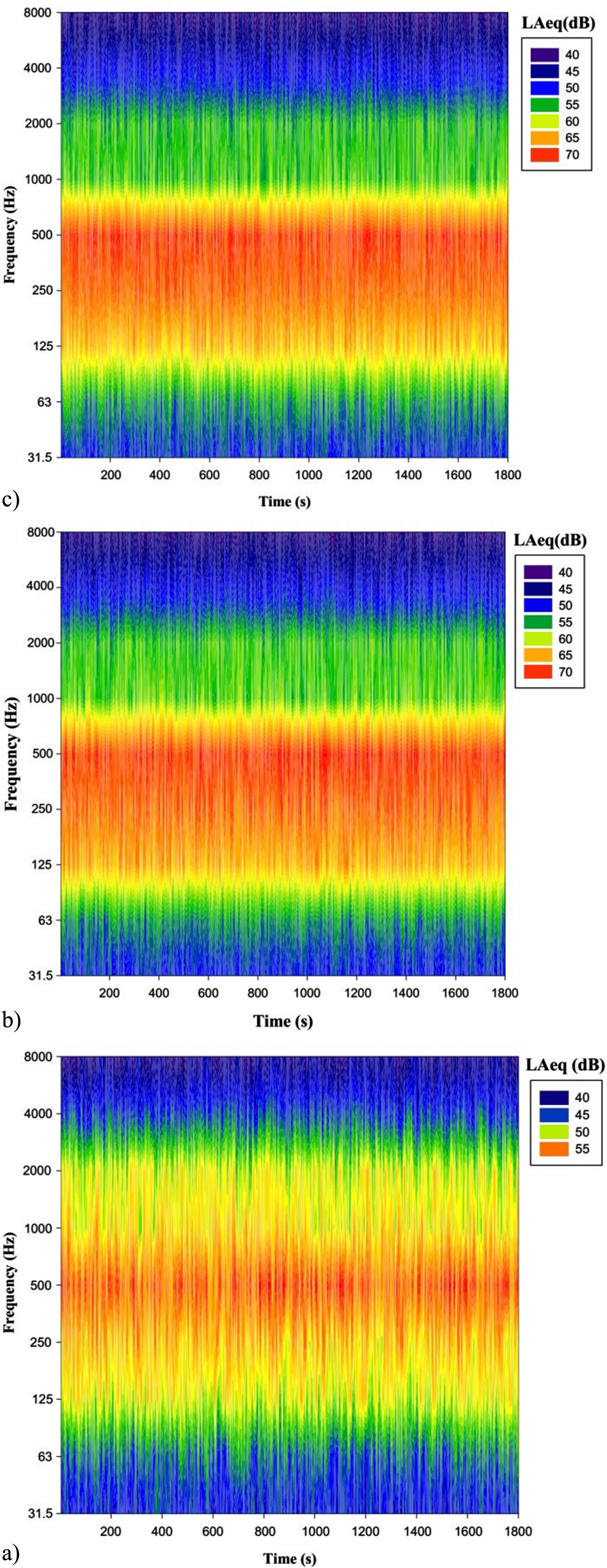
The spectrogram of the average noise exposure of participants (LAeq) in the banks at a) the beginning (section A), b) middle (section B), and c) at the end of the working time (section C).
The results of measurement of noise pressure levels in the banks at a) the beginning (section A), b) the middle (section B), and c) at the end of the working time (section C)
LAeq: Equivalent noise level, Lmax: maximum noise pressure level, Lmin: minimum noise pressure level.
The results of the average LAeq, LAeq (250-2000 Hz), and LAeq (500 Hz) values with the same pattern in the working day were presented in Fig. 5. The LAeq values at sections A, B, and C were 60.53 dB(A), 72.65 dB(A), and 72.88 dB(A), respectively. According to Fig. 5 and the results of Friedman’s test, the average noise exposure of participants (IBS and LAeq) was significantly higher in section B than in section A (P < 0.001). However, there was no significant difference between the noise exposure of participants in sections B and C (P = 0.213).
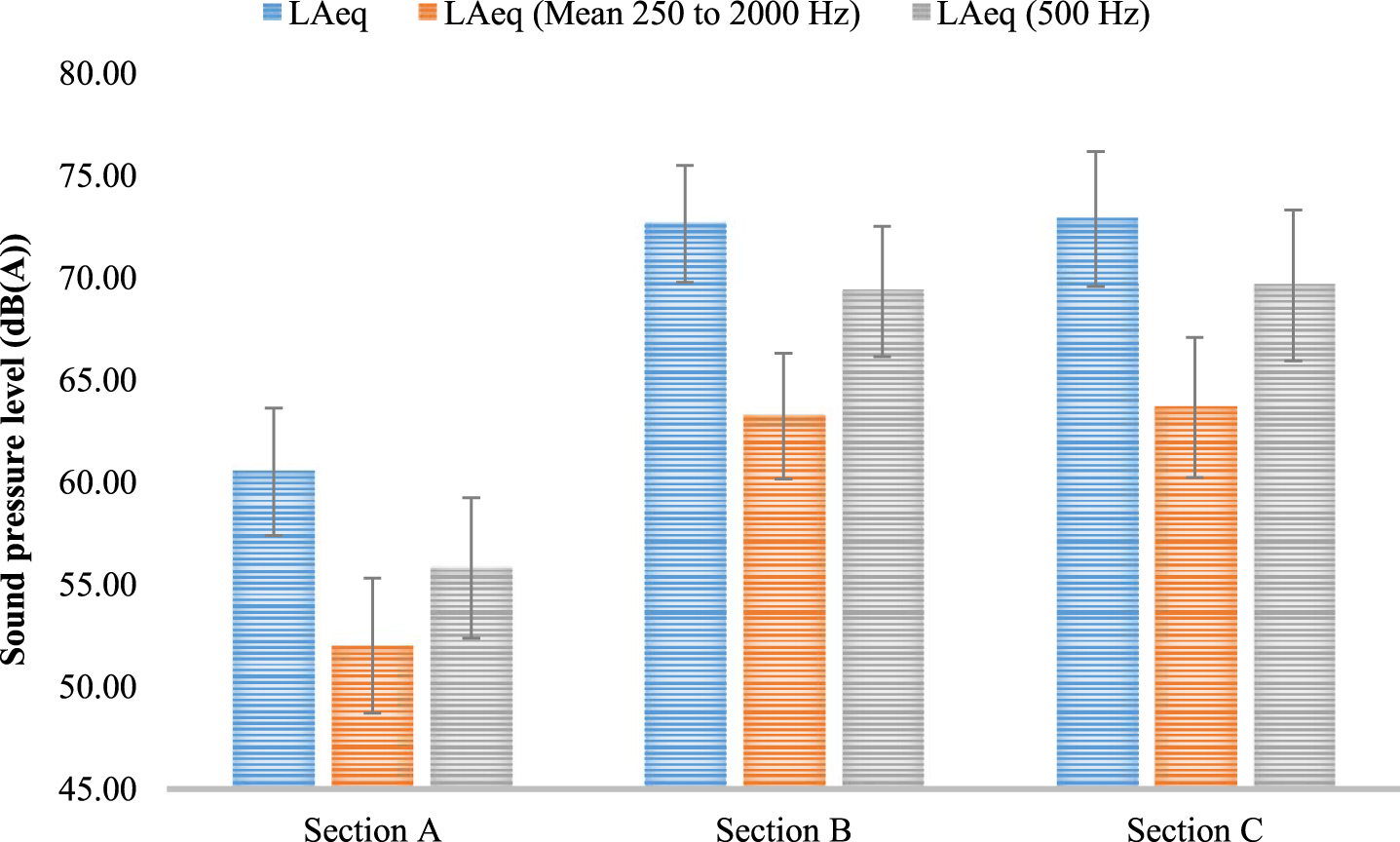
Mean±SD of equivalent noise level (LAeq), mean LAeq in the 250 to 2000 Hz frequencies, and LAeq in the 500 Hz frequency measured in three 30-min intervals at the beginning (section A), middle (section B), and at the end of the working time (section C).
Table 3 shows the average values of the subjective MWL ratings determined by the NASA-TLX questionnaire in the six subscales. The mean scores of temporal demand and own performance were the highest and lowest, respectively.
Results of measurement of mental workload (MWL) of the participants (n = 109)
Results of measurement of mental workload (MWL) of the participants (n = 109)
Based on the results of Friedman’s test, the mean of LF power was significantly higher in section B than in section A (P < 0.001); however, there was no significant difference between the mean LF power in sections B and C (P = 0.143). The changes in mean LF power (Table 4) were similar to the changes in average noise exposure of participants (Fig. 5) in sections A, B, and C. Moreover, there was a significant difference between the mean LF/HF ratio in sections A, B, and C (P < 0.001). There was no significant difference between the mean HR, HF power, and SDNN in sections A, B, and C. The results of the measurement of HR and HRV in sections A, B, and C are presented in Table 4.
Results of measurement of HR and HRV of participants at the beginning (section A), middle (section B), and end (section C) of the working time (n = 109)
Results of measurement of HR and HRV of participants at the beginning (section A), middle (section B), and end (section C) of the working time (n = 109)
HR: Heart rate; LF: Low frequency; HF: High frequency; SDNN: Standard deviation of normal to normal R-R intervals; bpm: beats per minute; ms: milliseconds.
The obtained results on the relationship between noise exposure of participants (LAeq and IBS) and ECG parameters are presented in Tables 5–7. As given in Table 5, there was a meaningful relationship between LAeq and LF/HF ratio (P < 0.001). It was observed with increasing LAeq, the LF/HF ratio increased. The relationship between LAeq and MWL with LF/HF ratio was significant and synergistic (P = 0.01); thus, with higher MWL, LAeq had more impact on increasing LF/HF ratio (see Table 4). Besides, Tables 6 and 7 show that the relationship between the IBS, MWL, and LF/HF ratio was similar to Table 4.
The correlation between HR, HRV, and LAeq of the participants regarding their MWL, their NAS, and their work experience was measured using the LMM model in sections A, B, and C
The correlation between HR, HRV, and LAeq of the participants regarding their MWL, their NAS, and their work experience was measured using the LMM model in sections A, B, and C
LAeq: Equivalent noise level, NAS: Noise Annoyance Scale, MWL: Mental Workload, WE: Work Experience, HR: Heart Rate, HRV: Heart Rate Variability, LF: Low-Frequency power, HF: High-Frequency power, SDNN: the Standard Deviation of all NN intervals. A*B: this expression showed how the effects of A on response changed over/in different values of B.
The correlation between HR, HRV, and LAeq (Mean 250 to 2000 Hz) of the participants regarding their MWL, their NAS, and their work experience was measured using the LMM model in sections A, B, and C
LAeq: Equivalent noise level, NAS: Noise Annoyance Scale, MWL: Mental Workload, WE: Work Experience, HR: Heart Rate, HRV: Heart Rate Variability, LF: Low-Frequency power, HF: High-Frequency power, SDNN: the Standard Deviation of all NN intervals. A*B: this expression showed how the effects of A on response changed over/in different values of B.
The correlation between HR, HRV, and LAeq (500 Hz) of the participants regarding their MWL, their NAS, and their work experience was measured using the LMM model in sections A, B, and C
LAeq: Equivalent noise level, NAS: Noise Annoyance Scale, MWL: Mental Workload, WE: Work Experience, HR: Heart Rate, HRV: Heart Rate Variability, LF: Low-Frequency power, HF: High-Frequency power, SDNN: the Standard Deviation of all NN intervals. A*B: this expression showed how the effects of A on response changed over/in different values of B.
As given in Table 7, the relationship between LAeq (500 Hz) and MWL with LF power was significant and synergistic (P = 0.04); thus, with higher MWL, LAeq (500 Hz) had more impact on increasing LF power parameter. As per Table 5, the relationship between LAeq and LF power was insignificant (P = 0.61). There was meaningful relationship between the participants’ work experience (WE) and LF power, so the LF power increased with higher WE.
As presented in Table 5, the relationship between LAeq and HF power was significant (P = 0.04), so with increasing LAeq, the HF power decreased. Besides, the relationship between IBS and HF power was the same. The SDNN in participants with moderate experience (between 10 to 20 years) as compared with low experience (between 1 to 10 years) was significantly reduced (P = 0.001). The results showed increasing participants’ exposure to noise, SDNN decreased, and HR increased; however, these changes were not statistically significant.
This study investigated the noise exposure of staff in open-plan bank offices, especially IBS, as the primary noise source and its relationship with physiological responses. Therefore, the current study provides new data about the staffs’ physiological responses to IBS.
The analysis frequency of the staffs’ exposure to noise (Fig. 4) indicated that the dominant frequency was 500 Hz and the LAeq in the frequency range of 250 to 2000 was higher than other frequencies. These results confirm that the primary source of noise in open-plan banks has been IBS. These results reflect those of Golmohammadi et al., who also found that the primary source of the subjective annoyance of staff in open-plan banks has been irrelevant speech [3]. In accordance with the present results, previous studies have demonstrated that the dominant frequency of the background noise of open-plan banks was 500 Hz [3, 6]. The study of Walker et al. emphasized that the dominant frequency of the LAeq should be considered to evaluate the health effects of noise exposure [31].
The potential mechanism that introduces noise as a stressor for the human is that noise stimulates the sympathetic autonomic nervous system tone, either directly or indirectly, through releasing hormones, which cause a “fight-or-flight” reaction [48, 49]. In general, the body’s reaction to noise as an environmental stressor causes changes in physiological responses [21]. The sympathetic nervous system (SNS) is one of the branches of the ANS, which is activated when the human body is exposed to external stimuli [50, 51]. The parasympathetic nervous system (PNS) is another branch of the ANS which tries to bring the body to rest and calm [51]. The LF is Low-frequency power that reflects the SNS and PNS activity [51]. The HF is a High-frequency power that reflects PNS activity [51]. The LF/HF ratio indicates the SNS/PNS ratio balance [51]. It should be noted that in the relationship between noise exposure of staff and physiological parameters, confounding factors such as MWL should be considered [18, 33, 34].
The analysis of the results (Figs. 4 and 5) indicated that staffs’ exposure to noise (LAeq and IBS) in the middle and at the end of the working hours is significantly higher than at the beginning of the working hours. The current study results revealed (Tables 5 to 7) with higher MWL, increasing noise exposure, especially IBS, there is an increase in LF/HF ratio. Similarly, with increasing the MWL of participants, the effect of LAeq (dominant frequency: 500 Hz) on LF power was greater (Table 7). So it can be concluded that an increase in MWL is a critical factor which intensify the SNS activity associated with IBS (dominant frequency: 500 Hz) exposure of participants. The increasing noise exposure of participants, especially IBS, increases the participants’ stress, and MWL is only an intensifying factor. The current study’s finding broadly supports the results of other studies in this area [18, 25]. Lee et al. showed that the LF power and LF/HF ratio increase in exposure to noise of 50 dB(A). They also reported that by increased noise levels (70 and 80 dB(A) than lower noise levels: 50 and 60 dB(A)), the rate of the LF/HF ratio increased [26]. Kraus et al. indicated persons exposed to noise less than 65 dB(A), with increasing noise exposure, both LF power and LF/HF ratio also increased [21]. In another study, Elarbaoui et al. indicated that increased exposure to noise increases LF/HF ratio and LF power [22]. Previous studies have shown that any disruption in HRV would increase the risk of cardiovascular disease over time [52, 53].
The results showed with increasing noise exposure of participants, the HR increased, but it was not statistically significant. Tomei et al. concluded that the HR parameter is less sensitive to show the effects of low-intensity noise exposure. However, the HR is higher in the participants exposed to high-intensity noise than those exposed to low-intensity noise [54]. So, noise as an environmental stressor can disturb the SNS and PNS work and decrease the body’s stress management capacity resulting in decrease HRV [55]. In the current study, the HF power parameter (PNS activity) significantly decreased with increasing the noise exposure of participants (LAeq and IBS). These results are consistent with the results of Walker et al. [31].
Nevertheless, the study of Sim et al. has shown that the LF power and HF power had decreased and increased, respectively, in exposure to speech noise [56]. It may be noted that studies which contradict our study were usually laboratory studies [57, 58]. Therefore, this contradiction may be due to the laboratory conditions and especially the MWL of the subjects studied in the lab.
In this study, the SDNN parameter also decreased with increasing IBS (dominant frequency: 500 Hz) exposure of participants, but its reduction was not statistically significant (Table 7). Also, with the increasing work experience of participants (work experience 10-20 years), SDNN significantly decreased. Many studies show that reducing SDNN was associated with cardiovascular diseases [59, 60]. Based on the results of a study on HRV parameters, SDNN changes are the best predictor of new cardiovascular disorders [61]. Regarding the importance and risk of SDNN reduction, it is strongly recommended to investigate the negative associations between SDNN and work experience in future studies.
Based on the results of this study, it seems that IBS can affect physiological responses and increase staff stress in open-plan bank office space. However, it should also be noted that in field studies, it is impossible to control all intervening variables, and the increase in staff stress may be influenced by their relationships with clients and colleagues and their cognitive performance. Therefore, it is suggested to investigate the staffs’ mental and physical workload more closely in future studies. In addition, the staffs’ cognitive performance and psychological variables should also be investigated.
Conclusion
Generally, the study achieved important information about the effects of IBS on physiological responses. It can be concluded that IBS can affect physiological responses and increase the LF power and LF/HF ratio of HRV. Consequently, noise exposure of bank cashier staff, especially IBS, can increase their stress. Moreover, their mental workload can intensify these parameters in the present working settings. So it is necessary to improve acoustic comfort and reduce the MWL in the workplace. As there is a relationship between LAeq noise intensity at the dominant frequency of 500 Hz with HRV, it is necessary to take adequate control action by partitioning the open bank workspace.
Ethical approval
The study was approved by the Ethical Committee for Research at Hamadan University of Medical Sciences (No. IR.UMSHA.REC.1395.437).
Informed consent
Not applicable.
Conflict of interest
The authors declare no conflicts of interest in the work submitted.
Footnotes
Acknowledgments
The study was adapted from a Ph.D. thesis at Hamadan University of Medical Sciences. The authors thank Bank Melli Iran’s administrative staff for their contribution.
Funding
The study was funded by the Vice-Chancellor for Research and Technology, Hamadan University of Medical Sciences (No. 9511267308).