



Abstract
BACKGROUND:
Prolonged and sustained work posture among computer users is one of the main factors that contributes to musculoskeletal discomfort. Rest-break interventions such as task variation and microbreaks may help prevent muscle fatigue and work-related musculoskeletal disorder.
OBJECTIVE:
We aimed to investigate the effects of task variation and microbreaks at seated and standing workstations on forearm muscle activity, namely extensor digitorum communis, extensor carpi ulnaris, flexor digitorum superficialis, and flexor carpi ulnaris; mouse operation force (vertical compression force); mouse operation parameters; and perceived body discomfort during mouse operation.
METHODS:
Twelve healthy right-handed young adults were recruited (male: n = 7, 21.6±1.4 years; female: n = 5, 21.4±1.7 years). Participants performed three blocks of computer tasks (computer mouse operation and typing) in both seated and standing postures with each block lasting for 30 min. Surface electromyography (EMG) of the forearm muscles and operation force were monitored during computer mouse operation. Body discomfort rating was recorded at the end of each block.
RESULTS:
With simulated task variation and microbreaks, work posture and work time showed no significant difference with EMG amplitude and mouse operation force.
CONCLUSION:
Task variation and microbreaks could be of benefit to computer users by reducing muscle fatigue during long hours of computer work at both seated and standing workstations.
Introduction
Computers have become one of the essential tools used in daily work and study. Computer users are often prone to musculoskeletal symptoms and work-related musculoskeletal disorders [1, 2]. Over the years, several risk factors have been identified such as repetitive work, low intensity workload, and static working posture [3–5]. Working posture is one of the main factors that contribute to musculoskeletal discomfort. Therefore, ergonomic solutions such as workstation design, standing workstation, task variation, microbreaks, passive and active pauses, and input devices have been suggested to address these risk factors.
Commonly, computer users will use input devices and pointing devices such as keyboards and computer mouses for their daily work. Previous studies suggested typing activities and mouse operations are directly related to muscle fatigue and potential cumulative trauma disorder such as carpal tunnel syndrome [1, 6–8]. Although the forces involved during the use of keyboard and computer mouse are relatively small, [9–12] prolonged working time with input devices may lead to muscle fatigue and increased risk of musculoskeletal symptoms [8, 13].
Conversely, temporal variation and activity variation, or in other words, microbreaks and task variation, are helpful in reducing cumulative muscle fatigue among workers [14–17]. Although the optimal time for microbreaks remains inconclusive, several studies suggest that microbreaks can range from 2 to 10 min [15, 19]. However, these studies mainly focus on typing activities. Therefore, better understanding of task variation and microbreaks on computer mouse operation may help prevent muscle fatigue and work-related musculoskeletal disorder.
Additionally, standing workstation is one of the office ergonomics interventions designed to address work-related musculoskeletal disorders. Standing workstation as an alternating work posture has shown several biomechanical benefits including a reduction in physical and mental burden among computer users [20, 21]. Since the postural support and freedom of movement differs between seated and standing workstations, we postulate that these work postures may result in different muscle activation patterns, manifestation of muscle fatigue, and computer work performance.
In this study, we investigated the effects of task variation and microbreaks, at seated and standing workstations, on the forearm muscle activity, namely extensor digitorum communis (EDC), extensor carpi ulnaris (ECU), flexor digitorum superficialis (FDS), and flexor carpi ulnaris (FCU), mouse operation force (vertical compression force), mouse operation parameters, and perceived body discomfort. We hypothesized that (a) cumulative working time will manifest as muscle fatigue and higher muscle activation regardless of working postures and (b) task variation and microbreaks would benefit the personnel by improving the mouse operation parameters and reducing perceived fatigue.
Materials and Methods
Participants
A convenient sampling method was used to recruit participants in this study. Twelve right-handed healthy young participants (male: n = 7, 21.6±1.4 years; female: n = 5, 21.4±1.7 years) without known musculoskeletal disorders were recruited. The handedness of the participants was determined using the Edinburgh Handedness Inventory. The participants provided written informed consent and this study was approved by Ethics Committee of the Faculty of Design, Kyushu University (No. 302-2).
Experimental protocol
All participants were evaluated under both sitting and standing conditions on separate days. A randomized sequence of the seated and standing conditions was assigned to the participants. For seated workstations, the chair height was adjusted to allow 90° knee flexion with the feet rested on the floor. The table height was adjusted such that it aligned with the participant’s seated elbow height. For standing workstations, the table height was adjusted such that it aligned with the participant’s standing elbow height with 90°–105° elbow flexion and 10°–25° shoulder abduction. Lastly, the height of the computer monitor was set at the participant’s eye level for both seated and standing workstations.
The participants were allowed to familiarize themselves with the posture and computer work in seated and standing conditions. In the seated and standing conditions, the participants were required to perform 3 blocks of 30-min computer tasks. Pointing device and input device used in this study were wireless mouse (M280BK, Logicool), and 106-key Japanese keyboard (K120, Logicool), respectively. The keyboard slope was set at 0° for all workstations. Each 30-min time block computer task consisted of two 12-min computer mouse tasks (pointing and dragging) and two 3-min bilateral hand typing tasks using Microsoft PowerPoint. Mousotron (Blacksun Software) was used to monitor and record the mouse operation parameters on the monitor screen, namely total distance, left click, and double leftclick.
The three 30-min time blocks of computer work were interspaced with 5-min rest time. The tasks were to be performed using Microsoft PowerPoint and included (1) aim and click, (2) click and trace, and (3) click and drag. The sequence of mouse tasks was randomized for all participants. Lastly, participants rated body discomfort (neck, shoulders, upper arm, forearm, wrist, and hand) before the start of the first time-block and at the end of each block. The scale ranged from 1 to 7, where 1 is “no discomfort” and 7 is “extremely severe”. A schematic diagram of the experiment protocol is show in Fig. 1.
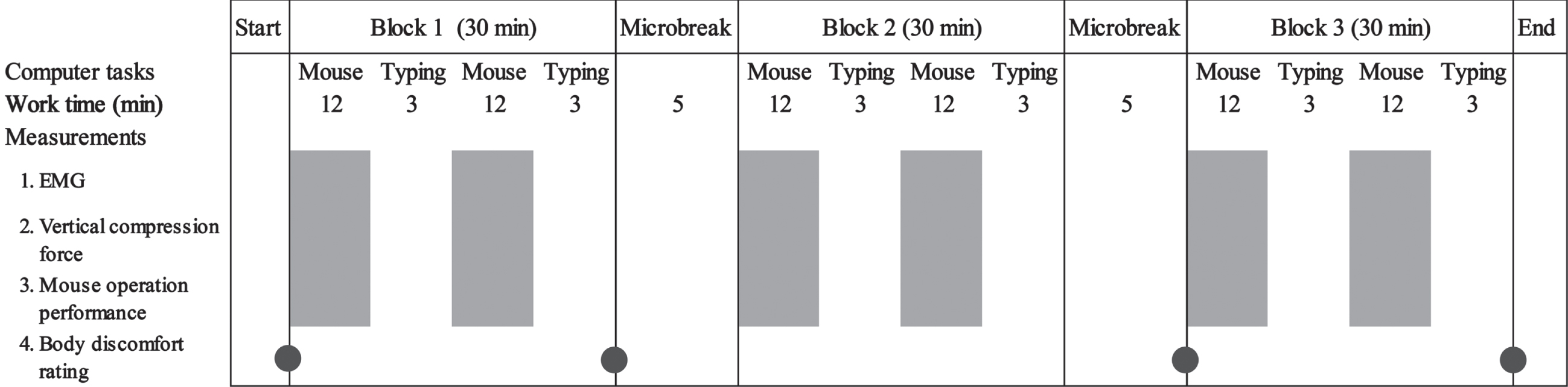
Schematic diagram for experiment protocol and timing of data collection.
Muscle activity was assessed by EMG (NIHON SANTEKU Co., Ltd, Japan) using active electrodes (BA-U410 m, NIHON SANTEKU Co., Ltd, Japan). The target muscles were right EDC, right ECU, right FDS, and right FCU. The skin was cleaned with 70% alcohol to reduce the skin resistance. Bandpass filter (15–500 Hz) was applied for filtering EMG signals.
Maximal voluntary contraction (MVC) force of the muscles (EDC, ECU, FDS, FCU) was measured thrice. During measurement of MVC, instructions were given to the participants to slowly increase force to the maximum and to hold the maximal force for 3–5 seconds. A 60-second rest period was scheduled in between each MVC measurement. The MVC of each muscle was used to normalize the muscle activity at different working conditions.
The vertical compression force during mouse operation was measured by a custom-made force plate with 3 loadcells (MCSR-5L-FG, Toyo Sokki Co., Ltd) secured to the bottom of an aluminum plate (200 mm×200 mm×5 mm), mounted flush with a plywood board. Data from the 3 load cells were sampled at 1 kHz. Subsequently, load cells and EMG amplifier were connected to a personal computer via PowerLab 16/30 (PowerLab 16/30, ML880, AD Instruments Pty. Ltd., Australia). Load cell data and EMG signals were then recorded and synchronized by LabChart v7.1.1 (AD Instruments Pty. Ltd., Australia).
The raw EMG and force data were analyzed by LabChart v7.1.1 (AD Instruments Pty. Ltd., Australia). The collected raw EMG data were full-wave rectified and smoothed, and then processed with an average rectified method by calculating the average per second. Next, the MVC measurements of each muscle were used to normalize the muscle contraction recorded under different conditions (% MVCEDC, % MVCECU, % MVCFDS and % MVCFCU, respectively). The recorded force data were then filtered with a low-pass filter at 30 Hz in LabChart v7.1.1 (AD Instruments Pty. Ltd., Australia). The analysis period for both EMG and force plate was during the mouse operation (12 min).
Statistical analysis
A two-way repeated analysis of variance (2×3 factorial design) was performed with the 2 postures (seated and standing) and 3 time blocks (0, 30, 60 min) as factors to examine the differences in % MVC, vertical compression force, and mouse operation parameters (total distance, left click and double left click). Post-hoc pairwise Bonferroni-corrected comparisons were performed to examine the significant differences between conditions.
A nonparametric Kruskal–Wallis H test was used to examine the differences in body discomfort rating. Subsequently, the Friedman test was performed to examine the repeated measures of mouse operation under each condition. All statistical analyses were performed using SPSS version 26.0 software (IBM Corp., Armonk, NY). The significance level was set at α= 0.05. EMG and force data were presented as mean±standard deviation (SD), while body discomfort rating was reported as mean±standard error (SE).
Results
EMG amplitude of EDC, ECU, FDS and FCU
Posture had a significant effect (F (1, 10) = 9.086, p < 0.05) on the EDC. Although EDC muscle activity was significantly higher in standing posture for all 3 time blocks (p < 0.05) (Fig. 2), there was no significant effect on the ECU, FDS, and FCU.
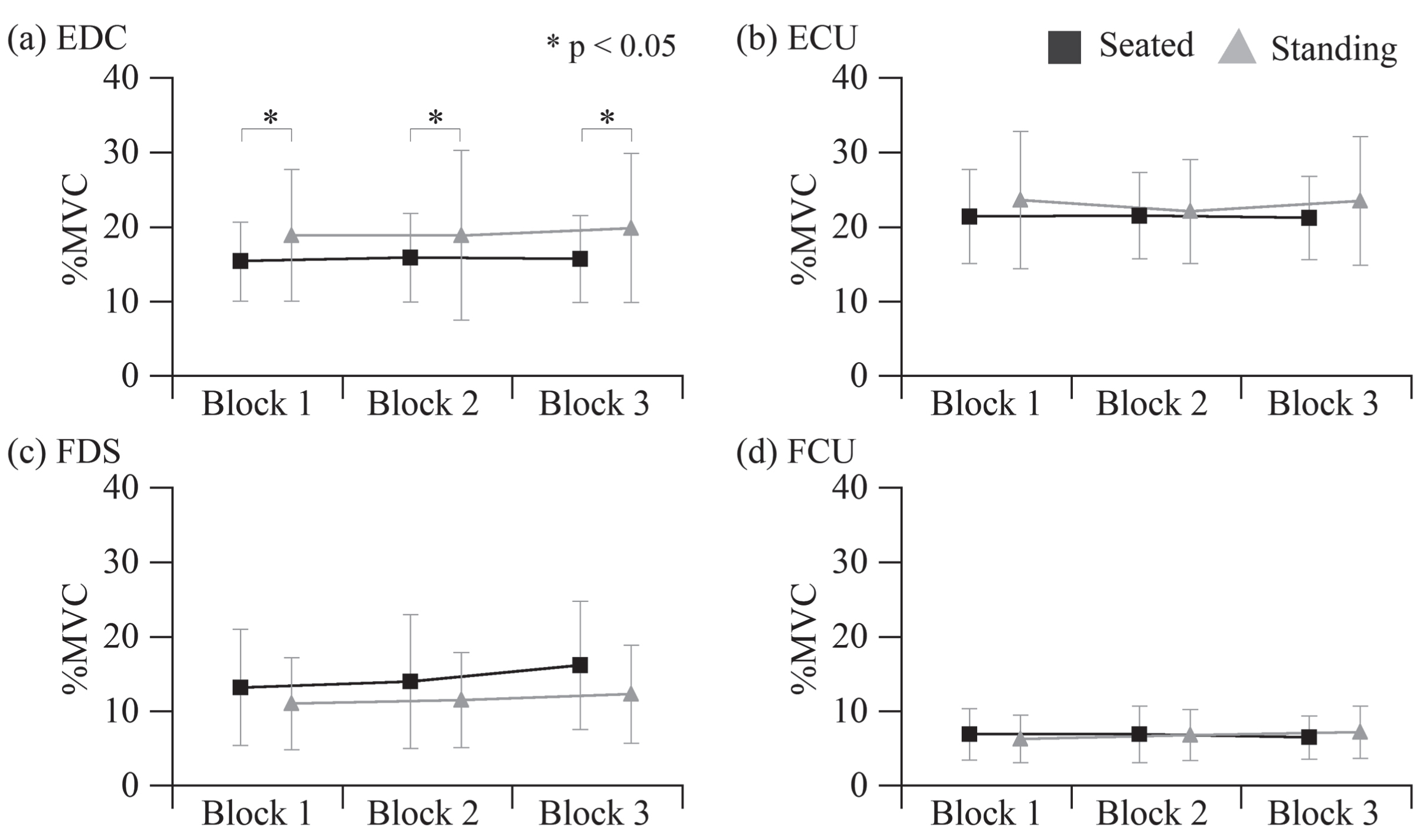
EMG amplitude (% MVC) results of EDC, ECU, FDS, FCU muscles by blocks.
The effect of posture and time block were not significant on the vertical compression force during mouse operation. Although the average vertical compression force during time blocks 1 and 2 were similar, time block 3 showed decreased values in seated posture and increased values in standing posture (Fig. 3).
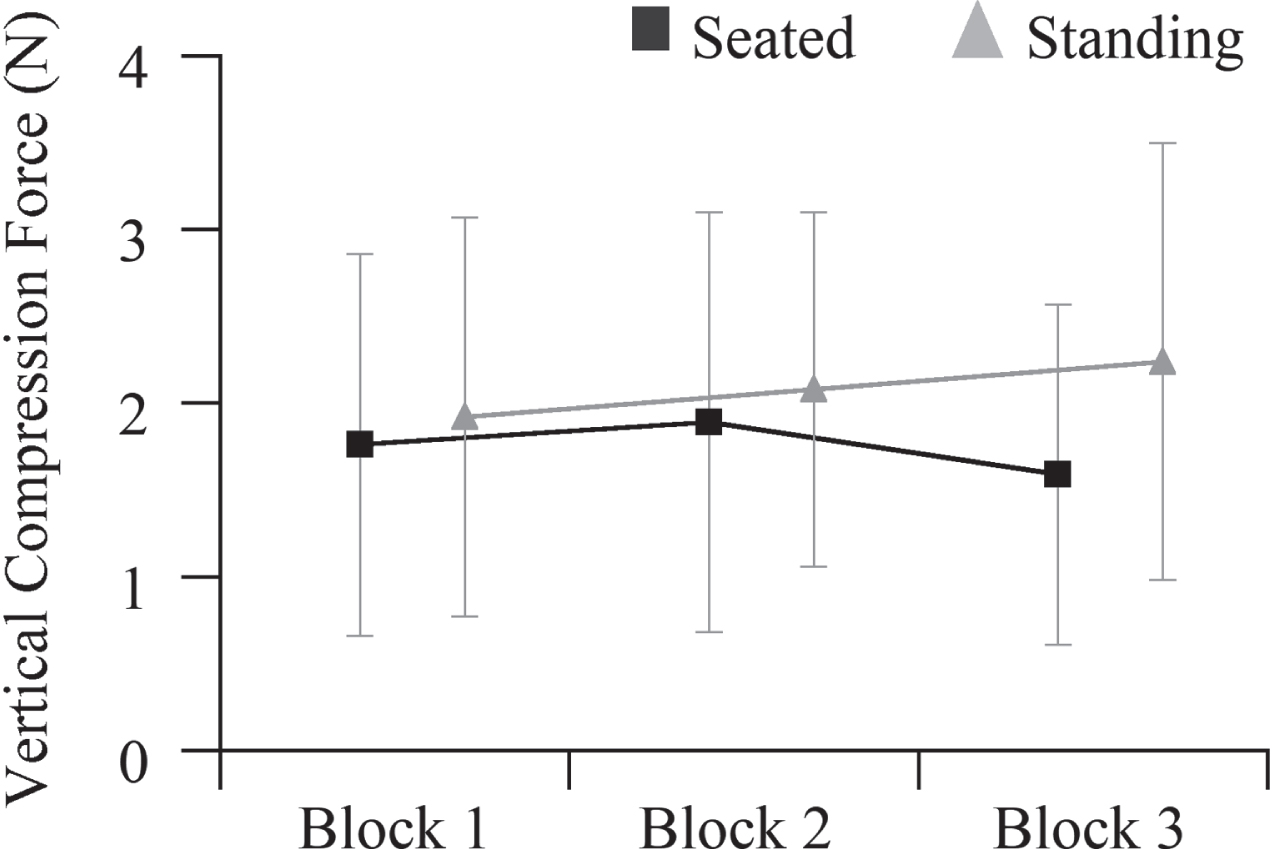
Vertical compression force (N) during mouse operation by blocks.
Although posture had no significant effect on the mouse operation parameters, time blocks significantly affected total distance (F(2, 18) = 12.403, p < 0.01), left click (F(2, 18) = 7.944, p < 0.05), and double left click (F(2, 18) = 11.428, p < 0.01) for both postures. The mouse operation parameters show an increasing trend from block 1 to block 3 (Fig. 4).
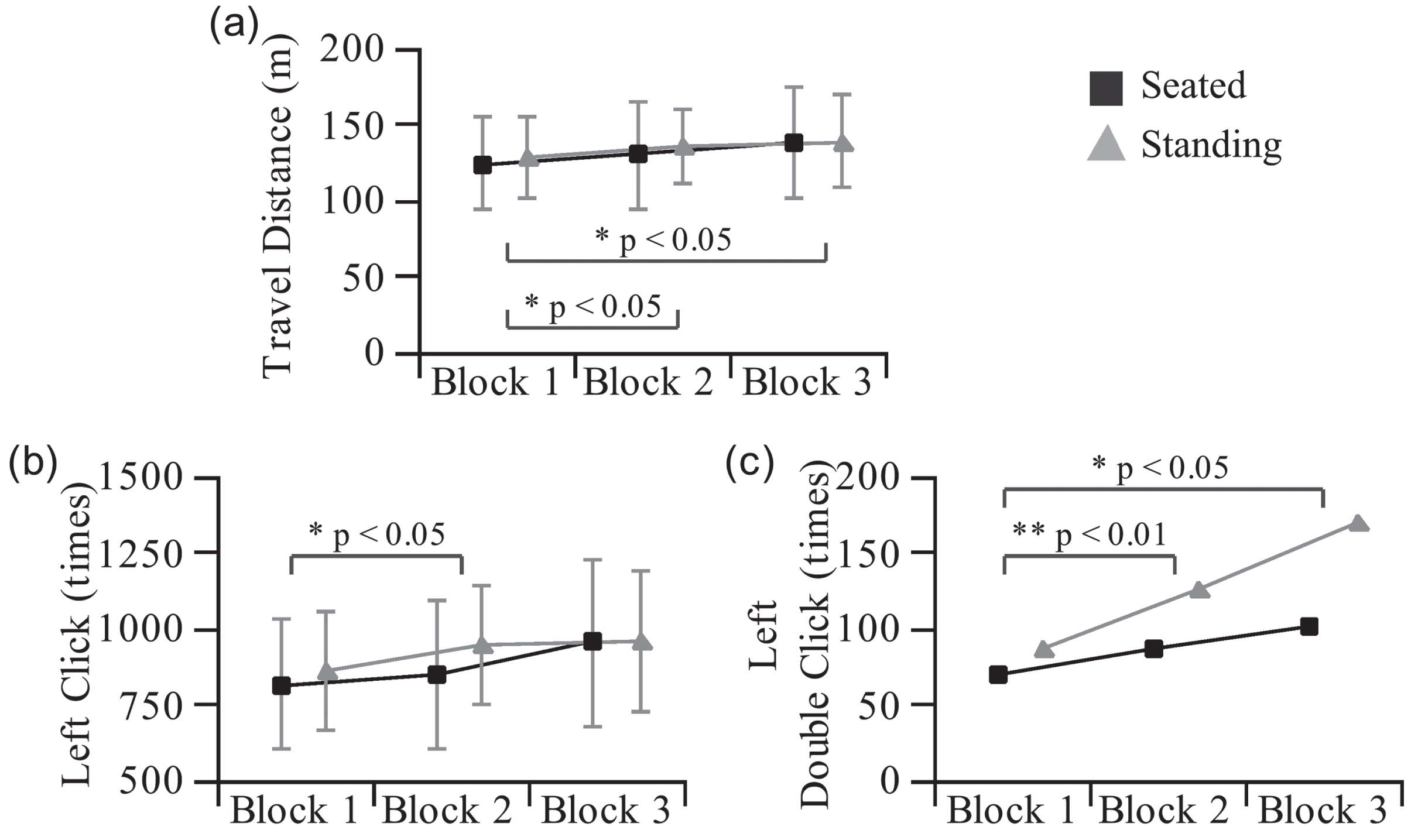
Mouse operation parameters by blocks: (a) Cursor travel distance (m), (b) Left click and (c) Left double click.
For both seated and standing postures, the body discomfort rating of neck, bilateral shoulder, right upper arm, right forearm, right wrist, and right hand were significantly increased at the end of block 3 (p < 0.05). However, there were no significant differences between time blocks. Although most of the discomfort ratings showed no significant differences between postures, the discomfort rating of right hand at seated posture was significantly higher than that of standing posture at block 3 (Table 1).
Body discomfort rating in seated and standing posture
Body discomfort rating in seated and standing posture
*significant changes in seated posture (p < 0.05), †significant changes in standing posture (p < 0.05), ‡significant difference between postures (p < 0.05).
Biomechanical risk factors such as repetitive movement and sustained work posture observed during computer use has been associated to work-related musculoskeletal disorders. Ergonomics solutions such as task variation and microbreaks are beneficial in reducing the risk of musculoskeletal disorders at workplace and relieving acute muscle fatigue [16, 22–24]. In this study, we aim to investigate the effects of task variation and microbreaks on muscle fatigue during mouse operation in simulated computer tasks at seated and standing postures.
Although the work time and work intensity of computer work such as typing and mouse operation often results in muscle fatigue and affects work performances [6, 22], the EMG results indicated a comparatively low amplitude for all four muscles, EDC, ECU, FDS, and FCU (Fig. 2). Previous studies reported a higher muscle activation of extensors during typing activities [6, 25]. Our results indicated a similar trend for extensor and flexor muscles in mouse operation at both seated and standing postures. Subsequently, the intensity of simulated computer tasks with focus on mouse operation was about 20% of the MVC of targeted muscles (Fig. 2). Therefore, our findings suggest that task variation and microbreaks could benefit both seated and standing work postures such as to maintain a lower muscle activation and thus avoid cumulative muscle fatigue at the end of a 90-min work time.
Next, we monitored the amount of applied force on the pointing device during mouse operation. Previous studies reported different contact forces on the pointing device such as grip force and force applied on pointing devices during computer work [10, 11]. Comparatively, our study measured vertical compression force on the mouse during simulated work tasks and observed a force of about 2 N being applied. We hypothesized that continuous computer work may lead to a higher applied force on the input devices such as the pointing device due to muscle fatigue. However, task variation and microbreaks during the 90-min work may relieve the cumulative forearm muscle fatigue and lessen the applied compression force during mouse operation.
Unexpectedly, the mouse operation performances remained similar from block 1 to block 3 for both seated and standing work postures. Muscular performances may be affected by cumulative muscle fatigue [26] and may eventually have a negative impact on the computer task performances [23]. Furthermore, our simulated computer tasks were rotated; mouse cursor traveled distance and left click indicate the total count of point-and-click and click-and-drag tasks. The mouse operation performances remained similar at both working postures, but they showed improvement across the 3 blocks of time. Since we randomized both work posture sequence and mouse operation tasks assigned to participants, the learning effects had minimal impact on these performances. Studies suggest that implementation of microbreaks not only lead to less musculoskeletal discomfort but also improves work efficiency and productivity [16, 27]. This experiment led to a similar conclusion that task rotation and microbreaks potentially minimize cumulative muscle fatigue.
Participants performed computer tasks at working postures recommended by the ergonomics guidelines. Our results indicate that repetitive low intensity work may not result in a distinctive difference in EMG amplitude or acute muscle fatigue (Fig. 2); however, the body discomfort rating of the neck and right upper limbs increased from the start to end of block 3, when compared to that of the left upper limbs (Table 1). This finding may be due to the accumulated long mouse operation time of 72 min out of the 90 min for the three blocks. However, the discomfort rating of the upper limb showed no consistent trend in both seated and standing postures. Regardless of how the tasks were rotated, the vertical compression force required for the mouse movements and successful performance at each trial might have been demanding. Since the requirements for the mouse movements were increasing due to the rapid development of the convenient graphical user interfaces, interventions to reduce the upper limb fatigue due to mouse usage should be sought.
The present study had some limitations. Firstly, the experiment designs such as young university participants and simulated typing and mouse tasks may limit the application of the current finding to general computer users. Furthermore, we excluded the characteristic differences between genders during computer use due to limited number of participants. Future studies may need to consider the effects of various designs of pointing devices such as a vertical mouse or trackball, in combination with task rotation and microbreaks, on muscle fatigue and vertical compression force.
Conclusion
Despite the limitations, the findings of the present study are meaningful and useful to office ergonomics. This study demonstrated that task variation and microbreaks could benefit computer users by reducing cumulative muscle fatigue during long hours of computer work at both seated and standing workstations.
Ethical approval
The study was approved by the Ethics Committee of the Faculty of Design, Kyushu University (No. 302-2).
Informed consent
Written informed consent was obtained from all participants.
Conflict of interest
The authors declare that they have no conflict of interest.
Footnotes
Acknowledgments
The authors have no acknowledgments.
Funding
This work was supported by JSPS KAKENHI grant numbers 18K17969 and 21K17686.