



Abstract
BACKGROUND:
Coronavirus disease 2019 (COVID-19) has badly affected the mental health, quality of life, and self-esteem of students worldwide.
OBJECTIVE:
The current study aimed to evaluate the psychological impact and self-esteem of dental students using Rosenberg self-esteem scale and PIDAQ during the COVID-19 pandemic.
METHOD:
This cross-sectional research was conducted amongst the dental students studying at various dental colleges in Karachi, Pakistan from January to May 2022. Evaluation of psychological aspect and self-esteem of students was carried out using “Psychosocial Impact of Dental Aesthetics Questionnaire (PIDAQ)”, and “Rosenberg self-esteem scale” as perceived by students during the pandemic. For data analysis SPSS v24 was used. Data analysis comprised of descriptive analysis, Spearman correlation, One-way Anova and Linear regression. The level of significance of p value was less than 0.05.
RESULTS:
Overall 332 students participated, among which there were 181 females (54.5%), 151 males (45.5%). Dental self-confidence showed a negative relationship with social influence, psychological effect, and aesthetic concern, while it was positively linked with self-esteem during the pandemic. Social impact demonstrated association with psychological impact, aesthetic concern, and self-esteem, while it was negatively correlated with dental confidence. Rosenberg score showed positive correlation with all the variables. Statistically significant association was identified for variables when compared with gender. Regression analysis indicated association of age with dental confidence and RSS, while gender with social influence.
CONCLUSION:
The pandemic, aside from affecting the health of individuals worldwide, also badly affected the well-being, mental health, and self-esteem of the dental students. Dental aesthetics plays a crucial role in the mental wellbeing and self-esteem of the students.
Introduction
The sudden outbreak of coronavirus disease 2019 (COVID-19) has badly affected the lives of people all over the world [1]. Due to the rapid increase in the number of COVID-19 affected cases, various countries implemented forced lockdown, which helped saved lives of millions of people [2]. Moreover, in Pakistan, after the first COVID-19 patient was identified, a country-wide lockdown was implemented on 1st April 2020. This lockdown assisted in restricting the spread of disease [3]. Nevertheless, this strict countrywide closure proved effective in controlling the virus, but at the same time it had negative impact on the psychological health of the individuals, which not only caused increased level of apprehension, despair, anxiety, but also affected the quality of life [4–6]. In the same perspective, quality of life of dental students worldwide also got affected [7], while a study from China reported higher incidence of depression in the students [8].
Due to the pandemic, all education continued online, and various video applications were used which included Microsoft Teams, Zoom, and Google Meet [9]. Aside from the advantages of online sessions, studies identified negative effects of how individuals perceived their image during those online sessions [10, 11]. It has been identified that during the video sessions participants’ attention shifted towards their appearance, and consequently generated a mirror effect, where users stared at themselves for a long period of time [12]. Mirror gazing had been associated with focused attention which increased the likelihood of being dissatisfied with their appearance which also affected their self-esteem [9, 13]. Moreover, perceptions regarding dental aesthetics are one of the crucial elements involved in the development of the personality [14]. The presence of malocclusion especially on anterior part, is quite noticeable, which could lead to negative social reaction and low self-esteem. [15]. Self-esteem reflects how one is perceived by others, especially the younger individuals who depends on others’ opinions and thoughts throughout their entire lives [16]. According to the World Health Organization, a person’s view regarding their state of life in relation to their culture, expectations, values, goals, standards, and priorities constitutes their quality of life [17]. The living condition of an individual along with the apprehensions faced, socioeconomic and the health status are few of the factors which can impact the quality of life [18, 19].
Various tools have been designed and developed which help evaluate the quality of life [20, 21]. These includes OHIP-14 [22] GOHAI [23] OIDP [24], PIDAQ [25], Rosenberg self-esteem scale [26]. All these tools differ with respect to the content of the item. OHIP-14 measures the effect of oral conditions on the quality of life, which includes physical pain, emotional discomfort functional limitation, physical, psychological, and social disability [22]. The GOHAI tool analyses several factors, including physical functioning related with eating and speaking, psychosocial dimension, oral health concern, dissatisfaction with appearance, and pain or discomfort in the mouth [23]. OIDP assessed an individual’s performance on daily activities based on their behaviors, some of which were eating, sleeping, laughing, and expressing their emotions [24]. PIDAQ “Psychosocial Impact of Dental Aesthetics Questionnaire measures four aspects, which includes “Dental self-confidence”, “Social Influence”, “Psychological Effect”, and “Aesthetic concern” [27]. Other than this Rosenberg self-esteem scale, which evaluates the self-esteem of an individual by identifying both negative and positive emotions associated with them [26]. OHIP-14 detected depression, GOHAI evaluates the masticatory efficacy, while OIDP assessed the daily routine [28]. Hence PIDAQ and Rosenberg self-esteem scale are two scales suitable for this study, as the study aimed to evaluate the psychological concerns associated with dental aesthetics and self-esteem.
PIDAQ was originally developed to identify orthodontic treatment needs, but it has also been used to measure the quality of life of participants related to dental esthetics [29]. Maligned teeth influence the masticatory efficiency and the orofacial esthetics but can also negatively affect the mental and emotional health of individuals [30].
According to MacDonald and Leary, self-esteem is a person’s opinion regarding their self-worth. It is based on an individual’s belief regarding their abilities which depends on their thoughts, life experiences faced by them, and effects their psychological health and well-being [31]. Choi et al. identified a link between self-esteem and depression; henceforth individuals with lower self-esteem are more likely to be subjective to feeling of despair, anguish [32].
Understanding and evaluating the psychosocial influence of dental esthetics and self-esteem amongst young adults is quite complex. Although various studies have examined the psychosocial impact of oral esthetics among adolescent patients [30, 32]. Similarly, in Pakistan previously conducted studies by Khan and Fida and Haq et al. only evaluated the psychological impact of participants using PIDAQ questionnaire [33, 34]. Another recent study by Azmi et al. assessed the anxiety and depression amongst the Saudi university students using Rosenberg scale and Self-Rating Depression scale by Zung, during the COVID-19 pandemic [35].
For our research, the study participants were dental students, who have more knowledge and awareness regarding dental conditions as compared to general population, despite not having completed their degree. Hence, we wanted to evaluate their responses with respect to self-esteem and dental esthetics concerns when the mode of education was online during the pandemic. In Pakistan, due to strict lockdown, on-campus education was conducted online, and at the same time the students were subjected to anxiety and uneasiness [4]. None of the studies conducted so far have analyzed the psychological aspects of dental students using PIDAQ scale and Rosenberg self-esteem scale during the pandemic. This study intended to evaluate the psychological impact and self-esteem of dental students using PIDAQ and Rosenberg self-esteem scale during the COVID-19 pandemic.
Materials and methods
For this cross-sectional study, 332 dental students enrolled in various dental colleges in Karachi, Pakistan were included. This study was conducted from January to May 2022. The main theme of the study was explained to all the study participants, and students’ perception regarding dental self-confidence, self-esteem along with other factors will be evaluated during the pandemic with the help of a questionnaire. This survey required approximately 10 mins to complete. Students were informed regarding maintaining full confidentiality of the information provided. All participants gave their consent before completing the survey forms.
Ethical approval
Formal ethical institutional approval for the study was obtained prior to its commencement (ERC 22/2021). This study was conducted conferring the Declaration of Helsinki.
Inclusion and exclusion criteria
Dental students from both genders, medically fit and well having no known underlying medical conditions, enrolled in dental universities in Karachi and those giving consent to participate were included.
Exclusion criteria comprised of students not giving consent, undergoing orthodontic treatment, having marked decay, periodontal disease, or trauma on anterior teeth, having cleft lip and palate, suffering from depression or other mental illness, providing incomplete information and absent on the day of data collection.
Process of data collection
Data was collected from the dental institutes in Karachi, with the help of a nominated faculty member. Printed questionnaire was distributed to the study participants, and the main concept of the questionnaire was explained to them before asking them to fill it. Students were approached during their free time and were asked to fill in the survey forms. Random sampling technique was used for data collection.
Study tools
To determine the oral health of the study participants, PIDAQ [25] was used for the investigation, whilst to determine the self-esteem of students, the Rosenberg Self Esteem Scale [26] was used.
PIDAQ scale
PIDAQ is an essential tool that determines the psychological and social influence of facial aesthetics of individuals. This questionnaire comprised of 23 items which had been further subdivided into four smaller groups. This included three questions asked related to aesthetic concern, six questions focused on evaluating the psychological effect, eight questions related to social influence whilst the oral confidence was assessed by six questions. For each question five options were provided using a five-point Likert scale. Additionally, zero marking implied no influence of facial aesthetics on quality of life whereas a score of 4 signified greater impact.
Rosenberg self-esteem scale
Rosenberg self-esteem scale encompassed 10 questions all focusing on similar dimension. It was assessed using the 5-point Likert scale. Five of the questions were positively worded while the remaining 5 were negative. To determine the total self-esteem value, the negative questions had to be (2, 5, 6, 8 and 9) recoded positively. After recoding, the values of all the questions were added all together, the greater the result, the greater the self-esteem of an individual.
Reliability of questionnaire
The reliability of the PIDAQ and Rosenberg self-esteem scale was measured using the Cronbach’s alpha and was identified to be satisfactory (0.83). The reliability score for dental self-confidence was 0.837, Social impact had 0.805, Psychological impact had 0.809, while Aesthetic concern was 0.817.
Sample size calculation
The sample size for the current research was evaluated using OpenEpi, Version 3. Using confidence level 95% with margin of error 5% and hypothesized prevalence was considered as 50% the sample size was identified to be 350. However, 18 forms were excluded due to incomplete information. Hence our sample size for study was 332.
Statistical analysis
Data was analyzed using SPSS version 24. Numerical variables have been displayed as mean and standard deviation, while categorical variables have been stated as frequency and percentage. Spearman correlation was applied, which evaluated association between different variables. One-way ANOVA test evaluated the association of PIDAQ and self-esteem (RSS) with different year of study. The Independent Sample T-test detected the association of PIDAQ and self-esteem (RSS) with gender. Linear regression assesses the dependence of variables with age and gender. P-value<0.05 considered to be statistically significant.
Results
Demographics details
From a total of 332, there were 181 females (54.5%), and 151 males (45.5%). Among these this included 47 (14.2%) 1st year, 50(15.1%) 2nd year, 116 (34.9%) 3rd year, 119 (35.8%) 4th year dental students. The age range of study participants was 97 (29.2%) 18-20 years, 177 (53.5%) 21-22 years, 58 (17.5%) were more than 23 years. Regarding the health status, 58.7% identified themselves in excellent health, 29.5 % rated it as good, 10.8% as fair, whilst 0.9% rated themselves poor health.
Correlation between PIDAQ & Rosenberg scale
Table 1 identified the correlation between the PIDAQ score and self-esteem during the pandemic, indicating direct or inverse relationship. Dental confidence was negatively correlated with social influence, psychological effect, and aesthetic concern, though it was positively associated with PIDAQ total score (p = 0.019) and self-esteem (p = 0.000). Social influence demonstrated positive relationship with psychological effect (p = 0.000), aesthetic concern (p = 0.001), and PIDAQ total score (p = 0.000) while it was negatively correlated with dental confidence, indicating that improvement in social impact will cause increases with the psychological influence and aesthetic concern.
Nonparametric correlations among PIDAQ and Self-esteem during the pandemic
Nonparametric correlations among PIDAQ and Self-esteem during the pandemic
**Correlation is significant at the 0.01 level (2-tailed). *Correlation is significant at the 0.05 level (2-tailed).
Psychological influence showed positive correlation with the social influence (p = 0.000), aesthetic concern (p = 0.000), and self-esteem (p = 0.032) whereas a negative relation was identified with dental self-confidence, hence if dental self-confidence decreases, it causes increase in the psychological impact. Aesthetic concern demonstrated an inverse relation with dental self-confidence, while aesthetic concerns were directly associated with social influence (p = 0.000), psychological effect, (p = 0.000) and Rosenberg self-esteem. Lastly, the total Rosenberg score demonstrated positive relation with dental self-confidence, social impact, psychological impact, and aesthetic concerns, however, statistically significant association was only seen with dental self-confidence (p = 0.002) (See Table 1).
Association of PIDAQ and Rosenberg self-esteem scores with students from different age groups could be seen from Table 2. Statistically significant association can be seen between social effect, and gender (p = 0.000). Psychological impact (P = 0.000) and aesthetic concerns (p = 0.011) showed statistically significant correlation with students from both genders. However, self-esteem did not demonstrate a positive association with gender (Fig. 1).
Linear regression analysis for the different variables
Linear regression analysis for the different variables
*Dependent Variable: Age & Gender. Linear Regression Analysis applied to see significance at P-value≤0.05.

Correlation of scoring of PIDAQ and self-esteem with gender.
Statistically significant correlation of dental self-confidence was identified with the age groups of students (p < 0.001). Social impact and psychological impact also demonstrated significant association with the age (p < 0.001). While the aesthetic concern also exhibited significant association with the different age groups (p = 0.015). Rosenberg total score also showed significant association with the age, identifying the impact of self-esteem (Fig. 2).
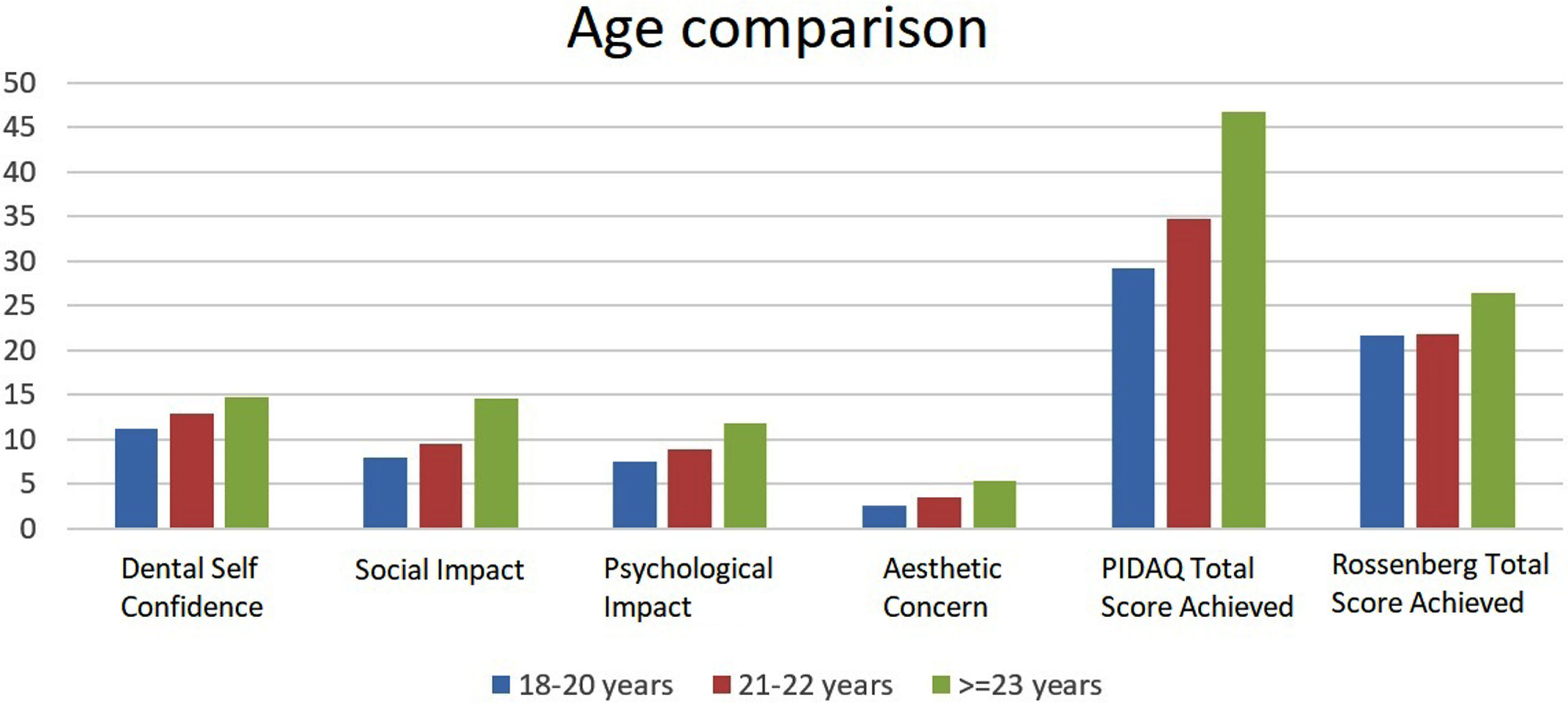
Correlation of PIDAQ and self-esteem (RSS) with age of participants.
Regression analysis was conducted to identify dependence of independent variables. Age and gender were assessed with social influence, oral confidence, psychological effect, concerns regarding aesthetics, and Rosenberg total score. Results showed statistically significant dependence among age and self-confidence, social impact, and Rosenberg total score, whilst gender showed significant association with social impact and Rosenberg self-esteem score. (Table 2).
Discussion
It has been found that throughout the pandemic, students experienced psychological stress, which led them getting worried about their self-esteem, owing to the burden of their coursework, and fear for the future [36]. Various previously reported studies have evaluated the psychological health of the students during the pandemic [37, 38]. The present study aimed at highlighting the effect of dental aesthetics on the psychological wellbeing and on self-esteem of dental students during the COVID-19 pandemic.
This study identifies that, for young adults, physical characteristics of the face play a fundamental role which has a substantial effect not only on the self-perception but also on their quality of life, confidence, and dignity [39–41]. Being physically attractive has a substantial influence on the above-described factors, which also impacts the psycho-social working [42]. In line with the previous literature, findings from current study showed that dental aesthetics had a higher impact on the mental health of the students, with significant implications on the body image [43, 44]. Bucchianeri et al. identified a direct relationship between age and body image in young individuals [45]. This could be attributed to the fact that during lockdown most of the individuals were forced to stay indoors, due to stress and anxiety many could have started binge eating which could have raised their weight and BMI and could have affected their self-confidence.
Psychological impact had statistically significant association with self-esteem, social and aesthetic concerns. These findings are in line with research led by Kavaliauskiene et al. who found an association between oral and psychosocial health. As a result, having good oral health can reduce the likelihood of experiencing anxiety, apprehension, and despair, demonstrating the existence of a link between the aforementioned variables [42]. Another study by Saladino also identified drastic impact of the pandemic on the social and psychological health of the population, which had significantly affected the college going students [46]. Moreover, this could also be because of the different economic status of students, which has been reported in previous literature [47]. It has been observed that students belonging to a lower socioeconomic background are greatly affected by dental appearance [48, 49] signifying that income has a direct effect on health care facilities and personal grooming. Lastly it can be seen that students from both genders were affected.
Social influence highlights the presence of an inverse relationship that existed between social influence and dental confidence. Also, it has been recognized that individuals who are quite mindful socially seem more cautious of their smile and looks. These outcomes are in agreement with the research led by Taghavi et al. which showed that individuals refrained from laughing in public to not show their teeth and isolated themselves from the crowd [50]. Furthermore, another study from Italy found that approximately 30% of the study participant’s physical appearance affected their frame of mind significantly during the pandemic, and this approach was more common within the female participants [51]. This is because females generally are more demanding and concerned regarding their dental aesthetics as compared to males.
Self-esteem can be described as the ability to understand the value of oneself. Furthermore, it was positively correlated with dental aesthetics, self-confidence, social and psychological influence. It has been known that individuals considering oneself as ‘less attractive’ generally have a lower self-esteem as compared to those who find themselves as ‘attractive’. This shows that self-thought aesthetics may have an impact on how one feels about themselves [52]. Our study findings are consistent with the studies conducted by Claudino and Traebert [53] and Badran [17]. Furthermore, findings from the study by Azmi et al. also showed that the self-esteem of 41% of the students was quite low during the pandemic, which had affected their quality of life [35]. Also, as our study participants were dental students, who basically have higher dental knowledge than public, in case of maligned or crooked teeth may get more conscious which could affect their self-esteem.
With respect to regression analysis, it was revealed that age of the participant affected the self-esteem and facial confidence. These outcomes are convergent from the study by Klages where no significant difference between age groups could have been identified [54]. Gender showed significant association with social impact and self-esteem. However, these findings are in contrast from a study done in Nepal, where gender did not have significant impact on social impact. Various researchers have stated higher level of self-esteem in males [43] whereas our finding is in line with the study of Azmi et al. where females had a higher level of self-esteem during the pandemic as compared to the males [35].
A statistically significant association was seen between students’ ages and the variables. Findings from the current study showed positive association of age with dental self-confidence, self-esteem, aesthetic, and psychological concerns. However, these findings are in contrast from the study by Hassan et al., who identified a direct association of social concerns with the lower dental confidence level, which was seen in young individuals [55]. However, our study participants aged 18 and above. This can be attributed to the fact that young children are more susceptible to teasing by their classmates in case of any visible dental malocclusion. Lastly self-esteem was also affected, as identified by the current study findings.
Our study’s main strength was being the first study to be carried out amongst the dental students after the COVID-19 pandemic using the Rosenberg scale and PIDAQ scale which have been identified as reliable indicator. This study could be helpful in understanding the dental students’ viewpoints and thoughts regarding the self-esteem and dental aesthetics as dental students have more awareness about the dental aesthetics as compared to the general public.
Limitations
The main limitation of the study was small sample size, despite conducting the study multi-centric, sample size was quite less. But we feel this can be due to limited seats being allocated for dental students in Pakistan. Secondly questions related to eating habits of students during the pandemic must have been asked, which could have further helped identify link between BMI and psychological aspect and self-esteem. Thirdly, as data was obtained from the students who voluntarily agreed, we feel these findings cannot be generalized. As, only dental students were evaluated in the current study, and the responses generated from the dental students could have been overstated, which could have led to overestimated or underestimated the influence of dental aesthetics and self-esteem. Therefore, it is recommended that for future studies students from other disciplines should be incorporated. Future studies could focus on evaluating relationships between different features of face with self-esteem, smile, and the type of personality as a possible factor in that relationship.
Conclusion
It has been identified that COVID-19, apart from affecting the health of individuals worldwide, also badly affected the quality of life, psychological health, and self-esteem of the dental students. Dental aesthetics played a crucial role in the mental wellbeing and self-esteem of the students. Moreover, for individuals who were already unhappy with their dental appearance, the pandemic further affected them psychologically and made them more conscious. The self-esteem of the students was also affected, which had further impact on their quality of life and well-being. Lastly, this study suggests use of PIDAQ and Rosenberg scale as useful tools to evaluate the psychosocial impacts of poor self-esteem and dental esthetics on young adults.
Ethical approval
The study was approved by the ethics committee of Bahria University Medical and Dental College, Karachi, Pakistan (ERC# 22/2021).
Informed consent
All participants were informed regarding the study design and provided informed consent.
Conflict of interest
Not applicable.
Footnotes
Acknowledgments
The authors would like to thank the dental students for helping them with this research project.
Funding
The authors report no funding.