



Abstract
BACKGROUND:
Stress is a pivotal aspect of organizational psychology. Although an individual’s attitude and behaviour at work have received greater investigation, scant attention has been given to family-related dynamics and their impact on work.
OBJECTIVE:
This study contributes to understanding work-family dynamics by investigating the connection between family incivility and job dissatisfaction during the pandemic. Based on the conservation of resources theory, the research explores the potential moderating role of perceived organizational support.
METHODS:
The investigation uses structural equation modelling (SEM) for data analysis while controlling for age, gender, and experience. Data has been collected with an adapted scale and time-lag technique in which the first wave encompassed independent variables and demographics. The second wave gathered moderator and dependent variables through a non-probability sampling of IT employees.
RESULTS:
Findings reveal a significant positive link between family incivility and job dissatisfaction, implying higher family incivility is linked to increased job dissatisfaction. Moreover, the study indicates that organizational support can mitigate the negative impact of family incivility on job dissatisfaction.
CONCLUSION:
This research underscores the pivotal role of organizational support in enhancing employee job outcomes. Hence, organizations should prioritize employee well-being, recognizing it as an integral aspect of their functioning.
Keywords
Introduction
Stress is a pivotal facet within organizational psychology, extensively explored with individual attitudes and behaviours at work. However, the influence of family-related dynamics on work outcomes has been comparatively understudied [1, 2]. Incivility emerges as a significant stressor capable of traversing home and workplace domains. Whether stemming from customers, supervisors, peers, or family members, even minor incivility incidents can gravely impact employee health, well-being, productivity, and job performance [3–5]. Research indicates that nearly 90% of employees have encountered incivility, with its prevalence being virtually universal [6].
While historical roots have ingrained incivility within family dynamics, it has gained contemporary attention within the workplace. Similar to organizations, families possess expectations of behaviour from members, and deviations from these norms can be construed as a breach of mutual respect [7, 8]. However, unlike organizations, families lack explicit rules, occasionally leading members to transgress these norms unknowingly. Notably, the research underscores the interconnectedness of stressors across life domains, illustrating how stress in one sphere can significantly reverberate in others [9–12]. This interconnectedness encompasses various outcomes such as role stress, work overload, psychological contract breaches, work engagement, and workplace incivility [2, 13–16].
Performance excellence requires substantial energy and resources, yet encountering family incivility (FI) can yield adverse job outcomes, including dissatisfaction and discomfort [2, 8]. Service quality hinges on positive human interactions, and employees’ experiences at home and work collectively influence their service delivery [17, 18]. FI can even intrude into an individual’s well-being beyond work, challenging their desire to be treated as more than just machinery. Employees’ productivity and dedication are intrinsically linked to their treatment within the workplace [19, 20]. Consequently, organizations wield considerable influence over employee perceptions, using policies, standards, and financial support to shape the perception of organizational favourability [19].
Perceived organizational support (POS), a construct within Organizational Support Theory, holds the potential to amplify employee commitment and dedication to organizational goals [21]. Recent research underscores that while FI drains resources, supportive constructs can act as a protective buffer against stressors, mediating their impact on job outcomes [2, 21]. This study postulates that POS can serve as a buffer, offsetting the adverse effects of FI on job dissatisfaction (JD), thus shedding light on how stressors within the family domain can ripple into job outcomes. This research addresses critical areas of organizational psychology by investigating the influence of family-related constructs, specifically FI, on job outcomes, mainly JD, during the pandemic. So, the study objectives are:
RO1: To examine the impact of family incivility (FI) on job satisfaction among Information Technology (IT) employees during the pandemic.
RO2: To investigate the potential mitigating role of perceived organizational support (POS) in mitigating the adverse effects of FI on job satisfaction.
This study seeks to contribute to understanding the intricate interplay between personal and work domains, which has yet to be minimally explored. By doing so, it highlights how organizations can mitigate the impact of FI and cultivate supportive environments. Hence, the study aims to explore the following research questions (RQ):
RQ1: How does family incivility impact job satisfaction among IT employees during the pandemic?
RQ2: To what extent does perceived organizational support moderate the adverse effects of family incivility on job satisfaction among IT employees during the pandemic?
This investigation was conducted among Information Technology (IT) employees across India, a sector profoundly shaping job creation and economic growth. Notably, the pandemic has introduced a novel work culture— working from home (WFH)— blurring the line between home and work and consequently fostering family-work conflict [23]. This study’s framework aligns with the Organizational Support Theory, suggesting that perceived support can influence employee commitment and job outcomes. Particularly relevant during the pandemic, this study examines the association between FI and JD while delving into the role of organizational support, which might be less overt but equally crucial. Thus, this study contributes to the theoretical advancement of understanding support’s role in mitigating negative stressors.
Theoretical background
In daily life, individuals navigate diverse roles, necessitating careful resource management. Introduced by Hobfoll in 1989, the Conservation of Resources (COR) theory illuminates how individuals procure, manage, and expend their resources. Over the past three decades, this theory has gained substantial traction in organizational psychology, particularly in stress management. According to COR theory, individuals strive to harmonize resources— energy, effort, time— across domains, optimizing their performance in each sphere. Given limited resources, strategic allocation becomes imperative, demanding astute attention to specific needs in each domain. Literature underscores that recovering lost resources is unlikely, prompting individuals to seek resources from alternate domains, such as work, to fulfil requirements [13, 24]. Notably, COR theory underscores the essence of efficient personal resource management for superior performance across life domains, enabling prudent resource allocation to uphold well-being and productivity.
Hypotheses development
Family incivility and job dissatisfaction
Strategic resource allocation tailored to workplace and home demands is paramount, especially when accounting for future necessities. Hobfoll posits that individuals allocate and accrue invaluable resources encompassing familial connections, a sense of belonging, and self-esteem [25]. However, the depletion of an employee’s resources due to family-induced stress can impair their effectiveness in the workplace [2, 8]. Persistent stress from either the professional or domestic sphere can exert detrimental effects on employees, resulting in discomfort, diminished productivity, and dissatisfaction [26, 27].
Literature underscores the adverse impact of FI, a corrosive interpersonal stressor eroding employee resources and retarding job performance [11, 29]. Actions such as rudeness, sarcasm, disrespect, and neglect by family members can inflict inadvertent emotional wounds, sapping valuable emotional resources crucial for stress management [1, 5]. This imbalance in emotional equilibrium reverberates into job outcomes [28, 30]. Despite extensive research on workplace incivility and its consequences, scant attention has been directed towards comprehending the ramifications of family-related stressors in the professional sphere [1, 22].
Hence, a thoughtful distribution of resources that caters to work and home exigencies while planning for future needs is indispensable. Acknowledging and effectively addressing FI stands pivotal in cultivating equilibrium, promoting optimal job outcomes, and safeguarding employee well-being. Therefore, addressing and managing FI is crucial to maintain a balanced state of mind and improving job outcomes.
Moderating role of POS
Amid technological advancements and societal shifts, emotions, sentiments, and acknowledgements remain integral to individual lives, societies, and nations. Within the professional realm, an employee’s perception of their organization’s support holds immense significance for their commitment and engagement. Termed POS encapsulates an employee’s sense of the care exhibited by their organization [31]. Through policies, cultural cues, financial backing, and more, organizations endeavour to portray an image of valuing their employees, nurturing a sense of allegiance [19]. OST elucidates how organizations diligently amplify employee dedication and belongingness. This is accomplished by offering support, and validating contributions, thereby kindling a sense of obligation within employees, ultimately fortifying the organization’s goals [19, 32]. Extensive literature underscores POS as a positive construct, wielding the capacity to cushion adverse consequences [33]. Beyond the work sphere, the family emerges as a potential stress source, permeating the workplace and impairing EP, JS, and performance [7, 34]. In line with the COR theory, stressors exhaust resources, necessitating supportive mechanisms to replenish those resources crucial for managing stress; in this context, POS plays an instrumental role [35, 36]. Given the premises above, our research postulates that POS assumes a moderating role, attenuating the link and countering the adverse fallout of FI on JD. Bolstering an employee’s POS can empower organizations to alleviate the detrimental impact of FI on JD.
Methodology
This study takes a comprehensive approach to unravelling the dynamics of individual roles within both the home and work domains, expanding upon the COR theory’s application to FI and POS. Investigating FI sheds light on how individuals strategically allocate their resources based on the COR theory’s principles, both at work and in their family context, while highlighting the moderating role of POS in the relationship between FI and JD.
JD, a quantifiable variable, can be measured through standardized scales or surveys. This approach permits empirical data collection, enabling statistical analysis and objective examination of the interplay between FI, POS, and JD. The investigation uses SEM for data analysis while controlling for age, gender, and experience. Data has been collected with an adapted scale and time-lag technique in which the first wave encompassed independent variables and demographics. The second wave gathered moderator and dependent variables through a non-probability sampling of IT employees. The initial sample of 512 was refined to 313 in the second wave. Previous research attests that obtaining 5–10 responses per item from participants is reasonable [37], and a sample size of 100–200 suffices for SEM [38, 39]. This study surpasses the requisite sample size (19*10 = 190) with 313 usable data points. To authentically capture the pandemic and WFH experience, respondents had at least two years of experience pre-COVID-19. The study adopted scales for FI, JD, and POS, with FI and POS assessed on six and eight-item scales, respectively [7, 40]. The JD scale, sourced from Ho and Au [41], comprises a five-item scale, with the Satisfaction Scale scores reversed [42]. Construct reliability scores of 0.973, 0.892, and 0.980 were recorded for FI, POS, and JD, respectively, underscoring the constructs’ reliability [37].
Data analysis and results
Descriptive analysis
The current study encompasses a descriptive analysis of its variables, encompassing mean values, standard deviations, maximum and minimum values, and standard deviation errors. Consistent with prior research, mean scores approximating three and standard deviations close to one indicate robust data quality [39, 43]. The descriptive analysis outcomes conform to these criteria, as delineated in Table 2. The Kaiser-Meyer-Olkin (KMO) test was executed for data sufficiency assessment, evaluating data factorization efficiency (Table 1). This conventional procedure gauges the aptness of the data structure and its suitability for factor analysis. A value nearing 1.0 signifies suitability for factor analysis, while a value under 0.50 is deemed unsuitable. The guideline threshold stands above 0.6, and our study yielded a KMO value of 0.921 [44]. The degrees of freedom were statistically significant based on the sphericity test.
Descriptive statistics
Descriptive statistics
KMO and Bartlett’s test
The current study employs SEM and integrates Exploratory Factor Analysis (EFA) and Confirmatory Factor Analysis (CFA), given the adaptation of constructs from foreign contexts to align with the host nation’s culture and environment. FI, a relatively less explored domain, necessitates EFA to scrutinize the structural intricacies and interconnections of the applied model [45]. CFA follows to assess the model’s reliability and validity and gauge its overall goodness of fit. Subsequently, SEM evaluates the proposed research model by examining pertinent model fit indices [54–57].
EFA constitutes a widely recognized statistical technique for streamlining or simplifying the dataset, facilitating an investigation into the theoretical model’s underlying structure and relationships [58–60]. Convergent and discriminant validity analyses ascertain the associations between or dissociations among constructs. Convergent validity gauges construct relationships through correlations, while discriminant validity assesses the distinctions between disparate constructs [37]. The analysis leverages the Average Variance Explained (AVE) and standard loading to gauge convergent and discriminant validity [61–63]. According to the literature, AVE should exceed 0.5, while the Mean Shared Variance (MSV) and Composite Reliability (CR) should surpass AVE, and CR should surpass 0.70 [37]. The analysis findings (Table 3) align with these benchmarks. Data analysis accounted for the potential influence of age, gender, and experience [7, 22]. However, the analysis did not yield substantial evidence signifying that these variables significantly impact the relationship between FI and JD [7].
Convergent and discriminant analysis
Convergent and discriminant analysis
Notes: Reliability: Construct reliability (C.R)>0.7; convergent validity: AVE > 0.5; C.R>AVE; discriminant validity: MSV < AVE; square root of AVE > Inter construct correlation. JD = Job Dissatisfaction, FI = Family Incivility, POS = Perceived Organisational Support.
The measurement model underwent assessment through Confirmatory Factor Analysis (CFA), a commonly employed technique to evaluate the proposed model’s fitness, suitability, and uni-dimensionality [47]. CFA served to determine the adequacy of the proposed model, scrutinizing various goodness of fit indices, including chi-square divided degrees of freedom (X2 /DF), Comparative Fit Index (CFI), Normed Fit Index (NFI), Root Mean Square Error of Approximation (RMSEA), and Root Mean Square Residual (RMR). The four-factor model was tested using Amos 24 software, employing the maximum likelihood estimation method. Modification indices were considered, encompassing CFI, GFI, CMIN/DF, P-value, and RMSEA. The analysis adhered to established threshold criteria: CMIN/DF should fall between 1 and 3, CFI should exceed 0.95, and SRMR and RMSEA should be less than 0.08 and 0.06, respectively. Furthermore, the P-value was expected to surpass 0.05 (Table 4) [48, 51].
Measurement model
Measurement model
This study’s core objective is to investigate the correlation between FI and JD and explore the moderating role played by POS. The first hypothesis postulates a robust link between FI and JD. The findings (β=0.276, P=***) affirm that FI substantially influences JD [5, 22]. Encountering FI drains an individual’s finite resources, leading to JD. The study delves into the moderating effect of POS, a critical factor that amplifies or mitigates the connection between the independent and dependent variables. The moderating variable acts as an amplifier, altering the strength of the existing relationship between the variables under investigation. The researchers posited that the positive impact of POS buffers the FI-JD relationship. Utilizing tools such as SPSS 25, PROCESS Macro, and Amos 24 [51], the study divulges that POS indeed moderates (H2) the association between FI and JD (β=0.15, P = 0.005). The analysis corroborates that POS operates as a moderator in the relationship between FI and JD. Figure 1 visually demonstrates that although FI demonstrates a positive link with JD (directly, β=0.24), the interaction effect of POS mitigates the adverse impact of FI on JD (β=0.15). Tables 5 and 6 provide insight into hypotheses testing and moderation effects, respectively, while Fig. 2 graphically illustrates the moderation slope.
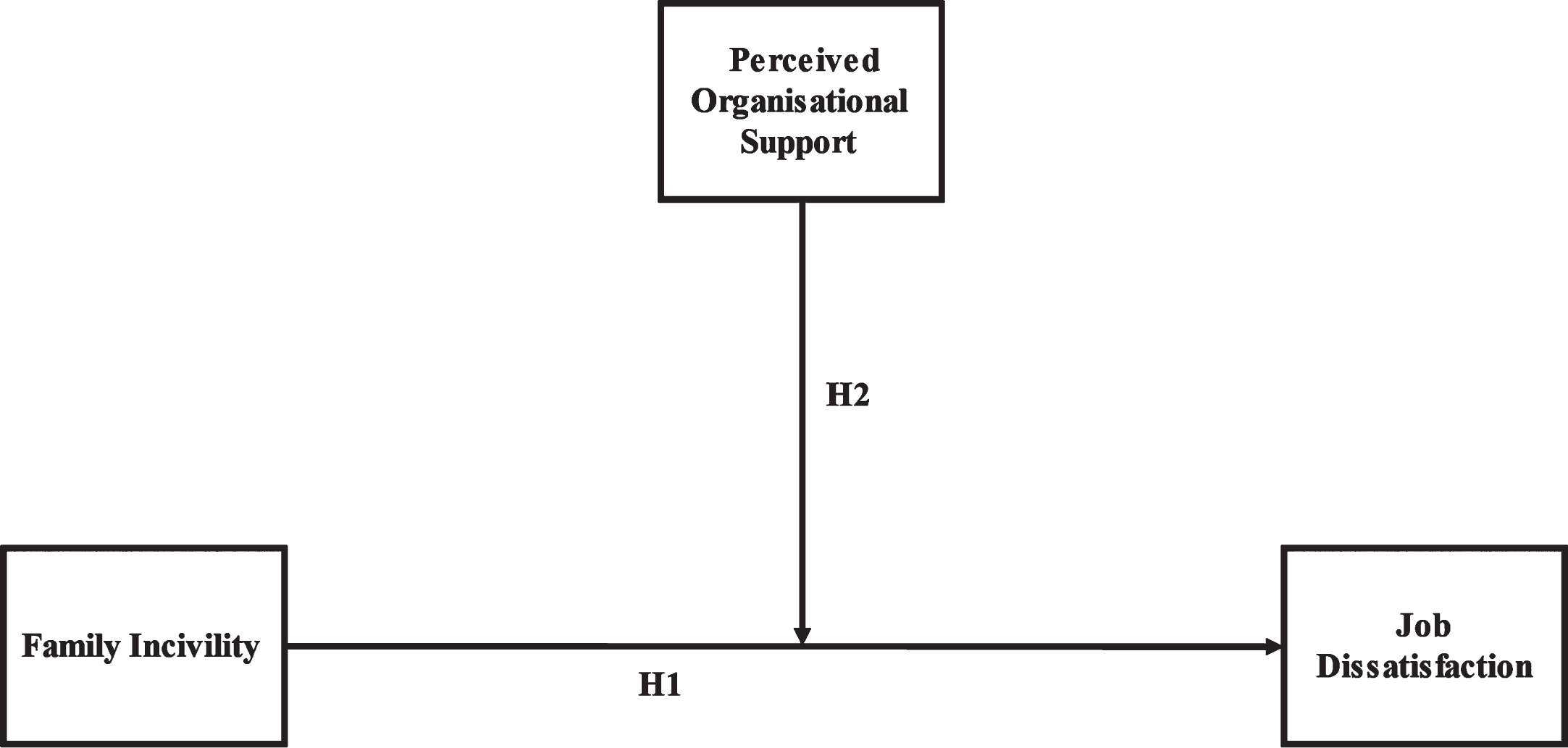
presents the theoretical model.
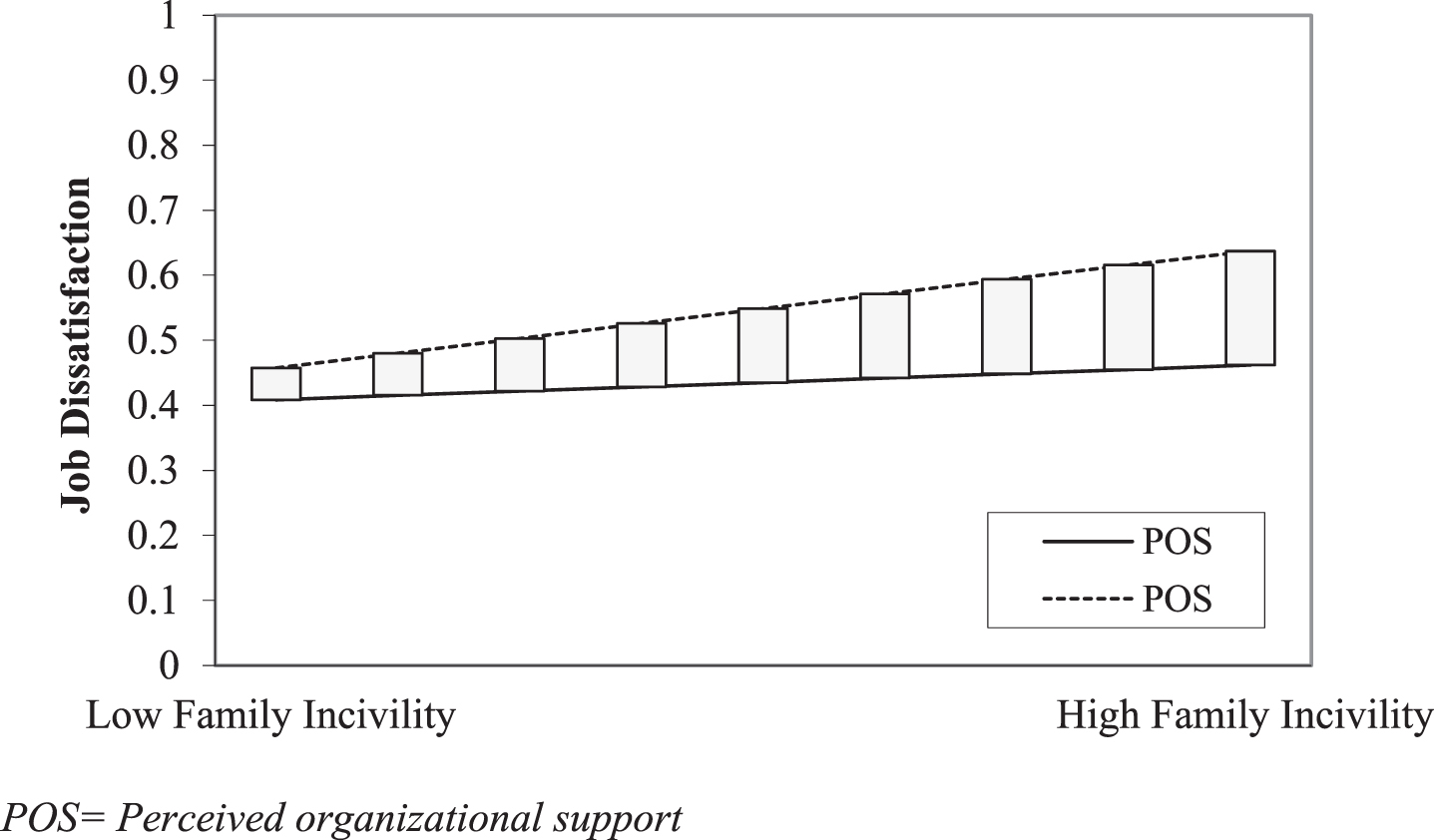
Moderation slope. POS = Perceived organizational support.
Hypotheses testing
FI = Family Incivility, JD = Job Dissatisfaction, POS = Perceived Organisational Support.
Moderation effects
ZEmoLab = Emotional Labour (Standardize value). Interaction = Family Incivility* Perceived Organisational Support (Standardize value).
This study endeavours to expand the realms of the Conservation of Resources (COR) theory by delving into the FI landscape and dissecting the interplay between FI and JD. While prior research has extensively delved into the domain of work-home conflict, this investigation zeroes in on the specific realm of FI. Under the COR theory’s premise that individuals possess finite resources, it is evident that FI acts as a resource-depleting factor, leaving individuals with diminished resources and culminating in JD. Our current data analysis solidifies the robust connection between FI and JD, a trend consistent with prior studies [1, 28]. In light of human beings’ innate social nature, interactions are often sought to release pent-up frustrations. Traditionally, homes serve as havens for stress alleviation, yet this paradigm may not hold for employees grappling with FI on the home front. Our data analysis underscores the positive association between FI and JD.
When employees encounter elevated levels of incivility within their domestic sphere, a corresponding rise in JD may follow suit. This research aligns with prior investigations [2, 26–29], suggesting that the ripples of incivility extend from home to the workplace. Frustrated employees experiencing FI tend to exhibit amplified JD due to the considerable depletion of their daily resource reservoirs; This creates a disparity between resource demand and supply needed for effective job performance. The study also addressed possible avenues to ameliorate the adverse consequences of FI on job outcomes, ultimately revealing that POS serves as a buffering agent against the impact of FI on JD. POS, a positive and constructive construct, underscores the imperative for employers to comprehend the daily stressors faced by their employees. Acknowledging the duality of individuals’ lives –encompassing both work and home domains –it is evident that employers must tread lightly in personal life. However, organizations can manifest their support through policy implementation, recognition, and providing a nurturing environment. Existing literature firmly attests that Organizational Support does not solely cushion the blow of stressors and elevates employee performance, dedication, and commitment [1, 52]. In scenarios where individuals grapple with FI, such as being ostracized or excluded from social interactions, their engagement with work becomes compromised, and the dearth of familial connections incites significant distress and resource depletion [2, 22]. While employees might commence their work shifts feeling depleted, organizations can step in to facilitate optimal performance, thereby alleviating JD.
Given that individuals navigate the intricate balance between home and work throughout their lives, the ability to seek support from the home domain in the presence of FI becomes compromised. In this context, organizations play a pivotal role in furnishing the requisite support and recognition for employee contributions, culminating in heightened commitment and JS.
Theoretical and managerial implications
The well-being of employees stands as a cornerstone for the triumph of any organisation. The current study’s revelations spotlight the deleterious consequences of FI on JD, underscoring the exigency for organisations to address this issue while introducing a pivotal factor for alleviating its adverse aftermath. While existing literature underscores the perils of incivility in the workplace, our inquiry further asserts that it is equally treacherous. Similarly, just as workplace incivility spills over into personal life, our investigation elucidates how FI infiltrates the workplace, amplifying JD. This reframes employee dissatisfaction to encompass organisational culture, managerial conduct, remuneration, acknowledgement, and the complex interplay of family dynamics.
The study’s exploration also extends to the role of POS within the context of the FI-JD relationship, revealing that POS effectively cushions the deleterious impact of FI on JD. In light of these revelations, organisations can proactively arrange family-therapist seminars to bolster awareness about the repercussions of FI and arm employees with strategies to manage their family dynamics better. Organisations can buttress employees facing FI by employing an array of measures, such as impartial feedback mechanisms, equitable job descriptions, just compensation structures, and an incentive system [7, 53]. Additionally, informal conversations or motivational dialogues may serve as a wellspring of resources, equipping employees to navigate work-related challenges [7]. Moreover, our study brings to the forefront the insight that individuals grappling with FI often neglect to consider seeking support from their familial sphere, thus underscoring the paramountcy of organisational backing. In this light, organisations can in state Employee Assistance Programs (EAP) and conduct training sessions on managing familial conflicts to empower employees to navigate these challenges adeptly. Further acknowledging that FI exacts an emotional toll, sapping morale and productivity, the study underscores that informal interactions can be instrumental in replenishing emotional resources.
Nevertheless, organisations must demonstrate their commitment to employee well-being to ascertain optimal performance. This entails providing flexible work arrangements, mentorship and camaraderie from supervisors and colleagues, emotional support mechanisms, recognition schemes, and pertinent policies. In sum, this study imparts a resounding message on the imperative of addressing FI to foster employee well-being and underpin the organisation’s broader success.
Conclusions, limitations, and future scope
In the intricate tapestry of organizational success, human resources are a cornerstone, necessitating an unwavering commitment to employee well-being. The current study casts a spotlight on the imperative for organizations to fathom the potential detriments of FI and grasp the instrumental role of POS as a salient buffer. By delving into the intricate interplay of FI, POS, and JD, this research makes a significant stride in organizational psychology, fortifying the bridge between familial dynamics and the workplace milieu. The outcomes underscore the crucial importance of nurturing a nurturing ecosystem at work while illuminating the symbiotic relationship between personal and professional realms in nurturing employee contentment and job gratification. Remarkably, even in the wake of familial incivility, organizational support emerges as a potent elixir that bolsters employees’ resources and instils a sense of fulfilment within the workplace.
Nevertheless, it is prudent to acknowledge the study’s limitations in pursuit of knowledge. Utilizing non-random sampling and the inherent complexities of causality within individual behaviours, perceptions, and attitudes introduce methodological constraints. While these limitations offer valuable insights, they prompt us to interpret findings cautiously. To enrich the field, future research might explore alternative moderators or mediators that influence the FI-JD relationship and delve into inventive interventions to counteract FI’s detrimental repercussions. A promising avenue involves embracing a mixed-method approach, which could provide nuanced insights into the intricate underpinnings of the phenomenon.
Furthermore, while the current study encapsulated the constructs of FI, JD, and POS, the future might beckon a closer examination of the moderating influence of supervisor support— precisely, the interpersonal facet. As an anchor, supervisor support could potentially attenuate the adverse ramifications of FI in the work domain. Consequently, delving into the dynamics of supervisor support could potentially unlock a more holistic comprehension of the myriad factors that impact employee well-being.
In closing, this study resounds with a clarion call for organizations to nurture a symbiotic ecosystem wherein individual well-being intertwines with organizational triumph. The intricate dance between FI, POS, and JD further substantiates that fostering employee resources and satisfaction is not merely a strategic pursuit but an ethical imperative that reverberates through the heartbeat of organizational vitality.
Ethical approval
Not applicable.
Competing interests
The authors declare no potential conflicts of interest with respect to the research, authorship and/or publication of this article.
Footnotes
Acknowledgments
The authors would like to thank the two anonymous reviewers, Associate Editor, and Editor-in-Chief for their valuable comments and suggestions that helped to improve the manuscript.
Funding
The authors received no financial support for the research, authorship and/or publication of this article.
Availability of data and materials
Data can be made available on request for academic purposes.