



Abstract
BACKGROUND:
The coronavirus disease 2019 (COVID-19) pandemic caused employees to be mentally absent at work and decreased their motivation and effort when they work collaboratively rather than individually due to the fear of transmission.
OBJECTIVES:
The study aims to test the effect of fear caused by COVID-19 on levels of presenteeism and social loafing from job tasks of employees.
METHODS:
Data were collected from 522 white-collar and blue-collar workers in Turkey by the snowball sampling method. Before testing the hypotheses, CFA was performed. Reliability analysis was assessed via Cronbach Alpha (FCV-19S = 0.941; PS = 0.713; SLS = 0.974), AVE (FCV-19S = 0.686; PS = 0.524; SLS = 0.725), and CR (FCV-19S = 0.734; PS = 0.722; SLS = 0.856) values. The mediating effect of fear of COVID-19 within the impact on presenteeism on social loafing was evaluated through Process Macro for SPSS. The coefficients for both direct and indirect effects were calculated in the 95% confidence interval using 5,000 bootstrap replicates.
RESULTS:
The results show that presenteeism has a significant positive impact on social loafing. Fear of COVID-19 has a statistically significant impact on presenteeism and social loafing. Also, fear of COVID-19 partially mediates within the impact of presenteeism on social loafing in the study.
CONCLUSION:
Organizations should consider employees’ views to increase the level of well-being and productivity. A high level of inventiveness from organizations is compulsory to explore which organizational roles and workflow are at least remotely operated during this period.
Introduction
The coronavirus disease 2019 (COVID-19) pandemic deeply affected our lives as of 2020 [1], not only changing the way we live but also affecting the way of doing business. Great necessities arose to adapt to the current situation, which required drastic alteration in a short period in the workplace [2]. Employees have experienced both physical and psychological unprecedented challenges due to the pandemic [3]. The effects of COVID-19 have been severe and have instilled a sense of fear in employees, who are worried about contracting the virus, resulting in a fear of COVID-19 [4].
It is acknowledged that fear contributes to maladaptive coping mechanisms and can result in individual and social breakdown, leading to detrimental outcomes. This fear may cause employees to experience severe psychological distress, loneliness, and dissociation, which can in turn lead to a loss of focus or complete isolation from crowded office spaces [5]. In this regard, the fear of COVID-19 can have detrimental effects on employees, such as presenteeism [6], and social loafing due to the fear of catching COVID-19, as employees are concerned about their job safety [1].
Understanding the mental effects of COVID-19 and the corresponding changes in presenteeism and social loafing is significant because the pandemic serves as a turning point toward a potential new normal. There may be a relationship between these three concepts, as the fear of COVID-19 and presenteeism can both contribute to social loafing. Thus, it is necessary to explore the factors that determine whether employees engage in presenteeism and social loafing, which holds both theoretical and practical significance. Specifically, identifying mediating variables may offer solutions for implementing policies aimed at minimizing or overcoming presenteeism and social loafing in organizations.
Our research aims to gain a deeper understanding of the mechanisms that explain why employees tend to exhibit presenteeism and social loafing behaviors during the COVID-19 pandemic. In this regard, the study focuses on the following three research questions: (a) Does presenteeism have an impact on social loafing? (b) Is the fear of COVID-19 a central determinant of social loafing? (c) How does the fear of COVID-19 predict these variables if presenteeism leads to social loafing?
Conceptual framework
Presenteeism
Presenteeism, which is one of the most common problems faced by employees and employers in today’s business world, has emerged as a significant issue during the COVID-19 pandemic. This is because it has become crucial to prevent and control COVID-19 outbreaks and prioritize the health and well-being of the community and employees [7]. As a result of the COVID-19 pandemic, a considerable portion of the workforce now works from home, and many individuals have more flexible work schedules.
Presenteeism is the phenomenon of individuals continuing to work when they are ill, rather than taking time off work as a sickness absence [8]. It is the state of being physically present at work, not mentally [9], and is defined by most researchers as those employees working while they are sick mentally [10]. An infected employee may stay at home but actually work remotely all day, which is another hybrid behavior that may be described as “remote presenteeism” [11].
Presenteeism may occur for several reasons such as personal factors (less teamworking responsibilities, financial difficulties, boundarylessness, sickness), demands (job insecurity, replaceability, control over the pace of work, conflicting demands, insufficient resources, management style, and time pressure), and organizational policies [12]. However, in general, it becomes a problem when employees are unable to fully function at work due to illness or other medical conditions, leading to a decrease in individual and organizational productivity.
The phenomenon of presenteeism can be effectively analyzed and explained from an economic perspective, particularly through economic theory, despite the presence of additional psychological, sociological, and medical determinants [13]. Economic theory is the science that studies the actions of individuals in the process of allocating scarce resources for the production, exchange, distribution, and consumption of goods and services [14]. Within this framework, economic incentives play a crucial role in determining the optimal level of presenteeism [15]. In other words, economic theory suggests that presenteeism can be driven by financial incentives. Employees may feel that they need to come to work even when they are unwell to avoid financial hardship or job loss. For example, an employee who does not have access to paid sick leave may feel that they cannot afford to take time off when they are sick, even if it means risking their health or the health of their colleagues. Similarly, an employee who is on a fixed-term contract or is in a precarious job situation may feel pressure to come to work even when they are not feeling well, to avoid being perceived as unreliable or risking the loss of their job.
Presenteeism is a much costlier issue than its productivity-reducing counterpart, absenteeism [16]. Though minimizing the cost of illness absence may appear vital, there is much evidence that illness presenteeism (working despite being ill) is far more costly than absenteeism [17, 18]. Because it may lose productivity depending on employees’ work despite health problems [19]. Therefore, it causes a decline in employees’ physical and psychological health and work performance, finally leading to productivity loss and increasing companies’ costs to cover it [20]. In addition to creating health problems and low productivity in employees, presenteeism is also a crucial factor in the emergence of social loafing behavior [21]. According to Oge and Kurnaz’s [21] study conducted on 102 employees working in the automotive sector in Konya, Turkey, a statistically significant positive relationship was found between presenteeism and social loafing. Based on this discussion, it could be hypothesized that:
H1: Presenteeism has a positive and significant impact on social loafing.
Social loafing
French agricultural engineer Max Ringelmann [22] who studied group performance first coined the term social loafing [23]. He found that groups did not meet their potential, identifying potential as the sum of the maximum output of everyone performing alone [24]. The Ringelmann effect or social loafing attracts attention since it appears to violate social psychological theory. Because the social psychological theory holds that well-learned tasks including dominant responses and the presence of other individuals should improve job performance [25]. However, the Ringelmann effect or social loafing emphasizes the finding that in increasing physical tasks, the average job performance of employees lessens by increasing group size [26].
The term social loafing is the behavior to decrease an employee’s effort when working coactively rather than individually on the same duty [27]. In other words, it describes the decrease in motivation and attempts while employees work together in contrast with working individually or collectively [28, 29]. It is an immoral behavior type that reduces productivity by remaining inactive at work and demotivates other team members to carry out their duties [30]. For this reason, it is acknowledged as a social disease at every level of social strata [31].
The basis for social loafing is the de-individuation that may occur when employees work together opposite of working individually [32]. The social loafing tendency describes the situation in organizations where employees coactively produce products and/or services, avoiding responsibilities within the group [33]. Thus, the emergence of social loafing disrupts the performance of employees in it, which impacts team performance and productivity [34]. It reduces job performance and coordination, caused by a lack of simultaneity of employees’ attempts when the number of them increases in [35]. Especially in the COVID-19 pandemic era, employees who had to work at offices perceived group-based work negatively. Because working in a crowded work environment meant being affected by COVID-19 at the same time. Therefore, instead of working with a large team, employees preferred social loafing and were deeply focused on individual work.
Fear of COVID-19
The global COVID-19 pandemic first announced in China in late 2019 and then spread fast around the world. The World Health Organization (WHO) declared COVID-19 a global pandemic starting in early January 2020 [1]. The COVID-19 pandemic, with its relatively high mortality and rapid transmission, has caused a huge burden on the whole world [36–38]. According to the WHO Weekly Reports [39], as of 8 January 2023, approximately 659 million confirmed cases and 6.6 million deaths have been announced globally since the beginning of the pandemic.
COVID-19 has caused many organizations to struggle for survival and imposed enormous challenges on business organizations [40]. It has forced many organizations to drastically shift how they operate their business and radically changed employees’ work routines and activities [41]. In other words, it actuated interventions such as travel restrictions, working virtually or remotely, social distancing, and core team members have constrained the earlier processes of doing business, thus shaping the way employees work [42, 43]. For instance, Facebook (or renamed “Meta”) focuses on a 3D space representation based on augmented reality (AR) and virtual reality (VR) [44] and introduced a new VR remote work application where employees may arrange and participate in meetings as avatar versions of themselves. Thus, employees can continue to work from home with Facebook’s Horizon Workrooms due to the global pandemic [45].
As the COVID-19 pandemic escalated, remote working and social distancing became the new normal and raised fears about the effects on people’s health and job performance between employees and managers [46]. For example, Tesla’s CEO Elon Musk has forced his employees to return to the office full-time, announcing that working remotely is no longer acceptable. Also, Musk sent to employees telling them to return to the office or resign [47]. In addition, US-based technology giant Apple has been more stringent about having its employees return to the office than some of its peers, and the company’s former machine learning director publicly cited its policy as the reason he left the company back [48]. Moreover, in March 2022, a global recruiting company, Robert Half, shared a survey that showed that 50% of employees in the US would rather resign than return to the organization full-time. During the pandemic, a large number of employees expressed that they would quit if organizations forced them back to the office [49].
Clearly, employees in many organizations are wondering whether the remote work practices that exploded during the pandemic continue. This because the pandemic has turned into “coronaphobia”, which literally means an over-triggered response to a fear of catching the virus that causes COVID-19 [50]. Thus, employees are struggling to balance their tasks to work with the fear of being infected and transmitting infection from work to home or vice versa [51]. This fear also creates myriad symptoms of mental trauma, such as stress, attention deficit, emotional distress, and mood swings in employees in the workplace [52]. These symptoms cause detrimental effects such as presenteeism on employees who go to work despite physical or mental challenges because of intense fatigue and tiredness and a lack of recovery possibilities [6]. In other words, it is possible that presenteeism may become another type of behavior both socially and by organizations, due to fear of COVID-19 transmission [18]. As Ferreira et al. [7] argue, the negative effects of COVID-19 on employees cause presenteeism in the workplace. They also suggested that the widespread pervasive adoption of remote work because of COVID-19 has important implications for the presenteeism literature and opens avenues for further research. At the same time, when employees are physically at the workplace during the pandemic this may cause fear of contracting the virus. Thus, while the employees are not worried about contracting COVID-19 at home, they may worry about it at work. On the other hand, because the fear of COVID-19 has severe psychological and psychosocial impacts, another type of behavior that occurs among employees in the workplace can be considered social loafing [1]. These consequences can be explained by the Conservation of Resources (COR) theory, which suggests that individuals are motivated to acquire, maintain, and protect resources that are important to them, such as their health, job security, and social relationships.
COR theory explains the basic principle that employees are motivated to obtain, preserve, and foster the acquisition of those things which they value – their resources [53, 54]. According to this theory, when individuals experience a threat to their resources, such as the fear of losing their job or getting sick, they may be more likely to engage in behaviors that protect or conserve those resources [55]. For instance, an employee who is afraid of losing their job due to the pandemic may be more likely to come to work even when they are not feeling well, which could increase the risk of spreading the virus and contribute to social loafing among their coworkers. Based on this argument, it could be hypothesized that:
H2: Fear of COVID-19 positively and significantly impacts presenteeism and social loafing.
COVID-19 has deeply affected working life and forced employees to establish a balance in terms of protecting their health and fulfilling their duties in this process. However, this caused employees to not be able to fully perform their jobs due to the fear of COVID-19 infection even if they go to work. Also, employees have been forced to work remotely despite not having contracted COVID-19. Employees who were exposed to the physical and psychological damages of COVID-19, started to stay away from the crowded work environment and not take part in teamwork in order not to be infected with COVID-19 again after they come back to the office. From this point of view, fear of COVID-19 was deemed appropriate as a mediating variable within the impact of presenteeism on social loafing in the present study. Therefore, the proposed hypothesis study is below.
H3: Fear of COVID-19 has a mediator role within the impact of presenteeism on social loafing.
Data and methodology
Research instruments
As a measurement tool in the study, the questionnaire form was designed into four fundamental sections. In the first part of the questionnaire, personal information questions were asked to participants to be informed of their demographic characteristics of the participants. In this part, they answered questions about their age, gender, education level, marital status, occupational concentrations, institution type, and work experience. The second part of the questionnaire contains the fear of COVID-19 items. The third part of the questionnaire includes presenteeism items and the last part of the questionnaire consists of social loafing items. In this sense, the scales used in the study are outlined below.
Presenteeism Scale (PS): The presenteeism level of employees was measured using the PS including six items and two factors derived by Koopman et al. [56]. The Turkish adaptation of PS was conducted by Ozmen [57] and the results showed that the Turkish version of the PS contains six items (e.g., “If I get sick, I am able to finish hard tasks in my work.”, “If I get sick, it distracts me from taking pleasure in my work.”, “I feel hopeless about finishing certain work tasks If I get sick.”) and a one-factor structure. The results indicated that the Turkish version of the PS was valid and reliable (α= 0.781) and fit indices were the acceptable limit. Participants answered using a 5-point Likert-type scale ranging from 1 “strongly disagree” to 5 “strongly agree”.
Social Loafing Scale (SLS): The social loafing level of employees was tested via the SLS containing ten items and a one-factor developed by George [58]. Kurnaz [59] adapted the Turkish and ultra-short version of the SLS that includes four items (e.g., “My colleagues avoid taking responsibility for collective tasks.”, “If there are others to do the work, my colleagues do the work they want or concentrate on the part of the work they want, not the task assigned to them.”, “Some of my co-workers appear to work but they do not work their tasks.”) and a one-factor. The results showed that the Turkish adaptation of the SLS was valid and reliable (α= 0.770) for the present study. Participants rated the items on a five-point scale ranging from 1 “strongly disagree” to 5 “strongly agree”.
Fear of COVID-19 Scale (FCV-19 S): The fear of COVID-19 level of employees was assessed using the FCV-19 S developed by Ahorsu et al. [60]. The Turkish version of the scale was adapted by Satici et al. [61]. The scale consists of seven items (e.g., “I am most afraid of the coronavirus.”, “I am afraid of losing my life because of the coronavirus.”, “My heart races or palpitates when I think about getting coronavirus.”) and a one-factor structure. Confirmatory factor analysis (CFA) analysis demonstrated that fit indices were all within the acceptable limit and the Cronbach’s alpha (α= 0.847) was found to be satisfactory in the study which Turkish validity and reliability were ensured by Satici et al. [61]. The participants used a 5-item Likert-type scale to indicate how much they agreed or disagreed with the statements. Answers were “strongly disagree,” “disagree,” “neither agree nor disagree,” “agree,” and “strongly agree”. Each item has a minimum and maximum score range of 1 and 5, respectively.
Participants and procedure
Ethical approval for this research was obtained from the Scientific Research and Publication Ethics Committee of Tarsus University in Turkey (Decision number: 2021/34). The data were collected from white-collar and blue-collar workers in Turkey by snowball sampling method. The snowball (chain) sampling method is one of the sampling techniques that is used when it is difficult to reach the population units or there is a lack of information about the size and depth of the population [62]. The snowball sampling method contributes to the creation of an expanding sampling network starting from an initial point. In this study, we reached out to 10 executives working in different sectors whom we believed to be suitable for our research via email as our initial point. They were informed about the aim and scope of the study. Then, we requested them to complete the survey and asked them to share it with white-collar and blue-collar employees. We received responses from 7 out of the 10 executives, and as the next step, we requested them to provide us with the contact information of executives they knew in different sectors. We repeated the sampling process using the contact information provided by the newly reached managers, which allowed us to expand our sampling network. This allowed us to reach 23 executives in total. The emails sent during the process of reaching out to the managers were kept confidential, ensuring adherence to ethical standards.
The survey was shared with participants via the Google Forms tool, in which the scales’ items were contained. The survey was organized in such a way that it was “mandatory” to answer all of them (At the conclusion of each item, Google indicates this requirement with a red asterisk). Therefore, each item was answered by the participants and there were no cases where the answers to any of the items were missing. In this sense, we allowed reaching a total of 522 participants for final evaluation in Turkey between 09.08.2020 and 14.03.2021.
Data analysis
Before testing the hypotheses and model of the study, CFA was performed by examining the validating factor structure. Reliability analysis was assessed on each scale via Cronbach Alpha (α), average variance extracted (AVE), and composite reliability (CR) values. Correlational analysis through Pearson’s r was performed to see the scales’ coefficients. Furthermore, descriptive statistical analysis was used, and skewness and kurtosis values were examined for the normality assumption.
The mediating effect of fear of COVID-19 within the impact on presenteeism on social loafing was evaluated through Process Macro for SPSS introduced by Hayes [63]. The coefficients for both direct and indirect effects were calculated in the 95% confidence interval using 5,000 bootstrap replicates. The sobel test was measured to assess the statistical significance of the mediating role. The analyses of the current study were run utilizing IBM SPSS Statistics 21.0, AMOS Graphics 24. In the study, a type I error rate of 0.05, and p-value < 0.05 were accepted statistically significant.
Results
Demographic results
Demographic information of the participants presents the data related to the research sample and is required for the identification of whether participants in a particular study a representative sample of the target population for generalization purposes are [64]. In the study, descriptive statistics illustrating participants comprised two columns are summarized in Table 1.
Demographic characteristics of the participants
Demographic characteristics of the participants
The first column of Table 1 shows the age and job experience in years of the participants. Most of the participants, 152 (29.1%), were over 42 years, while the minority of the respondents, 106 (20.3%), were in the 18–25 year age group. Also, 153 (29.2%) of respondents had 11–15 years of job experience and 147 respondents had 1–5 (28.2%) years of job experience, respectively. However, the second column of the table was labeled with gender, marital status, occupational concentration, and sector type of participants. Most of the respondents 305 (58.4%) were females, and 217 (41.6%) were males. Around 258 (49.4%) of respondents were single, while 264 (50.6%) were married. About 213 (40.8%) were blue-collar workers, while 309 (59.2%), were white-collar workers, respectively. More than half of the participants, 298 (57.1%) were working in the public sector.
CFA was calculated to examine the construct validity of the scale. Because of the normal distribution of the data, the maximum likelihood was used as the estimation method. In this sense, fit index values were indicated in Table 2.
CFA results of the scales
CFA results of the scales
According to Gurbuz and Sahin [65], the acceptable limit of RMSEA and SRMR values should be less than 0.10; GFI and CFI values should be between 0.90–0.95, and NFI value should be between 0.85–0.90. According to the CFA results, fit indices were all within the acceptable limit for each scale. Fix index values of the scales indicated that they were fit, and they achieved an acceptable fit with the data.
On the other hand, descriptive statistics are an essential part of the study background and a prerequisite for the understanding of further statistical evaluations, including the drawing of inferences [66]. In this study, mean (M), and standard deviations (SD) were computed for each item within a set. Also, skewness, and kurtosis, Cronbach (α), AVE, CR values of FCV-19 S, PS, and SLS were calculated and demonstrated in Table 3.
Descriptive statistics of the scales
N = 522, α= Cronbach’s alpha, AVE = Average variance extracted, CR = Composite reliability.
Table 3 represents the skewness and kurtosis values expressing the distribution patterns of the variables and their conformity to the normal distribution should be within the range of±1.0 [60]. It was calculated that the skewness and kurtosis values of the scales were to the normal data. As Adadan and Savasci [67] argue, Cronbach alpha values of 0.70 or higher indicate acceptable internal consistency. According to the calculation of the internal consistency, the scales have high reliability (FCV-19Sα= 0.941; PSα= 0.713; SLSα= 0.974). As Alarcón et al. [68] highlight, AVE measures the level of variance captured by a construct versus the level because of measurement error, values above 0.70 are accepted as very good, whereas the level of 0.50 is an acceptable limit. Also, CR is a less biased estimate of reliability than Cronbach’s Alpha, the acceptable value of CR is 0.70 and above. In this regard, the fact that the AVE (FCV-19 S = 0.686; PS = 0.524; SLS = 0.725) and CR (FCV-19 S = 0.734; PS = 0.722; SLS = 0.856) values of the scales were greater than 0.50 and 0.70 are evidence of the convergent validity of the assessment instrument. On the other hand, correlations between study variables, including demographic information, means, and standard deviations in Table 4.
Correlations between variables
**Correlation is significant at the .01 level (2-tailed). *Correlation is significant at the .05 level (2-tailed). M = Mean, SD = Standard deviation.
Table 4 shows the M and SD scores of demographic variables and each scale. The mean scores show that the respondents rated between “neutral” and “agree” (FCV-19SM = 3.73; PSM = 3.92; SLSM = 4.14). As a result of the correlational analysis, there was a statistically significant correlation between the demographic variables and each scale. Also, there was a statistically significant correlation between FCV-19 S total score and PS (r = 0.701; p < 0.001) and SLS (r = 0.597; p < 0.001) total scores. The increase in the FCV-19 S CS total score created a very high increase in the PS and SLS total scores. Similarly, there was a statistically significant relationship between the PS total score and the SLS (r = 0.667; p < 0.001) total score. The increase in the PS total score resulted in a higher increase in the SLS total score.
In the study, the independent variable was PS, the mediator was FCV-19 S, and the dependent variable was SLS. Bootstrapping analysis was conducted to test the predictive coefficients whether significant or not. Elemo et al. [69] highlight that the significance is identified when the confidence interval does not include zero. The bootstrapping analysis results are presented in Table 5 below.
The Mediating role of FCV-19 S within the impact of PS on SL
The Mediating role of FCV-19 S within the impact of PS on SL
** = p < 0.001, * = p < 0.05, N = 522, Bootstrap sample size = 5000, LL = Lower limit, UL = Upper limit, CI = Confidence interval.
The mediation model began with the first regression step of PS on SLS, ignoring the mediator FCV-19 S. As a result of the first regression step, PS had a significantly impact on SLS (ß= 0.667, t = 10.98, p < 0.001). A similar result was reported by Oge and Kurnaz [21] in the literature. As anticipated, the second regression indicated that FCV-19 S significantly predicted PS (ß= 0.701, t = 16.14, p < 0.001). The third regression indicated that FCV-19 S had a significantly impact on SLS (ß= 0.597, t = 14.66, p < 0.001). The last regression with PS and FCV-19 S predicting SLS showed that PS was a significant predictor of SLS when FCV19 S was included in the model (ß= 0.62, p = 0.023, p < 0.05). Also, the range of lower and upper limit values was not zero and all these results were significant. In summary, we found that FCV-19 S has a partial mediating role in the impact of PS on SLS. A partial mediation role means when the mediating variable is integrated into the model, the statistical significance of the relationship between the dependent and independent variable continues, and only a decrease in the significance coefficient [70]. This is in parallel with the findings obtained within the scope of the study. Supporting this indirect effect, the result of the Sobel test revealed that the mediation model was statistically significant (z = 2.571, p = 0.014, p < 0.05). Results demonstrated that H1 and H2 were supported and H3 was partially supported in this study. Also, a statistical diagram of the basic mediation model is presented in Fig. 1.
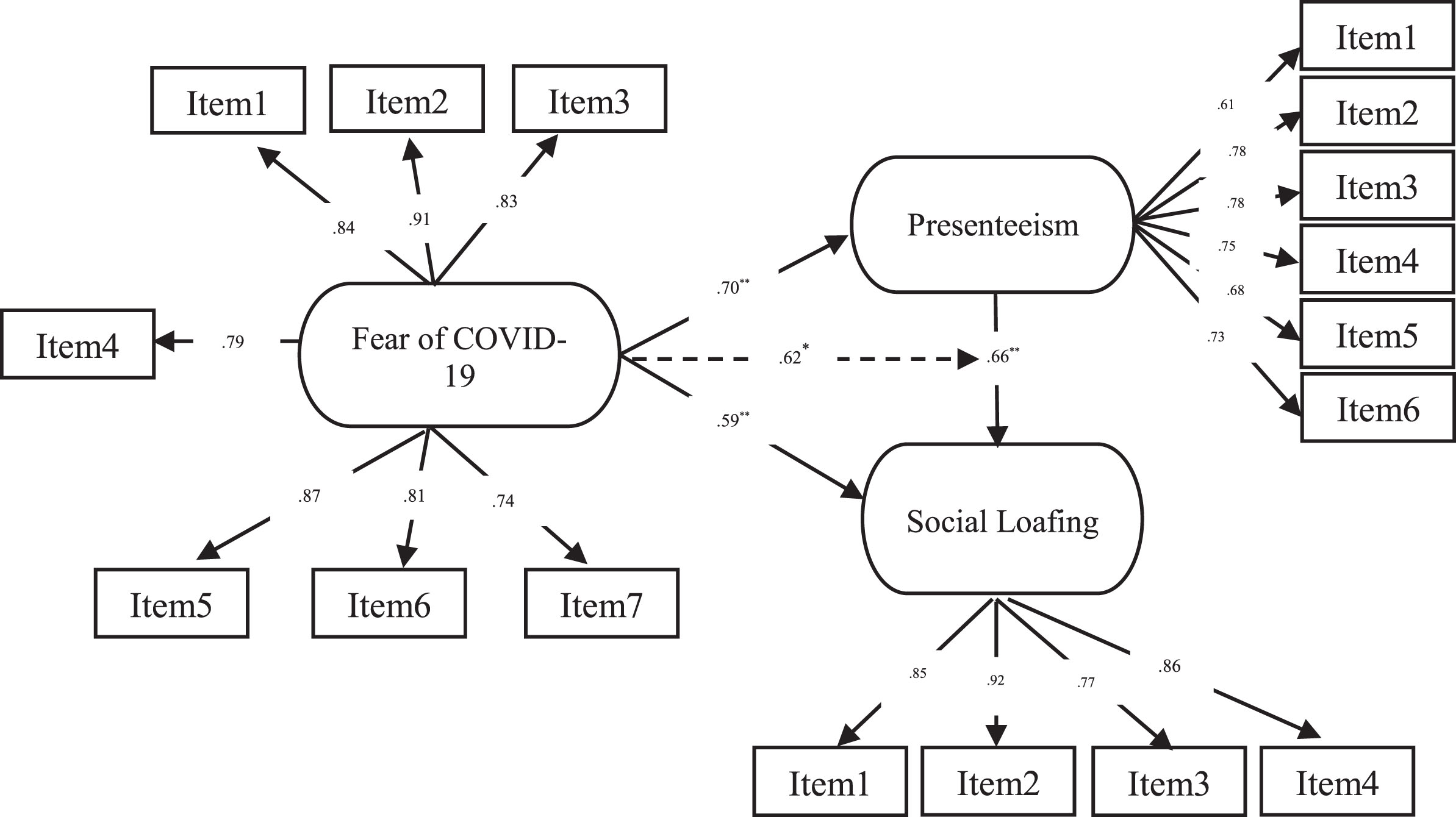
Mediation model of the study.
The COVID-19 pandemic and its negative consequences have affected many people’s psychological health and thoroughly created new work routines for employees in the workplace. Many employees suffered from an increased level of stress and greater exposure or fear of contracting the virus [71].
One of the main results of the current study is that employees working while sick were more likely to behave social loafing at group activities. Our results are similar to previous studies [e.g., 21, 33, 72]. When employees engage in presenteeism, they may not be fully engaged in their work or may be less productive, which can create a situation where other employees in the group must pick up the slack. This can create feelings of frustration or resentment among those who are working harder, which can lead to social loafing. Another reason why presenteeism can lead to social loafing is that when employees are not feeling well, they may be more likely to engage in passive behavior or avoid taking on tasks that require more effort or initiative. This can create a situation where some employees are not fully contributing to the group effort, which can lead to social loafing among the rest of the group.
As with similar studies in the literature, we also found that during the pandemic, the physical presence of employees in the workplace leads to a sense of not being present or “not belonging” (presenteeism) and they tend to avoid physical contact and social interactions [e.g., 7, 73–75]. The fear of COVID-19 can contribute to presenteeism in several ways. Many employees felt pressure to show up to work even when they are not feeling well due to fear of losing their job during the pandemic. This fear leads to presenteeism, as employees may come into work even if they are feeling sick or experiencing COVID-19 symptoms. Some employees did not have access to adequate sick leave, which can contribute to presenteeism during the pandemic. Employees who cannot afford to take time off may feel pressure to come into work even if they are feeling unwell, which can increase the risk of spreading COVID-19 to coworkers.
Our results also indicate that employees are unwilling to work collectively because they are anxious and fearful about contracting COVID-19. Employees who are fearful of getting sick may be less likely to work together on group projects, which can lead to decreased productivity and increased social loafing. Fear and anxiety can reduce motivation among employees, leading to decreased effort and engagement in work tasks. This reduced motivation can contribute to social loafing, as employees may be less likely to put forth the effort or take initiative when they are feeling fearful or anxious. This makes it important that employees are unable to complete tasks or perform with maximum efficiency.
The current study also shows that the fear of COVID-19 has a partial mediating role in the impact of presenteeism on social loafing behavior. It means that one of the factors explaining the relationship between presenteeism and social loafing is the fear of COVID-19. If employees are afraid of getting sick, they may be more likely to engage in presenteeism to avoid negative consequences such as loss of pay or disciplinary action. At the same time, their fear may also lead to decreased motivation or engagement, which can contribute to social loafing. Therefore, the fear of COVID-19 may partially mediate the relationship between presenteeism and social loafing behavior.
The organizations have overall responsibility for the protection of employees’ job safety and physical and psychological health. Organizations must make it clear to all employees that promoting and protecting employees’ physical and psychological health is a primary element of management. During this period, open communication methods, collaboration, and employee participation in decisions are crucial to building a strong organizational culture and demonstrating a commitment to protecting employees’ physical and psychological health. For this reason, in such situations that threaten the health of employees, organizations should consider employees’ views to increase the level of psychological well-being and productivity.
Organizations should set clear expectations and performance standards for each employee. This can help to ensure that every employee understands what is expected of them and is held accountable for their individual contributions. It should be implemented a reward system that recognizes and rewards employees for their individual contributions. This can help to motivate employees to perform at their best and to feel valued and appreciated.
Organizations should provide adequate resources and training to help employees perform their job duties effectively and safely, including training on COVID-19 safety protocols. Also, it is important to create a work culture that supports individual and team contributions and prioritizes the health and safety of employees during the COVID-19 pandemic. In this period, organizations should foster a sense of teamwork and collaboration among employees and encourage them to support and assist each other. This can help to create a positive and supportive work environment that reduces the likelihood of social loafing behavior.
On the other hand, during the COVID-19 pandemic, presenteeism can also pose a significant risk to the health and safety of other employees in the workplace. To prevent this, organizations should encourage sick employees to stay home or seek medical attention if necessary and to follow public health guidelines. It should be clearly explained to employees that they should stay home if they are experiencing any symptoms of illness, even if they believe it is just a mild cold. In this sense, it should be created an organizational culture where employees feel comfortable reporting illness and requesting time off when needed. Also, organizations should offer paid sick leave. It should be considered offering paid sick leave to employees who need to take time off due to illness. This can help alleviate financial concerns that may be contributing to presenteeism behavior.
Organizations should provide remote work options or work from home. This can help reduce the risk of transmission of COVID-19 in the workplace and can also provide employees with the flexibility to manage their work and personal responsibilities. A high level of willingness and inventiveness from organizations is compulsory to explore which organizational roles and workflow are at least remotely operated during this period. Especially considering the rapid transmission risk of COVID-19, if organizations desire to achieve efficiency and productivity, they should primarily protect their human resources and improve remote working conditions where they can work more flexibly. Well-managed remote employees can be far more productive than physically managed workers as organizations are required to be assessed productivity by objective metrics than the physical presence of “time in the office”. From this point of view, according to Aslan et al. [76] research that was conducted on 260 employees, the job performance of employees who work from home alone or work from home has increased performance compared to those who work in the workplace physically.
The present study contributed to the existing literature and current understanding in revealing the psychological effects of fear of COVID-19 on employees in the workplace. The study also contributed to the managerial implications in terms of revealing what kind of negative effects the fear of contracting COVID-19 has on organizations that want to achieve high productivity and performance from their employees.
Limitations
Several limitations to this study can be noted. First, the data are cross-sectional, which makes it difficult to make a general inference. For this reason, in the context of a shifting pandemic, this approach ignores the various measures and recommendations that were undertaken based on the pandemic’s progression.
Second, the results of the study can only be generalized to the participants in the research group in a certain period. Thus, it may be beneficial to study methodological studies with different populations.
Third, the participants were from the Turkish population and formal diagnoses of mood disorders were not obtained (e.g., stress, fear). Also, it was not known of the participants’ anxiety, stress, and fear levels. It makes it complicated to interpret effects, as prior levels may be confounding. Since COVID-19 appeared very suddenly, it was difficult to conduct a pre-test beforehand. Thus, the sensitivity and specificity of the scale cannot be examined.
Lastly, the study tested the mediating role of fear caused by COVID-19 on presenteeism and social loafing levels. However, the moderator effect of fear of COVID-19 on these two variables has been ignored.
Footnotes
Ethical approval
The study was conducted in accordance with the Declaration of Helsinki and was approved by the Scientific Research and Publication Ethics Committee of Tarsus University in Turkey (Decision number: 2021/34).
Informed consent
Due to the COVID-19 pandemic, the study was conducted online, and an informative text was generated using Google Forms. Participants were required to indicate their consent by approving the informed consent form if they wished to participate in the study.
Conflict of interest
The authors declare that they have no conflict of interest.
Acknowledgments
The authors thank the managers who forwarded the data collection form to their employees and the blue- and white-collar participants who participated in this study.
Funding
The authors report no funding.