



Abstract
BACKGROUND:
During the COVID-19 pandemic, digital working methods were increasingly implemented within the setting of German public administrations. Beyond the ostensible risk of infection, a high psychological burden arose for the employees.
OBJECTIVE:
A subsequent progression of mental strain is to be estimated as a residual effect (approximated by controlling other influencing factors) due to the impossibility of a counterfactual control group.
METHODS:
An online survey was conducted in 2020 and repeated in 2021 among a cohort of n = 706 employees of 38 departments of three public administrations in North Rhine-Westphalia, Germany. Mental strain was assessed by the Wuppertal Screening Instrument. Its temporal variation was operationalized as the intercept of a first-difference multiple regression model. Unit of analysis was the department level.
RESULTS:
The prevalence of suboptimal and dysfunctional strain increased from 71% to 73%. The multiple regression model showed a significant increase whilst controlling the influence of socio-demographic changes on the department level. Children, age and educational level were significant predictors. R2 indicated that about 40% of the variance in the temporal variation of mental strain could be explained.
CONCLUSION:
The observed factors explained a significant proportion of the increase in mental strain in German public administrations. Still, far more than half of the increase stemmed from external influences which were largely determined by pandemic conditions and latency effects remain still to be seen.
Keywords
Introduction
In May 2020, the World Health Organization described the impact of the COVID-19 pandemic on mental health as “highly worrying”, imposing a global public health challenge. Initial studies indicate that in the German population depressive and anxiety symptoms increased, while subjective mental health decreased from 2020 to 2022 according to large national surveys [1, 2]. Pre-existing mental disorders, female sex, and concerns about COVID-19 infection are known aggravating factors [3].
Also with regard to the working world, changing job demands had a strong influence on mental strain [4]. Working from home e.g. changes the demand profile of employees [5]. Although in terms of work organization, there might be advantages for some individuals (such as the elimination of commuting or reduced distractions by colleagues), communication within organizations still lacks clear structures for working from home. A lack of movement and physical meetings as well as suboptimal workplace ergonomics are examples of stressors that are generally associated with working from home. The need for caring for children (and/or relatives) while working at the same time and in the same space was a consequence of the COVID-19 pandemic due to lockdown phases in which kindergartens, schools, day care and clubs for leisure activities were closed [6].
At the same time, the pandemic situation has increased the digitalization of the work of public administrations with the aim of reducing personal contacts. This development worked as a catalyzer for the North Rhine-Westphalian state government’s plan specified by the e-government act from 2016 [7]. However, the introduction of digital working methods, online citizen services and electronic record keeping is associated with increasing demands on employees [8]. While civil service is regarded as a safe job with social security benefits, change management in the administrative sector is a challenge. In German public administration, work stress is reported due to restructuring measures, staff shortage, workload, the aging of the workforce, as well as low employee participation and few opportunities for relief at work [9]. Moreover, these factors are interrelated as e.g. the individual aging process is not only a stressor by itself but can lead to staff shortage on a structural level.
According to DIN EN ISO 10075-1, mental stress is defined as the “totality of all detectable influences that come from outside and affect a person psychologically” [10, 11]. Mental strain is understood as the corresponding immediate, but not long-term, effect of mental stress within the individual. Due to the possible positive as well as negative effects of mental strain and stress in the workplace, both terms are formulated neutrally [10, 12]. Persistent stress and strain lead to long-term strain consequences, which are also dependent on the work-related and personal resources of the affected employee, especially the individual locus of control [12]. The consequences can include, on the one hand, stimulating effects, such as further development of abilities or health, and, on the other hand, impairing effects, such as the occurrence of psychosomatic illnesses or early retirement. Beyond the stress-strain concept, a stressor is referred to as eustress by some authors if it has a stimulating, positive function. Stressors that are perceived as unpleasant or overwhelming have a negative function and decrease job performance. They are known as distress [13].
Knight et al. [4] reveal two pandemic related mental distress profiles for employees: (i) a declining distress profile where employees experienced reduced distress over time, suggesting adaptation and/or improved coping; (ii) a rising distress profile where distress increased and eventually plateaued. Employees with high workload, underload, or close monitoring, are more likely to belong to the rising distress profile. Detachment from work buffers the negative effects of the distress profile membership.
The COVID-19 pandemic created a massive impact on the economy, education, healthcare, business areas and other aspects of society (via spill-over effects) and therefore enhanced the cruciality of managing stress [13]. As one possible pathway, employees’ emotional responses are influenced by perceived organizational support, i.e., how the organization cares about their well-being and contribution to work, which in turn influences psychological safety. For instance, the approach of online communication practiced by managers has implications on the different levels of psychological safety experienced by the employee [14].
In the reporting year 2020, the number of cases of sick leave due to mental disorders was on the decline. Thus, there were fewer documented new mental illnesses, which can potentially be attributed to underdiagnosis, especially during lockdown phases. In contrast, days of sick leave due to mental disorders in the pandemic year 2020 increased compared to the previous year, which could indicate an aggravation of prevalent cases. Mental illnesses were responsible for a total of 17.5 per cent of all days of sick leave, making them the second most common cause of sick leave after musculoskeletal diagnoses. This corresponds to the most sickness benefit days (28.7%), which is due to the constantly high duration of mental illness cases with 43.4 days on average. The most important diagnoses were “reactions to severe stress and adjustment disorders” and depressive episodes [15, 16].
Skoda et al. found that generalized anxiety, symptoms of major depression and psychological distress were permanently elevated between March and July 2020 compared to pre-pandemic levels. It is noteworthy that the course of the pandemic as well as the decrease in the number of cases in the phase of the “new normality” (May to July 2020) had no influence on these outcomes. In contrast, the fear of a COVID-19 infection correlated clearly with these phases of different incidence. Consequently, the increased mental strain during the pandemic might have been mainly not due to fear of infection [17].
Data for the reporting year 2021 indicates that the mental health effects of the pandemic are reflected in the sick leave statistics –delayed, yet recognizably. It no longer only records an increase in days of sick leave due to mental illness. Meanwhile, an increase in the number of cases of sick leave can also be observed; probably approaching the actual prevalence [18].
The COVIDiSTRESS Global Survey data on adults reveals that higher levels of strain during the pandemic are correlated with younger age, being single, being female, living with (more) children and having obtained lower degrees of education [19]. Female employees are more likely than their male counterparts to experience increased strain due to work-family interference and demanding household chores when working from home [20]. Another pandemic consequence that is directly related to the mental strain of working women is an increased adherence to traditional gender roles and in some places even regressions in the sense of a re-traditionalization [21].
Furthermore, weight management was especially difficult during the COVID-19 pandemic due to reduced in-person support, less physical activity options, daily routine disruption, and food-focused coping which in turn are all associated with weight gain [22, 23]. The majority of participants enrolled in a behavioral weight loss program in deed gained weight during the COVID-19 pandemic [24]. This is relevant, because the condition is associated with diminished mental health [25]. Not least, individuals with overweight or obesity are at a higher risk of social isolation [26, 27], which itself was aggravated by the COVID-19 pandemic and can be considered as one of its greatest burdens [28, 29].
This work aims at an investigation on whether mental strain progressed in the setting of public administrations in Germany between 2020 and 2022. Based on the current literature, it is assumed that a possible change in strain may depend on having children, relatives in need of care, civil servant status, education and overweight and could be partly mediated by the employees’ locus of control.
Methods
A sampling frame of n = 1 319 employees in 38 departments of three public administrations in North Rhine-Westphalia, Germany, received a personalized link to an online survey in November 2020 and again in April 2022. All employees worked at a visual display unit (VDU) workstation. At both times, the survey was hosted on the external LimeSurvey© platform and was open for four weeks. After two weeks, a reminder was sent out via the departments’ e-mail distribution list, as was the invitation to the survey. Participation required informed consent and was not incentivized. A cohort of n = 706 employees participated in 2020 and n = 521 employees participated again in 2022. This translates to a response rate of around 54 percent in 2020, 40 percent in 2022 and a loss to follow-up rate of 26 percent at the individual level.
As a consequence of the loss to follow-up and due to concerns on the part of the public administrations regarding a potential re-identification of individual employees, the unit of analysis was the department level. For each of the 38 associated departments, which had a mean size of 35 employees, the average proportion or arithmetic mean of each variable was used, depending on its scale level. No imputation of missing values took place at the individual or department level. The sizes of the respective administrations and departments in terms of participants can be found in Fig. 1. The three public administrations, which were numbered from one to three for reasons of anonymity and are referred to as model regions, work at the municipal level. Each region represents a different quartile of the German Index of Socioeconomic Deprivation [30]. The departments included were selected for being immediately affected by the e-government act resulting in high digitalization requirements.
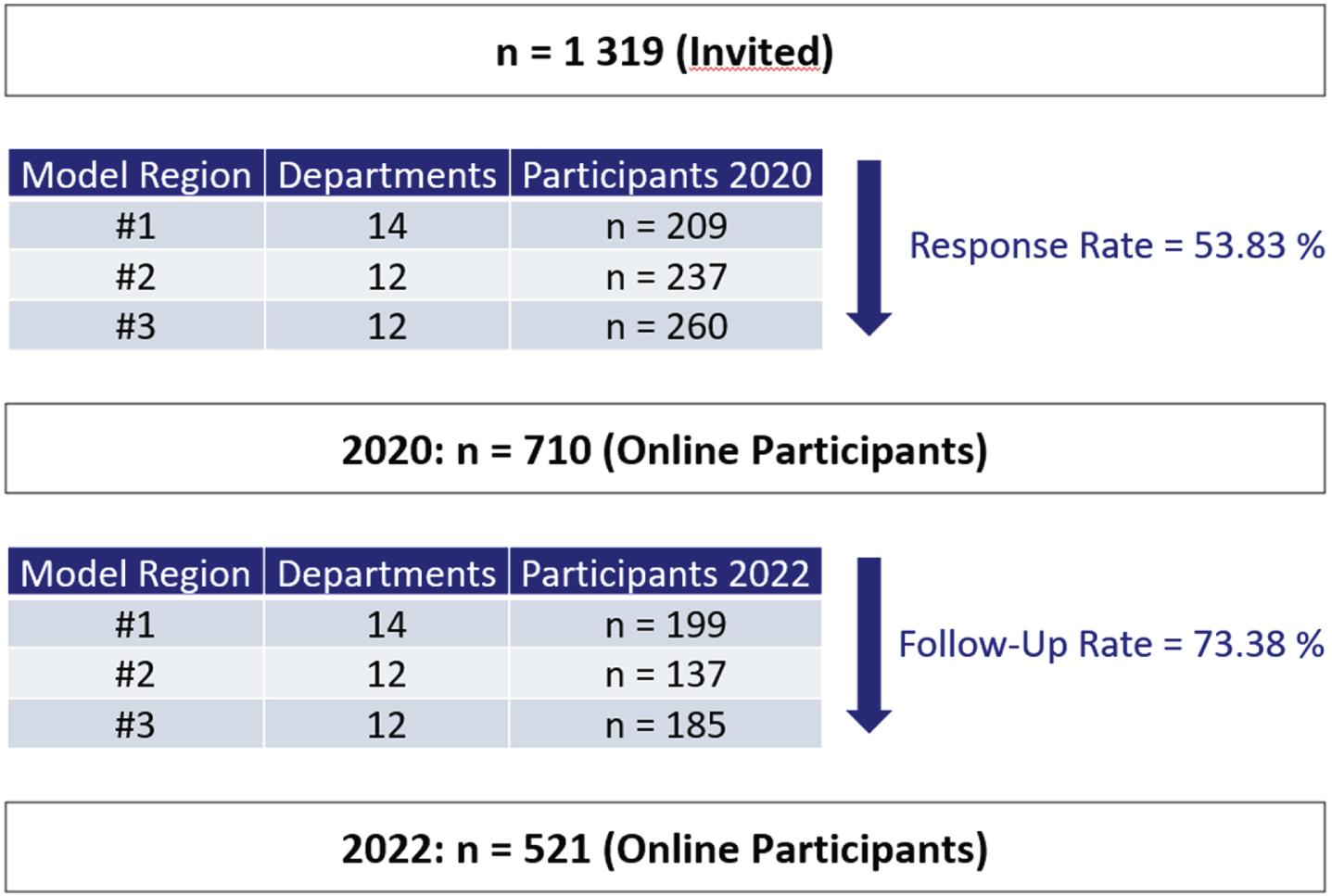
Flowchart for survey waves 2020 and 2022 indicating the number of departments, employees invited to participate, response and follow-up rate.
The present study is part of the “Health and Digital Transformation” project within the framework of the digital model regions funding set by the former Ministry of Economic Affairs, Innovation, Digitalization and Energy of the State of North Rhine-Westphalia. The study was given a positive vote by the ethics committee of the authors’ university under reference number 158/2020. This means that it was checked for compliance with the Declaration of Helsinki and applicable data protection regulations. Data analysis was performed with the software R-Studio in version 2022.02.2.
The primary outcome was (non-optimal) mental strain, which was operationalized using the Wuppertal Screening Instrument for Mental strain (WSIB) which was developed and validated at the University of Wuppertal, Germany [11]. The WSIB is an index that considers strain balance and control experience as indicators of healthy work conditions. The category suboptimal was combined with dysfunctional strain to form the new category “non-optimal” strain, which contrasts with optimal strain. The latter requires a positive strain balance and a high level of control. Strain balance and control experience are assessed using a validated list of items targeting strain and emotions (see Table 1). Strain balance is expressed as the difference between functional, positive strain (+) and dysfunctional, negative strain (–). Control experience is measured one-dimensionally using the same item structure (feeling “influential”).
Items of the Wuppertal Screening Instrument for Mental strain [11] with valence and coding
The central independent variable was the temporal development, which was operationalized by the strain difference between the beginning (first survey) and the development (second survey) of the COVID-19 pandemic. Thus, the research hypothesis stated that the self-reported mental strain experience of employees in German public administrations changed significantly over the course of the COVID-19 pandemic. The aim was to estimate a pandemic related effect, which was to be approximated by controlling socio-demographic changes on the department level due to loss to follow-up. Work-related changes (like working from home) were considered as related to the pandemic in order to summarize its direct psychological and indirect effects (on digitalization etc.) as well as to avoid multicollinearity.
A pooled OLS regression of the time-dependent differences was performed as a before/after comparison within a multivariate approach. The regression model based on the first-difference estimation, so that the intercept is to be understood as a time- and thus pandemic related residual effect [31]. With regard to the department-specific differences a t-distribution was assumed. The binary control variables integrated into the regression model were the presence of one or more children in one’s own household, relatives in need of care, a civil servant status, the existence of a university degree, and overweight in the sense of a body mass index of 25 or more. The same applies to the metric control variable age in years. To examine the effect size of the regression intercept, a conversion was made to Cohen’s D [32]. A classification of the effect sizes was made following Ellis [33]. In addition, to rule out autocorrelation, heteroscedasticity, and multicollinearity, the Breusch-Pagan [34] and Durbin-Watson [35] tests were calculated as regression diagnostics, and variance inflation factors [36] were put out and graphed.
The mental strain experience and the socio-demographics of the 38 departments surveyed are demonstrated separately according to the two survey dates in Table 2. The standard deviation between the departments is presented in parentheses after the respective average proportion or mean value (in case of the metric age variable). The difference of the average proportions and the mean values between t0 and t1 (fourth column from the left) forms the basis of the first-difference regression with the 95% confidence interval in parentheses behind it. Differences significant at this level are marked in bold.
Mental strain experience and socio-demographics in participating departments by survey wave
Mental strain experience and socio-demographics in participating departments by survey wave
The proportion of mentally non-optimally strained employees in a department increased from 71.330 % in 2020 to 73.315 % in 2022. The breakdown of non-optimal strain between suboptimal and dysfunctional strain originally proposed by the authors of the WSIB yields a share of dysfunctional strain (low control experience and negative strain balance) of 2.925 percent in 2020 and 3.275 percent in 2022. Meanwhile, suboptimal strain (low control experience or negative strain balance) increased from 68.405 to 70.040 percent (to obtain the share of suboptimal strain, dysfunctional strain has to be subtracted from non-optimal strain).
There was a significant increase in the proportion of employees with one or more children in their own household (t = 4.252, df = 37, p < 0.0001, 95% CI: 10.816% - 30.510%) and employees with relatives in need of care (t = 3.554, df = 37, p < 0.01, 95% CI: 7.440% - 27.176%) in the departments.
The results of the multiple OLS regression of first differences, each with 95% confidence interval, are shown in Table 3, significant effects are again marked in bold. In this case, the regression constant corresponds to the change in the proportion of employees with non-optimal mental strain in a department between the two survey dates while keeping the remaining covariates constant.
Constants, coefficients and quality measure of the multiple OLS regression of first differences in non-optimal strain (WSIB)
The multiple regression model shows a significant increase of 9.5 percentage points in non-optimal mental strain between the two survey waves when the influence of socio-demographic changes is removed (β=0.095, t = 2.275, df = 30, p < 0.05). Converting this into an effect size yields a value of d = 0.351, which can be classified as a moderate effect.
The interpretation of the influence of the covariates is as follows: An increase of employees with children in a department by ten percentage points leads to a 3.313 percentage point reduction in employees with non-optimal mental strain. Each additional year of life increases the proportion of non-optimal mental strain by 1.931 percentage points. Increasing the proportion of employees with a university degree in a department by ten percentage points reduces the proportion of non-optimally strained employees by 3.785 percentage points. All other effects do not reach significance.
The R-square shows that about 40 percent of the variance in the temporal variation of mental strain can be explained by the temporal variation of the independent variables. The adjusted R-squared reduces to 25,800 percent. Consequently, the variance explanation of the model can be rated as strong based on both parameters.
The result of the Breusch-Pagan test argues against the presence of heteroscedasticity (BP = 5.083, p = 0.650). The Durbin-Watson test shows no significance (DW = 2.241, p = 0.412), so that autocorrelation of the residuals cannot be assumed. All variance inflation factors are clearly below five, so that there is also no multicollinearity, which is graphically represented in Fig. 2 as a bar chart.
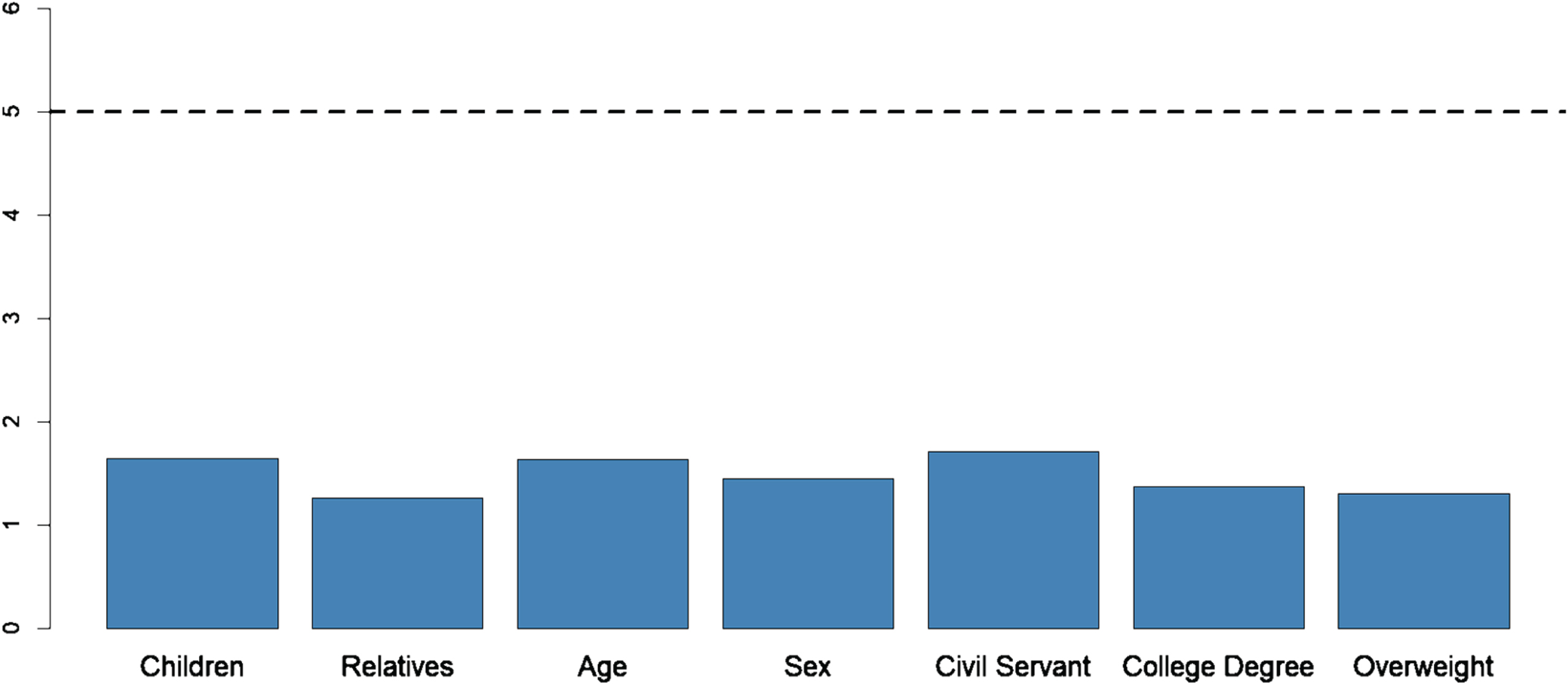
Bar chart of the variance inflation factors of the regression variables for the exclusion of multicollinearity.
In summary, the already high proportion of non-optimally strained employees in the German public administrations has increased compared to the beginning of the COVID-19 pandemic. Significant changes at the department level occurred for the proportion of employees with one or more children in one’s own household as well as relatives in need of care. This trend is not only a consequence of loss to follow-up but also consistent with an increasing number of births since the beginning of the COVID-19 pandemic in Germany [37], on the one hand, and pandemic related health dislocations with resulting needs for care, on the other [38].
The finding of a rising mental strain experience emerges when the opposite (i.e. “protective”) socio-demographic changes that occurred at the departmental level are out-factored. The term “strain experience” is used deliberately so that it becomes clear that this is a self-assessment. Socio-demographic characteristics included children in the household, increasing age and education level. While with the increasing average age in a department, the mental strain increases, the academic rate as well as children show up as protective factors.
Although the effect of education is as expected, the findings regarding age and children contradict the correlative analysis of the COVIDiSTRESS Global Survey data by Kowal et al. paraphrased in the introduction [19]. It suggests that older people coped better psychologically with the pandemic than younger people. The inverse linear correlation calculated in this study therefore has to be interpreted with caution as we did not delve deeper into the relationship, which is likely to be non-linear as suggested e.g. by Bergdahl and Bergdahl [39]. Staying with children being a protective factor also remains counterintuitive until considering the fact that, unlike Kowal et al., our study did not take into account the employees’ relationship status. As being single is associated with higher strain during the pandemic, living with children seems to be protective when compared to living alone.
From a resource perspective, characteristics like age, education and having children can lead to dysfunctional strain but also exert an influence on functional strain and individual control beliefs. In the WSIB framework, this is reflected by mental strain of employees being viewed as a combination of the balance between functional and dysfunctional strain on the one hand and individual control experience on the other.
The increased mental strain can be attributed to a residual effect which is somehow related to the COVID-19 pandemic, because both time-constant unobserved influencing factors (via first-difference estimation) and time-varying observed influencing factors (as covariates in the model) were controlled for. In addition to the aforementioned factors (average age, parents, academics), the observed factors include the percentage of employees with relatives in need of care, the gender ratio, the civil servant status of employees and the incidence of overweight.
Despite a percentage of overweight employees in the public administrations setting of our study that exceeds the nationwide average in Germany [40], no significant change was found between the two survey waves. This contradicts the assumption that overweight has worsened as a problem for employees of public administrations during the pandemic, although ceiling effects cannot be ruled out when considering the body mass index as a dichotomous variable.
In contrast to previously published cross-sectional studies based on the first survey of the project “Health and Digital Transformation” (e.g. [8, 41]), by means of the survey repetition the risk of an omitted variable bias concerning time-constant variables could be partly reduced by the study design. However, it still remains open to what extent the temporal development can actually be interpreted as a pandemic related effect, and if so, whether this is a matter of direct, personal-emotional or indirect, work-related changes (such as working from home etc.).
Most likely, we see what could already be expected considering the reports of health insurers [15, 16]: The psychological late effects of the pandemic, as well as of the measures taken to combat it, emerge only after a longer latency period, but now show up consistently. At the same time, the effect size in the present study is to be classified as medium to low, so that further developments remain to be seen. It would be desirable for future research approaches to consider more than two measurement time points during the pandemic and correlate them with the incidence risk. Until then, our study only provides an approximation of the true effect.
There may be other time-varying variables at the department level that have not been considered and the voluntary nature of the survey participation might have introduced self-selection and online bias. As a consequence, our sample is not representative of all employees affected by the introduction of e-government processes in public administrations but rather those being motivated and digitally savvy.
In addition, a region-specific decrease in the number of cases should be noted. On the department level the region is a time-invariant variable that is covered analytically by the longitudinal design of the study. However, a possible attrition bias within the departments could not be examined due to missing quantitative data on the non-respondents who did not react to invitation and reminder. Upon qualitative inquiry, the official integration of Ukrainian refugees and the resulting lack of time was cited by the project partners as by far the most frequent reason for loss to follow-up. Subsequently, additional administrative work for the employees accrued due to the reception of refugees from Ukraine after the Russian war of aggression since February 2022. Although, this reduces the confounding of a pandemic related effect by a possible “Ukraine effect”, attrition would rather affect more strained employees, which leads to an underestimation of the actual increase in mental strain within the public sector between 2020 and 2022. It has to be considered that public administrations are affected by a multiple of crises with severe implications for municipalities.
Conclusion
Therefore, this study might create awareness for this risk group of employees. It presents a rationale for the public employer to manage stress organizationally and improve strategies targeting occupational health, prevention programs and supportive workplace cultures. This is particularly important considering the skills shortage due to demographic change and the attractiveness of public administrations as employers.
Ethical approval
This study was performed in line with the principles of the Declaration of Helsinki. Approval was granted by the Ethics Committee of the Witten/Herdecke University under reference number “158/2020”.
Informed consent
Informed consent was obtained by following the online link und accepting the data protection clause. The participants had the options of not responding to questions and discontinuing the survey at any point.
Conflict of interest
The authors declare that they have no conflict of interest.
Footnotes
Acknowledgments
The authors thank all individuals of the public administration offices taking part in this study.
Funding
The funding for this study was provided by the former Ministry of Economic Affairs, Innovation, Digitalization and Energy (MWIDE) of North Rhine-Westphalia, Germany, under the reference number “33.31-DMR-AW-20-001/UNIWH”. The funding source had no role in the design, practice or analysis of this study.
Data availability
The datasets generated and analyzed during the current study are available from the corresponding author on reasonable request.