



Abstract
BACKGROUND:
Fitness tests have been previously used to predict academy graduation and highlight specific capacities to be targeted in applicants/trainees to optimise their potential for academy success.
OBJECTIVE:
To compare the fitness of graduated and released (did not complete academy requirements) firefighter trainees and explore using decision tree analysis to predict academy graduation via fitness tests.
METHODS:
Retrospective analysis was conducted on 686 trainees who completed an occupational physical ability test (OPAT): Illinois agility test; push-ups; pull-ups; leg tucks; estimated maximal aerobic capacity (VO2max); backwards overhead 4.54-kg medicine ball throw; 10-repetition maximum deadlift; and 91.44-m farmer’s carry. Data were recorded in raw and scaled scores (tests scored from 0–100; maximum OPAT score was 800). Trainees were split into ‘graduated’ (GRAD; n = 576) or ‘released’ (REL; n = 110) groups. Mann-Whitney U-tests compared between-group OPAT scores. A decision tree analysis using Chi-square automatic interaction detection was conducted, with raw and scaled scores entered into the analysis. A separate analysis was conducted with only the raw scores.
RESULTS:
GRAD trainees outperformed REL trainees in all OPAT events (p < 0.001). OPAT total score was the best predictor of academy graduation (p < 0.001), followed by the deadlift score (p = 0.003). Estimated VO2max was the only significant raw score predictor (p < 0.001).
CONCLUSIONS:
GRAD trainees were fitter than the REL trainees. Fitness could predict trainees who graduated from the academy. Overall fitness (OPAT total score), muscular strength (deadlift) and aerobic capacity were important graduation predictors. Training staff could develop these fitness qualities in their trainees to potentially improve fire academy graduation rates.
Introduction
Firefighting is an essential profession for a society. The U.S. Bureau of Labor Statistics [1] projected 28,000 openings for this profession per year from 2021 to 2031, thus highlighting a clear demand for firefighters. Accordingly, it is important to understand the prerequisites for a candidate to be accepted to a fire training academy. The first step for a firefighter candidate is to complete the requirements of the hiring process. Some of the requirements will likely include interviews, background investigations, medical evaluations, and general and occupationally-specific fitness testing [2]. Fitness or ability tests are included in the hiring process as firefighting involves physically demanding job tasks [3–7], performed under heavy occupational loads [8, 9], often times in dangerous environments [10–12]. In the United States of America (USA), most firefighter candidates will be required to compete the Candidate Physical Ability Test (CPAT) before they can be accepted to a fire training academy. The CPAT, which must be completed in 10 minutes and 20 seconds (s), is a test recognised nationally in the USA that simulates job tasks (stair climb, hose drag, equipment carry, ladder raise and extension, forcible entry, search, rescue drag, and ceiling breach and pull) to measure a candidate’s ability to perform the physically demanding firefighting job tasks [13]. Even in states within the USA that that may not require the CPAT, firefighter candidates are still expected to perform physically demanding fitness tests [14].
Fitness is of high importance for firefighter trainees. The required job tasks place heavy demands on an individual’s aerobic and anaerobic capacity, in addition to muscular strength, power, and endurance [3, 15–17]. Moreover, fitter firefighter trainees are also less likely to get injured during academy [18, 19]. It should be noted that there are other factors that can contribute to why a candidate may be successful at a first responder training academy (e.g., academic performance, skills test performance, motivation, etc.), and that physical fitness is but one contributing factor [20, 21]. Nevertheless, given that fitness can contribute to successful job performance [3, 15–17] and aid in the prevention of injury [18, 19], this highlights why some fire departments will conduct general fitness assessments to determine whether a candidate requires specific physical development prior to being accepted to a fire training academy [2]. It would be beneficial to quantify whether certain general fitness tests could provide an indication of a firefighter trainee’s ability to graduate a training academy. This is important, as the loss of candidates during the training process can create a financial burden on a fire department [18]. As an example, one fire department in the USA reported that it costs over $130,000 to recruit and train someone to become a firefighter [22]. Injury claims by trainees and recruits can also cost fire departments thousands of dollars in worker’s compensation claims [18].
There has been research conducted on whether fitness test performance can be predictive an individual’s ability to graduate from either a law enforcement or a fire training academy. For example, Dawes et al. [23] identified, via stepwise regression analyses, that muscular endurance indicated by push-up repetitions completed in 60 s was predictive of academy graduation in law enforcement cadets (i.e., cadets who completed more push-up repetitions were more likely to graduate; r2 = 0.139, p≤0.01). Lockie et al. [24] demonstrated that aerobic fitness measured by the 20-metre (m) multistage fitness test (MSFT), muscular endurance measured via arm ergometer revolutions completed in 60 s, and upper-body power measured by a 2-kilogram (kg) medicine ball throw predicted academy graduation in law enforcement recruits (adjusted r2 = 0.139, p < 0.01). In firefighter trainees, Lockie et al. [21] used a different statistical approach through receiver operating curves (ROC) and the resulting area under the curve (AUC) to investigate the predictive capabilities of a department-specific Occupational Physical Ability Test (OPAT). The OPAT was measured by raw and scaled scores, and included the Illinois agility test (IAT), push-ups, pull-ups, leg tucks, maximal aerobic capacity (VO2max) predicted from the MSFT, 4.54-kg (10-lb) backwards overhead medicine ball throw (BOMBT), 10-repetition maximum deadlift, and a 91.44-m (100-yard) farmer’s carry with 2 × 18-kg (40-lb) kettlebells [21, 26]. Lockie et al. [21] detailed that push-up repetitions (AUC = 0.754), BOMBT points (AUC = 0.727), and total OPAT points (AUC = 0.709) had fair accuracy for predicting academy graduation in firefighter trainees.
As general fitness testing for firefighter populations often incorporates a battery of measurements [19, 25–27], there are other novel data analysis approaches that could be adopted to identify important fitness characteristics for trainees. One process that has not been used to investigate the fitness of firefighter trainees is a decision tree analysis, which is a data mining approach that could assist with factors such as selection of the most important variables of a dataset, the relative importance of certain variables, and prediction of results for future records [28]. Data derived from an OPAT decision tree analysis within an exploratory study could be valuable as it may highlight specific fitness capacities to target in applicants or trainees that may best position them for academy success.
The purpose of this study was to explore the use of decision tree analysis to predict firefighter academy graduation via archival fitness test data in firefighter trainees. Trainees were split into those that graduated (GRAD) and those that were released for any reason (REL). Released trainees were those who did not complete the fire academy training requirements, such as via academic or skills test performance failures, injuries, or voluntary resignation. Firefighter trainee fitness test data was measured from the previously described OPAT [21, 26]. The study hypotheses were based on previous research that has shown push-ups and the BOMBT predicted fire training academy graduation [21], and numerous studies have detailed the importance of VO2max for firefighters [4, 29–31]. It was firstly hypothesised that the GRAD group would perform better in the OPAT compared to the REL groups. Furthermore, it was hypothesised that select tests within the OPAT, such as push-ups, the BOMBT, and estimated VO2max would predict academy graduation in the decision tree analysis.
Methods
Participants
De-identified data from 13 academy classes from one fire department were released for this retrospective investigation. All identifying information was coded by training staff from the fire department before being provided to the researchers. This resulted in a sample of convenience that comprised 686 trainees (age: 32.53±6.05 years). Apart from age, other demographic information (sex, height, and body mass) were not provided to the researchers. All demographic information is not always released by tactical organizations to third-party researchers [19, 32]. Some of these variables may not be recorded by a department and provided to third-parties for several reasons, such as to avoid any suggestion of preferential hiring and retention based on factors such as height, body mass, and sex [33, 34]. In reality, all trainees were required to attain the same standards within the fire training academy to graduate from academy regardless of their sex, age, or body size. Further, all trainees were 18 years of age or older and required to complete a pre-placement medical evaluation before their respective training academy [21, 35]. All academies were conducted through 2020–2022. The institutional ethics committee approved the analysis of pre-existing data (HSR-17-18-401), and the investigation conformed to the Declaration of Helsinki [36].
Procedures
The OPAT was completed outdoors in the early morning (6 : 00am) at the training centre in the fire department’s headquarters by trainees as part of their fire training academy obligations within a single 90-minute testing session. The tests in the OPAT were completed in the order presented. While there may be order effects [37], the testing approach was consistent across all academy classes. Any tests that adopted multiple trials included sufficient time (i.e., 2–3 minutes) between test attempts to ensure adequate recovery [21, 37]. Additionally, fire department staff assigned scaled scores (60–100 points) relative to the performance in each fitness test, where trainees could attain a maximum total of 800 points (Table 1) [21]. Although the researchers were not informed about how the scoring scale was developed, the system was standard within the fire department.
OPAT scoring system (IAT [s], push-ups [repetitions], pull-ups [repetitions], BOMBT [m], leg tuck [repetitions], VO2max [ml/kg/min], 10RM deadlift [kg], and farmer’s carry [s]) [21]
OPAT scoring system (IAT [s], push-ups [repetitions], pull-ups [repetitions], BOMBT [m], leg tuck [repetitions], VO2max [ml/kg/min], 10RM deadlift [kg], and farmer’s carry [s]) [21]
The IAT, which has good reliability (intra-class correlation coefficient [ICC] = 0.80–0.84) [38, 39], was used to assess change-of-direction speed [38, 40] and was conducted according to established methods [21, 26]. Trainees began in a prone position behind the start line outside the first marker (Fig. 1). The tester gave a command of “Ready”, and then “Go”. The trainee jumped to their feet and ran the IAT as fast as possible. Trainees were told not to cut over or contact any marker and to follow the correct route. If a trainee did not follow these procedures, or they slipped and fell, the trial was stopped and re-attempted. Time in s was recorded via a stopwatch from the “Go” command until the trainee crossed the finish line. Depending on time constraints, 1–2 trials were completed by trainees, with the fastest trial recorded.
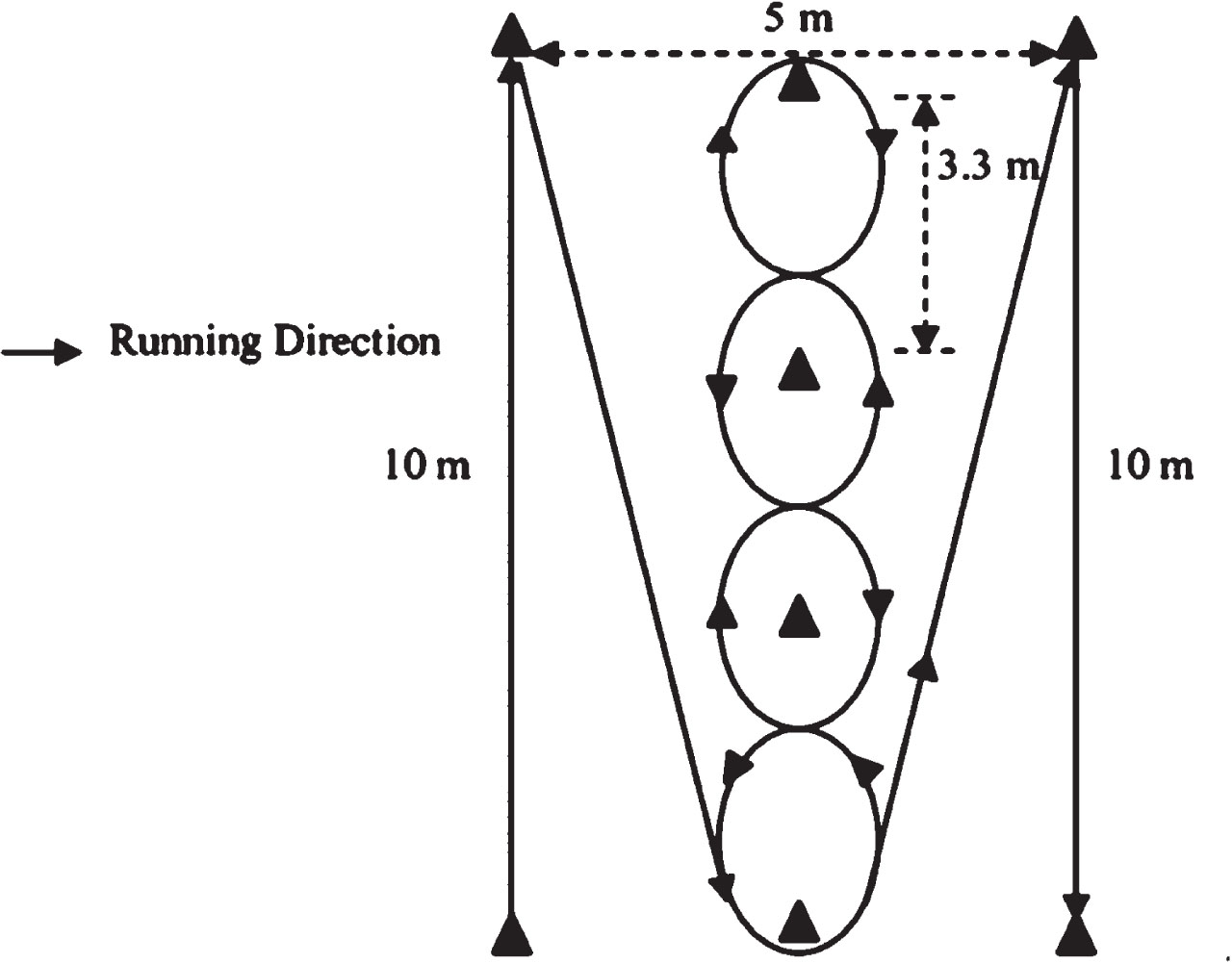
Dimensions (in metres [m]) and running direction for the IAT.
Maximal push-up tests assess upper-body muscular endurance [41, 42], and have high trial-to-trial reliability (ICC = 0.95) [43]. Trainees completed the push-ups in time with a metronome that had a cadence of 80 beats per minute, played via an audio file. On the “Get ready” command, trainees assumed the kneeling push-up position with extended arms. On “Get Set”, trainees adopted the ‘up’ position (body taut and straight, hands positioned shoulder-width apart, fingers pointed forwards) [41, 42]. On the “Go” command and initiation of the metronome, the trainee lowered themselves towards the ground by flexing the elbows until the upper arm was parallel to the ground. On the next tone, the trainee returned to the up position. On the next tone, the trainee returned to the bottom position, and so on. The test was stopped when the trainee could not complete repetitions in time with the metronome. If the trainee maintained the cadence, but missed other technical benchmarks (i.e., elbows did not fully extend, the upper arms were not parallel to the ground at the bottom position, there was sagging in the pelvis and trunk), the tester repeated the number of the last correct repetition and instructed the trainee to make the required correction. The number of correct repetitions completed was the final score. The maximum push-up repetition number was 100; trainees did not have to complete more repetitions beyond this number [21, 26].
Pull-ups
The pull-up assessed upper-body pulling strength [44], and this test has exhibited high reliability (ICC = 0.99) [45]. On the command, “Get ready”, trainees positioned themselves on the pull-up bar in a free-hang position. The hands were positioned shoulder-width apart with a pronated grip, thumbs wrapped around the bar, and extended arms. On the “Go” command, the trainee pulled their body up with a vertical body alignment until the chin was over the bar. The trainee then descended to the start position with the arms extended. They completed repetitions with this technique until they could no longer raise their chin over the bar. If the trainee kicked their way up, the repetition was not counted. The number of correct pull-up repetitions completed was the final score.
Leg tucks
The leg tuck measured grip, arm, shoulder, and trunk muscle strength and endurance [26], and the leg tuck test also has demonstrated high reliability (ICC = 0.998–0.999) [46]. On the “Get ready” command, the trainee moved to a free-hang position on the bar, with the hands positioned with an alternated grip. The body was extended and faced the length of the bar. On the “Go” command, the trainee lifted their legs up so their elbows flexed to an 90° angle while also bringing their knees to contact their elbows (i.e., they tucked their legs). The knees had to contact the elbows for a repetition to count. The trainee then returned to the free-hang position and repeated this action as many times as possible. The body had to be extended in the hang position between each repetition, and trainees could not rest the legs on the bar or swing past the start position when they lowered themselves. The number of correct leg tuck repetitions completed was the final score.
Estimated maximal aerobic capacity (VO2max)
Estimated VO2max was obtained from the MSFT, which was conducted with standard procedures [41, 48]. As a test, the MSFT has high reliability (ICC = 0.96) [49]. The trainees ran back and forth between two lines 20 m apart. Speed was standardised by auditory beeps played via an audio file and increased incrementally at the end of each level. The test was terminated when the trainee could not reach the lines twice in a row in accordance with the beeps. The MSFT was scored according to the final level and stage the trainee achieved. Estimated VO2max (ml/kg/min) was then derived for each trainee from the table produced by Ramsbottom et al. [50].
Backwards overhead medicine ball throw (BOMBT)
The 4.54-kg BOMBT measured total-body power [51–53], and the BOMBT has high reliability (ICC = 0.996) [51]. As previously described in the literature [52], trainees stood with their back to the throwing area, feet shoulder-width apart and heels on the start or zero line. The ball was held in front of the trainee, with the arms extended at shoulder height. In one movement, the trainee flexed the hips, knees, and trunk to lower the ball below the waist. They then extended their knees and hips and thrust the hips forwards, while flexing the shoulders and raising the ball above the shoulders as they threw it back over their head. The trainee’s feet could leave the ground after the throw, but they could not go past the zero line. The perpendicular distance was measured via a tape measure in feet from the zero line to the point where the ball first hit the ground. The throw distance was converted to metres (m) for this study.
10-Repetition maximum (10RM) deadlift
The 10RM deadlift provided a measure of lower-body strength [54, 55], and maximal leg strength tests can demonstrate high reliability (ICC = 0.92) [56]. The deadlift was performed with standard technique [54], although trainees could self-select their stance position and grip on the bar. The procedures for conducting the test have been described in the literature [21, 26]. Trainees performed warm-up sets as needed with set loads (52 kg [115 lbs], 74 kg [175 lbs], 84 kg [185 lbs], 102 kg [225 lbs]) [21, 26]. The weight was then progressively increased, and trainees completed 10 repetitions. Successful repetitions were obtained when the trainee was standing upright with the extension of the hips and knees and retraction of the shoulders [54]. Between repetitions, a pause of approximately 2 s was permitted at the top of the lift. The weight was then lowered with control back to the ground. No rest was allowed between repetitions while the weight was grounded. The test was terminated if the trainee did not reach the accepted standing position, they exceeded the approximate 2-s time limit at the top or bottom of a repetition, they dropped the weight, or they failed to keep the bar moving upward during a repetition. Approximately 2–3 minutes were provided between deadlift attempts. The load for the last successful 10RM attempt was recorded in lbs, before being converted to kg for this research.
Farmer’s carry
The last test in the OPAT was a farmer’s carry where trainees held 18-kg kettlebells in each hand and travelled four times up-and-back over a 22.86-m (25-yard) distance for a total of 91.44 m [21, 26]. The trainees completed the four shuttles as fast as possible by walking, jogging, or running. The trainee began at the start line with the kettlebells placed on the ground on either side of the trainee. On the “Go” command, the trainee lifted the kettlebells from the ground and proceeded to complete the farmer’s carry. If the trainee dropped a kettlebell, they could pick it up and continue the course. Time was recorded in s via a stopwatch from the “Go” command until the trainee completed the course.
Statistical analyses
Information regarding graduation status were provided by fire department staff to the researchers. Accordingly, trainees were split into two groups; those that graduated (GRAD; n = 576), and those that were released at any stage during their respective fire training academy (REL; n = 110). Statistical analyses were processed using the Statistics Package for Social Sciences (SPSS) Version 28.0 (IBM Corporation, New York, USA). Data normality was evaluated by the Kolmogorov-Smirnov test. As will be detailed in the Results, the raw and scaled scores were not normally distributed. Accordingly, Mann-Whitney U-tests were used to determine whether there were any significant (p < 0.05) fitness differences between the GRAD and REL groups. Data were presented as medians and interquartile ranges for this part of the analysis [57–59]. Effect sizes (d) were also calculated for the between-group comparisons, and this component of the analysis used means and standard deviation (SD) for each variable. The d for each comparison was derived from the difference between the means divided by the pooled SD [60]. A d less than 0.2 was considered a trivial effect; 0.2 to 0.6 a small effect; 0.6 to 1.2 a moderate effect; 1.2 to 2.0 a large effect; 2.0 to 4.0 a very large effect; and 4.0 and above an extremely large effect [61].
Following this, data were analysed via a decision tree analysis using Chi-square automatic interaction detection, with raw and scaled scores entered into the analysis (p < 0.05). Decision tree analyses can be adopted with non-parametric data [28]. A separate decision tree analysis was conducted with only the raw scores. To the authors’ knowledge, this was the first study using firefighter fitness test data within a decision tree analysis, so an exploratory approach was taken with entering all fitness test data into the analysis using procedures from the literature [28]. The minimum sample size for each node was specified as n = 50 and branching was limited to three levels [62, 63]. This approach was taken with a view towards reducing the complexity and increasing the reliability of any models produced [28].
Results
The Kolmogorov-Smirnov results indicated that age (p < 0.001), and all the raw (p≤0.005) and scaled (p≤0.002) scores were not normally distributed. Thus, the non-parametric Mann-Whitney U-tests were used to compare the GRAD and REL groups, with data reported as median and interquartile ranges (Table 2). The GRAD group was significantly younger and outperformed the REL group in all tests in the OPAT, measured by either raw or scaled scores. Further descriptive and effect size data is displayed for the raw and scaled scores in Tables 3 and 4, respectively. The difference in age had a small effect (d = 0.419). Most of the OPAT differences between the GRAD and REL groups also had small effects (d = 0.419–0.582), except for the farmer’s carry (trivial; d = 0.294), the BOMBT, and estimated VO2max (both moderate; d = 0.672 and 0.742, respectively). The between-group score differences for the BOMBT (d = 0.782), estimated VO2max (d = 0.734), 10RM deadlift (d = 0.799), and total score (d = 0.906) had moderate effects. All other differences had small effects (d = 0.418–0.541), except for the farmer’s carry score difference which was trivial (d = 0.268).
Between-group comparisons for the raw and scaled score data (median and interquartile ranges) for age and OPAT performance (IAT, push-ups, pull-ups, BOMBT, estimated VO2max, 10RM deadlift, farmer’s carry, and total OPAT) for firefighter trainees who graduated (GRAD; n = 576) or were released (REL; n = 110) from academy training
Between-group comparisons for the raw and scaled score data (median and interquartile ranges) for age and OPAT performance (IAT, push-ups, pull-ups, BOMBT, estimated VO2max, 10RM deadlift, farmer’s carry, and total OPAT) for firefighter trainees who graduated (GRAD; n = 576) or were released (REL; n = 110) from academy training
*Significantly (p < 0.001) different from the GRAD group.
Raw score descriptive data (mean±SD), between-group effect sizes (d), and d strength for age and OPAT performance (IAT, push-ups, pull-ups, BOMBT, estimated VO2max, 10RM deadlift, and farmer’s carry) for firefighter trainees who graduated (GRAD; n = 576) or were released (REL; n = 110) from academy training
Scaled score descriptive data (mean±SD), between-group effect sizes (d), and d strength for OPAT performance (IAT, push-ups, pull-ups, BOMBT, estimated VO2max, 10RM deadlift, farmer’s carry, and total score) for firefighter trainees who graduated (GRAD; n = 576) or were released (REL; n = 110) from academy training
The decision tree for when raw and scaled scores were entered is shown in Fig. 2. The root node was total OPAT score, which branched into the 10RM deadlift score. To provide an interpretation of each end of the decision tree, 44% of trainees who scored less than or equal to 256 points in the OPAT were released, while 56% graduated. Conversely, 98% of trainees who scored more than 538 points in the OPAT and 84 points in the individual event of the 10RM deadlift graduated from their training academy.
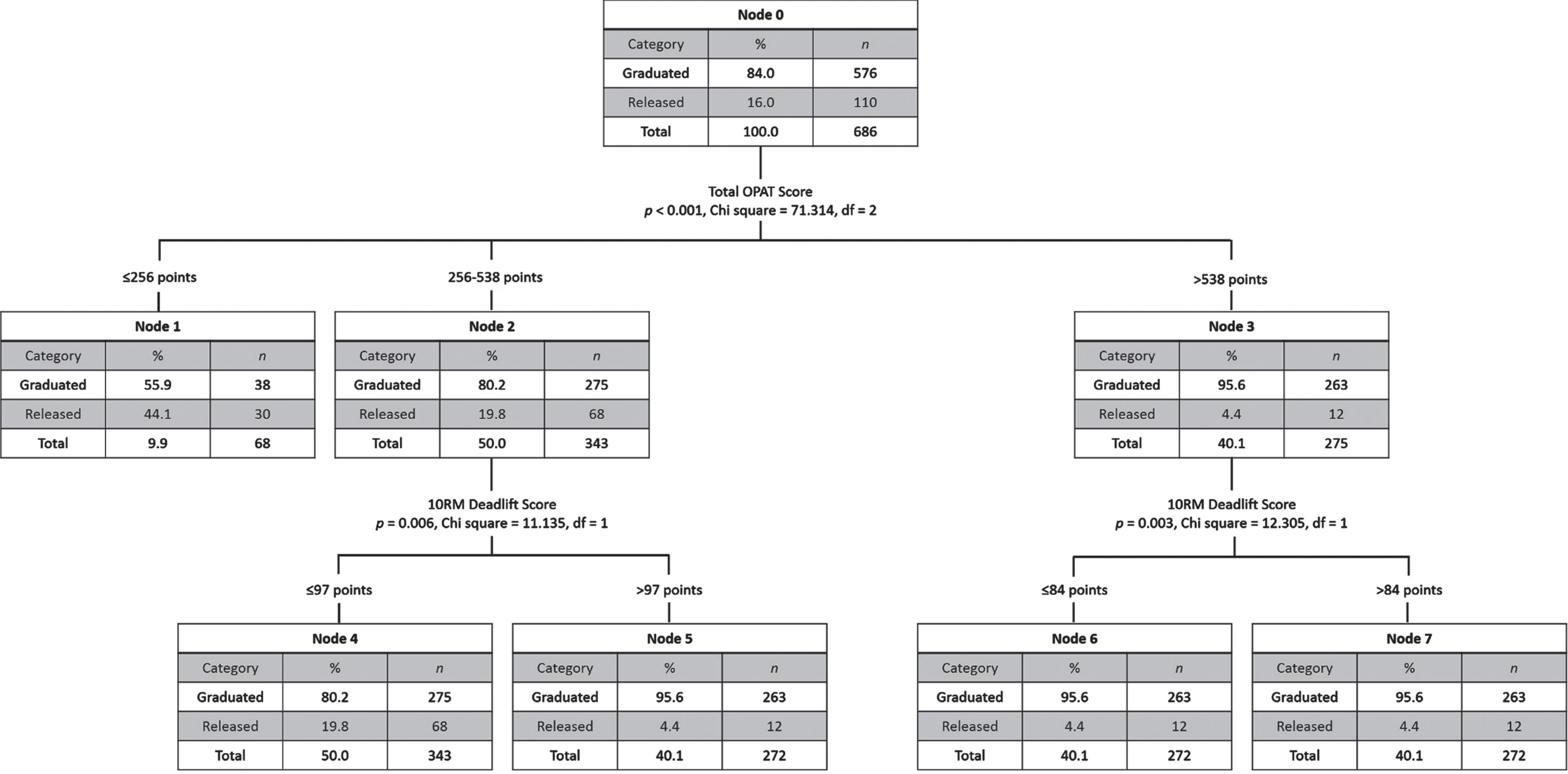
Raw and scaled score decision tree model for the Occupational Physical Ability Test (OPAT; Illinois agility test, push-ups, pull-ups, 4.54-kg backwards overhead medicine ball toss, leg tuck, estimated maximal aerobic capacity from the 20-m multistage fitness test, 10-repetition maximum deadlift, and the farmers carry) completed by graduated and released firefighter trainees.
When only raw scores were entered into the model (Fig. 3), the root node was estimated VO2max; 29.9% of trainees with an estimated VO2max≤43 mL.kg–1.min–1 were released, with 70% of trainees graduating. The number of trainees who graduated increased with greater aerobic fitness; 85% of trainees with an estimated VO2max between 43.5–49.9 mL.kg–1.min–1, and 96% of trainees with an estimated VO2max exceeding 49.9 mL.kg–1.min–1, graduated from their training academy. For both models, the risk estimate indicated the model incorrectly predicted academy graduation in 16% of cases (estimate = 0.016; standard error = 0.014). This means both decision tree models accurately predicted academy graduation in 84% of cases.

Raw score decision tree model for the Occupational Physical Ability Test (OPAT; Illinois agility test, push-ups, pull-ups, 4.54-kg backwards overhead medicine ball toss, leg tuck, estimated maximal aerobic capacity [VO2max] from the 20-m multistage fitness test, 10-repetition maximum deadlift, and the farmers carry) completed by graduated and released firefighter trainees.
This study explored the use of decision tree analysis to predict academy graduation via archival fitness test data in firefighter trainees from one large fire department. The first step in the analyses for this research was to compare the fitness as measured by a department-specific OPAT in GRAD and REL recruits. It was hypothesised that the GRAD group would be superior to the REL group in all OPAT events for both the raw and scaled scores, and this hypothesis was supported. These findings also concur with previous research that has indicated the importance of fitness relative to training academy graduation in first responders [19, 64]. The GRAD group was also younger than the REL group, which also concurs with previous first responder research [48]. It was also hypothesised that select tests within the OPAT, such as push-ups, the BOMBT, and estimated VO2max, would predict academy graduation in the decision tree analysis. As will be discussed, this hypothesis was partially supported; OPAT total score, the 10RM deadlift score, and estimated VO2max were identified as graduation predictors.
Most of the fitness differences measured by the OPAT had small effects, which is not surprising as the trainees had to successfully complete the CPAT before they were accepted to their respective academy [13]. There were some notable moderate between-group differences, including the raw and scaled BOMBT and estimated VO2max scores, scaled 10RM deadlift score, and total OPAT score. The BOMBT provides a measure of total-body power [51, 53], and has been previously found to be predictive of fire training academy graduation [21]. The importance of aerobic fitness for firefighters is well documented [4, 29–31]. Strength (measured by the 10RM deadlift) is important for firefighting tasks such as raising and manipulating a ladder [16], hose drags [17], and casualty drags [65–67]. The OPAT total score provides a metric for the combination of events completed by trainees [21], and the GRAD group had a total score that was 34% greater than the REL group. These data reiterate the importance of developing multiple fitness qualities for the firefighter trainee. Appropriate training programs can be used to improve aerobic and anaerobic fitness in firefighter personnel [68, 69]. Nevertheless, decision trees could provide more directed information for the firefighter trainee and department training staff.
The decision tree results when considering all the raw and scaled scores indicated that the OPAT total score (overall measure of fitness) and 10RM deadlift score (muscular strength) were the strongest predictors of graduation. The root node was the OPAT total score, which branched into nodes of ≤256 points, 256–538 points, and >538 points. Previous research has suggested that firefighters should be “all-rounders” (i.e., sufficient capacity in multiple fitness components) [21], and a higher OPAT score should be reflective of an overall fitter trainee. However, staff may need to note how the trainee achieved their overall OPAT score. For example, a trainee may have an overall good OPAT score, but may have performed poorly in one of the tasks (e.g., the IAT). A poor IAT could suggest limitations in linear and change-of-direction speed, coordination, and power [38, 71]. Staff could use this information for training program design. Further, an example of how trainees could make up for lesser performance in other tests is shown by the second and third total OPAT score nodes, which branched into terminal nodes incorporating the 10RM deadlift score. It is worth highlighting Node 5 from the model. For those trainees who may have scored lower in some tests that contributed to the total OPAT score, they could make up for those deficiencies by being better in the 10RM deadlift. Nevertheless, staff should ensure trainees do not overemphasize fitness one quality (e.g., lower-body strength) at the expense of others (e.g., aerobic capacity).
Estimated VO2max was the only significant predictor of graduation in firefighter trainees within the raw score model. A superior VO2max was beneficial; 96.1% of trainees that had an estimated VO2max>49.9 ml/kg/min graduated from the fire training academy, while 85.1% of trainees that had an estimated VO2max between 43.5–49.9 m ml/kg/min also graduated. Gledhill and Jamnik [6] recommended a minimum VO2max of 45 ml/kg/min for firefighters in order to successfully complete their job tasks, and the results from this study provide some support to this assertion. However, 70.1% of trainees with an estimated VO2max≤43.5 ml/kg/min still graduated from academy. Wynn and Hawdon [72] suggested that there was no adverse circumstances related to injury or illness in firefighter trainees from the United Kingdom if a VO2max standard of 42 ml/kg/min (compared to 45 ml/kg/min) was adopted. Even though numerous studies have indicated the importance of aerobic fitness for firefighting [4, 29–31], the results from this research may suggest utilizing a stringent estimated VO2max cut score could eliminate some potentially viable trainees. Rather, the information from this study could be used to identify trainees who could benefit from supplemental aerobic conditioning.
Provision of training information following a decision tree analysis could indeed be a focus for training staff, notwithstanding the each model’s accuracy (both models accurately predicted graduation in 84% of cases). When considering the first model, more than half of those recruits who scored less than 256 OPAT points still graduated. Additionally, factors other than fitness, including academics [73, 74] and skills test performance [15, 73], can influence whether a trainee graduates. Another consideration is that different variables may be indicated as important depending on the statistical approach. In a similar sample, Lockie et al. [21] documented the importance of push-up repetitions, BOMBT points, and total OPAT points via the use ROC/AUC analyses. The decision tree models in this research derived two models that highlighted different fitness qualities; total OPAT points, 10RM deadlift score, and estimated VO2max. Accordingly, rather than setting a definitive cut score, the current data does provide specific training feedback for staff. Both models could identify trainees at risk of release, which could then inform specific training interventions both during the pre-academy period and within the academy.
There are study limitations that should be acknowledged. All trainee characteristics (i.e., sex, height, and body mass) were not provided to the researchers for this study. Although the restricted provision of first responder trainee data is not uncommon [19, 32], this may limit the generalizability of the findings. Fitness was measured by a department-specific OPAT [21, 26], and it is possible that different fitness tests conducted with firefighter trainees from other training academies could yield different results. There may have been testing order effects from the events within the OPAT, especially as they did not follow generally recommended guidelines for testing order [37]. Nonetheless, the staff did work to ensure sufficient recovery between events for their trainees [21, 26]. The scaled scoring for the OPAT was designed relatively arbitrarily [21], although the findings from the current study do provide merit for how they could be used to identify trainee fitness limitations. This study grouped all trainees who were released into one group, without consideration as to why they were released (i.e., skills test performance or academic failures, injury, voluntary resignation). Previous research has detailed that fitness can influence the reasons for separation or release in first responder recruits [48]. That was not investigated in this study and is an avenue for future research.
Conclusion
GRAD trainees demonstrated better physical fitness as measured by OPAT raw and scaled scores when compared to the REL trainees. In the decision tree models that included OPAT raw and scaled scores, overall fitness measured by the total OPAT total score and muscular strength measured by the 10RM deadlift score were significant predictors of academy graduation. When only the raw OPAT scores were included in a decision tree model, aerobic capacity measured by estimated VO2max was the significant predictor of academy graduation. Decision tree analyses could identify trainees at risk of release from their fire training academy and inform specific training interventions both prior to, and during, a fire training academy.
Ethical approval
The study was approved by the ethics committee of California State University, Fullerton (HSR-17-18-401).
Informed consent
N/A.
Conflict of interest
None of the authors have any conflict of interest.
Footnotes
Acknowledgments
N/A.
Funding
This study received no external financial assistance.