



Abstract
BACKGROUND:
With the ongoing improvement in people’s living standards, people demand higher quality of medical service and medical staff, especially after the outbreak of the global COVID-19 pandemic. Professional quality is an important embodiment of medical staff’s comprehensive quality. Understanding the current situation of their professional quality will be beneficial in promoting reform and development of medical education and practice.
OBJECTIVE:
This study aimed to understand the situation of medical students’ professional quality after COVID-19 as well as to provide reference for deepening the reform of medical students’ professional quality education.
METHOD:
557 medical students from mainland in China were participated in by questionnaire through Internet. The questionnaire used in this investigation was adapted from prior studies to fit the research objective (Ren et al., 2019).
RESULTS:
Score of medical students’ professional quality was moderate, and there were some deficiencies: their cognition of the professional quality was insufficient, the development of professional quality was unbalanced, and curriculum of professional quality education needs to be optimized. In addition, parents’ educational level was correlated with medical students’ cognition of professional quality.
CONCLUSION:
Professional quality education with professional spirit and humanism at its core should be deepened furtherly, and teaching reform should be deepened to promote the all-around development of medical students’ professional quality. Meanwhile, it’s necessary to integrate professional quality education throughout the whole process of medical education, strengthen the capacity to build the humanistic quality of medical teachers, optimize the teaching mode and strengthen the collaborative-education function between family and medical colleges.
Introduction
Importance of medical students’ professional quality
Medical education is an important cornerstone of the development of human health care. The medical environment faces new changes especially after the outbreak of the global COVID-19 pandemic. People not only pay more attention to medical service quality, but also professional ability and quality of medical staff. In the face of new challenges and tasks, the General Office of the State Council of China has issued guiding opinions on accelerating the innovative development of medical education, which pointing out that it is necessary to comprehensively improve the medical education quality, with a particular focus on professional quality education [1]. A study on the professional identity of medical students after COVID-19 pandemic found that the professional identity of medical students after the pandemic was above the middle level, and the professional identity score of medical students who participated in the epidemic prevention and control was higher than that of medical students who did not participate. The professional attitude of medical students after the pandemic was the main factor affecting the professional identity of medical students which showed that the COVID-19 pandemic had a certain impact on the development of medical students [2].
Professional quality refers to the internalized norms and requirements of a profession. It is the comprehensive quality shown in professional activities, including professional attitude, professional ethics, and professional values [3]. Medical students’ professional quality is the unity of their scientific quality and humanistic quality to meet the needs of the industry. It is the comprehensive embodiment of medical students’ professional spirit and humanistic quality [4, 5]. Improving the medical students’ professional quality is not only conducive to the overall and healthy development of them, but also conducive to the development of medical and health practice [6. 7]. In addition, it is conducive to improving the professional satisfaction of medical staff [8], reducing their job burnout [9, 10], and improving their sense of happiness [11, 12]. Therefore, there is a necessity and practical significance to understand medical students’ professional quality and the relevant educational practice in order to promote the development of medical education after COVID-19 pandemic. This investigation aims to understand the medical students’ cognition and educational situation regarding the professional quality in order to provide scientific reference to deepen the professional quality education furtherly.
Factors influencing professional quality
Medical students’ professional quality is related to their job burnout, and improving the professional quality can reduce their job burnout. Previous studies have shown that social support is related to job burnout, and good social support has a significant effect on alleviating job burnout. Therefore, it can be expected that social support is also related to medical students’ professional quality, and good social support is somewhat related to good professional quality.
Individual and family factors are important factors that affect the professional quality of medical students, especially the social support from families. Social support refers to the material and psychological support provide by social networks to help individuals alleviate stress reactions when facing stressful events, including instrumental support (material assistance, behavioral assistance, social contact), emotional support, information support, and companionship support mainly [13]. Social support, as an external network resource, may have impact on job burnout through multiple paths. Previous studies have found that medical students’ individual factors are related to the professional quality, for example, there are significant differences in the professional quality scores of different grades medical students, while there are no significant differences in the professional quality scores of medical students of different sexes, majors, educational systems, and registered residence. Family factors are related to the medical students’ professional quality, for example, there are significant differences in the professional quality scores between medical students who frequently learn about the medical environment and related issues through their families and friends and those who do not. The words and deeds of family members are independent influencing factors of professional attitude and professional awareness scores [14]. Those indicate that individual and family factors have an impact on the medical students’ professional quality. Parents’ educational level and economic status can affect their understanding of professional quality which may affect their support for medical students, while previous studies have not considered the impact of those factors. This study will jointly explore the effects of personal and family factors on the professional quality of medical students.
Methods
Study settings
The medical students’ professional quality cognition was investigated from nine aspects: dedication, honesty, communication, cooperation, responsibility, humanitarianism, fairness, excellence and learning, it encompasses professional behavior, professional style, professional consciousness, professional skill, and professional ethics. The adapted questionnaire from prior studies (Ren et al., 2019) contains 28 questions, and a 5-point Likert-like scoring method (from A = “disagree” to E = “very much agree”) was used to calculate the average value of the nine aspects (among which question 27“medicine is just a way of making a living” was reverse scored). The overall score of professional quality was calculated as the total average value for the 28 questions. (The questionnaire can be found in the appendix)
Participant recruitment
The study selected subjects through random sampling method. All the participates were students from medical colleges in mainland China. They completed the questionnaire survey as required.
Results
Basic information of subjects
557 valid questionnaires were collected through the Internet, including 194 males (34.83%) and 362 females (64.99%), with one person who did not indicate their gender. 266 freshmen (47.76%), 103 sophomores (18.49%), 140 junior students (25.13%), 17 senior students (3.05%), 4 fifth year college students (0.72%), and 27 graduates (4.85%) participated. With regard to specialty, clinical specialty was represented by 45 (8.08%) respondents, stomatology by 8 (1.44%), clinical (orientation) specialty by 28 (5.03%), nursing by 58 (10.41%), anesthesia by 153 (27.47%), prevention by 1 (0.18%), pediatrics by 41 (7.36%), and other medical specialties by 223 (40.04%). 99 respondents were from cities (17.77%), 118 were from towns (21.18%), and 340 were from the countryside (61.04%). 432 had fathers (77.56%) with a high school education or below, 50 had fathers with a junior college education (8.98%), 75 had fathers with a bachelor’s degree or above (13.46%). 479 had mothers (86%) with a high school education or below, 40 had mothers with a junior college education (7.18%), and 38 had mothers with a bachelor’s degree or above (6.82%). 328 had (58.89%) an annual household income of less than 100000 RMB, 156 (28.01%) had an annual household income of 100000–150000 RMB, and 73 (13.11%) had an annual household income of more than 150000 RMB. (See Figure 1 and Table 1). This investigation was approved by the Ethics Committee of X Medical University (oral). Informed consent was at the beginning part of questionnaire, the participants could start to answer the questionnaire only after they known the contents of survey and agreed.
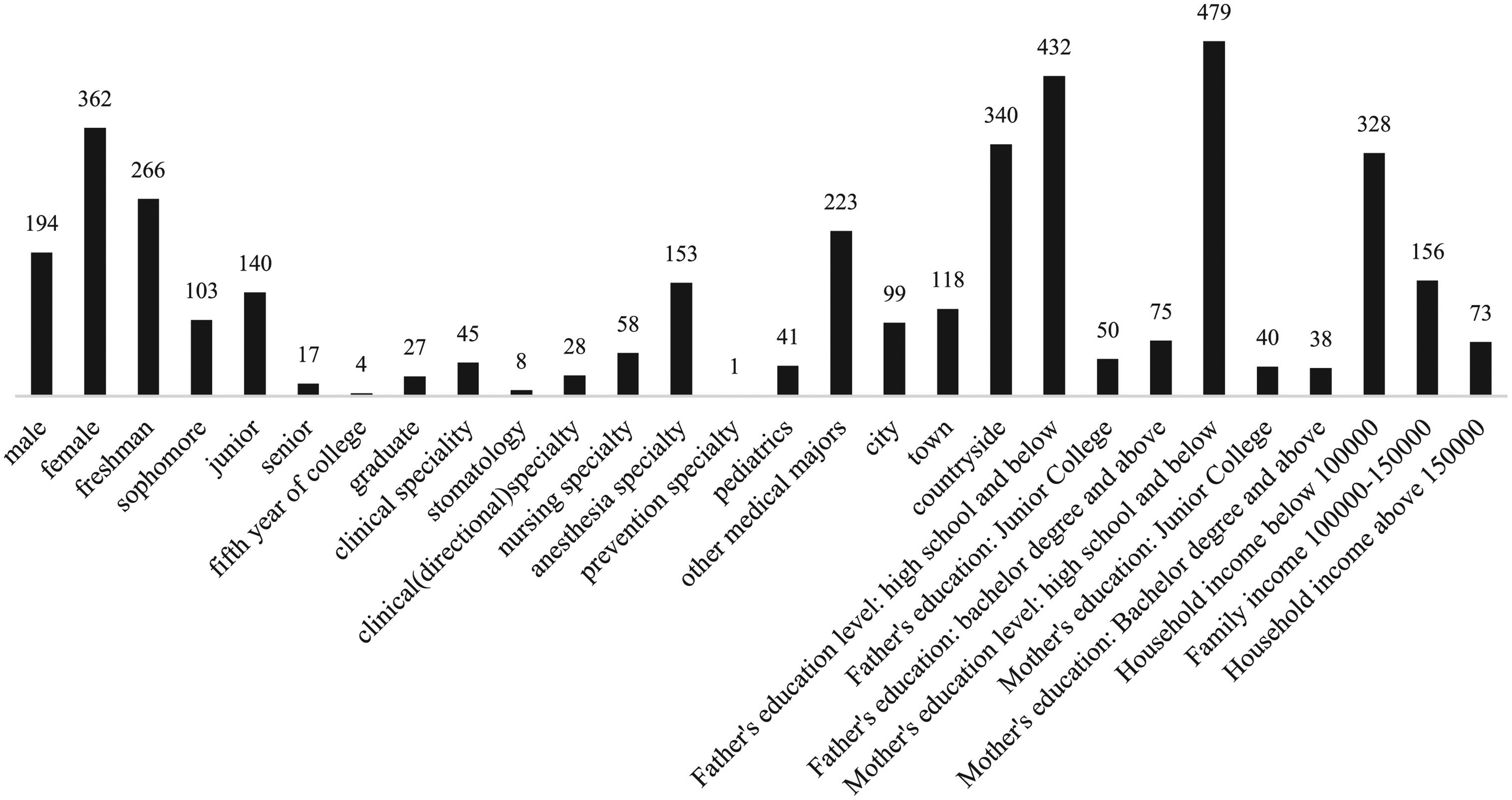
Basic information of survey participants.
Classification and proportion of each variable.

The overall average score of medical students’ professional quality was 3.88 (SD = 0.71), which was above the medium level. The average scores of the nine aspects of professional quality were between 3.67-4.02, with the score of responsibility being highest (Mean = 4.02), indicating that medical students believe that sense of responsibility is the most important embodiment of professional quality, while the score of excellence was lowest (Mean = 3.67). According to the standard deviation (SD), the biggest spread in scores was fairness, while the smallest spread in scores was for excellence. (See Table 2)
Analysis on the situation of medical students’ professional quality.

Analysis on the situation of medical students’ professional quality.
Note: Ded = Dedication, Hon = Honesty, Com = Communication, Coo = Cooperation, Res = Responsibility, Hum = Humanitarianism, Fai = Fairness, Exc = Excellent, Lea = Learning, Pro = Professional quality.
According to the professionalism dimension, cooperation and responsibility were incorporated into the professional behavior dimension, dedication into the professional style dimension, excellence and learning into the professional consciousness dimension, communication and humanitarianism into the professional skill dimension, and honesty and fairness into the professional ethics dimension. Results show that the level of professional behavior, professional style, professional consciousness, professional skill, and professional ethics was all above the medium level. Professional behavior scored highest, while professional style scored lowest. The standard deviation (SD) of professional consciousness was the smallest, while this of professional behavior and professional ethics were the largest, which indicating that there is a serious polarization in medical students’ sense of professional behavior and professional ethics. (See Table 3).
Analysis on the situation of various dimensions of medical students’ professional quality.

Not: Pro-B = Professional Behavior; Pro-S = Professional Style; Pro-C = Professional Consciousness; Pro-Sk = Professional Skill; Pro-E = Professional Ethics.
Correlation analysis between various dimensions of medical students’ professional quality and various demographic variables.

Note: Pro-B = Professional Behavior; Pro-S = Professional Style; Pro-C = Professional Consciousness; Pro-Sk = Professional Skill; Pro-E = Professional Ethics. ** = p < 0.01, * = p < 0.05.
As shown above, medical students had the lowest score in professional style, indicating that it needs to be improved. The standard deviations for the scores of professional style and professional ethics were the largest, indicating that there is serious polarization.
In terms of cognition regarding professional quality, the survey results showed that most medical students had a clear understanding of the contents covered by professional quality, and more than 93% of medical students agreed that professional quality includes professional ethics, professional skill, professional behavior, professional style, and professional consciousness. They had strong demand for professional quality education, and 94.8% of medical students believed that professional quality education is a necessary part of medical education. Most students were highly satisfied with their current education (95.33%), and more than half (72.53%) of them held a positive attitude towards their teachers’ professional knowledge and guidance, believing that their professional quality education meets the actual social needs (95.51%). In terms of professional quality practice, 64.99% of medical students thought the courses were attractive, 89.59% thought the academic activities, academic lectures, and academic conferences were relatively rich, and they were highly satisfied with the practical teaching (96.05%). Most of them thought that the theoretical and practical courses were in line with actual social needs (98.20%). They held a positive attitude towards the standardization degree in clinical basic comprehensive examination (97.66%).
Correlation and difference analysis between medical students’ professional quality and demographic variables
Difference analysis and multiple post comparison of various dimensions of professional quality and demographic variables.
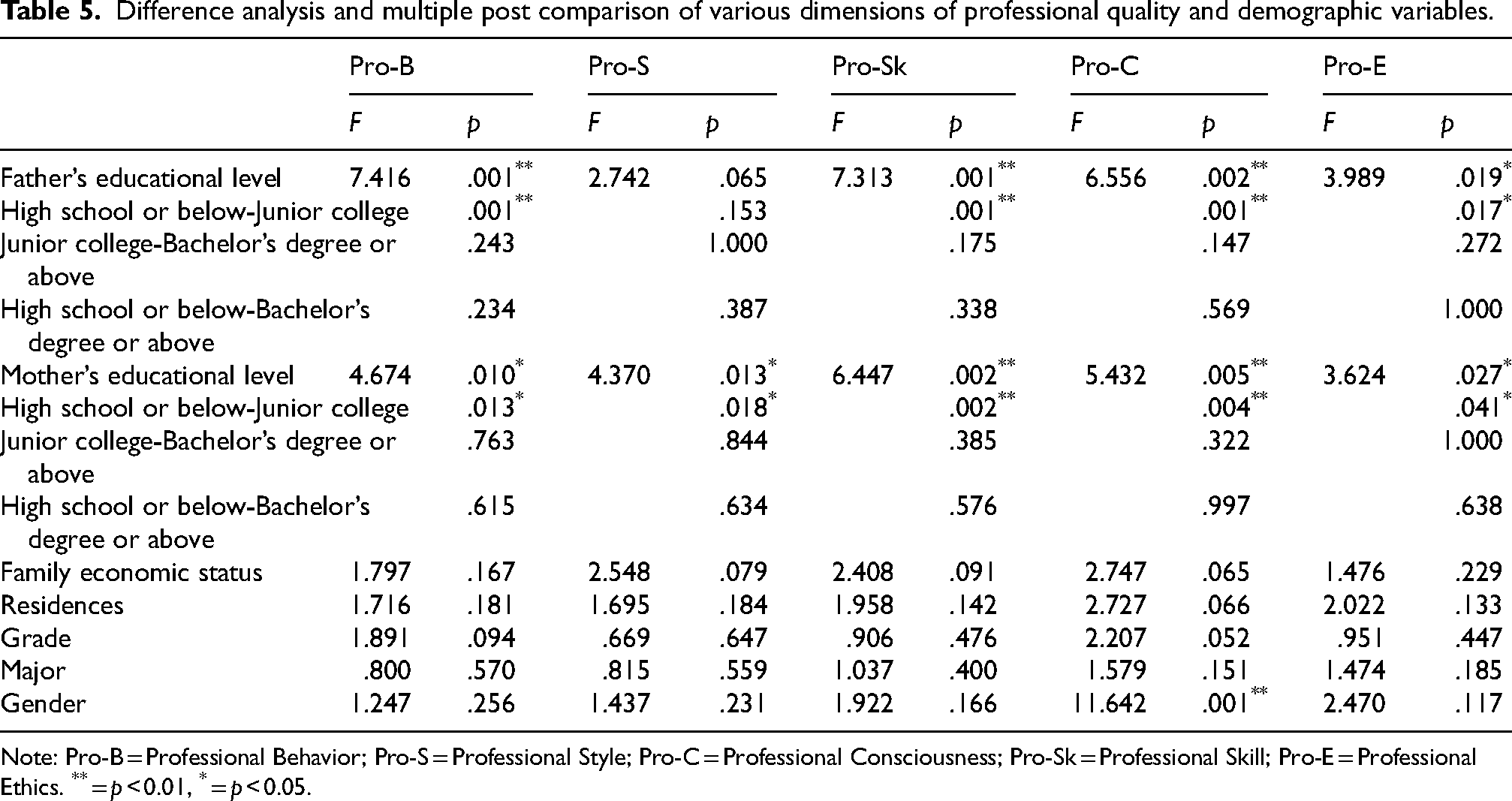
Difference analysis and multiple post comparison of various dimensions of professional quality and demographic variables.
Note: Pro-B = Professional Behavior; Pro-S = Professional Style; Pro-C = Professional Consciousness; Pro-Sk = Professional Skill; Pro-E = Professional Ethics. ** = p < 0.01, * = p < 0.05.
The bivariate correlation analysis results suggest that medical students’ professional behavior was negatively correlated with grade (t = –. 010, p < 0.05), and positively correlated with the educational level of their father (t = .112, p < 0.01) and mother (t = .096, p < 0.05). Professional style was positively correlated with mother’s educational level (t = .094, p < 0.05) and family economic status (t = .086, p < 0.05). Professional skill was positively correlated with the educational level of father and mother (t = .105, p < 0,05; t = .107, p < 0.05) as well as family economic status (t = .091, p < 0.05), and negatively correlated with the registered residence (t = –.084, p < 0.05). Professional consciousness was positively correlated with major (t = .088, p < 0.05), father’s and mother’s educational level (t = .093, p < 0.05; t = .091, p < 0.05), and family economic status (t = .097, p < 0.05), and negatively correlated with grade (t = –.111, p < 0.01) and registered residence (t = –.094, p < 0.05). Professional ethics was positively correlated with major (t = . 098, p < 0.05) and mother’s educational level (t = . 089, p < 0.05). See Table 4.
One way variance test results show that the educational level of parents had a significant impact on medical students’ professional behavior, professional skill, professional consciousness, and professional ethics, and students’ professional style was significantly affected by mother’s educational level. Post hoc multiple comparative analysis results show that the most significant impact of parents’ education on medical students’ professional quality came when the parents’ educational background was between senior high school or below and junior college, while there was no significant impact when parents’ educational level was between junior college and bachelor’s degree or above, senior high school or below and bachelor’s degree or above. The gender difference in professional awareness was significant (F = 11.624, t = 0.001, p < 0.01). Male medical students’ professional awareness was higher than that of females, but no significant difference was found among different majors, grades, registered residences or family economic status. See Table 5.
As we all know, the professional spirit, professionalism level, and humanistic quality of medical staff directly affect the patients’ medical experience. The conflict that arises between doctors and patients when professional spirit and medical ethics are lacking is an important factor that affecting the medical students’ professional identity [15]. Professional quality education, which focuses on cultivating medical students’ professional spirit and humanistic quality, has become important part of medical education. The results of this survey showed that most medical students have correct cognition of professional quality and have high satisfaction with their professional quality education. However, there are still some problems, such as students’ cognition is insufficient, the development of professional quality is unbalanced, and the courses need to further optimized.
Firstly, medical students’ cognition of professional quality and its importance to their career development needs to be strengthened. At present, there are still a small number of students do not have a clear understanding of the concept of professional quality and the basic elements contained therein. Nearly 10% of medical students in the survey believed that it is unnecessary to undergo professional quality education, and thus they have insufficient understanding of the necessity of professional quality education and its importance to the future development of their careers.
Secondly, medical students’ professional quality development is uncomprehensive, particularly in regard to professional consciousness, professional style, and professional ethics. The results of this survey showed that medical students’ professional behavior, professional skill, and professional consciousness are at the upper-middle level, but the standard deviation for them is large. This indicates the presence of polarization, which suggests that there is an imbalance in the development of professional quality, and the effect of professional quality education needs to be further improved.
Thirdly, the curriculum content and teaching methods of professional quality education need to be improved furtherly. According to this survey, there are some students who thought that the courses were unattractive (35.01%), the academic activities were unrich (10.41%), and the teaching did not meet actual needs (4.0%). Those were the main reasons for medical students’ dissatisfaction with professional quality education.
Conclusions and recommendations
With the integration of social, psychological, environmental and other factors into medicine, medical students should not only master exquisite clinical professional skill and exhibit lofty professionalism, but also should have more humanistic quality in order to provide high-quality medical services [16]. In view of the current state of medical students’ professional quality, there are still some medical students who have insufficient understanding of professional quality, do not understand its meaning, and their professional development is uneven, so it is necessary to carry out professional quality education throughout whole process of medical education and establish integrated education system for undergraduates, postgraduates, and residents, as well as carry out targeted professional quality education in different learning stages. For example, when medical students in the lower grades, education should strengthen their cognition of connotation, importance, and necessity of professional quality in order to enabling them had comprehensive understanding of professional quality in the initial stage of learning. When they in the internship stage, education should be focused on cultivating teamwork spirit, communication skills, and sense of responsibility. While, education should be focused on teaching students to become medical talents who love their job and bring fairness, honesty and excellence to it in the standardized training stage.
In addition, the survey found that some students believe that vocational education courses are not attractive enough and do not match the actual needs, so it is necessary to strengthen the capacity to build the humanistic quality of medical teachers, set up courses more in line with the development needs of medical students’ professional quality and improve teaching methods. In daily teaching, it can encourage students to participate in voluntary service activities in social practice actively, strengthen the construction of campus culture, run professionalism education and medical ethics education through the whole process of medical education and teaching [17], and carry out more academic and recreational activities with rich contents to improve medical students’ academic and humanistic quality. Besides, it is necessary to optimize the teaching mode and introduce the humanistic implicit courses [18], Prior research has suggested that implicit courses, service-oriented learning, and explicit courses are significantly related to the medical students’ professional quality [19]. Implicit courses play a core role in the cultivation of professional quality as medical students develop from school to hospital, from theoretical learning to clinical practice. Service-oriented learning helps to improve the level of medical students’ professional ethics in aspects such as teamwork, social practice, communication, respect, empathy, and social responsibility [20]. Therefore, medical students’ professional quality education should adhere to the implicit curriculum as the core, with service-oriented learning as an important way to improve the effectiveness of the explicit curriculum.
At the same time, it was found in survey that there is a correlation between the educational level of parents and the development of professional competence of medical students. Therefore, the influence of family education, especially the influence of parents, on the professional competence of medical students cannot be ignored, and a collaborative education mechanism between family and school should be established. As we all know, family education is an important part of one’s education. The results of this survey showed that parents’ educational level correlates with the development of medical students’ professional quality significantly. Parents’ cognition and participation in professional quality education correlates with medical students’ cognition. Therefore, parents should be included as a factor that may influence medical students’ professional quality, it is necessary to strengthen the popularization of medical professional quality education in order to realize the school-family collaborative aspect on medical students’ professional quality.
Footnotes
Acknowledgments
The authors would like to express their appreciation to the administrations who approved this study at their universities. Also, the authors would like to acknowledge all the participants for their time, effort, and contribution.
Ethical approval
This study was reviewed and approved by the Academic Ethics Committee of Gannan Medical University (2021381).
Informed consent
Informed consent was obtained from all participants involved in the study.
Conflicts of interest
The authors declare that there is no conflict of interest with respect to the research, authorship, and/or publication of this article.
Funding statement
This study received no financial support from any funding agency in the public, commercial, or not-for-profit sectors.
Appendix
Please tick the corresponding number for each question based on your perceptional level (✓), Thank you!
Items
A=disagree
B=Not quite agree
C=agree
D=Relatively
agree
E=Strongly
agree
1
I think doctor is a respected profession
2
I’m able to strictly demand myself and complete tasks on time
3
I can strictly abide by the rules and regulations
4
The doctor’s efforts match their gains
5
I believe that it is the sacred duty of medical workers to treat illnesses and save lives without hesitation
6
I’m able to strictly demand my words and actions in accordance with various behavioral norms
7
I believe that establishing a good trust relationship with patients is beneficial for one’s career development
8
I believe that good communication and expression skills are one of the most basic professional qualities
9
I believe that integrity and self-discipline are important manifestations of medical professional ethics
10
I can easily understand the patient’s feelings, feel their emotions, and communicate effectively with them
11
I would rather cooperate with others than compete with them
12
I’m able to treat every patient equally and respect every patient
13
Regardless of the situation, I believe that the patient’s life, health, and safety are the most important
14
I think the statement that “life is above all else” is completely correct
15
I believe that protecting the personal privacy of patients is the basic professional ethics of healthcare workers
16
I believe that being a doctor is a profession that requires continuous and lifelong learning
17
I think it is necessary to go out frequently to participate in academic exchange and conferences
18
I believe it is necessary to continuously strengthen self-learning and self-cultivation, and improve one’s academic and practical abilities
19
My life pursuit is to become a doctor who treats and saves people with kindness and compassion
20
I am able to promptly remind and provide correct opinions and suggestions for unfair behavior
21
I think it is necessary to firmly say “no” to industry misconduct
22
I am aware of the laws and regulations in the medical industry, as well as the rules and regulations of hospitals, and I am able to strictly abide by them
23
I believe that being brave enough to admit mistakes is a respect for the patient’s life
24
I am able to provide objective and fair medical evaluations and recommendations based on the patient’s actual situation
25
I think the professional value of doctors is higher than other general professions
26
When communicating with classmates from other majors, I feel proud to be in the medical field
27
I think that being a doctor is just a means of making a living
28
I think being a doctor can realize one’s life value