



Abstract
BACKGROUND:
Despite the physical nature of the occupation many firefighters have low levels of physical fitness which is associated with poor performance of occupational tasks and increased injury rates. For many fire departments an initial step in promoting health and wellness within the department is to conduct annual fitness testing.
OBJECTIVE:
To examine the effects of implementing a consequential fitness assessment within a fire department.
METHODS:
A retrospective repeated measures design was used to analyze annual fitness assessment data of professional firefighters (n = 1415) from 2019 to 2022 within a large urban fire department located in the mid-Atlantic region of the United States. The fitness tests included assessments of pull-ups, push-ups, sit-ups, aerobic capacity, and body composition. Repeated measure analyses of variances (ANOVAs) assessed the effect of year and a 2-way ANOVA was conducted to investigate the effects of sex and age on fitness measures on 2022 data.
RESULTS:
All fitness measures were found to be maintained over the 4-year period. Significant main effects of age and sex across all fitness measures, but no significant interactions were found. Older firefighters (50 + years) exhibited lower performance (p < 0.001, d > 0.80) on muscular fitness assessments than young firefighters (20–29 years). A large effect of sex (males > females) was found for pull-ups (d = 1.04), push-ups (d = 1.23), and aerobic capacity (d = 1.38).
CONCLUSIONS:
The results suggest that implementing a consequential fitness assessment could help maintain firefighters’ fitness levels over a multi-year period.
Introduction
The firefighter profession is a physiologically demanding job that includes high-intensity physical work performed in harsh environmental conditions [1]. Firefighters have a 9% higher incidence of cancer diagnoses than the general population in the United States [2], and cardiovascular disease is responsible for an estimated 45% of firefighter fatalities in the line of duty [3]. According to recent data, in 2020 alone, an estimated 64,875 firefighters were injured while on shift, with 31% of these injuries occurring while responding to emergency calls [4]. Maintaining adequate levels of fitness are important throughout the career of a firefighter. While fitness is necessary for performing firefighting occupational tasks [5], higher levels of fitness are also associated with numerous health benefits and lower risk of injury [6, 7]. Specifically, in regards to cardiovascular disease, the leading cause of line-of-duty death of firefighters [8], low levels of aerobic fitness have been found to increase risk for cardiovascular disease mortality by 52% and other chronic disease risk factors [9]. Muscular fitness appears important as well based on findings by Yang et al. who conducted a 10-year retrospective longitudinal study on over 1100 firefighters [10]. The main findings were higher push-up capacity, on baseline physical examinations, was associated with a lower incidence of cardiovascular events during the 10 year follow up period [10]. Concomitantly with low levels of fitness, approximately 50% of firefighters are reported to be overweight and about 25% are classified as obese [11]. Overfat firefighters, best characterized by high body fat percentages [12] although commonly assessed by body mass index (BMI) [13, 14], are at a higher risk of experiencing injuries [15, 16] and cardiac events [17].
Due to the physical demands of firefighting, individuals must pass a comprehensive health screen and several physical ability exams, which assess ability to perform common firefighting tasks, prior to entering the firefighting academy. Several studies have reported a decline in firefighter fitness levels and overall health following completion of the training academy [18, 19]. This suggests that while physical fitness is emphasized during firefighter training, it may not remain a priority once individuals graduate from fire academies. Findings by Cameron et al. from a cohort of 1169 male firefighters, over a 11 year period, support that fitness may not be emphasized following fire academy graduation [19]. Longitudinal analyses conducted in the study revealed a general decline in firefighter cardiorespiratory fitness with age. Interestingly, the youngest age group (< 30 years old) of firefighters demonstrated greatest absolute declines in cardiorespiratory fitness as compared to all other age groups (30–39 years, 40–49 years, and 50 + years) [19].
Despite the recognized importance of fitness, health, and wellness for firefighters, only about 30% of US fire departments have implemented a health and wellness program [11]. There are numerous barriers to implementing a health and wellness program within a fire department that include concerns of interference with physical readiness, peer and departmental support [20–23]. Although, conducting annual fitness testing is seemingly realistic to implement given numerous field tests of fitness requiring minimal equipment [24]. Recently, a large fire department in the mid-Atlantic region of the United States implemented mandatory fitness testing with punitive consequences for unsatisfactory performance. To support those with subpar results, resources such as strength and conditioning coach, group exercise classes, and a dietician were made available with a 6-month improvement period. During the probationary period, individuals could retake the fitness test every 2 months. However, failing to pass the test within 6 months led to termination of their employment with the county. The primary purpose of the present study is to report the effects of implementing a consequential fitness assessment in a large fire department over a 4-year period. A secondary purpose was to examine the effects of age and sex on fitness levels, which are factors previously reported to influence performance on fitness assessments in emergency responders [19, 25–28].
Methods
Participants
This study examined data from annual fitness testing conducted at a single facility within a large fire department in the mid-Atlantic region of the United States from 2019 to 2022. The analysis focused on incumbent full-time firefighters who had previously graduated from the firefighting academy. Over the 4-year period, 1415 firefighters participated in the fitness testing, with only 419 firefighters completing testing in all 4 years. A retrospective analysis of deidentified data was approved by the George Mason University Institutional Review Board (IRB#: 1871116-1).
Procedures
Following an annual physical exam with a physician, firefighters were approved to perform the fitness testing. Firefighters completed a battery of fitness tests in a standard order upon arriving to the testing facility. The tests completed were maximum pull-up repetitions, sit-up repetitions in 60 s, push-up repetitions in 60 s and a 3-minute step test. Staff at the fire department selected the tests within the battery as they were valid and reliable [29–32], easy to administer, time efficient and relatively safe to perform by firefighters. The staff at the fire department selected the areas of fitness to assess for health reasons [6, 10] and reported relationships with ability to perform occupational tasks [5].
Posterior upper body muscular fitness was assessed with pull-ups to failure. Participants assumed a shoulder-width pronated grip on the overhead bar, with elbows fully extended while hanging vertically with feet off the ground. To complete a repetition, participants pulled their body up in a linear path until the chin surpassed the bar level, and then descended in a controlled manner along the same path to the starting point. Repetitions were not counted if participants relied on momentum, twisting, swinging, or failed to reach the top of the bar with their chin. Rest between repetitions was not permitted, and only the total number of repetitions meeting the movement standards were recorded.
Core muscular endurance was assessed with maximal sit-ups in 60 seconds. Participants began in a seated position, placing their toes under 80lb dumbbells, and had arms crossed at chest level and each hand contacting the opposite shoulder. Once in position on the ground, a buzzer was placed behind the participant in line with the upper thoracic spine. Participants completed a repetition by flexing at the hip in order to raise torso from the ground, contacting their elbows to their knees, then lowering their torso back to the starting position in controlled manner until triggering the buzzer (AssessPro Rep-Addition Push-up Tester, Gopher Sports, Owatonna, MN, USA). A repetition was considered successful if there was audible beep of the buzzer in the down position.
Upper body muscular fitness was assessed using the maximal push-up test within a 60-second timeframe. Prior to starting the test participants placed their hands shoulder-width apart with extended elbows, while maintaining a flat back and having the balls of their feet on the ground. A 3-inch buzzer was positioned directly under the participant’s sternum. To achieve a successful repetition, participants lowered themselves in a controlled manner, maintaining a straight line from torso to legs, until reaching the depth of the buzzer, resulting in an audible beep. They then fully extended their elbows to return to the starting position. Repetitions were not counted if the buzzer was not triggered.
Aerobic capacity (VO2max) was assessed with a 3-minute step test, a valid method for assessing VO2max [33]. Participants were instructed to step up and down a 16-inch box to a tempo of 88 and 96 beats per minute for females and males, respectively. Each foot was required to land on a beat, and the same foot was used to lead the step up on to the box. Heart rate was recorded with a pulse oximeter (OxyWatch C1F Pulse Oximeter, ChoiceMed, PA, USA) for 15 seconds after completing the test and subsequently entered into a prediction equation to estimate VO2max.
During exam years 2021 and 2022, all participants had their body composition estimated using segmental bioelectric impedance analysis (BIA) via a commercially available device (InBody 270, InBody USA, Cerritos, CA, USA). Body fat percent values reported are percent of total body mass that is fat mass. BIA has been found to be a valid method of assessing body composition [34, 35], with the InBody 270 to have acceptable levels of agreement with dual energy X-ray absorptiometry, commonly called DXA [36]. All testing was supervised by trained staff who provided standardized instructions.
Statistical analysis
All statistical analyses were performed using R, version 4.2.1 (R Core Team, Vienna, Austria). Descriptive statistics were computed for demographic and fitness (pull-ups, sit-ups, push-ups, step-ups, body composition) variables. Normality was assessed with the use of Shapiro-Wilks tests and visualized with Q-Q and density plots. None of the demographic or fitness variables were normally distributed and common transformations, i.e. exponential, log, power, did not alter the distributions [37]. The mean and 95% confidence intervals were computed to describe age, years of service, and fitness measures. To further describe the sample participants were categorized in to five age groups (20–29, 30–39, 40–49, 50–59, 60 + years of age) [38]. However, due to the small sample of firefighters 60 years and older (∼1%), they were subsequently grouped with the 50–59 year old age group which was renamed to 50 + years. Chi-square tests were performed to examine whether the age and sex distributions differed by year. One-way analysis of variances (ANOVAs) were conducted to further examine differences in age and years of service of the department across the 4 years.
To address our primary aim of the study repeated measure ANOVAs were conducted to compare the effect of exam year (4 levels: 2019, 2020, 2021, 2022) on the fitness outcome variables. Effect sizes for ANOVAs were assessed with partial eta-square and categorized as negligible (η2< 0.01), small (0.01≤η2≤0.06), medium (0.06 < η2≤0.14), and large (η2 > 0.14) [39]. Pairwise comparisons with Bonferroni corrections were performed when significant main effects were observed. Effect sizes for pairwise comparisons were quantified using Cohen’s d and interpreted as follows: negligible (d < 0.2), small (0.2≤d≤0.5), medium (0.5 < d≤0.8), and large (d > 0.8) [39]. To address secondary aims of examining the effect of age and sex on fitness measures, a cross-sectional approach was taken and two-way ANOVAs were conducted on the 2022 data only (n = 1219) [19]. For each 2-way ANOVA, the fitness outcomes were the dependent variable with factors of age (4 levels: 20–29, 30–39, 40–49, 50+) and sex (2 levels: male and female).
Results
Descriptive data for firefighters from 2019 to 2022 are presented in Table 1. There was a statistically significant difference in age (C2(2, 4023) = 105.05, p < 0.001) and years of service (C2(2, 4023) = 58.53, p < 0.001) but not sex (C2(2, 4023) = 1.099, p = 0.777) distribution across the 4-year period. One-way ANOVA testing did indicate a main effect of exam year on age (F(3, 4019) = 26.000, p < 0.001) and years of service (F(3, 4019) = 7.832, p < 0.001); however, post-hoc testing indicated the differences in both measures between years were trivial or small (d < 0.4 in all instances). Notably, the largest differences in age and years of service of the department occurred in 2020 as compared to other years. This can be attributed to the impact of the COVID-19 pandemic on the fire department which limited the ability to administer the fitness testing and led to cancelation of fire academy classes. The potential impact of the COVID-19 pandemic on the findings is addressed further in the discussion.
Firefighter demographic data by exam year
Firefighter demographic data by exam year
Notes: 1)*rounded to neared 0.5 percent. 2) Abbreviations: CI, confidence interval. 3) 95% confidence intervals presented as [lower bound, upper bound]. 4) The final column describes the firefighters who performed the fitness assessment in all 4 years from 2019 to 2022.
Means and 95% confidence intervals of fitness measures for years 2019 to 2022 are presented in Table 2. A total of 419 firefighters completed the fitness assessment in all 4 years and were included in the repeated measures ANOVA analyses to examine whether fitness levels changed during this time period. There was no significant effect of exam year on pull-ups (F(3,1668) = 0.213, p = 0.887, η2 = 0.001), sit-ups (F(3,1668) = 0.167, p = 0.918, η2 = 0.013), push-ups (F(3,1668) = 0.305, p = 0.822, η2 = 0.010) or VO2max (F(3,1668) = 1.184, p = 0.315, η2 = 0.023). Results for estimated body fat percentage were limited to years 2021 and 2022 because the assessment was added as part of the procedures in 2021. Similar to the other fitness measures, no effect of examine year on estimated body fat percentage was found (F(1,805) = 0.01, p = 0.919, η2 = 0.001). While there were no statistically significant effect of exam year on the finess measures mean changes in sit-ups, push-ups and aerobic capacity trended toward small increases from 2019 to 2022 (last column Table 2). Interestingly, there was a non-significant trend toward an increase in estimated body fat percentage (1.5%, 95% CI [0.4, 2.7]) from 2021 to 2022.
Fitness data from 2019 to 2022 (n = 419)
Fitness data from 2019 to 2022 (n = 419)
Note: All fitness data are reported as means and 95% confidence intervals. Aerobic capacity was estimated maximal oxygen consumption via step-up test. Change in fitness measures was computed as 2022 performance minus 2019 performance for each firefighter, with the exception of Body Fat percentage which was computed as 2022 measures minus 2021 measures for each firefighter. The overall mean difference and 95% confidence interval are shown.
The results from the 2-way ANOVAs to assess the effect of age and sex on the fitness measures are presented in Table 3. For all fitness measures, there was a statistically significant main effect of age and sex; however, none of the interactions were significant. A large effect of age (η2 > 0.14) was found for pull-ups, sit-ups and push-ups. The greatest effect of sex was observed for push-ups (η2 = 0.133, medium effect), followed by aerobic capacity (η2 = 0.115, medium effect) and pull-ups (η2 = 0.086, medium effect). The lack of significant interaction effects indicates that the age related declines in fitness were similar for male and female firefighters. The fitness data are visually presented in Fig. 1 and results from post-hoc pairwise testing in Table 4. Generally, older firefighters did not perform as well on the pull-up, sit-up and push-up assessments with large effects (d > 0.80) observed between the 20–29 vs. 50 + and 30–39 vs. 50 + age groups. Age had small to no effect on aerobic capacity and only the youngest age group (20–29 years) and oldest age group (50 + years) had large effects in regards to the differences in body fat percentage (p < 0.001, d = 0.94), with the older firefighters having a higher body fat percentage. Large effects of sex were found for pull-ups (p < 0.001, d = 1.04), push-ups (p < 0.001, d = 1.23) and aerobic capacity (p < 0.001, d = 1.38) with males performing better than females.
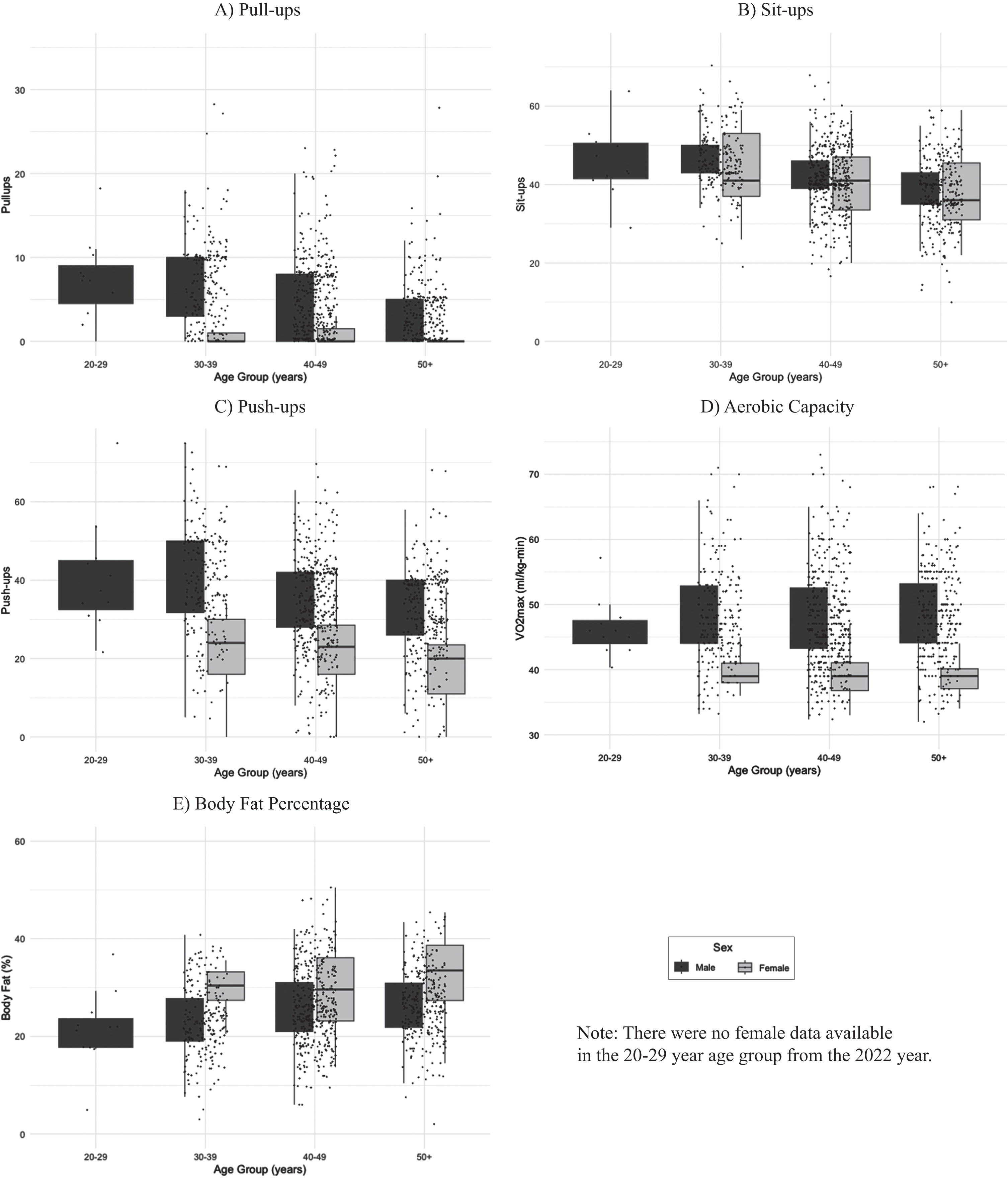
Distributions of fitness measures by age and sex. Note: There were no female data available in the 20–29 year age group from the 2022 year.
Two-way analysis of variance results for effects of age and sex on fitness measures
Note: F-value, p-value and partial eta-squared are reported for the main effect and interaction of independent variables age and sex. The degrees of freedom for age, sex and the interaction of age x sex were 3, 1 and 3, respectively. The residual degree of freedom was 1211. Effect sizes were assessed with partial eta-square and categorized as negligible (η2< 0.01), small (0.01≤η2≤0.06), medium (0.06 < η2≤0.14), and large (η2 > 0.14). Pairwise comparisons were performed following 2-way analysis of variance. Bonferroni corrections were made to p-values and Cohen’s d effect sizes were computed and interpreted as negligible (d < 0.2), small (0.2≤d≤0.5), medium (0.5 < d≤0.8), and large (d > 0.8). Large effect sizes are bolded.
The present study aimed to investigate the impact of implementing a mandatory fitness assessment, with punitive consequences for unsatisfactory performance, within a large fire department of professional firefighters. The findings indicate that the fire department experienced no significant changes in fitness measures during the time period studied. There were noteworthy findings in regards to age and sex differences in firefighter fitness levels from the cross-sectional analysis of 2022 data. Muscular fitness measures and body fat percentage tended to worsen with increasing age, emphasizing the importance of attention to fitness for older firefighters. However, the cross-sectional analysis did not indicate a significant decline in aerobic fitness among the older group compared to their younger counterparts. Additionally, the results indicated that, except for sit-ups, male firefighters exhibited superior fitness performances across all assessments versus females.
The absence of significant changes in fitness levels across the 4-year period could be interpreted in two contrasting ways. On one hand, it may suggest that the fitness assessment failed to promote fitness improvements among the firefighters whom data was available for the 4-year period. On the other hand, it could be argued that the assessment played a crucial role in maintaining their existing fitness levels. It is important to acknowledge that the study period coincided with the global COVID-19 pandemic, which imposed unprecedented stressors on fire departments. Minus a global pandemic, which increased the workload of firefighters, there are aspects of the firefighting occupation [20] that present challenges to regularly engaging in structured exercise that is needed to support physical fitness. Several reported barriers for firefighters to exercise are fear that exercising while on duty may interfere with ability to respond to emergency situations [21, 22], lack of peer support from peers [20, 23], and departmental support for worksite exercise programs [20]. Considering that aerobic and muscular fitness are crucial determinants in performing various firefighting tasks, it would appear that the firefighters likely remained consistent in their ability to physically perform their occupational requirements during this challenging time [5, 14]. Furthermore, the fact that the cohort of firefighters maintained their fitness levels over the four-year period provides preliminary evidence that mandatory and consequential fitness assessments may help counteract age-related declines in fitnesss [40] as observed in the cross-sectional analysis aspect of the present study.
The cross-sectional results regarding the effects of age on muscular fitness parallel what has been found in normal, healthy adults [40]. It has been reported that, in the general population, muscular fitness tends to peak between the age of 20 years to 30 years [41] followed by a decline in muscle mass of 3% to 8% per decade after the age of 30 years [40]. As exercise can slow the age-related loss of muscle [42], the physical demands of firefighting, coupled with mandatory annual fitness testing, could counteract the effects of age on decline in muscular fitness. Nonetheless, we found differences for pull-up, push-up and sit-up performance with each decade. Considering that numerous firefighting occupational tasks require lifting heavy objects, i.e., carrying or dragging victims, equipment and moving objects, or repeatedly pushing and pulling implements or objects, i.e., hose pulling and dragging, this could imply that older firefighters, with lower levels of upper body muscular fitness, would exert the same absolute effort, but a greater percentage of their maximal capability compared to more fit firefighters. The findings related to the effect of age on upper body muscular fitness are not supported by prior literature [25, 43]. In a cohort of 159 male firefighters aged from 20 years to 49 years, no significant changes due to age on maximal push-up repetition or 1-rep maximum bench press performance were found [25]. Kirlin et al. also reported an absence of differences due to age on a push-up and sit-up assessment in female firefighters between 20 and 54 years of age [43]. The sample size of the present study led to the analysis being overpowered which may have contributed to differing findings [44]. However, our study also included a large number of firefighters over the age of 50 who are underrepresented in previous literature [25, 43].
The present findings, concerning no difference in aerobic fitness (VO2max) with age, contradict previous reports in the general population [45, 46] and among firefighter populations [19, 43]. In a study conducted by Cameron et al. on firefighters, a significant decline in aerobic fitness was observed across 10-year age groups (20–29, 30–39, 40–49, 50 + years), with the largest decline occurring between the 30–39 and 40–49 age groups. Supporting these findings [19], the study by Kirlin et al. also reported significant differences in aerobic fitness with age. However, similar to our present study, Findley et al. did not find a significant difference in aerobic fitness due to age. It is worth noting that the firefighters in Findley et al.’s study had considerably lower VO2max values (20–29 years: 33.0±8.0; 30–39:32.0±8.6; 40–49:28.5±7.3 ml/kg-min) compared to the participants in our current study. One potential explanation for these conflicting results could be that the mandatory fitness assessment motivated older firefighters to focus on maintaining their aerobic fitness.
Sex differences in performance on fitness assessments are common among tactical populations [28, 47–49]. Consistent with previous studies, our findings indicate that men outperformed women on upper body muscular and aerobic fitness assesments [48]. It is important for fire departments to acknowledge and account for these sex differences in various aspects of fitness when interpreting performance results. In terms of taking action on fitness assessment results, the purposes of fitness testing should be considered. As reviewed by Orr and colleagues, fitness testing of tactical populations is generally conducted to 1) assess injury risk, 2) provide information on health and well-being or 3) to ensure individuals are capable of performing occupational demands [49]. Therefore, the fire departments must consider the purposes for fitness testing when determining whether to compare results to gender norms or against critical values deemed to be necessary to safely and effectively perform occupational tasks.
Limitations
As mentioned previously, the data was collected during the COVID-19 pandemic, which was a particularly stressful time for firefighters [50]. It is plausible that the demanding nature of their work during this period limited their availability for exercise training, potentially impacting the reported results. Another limitation is that firefighters were aware of the scoring standards of the fitness assessment, and while unsatisfactory performance had punitive consequences, there were no incentives to surpass the minimum thresholds. As a result, individuals may have focused on meeting the required fitness levels rather than exerting maximum effort during the assessments or preparatory training. Similar ceiling effects have been observed in other firefighter studies, where meeting the test requirements eliminates the need to surpass them [51]. The fitness assessment protocol lacked a measure of lower body strength or power, which has been documented to be an important fitness component for tactical populations [52]. Considering many firefighting tasks involve producing large amounts of force, i.e., forcible entry, charged hose advances and dummy drags, the fitness assessment used in this study did not capture a key fitness component for firefighters. Thus, we cannot conclude that the fitness assessments in the present study provided an adequate prediction of ability to perform firefighter occupational tasks.
Conclusions
In summary, the findings of this study support that the implementation of a consequential fitness assessment maintained physical fitness levels over a 4-year period. Considering well-documented health challenges experienced by firefighters, i.e., cardiovascular disease, obesity, cancer, [8, 54], as well as the positive effects of health-related fitness on disease [55], the overall benefits of implementing mandatory fitness assessments may extend beyond the scope of the present study. Moreover, the observed age and sex differences in fitness performance highlight the importance of recognizing these factors when interpreting assessment scores and determining the consequences, whether punitive or incentive-based, for performance on mandatory fitness assessments [49]. Future research should investigate the long-term effects of these assessments on injury, illness, and risk factors for chronic diseases. Additionally, it is important to explore individual-level factors associated with firefighters’ fitness throughout their careers and to examine age and sex disparities in greater detail.
Ethical approval
Approval was granted from George Mason University Insitiutial Review Board (IRB #: 1871116-1).
Informed consent
Informed constent was obtained from all participants involved in the study.
Conflict of interest
The authors declare that they have no conflict of interest.
Footnotes
Acknowledgments
Not applicable.
Funding
Not applicable.