



Abstract
BACKGROUND:
This study focuses on the user experience of a novel developed ergonomic chinrest (EC), customised to accommodate the individual violinist’s anthropometry and playing style. The EC was recently tested for biomechanical effect, but the violin player’s motivation, usage behaviour, usability and acceptability may be equally important.
OBJECTIVE:
To explore the user experience of violinists who used the novel EC with a low shoulder rest for two weeks. Through that experience, we wanted to learn about the potential user barriers and facilitators related to their motivation, usage behaviour, usability, and acceptability, when trying a new product.
METHODS:
Thirty-eight professional violinists participated and evaluated motivation, user behaviour, usability and acceptance using a 5-point Likert scale and open-ended questions.
RESULTS:
Participants showed high motivation hoping to improve posture, reduce muscle tension and enhance performance. Usage behaviour was also high, while product appearance, adjustment time, and sound impact were negatively evaluated. However, 37% planned to continue to use EC after the study.
CONCLUSION:
Participants showed high motivation and usage behaviour but faced challenges with product appearance, adjustment time, and sound impact compared to their usual chinrest. Incorporating user feedback and addressing design and usability challenges can enhance the user experience.
Introduction
Despite the widespread use of supportive equipment among musicians to increase comfort, enhance playing performance and alleviate pain [1] violinists still experience high levels of pain and musculoskeletal issues, ranging from 64.1% to 90% within the last year [2]. These issues primarily affect the neck and shoulder region, with the violin positioned on one shoulder leading to prolonged body postures with elevated upper arms, flexed elbow, and a rotated and flexed neck position [3–9]. Violinists commonly use chinrests and shoulder rests to address these issues and enhance the stability of the violin. This supportive equipment assists in facilitating complex playing techniques on instruments that typically has a length around 60 cm and a weight of approximately 400 grams [10]. Violinists typically play with both a chinrest (on the top of the violin) and a shoulder rest (positioned between the musician’s left shoulder and the instrument’s body) [11]. Despite the use of this supportive equipment, pain and discomfort remain prevalent among amateur and professional violinists [2, 13] leading to behavioural consequences such as increased use of painkillers and modifications in their way of playing and holding their instruments [14]. Many violinists explore and experiment with ergonomic equipment such as chinrests and shoulder rests throughout their careers, aiming to find an optimal playing posture and enhance their comfort [15].
The scientific evaluations of supportive equipment for violinists have primarily focused on the impact on muscular workload and body posture [1]. Some recent studies have examined shoulder rest from a biomechanical perspective [5, 16–18], while fewer have focused on the chinrest [19, 20]. In a feasibility study, a new ergonomic adjustable chinrest (EC) made of plastic and used with a low shoulder rest was recently found feasible among violinists [15]. The EC was selected for testing due to the incorporated features allowing for customised adjustment to accommodate the individual violinist’s anthropometry and playing style. Despite its promising design, the effectiveness of this new EC in comparison to violinists’ usual equipment revealed only minor or no significant changes in muscle activity in the neck, throat, and shoulders, as well as in neck kinematics [21]. However, the user experience of employing this combination of ergonomic products among violinists remains largely unexplored [5, 20], despite the significance of individual perceptions and the musician’s choice and use of such products.
Introducing any new equipment would bring potential benefits, problems, and complexities and several aspects, such as motivation, usage behaviour, usability and acceptance, may influence the user experience [22, 23].
Usability refers to the ease of use and how well a product meets the needs and expectations of the user to achieve specified goals with effectiveness, efficiency and satisfaction [24]. Therefore, it is important to include these perspectives to understand how an ergonomic product can support the health and well-being of musicians and how it can be improved to better meet musicians’ needs.
Gaining an understanding of the user experience when using a new product will provide valuable insights into the behaviour of violinists, who often try new products [15]. The field of user experience is expansive, and serves as an umbrella term, enveloping a wide range of various aspects of product design [22]. User experience can be viewed as an extension of usability that usually includes efficiency, effectiveness, and satisfaction but can also extend to encompass affect and emotions. This exploration may help to identify which potential facilitators or barriers that may arise when using a novel product [25]. This may influence motivation, usage behaviour, and acceptability as it has been found in usability tests of other kinds of assistive tools [26, 27].
The general lack of focus on the user experience may well limit our understanding of factors that promote or hinder the use of ergonomic equipment for violinists investigated in ergonomic studies [5, 19].
In the present study, we aimed to explore the user experience of violinists who used the novel EC with a low shoulder rest for two weeks. The broad approach to the different aspects of user experience may reveal potential user barriers and facilitators related to the violin players motivation, usage behaviour, usability, and acceptability, when trying a new product.
Methods
Study design
This study is a descriptive evaluation of the user experience conducted alongside a randomised crossover trial conducted in a controlled laboratory setting in one day. That trail evaluated upper-body kinematics and muscle activity when using the EC compared to the violinists’ usual chinrest and shoulder rest (UC) [21].
The study was performed in a setting very similar to the real life of a violinist trying a new ergonomic product for two weeks.
The Regional Scientific Ethics Committee stated that no ethical approval was required (S-20202000-87), and the trial was retrospectively registered at ClinicalTrials.gov. (NCT05604313).
Participants and procedure
Participants were recruited from professional symphony orchestras in Denmark through an initial email to the orchestra managers. In addition, conservatory students in their final year of education and freelance professional violinists were invited through social media and word of mouth. A recruitment video on YouTube [28] was created and utilised in the recruitment process. We made it clear that participation was open to all interested violinists, irrespective of their personal preferences or opinions regarding ergonomic products.
The inclusion criteria required participants to be professional violinists aged 18 years or older proficient in speaking and writing Danish or English. Exclusion criteria included participants who were currently using the specific EC, reported pain symptoms > 3 (rated on a numeric rating scale from 0 (no pain) to 10 (worst imaginable pain)), experienced recent trauma to the upper cervical spine or upper extremities within the past year, had a previous or planned shoulder/neck operation, had life-threatening health disorders, a pacemaker, or severe eczema on the neck and upper extremities.
All participants voluntarily participated and were provided comprehensive information about the study’s purpose. They provided informed consent prior to their involvement.
The study procedure is illustrated in Fig. 1. A baseline web-based questionnaire was used to assess participants’ motivation to participate in the study and their previous experience with ergonomic equipment. Participants were then given the EC (Kréddle) and low shoulder rest (Kun Super rest violin 4/4) (Fig. 1) for free via postal delivery and a self-administered two-week paper diary. Links to two YouTube videos were emailed to provide information about the project and how to assemble and adjust the EC, including instructions on head posture. The first video encouraged participants to use the EC during all their playing time [29, 30], while the second video explained the adjustment of EC [30]. Participants completed a two-week familiarisation period with the EC, after which they recorded daily usability data on their confidence, adjustment, and emotions in a paper diary. The participants had to self-adjust the EC without any further help. In the evening, participants received a reminder text to prompt them to fill in the diary. A motivational phone call was made after one week to encourage continued participation.
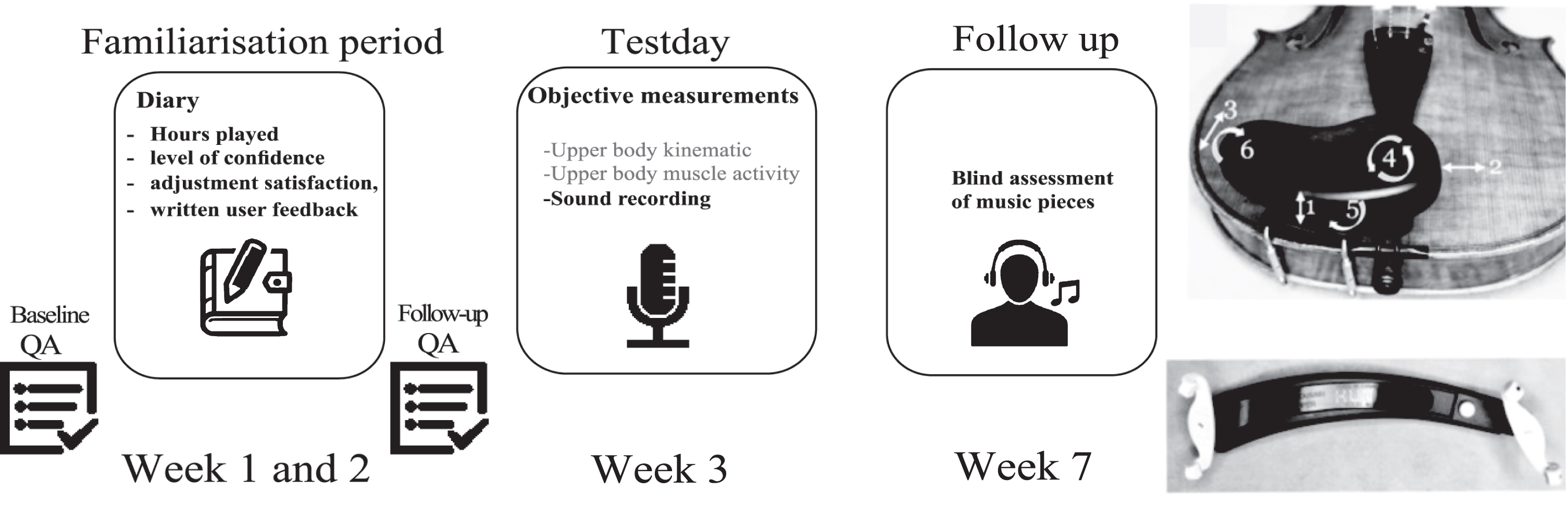
Timeline and overview of the procedures with questionnaires (QA), the two-week familiarisation period, test day in the randomised cross-over trial and the follow-up assessment of the music pieces. The objective measurements, coloured in grey, have been reported in an earlier study [21]. The two pictures to the right illustrate the EC with all the available adjustments and the low shoulder rest.
The follow-up questionnaire focused on the usability of the EC, with self-reported questions on design, comfort and performance. Participants were randomly assigned to play with the EC and UC in the third week (test day), while upper-body kinematics, muscle activity, and sound were measured. Lastly, the participants were asked to blindly assess their sound recordings one month after the test (week 7).
A 5-point Likert scale was used to evaluate motivation, user behaviour, usability, and acceptance –and in addition, open-ended questions were posed. The specific wording of the questions can be found in Appendix 1.
Motivation
The motivation to engage in this test of an EC was investigated in a baseline questionnaire using two different open-ended questions (Appendix 1).
Usage behaviour
During the familiarisation period, the diary was used to track usage behaviour, recording the number of playing days and the duration of each session using the EC or usual chinrest. The participants were encouraged to use the EC during all their playing time and every day.
Adherence was calculated as days using the EC and the total duration of playing time with EC.
Usability
We used the International Organization for Standardization definition of usability as a framework and adapted its criteria for effectiveness, efficiency, and satisfaction [24]. Our analysis yielded insights on confidence, performance (effectiveness), and adjustments (efficiency). To evaluate overall usability satisfaction, we measured factors such as emotions, comfort, design, and sound, which collectively influence the user experience [31].
2.3.3.1. Confidence and performance. We used the confidence outcome to estimate the number of days it took participants to play the music sheets with confidence (a measure of success in using the product to achieve a specific goal). This information was obtained through daily diary entries using a 5-point Likert Scale. This study reports the number of days it took for participants to give a positive response (‘fairly confident’) two days in a row (Appendix 1).
The performance scores were calculated based on three questions (Appendix 1). The overall score was subsequently calculated based on the Disabilities of the Arm, Shoulder, and Hand questionnaire (DASH) score calculation method [32]. Performance questions about using UC were included in the baseline questionnaire, and questions about using EC were included in the follow-up questionnaire.
2.3.3.2. Adjustment. The adjustment level was determined based on the days participants spent before finding an adjustment that worked while playing and answering, ‘yes’ instead of ‘no’. This study will report the number of days it took for participants to consistently provide positive responses for a minimum of two consecutive days (Appendix 1).
2.3.3.3. Emotions. Emotions can be described as neurophysiological states that encompass thoughts, feelings, and behaviour. They are often characterised as positive when associated with a sense of pleasure and negative when associated with a sense of displeasure. The participants were encouraged to submit responses elaborating on their positive or negative experiences (emotions) using the EC through the diary [22].
2.3.3.4. Comfort. The comfort scores were derived from five questions outlined in Appendix 1. These questions were asked simultaneously with the performance questions, and the calculation of an overall score followed the same method used for the performance score.
2.3.3.5. Design. The follow-up questionnaire included an open-ended question that asked participants to compare the appearance of the EC to their usual chinrest (Appendix 1).
2.3.3.6. Sound. The sound was evaluated a month after the recording was made on the test day. Two miniature microphones (DPA-4063) were attached to the music stand in front of the participant. The recordings were made with a DPA-MPS6030 battery-driven power supply and an Olympus LS-10 stereo digital recorder. The signals were sampled at 44.1 kHz with 16-bit resolution, stored in an uncompressed WAV format, and later converted to MP3. Three recordings were made for each setup (UC and EC): A and E major scale (warm-up) and then one recording of the music piece (second movement from Mozart’s violin concerto no. 5 in A major) that has been demonstrated to be a representative music piece for violinists [33, 34]. After a month, each participant received an email with six randomised recordings of their performance labelled A-F to ensure blind assessment. For each recording, the participant had to indicate whether they thought the recording had been played with EC by answering “yes,” “no,” or “I don’t know.”
Furthermore, they had to answer questions about their technique, tone, string crossing, quality of performance, and musical expression and interpretation. The different questions were adapted from a study investigating factors influencing the performance quality of violinists [35].
Acceptance
The participants were asked whether they planned to use the EC after the project ended by answering “yes”, “I will consider”, or “no” (Appendix 1).
Data analysis
Quantitative data
Descriptive data are presented as quartiles (Q1-Q3) frequencies, percentages (%), means, and standard deviations (SD). The difference in performance and comfort scores between UC and EC was analysed using a paired t-test after checking for normality using a Q–Q plot.
Although violinists may not be able to hear the sound/timbre associated with EC and UC, they may still distinguish between the audio files from each condition. Using a binomial probability test with n = 6 (audio files) and p = 0.05, we found a probability of 0.03 of distinguishing between the two conditions. Based on this probability, we expect 1.1 musicians to guess correctly or incorrectly on all six audio files. The differences in tone, string crossing, etc., were tested using a Wilcoxon sign rank test. Statistical significance was set to p < 0.05, and all statistical analyses were conducted in STATA (version 17).
Qualitative data
Open-ended responses from the diary and QA will be analysed using content analysis to condense the raw data into global themes. The data were coded in their original language, and the main author read the responses repeatedly and independently to become familiar with the data. The themes were categorised into positive, negative, and general responses and further condensed into global themes [36]. The general comments were written as sentences that could not be categorised as negative or positive and seemed irrelevant regarding using EC.
Results
Subject characteristics
The study included 38 participants, consisting of 12 men and 26 women. All participants self-identified as professional violinists, with three being conservatory students (master/soloist class) and 35 being full-time working violinists, including symphony orchestra members, freelancers, and music teachers. They were 42.6±12.0 years old and reported no pain at the time of inclusion.
Over half of the sample (63%) were currently very satisfied or satisfied using their usual chinrest, and seventy-four per cent of the participants had previous experience with trying another chinrest. Seventy-six per cent found the length of the familiarisation period appropriate. However, 79% usually only took days, hours, or minutes to decide if they liked a product. More detailed information, including the brand name of their usual chinrest and shoulder rest, can be found in Appendix 2 (a-b).
Motivation
All participants (n = 38) answered the open-ended questions, and 58 comments and reflections were received for the motivation question and 77 for the essential aspects of trying an ergonomic chinrest. For both questions, the same four categories were identified as motivators: ergonomics, sound, health, and performance. An additional category for the motivation for participation was “to find a new or a better product than their usual” (n = 16), while key aspects when trying a chinrest were “comfort and appearance” (Appendix 3).
Usage behaviour
The adherence to playing with the EC for each of the 14 days was high (median 85.7%, IQR 28.0%). Additionally, the total duration of playing time with the EC was also high (median 99.7%, IQR 16.6%). This indicates that the violinist spends almost all their playing time with the EC.
Usability
Confidence and performance
The median time was two days (IQR 2) before answering “fairly confident” when asked about confidence.
As shown in Table 1, the performance score is significantly worse for EC than UC, with 15.6 points higher score for EC.
Comfort and performance scores for both UC and EC were based on five and three
questions, respectively. UC: Usual chinrest and shoulder rest and EC: Ergonomic
chinrest including low shoulder rest. A score > 0 indicates a negative or reduced
comfort or playing performance (a scale ranging from 0–100). *Indicate
significant difference between UC and EC in performance score at
p = 0.03 including CI (confidence interval)
Comfort and performance scores for both UC and EC were based on five and three questions, respectively. UC: Usual chinrest and shoulder rest and EC: Ergonomic chinrest including low shoulder rest. A score > 0 indicates a negative or reduced comfort or playing performance (a scale ranging from 0–100). *Indicate significant difference between UC and EC in performance score at p = 0.03 including CI (confidence interval)
Finding an adjustment that worked by answering “yes” also took a median of two days (IQR 2).
Emotions
The written user experience from the diary on EC was divided into positive, negative, or general comments. In total, 420 comments were given over the two weeks, with more negative (n = 213) than positive (n = 163) comments.
Week 1 comments covered 84 positives (median 3.0; IQR 3.0), 129 negatives (median 1.5; IQR 3.0), and 20 general comments (median 0.0; IQR = 1.0). Similarly, week 2 covered 79 positives (median 2.0; IQR 4.0), 84 negatives (median 2.0; IQR 3.0), and 24 general comments (median 1.0; IQR 1.0).
During the two weeks, one participant gave no comments, two gave no negative comments, and five gave no positive comments. Most comments were on adjustment and body posture, second most on pain and discomfort, and third most on sound. The distribution of comments on these three main issues can be seen in Fig. 2. Figure 3 shows a flowchart with the total comments divided into barriers and facilitators related to the three themes.
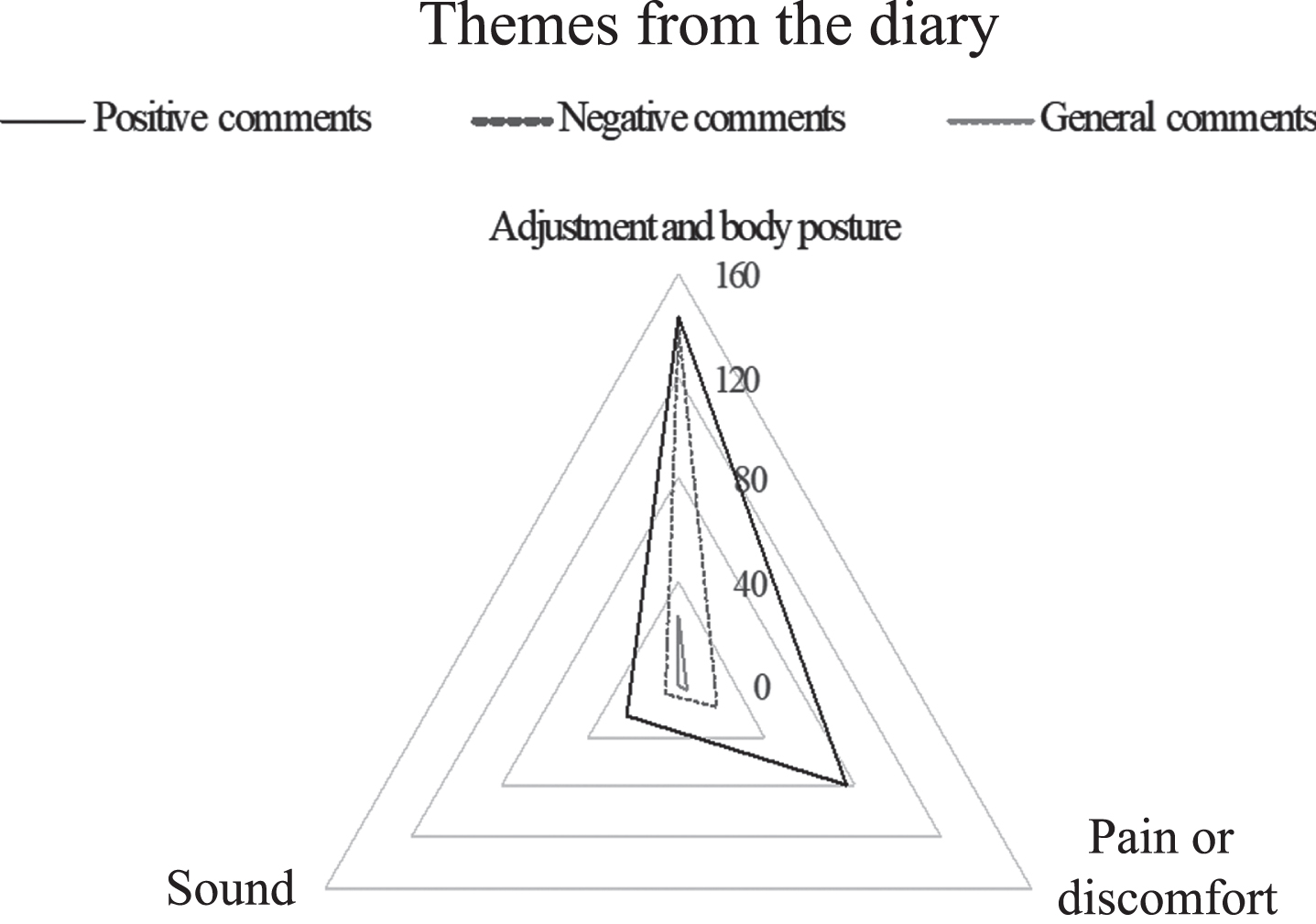
The radar chart shows, for both first- and second-week comments, the three themes and their distribution on positive, negative, and general comments and their internal relation.

The three identified themes with different factors that can facilitate or be a barrier to using EC.
The most common complaint about the EC was that adjustments were time-consuming and complicated due to the many options available. A significant barrier to using the EC was the time required for disassembly, storage in the violin case, reassembly, and adjustments, which detracted from practice, according to one participant: “You must just get your act together to get started because there are so many things you need to adjust. You just want to be able to play right away. Feel like you are wasting your practice time.” (Female, 46) Or another violinist wrote: “I get impatient having to put it on when using” (female, 29 years old)
Furthermore, many participants found the shoulder rest (Kun) problematic because it changed the angle of the violin or did not give the comfort and support, they felt they needed.
“Bad angle of the violin because of the shoulder rest” (female, 50)
“Tried different adjustments of the chinrest but ended with approximately the same as before. Can’t find the optimal angle for the shoulder rest, though. Lacks support on top of the shoulder”. (Female, 23)
The theme of pain and discomfort also revealed that several participants experienced discomfort in their collarbone due to the placement of the violin and the low shoulder rest. “The violin is placed badly on the collarbone, and I really want to raise the shoulder rest, as it hurts. But I don’t do it. It is also not comfortable to play so “far down” on the arm. I’m getting tension in my left elbow that I have not had before.” (Female, 37)
Fewer participants (n = 11) made a negative or a positive (n = 7) comment about the timbre. The negative comments were mainly that the timbre changed or that it was more difficult for them to hear their violin when sitting in the orchestra.
“One minus: The quality of the timbre is not top notch.” (Male, 46)
In contrast, most of the positive comments stated that the EC improved the timbre of the violin, with some explicitly noting this when playing scales: “The sound is definitely better with the Kréddle!” (Female, 64)
Positive comments about adjustments and body posture noted increased freedom in the body, neck, and left arm and the ability to adjust to the individual player: “The adjustment takes some time because Kréddle has so many options. It’s a great advantage, but it does take some time to find the right position. It improves the general posture, especially the neck”. (Male, 33 years old)
The positive comments about pain and discomfort were primarily that the discomfort that occurred at the beginning of the two weeks disappeared or decreased during the days:
“Tired in the neck, but not the same pain as with my own. I think the new head/neck position is good! Especially the better height of the chinrest helps 😊.” (Female, 50)
General comments were about where or how much they played or which specific adjustments they made on the EC.
In Table 1, the comfort score is shown. We did not find any difference in the comfort score between both setups.
Design
All participants left either a positive or negative comment about the appearance of the EC. Sixteen participants’ comments could be categorised as negative and nine as negative but not problematic. Examples from two participants that sum up the general negative feedback:
“Unfortunately, not as nice as my own chinrest; I think it is more beautiful with wood.” (Female, 25)
“I think it looks strange that it is “floating” so high above the violin. Not nice. It looks cheaper than my own chinrest.” (Female, 46)
The ones that did not find it problematic wrote:
“I don’t like plastic material, but the idea is good and can also be refined to fit different chins.” (Female, 50)
“Fine, but not as beautiful as my own.” (Male, 33)
Eight participants stated that “it is okay”, and five participants’ comments could be defined as genuinely positive about the appearance of EC, stating:
“It is more modern. Discreet” (Female, 36)
“It’s unconventional, but I like it very much.” (Male, 38)
Sound
Of 37 violinists, 12 (32.4%) could distinguish between the two conditions across all six audio files. Specifically, four participants guessed correctly for all six audio files, while eight guessed incorrectly for all six. The p-value was < 0.001, indicating that the null hypothesis can be rejected at a 5% significance level. Additionally, the 95% confidence interval for the actual probability of success was 0.18 to 0.50. In the blind assessment, no overall differences were detected between UC and EC regarding technique, string crossing, tone or musical expression and interpretation. Only “quality of performance” showed a significant difference between UC and EC (p = 0.02), with more participants scoring “bad” for EC than UC (Fig. 4).

Showing the results in the blind assessment for the scoring of the technique, tone, string crossing, quality of performance, and musical expression and interpretation. UC: Usual chinrest and shoulder rest and EC: Ergonomic chinrest including low shoulder rest. Only the quality of performance showed a significant result (p = 0.02) between UC and EC.
In total, 36.8% (n = 14) of the participants wrote that they would continue to use the EC, 28.9% (n = 11) said they will not, and 34.2% (n = 13) are considering using the EC later.
Discussion
This study examined user experience by gaining insight into the motivation, behaviour, usability, and acceptability of professional violinists using the EC for two weeks. Thirty-eight professional violinists were motivated to join the study to improve body posture and reduce muscle tension. They showed high usage and became confident in only two days. However, usability issues negatively impacted their experience, resulting in a 15.6% decrease in performance scores and a lower sound quality. Although the diary generally received many negative comments, 36.8% of participants expressed their desire to continue using the EC.
The appearance of a product can affect performance [37], highlighting the importance of considering aesthetics when designing it. In this study, the EC design received more negative feedback than positive, which may have influenced the performance score [38]. This knowledge can be used to refine the EC’s design process. However, the negative feedback may not accurately reflect the overall user experience due to negativity bias. Participants may focus more on negative elements because they “stand out more” immediately than the positive ones and are referred to as “usability flaws” [39–41]. Many positive comments with similar themes as the negative ones were obtained during the study, indicating a shift over time as participants became more accustomed to the adjustments with less pain and discomfort. Time and difficulty required for adjustment are major barriers to using the EC. The complexity of a new product can reduce its evaluation due to the learning cost needed to understand it [42]. Though the included violinists quickly adjusted and felt confident, this period can still be long for those accustomed to making decisions within a few hours or minutes. Hence, it may be relevant to conduct a study focusing on musicians’ initial impressions of the product, including its appearance and anticipated problems, and then conduct a follow-up evaluation after a shorter period to assess their typical decision-making process [43]. The study did not measure musicians’ anticipated performance, comfort, or immediate reaction to the appearance of EC, which could have provided another insight into positive and negative design issues before use [44]. However, several usability outcomes in this study are measured over time, offering insight into how users adapt to EC. Usability includes various methods to measure effectiveness, efficiency, and satisfaction. This study did not measure error rates, precision, or time to complete tasks before the two-week period, which could have offered further insights during usability testing.
Additionally, the participants included in the study were non-injured, which may have resulted in a negative bias towards the product’s complexity. In hopes of finding a solution to keep playing, injured violinists may prioritise other aspects over the product’s complexity [45]. Despite the potential negativity bias, it is important to acknowledge that the negative feedback received regarding the product is critical and holds valuable insights that can significantly influence the user experience. Factors such as pain issues, the use of the shoulder rest with this EC, and the sense of disconnection between the player and the violin highlight areas that need to be addressed in the design process when considering the factors that impact the user experience.
The violinists demonstrated better-than-chance ability to distinguish between EC and UC audio files, showcasing their trained musical ability to differentiate between sounds and timbre. This may be due to the significant difference between UC and EC, with more negative scoring for EC in “quality of performance”. However, it is important to note that out of the twelve participants, only four accurately identified the sound associated with EC, thereby introducing an element of uncertainty regarding the precise influence of EC on the auditory experience. In addition, a prior study supports that timbre could be altered by different shoulder rests, with variation depending on the violin used [45]. The results of this study suggest that changing the chinrest and shoulder rest may impact the timbre and overall performance quality. Further investigation is warranted to determine whether the EC, the low Kun shoulder rest, or the combination influences timbre. This highlights the need for designers of EC to consider these variables during the design process.
By addressing concerns related to design, adjustment time, sound changes, pain, shoulder rest compatibility, and the sense of disconnection in the design process, it might be possible to create a chinrest that not only meets the ergonomic needs of the users but also enhances their overall musical experience.
Strength and limitations
This study answers the research question by combining information from questionnaires and written user feedback (open-ended questions), strengthening the identification of needed improvements of the EC.
While this study’s high compliance and adherence rates are encouraging, it may not entirely reflect real-life usage. To ensure user satisfaction, it is important to consider design factors such as ease of use and comfort. This is particularly crucial given the relatively short timeframe in which musicians often evaluate a product’s usefulness, which typically ranges from minutes to hours or a few days.
One limitation of this study is that the motivation questions need more specific theoretical underpinnings. Additionally, certain usability outcomes were developed solely for this study, indicating a need for further validation and standardisation. While it is a strength that the applied questionnaires are tailored to the product and cover sound, design, and emotions towards EC, it lacks well-established standardisation like the System Usability Scale [46]. Therefore, the results must be interpreted cautiously, as they may not be directly comparable to those obtained using a standardised scale. Moreover, this study did not extensively explore demographic factors such as age (visual acuity) and gender (physical abilities, anthropometry, communication, and decision-making processes), which may have influenced the interactions with the EC [47]. Insight into these aspects might have ensured that the product is accessible and usable for many users. However, the high external validity of our study is evidenced by the representative sample of professional musicians, which includes a higher proportion of women and an average age.
Conclusion and perspective
In conclusion, professional violinists demonstrated high usage behaviour with the EC, hoping to improve posture, reduce muscle tension, and enhance performance.
While the study identified various usability factors affecting the user experience of EC (including design, adjustment time, performance and sound), it’s worth noting that our previous publication reported no significant differences in muscle activity in the neck, throat, shoulders, or neck kinematics when using the EC compared to their usual chinrest [21]. Furthermore, our study highlights barriers such as increase in discomfort, particularly collarbone discomfort, associated with the EC, possibly due to instrument positioning and the use of the Kun shoulder rest. Considering this, we would encourage users to explore alternative positioning options that align more with comfort and needs. A particular focus should be on optimising neck positioning to lower the elevated muscle activity presented in the previous publication.
Notably, 37% of the violinists expressed an interest in continuing to use EC after participating in this study. This indicates the potential value of the EC in specific contexts and for certain violinists.
Understanding the key factors influencing performance can assist violinists in making informed product decisions, ultimately increasing satisfaction and performance. Furthermore, product developers can integrate human factors considerations into the design process to meet users’ needs and enhance the overall user experience. This study also contributes to the ergonomics and human factors field by enhancing the understanding of how individuals interact with products and technology, ultimately driving the development of safe, efficient, and user-friendly products.
Ethical approval
The Regional Scientific Ethics Committee for the Regions of Southern Denmark assessed the study procedure and stated that approval was not required (Date: 2020, Number: S-20202000-87).
Informed consent
All participants provided written informed consent prior to their participation in the study.
Conflict of interest
The authors declare that they have no known competing financial interests or personal relationships that could have appeared to influence the work reported in this paper. The Kréddle company was not involved in the design of the study, the execution, analyses, data interpretation or decision about submitting the results.
Footnotes
Acknowledgments
We would like to express our gratitude to the management of the orchestra for their assistance in recruiting participants. We are also thankful to all participants involved in this study.
Funding
This study was supported by the Axel Muusfeldts fond, Denmark (ID: 2018-1061), the Region of Southern Denmark (ID: 18/50654), and Helsefonden, Denmark (ID: 18-B-0292).
The Kréddle company provided the ergonomic chinrest (Kréddle) for this project worth approx. €3258 Euro.
