



Abstract
BACKGROUND:
During periods of high-volume vigorous exercise, United States Marine Corps recruits often experience musculoskeletal injuries. While the program of instruction (POI) for basic training is a defined training volume, the total workload of boot camp, including movements around the base, is unknown.
OBJECTIVE:
The present study aimed to quantify the daily total workload, energy expenditure, and sleep during basic recruit training at Marine Corps Recruit Depot (MCRD) San Diego.
METHODS:
Eighty-four male recruits from MCRD San Diego wore wrist wearable physiological monitors to capture their complete workload (mileage from steps), energy expenditure, and sleep throughout the 10-week boot camp.
RESULTS:
Marine recruits traveled an average of 11.5±3.4 miles per day (M±SD), expended 4105±823 kcal per day, and slept an average of 5 : 48±1 : 06 hours and minutes per night. While the POI designates a total of 46.3 miles of running and hiking, the actual daily average miles yielded approximately 657.6±107.2 miles over the 10-week boot camp.
CONCLUSION:
Recruit training requires high physical demand and time under tension due to the cumulative volume of movements around base in addition to the POI planned physical training.
Introduction
The United States Marine Corps (USMC) provides basic training (boot camp) to over 38,000 recruits each year. Of the 38,000 recruits, an expected 39.6% (∼15,000 individuals) suffer a musculoskeletal injury (MSKI) during their basic training cycle [1, 2]. This high rate of MSKI is estimated to cost the USMC approximately $111M USD and 356,000 lost duty days each year from service members who are not mission ready [2–4]. Furthermore, a study examining Navy recruit training reported that 488 Navy recruits were physically unable to perform the necessary stages of basic training because of an MSKI. The failure to complete such training was estimated to inadvertently cost the Navy nearly $5M USD [5]. MSKIs are among the leading culprits contributing to lost duty time and morbidity during military training and deployment [6].
Past research suggests that MSKIs are most common among younger Marines and frequently occur during intense physical exercise. The injuries often take the form of sprains, strains, and stress fractures, which are typically due to overuse or overtraining. These issues may arise from a sudden increase in training volume and inadequate recovery time [7]. The current basic training regimen follows a predefined program of instruction (POI) that includes physical training (e.g., running, swimming, obstacle course, hiking) as well as military technical and tactical skills (e.g., marksmanship, drill, navigation, martial arts). However, additional daily activities and movements outside the POI could contribute to program-induced cumulative overload, leading to overtraining and eventual injury [8].
Core elements of a well-rounded exercise training or activity program include progressive overload, specificity, and periodization of activity, balanced with adequate rest and recovery time. At its essence, the physical training process is a symbiotic relationship between stressing the system and allowing sufficient time for the body to recover. The boot camp POI is based on these foundational principles; however, high rates of overuse injury persist. When the POI is implemented incorrectly, stress overtakes recovery and the individual becomes at risk of entering a state of overtraining, thereby increasing the risk of injury [1, 9]. Many factors lead to MSKI in the military [10], some of which are modifiable, such as training volume. Quantification of daily and total workload, together with energy expenditure and sleep, could inform an adjustment of training volume to effectively prepare recruits physically while also reducing MSKI. This ultimately would lead to a more capable Marine, thus saving resources, time, and money. Holistic quantification of basic daily training workload that encompasses all activity, including physical training outlined in the POI and all movements around base, is warranted to understand total physical load. Thus, the objective of this study was to quantify daily total workload, energy expenditure, and sleep during USMC basic training to determine cumulative training volume and estimate rest and recovery time in recruits.
Methods
Participants
The study engaged recruits from two training battalions at the Marine Corps Recruit Depot (MCRD) San Diego, operating within the larger framework of a broader project [11]. Each battalion adheres to an identical POI, yet the physical positioning of their barracks (where they sleep) varies significantly in relation to the mess hall (where they eat their meals) and training locations. An information session clarified the study’s objective, after which recruits volunteered to share their physical training metrics and injury data and agreed to wear a physiological monitor. From the 1129 volunteers, we selected 84 males and 110 females representing a broad demographic spectrum of body sizes and fitness levels. This article focuses solely on the data of male participants; we have published the female data in a separate study [12]. The study protocol was reviewed and approved by the Naval Health Research Center Institutional Review Board.
Physiological monitoring
Workload (mileage from steps), energy expenditure, and sleep duration data were obtained from a wrist-worn physiological monitoring devices (Polar® Grit X Pro, Polar Electro USA, Lake Success, NY, USA). The Polar Grit X Pro (PGX) was selected based on internal validation (unpublished data) and prior validation of the Polar Vantage for steps, acceptability within the USMC recruit population, ease of use, battery life, and cost [13, 14]. Wearables were distributed at the beginning of week 1 and were worn throughout the 10 weeks of boot camp and included the final training exercise known as the Crucible. Wearables were worn continuously, and data were manually downloaded as previously described [12]. The PGX is equipped with a triaxial accelerometer that measures acceleration in three directions and an optical heart rate sensor that measures continuous heart rate and heart rate variability to determine sleep duration. Polar uses proprietary algorithms to convert acceleration data into step counts, distance traveled, and sleep duration.
Prior to distribution, each participant’s body mass, height, age, and gender were input into the device settings. The PGX estimates energy expenditure using a proprietary algorithm that includes demographic information, heart rate, and acceleration data, and the PGX has been validated against indirect calorimetry [15].
Program of instruction
A complete training matrix for the POI for MCRD San Diego is publicly available [16]. In short, receiving week (week 0) consists of the Initial Strength Test and in-processing. On the West Coast, week 1 through week 6 training is located at the MCRD San Diego facility. Weeks 7–10, recruits are bussed to Marine Corps Base Camp Pendleton for weapons and field training. Week 10 is the final phase of physical training that concludes with the Crucible, a 54-hr capstone event. Recruits who successfully complete the Crucible return to the San Diego depot as Marines and remain for an additional 2 weeks of administrative tasks (weeks 11 and 12) prior to graduation and moving on to additional training courses or their first duty station. Thus, in total, boot camp spans 13 weeks, however data collection using the PGX was intentionally weeks 1–10 to capture only the physical portion of training.
Statistical analysis
Data from PGX were removed from the data set if the daily active time was less than 6 hr. This cutoff was chosen to account for light duty and sick days and filter out non-wear days. Numbers that were over double the daily mean were deemed erroneous, and thus removed from the data analysis. Average daily values across all outcome measures were calculated for each week within the POI, with means±standard deviations reported. Descriptive statistics for participant demographics and outcome measures within and across companies were obtained. To investigate the company and week differences in daily miles, energy expenditure, and sleep duration, a series of mixed effects between and within factorial analyses of variance (ANOVAs), with training week as the within factor and company as the between factor, were performed for each outcome variable. Where testing yielded a significant interaction effect for the two predictor variables, simple main effects followed by Bonferroni adjusted simple pairwise comparisons were performed to investigate specific differences. Where significant interaction effects were not present, main effects were explored further with Bonferroni adjusted pairwise comparisons. All analyses were performed in R version 4.2.2 [17]. Data are presented as mean±standard deviation.
Results
Participants
A total of 84 males aged 17–26 years (19.31±1.57) data were reported in this paper. Split by company, there were 23 recruits in Golf 1, 42 in Golf 2, and 19 in Lima. Results from a series of one-way ANOVAs indicated that there were no significant differences in height, weight, body mass index or resting metabolic rate between the three companies. Due to the uniformity in recruit profiles across companies, demographic information was aggregated across the three companies (Table 1).
Aggregated demographics for male Marine recruits (n = 84) from Golf 1, Golf 2, and Lima companies
Aggregated demographics for male Marine recruits (n = 84) from Golf 1, Golf 2, and Lima companies
Note. BMI = body mass index; IQR, interquartile range; RMR, resting metabolic rate; SD, standard deviation. *RMR calculated via Mifflin-St Jeor equation.
Data yield (compliance) was 82% over the 10 weeks of boot camp. Lost data were due to PGX battery failure and non-wear of the PGX during certain events and times of the day. The average active time (duration) across all training days is presented in Table 2.
Recruit daily average metrics over 10 weeks of Marine Corps boot camp
Recruit daily average metrics over 10 weeks of Marine Corps boot camp
Note. Values represent daily averages across participants, where n is total number of days. Overall denotes the combined average across the three companies. SD, standard deviation.
The POI includes 46.3 miles of planned movements to include physical training runs and conditioning hikes. The total workload for the 10 weeks of boot camp as calculated by the PGX is 657.6±107.2 miles across all recruits and includes the planned physical training as part of the POI as well as all movements around MCRD San Diego.
Average daily workload was 11.5±3.4 miles (Table 2). A mixed effects factorial ANOVA was conducted to investigate the effects of company and week of training on recruit average daily miles. Workload met statistical assumptions of normality, homogeneity of variance, and homogeneity of covariance. There was a significant interaction effect for company and week, F (10.21, 398.13) = 7.98, p < .0001, η2p = 0.17. Simple main effects for training week revealed that workload differed significantly between the three companies at weeks one, F (2, 81) = 6.44, p = .03, η2p = 0.14; nine, F (2, 78) = 12.35, p = .0002, η2p = 0.24; and ten, F (2, 78) = 6.07, p = 0.04, η2p = 0.14, despite no changes to the POI. Bonferroni adjusted pairwise comparisons revealed significant differences between Golf 1 (12.0±3.0) and Lima (10.0±2.5) at week 1 (p = .002), Golf 1 (12.5±2.9) and Golf 2 (11.3±2.6) as well as Golf 2 and Lima (13.6±2.7) at week 9 (p = .025 and p < .0001), and between Golf 2 (14.5±5.3) and Lima (16.8±6.2) at week 10 (p = .004) (Fig. 1).
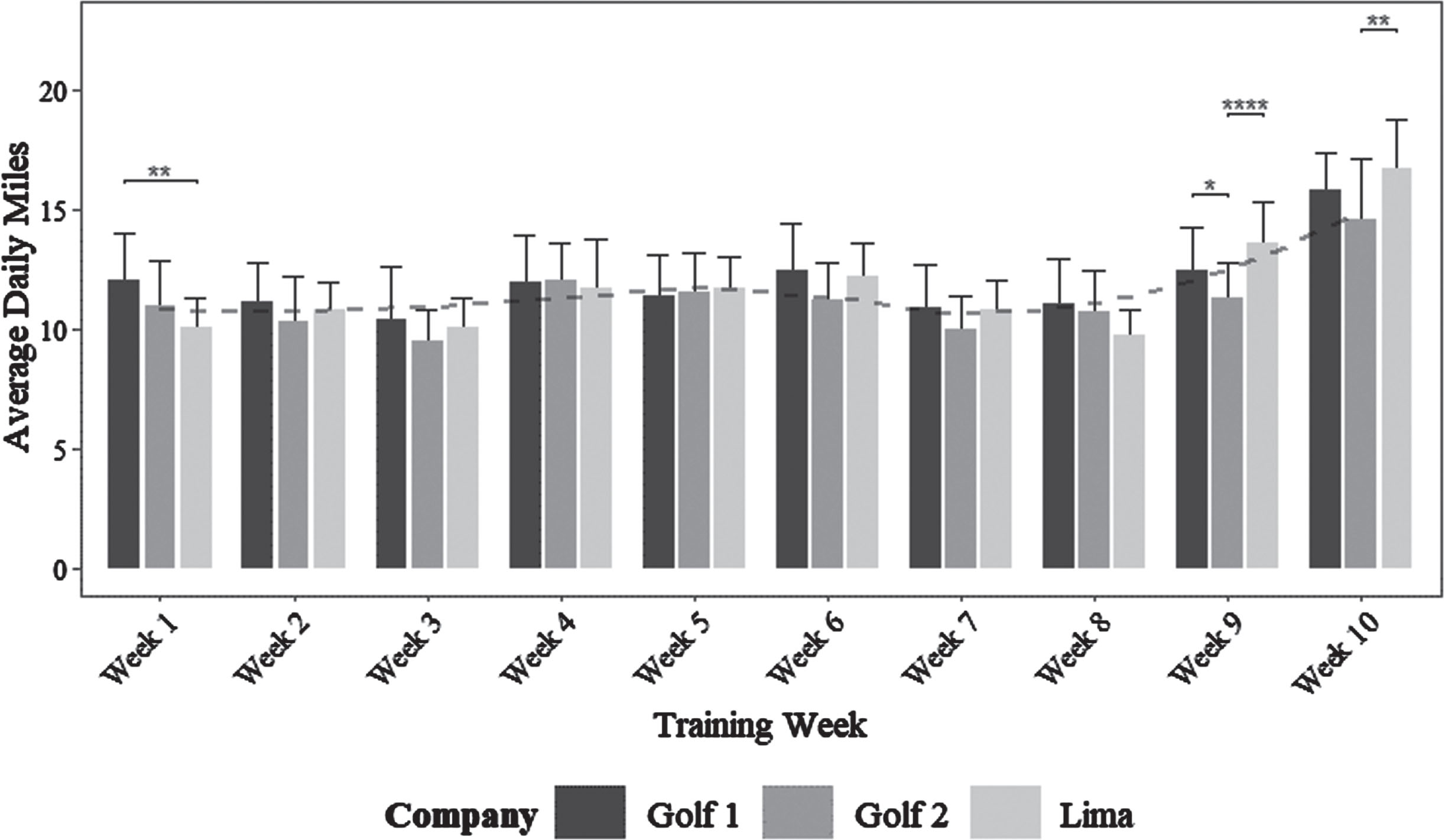
Average daily miles traveled by Marine recruits during 10 weeks of training. ANOVA, F(10.21, 398.13) = 7.98, p < .0001, η2p = 0.17; ****p < .0001; **p < .01; *p < .05.
Recruit daily average HR over Crucible days (week 10)
Recruit daily average HR over Crucible days (week 10)
Note. Values represent a daily average of all nightly average heart rates across companies. SD, standard deviation.
Data for average daily energy expenditure were normally distributed across groups, met assumptions of homogeneity, and were free of any significant outliers. Marine recruits estimated daily energy expenditure was 4105±823 kcals. Data were further stratified by company and training week. Mixed ANOVA results for energy expenditure indicate a significant interaction between company and training week, F (10.38, 404.86) = 5.86, p < .0001, η2p = 0.13. Post hoc analyses revealed a significant simple main effect for week 1 but not for any other training week, F (2, 81) = 7.01, p = .02, η2p = 0.15. Pairwise comparisons show Golf 1 (4692±802) had a significantly higher energy expenditure compared with Lima (3904±516) at week 1 (Fig. 2).

Average daily energy expenditure by Marine recruits during 10 weeks of training. ANOVA, F(10.38, 404.86) = 5.86, p < .0001, η2p = 0.13; **p < .01.
Marine recruits slept an average of 5 : 48±1 : 06 hours and minutes (h:mm) per night across the full 10-week boot camp. A mixed effects factorial ANOVA was conducted to investigate the effects of company and week of training on participant average nightly sleep. Average nightly sleep met statistical assumptions of normality, homogeneity of variance, and homogeneity of covariance. There were no significant interaction effects between companies and nightly hours slept, F (14.36, 538.61) = 1.65, p = .06, η2p = 0.04. However, there were significant main effects for company, F (2, 75) = 5.49, p = .006, η2p = 0.13, and training week, F (7.18, 538.61) = 4.65, p < .0001, η2p = 0.06. Bonferroni adjusted pairwise comparisons revealed significant differences (Fig. 3) between weeks 2 and 6 (p = .015), 2 and 10 (p = .018) and weeks 3 and 6 (p = .036). Pairwise comparisons by company (Fig. 4) show a significant difference between Golf 1 (5 : 38±1 : 03) and Golf 2 (5 : 53±1 : 08, p < .0001) as well as Golf 1 and Lima (5 : 47±1 : 04, p = .0479) across all training weeks.
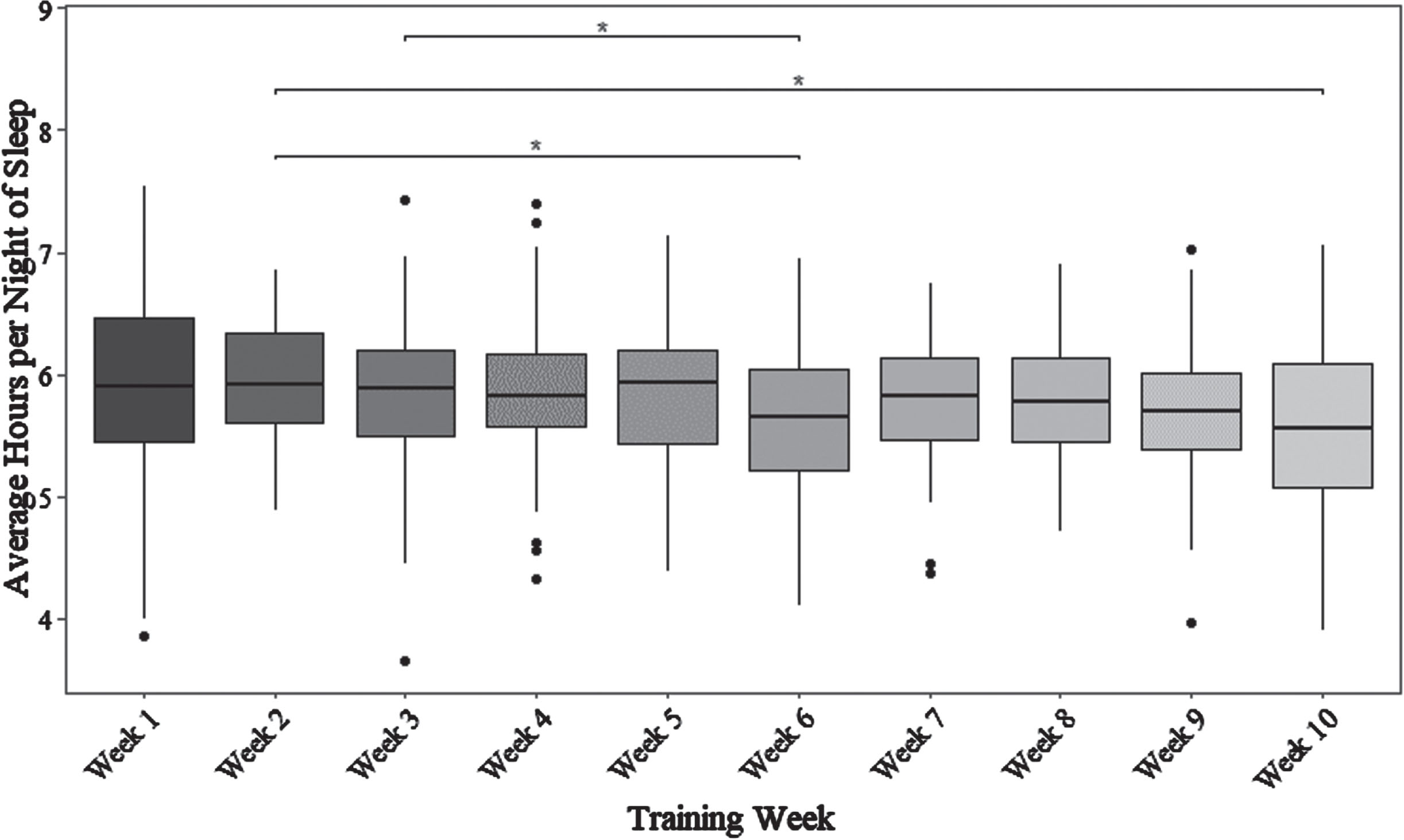
Average weekly hours slept by Marine recruits during 10 weeks of training. ANOVA, F(14.36, 538.61) = 1.65, p = .06, η2p = 0.04; *p < .05.
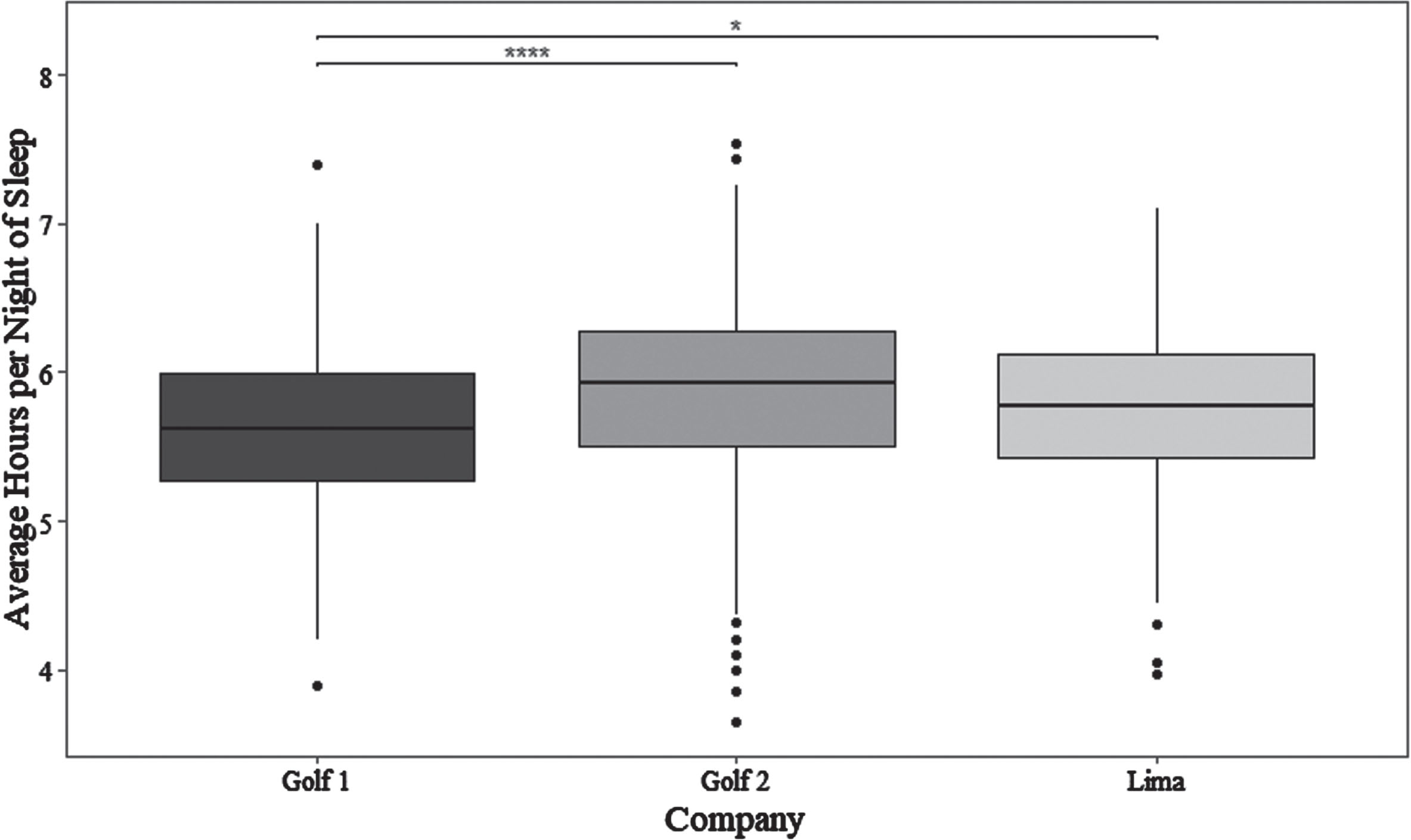
Average nightly sleep by Marine recruits during 10 weeks of training, by company. ANOVA, F(14.36, 538.61) = 1.65, p = .06, η2p = 0.04; ****p < .0001; *p < .05.
Nightly heart rate (while sleeping) data met all normality, homogeneity of variance, and outlier assumptions before statistical testing. Estimated nightly heart rate was 54.9±8.6 bpm across all companies during the full 10-week boot camp. Mixed ANOVA results for nightly heart rate showed a significant interaction effect between company and training week, F (7.71, 154.26) = 2.17, p = .034, η2p = 0.1. Post hoc analyses indicated a significant simple main effect of company for week 10 only, F (2, 73) = 11.6, p < .001, η2p = 0.24. Additional pairwise comparisons revealed Golf 2 (56.2±8.6) had a significantly higher nightly heart rate compared with Lima (52.8±8.5, p < .001) and Golf 1 (54.8.2±8.5, p = .008) at week 10 (Fig. 5).
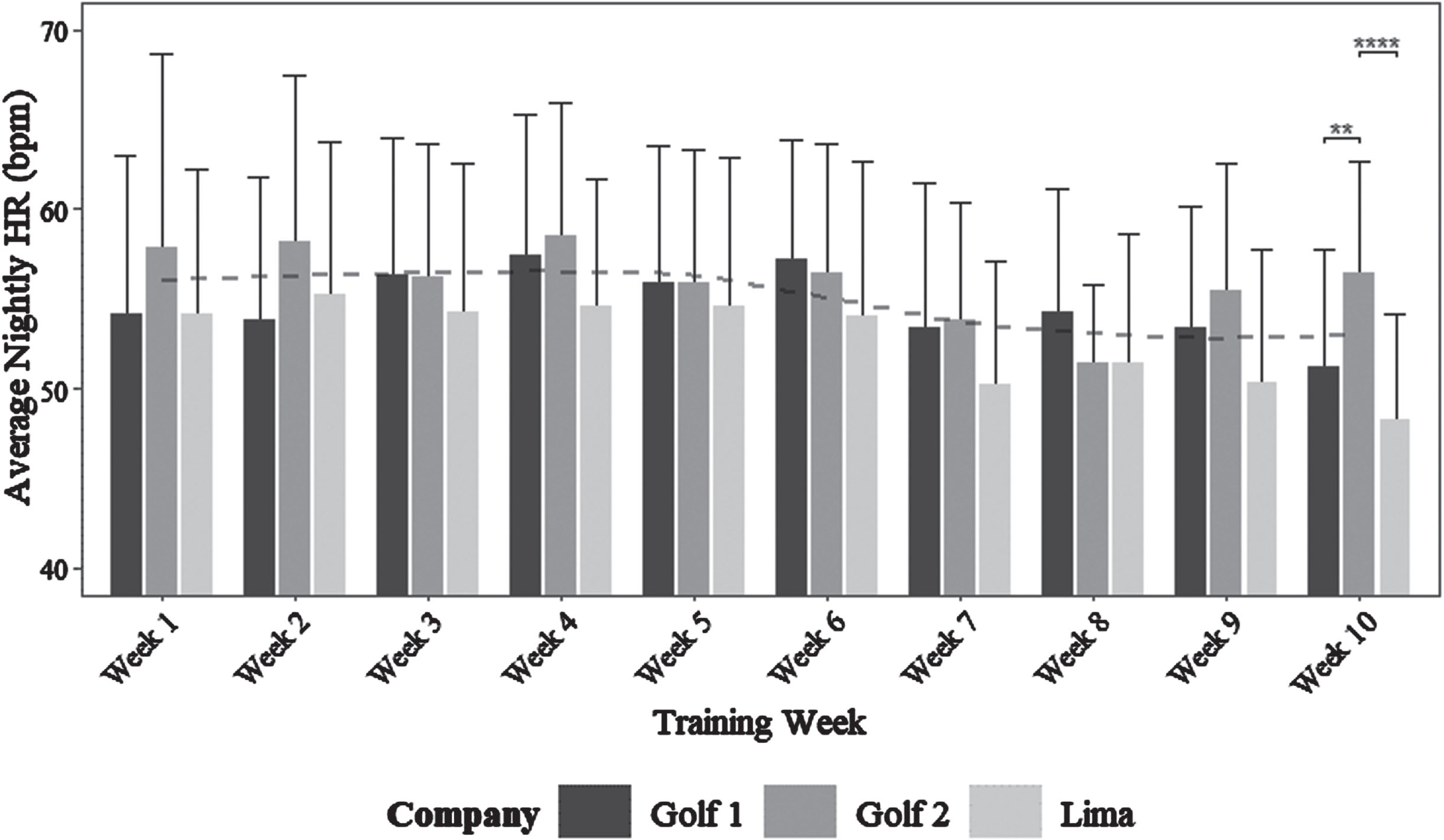
Average nightly resting heart rate by Marine recruits during 10 weeks of training. ANOVA, F(7.71, 154.26) = 2.17, p = .034, η2p = 0.1; **p < .01; ****p < .0001.

Average daily miles by Marine recruits during Crucible week, by company.
Descriptive statistics for all outcome variables were separated for the final training exercise known as the Crucible, which has the highest daily workload (15.1±5.6 miles), energy expenditure (4578±1287 kcal), and least amount of sleep (5 : 44±1 : 33 h:mm). Analyses of individual days show the second day of the Crucible (Tuesday) was the most demanding as measured by workload (21.8±3.0 miles, 44070±7381 steps) and energy expenditure (5955±932 kcal) coupled with the lowest recorded sleep (4 : 11±0 : 41 h:mm).
Discussion
The fundamental aim of this effort was to calculate the daily and total workload, defined by mileage accrued from steps, alongside energy expenditure and sleep during USMC boot camp. To our knowledge, our research is the first to examine the holistic monitoring of average daily movement (training and foot travel around base) alongside estimated energy expenditure and sleep among USMC recruits. We found recruits had a high daily workload (11.5±3.4 miles) equivalent to 22,950±6794 daily steps, expended 4105 kcal per day, and slept an average of 5 hours and 48 minutes per night over the10 weeks of training. According to the current POI, running and hiking physical training events over the entirety of boot camp add up to 46.3 miles in total. Thus, the POI does not account for 10.8 miles daily in administrative movements (i.e., walking to and from mess hall and training activities).
Although our investigation did not separate physical activity into intensity minutes, we postulate, as with other basic training reports, that most of the time would classify as low intensity, despite placing strain on the body. Our findings show USMC recruit workload is considerably higher than previous reports of military basic training workloads of similar program lengths (i.e., 12 weeks) reported as ∼10,000–17,000 steps per day [18, 19]. In the present study, the variability in workload between recruit companies can be explained by the location of their barracks relative to the mess hall and daily training activity sites.
While we cannot adjust the POI to account for this variability, it is essential to understand this additional workload due to daily movements to explain differences in injury rates. Overuse injuries comprise at least 70% of all injuries and MSKIs and 65% of all medically nondeployable active duty soldiers [20, 21]. MSKIs become a higher risk with excessive loading, inadequate recovery, and under-preparedness for load changes [22]. However, to understand these risks, we must identify modifiable risk factors for overuse injury, such as exercise programming and insufficient sleep. Therefore, our current exploration focused on understanding cumulative load, a primary factor leading to tissue maladaptation and injury.
Increased loading during military recruit training is necessary to build the strength and endurance required for military movements. The two main stressors identified in basic training are load carriage and muscular fatigue [23]. Marine recruits frequently bear the weight of their uniform, protective tools, and weapons. Depending on the body part carrying the load, each kilogram of added load amplifies energy expenditure by 4–10% [24]. Load carriage also increases ground reaction forces, as does the fixed pace of marching, leading to altered gait and stride [25]. This sudden increase in prolonged externally loaded movement upon arrival at boot camp contributes to increased energy expenditure, force impact, and muscular fatigue, thus increasing the risk of physical strain on bones and joints [26, 27]. In addition to being significant for recruits during basic training, the enhanced external load also plays a crucial role in determining the performance quality throughout their future combative years.
While recruits must endure physically challenging and overloaded training, balancing training and recovery is crucial to prevent non-functional overreaching [28]. Non-functional overreaching is when a stimulus above a person’s training threshold is applied for too long and leads to decreased performance and increased risk of injury [29]. Overtraining symptoms are common in military populations and are consistent across multiple basic training programs [30–32]. Monitoring training load can help reduce risk of injury, illness, non-functional overreaching, and help maintain performance readiness [33]. Daily workload in boot camp started immediately around 11.0 miles per day (∼22,000 steps), which likely represents an abrupt increase for most recruits from civilian high school activity. Progressive overload, a principle of program design that increases load and/or repetition incrementally over time, is a method to overcome the increased injury risk from sudden changes in exercise volume via gradual increases in exercise for progressive adaptations [34].
In addition to monitoring training, matching caloric intake with expenditure is critical to recovery. Recruits in our study had demographics nearly identical to those in previously reported efforts and similar estimated energy expenditure and caloric requirements (3350–4300 kcal per day; [18, 19]. Moreover, recruits slept on average 5 : 48 h:mm per night, falling short of recommendations for adults (7–9 hr) and athletes (9–10 hr) [35] but consistent with others’ reports of sleep duration in entry-level training programs [18]. For instance, prior studies showed Australian Army recruits slept 6 : 18 h:mm [18], Australian Army Combat Engineer training school students slept 5 : 24 h:mm [18], and United States Military Academy cadets slept 5 : 46 h:mm per night [36]. Sleep loss and irregular sleep patterns are common in the military, and short sleep duration has been shown to negatively impact soldiers’ physical performance, weapons handling, and equipment control. Sleep loss and irregularities can contribute to fatalities during military operations. Therefore, protecting sleep time, especially during entry-level training, is essential to maximize training potential.
This study has limitations. First, due to an inability to use Global Positioning System distance tracking, possible error in distance precision from mileage/step estimation based on wrist movement. Second, despite high data yield (82%), watch wear time compliance leaves room for error in underestimating total daily distance. Third, energy intake, which would provide insight into overall energy balance, was not measured. For two of the companies, watches were removed from recruits at approximately 10 : 00 a.m. on the final day of the Crucible, thus the data reflected only a partial day of mileage and energy expenditure tracking. Despite these limitations, our study offers valuable insight into the daily and overall workload of boot camp. Knowledge of the total physical strain could help inform program planning to reduce MSKIs and ultimately build a stronger Marine.
Conclusion
The results of our study provide a comprehensive perspective of the physical demands and workload experienced by USMC recruits during boot camp. Our findings highlight a higher workload than previously reported in similar military basic training studies and present variability in workload between recruit companies. While increasing physical load during boot camp is necessary to build recruits’ strength and endurance, understanding and managing this workload is critical to prevent overuse injuries, maintain performance readiness, and ensure overall health. The abrupt transition from civilian high school activity to military training in conjunction with inadequate sleep and recovery can pose significant risks to recruits.
Our study calls attention to the importance of incorporating progressive overload principles, adequate recovery periods, and sufficient caloric intake in the training regimen to avoid non-functional overreaching and to reduce injury risk. Additionally, recognizing the need to protect sleep time during such demanding training periods is paramount to optimizing performance and maintaining morale. Despite limitations in distance precision and energy intake measurement, our study offers valuable insights into the daily and overall physical workload of USMC boot camp. This knowledge can inform program planning to reduce MSKIs and produce more robust and prepared Marines. Future research is warranted to quantify the stress response to the POI, specifically the relationship between caloric intake and expenditure, with the goal of enhancing performance and recovery to minimize injury risk during the 10-week military boot camp.
Disclaimer
KK is an employee of the U.S. Government. This work was prepared as part of her official duties. Title 17, U.S.C. §105 provides that copyright protection under this title is not available for any work of the U.S. Government. Title 17, U.S.C. §101 defines U.S. Government work as work prepared by a military service member or employee of the U.S. Government as part of that person’s official duties. Report No. 23-74 was supported by the Military Operational Medicine Research Program under work unit no. N1627. The views expressed in this work are those of the authors and do not necessarily reflect the official policy or position of the Department of the Navy, Department of Defense, nor the U.S. Government.
Ethics statement
The study protocol was approved by the Naval Health Research Center Institutional Review Board in compliance with all applicable federal regulations governing the protection of human subjects. Research data were derived from approved Naval Health Research Center Institutional Review Board protocol number NHRC.2020.0008.
Informed consent
Not applicable.
Conflict of interest
The authors declare that they have no conflict of interest.
Footnotes
Acknowledgments
The authors wish to thank MCRD San Diego Sports Medicine Director Melissa Mahoney and Athletic Trainer Michael Carter for their assistance in coordinating this research effort.
Funding
Funding was provided by the Military Operational Medicine Research Program Joint Program Committee-5 under work unit number N1627.