



Abstract
BACKGROUND:
Appropriate arrangement of classroom ergonomics is necessary for maintaining health and improving academic performance, learning, and motivation.
OBJECTIVE:
We aimed to determine the anthropometric measurements and ergonomic risk levels of students during a handwriting activity on a fixed desk and chair and to analyze the mismatch and relationships between these factors.
METHODS:
This study included 149 university students (female:73, male:76). Anthropometric measurements (lower and upper extremity length, shoulder height, elbow-rest height, hip-popliteal length, popliteal height, knee height, the distance between tragus and wall, and between acromion and wall) were done with a tape measure. The Rapid Upper Limb Assessment (RULA) tool was conducted to determine the ergonomic risk level while students wrote a standard text on a fixed desk and chair as if they were taking notes in the classroom. The mismatch was evaluated between backrest height and sitting shoulder height, seat height, and popliteal height. The Pearson Chi-Square and the Spearman Correlation test were used for statistical analysis.
RESULTS:
The median values of the participants’ age, height, weight, and BMI were 22 years, 1.70 m, 68 kg, and 23.18 kg/cm2, respectively. Most students had inadequate ergonomic posture while writing on fixed furniture at the university (Median RULA grand score: 4). More mismatches for seat height (54.4%) were found in high ergonomic risk levels but mismatches for backrest height did not follow a similar result.
CONCLUSIONS:
More investigation should be conducted with prospective studies including interventions like adjustable furniture.
Introduction
Classroom furniture is just as important as university buildings and other learning resources and plays a vital role as an environmental factor in the learning process. Appropriate ergonomics in educational settings is necessary for maintaining health and improving the academic performance, learning, and motivation of students [1].
University students are required to be seated for most of their classroom lessons and spend a considerable part of their daily life sedentary [2, 3]. Classrooms are similar to other work environments that require both a “static task”, such as the musculoskeletal effort required to maintain or hold a particular position, and “force”, which refers to the amount of tension produced in the muscles to move or hold the body in a particular posture [1].
In particular, classroom tasks such as reading, writing, and computer usage are among their primary tasks and they adopt different postures while performing them [2, 4]. These primary tasks performed in a classroom are related to the anthropometric data of the student, the design of the classroom furniture, and posture habits and affect the sitting posture of the students [3].
The lifetime prevalence of low back pain in adults has been stated as approximately 70% for many countries and the most reported reason is poor posture in sitting [5]. The long-term sitting position to which university students are also exposed can lead to an increase in kyphosis and reduce the blood flow to the bones, muscles, ligaments, and tendons resulting in stiffness and pain. Moreover, inappropriate chair and desk features may result in further deterioration of these factors mentioned above [3, 4].
Ergonomics is the discipline that deals with well-designed technology for optimum human well-being and work performance. A suitable ergonomic design can prevent strain injuries and long-term disabilities [4]. Ergonomic designs that fit the user and reduce the discomfort of the user are based on multiple tools, including the user’s anthropometric measurements. Since anthropometric measurements are an important factor to be considered in the design of university furniture, ergonomic risk analysis is required to determine the appropriate dimensions of the furniture. Anthropometric measurements such as popliteal height, knee height, hip-popliteal length, and elbow height are generally required to determine furniture dimensions that will minimize ergonomic risks [4, 5].
Determination of mismatches between students’ anthropometric measurements and furniture is important to find solutions to high ergonomic risk factors, as it is known that mismatches can lead to an increase in discomfort, accidents in classrooms, biomechanical stress, fatigue, injuries, and cumulative trauma, and as a result, a decrease in productivity of students [6]. For this reason, studies have been carried out in various countries in recent years on the design of furniture and have determined its matching or incompatibility with students’ anthropometric measurements [7–9].
Although there are publications discussing the mismatch between anthropometric measurements of university students and classroom furniture as mentioned above [6–9], there appears to be limited investigation of these factors in classroom tasks. From an educational point of view, there are two main sitting postures: leaning back while listening to the teacher or watching activities on the board, and leaning forward while writing or reading. Since most of the studies on the sitting position have been conducted on adult subjects such as office workers, it is insufficient to reconcile the results of their research with students [10]. For these reasons, this paper aimed to investigate the relationship among anthropometric measurements, classroom furniture, and writing postures of students who frequently perform these tasks in classrooms.
Ergonomic designing of buildings, furniture, and equipment used by the students, who spend a significant part of their daily lives at university, should be taken into account with their anthropometric measurements since the adequate matching between these factors will support both the musculoskeletal system of students and quality of education. For this reason, this study was planned due to the use of fixed desks and chairs, which is an ergonomic risk factor, in many universities. The primary aim of our study is to determine the anthropometric measurements and ergonomic risk levels of students during the handwriting activity on a fixed desk and chair and then analyze the mismatch and the relationships between these factors.
Materials and methods
Study design and participants
This study was planned and carried out as a cross-sectional study. The recruitment was carried out between November 2022 and January 2023 and the study was held in a classroom with fixed desks and chairs at the university. The university has different classrooms for practical and theoretical courses and students spend more time in static postures in theory-based courses so the latter classroom’s desk and chair designs were included in the study. The height of the desk is 77 cm, the desk depth is 41 cm, the backrest height is 32 cm, the backrest width is 46 cm, the seat height is 41 cm, the seat depth is 41 cm, the seat width is 46 cm and the distance from the top point of the backrest to the floor is 90 cm. The distance from the backrest to the desk is 55 cm. There is no armrest (Fig. 1). The study was approved by the Eastern Mediterranean University Research and Publication Ethics Board with the decision numbered ETK00-2022-0249. Since this is a state university and computer use needs a battery after a while and classrooms have limited opportunities for these kinds of needs, the students commonly prefer to use handwriting while taking notes in the long-time lectures of health sciences education and only handwriting posture was tested in this study. University students between the ages of 18–25 who signed a written informed consent form and received education on fixed desks and chairs were included in our study. Exclusion criteria were musculoskeletal pain which could affect the assessments like writing posture on the fixed desk and/or diagnosed musculoskeletal system disease.

Fixed desk and chair. A) Desk depth, B) Desk height, C) Seat height, D) Seat depth, E) Backrest width, F) Backrest height, G)The distance from the top point of the backrest to the floor.
The authors claim that all procedures used in this study adhere to the Helsinki Declaration and the ethical standards of relevant national and institutional committees on human experimentation.
The study’s sample size was determined using the G* Power 3.0 program. Since reference data from comparable research were unavailable, Cohen’s d was used to assess the effect size. In the study by Cohen. [11], the effect size specified in the correlation studies was determined as 0.30 (moderate), and the sample size was calculated as 134, assuming α = 0.05 and 80% power. Taking into account the people who do not meet the study requirements, the sample size will be increased by 10%, increasing the total number of participants to 149.
Outcome measures
Demographic information
Age, gender, height, weight, body mass index (BMI), and lower and upper extremity dominance of all participants were recorded. Upper extremity dominance was determined by asking about the hand used while handwriting and lower extremity dominance was determined by asking about the foot used while hitting the ball [12].
Anthropometric measurements
Lower extremity length [13], upper extremity length [14], shoulder height, elbow-rest height, hip-popliteal length, popliteal height, knee height [15], the distance between tragus and wall [16], and between acromion and wall [17] were measured with a tape measure. The measurements are explained in detail in Table 1.
Descriptions of anthropometric measurements
Descriptions of anthropometric measurements
•Mismatching backrest height and sitting shoulder height
The following interval was proposed to match the backrest and sitting shoulder heights, where BH is backrest height and SH is shoulder height [18].
•Mismatching seat height and popliteal height
The seat height (SH) is commonly linked to popliteal height (PH). For matching these anthropometric measurements, the following formula was used. Where PH is popliteal height and SH is seat height [19].
The Rapid Upper Limb Assessment (RULA) tool was used to assess biomechanical and postural loading on the upper extremities while writing in the classroom through direct observation of students by the dominant side. Students will be asked to write a sentence continuously ‘this winter is very cold’ during the evaluation as if they were listening to the lecture and taking notes for two minutes during the assessment (Fig. 2). It is divided into two segments (A and B). Segment A includes steps regarding the assessment of the upper arm, lower arm, and wrist, whereas segment B is related to the assessment of the neck, trunk, and legs. Zero and 1 points were added to A and B scores depending on the muscle use (static postures held for longer than one minute or repeated more than four times per minute) and force (total hours of work in a day). Then the grand score was calculated. The grand score calculated in the RULA tool ranges from 1 to 7 in which a score of 1 or 2 is acceptable, a score of 3 or 4 needs further investigation, 5 or 6 needs investigation and changes sooner, and a score of 7 needs immediate investigation and change [20, 21]. During the matching of classroom furniture and anthropometric measurements, ergonomic risk results were divided into 2 groups 1–4 points for low risk and 5–7 points for high risk [22].
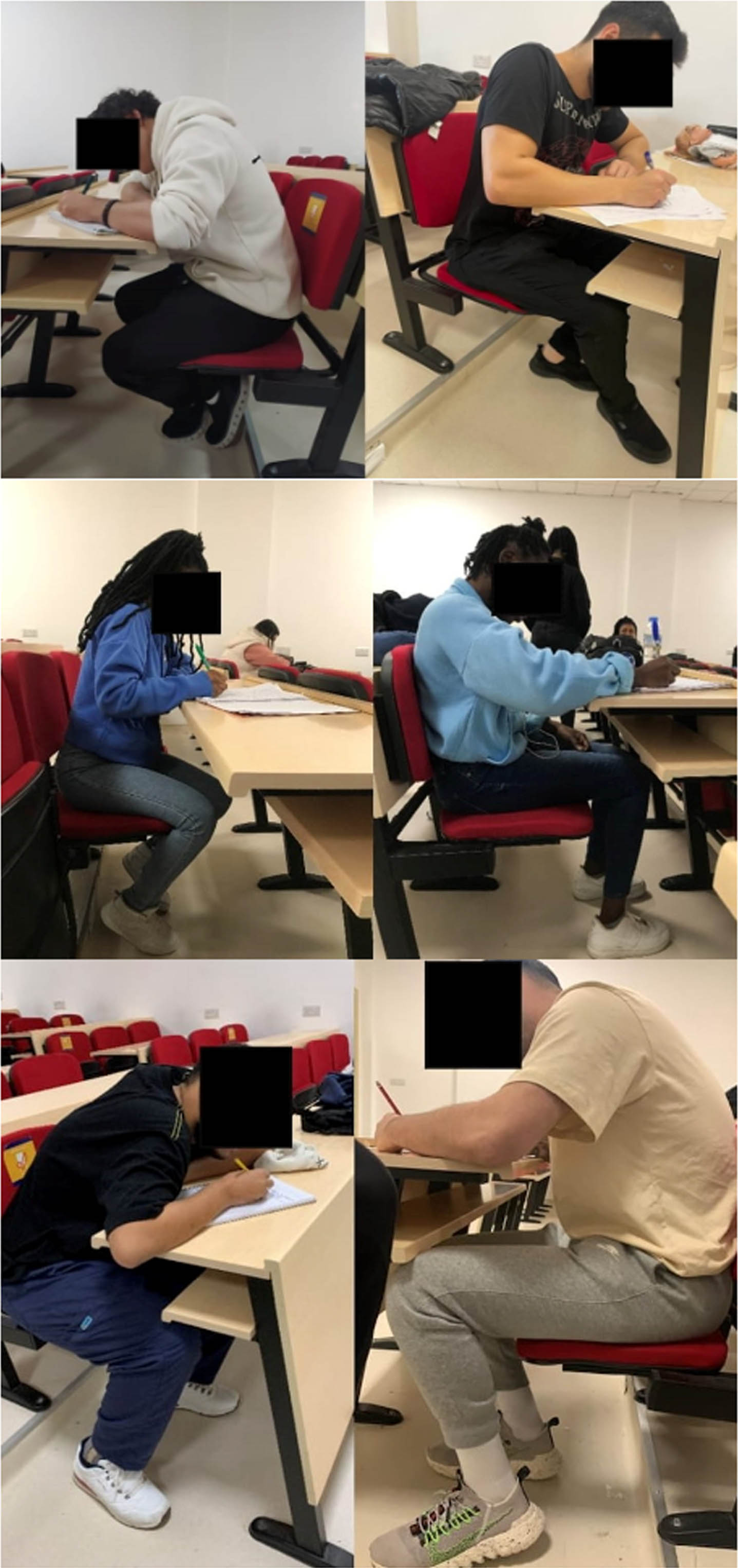
Examples of students’ writing postures.
The datas were analyzed with the Statistical Package for Social Science (SPSS) 26.0 statistical data analysis package software. Scale datas such as age, height, weight, and anthropometric measurements were given as a median and interquartile range (25-75% IQR), and categorical data such as gender, and extremity dominance were given as a percentage (%). The distribution of the data was examined visually with histograms and plots, and with analytical methods using the Kolmogorov-Smirnov test for normality. The Pearson Chi-Square was used to assess the mismatch of the classroom furniture dimensions against body dimensions and the Spearman Correlation test was used to analyze the relationship between ergonomic risk level and anthropometric measurements of the participants. P < 0.05 was accepted as a statistically significant level [23].
Results
All the invited students agreed to participate and there were no exclusions due to musculoskeletal pain or diagnosed musculoskeletal system disease. Age, height, weight and BMI median (IQR) values of the participants were 22 (21–24) years, 1.70 (1.64–1.79) cm, 68 (60–82) kg, and 23.18 (21.20–27.0) kg/cm2, respectively. Of the 149 participants, 73 (49.0%) were female and 76 (51.0%) were male. When the upper and lower extremity dominance is examined, it was found that 133 of the participants use the right (89.3%) upper extremity and 16 of them (10.7%) used the left upper extremity while 130 of them used the right lower extremity (87.2%) and 19 of them (12.8%) used the left lower extremity (Table 2). The median (IQR) and number (percentile) results of anthropometric measurements and ergonomic risk were shown in Table 3.
Demographic information of the participants
Demographic information of the participants
IQR: Interquartile range; BMI: Body Mass Index.
Anthropometric measurements of students and ergonomic risks while handwriting position
Anthropometric measurements of students and ergonomic risks while handwriting position
RULA: The Rapid Upper Limb Assessment, IQR: Interquartile Range.
As can be seen from Table 4, while 80.5% of students with low ergonomic risk had a mismatch with backrest height and sitting shoulder height, this percentage was 61.3 in students with high ergonomic risk. These heights were significantly more often mismatched in individuals with low ergonomic risk (p = 0.010).
Mismatch of classroom furniture dimensions against anthropometric measurements and comparison according to ergonomic risk levels
Pearson Chi-Square.
While 64.5% of individuals with high ergonomic risk had a mismatch in popliteal height and seat height with furniture dimensions, this percentage was 47.1 in individuals with low ergonomic risk. In addition, it was determined that these heights were significantly more often mismatched in individuals with high ergonomic risk (p = 0.036).
As seen in Table 5, the length of the right lower extremity has a positive correlation with the RULA B score (r = 0.209, p = .011) and grand score (r = 0.177, p = 0.031). The length of the left lower extremity has a positive correlation with RULA B (r = 0.221, p = .007) and grand score (r = 0.190, p = 0.020). Also, there was a positive correlation between the RULA A score and the height of the popliteal (r = 0.242, p = 0.003) and the height of the knee (r = 0.210, p = 0.010). A low positive correlation was also found between tragus wall distance and RULA A score (r = -0.364, p = 0.001) and RULA B score (r = 0.472, p = 0.001) and grand score (r = 0.479, p = 0.001). In addition, a positive correlation was found between acromion wall distance and RULA B score (r = 0.251, p = 0.002) and grand score (r = 0.256, p = 0.002). Table 5 indicates that there were no further statistically significant correlations found between other anthropometric measurements and ergonomic risk (p > 0.05).
The relationship between anthropometric measurements and ergonomic risk levels
The relationship between anthropometric measurements and ergonomic risk levels
The Spearman correlation test; RULA: The Rapid Upper Limb Assessment. *: p < .05, **: p < .001.
Since the classrooms are where students coexist and learn together, this environment should be supported to be more effective. Inadequate furniture designs may result in musculoskeletal problems as students mostly spend their time in sitting positions [24]. This study investigated the ergonomic risk levels during handwriting activity on fixed desks and chairs and the relationships between these levels and anthropometric measurements. Very few students had an adequate ergonomic posture while writing on fixed desks and sitting on fixed chairs, 72.5% of students had a mismatch in backrest height and sitting shoulder height as well and 54.4% of students had a mismatch in popliteal height and seat height. According to the findings of correlations, the only significant correlation was found between tragus-to-wall distance and ergonomic risk scores. There was no significant correlation between other anthropometric measurements and ergonomic risk levels. When ergonomic risks were classified as low and high and compared according to mismatch values, there were significant differences between the mismatch variables and ergonomic risk levels. Although more mismatch between popliteal and seat heights was found in high ergonomic risk levels, more mismatch between backrest and sitting shoulder heights was seen in low ergonomic risk levels.
At universities, fixed furniture is popularly preferred to take more people and create an orderly classroom environment, but the effects of this fixed furniture and the correlations between anthropometric measurements and ergonomic risk levels should be investigated [25]. The study by Al-Saleh et al. indicated that the chair and desk set with constant measurements caused more back and upper limb muscle activation when compared with adjustable sets [26]. Similarly, Isapka and Omorodion revealed the mismatch between fixed furniture and anthropometric measurements [24]. This may support our findings that most of the students had inadequate postures while sitting and writing on fixed furniture. Only 2.7% of students had an acceptable posture while handwriting on the fixed desk and chairs so it should be considered that interventions are required to prevent possible musculoskeletal system problems and increase academic performance while taking notes during the lectures.
When the fixed desk and chair dimensions used in our study were examined, it was observed that the desk height, the seat and table depth, and the backrest width were below the standard values according to the Turkish Standards Institution (ENV 1729-1) [27]. Moreover, these dimensions used in this study were also not adequate according to the recommended seat height and seat depth in a study that investigated the educational setting [28]. These results support our findings that the fixed furniture included in this paper was not designed according to the anthropometric measurements of most of the students. Armrests can provide a good surface area for the arm to contact so that pressure between an arm and armrest is minimized [18]. It was seen that there was no arm support in the classroom. In order not to worsen the posture habits that change over time and to maintain a good posture, the standard values found should be constantly modified and the classrooms should be arranged according to these measurements. Thus, with these arrangements, ergonomic risk levels may be reduced during lectures.
When matching the seat height with popliteal height was conducted, slightly more than half of the students had a mismatch. Mismatch in seat height prevents adequate resting of feet on the floor so this may cause discomfort and be difficult to protect adequate postures among students [4, 29]. Although we did not measure the level of discomfort, our findings support this impression with the difference in ergonomic risk levels of students who had a mismatch for seat heights since more mismatch was seen in higher levels of ergonomic risks. In the study in 2019 by Parvez et al., this mismatch was seen in 29% of male students and 100% of female students as male students had longer lower limbs. Thus, similarly to our findings almost 50% of students had this mismatch [19]. Another study by Kahya in 2019 similarly showed that 44.45% of students had a mismatch with the seat height of the existing furniture in their classrooms [6]. Thus, our paper supported the literature that if no intervention was conducted and similar dimensions were used for university students, nearly half of them have an inadequate match with furniture. This may cause a high level of ergonomic risk while writing since we had a significant difference between seat height mismatch and ergonomic risk levels.
Another mismatch was found with larger proportions for backrest height. Back support is important to prevent flexor posture and decrease compression on low back so it matches with backrest height [28]. Backrest height was inadequate for 72.5% of the students in this paper. Similarly, in 2013, Baharampour et al., showed that more than 83% of students had a mismatch with the backrest height of the chair [18]. However, more mismatch with backrest was seen in lower levels of ergonomic risks and this was an unexpected result. This may be related to the handwriting posture since the students may not benefit from backrest while handwriting. More research should be conducted for other classroom activities like listening to the lectures or using a laptop to investigate this finding.
Tragus-to-wall distance had a significant correlation with ergonomic risk levels. Thus, more ergonomic risk should be considered if a person has a longer distance from tragus to the wall. The distance from the tragus to the wall may indicate some postural deformities like kyphotic posture or forward head so these deformities will probably cause higher levels of ergonomic risks while handwriting [29]. Moreover, this can be supported by the ergonomic risk levels of the students. More than half of students had 3-4 levels defined as “needs further investigation”. If we think that the students included in this study are young and healthy people, this correlation is more important as more postural sways are seen in older populations. As a result, tragus-to-wall distance should be considered while determining the ergonomic designs of classroom desks and chairs.
Various studies investigated the designs of optimal school furniture according to anthropometric measurements for a very long time [30–33]. There appear to be few published investigations of fixed furniture in educational settings. Al-Saleh et al. recommend adjustable furniture to prevent discomfort in the sitting posture [26]. Studies mostly focus on school children since they have growing organisms so it can be considered that ergonomic designs have more potential to develop risk for their musculoskeletal system and academic performance. However, as we see from the anthropometric measurements of the university students that they have a wide range of values. Thus, adjustable furniture, at least the adjustable chair since mismatch has a significant difference for popliteal height, is needed to prevent ergonomic problems in the classroom environments.
While examining the mismatch of students who must write for long periods with the fixed furniture, the measurements were conducted with objective methods, which is the strength of this study. Moreover, the participants were the students of health sciences. Their future employed work often entails substantial ergonomic risk [34] so this paper will contribute to them being aware of their postures in every condition. There are also some limitations of the paper. First of all, the measurement method of ergonomic risk has 7 scores whereas anthropometric measurements have a wider range of values. Since we did not have a significant correlation between ergonomic risk level for writing activity and anthropometric risk levels, except tragus to wall factor, more objective devices like EMG or 3D human biomechanics analyses could be used to investigate this result in future papers. Secondly, some variables like pencils, and shoes which were used by students could not be standardized to make it a natural environment for students, but these factors could be taken into account in further papers. Nevertheless, to the best of our knowledge, there are few papers that investigate the postures of university students on fixed desks and chairs with the same furniture dimensions.
Conclusion
In conclusion, most of the university students had inadequate ergonomic postures when they were observed in writing positions on fixed desks and chairs. This was supported by mismatch proportions of seat height against ergonomic risks, whereas mismatch with backrest height may not be related to ergonomic risk measured while writing activity so more papers are required to investigate the ergonomic risk factors with the anthropometric measurements of students. Adjustable furniture, particularly adjustable chairs, may be used as an intervention. However, this intervention will require time, as well as resources. Some interventions including regular short rest breaks during which the students stay nearby at their desks but stand up, and some exercises like stretching, breathing deeply, etc. will be more adequate to take immediate prevention. Moreover, in a holistic view, rest breaks are a vital component of healthy work/study activity. These interventions can be searched to see their effects on ergonomic risk levels in further papers.
Author contributions
The study was conceptualized and supervised by the primary investigator OD and designed by all the authors. OD, ZGT, and HT collected all data and contributed to data analysis, processing, interpretation, and drafting of the manuscript. The literature search was conducted by OD and ZGT. The original manuscript was written by OD, ZGT, and HT. The final manuscript was critically reviewed by OD and finally approved by all the authors.
Ethical approval
Ethical approval was obtained from the Eastern Mediterranean University Research and Publication Ethics Committee (ETK00-2022-0249).
Informed consent
Yes.
Conflict of interest
The authors declare that they have no conflict of interest.
Footnotes
Acknowledgments
We would like to thank the participants for their willingness to participate in this study.
Funding
The authors report no funding.