



Abstract
BACKGROUND:
Trolley bags have gained popularity among students, but there is limited research comparing them to backpack-style school bags.
OBJECTIVE:
This study aimed to compare how carrying a backpack versus a trolley bag affects the activity of trunk and lower limb muscles in secondary school students.
METHODS:
Electromyographic activity was measured in 25 students (13.4±1.1 years) as they walked on level ground and up/down stairs while carrying both types of bags. The activity of the gastrocnemius, tibialis anterior, semitendinosus, rectus femoris, lumbar erector spinae, and rectus abdominis muscles was assessed on both the dominant and non-dominant sides.
RESULTS:
The study found significantly reduced muscle activation in most of the targeted muscles when walking on level ground with the trolley bag and when going up/down stairs with the backpack.
CONCLUSIONS:
Lifting a trolley bag depends on the slope of the walking surface and is more efficient on level ground, while carrying a backpack is more efficient when going up and down stairs. Since it is not practical to switch bags when encountering stairs in schools, a bag with a mixed model design incorporating features of both trolley and backpack may be more beneficial and practical for students to use. Students, parents, and teachers should be aware of the injury risks associated with carrying different types of bags.
Background
Researchers have investigated various factors related to students carrying backpacks and have sought to identify comfortable, functional, and well-fitting backpacks that provide safety, stability, and balance without impacting performance or requiring excessive energy expenditure [1]. It has been found that commonly used backpacks with unevenly distributed loads and inadequately padded straps do not meet these criteria. Over the years, studies have evaluated the effects of weight, design, positioning, and mode of carrying backpacks, as well as their physiological, biomechanical, and psychological responses under different conditions [2, 3]. These studies have indicated that the way backpacks are carried, including duration, loading conditions, and design, is associated with neck, shoulder, and back pain due to postural biomechanical issues [4–10]. Systematic reviews have reported conflicting findings regarding the effects of backpack positioning and shoulder strap design on the spine, but front and double backpacks have been linked to better posture [11, 12]. However, conducting a meta-analysis to obtain conclusive results is challenging due to the diverse methodologies used in these studies [4]. Nevertheless, suitable backpack design is consistently emphasized as a key preventive measure for musculoskeletal disorders [3, 13]. Bag placement on the body also plays a role in kinematic adaptations and physiological function, including pulmonary capacities, among school students [14, 15]. Another important factor related to carrying backpacks is the weight of the bag, which varies globally among school students [16, 17]. Although heavy school bags are common in regions where students spend more time in school or have a greater number of prescribed textbooks, the recommended weight limit is 5% to 20% of their body weight [18].
Researchers have attempted to develop backpack models with biomechanical and physiological advantages, but not all are suitable for students [19, 20]. One alternative design is trolley bags, but fewer studies have comprehensively examined their effects. Studies involving trolley bags have mainly focused on gait and posture analysis, while other parameters such as metabolic cost, muscle activity, and pulmonary function have not been investigated as extensively done for other backpack designs [7, 21]. Carrying backpack is a dynamic activity as students need to walk around and even go up and down stairs in schools, most of the studies have focused on the effects of a loaded backpack while standing in a typical upright posture [4, 23]. Although few studies have examined these effects while short duration walking [24–26], to the best knowledge of the authors, no study has investigated the influence of carrying trolley bag on the muscle activity. By measuring and analyzing electromyographic activity (EMG), researchers can quantify and compare muscle activation levels across different individuals, conditions, and interventions. This quantitative assessment allows for objective evaluations and can help identify differences in muscle activation patterns, potential muscle imbalances, or the effectiveness of various interventions [27]. Further research is needed to compare the effects of different backpack types during gradient walking and stair climbing, activities commonly performed by students on their muscle activation patterns.
This study aimed to compare the peak (PEMG) and mean (MEMG) EMG activity of six major muscles in the trunk and lower limbs, including gastrocnemius, tibialis anterior, semitendinosus, rectus femoris, lumbar erector spinae, and rectus abdominis, while secondary school students carried backpacks or trolley bags weighing 20% of their body weight and walked on level ground or up and down stairs. Several points, including functional relevance, muscle action (prime movers/stabilizers), muscle activation patterns, clinical relevance, previous research, and practical considerations such as ease of electrode placement, accessibility for surface EMG recordings, and the availability of validated protocols for measuring muscle activity, were considered when choosing these muscles for this study. The hypothesis was that the effect of trolley bags and backpacks on muscle activation patterns would differ depending on the walking slope and that the asymmetric lifting of a trolley bag while walking on level ground or ascending or descending stairs would affect muscle activation patterns in the dominant and non-dominant sides differently.
Materials and methods
Study design
This study was conducted using a crossover study design
Participants
The sample size of 25 participants was determined using G*power software with a partial eta squared of 0.04 and a significance level of 0.95. Healthy secondary school students aged 12–15 years were recruited. Preferred hand for writing and other daily activities like wearing clothes, opening zippers, etc. was referred to as dominant. Participants with injuries, postural deformities, low back pain history, or major surgeries in the last six months were excluded. Informed consent was obtained from participants and their parents. Fourteen boys and 11 girls with a mean age of 13.4±1.1 years were included in the study.
Procedure
During the first visit, participants’ age, sex, hand dominance, and injury history were recorded, and they were asked to walk twice in each condition to familiarize themselves with the protocol and test procedure. Standard model backpack (Dunlop International Limited, China) and trolley bag with a height of 0.46 m from the bottom of the two wheels to the handle were used in this study (Fig. 1). The net weights of the trolley bag and backpack were 1.55 kg and 0.55 kg, respectively. Participants carried these bags loaded with books equivalent to 20% of their body weight while walking on level ground and up/down stairs. Additional weights were placed in the backpack so that its weight would be equivalent to that of the trolley bag. Participants pulled the trolley bag with their dominant hand and wore the backpack symmetrically over both shoulders such that its bottom reaching the participant’s waistline. They were instructed to adjust the tightness of the belts of the backpack based on their subjective comforts. Participants had to walk 30 steps in a straight corridor for level ground walking at their preferred speed. Stair ascents and descents were performed on the same 30-step staircase with a height of 15 cm and a depth of 33 cm. Muscle activity of 12 muscles on the dominant and nondominant sides was recorded during 15 gait cycles (as described in the following section) for each condition in the random order. All the recordings were done by a research assistant who was blinded to the objectives of the study.
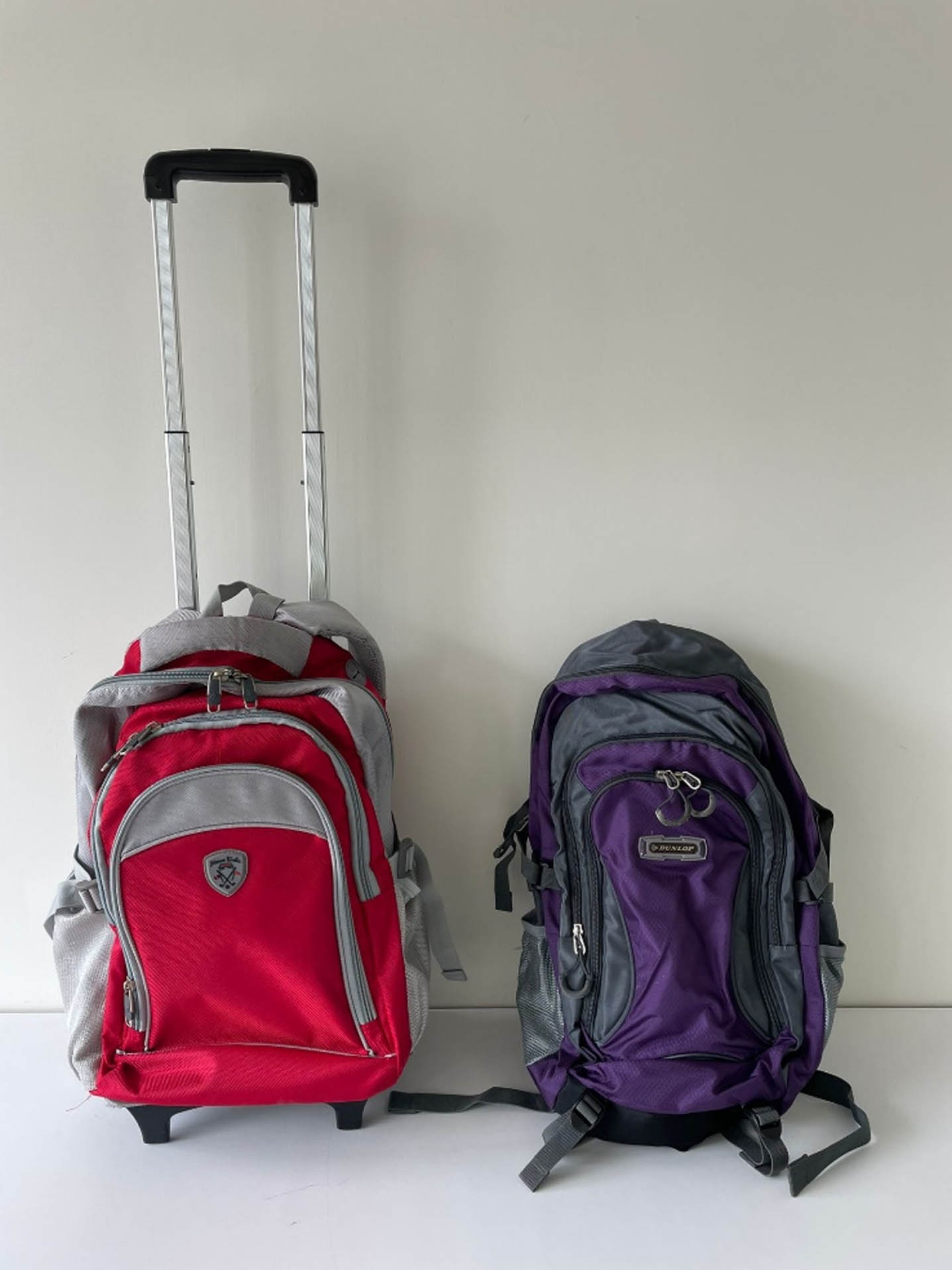
Sample of backpack and trolley bag used in this study.
EMG recording
Muscle activation patterns were recorded using a 16-channel wireless surface EMG system (Ultium EMG, EM-U810M8, Tele Myo2400, Noraxon USA Inc., Scottsdale, AZ, USA) at 2000 Hz with band-pass filtering (10–500 Hz) on a personal computer (EM-P5, Noraxon) using a receiver (EM-U880, Noraxon). Electrodes were placed on cleaned skin to limit the impedance to 5 Ω or less [28]. The placement of the electrodes is illustrated in Fig. 2. Data collection was initiated after 10 seconds of standing still using a built-in accelerometer in the EMG system for each foot to identify the onset of each gait cycle during walking and climbing. EMG data were normalized and expressed in terms of the percentage of maximum voluntary contraction (MVC%) of each muscle. The mean and standard deviations of maximum MVC% (PEMG) and mean MVC% (MEMG) were obtained for both dominant and nondominant sides. MEMG denotes the total muscle effort, whereas PEMG refers to the potential peak effort by the muscle.
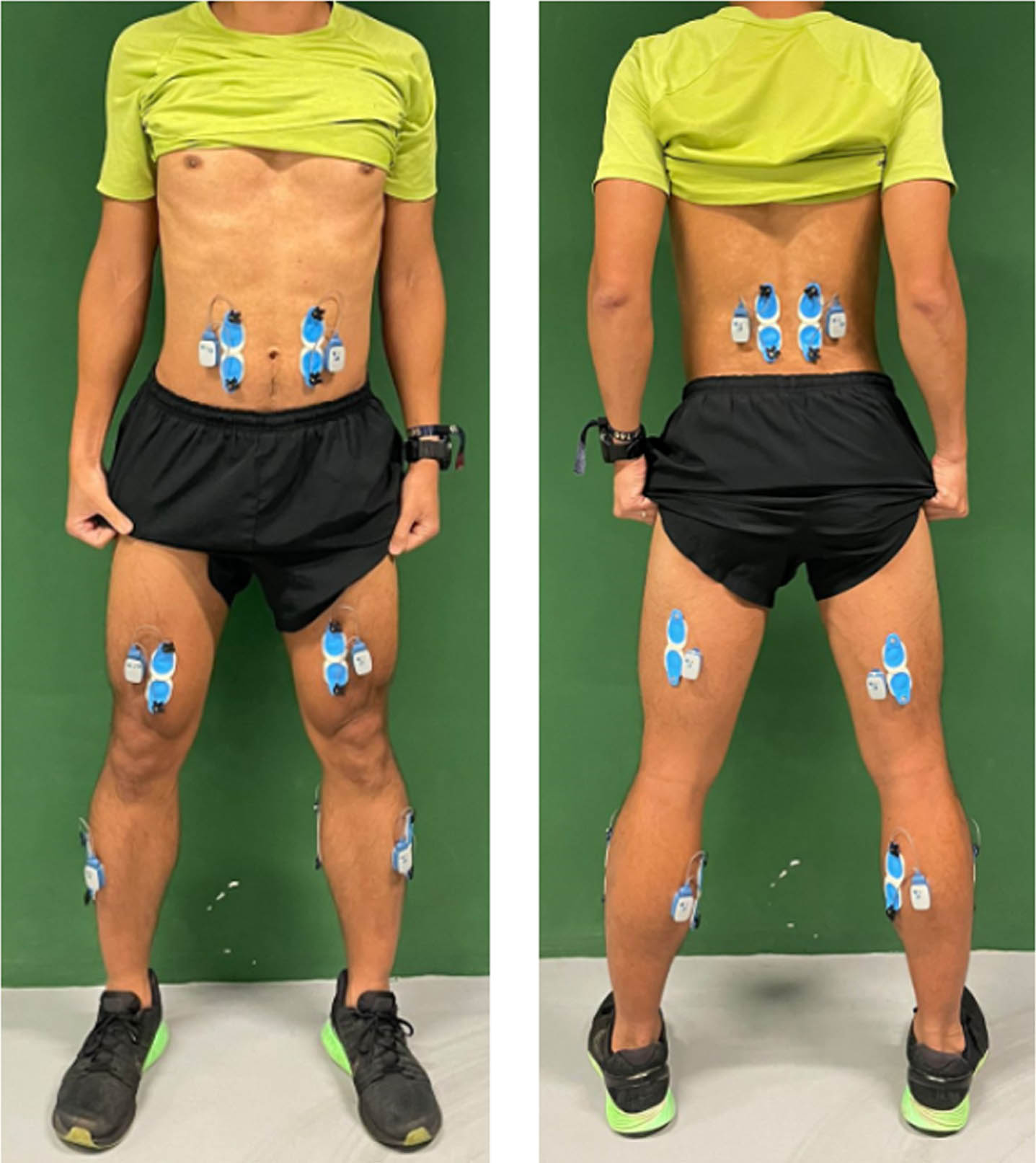
Electrode placement for electromyographic recording for target trunk and lower limb muscles.
Standard MVC tests were performed before data collection to analyze muscle activation patterns. It is an objective, standardized and sensitive tool for measuring muscle strength [29, 30]. The participants were instructed to avoid tight clothing, as it may produce artifacts and affect the results. They were asked to contract the target muscle for 3 to 4 seconds at their perceived maximum contraction level against the static resistance provided by the examiner.
For the rectus abdominis muscles, participants remained in a crook lying position with legs bent and feet fixed with an anchor. They had to attempt to flex the upper trunk while the examiner applied resistance at the thorax level [31]. For the erector spinae muscles, participants remained prone on an exercise bench so that their torso was suspended horizontally over the end. They had to attempt to extend the upper trunk while the manual resistance was applied at the shoulder level [32]. For the gastrocnemius muscles, participants had to stand straight and attempt to perform ankle plantar flexion against the resistance provided by their body weight [33]. Similarly, for the tibialis anterior muscles, participants had to maintain a supine position, keep the ankle and knee in a neutral position, and perform ankle dorsi flexion [34]. For the rectus femoris muscles, participants had to sit with their hip and knee flexed to 90° and attempt to perform knee extensions [35]. Finally, for the semitendinosus muscles, participants had to maintain a sitting position with the hip and knee flexed 90° and attempt to perform knee flexions [36].
Data analysis
The gait cycle data were normalized using the software of the EMG system (Noraxon myo MUSCLETM, USA), and muscle activity levels were expressed as MVC%. Data analysis was performed using JASP 0.16.3.0. Data normality was determined using the Shapiro–Wilk test and as the data were not normally distributed, nonparametric tests were used. A two-way mixed repeated-measures analysis of variance ANOVA was used to analyze the effects of bag type (trolley vs. backpack) and muscle dominance (dominant vs. non-dominant) on muscle activity. Simple effects were determined using one-way repeated-measures ANOVA if there was a significant interaction. Statistical significance was set at p < 0.05.
Results
Table 1 displays the mean and standard deviation of MEMG and PEMG activity for the nondominant and dominant sides of the trunk and lower limb muscles under different conditions. The impact of bag type and muscle dominance on MEMG and PEMG muscle activity is summarized in Table 2.
Peak (PEMG) and mean (MEMG) electromyography activity (MVC%) of the trunk and lower limb muscles on the nondominant and dominant sides when carrying a backpack and trolley bag loaded with the equivalent of 20% of body weight on level ground, upstairs, and down stairs
Peak (PEMG) and mean (MEMG) electromyography activity (MVC%) of the trunk and lower limb muscles on the nondominant and dominant sides when carrying a backpack and trolley bag loaded with the equivalent of 20% of body weight on level ground, upstairs, and down stairs
Mean (Standard Deviation).
ANOVA results for the effect of bag type and muscle dominance on mean and peak electromyography muscle activity when carrying a load equivalent of 20% of body weight on level ground, upstairs, and down stairs: p-value (factor with higher mean)
[B: backpack, T: Trolley Bag, ND: Nondominant, NS: Not significant].
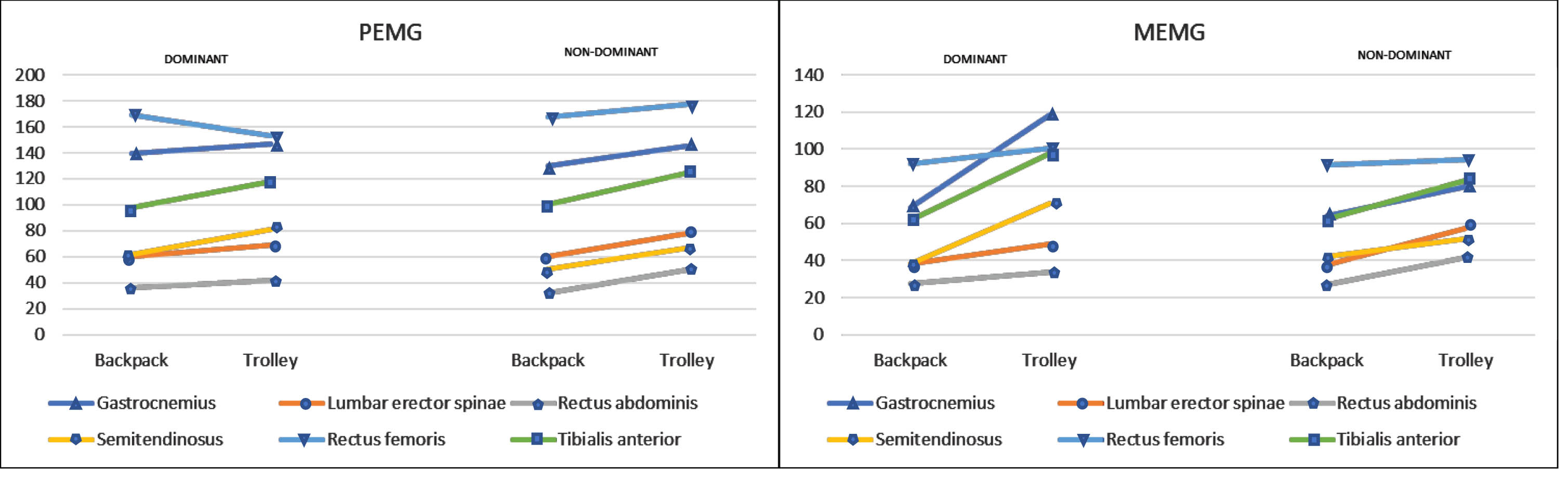
When walking on level ground, carrying a backpack resulted in significantly higher MEMG and PEMG activity in the rectus femoris (p < 0.001) and tibialis anterior (p < 0.05) muscles. Additionally, MEMG activity was significantly higher in the rectus abdominis (p < 0.05) and PEMG activity in the gastrocnemius (p < 0.001) muscles. No significant differences were observed between the dominant and nondominant sides for both MEMG and PEMG activity in the target muscles, regardless of the bag type. There was also no significant interaction effect between bag type and muscle dominance (Fig. 3).

Mean peak (PEMG) and mean (MEMG) electromyographic muscle activity of the dominant and non-dominant sides while carrying backpacks and trolley bags with 20% of body weight on level ground. Note the significantly higher muscle activity while carrying backpack in the Rectus Femoris (PEMG, MEMG), Rectus Abdominis (MEMG), Tibialis Anterior (PEMG, MEMG) and Gastrocnemius (PEMG) muscles.
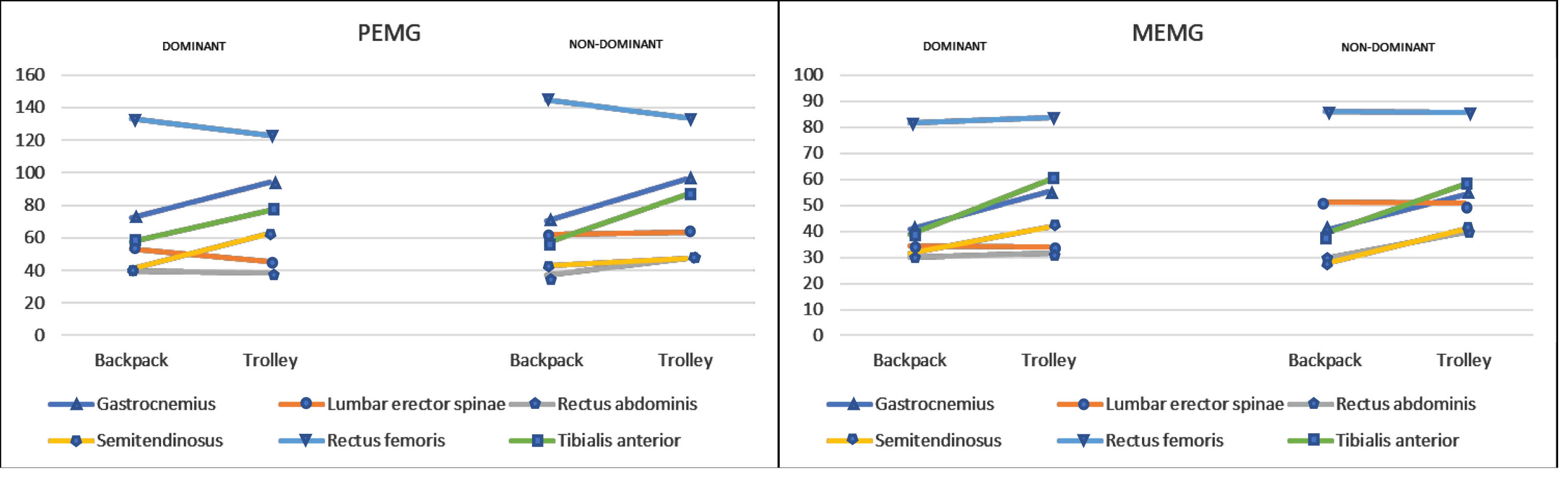
Ascending stairs while carrying a trolley bag led to significantly higher MEMG and PEMG activity in the semitendinosus, rectus abdominis, tibialis anterior, and lumbar erector spinae muscles (p < 0.05). Similar to level ground walking, no significant differences were found between the dominant and nondominant sides in the MEMG and PEMG activity of the target muscles, irrespective of the bag type. However, there was a significant interaction effect (p < 0.05) of bag type and muscle dominance on the MEMG and PEMG activity of the rectus abdominis muscle and the PEMG activity of the rectus femoris muscle (Fig. 4).
Mean peak (PEMG) and mean (MEMG) electromyographic muscle activity of the dominant and non-dominant sides while carrying backpacks and trolley bags with 20% of body weight upstairs. Note the significantly higher muscle activity while carrying trolley bag in the Semitendinosus (PEMG, MEMG), Rectus Abdominis (PEMG, MEMG), Tibialis Anterior (PEMG, MEMG) and Erector Spinae (PEMG, MEMG) muscles.
While descending stairs, carrying a trolley bag resulted in significantly higher MEMG and PEMG activity in the tibialis anterior and gastrocnemius muscles (p < 0.001). Additionally, MEMG activity was significantly higher in the rectus abdominis (p < 0.05) and PEMG activity in the semitendinosus (p < 0.05) muscles. MEMG activity was also significantly higher (p < 0.05) on the nondominant side of the lumbar erector spinae muscle. Furthermore, there was a significant interaction effect (p < 0.05) of bag type and muscle dominance on the PEMG activity of the tibialis anterior muscle (Fig. 5).
Mean peak (PEMG) and mean (MEMG) electromyographic muscle activity of the dominant and non-dominant sides while carrying backpacks and trolley bags with 20% of body weight downstairs. Note the significantly higher muscle activity while carrying trolley bag in the Semitendinosus (PEMG), Rectus Abdominis (MEMG), Tibialis Anterior (PEMG, MEMG) and Gastrocnemius (PEMG, MEMG) muscles.
This study aimed to compare the effects of carrying a backpack and trolley bag, each with a 20% body weight load, on muscle activity in secondary school students during walking on level ground, ascending stairs, and descending stairs. The results showed that the trolley bag and backpack had different effects on muscle activation patterns in the trunk and lower limbs, depending on the walking slope. Pulling a trolley bag was found to be more efficient for walking on level ground, while carrying a backpack was more efficient for going up and down stairs. There were no major differences observed between the dominant and nondominant side muscles in all conditions. This study is one of the first to investigate lower limb muscle activity in school students.
Higher muscle activity is generally seen as negative because it increases energy consumption and can lead to early fatigue and an increased risk of injury. Previous studies have examined muscle activity levels in individuals carrying different types of bags with varying loads [1]. One such study among students carrying backpacks with different designs and a load of 15% of their body weight found significant differences in neck muscle activity [37]. Among adults, studies have yielded conflicting results regarding lower limb muscle activity. Some studies have found significant increases in muscle activity with heavier loads, while others have found no significant difference compared to the unloaded condition[38–40]. Given these findings, it is important to explore alternative school bag designs that offer biomechanical advantages without drastically deviating from traditional designs. This research could be valuable for manufacturers looking to develop more efficient and effective school bags.
A related study conducted among children found that the kinematics of walking on a level surface while carrying a loaded trolley bag were similar to those of walking with an unloaded backpack [41]. Additionally, when loads needed to be carried, using a trolley bag was found to have positive effects on spatiotemporal variables such as cadence, velocity, stride length, and step width during level walking [42]. Consistent with these findings, the current study also showed that pulling a loaded trolley bag on level ground required less muscle activity in most trunk and lower limb muscles compared to carrying a backpack. This could be due to the lower stress load on the spine and body, as well as the overall similarity of kinematic patterns to normal walking when using a trolley bag [41]. When students carry a heavy backpack, their body tends to lean forward to counter the additional forces. This forward leaning of the trunk was also observed in a previous study of students carrying loaded backpacks while walking on level ground [43]. Carrying a backpack shifts the center of mass backwards, and to balance the extension moment caused by the additional load, the trunk inclines forward [44–46].These additional forces alter the natural curve and shape of the spine, increasing tension in the trunk and lower limb muscles and compromising balance [38, 47]. Loss of balance can further increase the load on the spine and require more effort to maintain stability [48]. In the present study, no difference in muscle activity was observed between the dominant and nondominant sides when using different bag types on level ground. This suggests that carrying a trolley bag can reduce muscle activation on both sides while walking on level ground.
The findings of the current study suggest that trolley bags are not efficient for carrying loads when going up and down stairs, as they require significantly greater muscle activity in most of the lower limb and trunk muscles compared to carrying a backpack. The incline of the walking surface is a crucial factor that affects muscle activity, particularly in the tibialis anterior muscle. Previous research has shown a significant increase in tibialis anterior muscle activity when participants carried a loaded backpack on an inclined surface [49]. When using a trolley bag, large dynamic forces are generated while navigating stairs, which can lead to increased muscle activity [50]. While there was no significant difference in gastrocnemius muscle activity when carrying the two types of bags upstairs, the activity of this muscle was significantly higher when carrying the trolley bag downstairs. Previous research has indicated that gastrocnemius muscle activity differs when going up and down stairs and is influenced by the speed of movement [51]. In the current study, it was observed that the semitendinosus, lumbar erector spinae, and rectus abdominis muscles had significantly lower EMG activity when carrying a backpack compared to a trolley bag while ascending stairs, indicating that a backpack is a more effective method of carrying loads in this situation. This may be because students have to lift the loaded trolley bag while ascending stairs instead of simply pulling it.
During the study, it was observed that participants lifted the trolley bag with their dominant hand while ascending stairs, causing a shift in their center of mass towards the nondominant side and inducing asymmetry. This asymmetrical carriage can lead to lateral flexion in the trunk, resulting in higher activation of trunk muscles such as the lumbar erector spinae and rectus abdominis [38, 53]. The semitendinosus muscle, responsible for hip extension during stair climbing, did not show significant changes in activity when carrying a backpack. However, significantly higher EMG activity was observed in the gastrocnemius muscle when carrying a trolley bag downstairs, potentially necessary for maintaining stability and generating toe-off force during stair climbing. Carrying a trolley bag by hand requires additional muscle activation to counterbalance the asymmetrical walking mechanics. Furthermore, descending stairs involves eccentric muscle contractions, leading to increased muscle activity for body stabilization.
While carrying different types of bags down stairs, no difference in lumbar erector spinae activity was observed. However, there was lower activation of the dominant side lumbar erector spinae muscle, suggesting that the nondominant side muscle may contribute more to stabilizing the spine during descent. Previous research has also shown that lumbar erector spinae muscle activity decreases when wearing backpacks and exhibits asymmetrical activation when carrying a shoulder bag on one side of the body [54]. The lumbar erector spinae muscle plays a crucial role in maintaining trunk posture, and decreased activity can lead to a reduction in lumbar lordosis [22, 55]. In the current study, the trolley bag was carried on the dominant side during descent, supporting previous findings. Another study reported asymmetrical effort and potential excessive stress on the upper extremities when carrying a loaded trolley bag while ascending or descending stairs [50]. This asymmetrical movement and stress can increase lumbar spinal loading and muscle force, which are associated with a higher risk of lower back injury [56]. Additionally, the perceived stress of asymmetric lifting was rated higher than that of symmetric lifting [57]. Lifting with one hand alters lumbar spine motion, leading to lateral shear forces and spinal compression, increasing the risk of lower back disorders [58].
Given the various factors to consider in designing an efficient backpack and the advantages and disadvantages of different modifications[3, 15], a mixed model design may be more beneficial and practical for use, especially among school-going students. This means incorporating features of both trolley bags and backpacks into one design. The results of this study suggest that a bag with features that allow for both pulling and carrying on the back should be used by students, as it is not practical to switch bags when going up or down stairs in schools. This mixed model design could potentially address the health-related outcomes such as postural changes, metabolic cost, physical stress, pulmonary function, perception, muscle activity, and contact pressure on shoulders and feet that are associated with carrying loads.
Limitations and future research
There was no comparison between carrying the bag and not carrying it, as well as the absence of controlled walking speed, can affect the interpretation of the results. Additionally, the study only examined the short-term effects carrying backpacks and trolley bags on selected muscle activity, without considering long-term effects, fatigue status, and walking speed variations. Future studies should take these factors into account when evaluating the effects of different bag types, walking surfaces, and loads on muscle activity. The difference in weight between the empty trolley bag and backpack was addressed by adding additional load to the backpack. However, it is important to acknowledge that the loads of these bags may differ in the unloaded condition. Conducting kinematic and kinetic analyses using motion capture systems would provide a more comprehensive understanding of the biomechanical effects of different bag types on the neck, back, and upper limbs. These analyses would also allow for exploring the differences in posture and strain on different parts of the body. Furthermore, considering that the ideal weight of school bags varies around the world, future studies should examine the effects of different loads while carrying different types of bags. Correlating body kinematics, such as spinal angles, with muscle activity among school students would be crucial in understanding the impact of carrying school bags on their musculoskeletal health.
Conclusions
The muscle activation patterns during asymmetric lifting of a trolley bag can vary depending on the walking slope. Pulling a trolley bag may be more efficient on level ground, while carrying a backpack may be more efficient when navigating stairs. Given this, a bag with a mixed model design incorporating features of both trolley and backpack may be more beneficial and practical for students to use. It is essential for students, parents, and teachers to be aware of the injury risks associated with carrying different types of school bags in order to prevent the injuries and promote the musculoskeletal health of students.
Human subjects approval statement
This study was approved by the Human Research Ethics Committee (Ref. No. 2020-2021-0129) of the Education University of Hong Kong.
Informed consent
Informed consent was obtained from participants and their parents before the experiment.
Conflict of interest disclosure statement
The authors declare that they have no competing interests to declare.
Footnotes
Acknowledgments
Not applicable.
Funding
Not applicable.
Author contribution
Conception and design of the study: SCP and DHC; data acquisition: SCP; data analysis: ZAI; drafting the manuscript: ZAI; Writing – review & editing: DHC. All authors read and approved the final manuscript for submission to the journal.