



Abstract
BACKGROUND:
Professional driving requires long hours of work, uncomfortable seats, negotiating rough terrain and highways, and possibly minor repairs and other auxiliary transportation duties. Heavy vehicle drivers driving vehicles such as trucks, bulldozers, etc. due to such working structures are more prone to various musculoskeletal disorders (MSDs) and pain, which is of great concern.
OBJECTIVES:
In the present study, it is planned to investigate possible ergonomic risk factors such as age, weight, driving exposure, seat suspension systems, lifting heavy weights causing MSDs in drivers of various heavy vehicles. The results of the study are expected to help drivers reduce the risk of MSDs.
METHODS:
For the present study, the Nordic questionnaire on musculoskeletal disorders was modified and standardized and was administered to the 48 heavy vehicle drivers randomly selected to collect the data.
RESULTS:
The analysis divulged that over the past 12 months, lower back pain (LBP) emerged as the most dominant pain experienced by 56% of drivers, followed by knee pain (KP) (43%) and neck pain (NP) (39%) respectively. The prevalence of shoulder pain (SP) was observed to be much lower than in previous literature. The logistic regression model further revealed that increasing age, poor suspension system and poor body posture were significantly associated with lower back pain. Additionally, a poor suspension system and lifting heavy weights had significant effect on the drivers’ knee pain.
CONCLUSION:
The results demonstrated the evident necessity for ergonomic consideration in vehicle designing and ergonomic training for heavy vehicle drivers.
Keywords
Introduction
As economic growth is growing exponentially in India and other developing countries year on year, there is an increase in the need for transportation. Several central government policies like the Make in India campaign, Automotive Mission Plan (AMP) and National Electric Mobility Mission Plan (NEMMP) have also led to the boom in commercial vehicle manufacturing. It is expected that the sale of commercial vehicles by fiscal year 2024 could reach a volume of 2,059.95 thousand units [1]. At present, it is estimated that about 4 million trucks in 2022 are running on Indian roads and highways which will increase more than 4 times to reach up to 17 million by 2050 according to a report published by Niti Aayog in September 2022 [2]. For this reason, a large number of workers like drivers are employed in this sector. Drivers of heavy vehicles, especially in developing countries, do not have a very healthy lifestyle due to many constraints. They face various challenges in their work that seriously deteriorate their health like bad road conditions, air pollution, bad weather conditions, poor posture, etc. [3, 4]. Also, sitting in a fixed posture for long hours of stretching while driving causes excessive tension in the body [3, 5]. Additionally, continued exposure to whole-body vibrations and sudden jolts aggravates their work-related musculoskeletal disorders (WMSD) [5, 6].
Several epidemiological studies conducted have shown that musculoskeletal disorders (MSDs) such as lower back pain (LBP) and other spinal disorders are mainly prevalent among professional drivers [7]. Abundant literature is available regarding MSDs in drivers of light and heavy vehicles due to various reasons such as work years, stress, vibration exposure, etc. [8, 9]. Drivers of heavy vehicles are exposed to WBV, which leads to painful lower back pain and spinal disc herniation [10]. Truckers are the group of people most affected by MSDs. Due to the nature of the job, the chances of having MSDs are very high [11]. As ergonomic risk factors are high in their work, such as poor body posture, whole body vibration, high pressure exercise and repetition [12–14]. Therefore, they have greater injury occurrence rates as compared to other driving occupational groups [15]. A cross-sectional study conducted in Nagpur, India, reported that about 62.1% of truck drivers suffer from LBP [16]. In a similar study carried out in the United States by Kim et al. [17], evaluated the presence of MSDs in a total of 96 truck drivers. They found that LBP was prevalent among the majority of drivers at around 73%, followed by shoulder pain (SP) in around 52% and neck pain (NP) in 51% of drivers. Some authors like Hakim and Mohsen [5], conducted a Nordic musculoskeletal questionnaire survey on bus drivers. They reported that LBP was 6.6 times higher among drivers who had worked for more than 10 years than among those who had worked less than 10 years. Another study conducted in Iran by Aminian et al. [18], on truck and taxi drivers reported that LBP was the most common discomfort among both types of drivers. They concluded that the risks of NP and knee pain (KP) were higher among truck drivers than among taxi drivers. Yasobant et al. [19], in their study of 280 drivers aged 25–55 found that approximately 24% of drivers suffer from LBP, followed by NP and SP in around 26% and 20% of drivers respectively. They showed uncomfortable sitting posture, steering wheel position, inadequate leg space and poor ergonomic chair were the risk factors associated with lower back pain. Similarly, awkward and prolonged sitting position, steering wheel position and misalignment of the driver seat were the risk factors associated with NP. Thus, the current literature shows the existence of a prevalence of MSDs among heavy vehicle drivers. Although several studies [12, 13], have been conducted to find out the prevalence of MSDs for different professions, but only a few relevant researches [12, 13], are available in the literature on the effect of different risk factors (such as age, weight, lifting heavy weights) among drivers of heavy vehicles. Some of the national roads and those that connect villages and small towns are in a terrible state. They can have an impact on the truck as well as on the health of the drivers, making their life more difficult. Driving conditions are significantly aggravated by the weather in northern India. It will be important to know the effect of different ergonomic risk factors such as personnel characteristics, occupational history and medical health of drivers that could be responsible for MSDs in drivers, as this will help prevent them. Therefore, in the present study, it is planned to investigate possible ergonomic risk factors such as age, weight, driving exposure, seat suspension systems, lifting heavy weights causing MSDs in drivers of various heavy vehicles. The results of the study are expected to help drivers reduce the risk of MSDs.
Method
Questionnaire structure
For the purposes of the study, the Nordic questionnaire was modified and standardized. First, a comprehensive review of the literature and previously developed scales was carried out. In the first part of the questionnaire, the questions concerning the personal and general information of the data subject have been retained. The next dimension, which was the first domain of the questionnaire, contained questions with sub-questions related to the occupational history of the heavy vehicle driver. In the next dimension Personal Medical History, the questions focus primarily on the lower back, neck, shoulders, and a few questions on the elbows, upper back, knees, and other parts of the body. As previous literature [20], showed that the lower back, neck and shoulders were the most dominant MSDs found in drivers, therefore an additional Body Discomfort Scale also called Drivers Pain Severity Scale was used in this part to measure the pain intensity (scale of 0 to 10, where 0 indicates no pain and 10 indicates the worst pain) of these areas. As the penultimate dimension, questions related to remedial measures were included. The final dimension was to assess drivers’ subjective opinion of whether their symptoms were work-related.
Study design
The survey was planned and conducted in few districts of the state of Uttar Pradesh in India on the highways, which are connected to almost all the states of India. The data on the designed questionnaire was collected using a random sampling method. A total of 77 drivers of various heavy vehicles such as trucks, bulldozers, cranes, planners, etc. were contacted and invited to participate in the cross-sectional study. The authors decided that the inclusion criteria were that all drivers should have more than 5 years’ experience, be over 18 years old and understand English or Hindi. The exclusion criteria were the absence of a history of surgery on any part of the driver’s body, the absence of MSDs before the start of driving and the absence of injury due to an accident. Twelve drivers declined to participate. Seven drivers terminated their survey in between due to unavoidable reasons. Response of 10 drivers was found to be flawed. Analysis of their responses revealed that individuals appeared to have overstated the pain they experienced from their MSDs. Furthermore, they admitted to have every type of MSD. Therefore, their responses were discarded, ultimately leaving 48 responses for further analysis. The questionnaire was in English and Hindi. Every precaution had been taken so that the drivers can fully understand the questions. Before start, appropriate consent was collected from each driver willing to participate.
Validation and psychometric characteristics
After the preparation of questionnaire by thorough literature review and study of previous questionnaires, the second step was to validate it by face validity and content validity. In the third step a pilot study was done on 25 subjects of the targeted population followed by reliability analysis in order to find out internal consistency of questionnaire by Cronbach’s alpha method. Finally, the questionnaire was validated and standardized.
Face validity
For face validity 10 experts in the field of design and ergonomics were chosen for reviewing the questionnaire. They were asked to respond on a Likert scale ranging from 1(strongly disagree) to 4(strongly agree) to a question so that the developed questionnaire correctly captured all the domains. All experts responded to either agree or strongly agree except two giving us average score of 3.5(out of total 4). Suggestions were noted and the face and content of some questions were changed accordingly.
Content validity
Lucidity and relevancy were the attributes of the questionnaire. A content validation form was prepared on which researcher asked the reviewers to give their expert judgement on a 4-point Likert scale (1 = not relevant, 2 = somewhat relevant, 3 = quite relevant and 4 = highly relevant) of each item to the measured domain. Item Content Validity Index (I-CVI) was calculated for each item of each of the four domains. Scale Content Validity Index (S-CVI/Avg.) was calculated for each of the four domains. Universal agreement (UA) was also calculated for each of the four domains. I-CVI, S-CVI and UA were calculated for both lucidity and relevancy attributes. During calculation of S-CVI/Avg. 1 and 2 was recoded as 0 where 0 indicates experts consider items as undesirable to the measured domain and 3 and 4 was recoded as 1 where 1 indicates experts considered items as desirable to the measured domain respectively. Table 1 shows the values obtained for S-CVI/Avg. and UA for the 4 domains. All values were observed to be above 0.8 which is acceptable.
Content Validity and Internal Consistency according to different domains
Content Validity and Internal Consistency according to different domains
Reliability of different domains of present questionnaire as shown in Table 1 obtained according to the pilot study. All values are above 0.75 which showed high internal consistency of the items.
Data examination and prediction models for MSDs
After field data collection through the standardized questionnaire-data was coded, entered and analysed using statistical software SPSS version 23.0. Anthropometric features like weight and height were taken with the help of a calibrated scale. Descriptive statistics was used for continuous variables and presented as mean, median and standard deviation while results for categorical variables were obtained as frequency and percentage. One way ANOVA was performed to determine if there was a significant difference between average scores of body discomfort scale related to lower back, neck and shoulders. Logistic regression analysis was performed to investigate the relationship between various risk factors termed as covariates and the likelihood of occurring MSDs within a period of 12 months. Models were fitted for outcomes like LBP, LBP severity scale, NP, NP severity scale, KP and any MSDs (at least one type of MSDs) as these are identified as the dominant pains in drivers. To determine the association of single individual variable (risk factor) and an outcome, first a bivariate analysis was performed in order to find Crude Odds Ratio (COR) for expected risk factors contributing to pain. Then to examine the effects of all variables simultaneously on an outcome a multivariable binary logistic regression model was fitted to find Adjusted Odds Ratio (AOR) (Table 4). All those variables which were not found statistically significant in first step were also included in the model due to their medical significance. Driver’s pain severity scales for lower back and neck were divided into two parts to make it categorical in nature. Rating within 0–5 was labelled as low to moderate pain whereas within 6–10 was labelled as high pain. Low to moderate pain and high pain were coded as 0 and 1 respectively. Multicollinearity was checked between continuous independent variables. Hosmer and Lemeshow test was used to find overall goodness of fit. Explained variance in percentages and correct classification of cases are shown in Table 4. Statistical significance level was tested at α= 0.05.
Association of dimensions taken in the questionnaire vs. types of problems in heavy vehicle driving with AOR
Association of dimensions taken in the questionnaire vs. types of problems in heavy vehicle driving with AOR
Note: CI = Confidence Interval; X2(degree of freedom, no of cases) = Chi square value, R2 = Cox and snell, Nagelkerke R square, C = Overall Classification.
Data collection was conducted from 1st August to 30thAugust 2022. Ethical clearance was obtained from the National Institute of Technology, Manipur, India.
Results
Personnel and general characteristics of drivers
In the final phase survey of forty-eight heavy vehicle drivers was done after having a validated questionnaire. Six bulldozers, five cranes, seven planners’ operators and thirty truck drivers were among the 48 drivers who participated in the survey. All were male drivers. Table 2 & Table 3 shows descriptive statistics for driver’s anthropometric features and behavioural characteristics. The summary of the data is shown in all four dimensions of the questionnaire separately in following subsections:
The distribution of drivers (N = 48) according to their socio-demographic and behavioural characteristics
The distribution of drivers (N = 48) according to their socio-demographic and behavioural characteristics
The basic characteristics of drivers (as per Table 2)
The mean driving exposure in years were 18.93±10.61SD (19 Median) with a maximum of 40 and minimum of 5. 14(29.1%) reported that they sit properly with straight posture during driving while 34(70.84%) admitted to have other postures: like bending forward; backward; and twisted; because of either bad ergonomic seat design or cabin. Regarding lifting of very heavy loads, 8(16.7%) out of 48 drivers agreed to lift as part of their job. Drivers performing their usual field work like loading or unloading of vehicle by goods of lifting components while maintaining their vehicles were not included in above category. 25(52.1%) complained about their seats and reported either complete absence of any suspension system or a very bad suspension system. 21(43.75%) admitted taking painkillers in order to get relief from pain after consultation with doctors. 5(10.42%) used special ortho-mattress to sleep for pain relief. 3(6.25%) revealed to even use special cushions to sit while driving.
Subjective views
Majority of driver’s i.e., 75% (36) were having personnel opinion that any type of MSD pain they were having was because of their heavy vehicle driving. They complained about vehicle ergonomics like seat design, position of steering wheel, vibration, leg space etc. 6.25% (3) reported that their condition was deteriorating while working on heavy vehicles. Nearly 89.6% (43) do not experienced any pain after taking rest while only 8.33% (4) still suffered from pain the next day at work.
MSDs among drivers
Nearly each subject reported their respective pain for last one week as well as for last one year also. As there was risk of biasness of forgetting the health conditions prior to 12 months, the drivers were asked about pain conditions that they felt in last 12 months only. Therefore, in the present study one year prevalence data were mentioned and these were further used for statistical analysis. Results revealed around 87.5% of subjects have reported at least one type of MSDs. Figure 1 illustrates that approximately 56% of drivers reported LBP i.e., more than half of drivers experienced such driving. 39% experienced NP and 25% felt SP in the last 12 months respectively. Likewise, about 18% experience elbow pain, 8% report wrist pain, 8% upper back problems, 22% hip problems, 43% apprised knee problems and 25% ankle problems respectively. The results of this study revealed that heavy vehicle drivers were more prone to lower back problems while driving followed by NP and KP respectively. After performing one-way ANOVA test a significant difference (F(2,141) = 6.290, p < 0.003) in the mean scores of body discomfort scale of the three different groups (lower back, neck and shoulders) was observed. To know which group were significantly different from another group, a Bonferroni post hoc test was performed. It was revealed that the pain score in the lower back region (3.291±3.087 SD) was significantly larger compared to pain score in the shoulder region (1.333±2.373 SD, p < 0.0008). Neck region pain score (2.104±2.667 SD) was not found to be significantly different from either group.
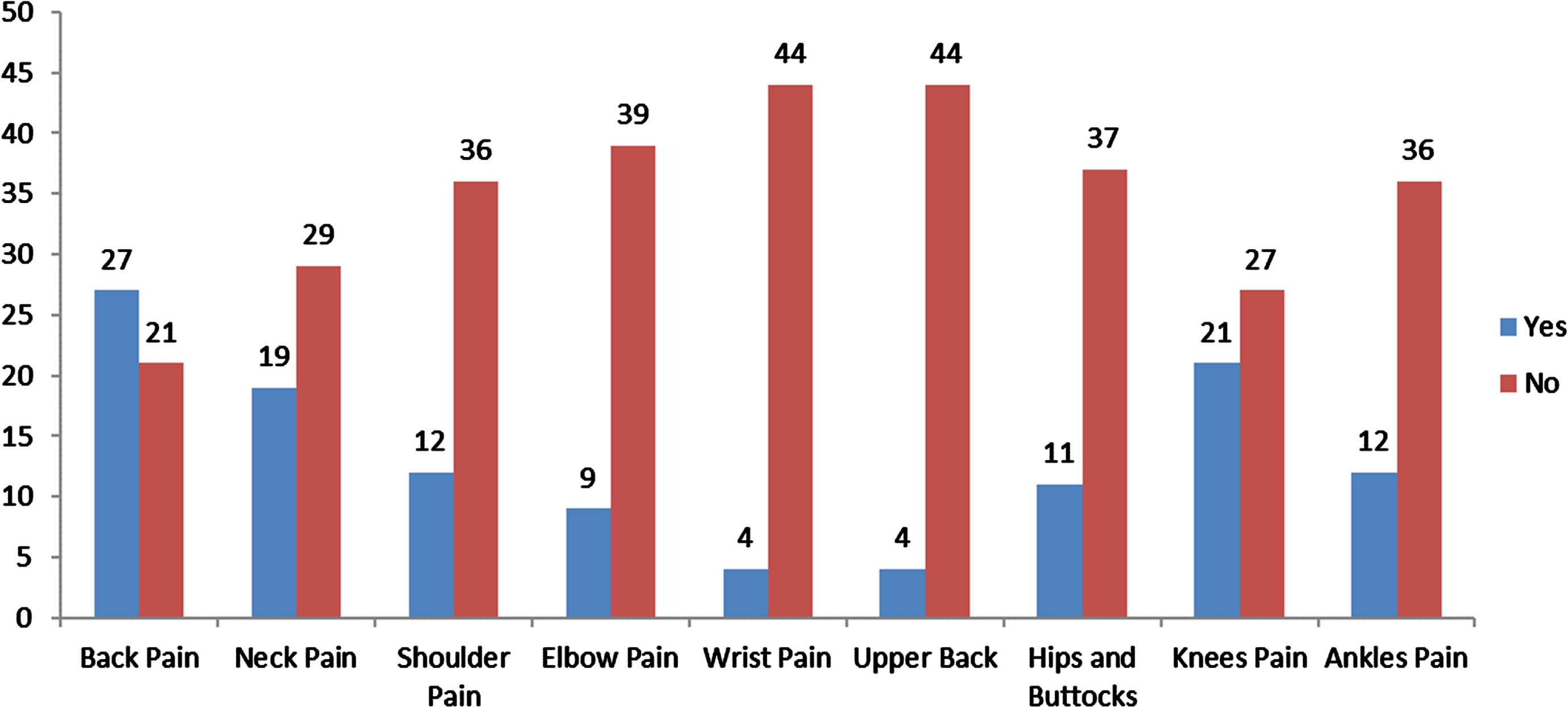
Prevalence of MSDs by body part among drivers.
Several ergonomic risk factors are responsible in development of WMSD like repetition, awkward posture, stationary position, direct pressure, vibration, extreme temperature and noise [13]. In a study by Tamrin et al. [21], on bus drivers and Robb et al. [14], on truck drivers in U.K have found approximately similar prevalence rate of total MSDs as predicted in our study of around 81.8% and 81% respectively. Slight variation in results might be due to difference in demographic features and different environmental conditions. Also, number of subjects taken in both studies is relatively much higher as compared to our study. Present results reflected the prevalence of LBP (56%), KP (43%) and NP (39%), as the most reported MSDs in drivers followed by SP (25%), ankle pain (25%) and hip problems (22%). Elbows, wrist and upper back are least affected by MSD problems. A systematic review [20], of various heavy vehicle drivers from around the world revealed a meta-prevalence of MSD in the lower back, neck, and hips of 56.6%, 38.1%, and 20.1% respectively, which is highly consistent with our findings. Also reported meta-prevalence of KP was 23.5%, which is much below compared to present results. It may be due to hard clutching and intense heat produced inside the driver’s cabin majorly in the summer time. Several studies [20, 22], found SP as one of the mostly affected region in drivers but in this study prevalence was relatively much lower. It maybe probably due to when asked during survey most drivers were satisfied with the working of new power steering system installed by companies in Indian manufactured heavy vehicles. The present study revealed NP as the second most prevalent MSD in drivers. Similar findings were revealed by previous literatures [14]. Hand arm vibration might be the reason of causing NP because vibration enters into neck through hands and shoulders. Another reason might be the adoption of the forward head posture by the drivers due to prolonged sitting [23]. Bivariate analysis only predicted increasing age was significantly associated with LBP(p = 0.046) and getting high intensity LBP(p = 0.024). Also, increasing weight(p = 0.007), BMI(p = 0.004) and performing heavy-duty job(p = 0.005) were significantly associated with KP while good suspension system decreases the likelihood of getting KP(p = 0.022). Logistic Regression analysis predicted age as a significant risk factor (p = 0.038) for the likelihood of having LBP (Table 4). Our investigation suggests that for every unit increase in age in years drivers were 1.186 times more likely to have LBP. This outcome (age) was also confirmed by other studies which predicted age as a risk factor [3, 24]. Further our study demonstrated risk factors-posture (p = 0.029) and suspension system of seats (p = 0.038) were significantly associated with LBP (Table 4). Adopted postures other than vertical like bending forward, twisting etc. which unnecessarily increases compression on lumbar area have greater risk of developing LBP. This is also predicted in another study [25]. Having a good suspension system acts as a protective factor and decreases the likelihood of getting LBP because it may be absorbing the whole-body vibration which itself consider a high risk factor according to previous studies done [8]. Consuming painkillers which were treated as risk factor was not found statistically significant associated with LBP but odds of getting high intensity LBP were high for those who consume painkillers regularly and was significant (p = 0.014). Further research is needed in this area by the ergonomists and medical practitioners. Also, regression analysis showed that none of the risk factors were significantly associated with NP and NP severity. Driver’s suspension seat (p = 0.008) and heavy-duty job (p = 0.048) were found significantly associated with knee disorders (Table 4). Drivers having bad or no suspension seats were having higher odds of getting KP. This may be attributed to the fact that they cannot adjust their seats according to the leg position. Majority of seats present in the surveyed heavy vehicles don’t have suspension and are not adjustable in any of the orthogonal axis. Significant correlation was observed between handling heavy loads and KP. High odds ratio of more than 30 were observed for drivers who were lifting heavy loads or improperly lifting and were likely to suffer from knee disorders. In long time it can damage knees [26]. Although no risk factors were found to be significantly associated with any MSDs but some basic inferences could be concluded by A.O.R. Present research predicts awkward posture, heavyweight lifting, overweight, being alcoholic, smoker, exercising and driving experience increasing the odds of getting any sort of MSDs (Table 4). All these problems can be addressed through proper education in their own languages, giving them correct pre-job training, performing their periodic health check-up, encouraging them to lose weight and quit smoking and improve their lifestyle by gradually reducing and eventually stopping alcohol intake.
Limitations
The present research contributes valuable findings on the occurrence of MSDs among heavy vehicle drivers despite facing certain limitations. Efforts were done by the researcher in full capacity to obtain data from a bigger sample of drivers which got limited due to the unavailability of drivers, not attempting the questionnaire with seriousness and some of them leaving in between. Further the drivers who drive in those inner districts that do not touch the highway connecting the other states of India which may have slight terrain differences, travel conditions were not sampled for the present study. Due to time constraint the researcher was also not able to re-contact the participants who left the questionnaire in between due to their critical job requirements. There are several factors which may be the underlying cause of MSDs however in the present study the researcher has focused on some specific factors only.
Conclusions
The heavy vehicle drivers are exposed to whole body vibration continuously as long as they are driving. Such long exposures to whole body vibration have set to be associated with occurrence of musculoskeletal disorders and body pain especially LBP and KP. The study revealed LBP to be the most dominant pain being experienced by 56% of the sample followed by KP experienced by 43% and NP by 39%. Age, suspension system and bad posture were found significantly associated with LBP. Drivers KP were also significantly impacted by a bad suspension system and carrying heavy objects. The majority of drivers believed that driving heavy vehicles was to blame for any type of MSD discomfort they experienced. The results demonstrated the evident necessity for ergonomic consideration in vehicle designing and ergonomic training for heavy vehicle drivers.
Questionnaire and data availability
Questionnaire and data will be made available upon reader’s request by the corresponding author.
Ethical approval
Approved by Dept. Of Mechanical Engineering, National Institute of Technology, Manipur, India: R1/29th July 2022.
Informed consent
Informed Consent was obtained from all participants prior to participation.
Conflicts of interest
No conflict of interest.
Footnotes
Acknowledgments
Not Applicable
Funding
Not Applicable