




Abstract
BACKGROUND:
Many organizations around the world have prudently adopted corporate environmental citizenship. However, the corporate environmental citizenship implementation may vary from reality. Thus, this study examines corporate environmental citizenship to identify ultimate practices to create a strong premise of CEC.
OBJECTIVE:
The study examines the influence of organizational learning capability, organization age on corporate environmental citizenship.
METHODS:
The data were collected from 50 Malaysian construction firms using the survey questionnaire and analyzed by using Partial Least Square Structural Equation Modeling (PLS-SEM).
RESULTS:
The finding revealed that organizational learning capability positively related to corporate environmental citizenship. Organization age was not found to moderate such relationships.
CONCLUSION:
This study establishes that organizational learning capability encourages construction firms to take risks and explore new opportunities are essential for corporate environmental citizenship implementation. This study highlights the role of organizational learning capability to achieve corporate environmental citizenship irrespective of their organization age for construction firms. This study confirms the logic of Natural Resource Based View (NRBV) theory for predicting organizational learning capability as a critical foundation to build corporate environmental citizenship.
Keywords
Introduction
Organizations are the biggest culprit for irregular weather patterns or ecological problems due to the large quantity of waste generated and consumption of resources [1]. In response to environmental demands from the community [2], many organizations around the world have prudently adopted Corporate Environmental Citizenship (CEC) i.e., organizations acknowledge the importance of the environment in their organizational strategy and the strategic planning processes to preserve the natural environment [3].
Indeed, organizations have taken significant initiatives to develop climate change policies, clean energy processes and sustainable practices in their business [4]. However, despite all these initiatives, ecological problems escalate, leaving the key unanswered question of whether CEC changes organizations to solve ecological problems. Organizations often used CEC as a symbol without serious changes and adaptation of their actions [5]. This is possible since it is usually assumed that an organization’s motivation for CEC efforts is to obtain legitimacy from stakeholders such as suppliers, customers and the community [1, 2]. If so, the CEC implementation may vary from reality, causing inconsistency between the expected and actual actions. On this basis, this study examines CEC to identify ultimate practices to create a strong premise of CEC, offering crucial information on key practices to ensure successful implementation of CEC.
Besides, the implementation of CEC is complicated and deals with various difficulties [6, 7]. In this case, Organizational Learning Capability (OLC) i.e., organizational characteristics that facilitate the organizational learning process [8, 9] are needed to learn environmental behavior and interpret the situation in an environmentally friendly approach to pursue CEC [10]. OLC also happens when it embeds in organizations memory such as values, norms and cultures to guide the organizations including environmental responsibility into the business operation process [11]. Nevertheless, little research to date has explored how OLC contributes to CEC. Prior studies have mainly been explored conceptually and empirically which are confined to case studies [6, 7, 10]. It causes poor understanding of the relevance of OLC in achieving CEC. Agyabeng-Mensah [12] claims how organizational learning (e.g., OLC) fosters corporate social responsibility (e.g., CEC) remains partially understood. Therefore, there is a need for more clarity about this connection. To overcome this gap, this study investigates the influence of OLC on CEC.
Additionally, the role of organization age i.e., the operation years of an organization considered from the start time to date [13] as a moderator between OLC and CEC remains unexplained because organization age is widely found in the firm performance and innovation studies [14, 15]. This study proposes that organization age is a useful moderator to understanding when and how OLC might influence CEC. Organization age shows the ability, experience and capability to implement CEC. Cincalova [16] argued that mature organizations realize more than young organizations about the value of CEC to attract investors and create a good image. Conversely, when organizations have fewer years of operations, organizations have limited experience with the external environment and lack of know-how to integrate environmental practices into daily business i.e., CEC [17]. Therefore, this part needs further empirical investigation in this study, particularly in relation to the moderating effect of organization age between OLC and CEC. In summary, this paper makes several contributions. First, this study provides a better explanation of the impact of OLC on CEC which brings useful insight for future practice and theory. Second, this study contributes to the literature by analyzing the relationship between OLC, CEC and the moderating role of organization age, which is new evidence in the literature. Third, both mature and young organizations enable us to develop relevant and appropriate CEC strategies and directions based on the findings. This paper is organized as follows: first, introduce the conceptual background of OLC, CEC and the hypothesis development discussions. Next, the paper presents the research methodology followed by findings. Finally, this paper highlights the finding discussion, future research agenda and study limitations in the conclusion.
Literature review
OLC and CEC
Natural Resource-Based View (NRBV) theory is well-suited to explaining the relationship between OLC and CEC. Referring to Hart [18], environmental practices minimize carbon footprints, waste and improve efficiency. Acknowledging the importance of environmental practices to achieve a sustainable competitive advantage, Hart [18] suggests NRBV theory by incorporating three strategic capabilities namely pollution prevention (reduce waste and emissions), product stewardship (life cycle cost of products) and clean development (reduce environmental impacts results from firm growth).
Under natural resource-based view theory, OLC is consistent with the assumption of NRBV theory. By using OLC, organizations can obtain strategic capabilities, which in turn lead to a sustainable competitive advantage. It involves organizations learning from experience and inquiry for environmental issues such as looking into products’ life cycle process from raw material extraction until the final disposal to minimize or prevent the environmental footprint. OLC also entails organizations to take risk in investing future technologies in pursuit of environmental practices, which deliver positive environmental impacts over the long term. As such, it may highly influence organization adoption of CEC. Organizations have significant cost savings, productivity and efficiency compared to competitors [19].
While earlier research has attempted to identify the relationship between OLC and CEC [6, 9], little has been done to determine if organizations’ CEC implementation is associated with higher organizational learning. Experimentation (i.e., sub-dimension that forms OLC) involves trying new ideas and suggestions [8]. Experimentation is closely associated with organizations’ willingness to evaluate existing knowledge, beliefs, routines and assume the need to try new environmental knowledge [19]. That is, progressive experimentation eases critical reviews of self and others questioning practices and contributes to an enhanced CEC. Further, organizations with learning capability characteristic is an open system where organizations regularly interact and exchange resources or feedback with the external environment i.e., customer, suppliers, government agencies [9]. Employees benefit from these interactions and exchange, adapting their work practice or style based on the resources or feedback obtained [7]. This facilitates organizations to address changes in the external environment, concern the stakeholder needs, integrate stakeholders’ suggestions in practice, warranting the practices always aligned to their needs [7]. All these are essential for CEC implementation. For instance, organizations launch environmental friendly innovation in production, packaging and products when organizations learn that the public is environmentally conscious using customer surveys. Such interactions build networks with the public, gain insights on environmentally friendly innovation, enhancing CEC [7].
Additionally, Babiak [20] highlights that organizations engaged in stakeholder dialogue can obtain an understanding of various stakeholders’ environmental demands, perceptions and values. Every stakeholder perceives an organization has an obligation to protect the natural environment and expect organizations to invest in CEC [20]. In turn, organizations can identify the challenges and opportunities in the development of CEC [20]. In a similar vein, stakeholder dialogue helps identify organizations’ limits and their place on CEC issues. Nowadays, stakeholders demand more on organizations’ transparency not only on products but also on environmental values and commitment [22]. Therefore, organizations are expected to justify their business decisions and environmental footprints [22]. At the end, organizations monitor stakeholders and scrutinize the business environment in which strategic CEC decisions are made [23]. Thus, it enhances the quality and effectiveness of CEC decisions.
Along similar lines, CEC is reinforced by employees’ participative decision making. While employees realize themselves as part of determining environmental programs and activities, differences about what to do and how to do concerning environmental processes will be reduced [23]. Thus, a high level of employees’ dedication, passion and interest in environmental programs and activities are more likely to be demonstrated [23]. Subsequently, employees recognize environmental goals, accept environmental innovation, intervention and requirements while solving various environmental problems [25] leading CEC. Organizations can find ways to create two-way communication regularly that focus on the need for advancing CEC will improve employees’ awareness of their significant environmental contributions [26]. Thus, it is hypothesized that:
H1:
OLC positively influences CEC.
The moderating effect of organization age
Drawing upon socioemotional selectivity theory (SEST), this study assumes that the relationship between OLC and CEC relies on the organizational characteristic i.e., organization age. Specifically, older organizations prefer to spend their time with familiar organizations to share positive relationships [27, 28]. In this context, CEC arises from older organizations’ desire to strengthen relationships due to positive returns from the relationships. Therefore, older organizations practice CEC to gain reputation, better financial performance benefits in the long term when external stakeholders view organizations socially responsible [29], causing customers to feel proud of purchasing products and services engaged by CEC, investors willing to invest by purchasing stock organizations [30].
In a similar vein, organizations’ resources, capacities and abilities change and develop over time [19]. Older firms have more established environmental routines and relevant approaches for engaging in environmental innovations [18]. From this viewpoint, older organizations have extensive experience and expertise in pursuit of CEC. In contrast, younger organizations have limited exposure to environmental innovations [18] and lead to fewer experiences involving CEC. Further, from the financial aspect, stable profitability and predictable cash flows allow older firms to invest in CEC activities [17, 31]. However, younger firms have uncertain cash flows, hence they prefer to focus on survival and lack of resources to invest in CEC activities [17, 31]. Additionally, external stakeholders may be unwilling to associate with younger organizations, making them harder to involve in environmental innovation projects [31]. This may not achieve CEC, given that they have limited stable links and legitimacy in the eyes of external stakeholders whom they associate with [31]. In contrast, as an older organization, its CEC history and reputation enhances external stakeholders’ confidence and expectations about environmental project sponsorship [31]. It causes older organizations very hard to withdraw from CEC activities.
Besides, older organizations have long survived to develop a sense of belonging to the community where they operate, expecting to be socially responsible citizens [29, 32] by engaging CEC. Socially responsible creates older organizations’ reputation among customers and potential customers, who in turn prefer to buy their products and services, strengthening their financial performance in the future [29, 32]. This is different from younger organizations who are not close to the business environment and community where they operate, leading younger organizations are not always interested in acting as good citizens by practicing CEC [29, 32]. Along similar lines, younger organizations never realize positive returns (e.g., goodwill, higher financial performance) of CEC [29]. For instance, younger organizations have little emphasis on communicating environmental activities (e.g., setting up a department of environment, preparing environmental reports) to external stakeholders as it is quite costly. Thus, it is hypothesized that:
H2:
Organization age moderates OLC and CEC
Methodology
Sample and procedure
Data were collected via questionnaire. The population is 244 construction firms in Malaysia which was retrieved from the website of Construction Industry Development Board (CIDB) [31]. Following Krecjie [34] sample size table, the adequate sample size is 169. The systematic sampling technique was employed to identify the study sample because elements in the population have a chance to be selected systematically [35]. All construction firms on the list would be chosen until 169 Grade 7 construction firms were obtained, since 244/169 = 1. Thenceforth, an invitation email describing the purpose of research and data confidentiality was sent to organization directors (i.e., target respondents). 95 organization directors expressed their willingness to participate and were given two weeks to complete the questionnaire. Among 169 questionnaires, 86 were returned 6 were incomplete due to similar responses across all items. Only 80 completes were used for subsequent analysis. The majority of respondents were Malaysian ownership construction firms (96%). Construction firms’ business activities were handled by the professional management groups (58%) and business owners (42%).
Instruments
To measure OLC, this study included 14 items from Chiva et al. (2007). The measurement has gained strong evidence of reliability and validity in prior studies [36, 37]. Further, CEC was accessed using 16 items from Banerjee [3]. The measurement has been empirically validated by various researchers [38–40]. Respondents identify their perception levels assessing OLC and CEC on a five-points Likert scale (1 = strongly disagree to 5 = strongly agree).
Organization age was measured using the formation years [16, 41]. Following prior studies [41–43], this study categorized the organization age into older and younger construction firms. Construction firms with less than 10 years were considered younger, while those with more than 10 years were ranked as older [17, 44]. This study employed a dichotomous measure where younger construction firms were coded “1” and older firms were coded “0”.
Next, a pilot test was performed to determine whether questionnaire instructions and item clarity made sense. The pilot test results reported OLC and CEC measurements have higher reliability values, greater than 0.70, meeting Nunally [45] minimum value. In short, the measurement was reliable.
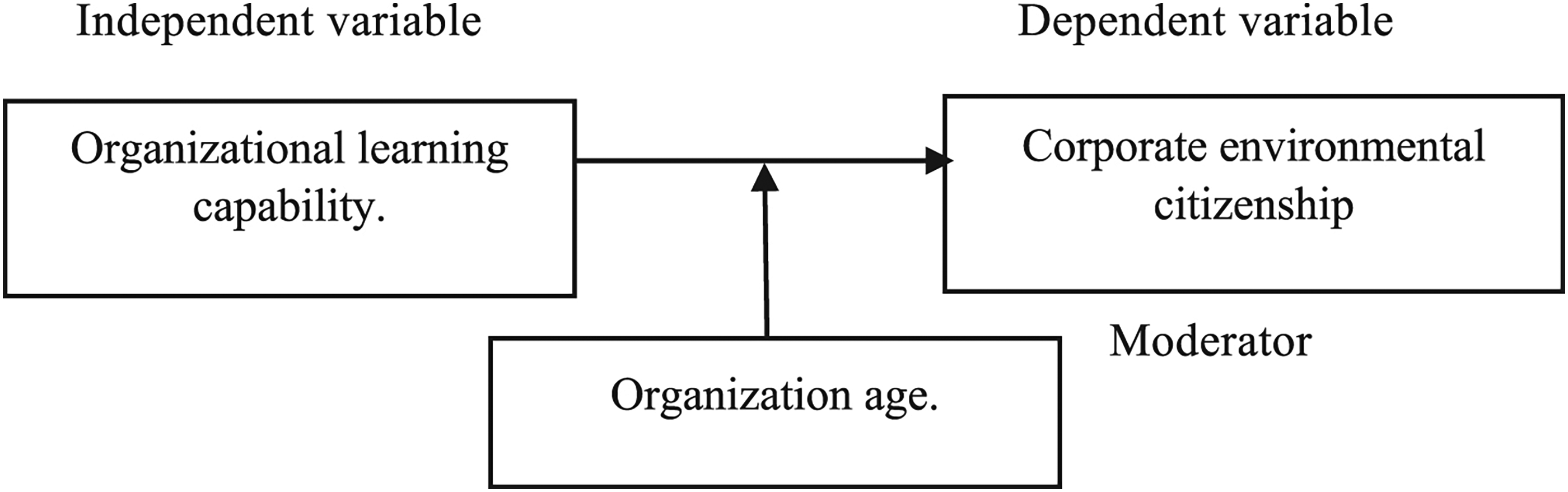
Research Model.
Collected data were screened against four requirements namely 1) missing data, 2) suspicious response pattern, 3) outliers, 4) common method bias [44]. This study has no suspicious response pattern and missing values. 30 responses identified outliers and removed them, leading 50 responses were used for further analysis. After that, PLS-SEM is preferred when testing a research model from a prediction angle, theory development and exploration of new phenomena, especially when the research area is emerging and dynamic. Hence, referring to the study’s objectives PLS-SEM is chosen and executed using SmartPLS 4.0 software. Additionally, both CEC and OLC are multidimensional constructs, where items reflectively measured Lower-Order Constructs (LOCs) while relevant variables are formatively measured Higher-Order Constructs (HOCs). PLS-SEM supports multidimensional constructs because it captures the complexity of multidimensional constructs in the research model.
Measurement model
Reflective measurement model
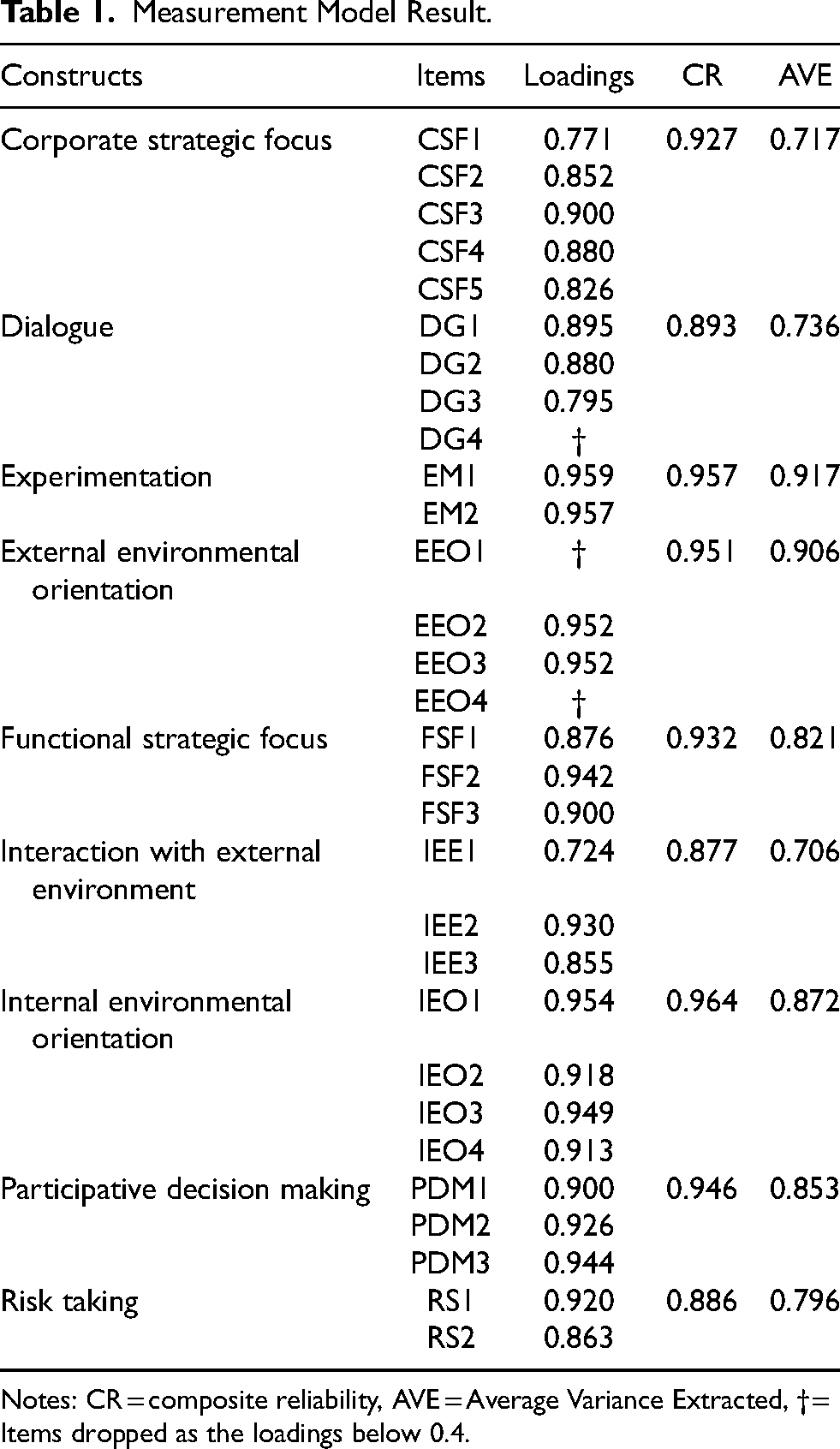
From Table 1, item loadings exceeding the threshold value i.e., 0.7 except EEO1, EEO4, DG4 were removed as the outer loadings were below 0.40 [46]. Removing these items does not change the meaning of external environmental orientation (EEO) and dialogue constructs because items are the reflection of the constructs [47]. From Table 1, the CR of the constructs are close to the acceptable threshold value of 0.7 [48, 49], thus providing higher levels of reliability. The results exhibit Average Variance Extracted (AVE) values above 0.50, explaining 50% or more item variance that form the construct [48]. As shown in Table 2, the values below HTMT 0.90 criterion. Overall, the measurement model was satisfactory.
Measurement Model Result.
Measurement Model Result.
Notes: CR = composite reliability, AVE = Average Variance Extracted, †= Items dropped as the loadings below 0.4.
Heterotrait-Monotrait Ratio (HTMT) Results.
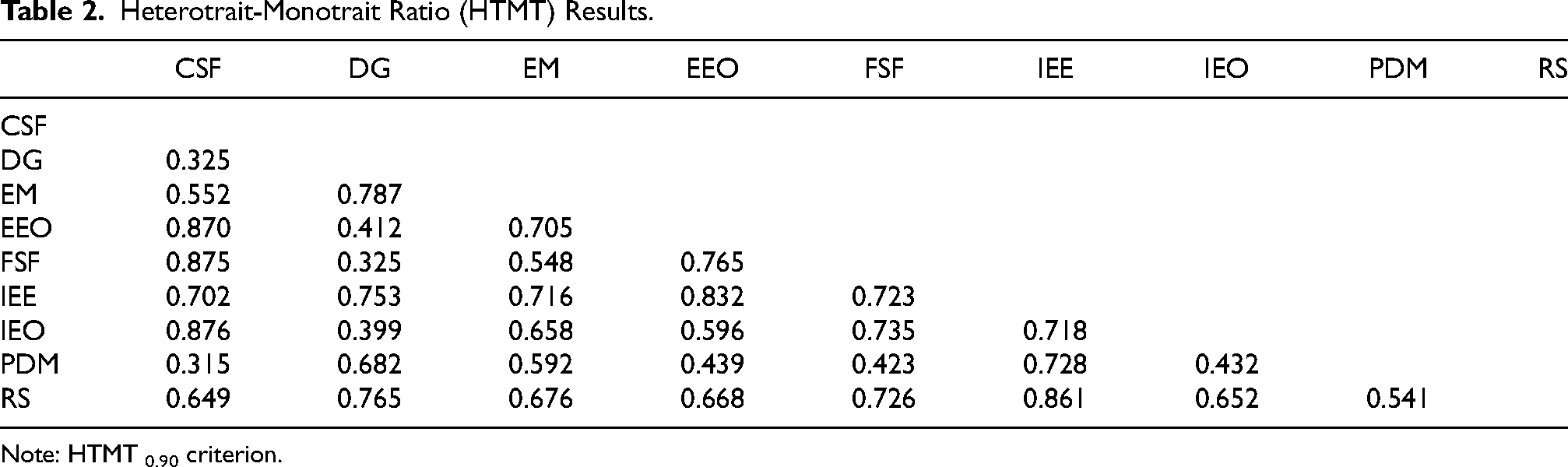
Note: HTMT 0.90 criterion.
VIF, Formative Items’ Outer Weights, Outer Loadings.

Note: *t value > 1.96.
The first step is evaluating OLC convergent validity [44] via redundancy analysis, providing a path coefficient of 0.81, above the threshold value 0.70, therefore supporting OLC convergent validity. Besides, the second step is examining Variance Inflation Factor (VIF) to assess formative items’ collinearity [44]. VIF values were less than 5, which means no collinearity issues in the formative items (see Table 3). Meanwhile, the third step is to assess the formative item outer weights’ statistical significance [48]. Referring to Table 3, one formative item was found to be statistically significant at p < 0.00 except external environmental orientation, corporate strategic focus, functional strategic focus, experimentation, risk taking, interaction with external environment, dialogue, participative decision making. These formative items are not necessarily illuminated as proof of poor measurement model quality although their outer weights are insignificant [46]. Alternatively, outer loading formative items were considered [46]. As exhibited in Table 3, formative item outer loadings were greater than 0.50, suggesting that these formative items remain for subsequent analysis [46].
Structural model
Firstly, the SRMR value is 0.084, less than the cut-off point of 0.10 [51] indicating the satisfactory data fitting the research model. Secondly, all VIF values were clearly below 0.50, the collinearity was eliminated. Thirdly, R2 of 0.826, meaning that 82.6% of CEC variance was explained by OLC. 0.826 R2 values can be considered as substantial based on Hair [46] recommendation. Fourthly, OLC has a large f2 effect size of 3.66 in CEC. Fifthly, Q2 value is above zero i.e., 0.574, providing the research model has predictive relevance. Sixthly, Table 4 revealed that OLC has a significant effect on CEC, thus, H1 is supported. Alternatively, an organization’s age has no moderating effect between OLC and CEC because the confidence interval contains zero. H2 is not supported.
Hypothesis Testing Result.

Hypothesis Testing Result.
Note: OLC = organizational learning capability, CEC = corporate environmental citizenship, *t value > 1.96, Italic terms represent the results of moderation effect.
The finding revealed that OLC significantly related to CEC, suggesting that the construction firms under this study perceive that OLC promotes the generation of organizational competencies and abilities to deal with environmental problems and thus achieve CEC. This finding is similar to Zeimers [52] and Zhang [53]. A possible explanation is that the construction firms have embedded environmental norms, routines, codes, structure and systems to educate employees learning environmental orientation throughout the construction firms [54]. This explains that the majority of Grade 7 construction firms have environmental officers to assess construction projects’ environmental performance and review construction projects that comply with environmental regulations and client requirements [33]. As such, environmental officers educate employees via toolbox briefings and training sessions, communicating pollution control approaches and environmental goals [33]. It is more likely to enhance all workers’ competencies, abilities and CEC.
Another explanation is Grade 7 construction firms have varying numbers of experienced employees with higher level competency and the education level positively impacts OLC. It is closely related to their willingness to be involved in the process of learning new environmentally friendly knowledge and technologies. They learn via external stakeholder (e.g., competitors, customers, universities) interactions, modify work practices in line with the environmental information obtained and contribute to CEC. Additionally, the finding showed that organization age does not moderate OLC and CEC, providing the age of construction firms under this study has no impact on CEC action. This means that young construction firms did not engage less in CEC. This conforms to Cincalova [16] and Badulescu [17] who never associate corporate social responsibility (e.g., CEC) action with firm age. A possible justification is given the construction industry, CEC enhancement not only depends on organization age, but on other critical factors related to CEC such as government support [55, 56], suppliers’ collaboration [57, 58].
Research implications
This finding contributes to the OLC and CEC literature in several ways. Specifically, this study confirms that the logic of NRBV theory for predicting OLC creates a critical foundation to build CEC. This is where organizations take the risk of investing in environmental innovation, making sure to minimize the use of natural resources and toxic release [20, 59]. Thus, organizations’ interest in CEC increased, adding value to reputation and bigger market demand [60, 61]. This finding further advances the understanding of OLC and CEC relationships. Thus, it can be used as a future reference for exploring the relationship between organizational learning and environmental related studies. Besides, this study adds new proof on the relationship between OLC and CEC by investigating the moderating role of organization age, which warrants fresh perspectives in the literature. Moreover, this study does not confirm that organization age moderates the association between OLC and CEC, contradicting SEST theory [27, 28]. As such, future studies explore whether OLC and CEC are moderated by organization age. This finding reminds the construction firms of the importance of OLC in pursuing CEC. Construction firms could enhance the environmental learning efforts by developing shared knowledge among the employees.
The employees may use the shared knowledge to access environmental opportunities and search for environmental initiatives for the construction firms. The results of this study offer insights for government agencies, especially CIDB to support CEC in the construction industry. CIDB can exhibit commitment to CEC by offering resources necessary for CEC success. For example, CIDB determines the strategic decisions to ensure registered construction firms have tools, budget, recognition and system to enhance CEC. CIDB must model itself as well as be involved in leading this long-term practice i.e., CEC because it is not a once-and-done practice. Instead, CEC is a complex practice that construction firms initiate, sustain and evolve over a long time. Besides, the findings indicate that older and younger construction firms can achieve CEC when implementing OLC. An explanation of this can be that older and younger construction firms with OLC enable them to explore new opportunities, exploit existing opportunities, interact and exchange feedback with stakeholders, review existing goals and practices can achieve CEC as theorized by Leonidou [20].
Research limitations and future research suggestions
This study has limitations. First, this study is restricted to construction firms, which may constraint the generalizability of the results to the non-construction industries. Future studies should extend this research framework to the non-construction industries. Second, this study uses two factors i.e., OLC and organization age to examine CEC. For this reason, future studies may be extended to include other factors (e.g., innovation, technological knowledge) influence CEC. Innovative technologies enable organizations to reduce their environmental footprints by improving resource efficiency, minimizing waste generation and mitigating pollution [62]. For example, adopting 3D models of buildings and structures can identify clashes, conflicts and inefficiencies in the construction planning stage. Third, this study suffers from a causal design. As such, longitudinal studies may be relevant in future studies to examine the evolution of OLC and CEC influence over the years. Fourth, a single informant technique (each firm has one respondent) was applied, there is a fair chance of bias issue (i.e., the respondents prefer to give desirable responses). Multi-informant and multi-method designs could be used in future studies to determine organizations’ learning capability, CEC and age. For example, document analysis could be integrated with a self-administered questionnaire to measure OLC, CEC and age. Another example is that more than one respondent from each firm could be considered, especially at different position levels because OLC and CEC implementation may vary across employees although they work in the same firms.
Footnotes
Ethical approval
Not applicable.
Informed consent
Informed consent was obtained from all participants.
Conflict of interest
The authors declare that they have no conflict of interest.
Acknowledgments
The authors have no acknowledgments.
Funding
Not applicable.