



Abstract
Plasma cooling due to hard x-ray radiation from the Runaway electrons is an important issue in tokamaks. Thus, developing effective methods to reduce the Runaway electrons and the emitted hard x-ray is also important for optimal tokamak plasma operation. In this study, we investigated the effects of external fields on hard x-ray intensity and the Magnetohydrodynamic (MHD) activity. In other words, we presented the effects of positive biased limiter and Resonant Helical Field (RHF) on the MHD fluctuations and hard x-ray emission from the Runaway electrons. MHD activity and hard x-ray intensity were analyzed using Wavelet transform in the presence of external fields and without them. The experimental results showed that the MHD activity and therefore the hard x-ray intensity could be controlled by the external electric and magnetic fields.
Introduction
In fusion research, the most promising method for hot plasma confinement is the use of appropriate strong magnetic fields such as in tokamaks. An equilibrium condition between plasma pressure and magnetic pressure must be satisfied for such magnetic confinement systems. The problem of achieving toroidal equilibrium in tokamaks separates into two parts. First, the magnetic configuration must provide radial confinement, i.e., radial pressure balance in the poloidal plane so that the pressure contours form closed nested surfaces. Second, the configuration must compensate the radially outward expansion force inherent in all toroidal geometries, i.e., toroidal force balance. But, in the second part, the two opposite forces (expansion force and Lorentz force due to external vertical field) may not be equal and consequently plasma intend to shift inward or outward, which is dangerous for tokamak plasma. However, plasma equilibrium study is one of the fundamental problems in the magnetically confined plasmas. In tokamak equilibrium studies, there are many available experimental methods and analytical solutions for the steady state MHD equations, in particular the Grad-Shafranov equation.
Control of plasma position plays an important role in plasma confinement and the achievement of optimized tokamak plasma operation. Therefore, accurate determination of plasma column displacement during confinement is essential to transport it to a control system based on feedback. Over the years different methods have been developed to analysis the tokamak plasma equilibrium characteristics. The high energy current of Runaway electrons during a major disruption in tokamak reactors can cause serious damage to the first wall of the reactor and reduce its life time. For instance, during plasma start-up or during major disruptions, Runaway electrons in a MeV range can be observed due to a low plasma density or a high loop voltage.
In large tokamaks, Runaway electrons energy during a major disruption may reach to several ten MeV. In these tokamaks, the Runaway electrons current during a major disruption is also remarkable. With the increase of sizes, magnetic field and currents in tokamak experiments the disruption-generated Runaway currents might be up to 60% of the pre-disruptive currents. At ITER nominal parameters the estimated Runaway currents can reach 10 MA in the MeV energy range.
However, since neutron energy will be converted to thermal energy in the blanket with a high tritium breeding rate in tokamak fusion reactors, the first wall will have to be thin. High energy current of Runaway electrons can cause severe damage to this first wall. Thus avoidance, suppression and termination of Runaway electrons should be developed in present tokamaks in order to realize a reasonable first wall thickness in tokamak fusion reactors. On the other hand, plasma can be cooled due to high energy x-ray radiation of Runaway electrons. The fact that the mean free path of an electron in plasma is a strongly increasing function of its velocity gives rise to the phenomenon of high energy electron production. In an electric field, electrons which exceed a critical velocity, for which the collisional drag balances the acceleration by the field, are accelerated freely and can reach very high energies.
In low density tokamak discharges a considerable amount of these high energy electrons with energies up to tens of KeV to MeV can thus be created. As these energetic electrons are effectively collision-less, they follow the magnetic field lines and can therefore been used to probe the magnetic turbulence in the core of the plasma. If the speed of the electrons is over the critical velocity, the electrons continuously accelerate and Runaway [1]. This is primary generation mechanism of Runaway electrons. There is another mechanism for producing Runaway electrons that is called avalanche phenomena. In this method, the interaction of the primary Runaway electron with thermal electron generates secondary Runaway electrons. Runaway electron emits hard x-ray. The current and energy of the Runaway electrons depend on, plasma density, plasma temperature, loop voltage, impurity concentration and MHD activity. The effect of above parameters have been examined theoretically [2, 3] and experimentally [4, 5]. The high energy current of Runaway electrons can be severe damage to the inner wall of tokamak. Thus, it is desirable to study methods to suppress and terminate the Runaway electrons. Electric biasing with both positive and negative polarity can be applied to the plasma tokamak. In this model the radial electric field is modified by electric biasing. The radial electric field creates E × B velocity shear and a transport barrier, which decreases the turbulence in the plasma, finally enhance particle confinement [6, 7]. RHF is an external helical magnetic field, which can have the influence on MHD activity [8] and major disruptions [9, 10].
In this paper, we intend to investigate the effects of RHF (L = 2, 3) and electrically biased limiter on MHD activity and hard x-ray intensity simultaneously with Wavelet analysis. The experimental setup will be presented in section 2. The theory of Wavelet analysis will be presented in section 3. Also, experimental results will be presented in section 4. And Summary and conclusion is discussed in section 5.
Experimental set-up
IR–T1 is a small, large aspect ratio, low beta, circular cross section tokamak. It’s minor and major radius are a = 12.5 cm and R = 45 cm. It has no diverter but uses a two stainless steel grounded fully poloidal limiter with a radius 12.5 cm. The experiments were performed in hydrogen. The range of pressure before discharge varies from 2 - 2.3 × 10⁻⁵ torr. The maximum amount of toroidal magnetic field is 0.9T. The range of the electron density is 0.7 - 1.5 × 10¹⁹m-3.
The maximum achieved plasma current in IR-T1 is 40 kA. The maximum discharge time is 35 ms. A set of 12 poloidal Mirnov coils is installed to observe the magnetic fluctuations, in which coils are placed in polar plane and coils axis is in the poloidal direction. Also for observing hard x-rays, a NaI-scintillator (3 × 3 in2) is used. This detector is placed at a distance of 3-4 m from the vacuum vessel in the equatorial plane. Hard x-ray emission in the detector would be showed on the data acquisition after the pre-amplifier and amplifier. The applied voltage to photomultiplier varies from 700 to 800 volts. We used a horizontal movable limiter inserted in tokamak to apply limiter biasing in the edge of chamber. This limiter consists of an arc-shaped molybdenum head, with a thickness of 2 mm. The voltage is applied between the head of limiter and the wall of tokamak. In this study, biased voltage was +350 V and biased time was 10 ms after discharge.
The biasing current (I bias ) is 35A. Moreover, the RHF is an external helical magnetic field which can effect on plasma confinement in tokamaks. In IR-T1, this field is generated by two winding with optimized geometry conductors wound externally around the tokamak chamber with a given helicity. The minor radius of helical windings are 21 cm (L = 2, n = 1) and 22 cm (L = 3, n = 1). In this experiment, the current through the helical windings is between 80 and 100 A, which is very small compared with the plasma current (30 kA). RHF was applied after 10 ms to the end of discharge. In this work, the signals from Mirnov coils and hard X-ray detectors were analyzed with Wavelet technique in the presence of external fields and without them.
Wavelet transform
The Wavelet transform is usually used in the study of un-stationary signals to show the time-frequency spectrum with multi-scale resolution. Wavelet extracts both time evolution and frequency composition of a signal, while Fourier sines transform extract only frequency information from a time signal, thus losing time information [11]. There are several mother Wavelets. In the present work, for analysis of Mirnov coil and hard X-ray data, we focus on Morlet Wavelet as a mother Wavelet, because its frequency variation is close to Mirnov coil and hard x-ray signals. The Morlet Wavelet is definedas [12]:
The Wavelet transform of the signal x (t) about the mother Wavelet ψ (t) is defined as:
ψ
aτ
are translations and dilations of the original Wavelet defined by:
where τ denotes the position (translation) and a scale (dilation) of the Wavelet. The Wavelet transform scans the signal with both frequency scale dilation and time space translation of the mother Wavelet to convert the initial temporal signal in to a more redundant representation in time and frequency.
In the present paper, we have analyzed the MHD fluctuations and hard x-ray intensity signals obtained from the IR-T1 tokamak using Wavelet transform. Figure 1 shows a typical discharge with the plot being MHD fluctuation, hard-X-ray intensity and Vloop, respectively. The sample with dimensions 2cm*2 cm was hold and processed. The simplest diagnostics is that of the toroidal loop voltage (Vloop) which is determined by measuring the voltage round a toroidal loop of wire parallel to the plasma. The loop voltage is useful in determining the resistance and the Joule heating of the plasma although the interpretation is not always simple. The voltage is induced by flux changes due both to current in the primary circuit and the plasma current itself, and consequently internal rearrangement of the plasma current or a change in its magnitude leads to a toroidal voltage which varies across the plasma.
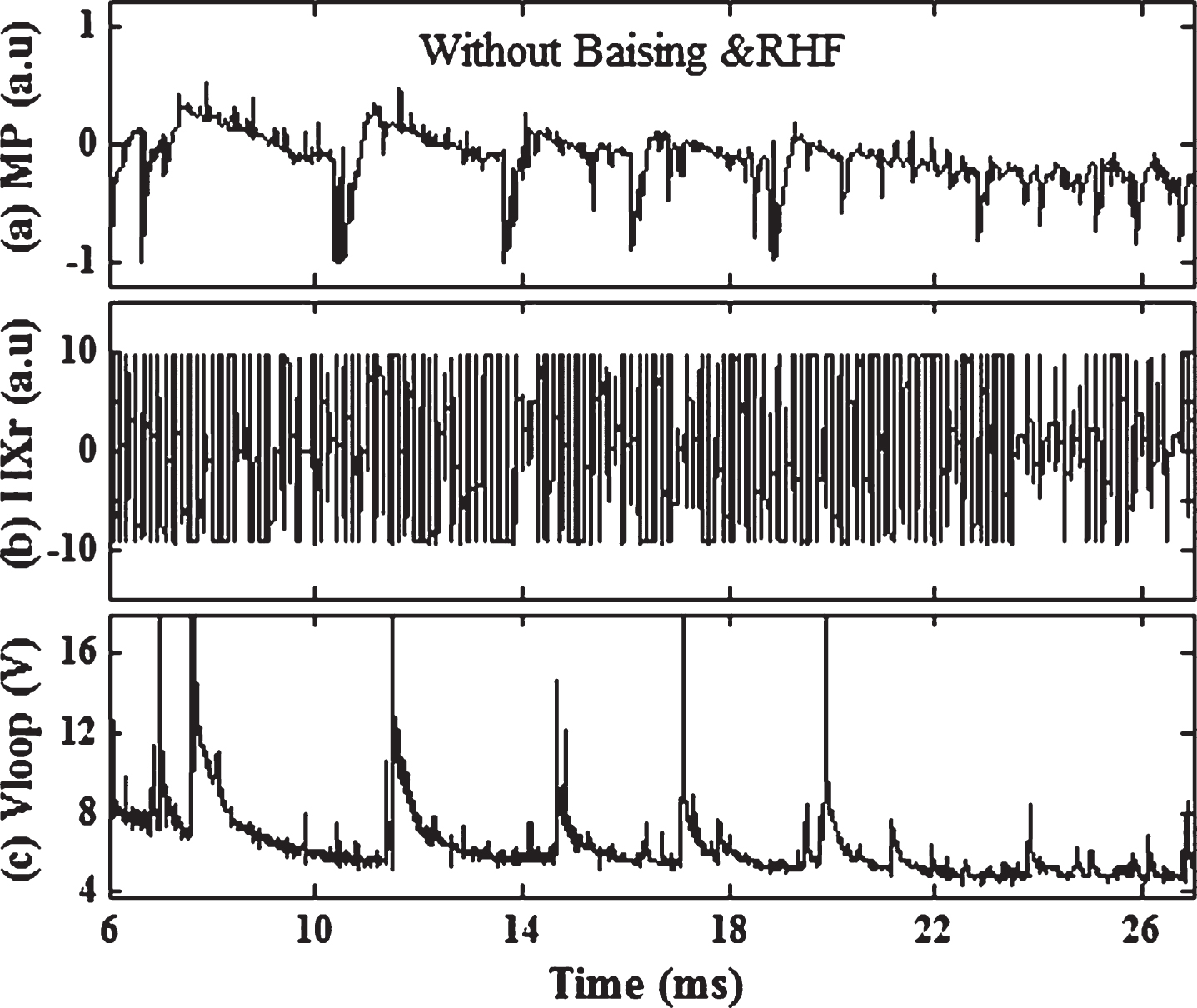
Time evolution of Mirnov oscillation, hard x-ray intensity, loop voltage in the absence of biasing and RHF.
Only when the plasma current and the current density profile are constant in time, the toroidal voltage uniform across the plasma and equal to the loop voltage measured at the surface. Figures 2–3 show the above plasma parameter in the presence of external fields. As observed in Figs. 2–3, MHD activity was increased and hard x-ray intensity was decreased after applying biasing and resonant helical fields. Also, changes in loop voltage are close to MHD fluctuations. Also, we intend to discuss how external fields effect on time–frequency of hard x-ray and MHD fluctuations.
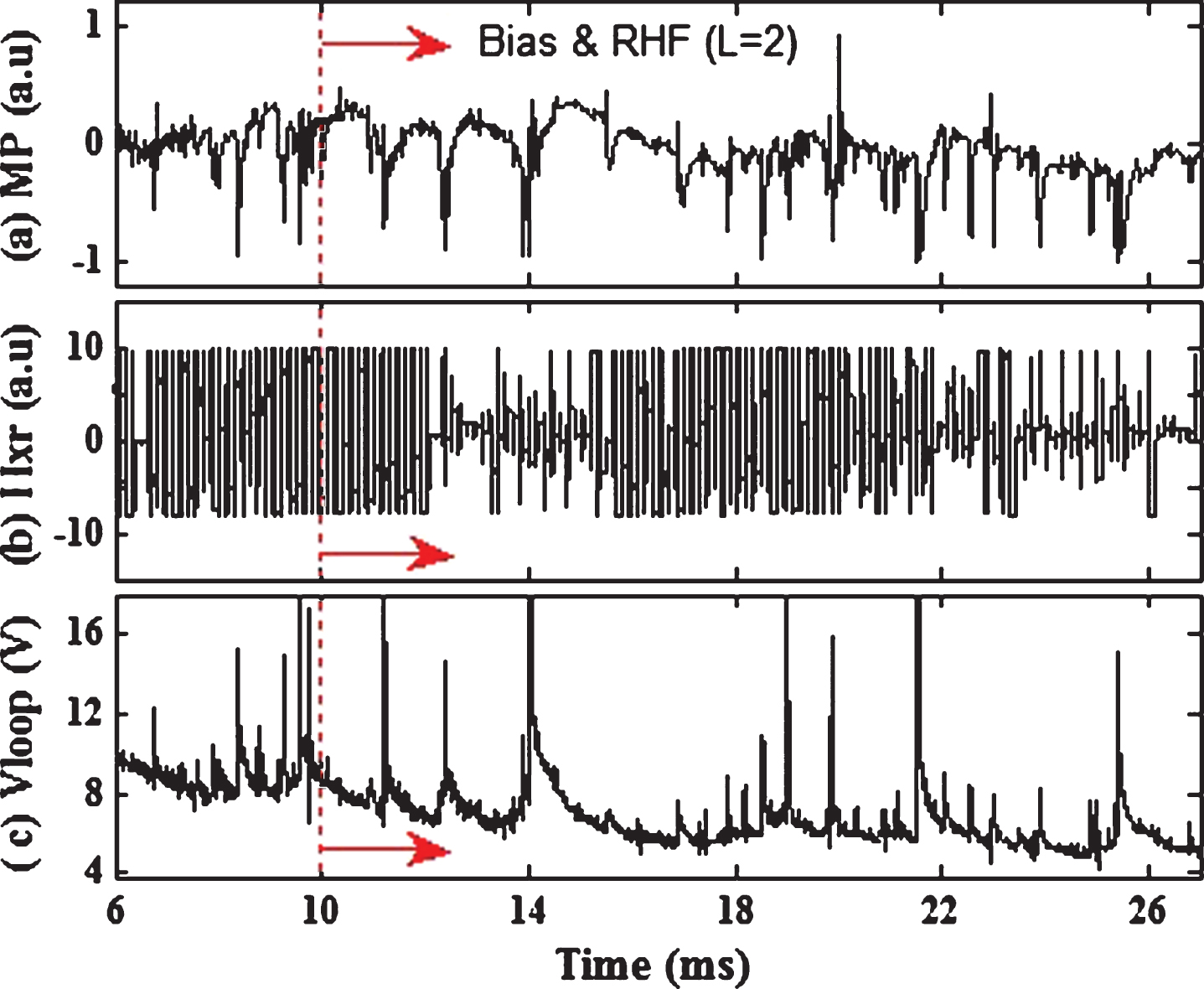
Time evolution of Mirnov oscillation, hard x-ray intensity, loop voltage in the presence of biasing and RHF (L = 2).
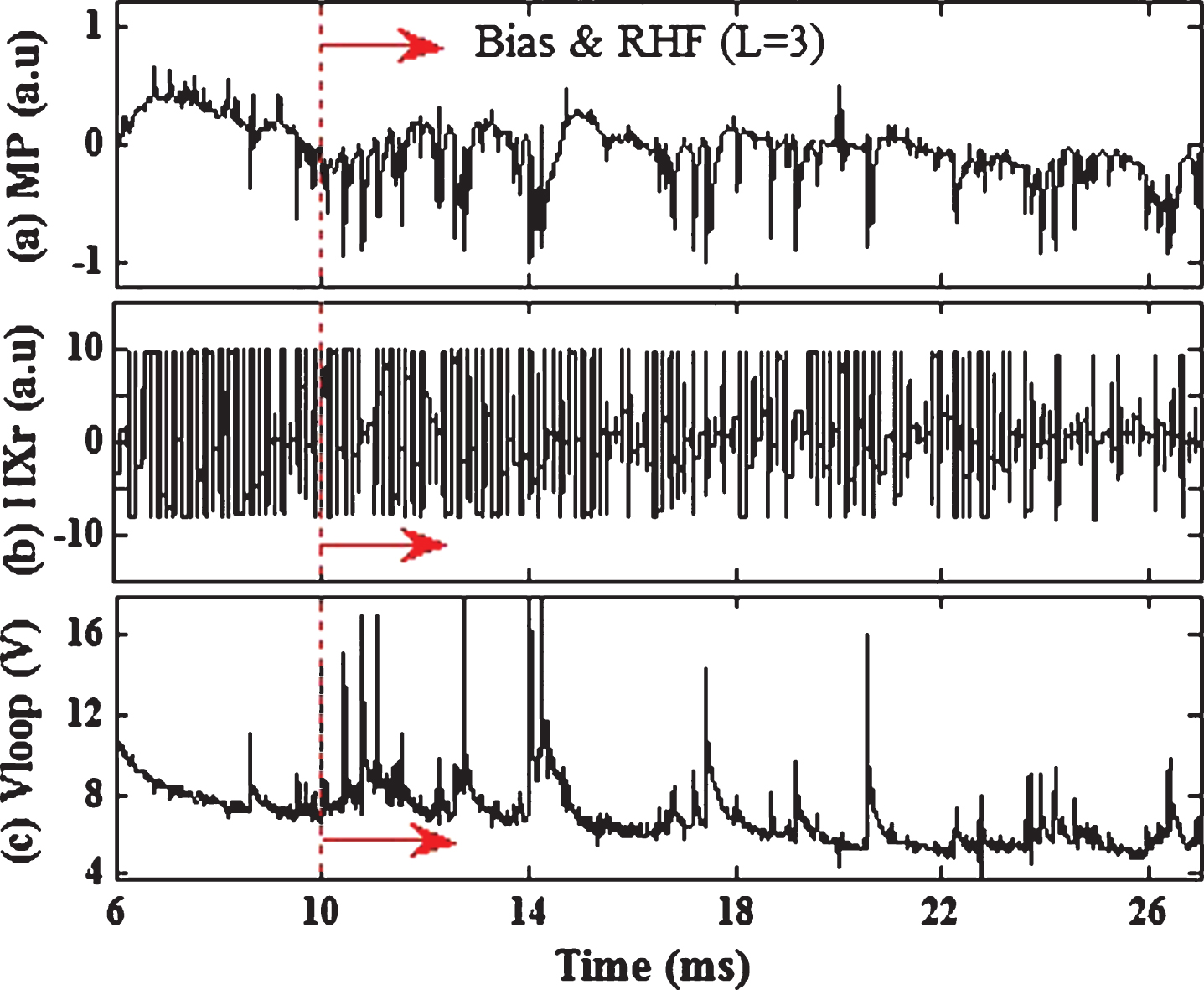
Time evolution of Mirnov oscillation, hard x-ray intensity, loop voltage in the presence of biasing and RHF (L = 3).
For this purpose, Wavelet analysis is suitable. As mentioned in section 2, for measuring MHD activity we used the arrays of Mirnov coils. For analyzing time-frequency activity of MHD, one Mirnov coil was used. Figure 4 show Wavelet spectrums of Mirnov coil and hard x-ray intensity without biasing and RHF. Wavelet analysis of MHD activity and hard x-ray for the shots with external fields is shown in Figs. 5–6.
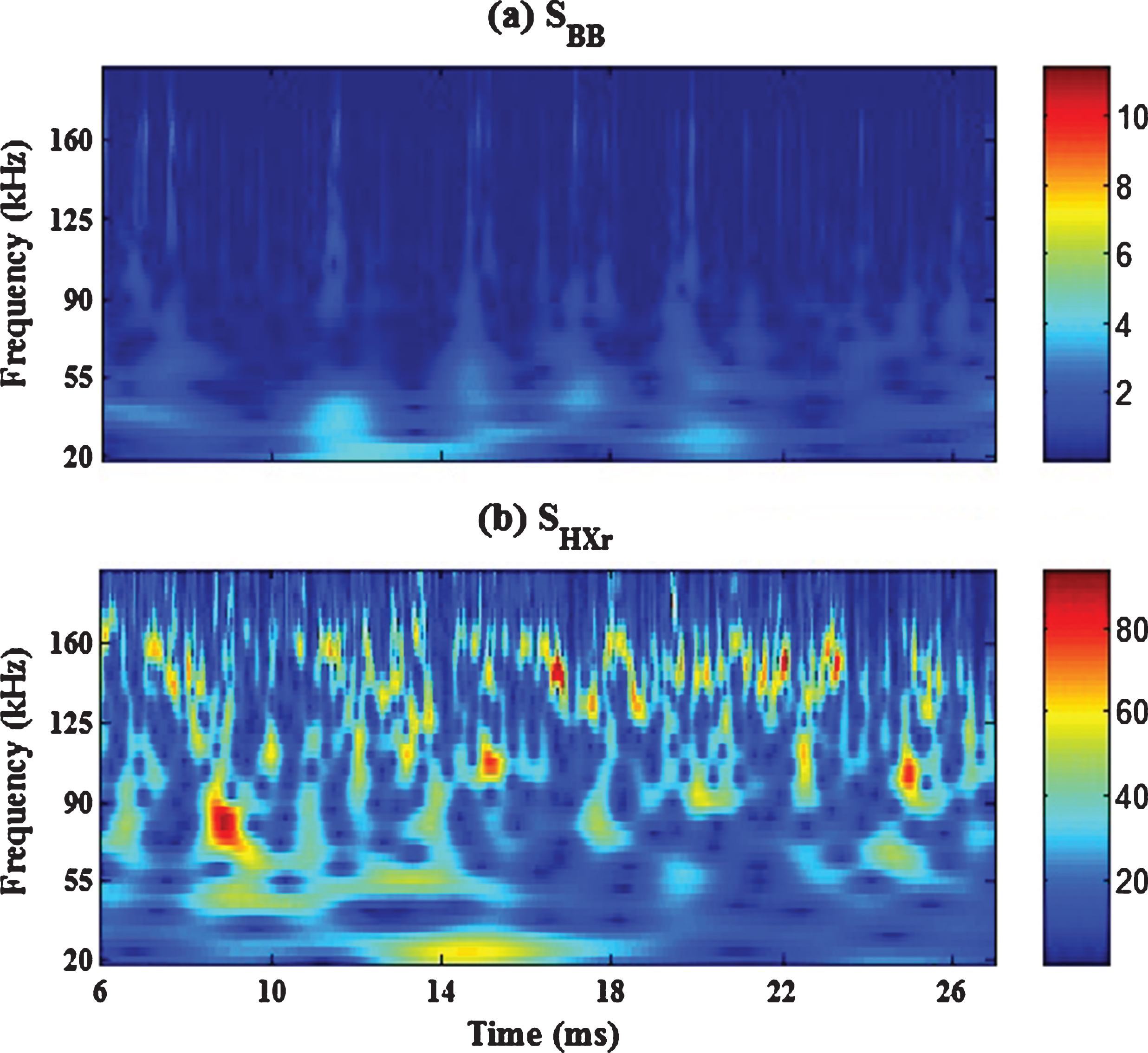
Morlet Wavelet spectrum showing the time evolution of the spectral properties of (a) MHD activity (b) Hard x-ray intensity without biasing and RHF.
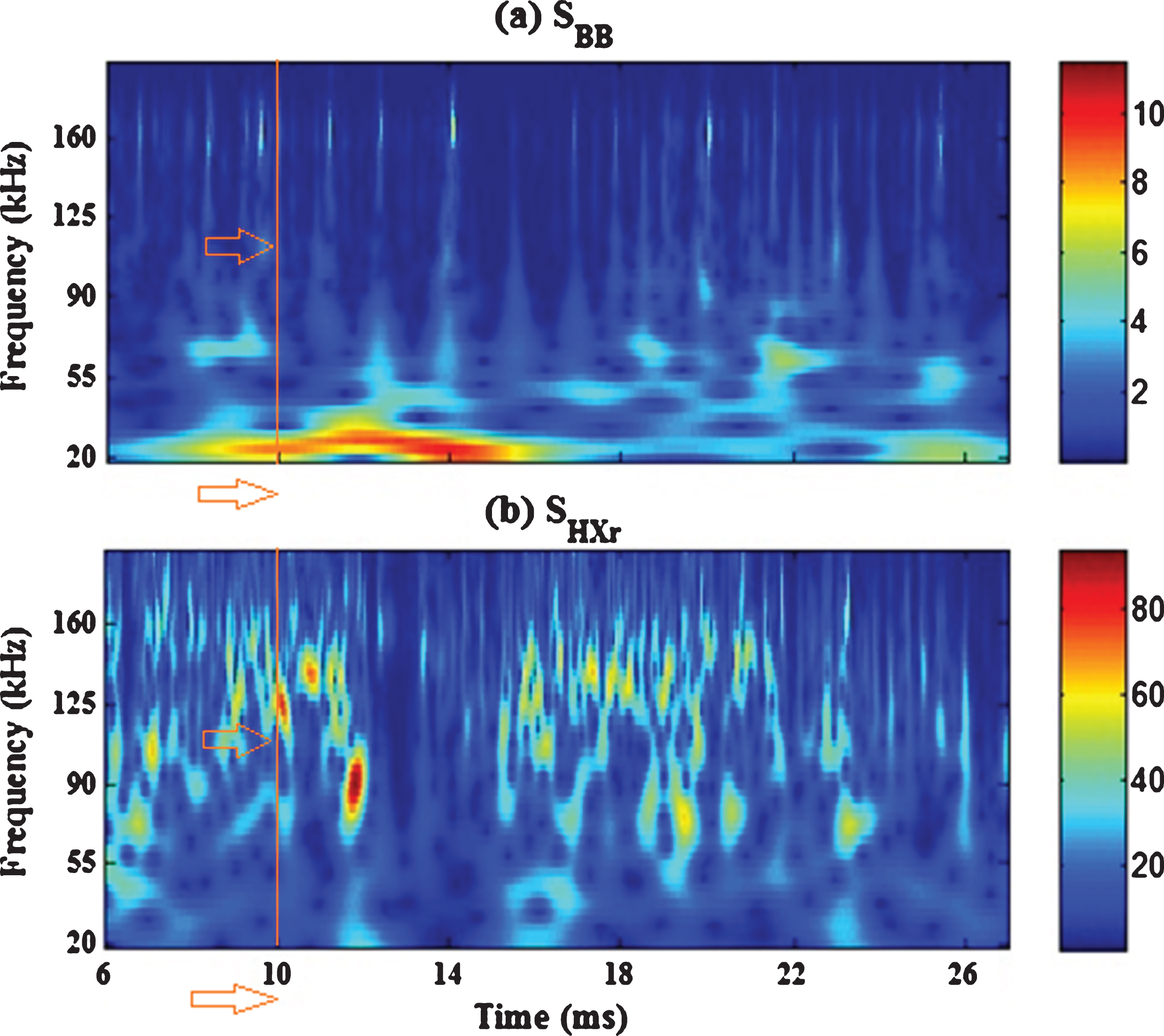
Morlet Wavelet spectrum showing the time evolution of the spectral properties of (a) MHD activity (b) Hard x-ray intensity in the presence of L = 2 and positive biasing.
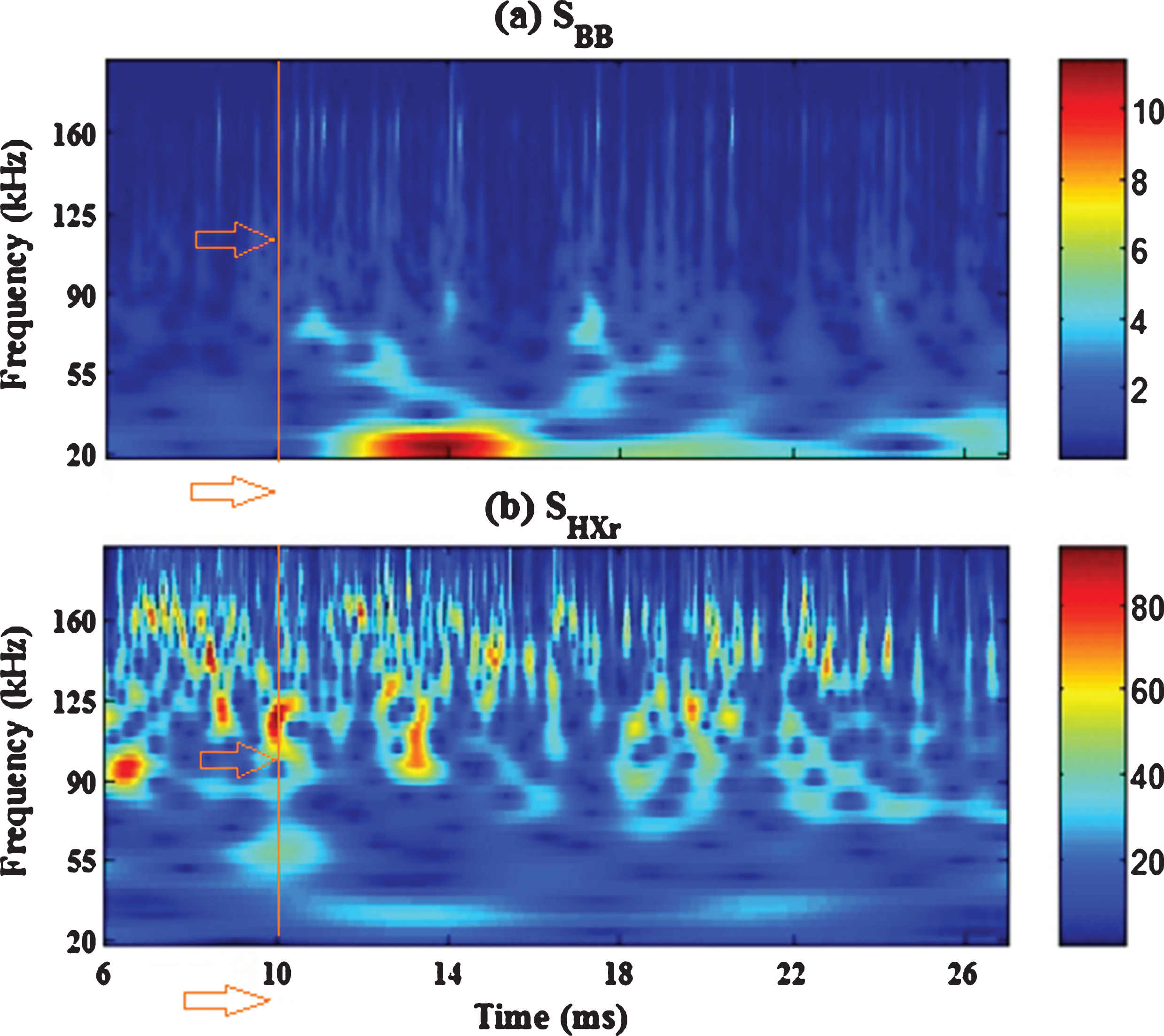
Morlet Wavelet spectrum showing the time evolution of the spectral properties of (a) MHD activity (b) Hard x-ray intensity in the presence of L = 3 and positive biasing.
As illustrated, frequency activity of MHD oscillation is increased after the application of external field. It seems that increasing of frequency intensity of MHD is more after applying L = 2 and biasing compare to L = 3 and biasing. Figures 5(b) and 6(b) present hard x-ray intensity spectrum in the shots with L = 2 and biasing plus l = 3 and biasing respectively. In comparison of Figs. 4(b) with Figs. 5(b) and 6(b), it is clear after applying external fields, hard x-ray frequency activity was reduced and some frequencies was omitted in some points. It seems that the effect of L = 2 and biasing in reduction of hard x-ray frequencies is more compare to another.
Suppression and reduction of hard x-ray intensity is the conclusion of suppression of Runaway electron. Suppression of Runaway electrons can be explained by three factors [14]. Firstly, Runaway electron is generated by toroidal electric field with minimum amount of:
where Λ is constant parameter which depend on tokamak parameters, Z eff is effective atomic number and vth. is thermal speed that exits in plasma discharge [13]. After applying biasing the modified radial electric field cause the resultant of electric field, around the horizontal limiter, to lie in the non-toroidal direction. Therefore, the number and energy of Runaway electron decrease. Secondly, Runaway electrons generate inside the plasma column drift in the radial direction till their orbits meet the tokamak limiter. Edge limiter biasing modify E×B velocity shear and form a transport barrier. This barrier reduces the collision probability of low-energy Runaway electrons with the tokamak limiter. Also, RHF has a pleasant effect on reducing plasma displacement and improving confinement process. The effects of RHF (L = 2, 3) on reduction of horizontal plasma displacement, flatting the plasma current and improving confinement quality is investigated in IR-T1 [8].
Last, increasing of MHD instability destroys the Runaway electron beam which accelerates to the wall of tokamak. It seems due to the formation of magnetic islands. Such a suppression of hard X-ray emission by MHD oscillations was also observed in other tokamaks [15]. Also, other example of the effect of biasing on plasma fluctuations can be seen in the experiments performed on the IR-T1 tokamak [14, 17].
For many reasons Wavelet analysis provides a favored tool for studying the signals. For example, the Ref. [18] presents a novel segmentation approach based on Wavelet density model (WDM) for a particular interest in the outer surface of anterior wall of maxilla.
Nineteen CBCT datasets are used to conduct two experiments. This mode-based segmentation approach is validated and compared with three different segmentation approaches. The results show that the performance of this model-based segmentation approach is better than those of the other approaches. In the Ref. [19]. Tikhonov regularization has been proposed for sense to reduce the noise. However, Tikhonov regularized images suffer from residual aliasing aritfacts or image blurring when a low resolution prior image is used. The Ref. [20] presents a novel approach for fusion of computed tomography (CT) and magnetic resonance (MR) images based on Wavelet transform.
The medical images to be fused are firstly decomposed into multi-scale representations by the Wavelet transform. Then, by considering the physical meaning of Wavelet coefficients and the characteristics of the CT and MR images, the coefficients of the low frequency band and high frequency bands are treated with different schemes: the former is performed with a maximum-selection (MS) rule, and the latter is convolved with a Laplacian operator followed by a MS rule. The fused image is reconstructed by using the inverse Wavelet transform with the combined Wavelet coefficients. In the Ref. [21], authors have investigated a 2-dimensional gas type detector based on plasma display technology as a candidate for the flat-panel radiation detector. By using the Garfield code, the dependence of X-ray absorption and multiplication on gas composition, cell gap and electric field were examined.
Considering the simulation results, three prototype detectors were designed and fabricated. The performance of these detectors was evaluated by measuring the collected charge density, dark current density and sensitivity. In our study, the effects of resonant fields on frequency variation of MHD oscillation and hard x-ray intensity were investigated with Wavelet analysis. In this research, we used a horizontal movable biased limiter and resonant helical windings (L = 2, 3). Some plasma parameters such as MHD activity, hard x-ray intensity and loop voltage in the presence of external fields and without them is measured. Also, Wavelet spectrums of the MHD activity and hard x-ray intensity were obtained.
Results showed that time-frequency activity of MHD oscillation increase and time-frequency activity of hard x-ray decrease in the presence of external fields. It seemed the effect of L = 2 and positive biasing in decreasing hard x-ray emission were more compare to l = 3 and positive biasing. Therefore, RHF (L = 2, 3) and positive biasing can reduce the Runaway electron beam and decrease unpleasant effects of them.