




Abstract
BACKGROUND:
Metal oxide glass composites have attracted huge interest as promising shielding materials to replace toxic, heavy, and costly conventional shielding materials.
OBJECTIVE:
In this work, we evaluate shielding effectiveness of four novel tellurite-based glasses samples doped with oxide metals (namely, A, B, C, and D, which are 75TeO2- 10P2O5- 10ZnO- 5PbF2- 0.24Er2O3 ; 70TeO2- 10P2O5- 10ZnO- 5PbF2 -5MgO- 0.24Er2O3; 70TeO2- 10P2O5- 10ZnO- 5PbF2- 5BaO- 0.24Er2O3 ; and
METHODS:
The radiation-shielding parameters including mass attenuation coefficient (MAC), linear attenuation coefficient (LAC), half-value layer (HVL), mean free path, (MFP), effective atomic number (Zeff), effective electron number (Neff), and the transmission factor are computed in the selected range of ionizing radiation energies. Furthermore, the proposed samples were compared with the most common shielding glass materials. The optical parameters viz oscillator, dispersion energy, nonlinear refractive indices, molar, and electronic polarizability of these transparent glasses are reported at different wavelengths.
RESULTS:
The results show that the proposed samples have considerable effectiveness as transparent shielding glass materials at various ionizing radiation energies. They can be employed for effective radiation-protection outcomes. Sample C demonstrated slightly better shielding properties than the other samples with differences of 1.33%, 4.6%, and 4.2% for samples A, B, and D, respectively. A similar trend is observed regarding the mass attenuation coefficients. Nevertheless, sample B shows better optical properties than the other prepared glass samples.
CONCLUSIONS:
Our findings indicate that the proposed novel glass samples have good shielding properties and optical characteristics, which can pave the way for their utilization as transparent radiation-shielding materials in medical and industrial applications.
Keywords
Introduction
Ionizing radiation technologies have many beneficial applications, including their uses in medical imaging and cancer treatment [1–3]. Introducing new technologies in medical imaging. The overarching concept of radiation protection from ionizing radiation involves the time of exposure, distance from the source, and shielding methods. Risk is inherent in the use of ionizing radiation for medical and industrial applications. Many studies have examined the relative contribution of medical exposure to the population dose and its potentially harmful effects [4–8].
Radiation shielding is a prime factor that must be considered in radiation protection protocols, in order to control the amount of radiation delivered during medical and technical radiation procedures. The effectiveness of radiation-shielding materials depends on many factors, such as the energy of the ionizing photons, the emission type, and the characteristics of the selected shielding material. Materials with a high atomic number and high density are considered more effective shielding materials against the ionizing radiation spectrum. The most widely used materials for X-rays and gamma rays are lead, tungsten, and concrete. Although lead has a high atomic number and high density and is more effective in attenuating gamma and X-ray photons, it is extremely toxic, bulky, and expensive and has a poor melting point [9–12].
Many theoretical and experimental studies have investigated the development of alternative materials to replace the use of lead in various radiation-shielding applications. Some of these materials show good performance as shielding materials, in terms of thermal stability, good optical properties, and a high shielding efficiency without a loss of transparency; these include phosphate, tellurite, and germinate-tellurite glasses doped with metal oxides such as sodium oxide (Na2O) barium oxide (BaO), erbium oxide (Er2O3), Ongoing research focuses on the physical properties of radiation-shielding materials, including the density (ρ), half-value layer (HVL), linear attenuation coefficient (LAC), mass attenuation coefficient (MAC), and effective and equivalent atomic number, in addition to the photon mean free path (MFP) and the energy absorption and exposure build-up factors. Kaur et al. [18] studied the physical properties of the bismuth borate glass system modified with barium (Bi2O3 -BaO -B2O3) across a wide energy range (1keV–100GeV). They found that the addition of Ba increases the effective atomic number and decreases the tenth-value layer and the mean free path. Vania et al. [19] investigated the structural, optical, thermal, and ionizing radiation-shielding characteristics of fluorotellurite glasses doped with barium and zinc. Their findings indicate that a glass-doped system with heavy elements such as barium can strengthen shielding properties and replace concrete and lead-based glasses. Grelowska et al. [20] studied the influence of BaO on optical and thermal properties, using the structure of the TeO2–BaO–Na2O (TBN) and TeO2–BaO–WO3 (TBW) glasses system. Their results show that the glasses containing BaO have a higher refractive index, a greater glass network polymerization, and a greater ability for glass crystallization than heavy elements. The most commonly used commercial glass materials are considered heavy shielding materials due to the high concentration of lead oxide in the glass matrix. Currently, the majority of medical and industrial businesses are considering light, non-toxic, low-cost, and highly effective transparent shielding glass materials, which could improve the efficiency of established radiation-protection protocols and enhance the services and products that these businesses provide [13–32].
We in this study investigate the shielding effectiveness of four novel tellurite-based glass samples doped with various oxide metals across a wide energy spectrum ranging from 0.015 to 15 MeV. The shielding effectiveness of these proposed systems was assessed by evaluating the shielding properties, including LAC and MAC, HVL, MFP, the total atom cross-section (σ a ), the total electronic cross-section (σ a ), Zeff, Neff, Zeq, and the exposure buildup factor (EBF).
Materials and methods
We developed tellurite glass systems with different compositions: 75TeO2 -10P2O5 -10ZnO-5PbF2 - 0.24Er2O3 (Sample A); 70TeO2 -10P2O5 -10ZnO-5PbF2 -5MgO -0.24Er2O3 (Sample B); 70TeO2 -10P2 O5 -10ZnO-5PbF2 -5BaO- 0.24Er2O3 (Sample C); and 70TeO2 -10P2O5 -10ZnO-5PbF2 -5SrO (Sample D). We prepared the samples with a melting technique. We placed the raw material in a Pt crucible in a heating furnace at a temperature of 850C for 30 minutes. The melted material was stirred; when it had reached a high viscosity, it was cast in a brass mold. The prepared sample was placed in the annealing furnace for 2 hours at 320C; the annealing furnace was subsequently switched off. After annealing, the prepared samples A, B, C, and D were homogeneous; they are shown in Fig. 1A. Table 1 shows the weights of the prepared glass samples with the mole fractions of their component elements (Te, O, P, Zn, Pb, F, Mg, Ba, Sr, and Er). A helium pycnometer (UltraPyc1200e) was used to measure sample densities, with an average of±0.00029% accuracy. The samples’ densities, constituents, elements weight, and mole fractions are illustrated in Table 1. The recorded densities of these glasses range from 5.126 to 5.267 g/cm. The ellipsometric measurements of the refractive indices of the proposed samples were made using a J.A. Woollam M-2000 spectroscopic ellipsometer. The measured refractive indices were used for the calculation of the various optical properties of the proposed samples.

(A) Photo of prepared glasses; (B) the variation of 1/(1-n2) with (hν)2 in (eV)2 of prepared glasses.
Summary of the chemical compositions, densities, and weight fractions of the elements utilized for the proposed sample A, B, C, and D
The shielding parameters of the proposed glasses system were computed using the WinXcom program [34] and the online software (Phy-X/PSD) [35]. The results for the shielding properties were compared to those of other commercial shielding materials commonly used in photon and neutron applications.
Optical parameters, such as dispersion energy (Ed), single oscillator energy (Es), electronic with magnetic oscillator strength, linear refractive indices (n), non-linear refractive indices (n2), and third-order susceptibility (χ (3)), are important to use in the process of fabricating optical devices, primarily in the case of utilizing novel glass compositions for radiation-protection purposes. These parameters strongly depend on the chemical composition of prepared novel glasses. By utilizing the single oscillator model estimated by Wimple and DiDomenico [37], we evaluated the Ed and Es using the following equation:
where h is the Planck’s constant and w is the angular frequency.
Based on the above model, the single oscillator parameters Es and Ed are related to the imaginary component (ɛi) of the complex dielectric constant and the -1 and -3 moments of the ɛi. The optical spectrum can be derived from them as follows:
The third-order nonlinear optical susceptibility (χ
(3)
) can be determined by using linear optical susceptibility (χ
(1)
), according to the following equation:
where χ(1) = (1/12.56) × (n2 - 1). The molar refraction (Rm) can be calculated using the following equation [38]:
where M, ρ, and n are the molar weight, density, and refractive index, respectively; molar polarizability (αM) can be calculated using the following equation [38]:
where N
A
is Avogadro’s number. We determine the metallization criterion (M
c
) of the prototyped samples A, B, C, and D at varied wavelengths, according to the following equation:
where N A represents Avogadro’s number and M expresses the molecular weight of the prepared glass materials.
The effectiveness of a shielding material can be assessed based on its physical properties and radiation-shielding parameters. The cross-section for scattering and absorption, the effective atomic number, the electron density, and the half-value layer are the most important physical properties and radiation-shielding parameters that describe the effectiveness of the shielding materials. The cross-section for scattering and absorption can be characterized by the total mass attenuation coefficient (μ/ρ), which can be computed utilizing the WinXcom program [33, 34]. The mass attenuation coefficient of a mixture and compound can be computed as follows:
where w
i
is the fraction by weight of the ith atomic element and
The probability for the interaction of photons with the material can be calculated using the total atom cross-section (σ
a
) and the total electronic cross-section (σ
a
), according to the following equations [32]:
where fi is the fraction by mole of the ith atomic element; A i is the atomic weight of the ith atomic element; Z j is the atomic number; and N A is Avogadro’s constant.
The effective atomic number is a basic parameter that can be used to characterize the properties of a radiation-shielding composition. The effective atomic number, which varies with energies, can be calculated from the ratio of atomic and electronic cross-sections using the following relation:
The electron density (the number of electrons per unit mass) of the shielding material can be computed as follows [32]:
where A represents the mean atomic mass, which is equal to ∑ i f i A i ; f i is the fraction by mole of the ith atomic element; and A i is the atomic weight of the ith atomic element.
The mean free path (MFP) and the half-value layer (HVL) also play prime roles in characterizing the effects of ionizing radiation-shielding materials. The half-value layer (HVL) is a prime shielding factor that measures the effectiveness of shielding materials; the HVL is the thickness required to reduce the intensity of a mono-energetic beam to half of its value. The average distance between two successive interactions is represented as the MFP. These parameters can be defined using the following equations:
where μ is the linear attenuation coefficient. The equivalent atomic number (Zeq) for the proposed shielding composition can be computed by calculating the mass attenuation coefficients’ ratio of the Compton component to the total mass attenuation coefficients at selected energies; this is then matched to the ratio of an element within the same range of the selected ionizing radiation energies. If the ratio lies between two elements, the equivalent atomic number (Zeq) is calculated using the following interpolation procedure [29, 30]:
where Z1 and Z2 are the atomic numbers of two elements in relation to the ratios R1 and R2; R is the ratio of the proposed shielding material.
When estimating the physical properties of the proposed shielding material using the Lambert-Beer Law, a thin absorbing material is considered, which is not the general condition. For the general condition, an additional correction factor must be introduced to account for the photon build-up in the material of intersect. The build-up factor is the proportion of the overall radiation quantity at any spot out of the quantity value of the uncollided ionizing photons reaching the same spot. Two types of build-up factors are of interest: The exposure build-up factor (EBF) and the energy absorption build-up factor (EABF) [35]. These factors depend upon the atomic number of the shielding composition, the photon energy, and the mean free path of the mono-energetic beam. The build-up factors can be computed utilizing the geometric-progression (G-P) developed by Harima et al. [35, 36].
The G-P fitting parameters for the proposed materials can be computed using the following formula:
where C1 and C2 are the values of the G-P fitting parameters, which correspond to the atomic numbers Z1 and Z2, respectively.
Using the G-P fitting parameters at the selected range of energies, the buildup factors can be estimated from the following equations [31]:
where x represents the source-detector distance (SDD) in MFP units. E represents the energy of the incident photons; (X K , b, a, and d) expresses the G-P fitting parameters; and K(E,x) represents the dose multiplicative factor.
Figure 1 shows a plot of [n2 - 1] -1 versus E2 for prepared samples A, B, C, and D (75TeO2 -10P2O5 -10ZnO-5PbF2 - 0.24Er2O3; 70TeO2 -10P2O5 -10ZnO-5PbF2 -5MgO -0.24Er2O3; 70TeO2 -10P2 O5 -10ZnO-5PbF2 -5BaO- 0.24Er2O3; and 70TeO2 -10P2O5 -10ZnO-5PbF2 -5SrO). From the linear regression, the values of E s and E d for the prepared glasses can be determined; these can be evaluated in two different ranges: 7.13–7.48 eV and 20.33–21.28 eV, respectively (Table 2).
Density,ρ, molar volume, Vm, oscillator energy, E0, dispersion energy, Ed, third order susceptibility, χ(3), and nonlinear refractive index, n2, of prepared glasses
Density,ρ, molar volume, Vm, oscillator energy, E0, dispersion energy, Ed, third order susceptibility, χ(3), and nonlinear refractive index, n2, of prepared glasses
The χ(3) and n2 values at the wavelength of 1700 nm for the prototyped glass materials are listed in Table 2. An improvement for the χ(3) and n2 values has been recognized, with increasing TeO2 compound in the glass matrix.
The R M and αM values at 1700 nm decreased from 14.63 to 14.21 in cm3· mol–1 and from 5.8 to 5.64 in A03, respectively. The value of M c is reported in the range from 0.501 to 0.507 at 1700 nm (Table 3).
Molar refraction (Rm), polarizability (αM), and metallization (MC) of prepared glasses at a different wavelength (i.e. 400 nm, 633 nm and 1700 nm)
Figures 2A and 2B show the computed linear and mass attenuation coefficients (LAC and MAC) of the four proposed samples in a wide energy spectrum ranging from 0.015 to 15 MeV. Sample C recorded the highest values for MAC and LAC of any samples under investigation. For example, the LAC value recorded for sample C was 3.14 cm–1, compared to 3.09, 2.99, and 3.01 cm–1 at 0.15MeV (with percentage differences of 1.33%, 4.6%, and 4.2%) for samples A, B, and D, respectively. Similar behavior was recorded for the mass attenuation coefficients.
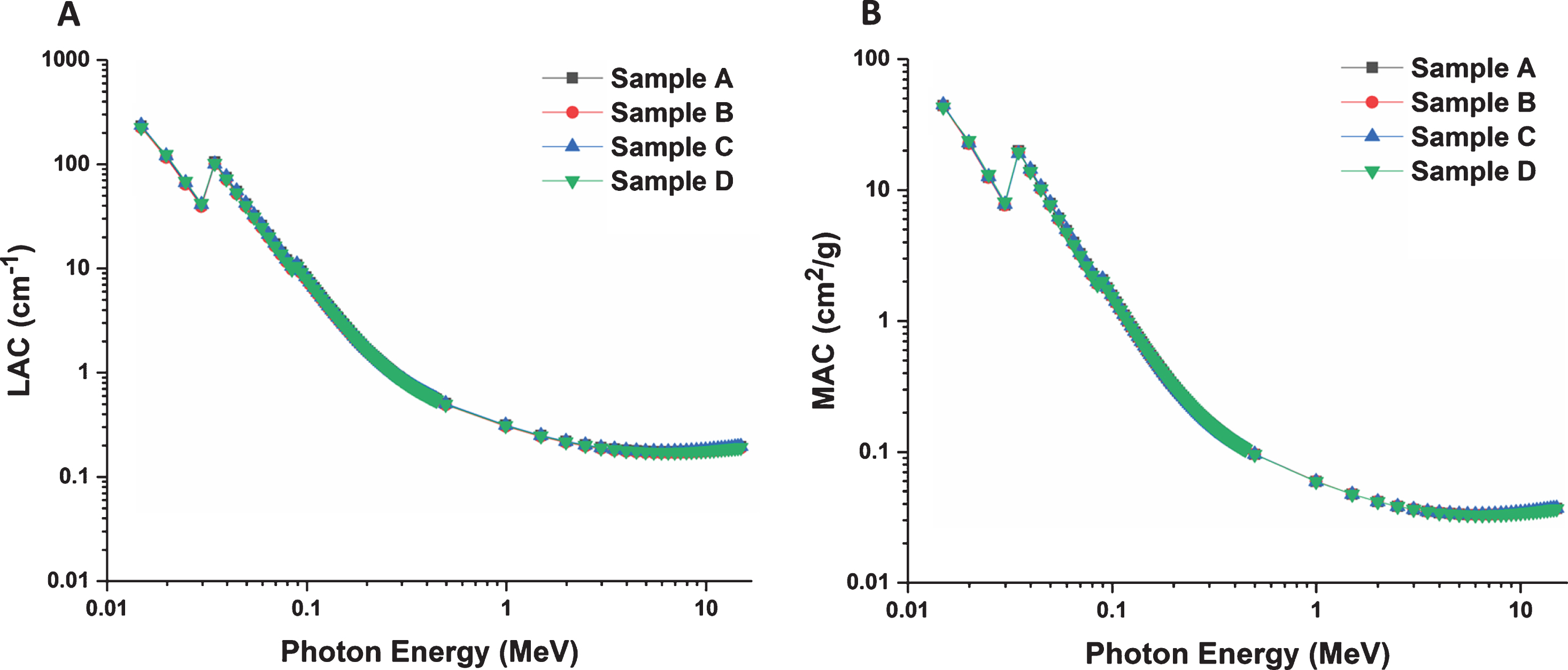
The linear attenuation coefficient (A) and the mass attenuation coefficient (B) for the four prepared glass samples (Sample A, B, C, and D).
Figure 3A shows the computed half-value layers of the proposed sample materials in a wide energy spectrum ranging from 0.015 to 15 MeV. As shown in Fig. 3A, the reported values for sample C are slightly lower than those of the other samples under investigation. For example, the computed HVL value of sample C was found to be 0.22 cm, compared to 0.223, 0.2314, and 0.2304 cm at 0.15 MeV, with percentage differences of 1.33%, 4.6%, and 4.2%, for samples A, B, and D, respectively. Figure 3B shows the HVL of the proposed glasses systems, comparing it with the HVLs of the common concrete materials Chromite and Ferrite [18] and the most common commercial lead-coated glass materials developed by Schott Co. (RS-253 G18, RS-520 [71 mole% of PbO], and RS-369 [45 mole% of PbO]) [39]. The proposed samples recorded lower values than the commercial materials. For example, the computed HVL values at 0.5MeV for sample C, RS-360, Chromite, and RS-253 G18 were 1.369, 0.89, 1.65, and 3.12 cm, respectively, with percentage differences of 17%, 2%, and 56%.
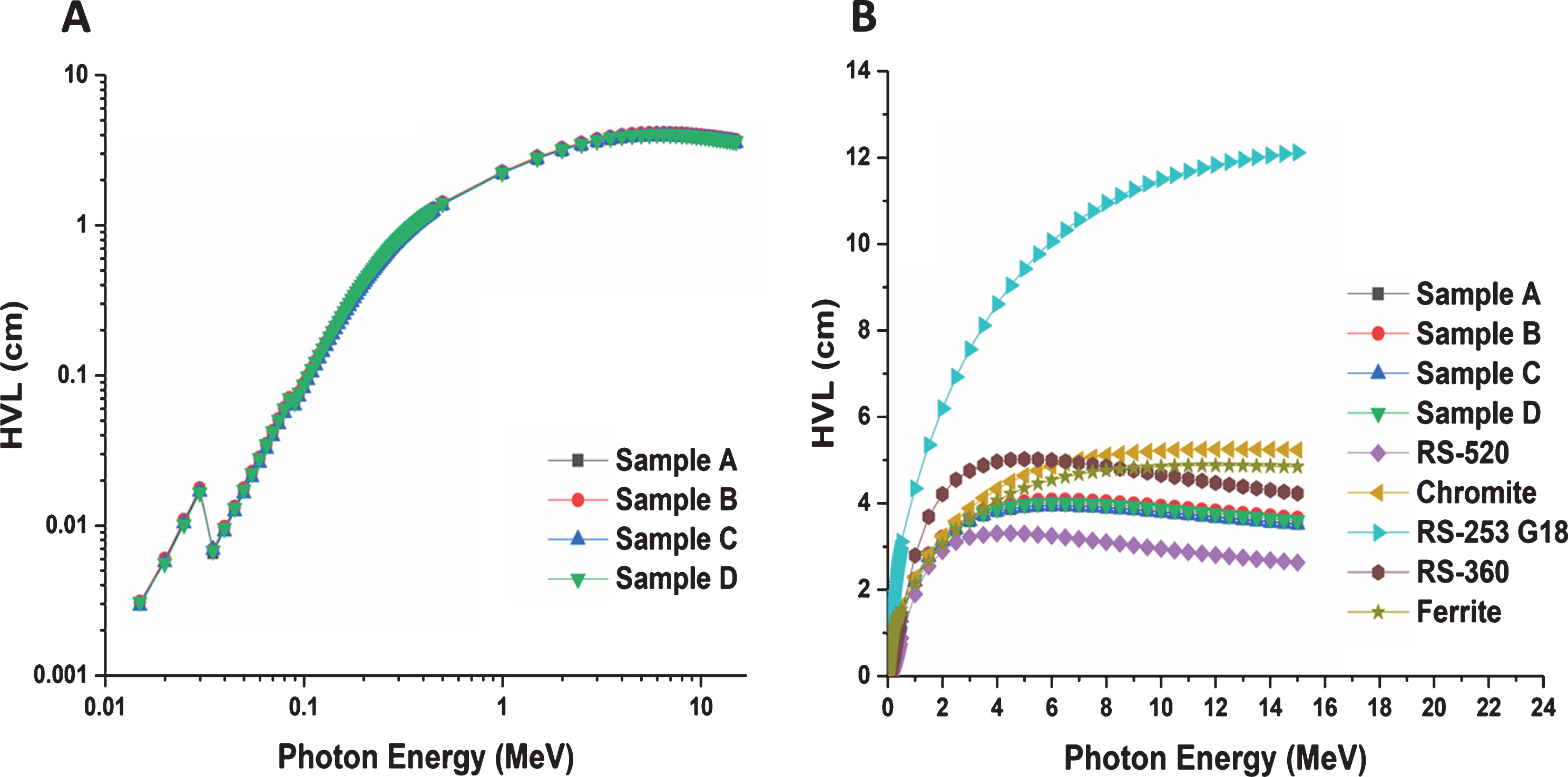
(A) The reported half-value layer (HVL) values for the proposed shielding materials (Samples A, B, C, and D); and (B) Comparison of the reported HVL values with other HVLs for a variety of ionizing radiation shielding materials.
Figure 4A illustrates the mean free path (MFP) as a function of the photon energy (keV) of the proposed four samples. Sample C recorded the. Figure 4B compares the half-value layer (HVL) of common commercial shielding materials [17–22, 39] to the HVLs of the proposed novel glass materials.
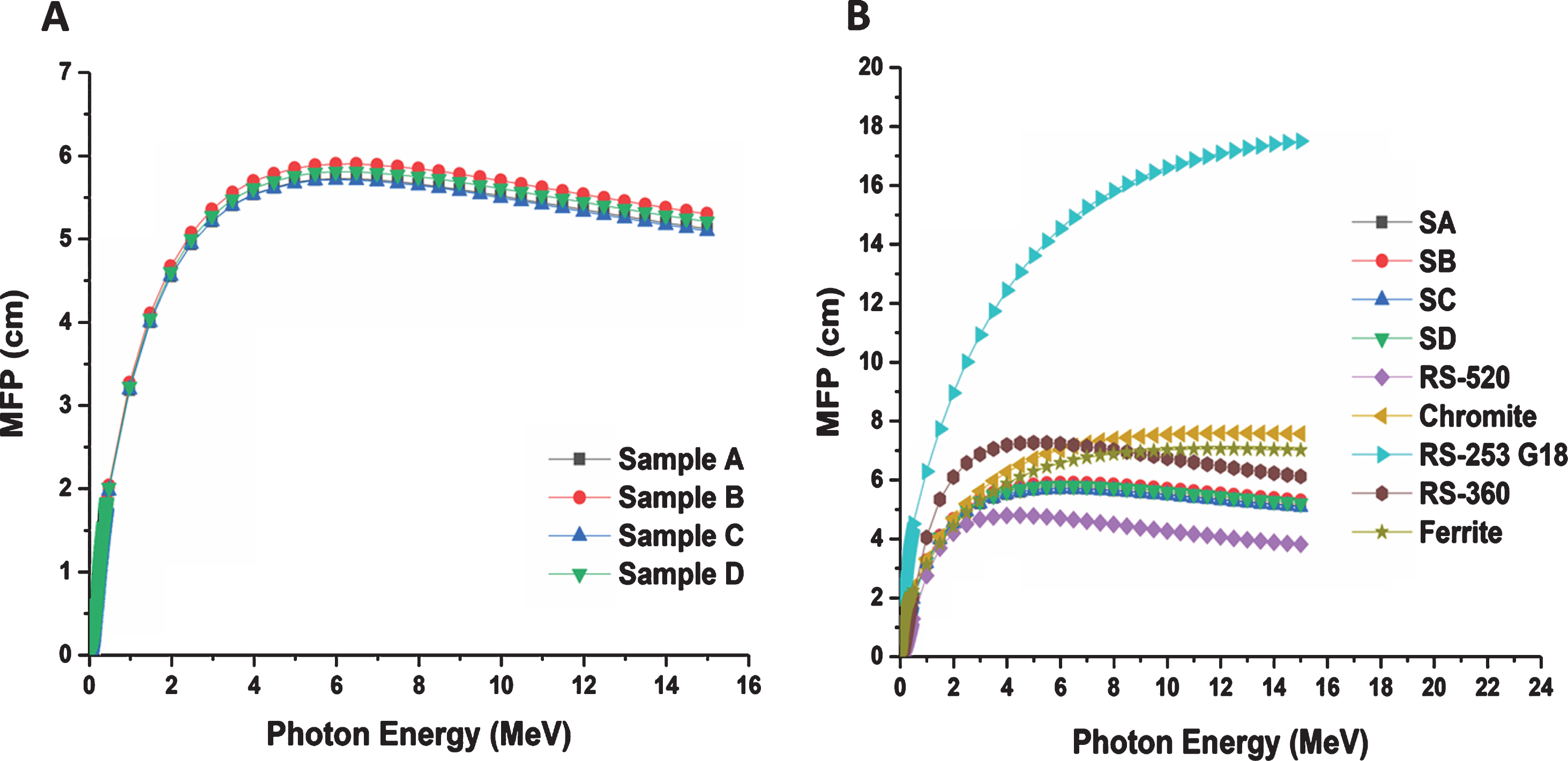
(A) Recorded mean free path (MFP) values for the proposed materials (i.e. Samples A, B, C, and D); (B) Comparison of the reported MFP values with other MFPs for a variety of ionizing radiation shielding materials.
Figures 5A and 5B show the values of the total atom cross-section (σ a ) and the total electronic cross-section (σ a ) as a function of photon energy for the prototyped glass system. Sample C recorded higher values of atomic and electronic cross-sections than the other samples under investigation.
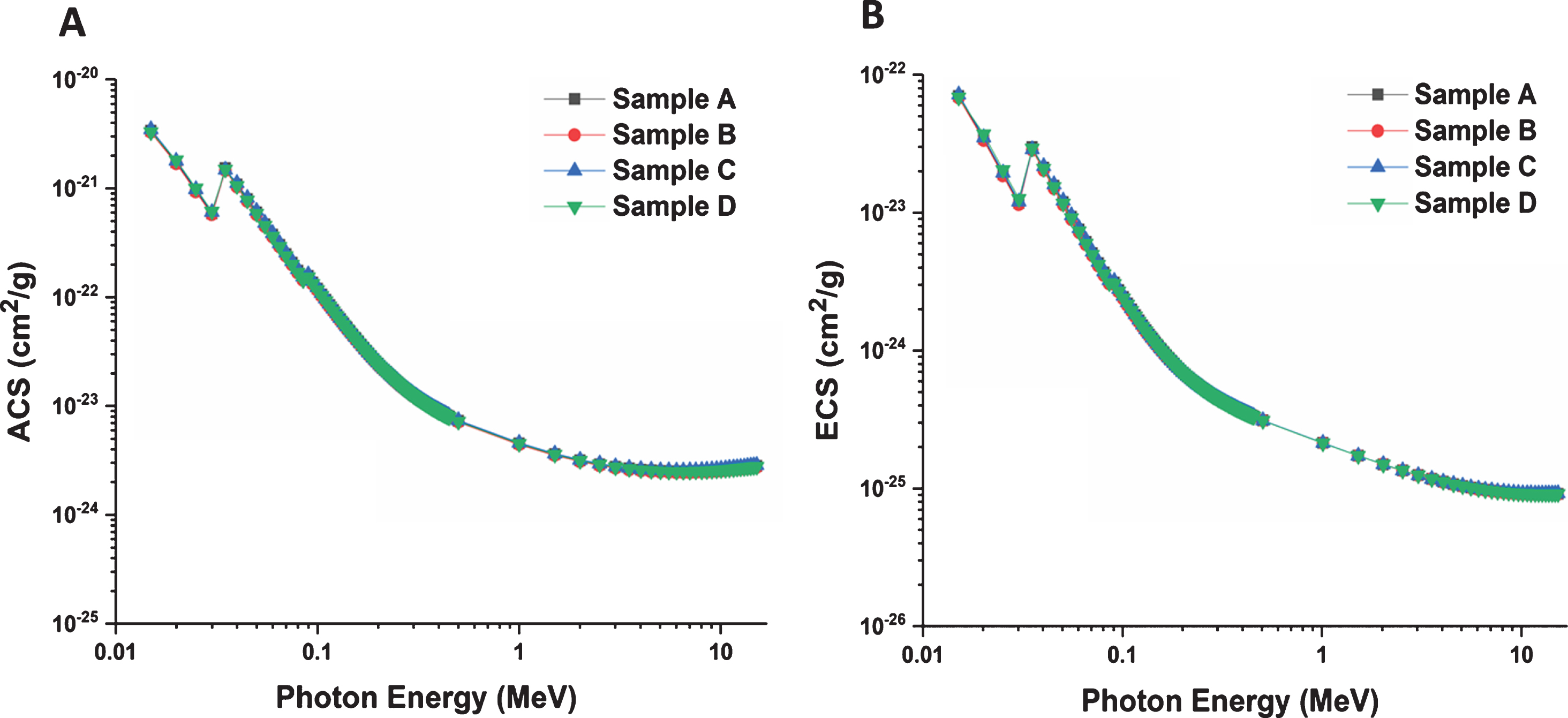
Line graphs showing the total atom cross-section (σ a ) (A) and total electronic cross-section (σ a ) (B) as a function of photon energy for the prototyped shielding samples.
Figures 6A and 6B present the effective atomic number (Zeff) and the effective electron numbers (Neff) as a function of the photon energy (keV) of the proposed samples. Sample C recorded the highest effective atomic number (Zeff) and effective electron numbers, which is consistent with the previous findings on the linear attenuation coefficient and the other shielding parameters.

Line graphs showing the changes in effective atomic number (A) and effective electron density (B) as a function of incident photons’ energy.
Figure 7 shows the values of Zeq for the proposed shielding materials. Because Zeq was estimated from the ratio of the mass attenuation coefficients of the Compton component to the total mass attenuation coefficients, sample C recorded the highest values among the samples. In addition, Figs. 8(A-D) illustrate the exposure build-up factors (EBFs) for the proposed samples as a function of penetration depth at energies 15keV, 500keV, 2MeV, and 15MeV, respectively.
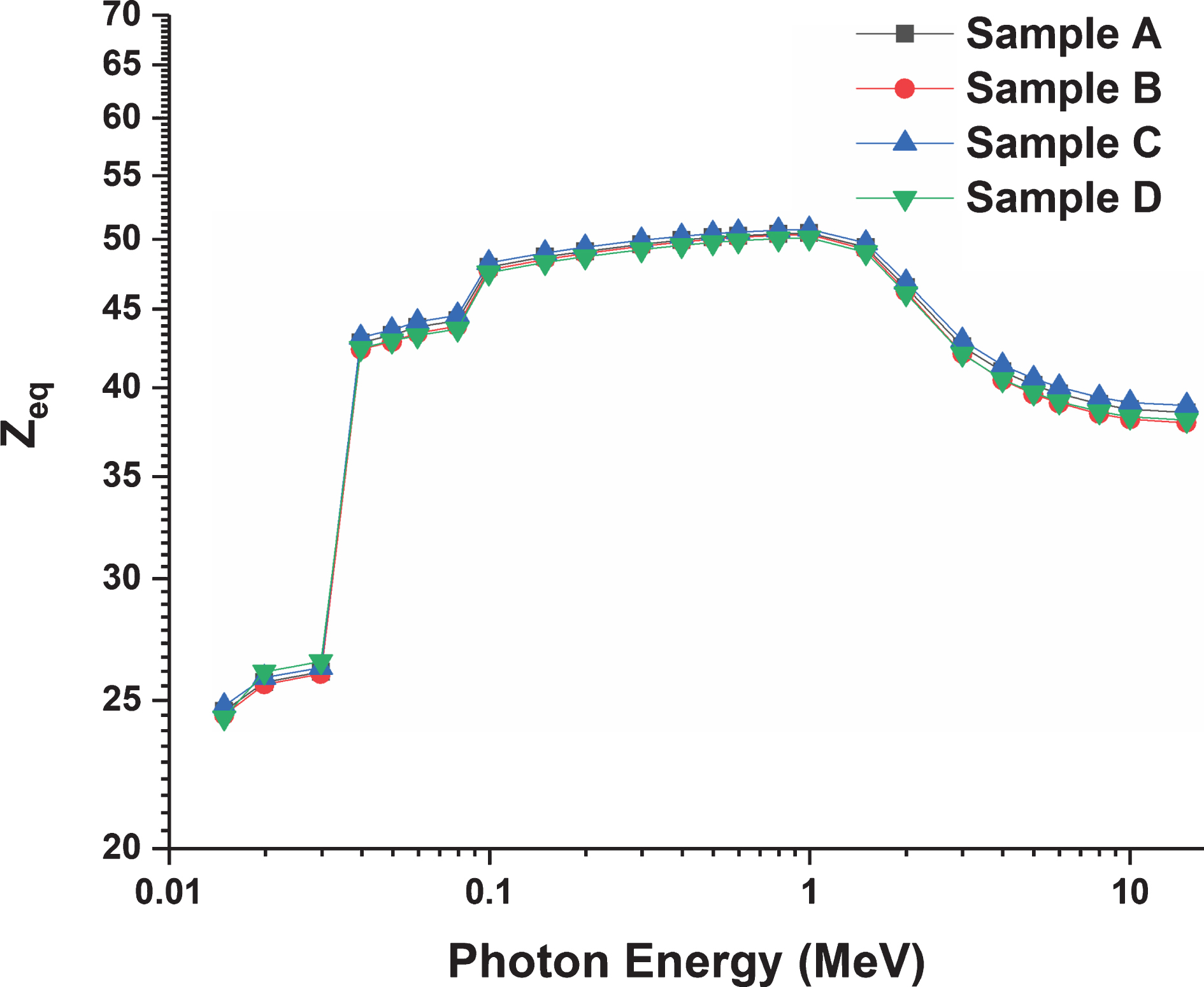
The equivalent atomic number (Zeq) of the proposed samples as a function of ionizing incident photons’ energy. Sample C recorded the higher values of Zeq in comparison to other proposed samples.
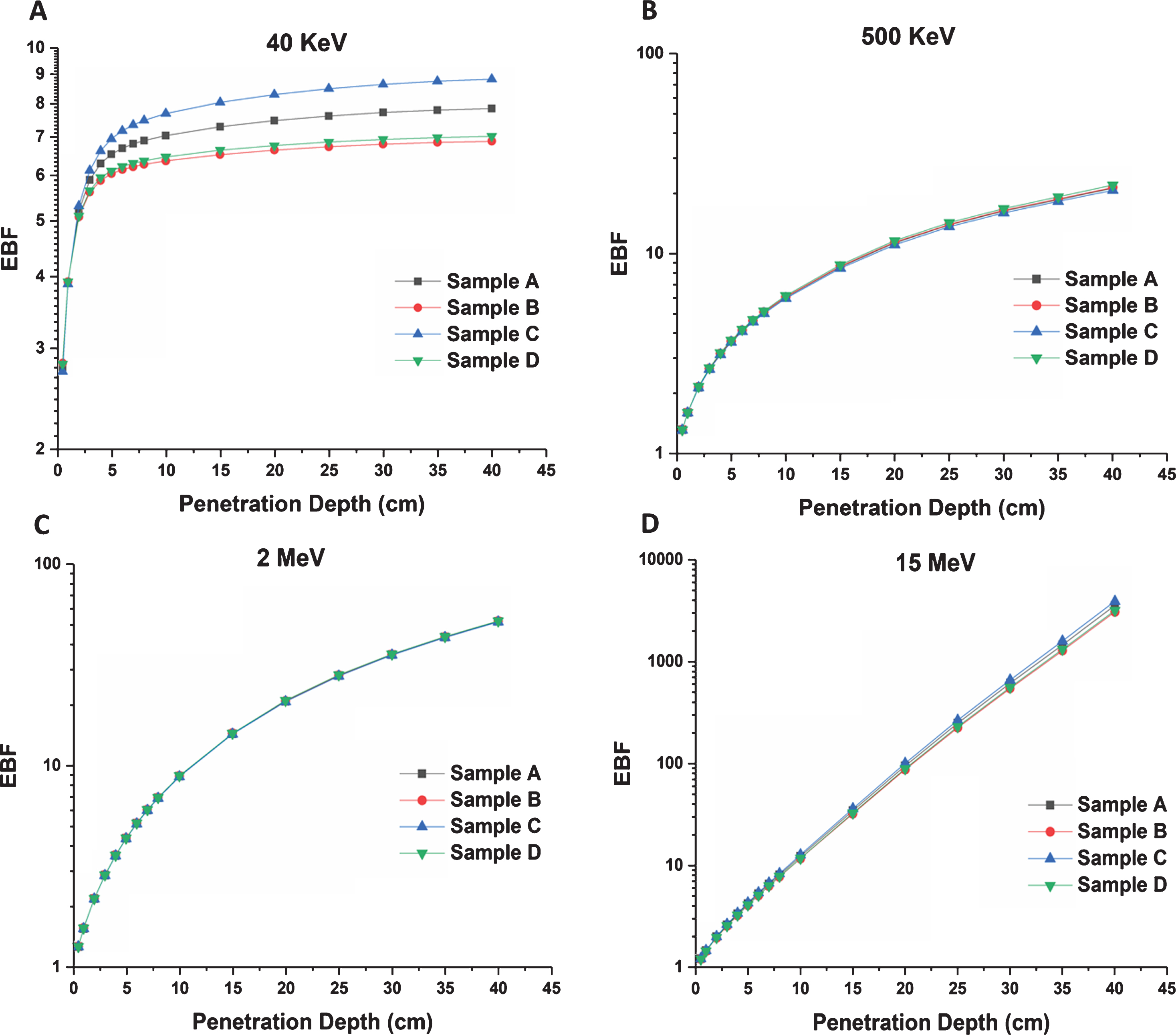
Line graphs illustrating the exposure build-up factors (EBFs) for the proposed shielding materials as function of penetration depth at energies 15keV (A), 500keV (B), 2MeV (C) and 15 MeV(D).
The effectiveness of any shielding material, in terms of its optical and physical properties, depends strongly on its chemical composition and the involvement of metal oxide compounds. As shown in Fig. 1 and Table 2, sample B has the highest values for both Ed and Es; sample D has the lowest values. These values depend directly on the single bond strength (BM - O in kJ/mol) of the modifier in the proposed glass samples.
The optical properties of the proposed samples depend heavily on the polarizability of the Te2 + ions within the glass network, because the third equatorial position of the ions of Te4 + is occupied by a lone pair of electrons phase of TeO4, which has greater polarizability relative to the TeO3 and TeO3 +1 phases (as seen in Table 3). Therefore, sample A has the highest values for χ(3) and n2, with a high content (in mol%) of TeO2 compared to the other glasses.
Sample A has the highest value for the linear refractive index; it also has the highest molar polarizability. Sample B, which contains MgO, has the lowest values for both R
M
and αM at 1700 nm (Table 2). This phenomenon occurred in the sequence of the chemical modifiers (BaO, SrO, and MgO), which is directly proportional to the increasing cation polarizability of metal elements for each modifier, as follows: Ba2 + (1.595
As shown in Figs. 2A and 2B, the photon attenuation for the four samples depends on the doped oxide materials, as well as on the X-ray photon energy. For instance, sample C (which contains barium oxide (BaO) and is doped with 2400ppm of erbium oxide) recorded slightly higher linear attenuation and mass attenuation coefficients than the other samples. These results align with previous findings [18–20, 40]. The decrease in the attenuation coefficients with the increased photon energy (as shown in Figs. 2A and 2B) results from the contribution of the photoelectric effect and Compton scattering, which are the predominant interaction in the diagnostic energies range.
HVL is commonly used to estimate the required shielding thickness for the specific energy range. The reported values for sample C are slightly lower than those of the other samples; this is expected due to the higher linear attenuation recorded for sample C than the other samples. The high attenuation recorded is due to the high atomic number and the density of the doped materials, as discussed before, which increase the possibility of photon interaction within the material and decrease the possibility of a photon passing through it. The lower values of HVL for sample C indicate that doping the glass shielding material with oxide materials that have a high atomic number and high weight will improve the effectiveness of the shielding material. These findings align with previous findings [27–30].
As shown in Fig. 3B, the HVL values of the proposed sample materials are lower than those of the common commercial glass shielding materials RS-360 and RS-253 G18 or the common commercial shielding materials Ferrite and Chromite at all energies. This indicates that the proposed samples have better shielding characteristics. Nevertheless, RS-520 shielding materials have a better performance than the proposed shielding materials at all energies, due to the presence of the high-weight lead oxide contained in RS-520 (89.59%).
The mean free path (MFP) is another important parameter used to evaluate the efficacy of a radiation-shielding material. MFP is the average distance between two successive interactions. A lower MFP value indicates the greater effectiveness of the shielding materials, as shown in Fig. 4A. Sample C recorded the lowest MFP value among the samples under investigation. This aligns with findings recorded for the HVL; both the MFP and HVL are strongly dependent on the attenuation coefficients and the physical density of the samples. Furthermore, the MFP values of the proposed samples were compared with those of other shielding materials (RS-253 G18, RS-520, RS-369, Chromite, and Ferrite), as shown in Fig. 4B. The findings are similar to the findings regarding the half-value layer. Higher density and photon attenuation in the shielding material yield lower recorded mean free path values.
Higher values for atomic and electronic cross-sections indicate a more effective shielding material. As shown in Figs. 5A and 5B, sample C recorded higher atomic and electronic cross-section values than the other samples. These results are consistent with the previously discussed findings on linear and mass attenuations.
The density of a material is highly dependent on its atomic number and the number of electrons available in the elements—a higher atomic number and a greater number of electrons yield a higher density in the element. For a compound or mixture, the atomic number and the number of electrons are defined as the effective atomic number (Zeff) and effective electron numbers (Neff), which can be computed from the mass attenuation coefficients of the compound elements. Effective atomic number and effective electron numbers are also prime factors for investigating the efficacy of the prototyped shielding materials. As shown in Figs. 6A and 6B, sample C recorded the highest effective atomic number (Zeff) and effective electron numbers, which is consistent with previous findings on the linear attenuation coefficient and the other shielding parameters. The effective electron number (Neff) is directly proportional to the effective atomic number and inversely proportional to the mean atomic mass of the proposed shielding material. Sample C has the highest mean atomic mass among the samples; this results in slightly lower values for effective electron numbers (Neff) than the other samples.
The equivalent atomic number (Zeq) of the proposed shielding materials was also evaluated against a wide energy spectrum (0.015–15 MeV). As shown in Fig. 7, sample C recorded the highest values among the samples. The highest values for the equivalent atomic number were recorded at intermediate energies, as a result of the effect of the Compton scatter process, which is the predominant process in this region.
As shown in Fig. 5, at low energy (15keV), the exposure build-up factors for all samples increase as penetration depth increases, up to a certain depth. Then, the curve becomes flatter because, at low energy, the photoelectric absorption is the predominant interaction process, in which all photons are completely absorbed. At intermediate and higher photon energies, the exposure build-up factors for all samples increase gradually as penetration depth increases, due to the contribution of the more energetic Compton scattering photons and the production of the annihilation gamma photons. In low-energy photons, it is clear that the EBFs increase as the equivalent atomic number (Zeq) increases; at intermediate and high energies, the values of EBFs become independent of the Zeq, due to the contribution of Compton scatter. These results align with previous findings [42].
Conclusion
The development of optical characteristic new shielding materials for medical applications is a matter of interest for radiation-protection purposes. The glass 70TeO2 -10P2O5 -10ZnO-5PbF2 -5MgO- 0.24Er2O3 has the highest values for both Ed and Es in eV. Glass with the composition 75TeO2 -10P2O5 -10ZnO-5PbF2 - 0.24Er2O3 has the highest values for χ(3) and n2, with a higher content (in mol%) of TeO2 than the other prepared glasses. The efficacy of a material as a shielding material depends on its physical properties and shielding parameters, including density, linear and mass attenuation coefficients, HVL, MFP, Zeff, Neff, and the transmission factor, in addition to superior optical properties. Our study has investigated the photon-shielding parameters of four glass sample materials doped with several oxides in a wide spectrum of energies, ranging from 0.015 to 15 MeV. We calculated the shielding parameters using the program WinXcom [33, 34] and the online software Phy-X/PSD. Sample C, which contains barium oxide (BaO), recorded the highest linear attenuation and mass attenuation coefficients of all samples. Furthermore, sample C shows better shielding performance than the other samples in terms of the lowest recorded half-value layer (HVL), transmission factor, and mean free path (MFP); sample C also possesses the higher recorded Zeff values. By comparing the effectiveness of the proposed samples to that of several commercial shielding materials such as lead-coated glass and concrete materials (RS-520, RS-360, RS-253 G18, Chromite, and Ferrite), we determined that the proposed sample materials show better shielding effectiveness than the common commercial shielding materials (RS-360, RS-253 G18, Chromite, and Ferrite). Based on the above results, it is clear that increasing the amount of tellurite oxide material in the proposed glass matrix improves the optical properties of the proposed glass. The introduction of heavy metal oxide and rare earth elements enhances the shielding effectiveness, primarily in the low photon energies (in the diagnostic range). This gives our prototyped glass system superiority in its optical characteristics and radiation-shielding properties, which paves the way to utilize this novel glass system in various medical and technical applications.
Footnotes
Acknowledgments
The authors extend their appreciation to the Deanship of Scientific Research at King Khalid University (KKU) for funding this research project Number (R.G. P2/63/40).