



Abstract
The study aims to develop a rational polynomial approximation method for improving the accuracy of the effective atomic number calculation with a dual-energy X-ray imaging system. This method is based on a multi-materials calibration model with iterative optimization, which can improve the calculation accuracy of the effective atomic number by adding a rational term without increasing the computation time. The performance of the proposed rational polynomial approximation method is demonstrated and validated by both simulated and experimental studies. The twelve reference materials are used to establish the effective atomic number calibration model, and the value of the effective atomic numbers are between 5.444 and 22. For the accuracy of the effective atomic number calculation, the relative differences between calculated and experimental values are less than 8.5%for all sample cases in this study. The average calculation accuracy of the method proposed in this study can be improved by about 40%compared with the conventional polynomial approximation method. Additionally, experimental quality assurance phantom imaging result indicates that the proposed method is compliant with the international baggage inspection standards for detecting the explosives. Moreover, the experimental imaging results reveal that the difference of color between explosives and the surrounding materials is in significant contrast for the dual-energy image with the proposed method.
Keywords
Introduction
In recent years, the interest and demand for explosive detection systems (EDS) have increased internationally with the rapid increase in terrorist incidents [1]. In particular, air terrorism has always been the main target of terrorists because a small number of explosives may cause a large number of casualties. Therefore, several advanced countries have been pursuing various research fields to develop new inspection methods.
The radiation detection techniques of EDS based on X-rays, gamma rays, and neutrons have been employed for detecting explosives and other contrabands [1–5]. Among the aforementioned various radiation source, the inspection systems based on X-ray have been widely used to detect the contrabands and explosives in the airport because of the high throughput it provides [1]. However, the exact attenuation coefficient of the specific material is very hard to obtain because of the properties of the continuous X-ray spectrum. Moreover, the conventional X-ray inspection system can only detect the shape and the attenuation intensity of the object. Hence, the composition of the inside materials is impossible to obtain only by using the X-ray transmitted signal.
To overcome the weakness of the current inspection systems. The inspection system with dual-energy imaging capability is suggested to measure the X-ray attenuation coefficients with various energy bands [6, 7]. The effective atomic number can be derived from the ratio of the attenuation coefficients at two different energies. The calculation accuracy of the effective atomic number depends on the calibration model with various approximation methods. In general, the polynomial approximation method was widely used to model the relationship of the attenuation coefficient ratio and the effective atomic number [6, 8]. The advantage of the conventional polynomial approximation method has a fast calculation and meets the spectroscopic abilities of the international standard for baggage inspection. However, the limitation of the second-order polynomial approximation method is that the calculation error of the effective atomic number increased with low-Z and high-Z materials according to our experimental results.
In this study, we developed a rational polynomial approximation method to calculate the effective atomic number. The method was a multi-materials calibration method that involved an iterative minimization process, which can be used to reduce the number of errors in the effective atomic number calculations. For the proposed method in this study, the imaging system characteristic was considered using the multi-materials calibration process compared to the conventional numerical calibration model [8]. The calculation accuracy of the effective atomic number was improved by adding a rational term without increasing the order of the approximation equation and calculation complexity. Hence, the computation time of the proposed method was not increased compared to the conventional method. The simulated and experimental evaluations were performed to assess the calculation error for the various approximation methods. Moreover, X-ray imaging experiments were implemented using the certified phantom and explosive simulants to validate the performance of the effective atomic number calculation, and the X-ray images with and without the effective atomic number mapping were compared.
Materials and methods
Calculation of the effective atomic number using a dual-energy X-ray imaging system
Within the photons energy range of 30 keV to 200 keV, these interactions are known to be dominated by the photoelectric effect and Compton scattering [9]. The photoelectric effect and Compton scattering are both material and energy-dependent, which is modeled as the product of a material-dependent term and an energy-dependent term as follows:
where (x,y,z) mean the coordinates of material, E is the incident photon energy, μ(x,y,x,E) is the total X-ray attenuation, a
p
(x,y,z) is the material-dependent coefficient of the photoelectric effect, f
p
(E) is the energy-dependent of the photoelectric effect as below:
f
K
N (E) is the Klein-Nishina cross-section for Compton scatter as below:
where α = E/ 510.975keV, a
c
(x, y, z) is the material-dependent coefficient of Compton scattering. The material-dependent part of photoelectric and Compton interactions is a function of material characteristics, e.g., mass, density, and the effective atomic number [1, 10]. The dual-energy X-ray imaging system provides two logarithmic projections as below:
where P
L
(r) and P
H
(r) are the low and high energy logarithmic projections, respectively. r is the position of line integral relates to the coordinates of the material (x,y,z), S
L
(E) and S
H
(E) are the low and high energy incident X-ray spectra, respectively. A
p
and A
c
are line integrals of photoelectric and Compton coefficient as follows:
The ratio of total attenuation coefficients in dual-energy X-ray imaging can be expressed as R(E
L
,E
H
,Z
eff
):
where E L and E H are low energy and high energy in the dual-energy imaging process, respectively. μ t (E L , Z eff ) and μ t (E H , Z eff ) are the total attenuation coefficient for low energy E L and high energy E H , respectively. Both of them are energy and material-dependent coefficients.
According to the Equation (8), the relationship of the effective atomic number and the ratio of the attenuation coefficient can be fitting using the polynomial regression model as below:
where a n is the i-th coefficient term of the polynomial model.
According to the Equation (9), the relationship of the effective atomic number and the ratio of dual-energy logarithmic projections can be expressed as a second-order polynomial approximation [11]:
The appropriate root of the effective atomic number for Eq. (10) is
The gradient magnitude of the ratio R is smallest with the effective atomic numbers of the low-Z materials. In order to approximate the relationship of the ratio R and the effective atomic number Z
eff
more accurately, we added the fraction into the second-order polynomial approximation as follows:
The appropriate root of the effective atomic number for Eq. (12) is
To further improve the calculation accuracy of the polynomial coefficients (c1,c2,c3,c4), we used a nonlinear least-squares method to iteratively minimize the square error between the nominal effective atomic number (Zeff,i) and their estimated effective atomic number Zeff,i(c1,c2,c3,c4). The estimated effective atomic number can be calculated by Eq. (13). The coefficients (c1,c2,c3,c4) of the polynomial is adjusted to minimize the square error between (Zeff,i) and Zeff,i(c1,c2,c3,c4) to obtain the optimized (c1,c2,c3,c4). The algorithm we used was the Levenberg-Marquardt algorithm [12], and the objective function was as follows:
where (Zeff,i) is the nominal effective atomic number of reference materials, Zeff,i(c1,c2,c3,c4) is the estimated effective atomic number using the rational polynomial approach, and n is the number of the reference materials for calibration. The initial guess of the polynomial coefficients (c1,c2,c3,c4) were zero.
To evaluate the accuracy of the multi-materials calibration model with iterative optimization, we developed a program to simulate 2D X-ray projections from 3D objects [13]. We used the numerical method to obtain simulated X-ray imaging, which is based on the ray-tracing algorithm for calculating line-integrals [14]. The kernel of the ray-tracing algorithm for simulating X-ray images is written by C++program and link to MATLAB with MATLAB C++MEX Function. To improve simulation efficiency, the focal spot of the X-ray tube is an ideal point source, and we only simulated the interaction of the photons and object without photon scattering. Furthermore, the image receptor has perfect detection efficiency (DE), the modulation transfer function (MTF), and the noise power spectrum (NPS). The input parameters of this program consist of X-ray tube energy spectra, the object material and geometry, the image receptor properties, and the imaging system geometry. The outputs are the 2D X-ray projections with two different energy spectra.
To obtain realistic projections, the polyenergetic X-ray beam was generated by using SPEKTR 3.0 toolbox [15]. The energy spectra we used were based on the tungsten anode spectral model using interpolating polynomials (TASMIP) model with 1.6 mm aluminum (Al) inherent filtration [16]. The X-ray tube voltages of dual-energy we used were 90 kV (filtration: 0.5 mm Tin (Sn)+1 mm Copper (Cu)) and 140 kV (filtration: 3 mm Sn), respectively, as shown in Fig. 1. The mean energy of the low and high energy spectrum was 71.7 keV and 114.3 keV, respectively.
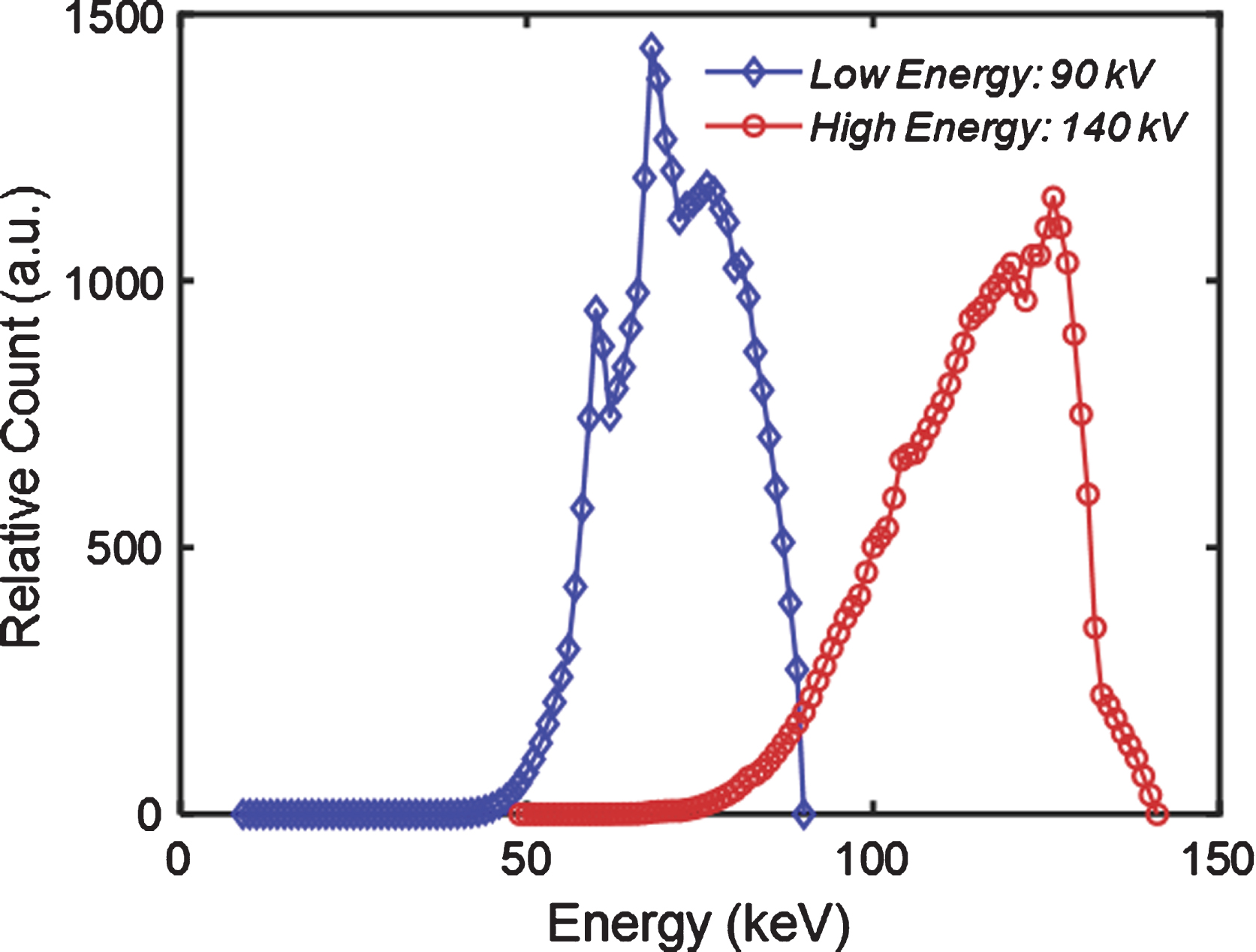
The energy spectrum of the dual-energy X-ray imaging simulator.
For system configuration in the simulation study, the source-to-image-receptor distance (SID) was 1400 mm, and the source-to-axis distance (SAD) was 700 mm. During the process of acquiring projections, all of the system components and the objects were stationary. For acquiring the dual-energy projections, the two different spectra were applied to the simulator input parameters as shown in Fig. 1. The image receptor was a 512×512 pixels matrix flat-panel detector with a pixel size of 1.17×1.17 mm2.
The twelve reference materials used in the simulation study consist of six kinds of compounds, five kinds of elements, and an explosive material TNT. The effective atomic numbers of these materials are from 5.444 to 22, and the detailed material characteristics are shown in Table 1. The photon attenuation coefficients of these materials refer to NIST XCOM Photon Cross Sections Database [17].
Various materials and material characteristics for simulation
To evaluate the usability of the proposed method in the simulated case, the nine samples of these reference materials were chosen and designed with specific thicknesses to imitate the extreme condition for the similar attenuation in traditional X-ray projections. In this case, the different materials are hard to identify with their attenuation in traditional X-ray projections. Hence, the calculation of the effective atomic number with dual-energy X-ray imaging can be used to overcome this limitation. The calculation accuracy of the effective atomic number for two various methods was evaluated with simulated data.
For evaluating the method with the experimental data, the self-developed X-ray imaging system (TomoDR) was used to acquiring dual-energy projections. TomoDR is a general-purpose X-ray imaging system for medical use, which can provide 2D projection images and 3D tomosynthesis reconstructed images [13, 18]. This system was assembled with a medical X-ray source (Model: SG-1096, Varian Medical Systems, USA) and a digital flat-panel image receptor (Model: PaxScan 4343CB, Varian Medical Systems, USA).
For system configuration in the experimental study, the SID was 1120 mm, and the SAD was 1100 mm. The experimental setup of the X-ray tube voltage and additional filtration were the same as in the simulation study. The image receptor was a 3072×3072 pixels matrix flat-panel detector with a pixel size of 0.139×0.139 mm2. We used binning mode 2 of the image receptor to reduce the amount of time required for the image process.
To evaluate the accuracy of the effective atomic number calculation, we used a set of explosive simulants (Model: SECUR001, Tamar Israeli Advanced Quarrying Co Ltd, Israel). The attenuation and material properties of simulants are similar to real explosives. For data consistent, most of the calibration materials used in the experimental study are the same with simulation. The effective atomic numbers of these materials are from 5.444 to 22, and the detailed material characteristics are shown in Table 2.
Various materials and material characteristics for the experiment
Various materials and material characteristics for the experiment
For the calculation of the effective atomic number in the experimental study, the simulants were placed on the table surface to acquire dual-energy X-ray projections. The center of the simulant is aligned with the center of the X-ray and the image receptor. The tube voltage and additional filters in the experimental case were the same as the simulated case for dual-energy X-ray image acquisition. For data quantitative analysis in the experimental study, the mean value and standard deviation of the calculated effective atomic number were computed by ROI size 20×20 pixels in the center of the simulant.
To meet the international standards of the X-ray baggage inspection system, we also used the X-ray equipment image quality assurance (QA) phantom (Model: SECUR008, Tamar Israeli Advanced Quarrying Co Ltd, Israel) to evaluate the spectroscopic abilities between organic and non-organic materials for the proposed method. These spectroscopic abilities are determined by the calculation accuracy of the effective atomic number. The QA Phantom was designed and tested according to Doc. 30 of the European Civil Aviation Conference (ECAC) specifications [19]. The dual-energy X-ray images with effective atomic number mapping were presented by using a false-color encoding technique [20]. The colors of the different material types for the organic, the non-organic, and the metallic were presented as orange, green, and blue, respectively.
To evaluate the performance of the proposed method for realistic baggage inspection cases, we designed three different scenarios with explosive simulants to imitate the improvised explosive devices (IEDs). The effective atomic number can be associated with additional object information such as shape, size, and density. This information can assist the inspectors to discriminate the contrabands from the normal objects in the baggage. For the first IED case, there is a C4 explosive simulant connected with electric circuits which were concealed in the normal shoes. For the second IED case, there is a TNT explosive simulant connected with electric circuits and screws which were assembled in the iron can to simulate a grenade. For the third IED case, the hard disk of a laptop was replaced with a Semtex explosive simulant, which is one of the hardest scenarios for baggage inspection because there is a complex and high density of the electric devices.
The simulation results of the effective atomic number calculation with the dual-energy X-ray imaging simulator
To evaluate the performance of the multi-materials calibration model with various approximation methods, the attenuation coefficient ratios R of the twelve reference materials were obtained according to Eq. (8). The effective atomic numbers of calibration data are between 5.444 and 22 as listed in Table 1. For different approximation methods, the proposed rational polynomial approximation method of this study revealed a better fit than the conventional polynomial method as shown in Fig. 2. The r-squared (r2) value of the rational polynomial method is 0.999 which has a good interpretation for low-Z materials.
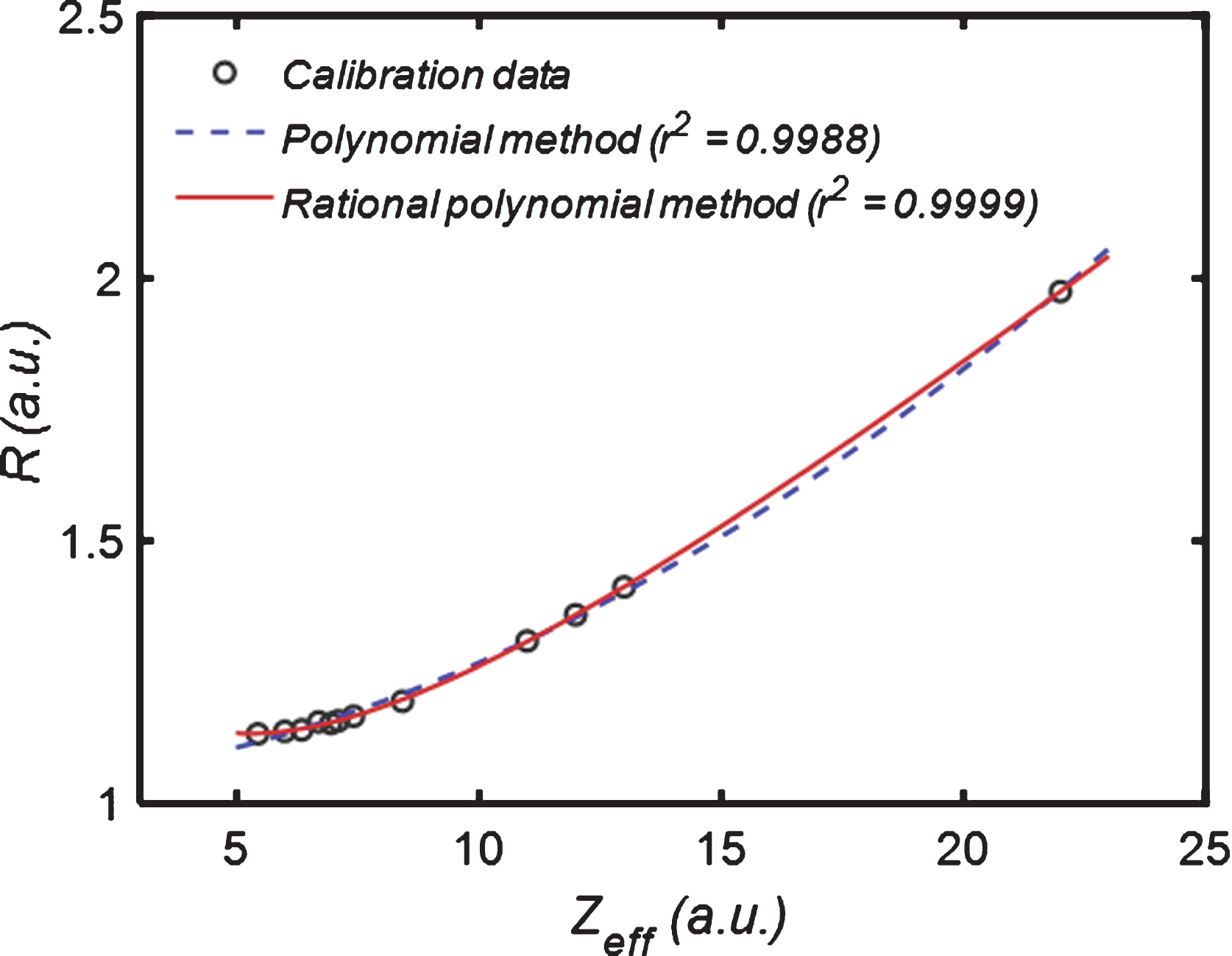
The calibration curves of the effective atomic number Z eff and the attenuation coefficient ratios R with various approximation methods in the simulation study.
In order to evaluate the usability of the proposed method, the nine various materials were designed with specific thicknesses to imitate a similar attenuation in traditional projections. Figure 3(a) and Fig. 3(b) are the low energy P L (r) and high energy P H (r) X-ray projections of these materials using the aforementioned imaging parameters, respectively. And they are presented in natural logarithm operation. For the two different projections of Fig. 3, the average gray value of high energy X-ray projection is lower than low energy X-ray projection due to X-ray with higher energy has higher penetration and lower attenuation coefficient. In this case, it’s difficult to distinguish the various materials only according to their X-ray attenuations. For the effective atomic number calibration, the map of the attenuation coefficient ratio R of Fig. 3 can be computed by using Eq. 8. Hence, the effective atomic number map can be determined using the R-Z eff calibration curves as shown in Fig. 4. The simulated results of the effective atomic number for various samples with different methods are listed in Table 3. For the polynomial method, the relative differences between the reference values and the calculated values are less than 11 %in all cases. Furthermore, the relative differences are further reduced to 5 %for the rational polynomial method. The relative mean absolute difference (RMD) of these materials is 1.63 %for the rational polynomial method compared to 3.61 %of the polynomial method.
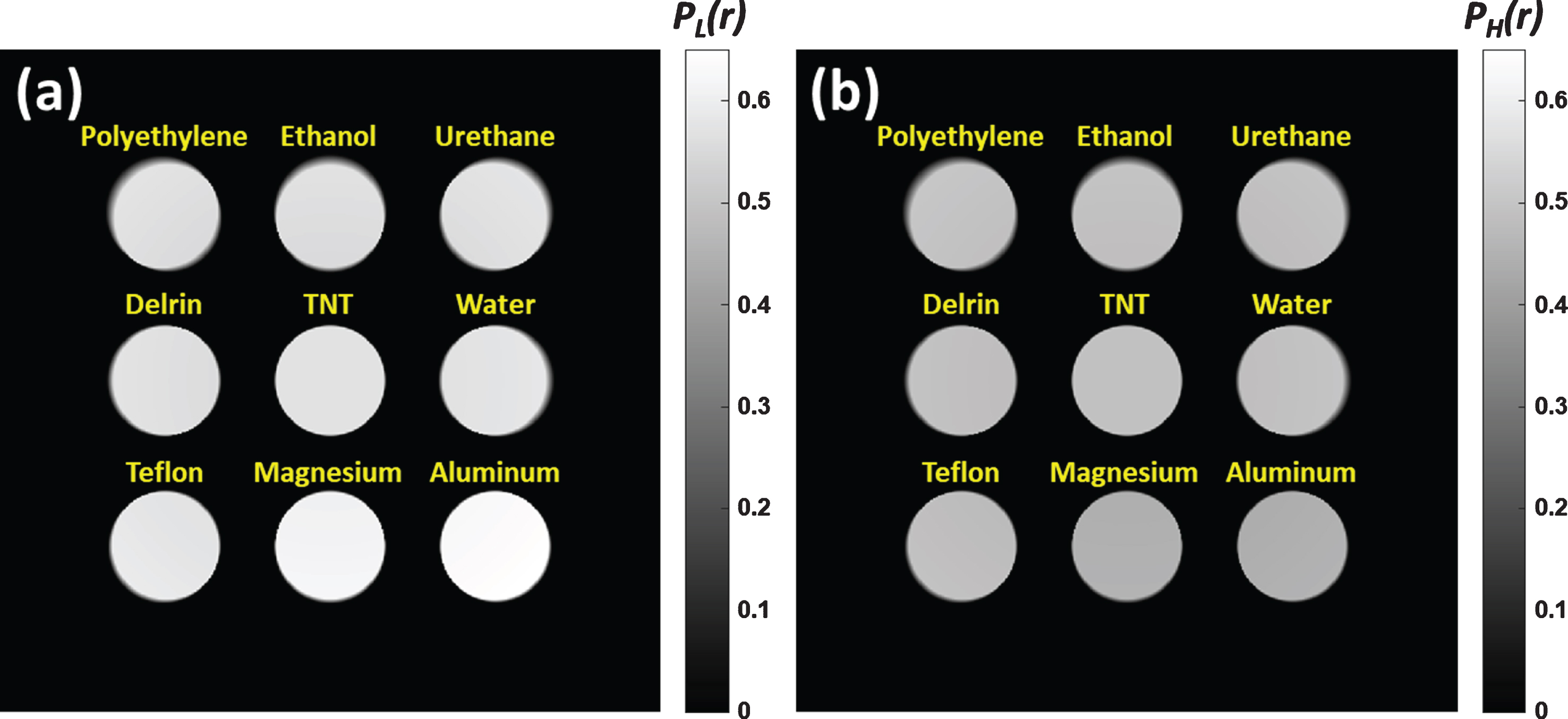
The projections of the nine different materials. (a) Projection with low energy photons (tube voltage: 90 kV) and (b) Projection with high energy photons (tube voltage: 140 kV). Images are displayed between 0 and 0.65.
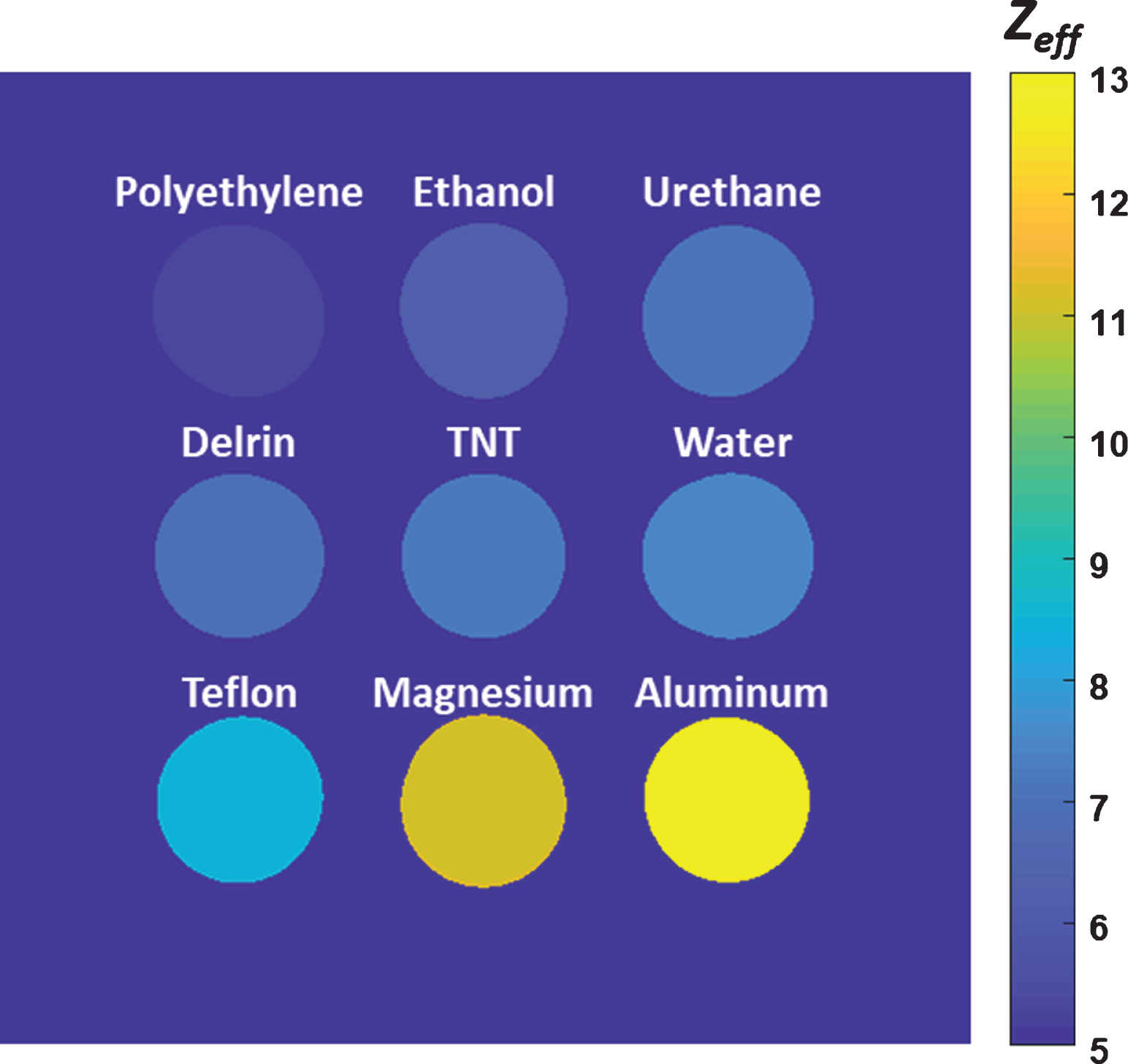
The map of the effective atomic number calculated by the proposed method.
The simulated effective atomic number of various samples with different methods
For the experimental study, the mean value and standard deviation of the attenuation coefficient ratios R were computed by ROI size 20×20 pixels. The R-Z eff calibration curve of various approximation methods for the twelve reference materials is shown in Fig. 5. The proposed rational polynomial approximation method (r2 = 0.9986) also revealed a better fit than the conventional polynomial method (r2 = 0.9977). For low-Z materials, the rational polynomial method can provide a better approximation.
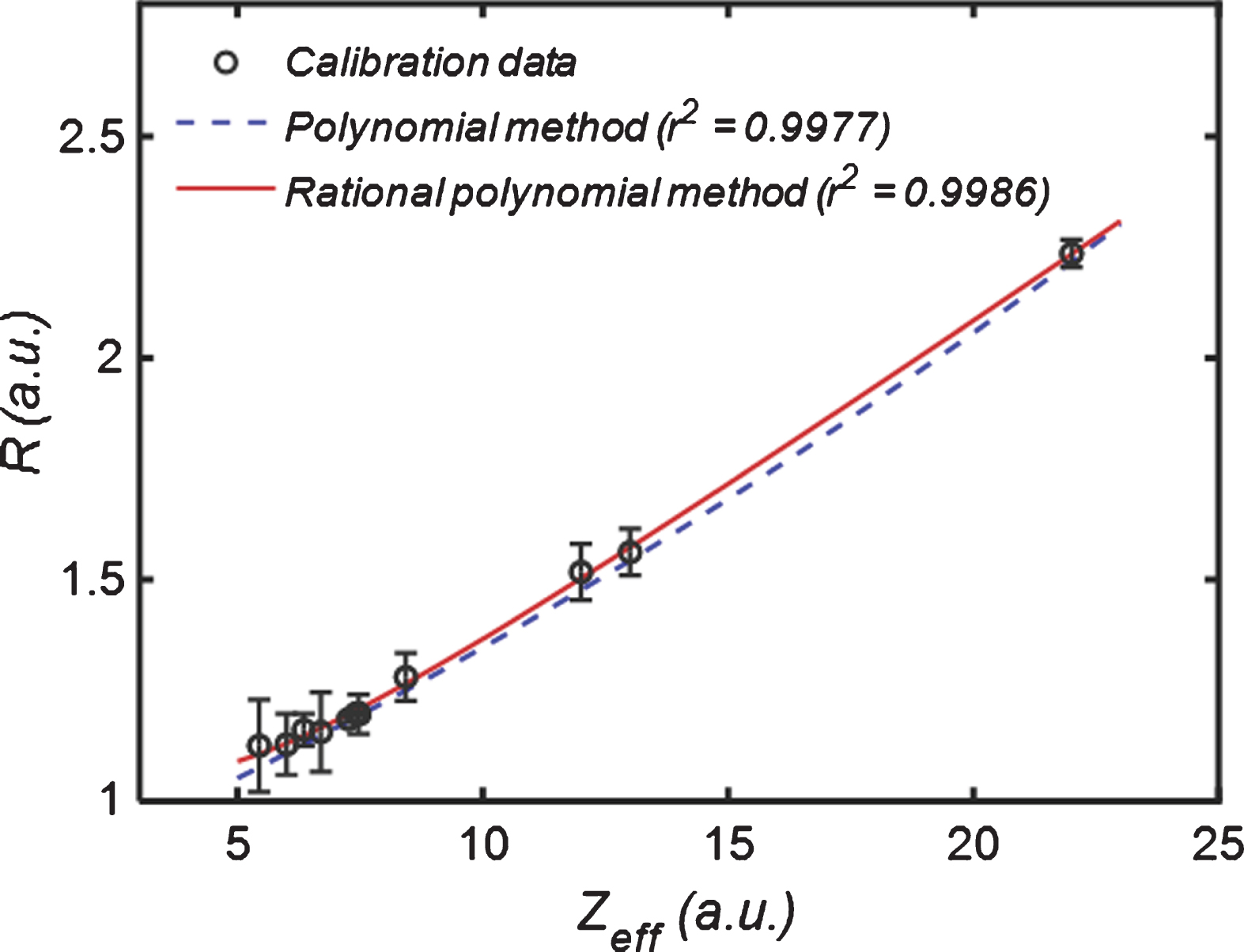
The calibration curves of the effective atomic number Z eff and the attenuation coefficient ratios R with various approximation methods in the experimental study.
The experimental results of the effective atomic number calculation for various samples with different methods were listed in Table 4. For the polynomial method, the relative differences between the reference values and the calculated values are less than 16 %in all cases. Furthermore, the relative differences are further reduced to 8.5 %with the rational polynomial method. Especially for low-Z materials (Z eff ≦6.35), the relative difference of these materials (Polyethylene, carbon, ethanol) using the rational polynomial method are improved between 4.91%to 7.74%compared to the polynomial method. Hence, the experiment results indicated that the proposed method can provide a better approximation for low-Z materials. The relative differences of the experimental study are higher than of simulation study due to the imperfect of the realistic imaging system such as X-ray scattering and detector properties. The relative mean absolute difference (RMD) of these materials is 2.57 %for the rational polynomial method compared to 4.46 %of the polynomial method.
The experimental effective atomic number of various samples with different methods
To verify the performance of the proposed method in this study, the QA phantom for baggage inspection was used to evaluate the calculation accuracy of the effective atomic number. The effective atomic number map of the QA phantom was obtained using the aforementioned dual-energy X-ray imaging protocol and the R-Z eff calibration curve. Concerning to the aim of this study is to evaluate the calculation accuracy of the effective atomic numbers, we therefore focused on the spectroscopic abilities between organic and non-organic materials for the proposed method. In general, most of the explosives are made of organic materials. Figure 6 shows the dual-energy X-ray image with the effective atomic number mapping compared with the conventional X-ray image. The assessment area of spectroscopic abilities between organic and non-organic materials was indicated as a red dashed box. The organic and non-organic materials are denoted as symbols “SR” and “ST”, respectively. The results reveal that using the conventional X-ray image is hard to distinguish the different materials with specific thicknesses. Nevertheless, the dual-energy X-ray image with the effective atomic number mapping can be a good tool to separate the two different materials. For the result of quantitative data between “SR” and “ST” area, the CNR of the effective atomic number map calculated by the proposed method can improve 2.8 times compared to the conventional X-ray image. The experimental result of the baggage inspection QA phantom indicated that the proposed method is compliant with the ECAC international standards for detecting the explosives.

The X-ray images of the QA phantom for baggage inspection. (a) conventional 2D X-ray image and (b) 2D dual-energy X-ray image with effective atomic number mapping.
For the first IED case to imitate the realistic baggage inspection situation, there is a C4 explosive simulant connected with electric circuits which were concealed in the normal shoes. The conventional 2D X-ray and the dual-energy X-ray image with the effective atomic number mapping are shown in Fig. 7. For the conventional X-ray image, it’s difficult to identify the material properties according to the image gray-scale. The image gray-scale of the steel toe caps shows the similar to the image of the explosive simulant (C4), and these phenomena may cause the inspector with misjudgment. Nevertheless, these limitations would be overcome for the dual-energy X-ray image with the effective atomic number mapping. The components of IED were mapped using a false-color encoding technique with the corresponding colors according to their atomic numbers. For the result of quantitative data between the steel toe caps and C4 area, the CNR of the effective atomic number map calculated by the proposed method can improve 3.3 times compared to the conventional X-ray image.
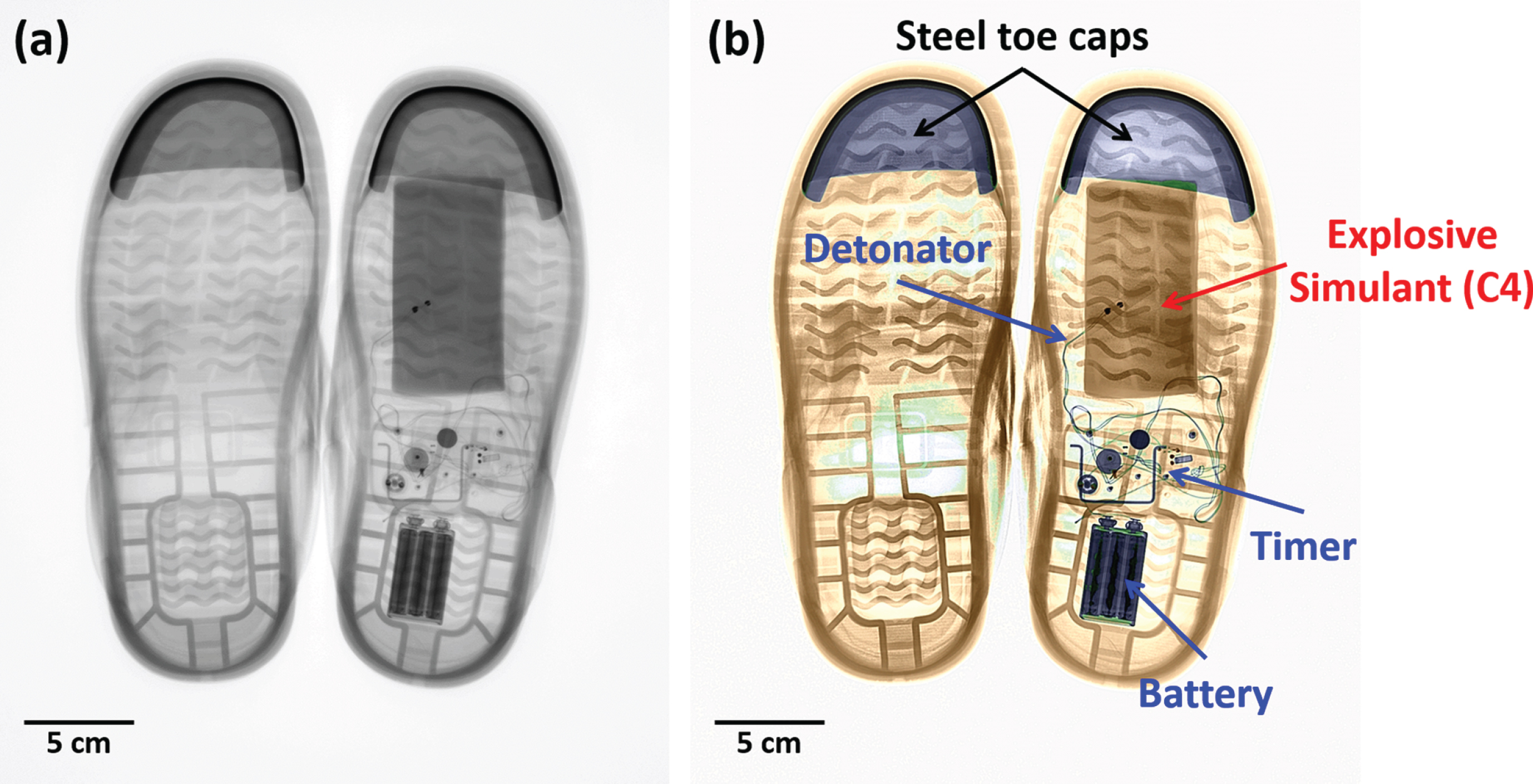
The X-ray images of the shoe bomb IED. (a) conventional 2D X-ray image and (b) 2D dual-energy X-ray image with effective atomic number mapping.
For the second IED case, there is a TNT explosive simulant connected with electric circuits and screws which was assembled in the iron can to simulate a grenade. The conventional 2D X-ray and the dual-energy X-ray image with the effective atomic number mapping are shown in Fig. 8. For the conventional X-ray image, it’s also hard to determine whether it’s IED only according to the image gray-scale value. For the dual-energy X-ray image with the effective atomic number mapping, TNT was mapped with correct organic material color, and the metal materials were encoded with blue color. Most of the explosives are made of organic material, thus the object with organic materials inside would make inspector attention. For the result of quantitative data between the metallic part of timer and TNT area, the CNR of the effective atomic number map calculated by the proposed method can improve 6.1 times compared to the conventional X-ray image.
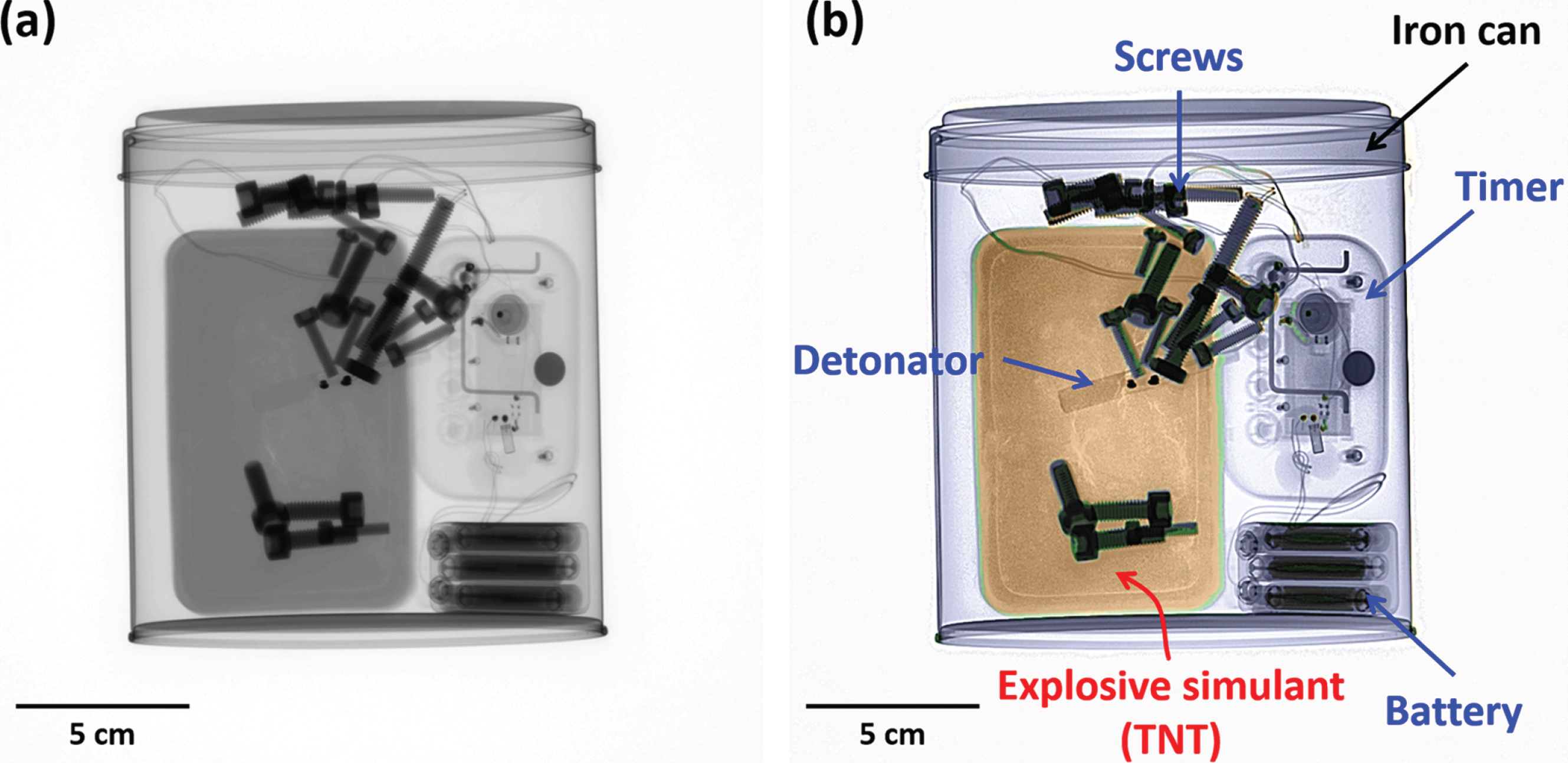
The X-ray images of the iron can grenade IED. (a) conventional 2D X-ray image and (b) 2D dual-energy X-ray image with effective atomic number mapping.
For the third IED case, the hard disk of a laptop was replaced with Semtex explosive simulant. This case is one of the hardest scenarios for baggage inspection because there is a complex and high density of the electric devices. The conventional 2D X-ray and the dual-energy X-ray image with the effective atomic number mapping are shown in Fig. 9. For the conventional X-ray image, it’s hard to discriminate the battery and the explosives according to the X-ray attenuation. In general, electric devices don’t contain any organic materials. Therefore, the inspector will increase attention when the potential threats are indicated by the dual-energy X-ray image with the effective atomic number mapping. For the result of quantitative data between the battery and Semtex area, the CNR of the effective atomic number map calculated by the proposed method can improve 2.7 times compared to the conventional X-ray image. The results of three cases revealed that the proposed method can exactly indicate the location of the potential threats with correct color mapping.
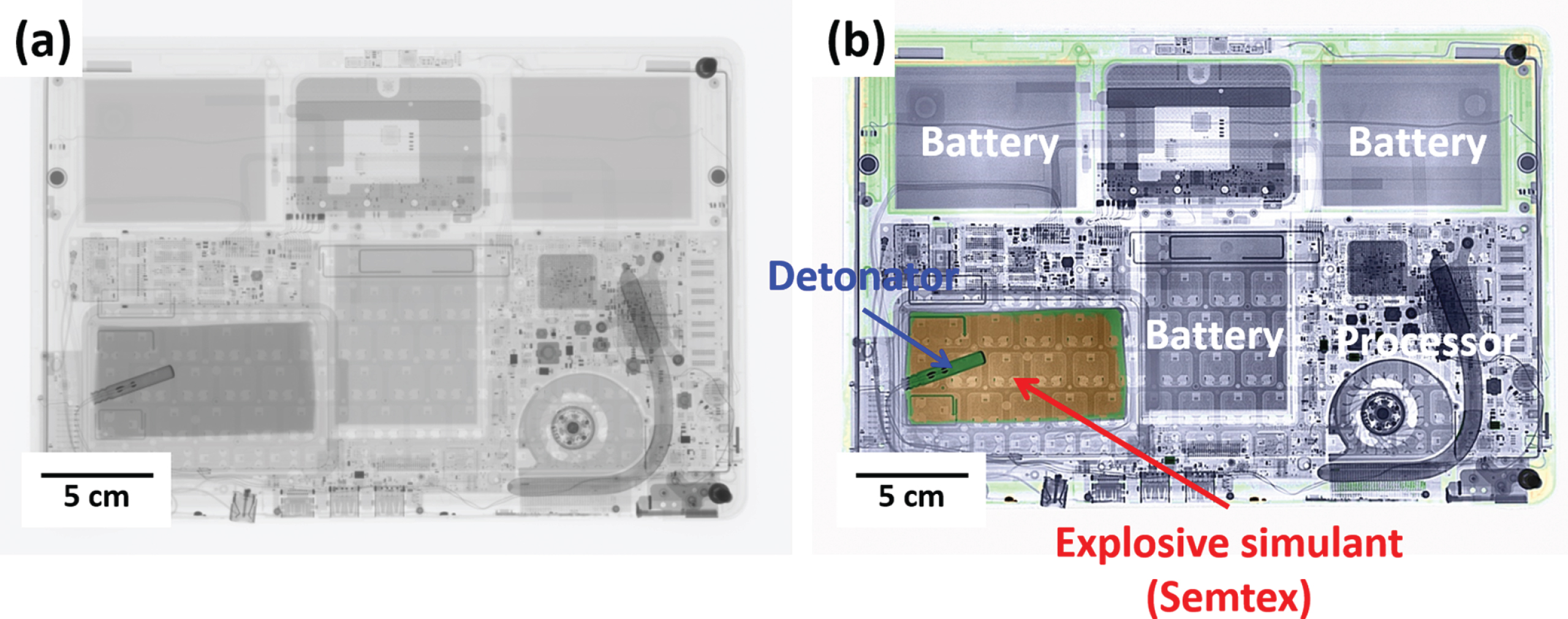
The X-ray images of the laptop computer IED. (a) conventional 2D X-ray image and (b) 2D dual-energy X-ray image with effective atomic number mapping.
The effective atomic number is obtained by using the rational polynomial approximation method proposed in this study and implemented on a dual-energy X-ray imaging system. The proposed method was a multi-materials calibration model with an iterative minimization process, which was validated by simulation and experimental studies. For the calculation of the effective atomic number, the average accuracy of the proposed method in this study can be improved by about 40%compared with the conventional method. The QA phantom results indicated that the proposed method is compliant with the ECAC international standards for detecting the explosives. The experimental results with three different IED cases revealed that the proposed method can exactly indicate the location of the explosives with the correct color. The method proposed in this study can improve the identification ability and efficiency of different materials. It can also assist the security agencies to quickly distinguish between normal items and contrabands, and further enhance aviation safety.
Footnotes
Acknowledgments
This work was supported by the Atomic Energy Council of Taiwan and the Ministry of Science and Technology, Taiwan, R.O.C. under Grant Nos. MOST108-3111-Y-042A-119.