



Abstract
BACKGROUND:
Interest exists in dual-energy computed tomography (DECT) imaging with scanning arcs of limited-angular ranges (LARs) for reducing scan time and radiation dose, and for enabling scan configurations of C-arm CT that can avoid possible collision between the rotating X-ray tube/detector and the imaged subject.
OBJECTIVE:
In this work, we investigate image reconstruction for a type of configurations of practical DECT interest, referred to as the two-orthogonal-arc configuration, in which low- and high-kVp data are collected over two non-overlapping arcs of equal LAR α, ranging from 30° to 90°, separated by 90°. The configuration can readily be implemented, e.g., on CT with dual sources separated by 90° or with the slow-kVp-switching technique.
METHODS:
The directional-total-variation (DTV) algorithm developed previously for image reconstruction in conventional, single-energy CT is tailored to enable image reconstruction in DECT with two-orthogonal-arc configurations.
RESULTS:
Performing visual inspection and quantitative analysis of monochromatic images obtained and effective atomic numbers estimated, we observe that the monochromatic images of the DTV algorithm from LAR data are with substantially reduced LAR artifacts, which are observed otherwise in those of existing algorithms, and thus visually correlate reasonably well, in terms of metrics PCC and nMI, with their reference images obtained from full-angular-range data. In addition, effective atomic numbers estimated from LAR data of DECT with two-orthogonal-arc configurations are in reasonable agreement, with relative errors up to ∼ 10%, with those estimated from full-angular-range data in DECT.
CONCLUSIONS:
The results acquired in the work may yield insights into the design of LAR configurations of practical dual-energy application relevance in diagnostic CT or C-arm CT imaging.
Introduction
In dual-energy CT (DECT) imaging [1], two data sets are collected generally over two full-angular ranges (FARs) of 360° with two different spectra, and low- and high-kVp images are reconstructed then from the two data sets collected, respectively. Interest exists in DECT imaging only over scanning arcs of limited-angular ranges (LARs) [2–4], as they may be exploited for reducing scan time and radiation dose, and for enabling scan configurations that can avoid possible collision between the rotating X-ray tube/detector and the imaged subject.
There are CT systems with dual X-ray sources placed at orthogonal positions (i.e., separated by 90°) on a circular trajectory for simultaneously collecting dual-energy data [5]. When the two X-ray sources of low- and high-kVp spectra rotate simultaneously over an arc of LAR ≤90°, a scan configuration is formed, which is referred to simply as the two-orthogonal-arc configuration in the work, with two non-overlapping, orthogonal arcs of LARs. A two-orthogonal-arc configuration can also be realized with the slow-kVp-switching technique [6] that allows for dual-energy data collection only over two orthogonal arcs of LARs with low- and high-kVp spectra, respectively.
Image reconstruction from LAR data in conventional single-energy CT (SECT) and DECT remains challenging due to the ill-conditionedness of the data model for LAR scans. Recent works suggest that the directional-total-variation (DTV) algorithm may reconstruct accurate images from LAR data in SECT [7]. We formulate image reconstruction in DECT for a two-orthogonal-arc configuration as a convex optimization problem that includes a data-fidelity term and constraints on image’s DTVs along orthogonal axes in the image space. The DTV algorithm, which was developed previously basing upon the first-order primal-dual algorithm [8, 9], is adapted to solve the optimization problem for achieving image reconstructions, respectively, from low- and high-kVp LAR data.
In this work, motivated by the existing hardware features and exploiting the capability of the DTV algorithm for image reconstruction from LAR data, we focus on investigating image reconstruction from data collected with two-orthogonal-arc configurations of LARs ranging from 30° to 90°. Using the basis images decomposed from the low- and high-kVp images reconstructed, we create monochromatic images, i.e., the spatial distributions of linear attenuation coefficient, at energies of interest. In addition to visual inspection of monochromatic images obtained, we also evaluate reconstruction performance in a task of estimating effective atomic numbers within regions of interest (ROIs) of a monochromatic image as functions of the LAR in a two-orthogonal-arc configuration.
Materials and methods
Scanning configuration
We consider a DECT configuration of a fan-beam geometry, with a source-to-rotation distance (SRD) of 100 cm, a source-to-detector distance (SDD) of 150 cm, and a linear detector of 32 cm consisting of 512 bins, as shown in Fig. 1a. Each of the two non-overlapping arcs with low- and high-kVp spectra covers an equal LAR, α, that is no more than 90°. Without loss of generality, the arcs of low- and high-kVp scans are assumed to be symmetric relative to the y- and x-axes, respectively, in the image space, and to have their centers separated by 90°. We refer to this configuration with two non-overlapping, orthogonal arcs as a two-orthogonal-arc configuration in the work. As discussed, the two-orthogonal-arc configuration can readily be implemented on dual-source CT, slow-kVp-switching CT, and other CT systems, e.g., with X-ray nanotube sources.
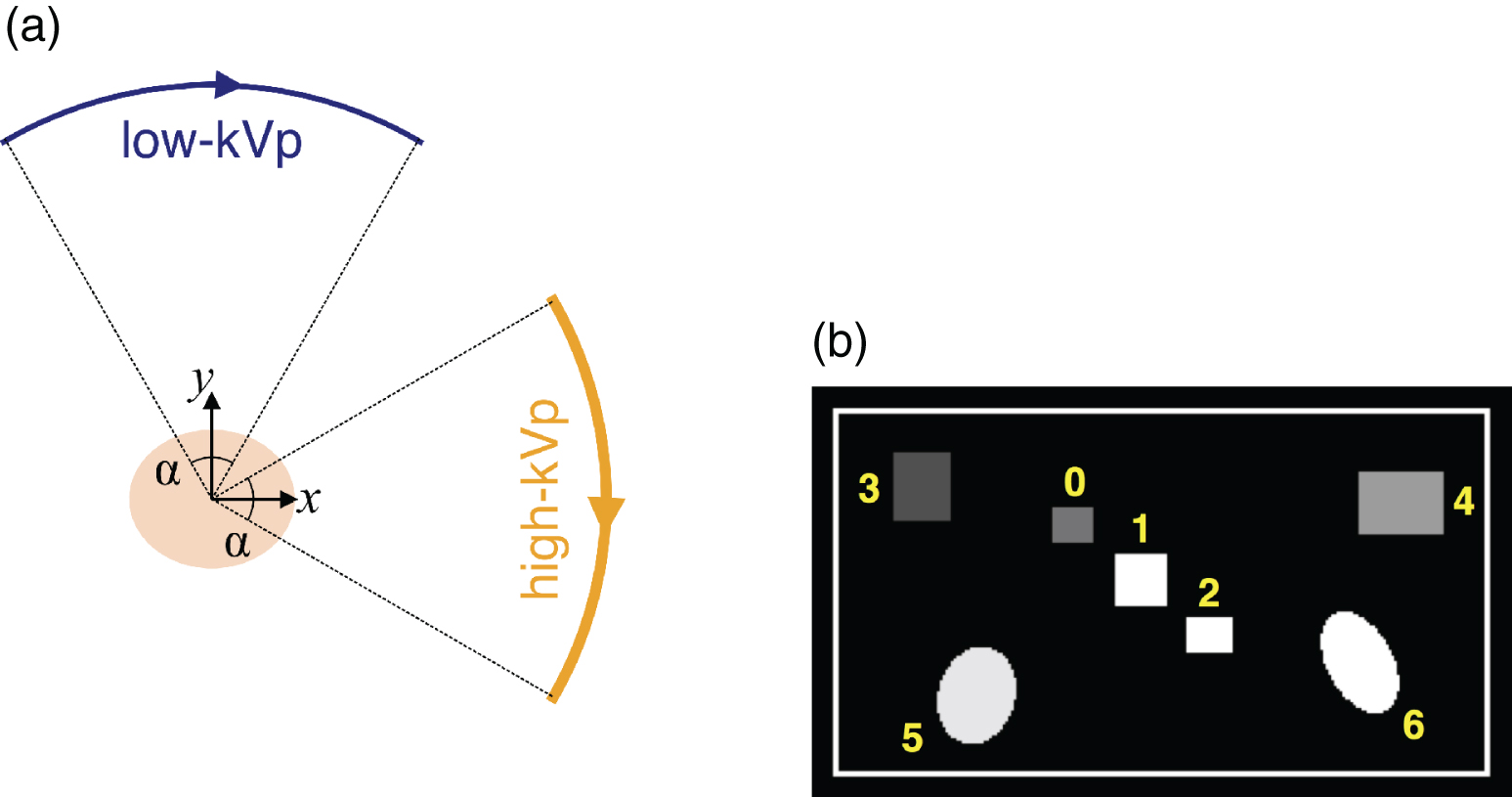
(a) The two-orthogonal-arc configuration with two non-overlapping, orthogonal arcs of LAR α ≤ 90° for collecting low- and high-kVp data; and (b) the monochromatic image, i.e., the spatial distribution of the linear attenuation coefficient, for the suitcase phantom at 40 keV. The numbers indicate ROIs of different materials: ROIs 0-6 contain C, Al, Ca, water, ANFO, teflon, and PVC, respectively. Display windows is [0.1, 0.65] cm-1.
In this work, we investigate image reconstruction for two-orthogonal-arc configurations of LAR α ≤ 90°, and present selective results for α = 30°, 45°, 60°, and 90°. In each of the two-orthogonal-arc configurations studied, the angular interval between two adjacent views is 1°. The DTV algorithm is tailored for image reconstruction from the low- and high-kVp LAR data collected, respectively. Images are reconstructed also from low- and high-kVp data over FARs of 360° by use of the DTV and FBP algorithms, and they are referred to as the DTV- and FBP-reference images.
Using a two-orthogonal-arc configuration in Fig. 1a, the low- and high-kVp LAR data are generated from a digital phantom of a suitcase, shown in Fig. 1b, mimicking baggage screening in security-scan applications. In the suitcase phantom, three bar-shaped ROIs 0-2 contain elements C, Al, and Ca, respectively, whereas rectangular and elliptical ROIs 3-6 are filled with water, ANFO (Ammonium Nitrate and Fuel Oil [10]), teflon, and PVC, respectively. The suitcase phantom is represented on an image array of 150 × 256 square pixels of size 0.7 mm, while each of the pixels is labeled with a material type and associated with a linear attenuation coefficient at a given energy.
Let
Let vector
The DTV algorithm was developed previously for image reconstruction from LAR data in conventional SECT [7]. In this work, we tailor the DTV algorithm to solve Eq. (2) for achieving reconstruction of low- and high-kVp images
From images
We subsequently obtain the monochromatic image of interest at energy level m of interest as
We present below study results on reconstruction of monochromatic images and estimation of effective atomic numbers from noiseless and noisy data of low- and high-kVp spectra from the suitcase phantom acquired with two-orthogonal-arc configurations in DECT.
Image reconstruction from noiseless data
Using the DTV algorithm, we first reconstruct images
Visual inspection of monochromatic images We first show in Fig. 2 monochromatic images and their respective zoomed-in ROI views at 40 keV obtained from the noiseless data over 60° by use of the DTV and FBP algorithms, along with the DTV- and FBP-reference monochromatic images from noiseless data over 360°. The zoomed-in ROI is enclosed by the rectangular box depicted in the FBP-reference image (row 1, column 4) in Fig. 2. It can be observed that the DTV monochromatic image from 60° data displays considerably reduced LAR artifacts that are otherwise observed in the corresponding FBP monochromatic image. While some residual artifacts due to the combined effect of LAR and beam-hardening can be observed also in the DTV monochromatic image, it appears to be largely similar visually to the DTV- and FBP-reference images, and the contrast between water and ANFO can be discerned as clearly as that observed in the DTV- and FBP-reference images.
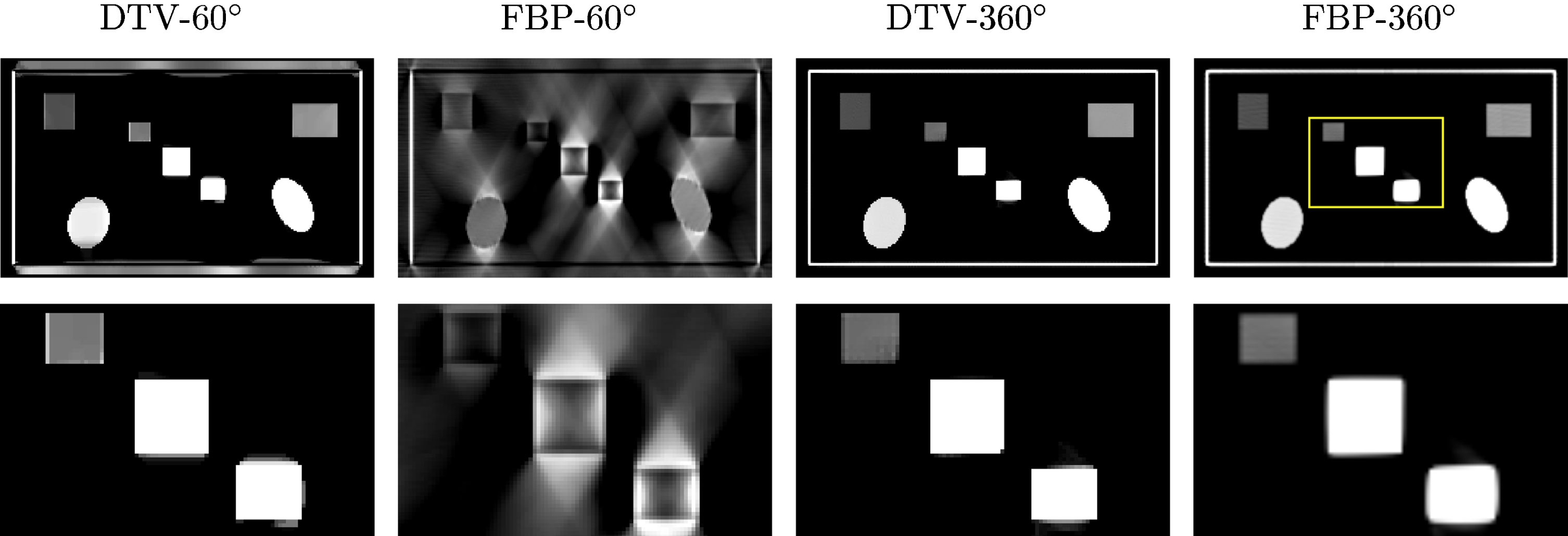
Monochromatic images at 40 keV (top row) and their respective zoomed-in ROI views (bottom row) obtained by use of the DTV (column 1) and FBP (column 2) algorithms from noiseless data of LAR α = 60°, and the DTV-reference (column 3) and FBP-reference images (column 4). The ROI is enclosed by the rectangular box depicted in the FBP-reference image. Display window: [0.1, 0.65] cm-1.
We also present in Fig. 3 monochromatic images and their respective zoomed-in ROI views at 40 keV obtained by use of the DTV algorithm from noiseless data for two-orthogonal-arc configurations of LARs α = 30°, 45°, 60°, and 90°, respectively. Monochromatic images are also reconstructed from the data by use of the FBP algorithm, but not shown here because they contain significant artifacts similar to those observed in the FBP reconstruction with α = 60° in Fig. 2. It can be observed that the DTV-monochromatic images are with visually significantly reduced artifacts, and that as expected, the DTV-monochromatic images approach to its DTV-reference monochromatic image with diminished residual artifacts as the LAR increases within the range of 30° ∼ 90°.
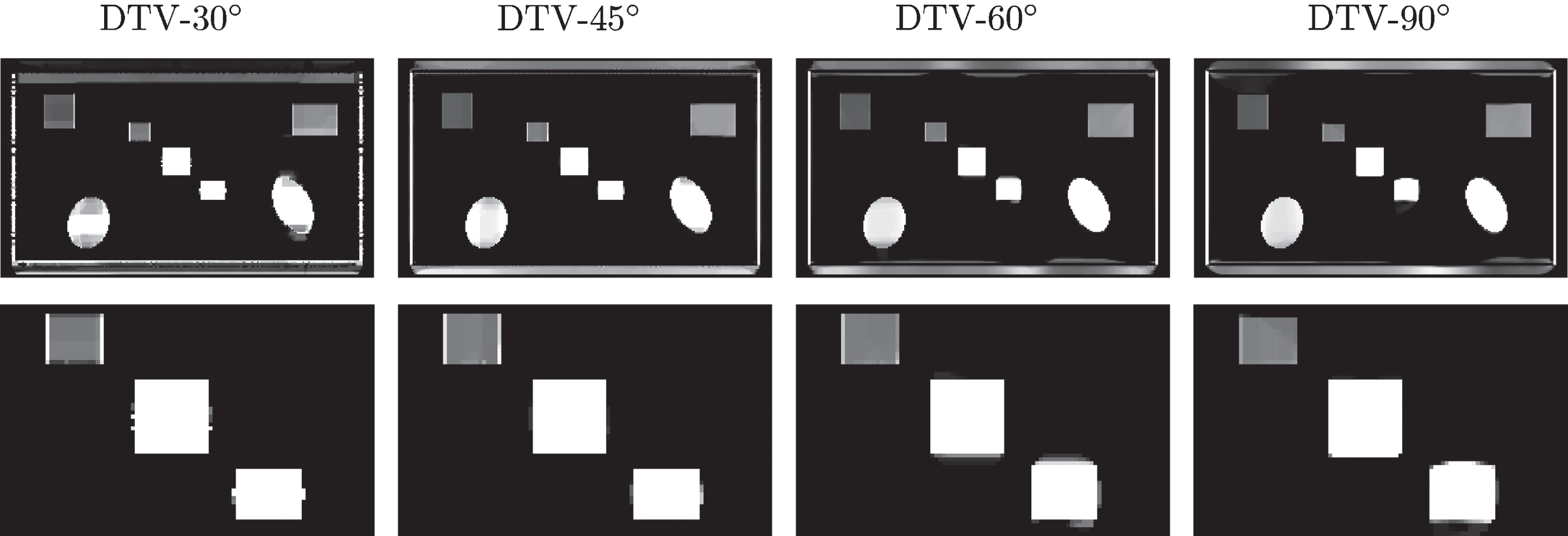
Monochromatic images (row 1) at 40 keV and their respective zoomed-in ROI views (row 2) obtained by use of the DTV algorithm from noiseless data for two-orthogonal-arc configurations of LAR α = 30°, 45°, 60°, and 90°, respectively. The ROI is enclosed by the rectangular box depicted in the FBP-reference image in Fig. 2. Display window: [0.1, 0.65] cm-1.
Quantitative analysis of monochromatic images obtained In addition to visual inspection, using the DTV-reference image (row 1 and column 3) in Fig. 2, we compute metrics normalized root mean square error (nRMSE), Pearson correlation coefficient (PCC), and normalized mutual information (nMI) [7, 14–16] of the DTV monochromatic images reconstructed from the noiseless data of the suitcase phantom. Metric nRMRE provides a quantification of the global difference between the reconstructed and reference images, whereas metrics PCC and nMI reveal visual correlation between reconstructed and reference images. We show in Fig. 4 metrics nRMSE, PCC, and nMI calculated as functions of angular range α for images reconstructed by use of the DTV algorithm. It can be observed that while PCC and nMI drop as α decreases, they remain generally above 0.8 for PCC and 0.38 for nMI, suggesting that monochromatic images of the DTV algorithm from LAR data correlate reasonably well with the DTV-reference image. For providing a benchmark, using the FBP-reference image (row 1 and column 4) in Fig. 2, we compute nRMSE, PCC, and nMI of the FBP monochromatic images and plot them in Fig. 4. The results reveal that the FBP monochromatic images for α < 90° correlate poorly with its reference image due to the LAR artifacts not corrected for.
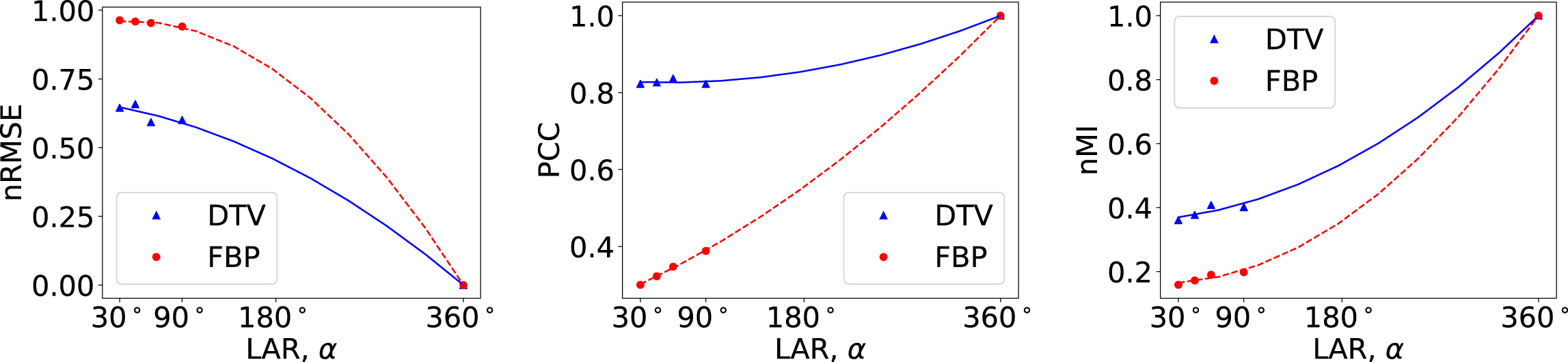
Metrics nRMSE (left), PCC (middle), and nMI (right), as functions of LAR α, of monochromatic images of the suitcase phantom at 40 keV obtained by use of the DTV and FBP algorithms from noiseless data.
Estimation of effective atomic numbers We first perform a calibration computation to determine constants c and n by using known atomic numbers of the materials and basis images estimated within ROIs 0-2 as depicted in Fig. 1b based on the DTV-reference image. Subsequently, using c and n determined, along with the basis images, we estimate the effective atomic numbers of materials water, ANFO, teflon, and PVC, respectively, in ROIs 3-6 by using Eq. (5). The values are shown in Table 1. The estimated atomic numbers are also plotted as functions of LAR α in Fig. 5, along with the effective atomic numbers obtained from the DTV- and FBP-reference images. The table and plots suggest that effective atomic numbers can be estimated by use of the DTV algorithm in reasonable agreement, with relative errors up to ∼ 10%, with the values obtained from the reference images. The deviation of the effective atomic numbers estimated relative to their reference values is largely due to the combined effect of the residual LAR artifacts and the beam-hardening artifacts that are not considered in DECT reconstruction algorithm. On the other hand, the substantial artifacts in the low- and high-kVp images reconstructed by use of the FBP algorithm from LAR data can result in basis images with negative values, thus preventing the use of Eq. (5) from estimation of effective atomic numbers especially for the LARs considered in the work.
Effective atomic numbers within ROIs 3-6 estimated from images reconstructed by use of the DTV algorithm from noiseless data of LAR α = 30°, 45°, 60°, and 90°, and FAR α = 360°
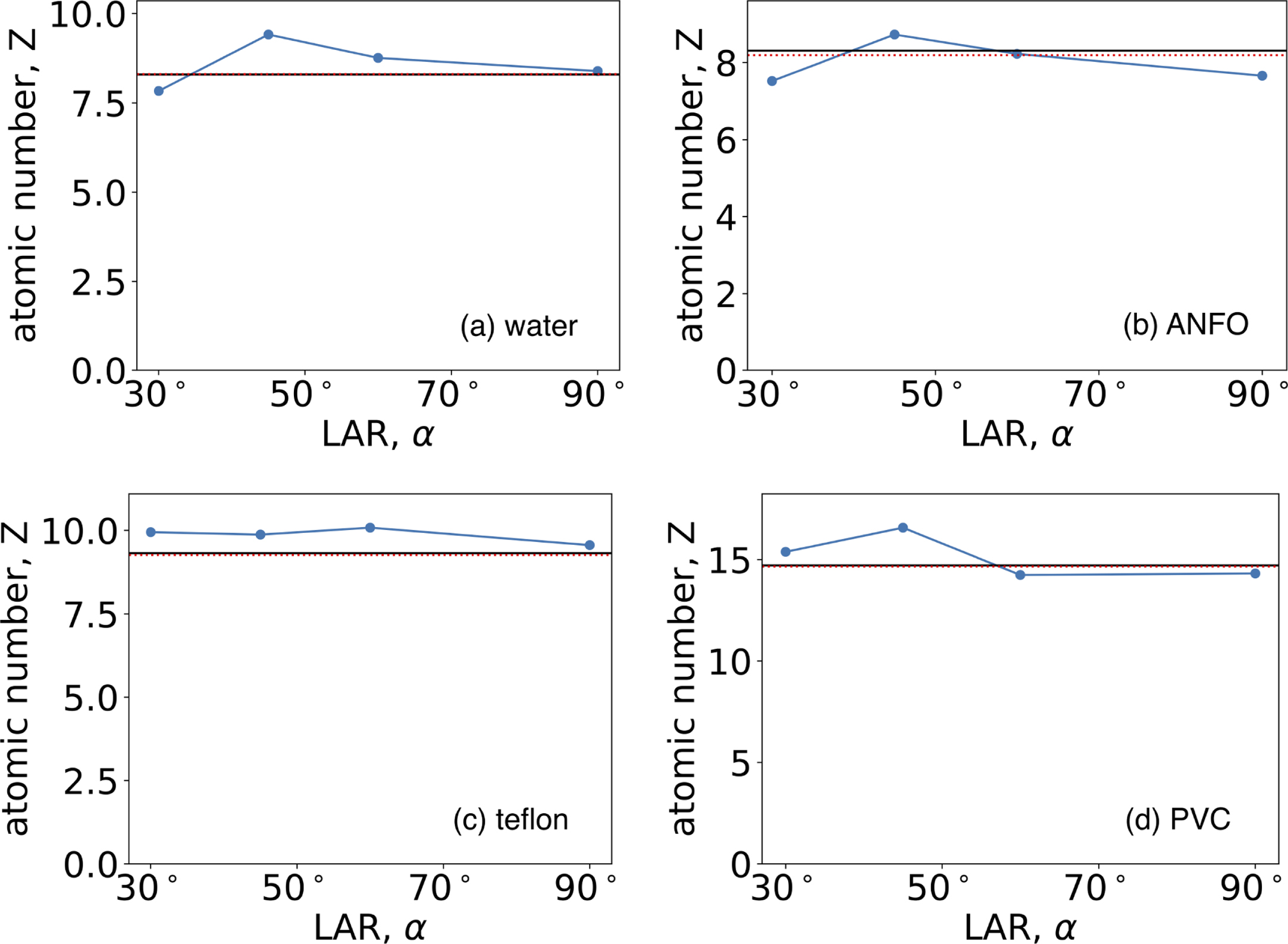
Effective atomic numbers (solid, blue), as functions of α, for (a) water, (b) ANFO, (c) teflon, and (d) PVC estimated from images reconstructed by use of the DTV algorithm from noiseless data of LAR α = 30°, 45°, 60°, and 90°, respectively. The horizontal lines indicate the effective atomic numbers estimated from the DTV-reference (dashed, black) and FBP-reference (dotted, red) images.
We also repeat the study of Sec.3.1 with noisy data. From images
Visual inspection of images reconstructed We show in Fig. 6. monochromatic images and their respective ROI images at 40 keV obtained by using the DTV algorithm from noisy data for two-orthogonal-arc configurations of LARs α = 30°, 45°, 60°, and 90°, respectively. Monochromatic images are also reconstructed by use of the FBP algorithm, but not shown here because they contain significant artifacts similar to those observed in the FBP reconstruction with α = 60° in Fig. 2. The DTV monochromatic images display considerably reduced LAR artifacts that are otherwise observed in the corresponding FBP monochromatic images. It can also be observed that as expected, the DTV-monochromatic images approach to its DTV-reference monochromatic image with diminished residual artifacts as the LAR increases within the range of 30° ∼ 90°.
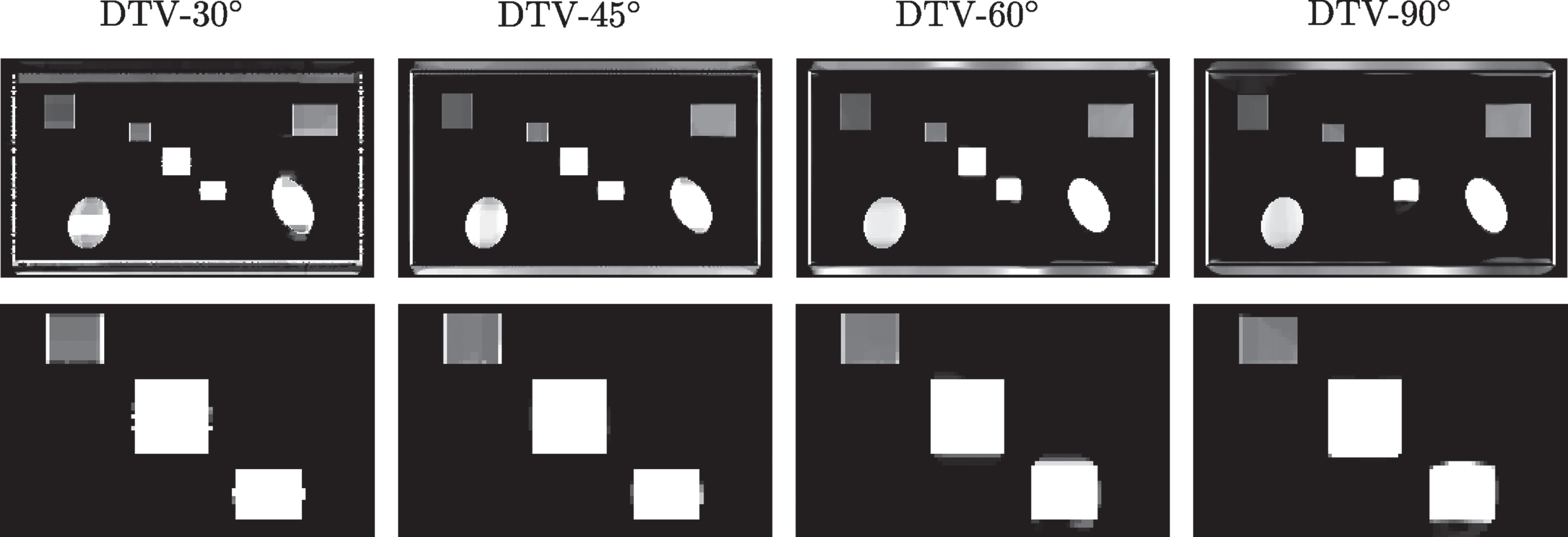
Monochromatic images (rows 1) at 40 keV and their respective zoomed-in ROI views (row 2) obtained by use of the DTV algorithm from noisy data for two-orthogonal-arc configurations of LAR α = 30°, 45°, 60°, 90°, respectively, The ROI is enclosed by the rectangular box depicted in the FBP-reference image in Fig. 2. Display window: [0.1, 0.65] cm-1.
Quantitative analysis of monochromatic images obtained In addition to visual inspection, using the DTV-reference image (row 1 and column 3) in Fig. 2, we compute metrics nRMSE, PCC, and nMI of the DTV monochromatic images reconstructed from the noisy data of the suitcase phantom. We show in Fig. 7 metrics nRMSE, PCC, and nMI calculated as functions of angular range α for images reconstructed by use of the DTV and FBP algorithm. It can be observed that PCC and nMI remain generally above 0.8 and 0.39, respectively, suggesting that monochromatic images of the DTV algorithm from LAR data correlate reasonably well with the DTV-reference image, while the FBP monochromatic images for α < 90° correlate poorly with its reference image.

Metrics nRMSE (left), PCC (middle), and nMI (right), as functions of LAR α, of monochromatic images of the suitcase phantom at 40 keV obtained by use of the DTV and FBP algorithms from noisy data.
Estimation of effective atomic numbers Using c and n determined in Sec 3.1 above, along with basis images, we estimate the effective atomic numbers of materials water, ANFO, teflon, and PVC, respectively, in ROIs 3-6. The values are shown in Table 2. These estimated atomic numbers are also plotted as functions of LAR α in Fig. 8, along with the effective atomic numbers obtained from the DTV- and FBP-reference images. The results in the table and the plots suggest that effective atomic numbers can be estimated from noisy data in reasonable agreement, with relative errors up to ∼ 10%, with their reference values by use of the DTV algorithm. The deviation of the effective atomic numbers estimated relative to their reference values is largely due to the combined effect of the residual LAR artifacts and the beam-hardening artifacts that are not considered in DECT. On the other hand, the low- and high-kVp images reconstructed by use of the FBP algorithm from LAR data contain substantial artifacts, which leads to basis images estimated with negative values. Therefore, effective atomic numbers cannot be computed by use of basis images with negative values in Eq.(5) especially for the two-orthogonal-arc configurations of LAR α ≤ 90° considered in the work.
Effective atomic numbers within ROIs 3-6 estimated from images reconstructed by use of the DTV algorithm from noisy data of LAR α = 30°, 45°, 60°, and 90°, and FAR α = 360°
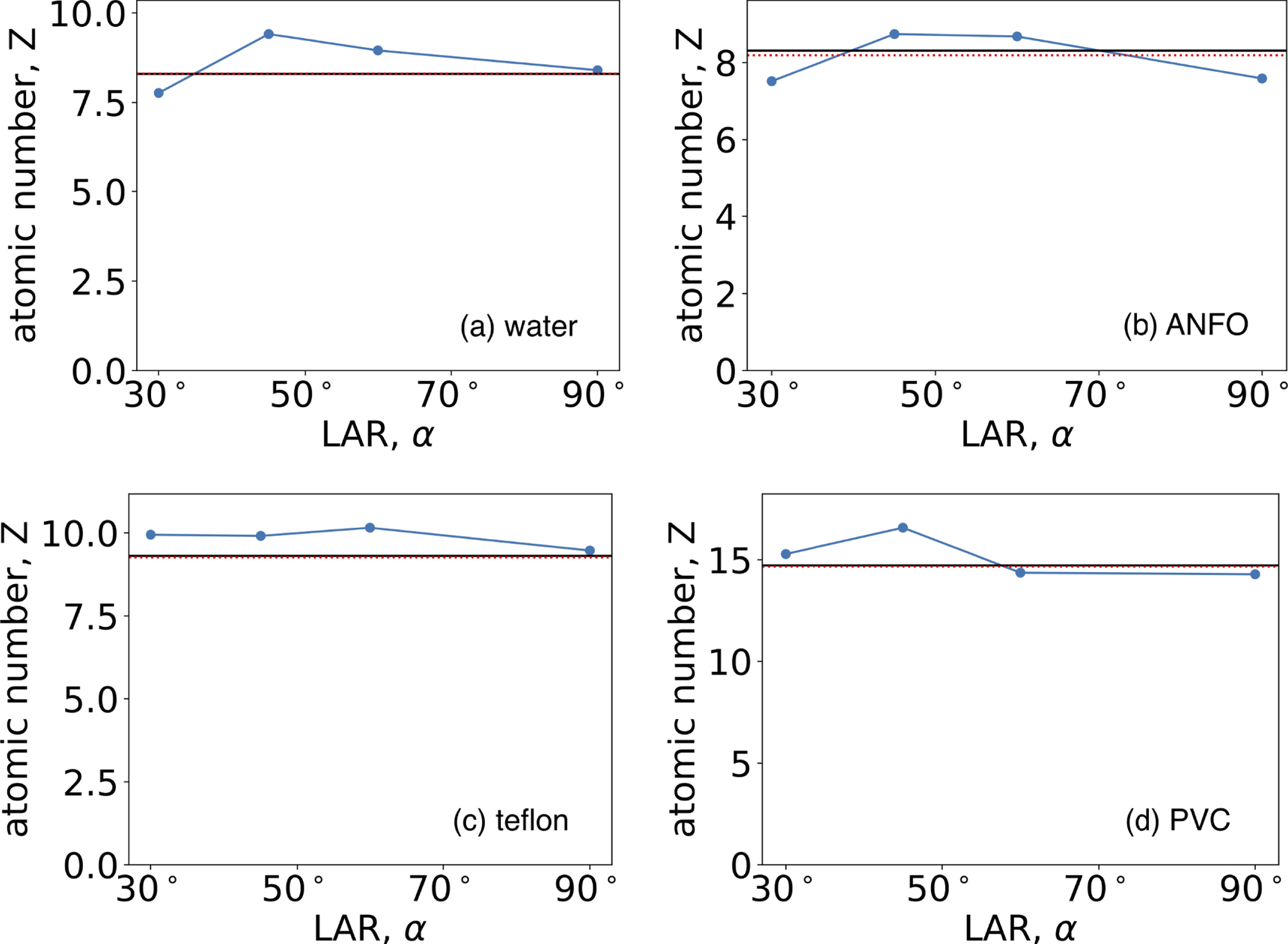
Effective atomic numbers (solid, blue), as functions of α, for (a) water, (b) ANFO, (c) teflon, and (d) PVC in the suitcase phantom estimated from images reconstructed by use of the DTV algorithm from noisy data of LAR α = 30°, 45°, 60°, and 90°, respectively. The horizontal lines indicate the effective atomic numbers estimated from the DTV-reference (dashed, black) and FBP-reference (dotted, red) images.
In the work, we investigate image reconstruction by tailoring the DTV algorithm developed previously from low- and high-kVp data collected by use of two-orthogonal-arc configurations with various LARs α ≤ 90° in DECT. Visual inspection of the monochromatic images indicates that the DTV algorithm can considerably reduce LAR artifacts that are observed in monochromatic images obtained with existing algorithms in DECT. Furthermore, the effective atomic numbers estimated from images reconstructed by use of the DTV algorithm for LAR 30° ≤ α ≤ 90° appear to be in reasonable agreement with their reference values obtained from FAR data. Conversely, due to the significant LAR artifacts, reconstructed image values by use of the existing algorithms such as the FBP algorithm can be negative and thus prevent their being used for estimating the effective atomic numbers.
The two-orthogonal-arc configurations considered in this work consist of two scans with low- and high-kVp spectra over two non-overlapping, orthogonal arcs of LAR α ≤ 90°. They can readily be implemented on existing dual-source DECT, or alternatively, can be realized with a slow-kVp-switching technique to collect low- and high-kVp data in conventional CT with a single source. The two-orthogonal-arc configurations investigated in the work include two scans of LAR α, ranging from 30° to 90°, and the combined angular ranges of the low- and high-kVp LARs are ≤180° (i.e., smaller than the short-scan-angular range,) thus offering opportunities potentially for reducing radiation dose and scan time and for avoiding collision between the rotating source/detector and imaged subject in, e.g., C-arm CT. For a two-orthogonal-arc configuration considered with LAR α substantially less than 90°, image reconstruction is more challenging than those from data acquired over LARs α ≥ 90° reported in the literature [2, 3]. The approach and experimental design in the work can also readily be applied to studying image reconstruction from data collected with configurations of two non-overlapping, non-orthogonal arcs of LARs.
Like many existing algorithms such as the FBP algorithm in DECT, the DTV algorithm employs a linear-data model, i.e., the DXT, in the optimization problem. As a result, the non-linearity effect in DECT data is not accounted for, which leads to beam-hardening artifacts in images reconstructed. As shown in Fig. 2, the LAR artifacts, when unaccounted for, are dominantly more significant than the beam-hardening artifacts in the monochromatic images. Therefore, the focus of the work is on correcting the LAR artifacts in LAR DECT without explicit beam-hardening correction. As such, the results obtained from the LAR DECT are compared against those from the FAR DECT, which is also without explicit beam-hardening correction yet free from LAR artifacts. We are currently investigating algorithms for simultaneously correcting for the LAR and beam-hardening effect in LAR DECT.
In the work, we have focused on investigating image reconstructions and effective atomic number estimations in two-orthogonal-arc DECT with simulated data from a digital phantom of practical relevance. However, it would be important to further investigate the proposed scan configuration and the DTV algorithm in real-data studies in research or practical applications, where additional physical factors, such as scatter, beam-hardening effect, cone-beam effect, and different noise levels, may also affect the results. Knowledge and insights obtained in this work may provide some guidance to the designing and conducting of future studies on image reconstructions from real two-orthogonal-arc data collected in research, industrial, and clinical DECT.
Conclusion
In this work, we have investigated by use of the DTV algorithm image reconstruction from low- and high-kVp data collected with two-orthogonal-arc configurations of LARs in DECT. The configuration can be implemented on existing dual-source CT scanners or with the slow-kVp-switching technique on conventional CT scanners, especially C-arm CT, with a single source. Results in the numerical studies reveal that monochromatic images obtained for two-orthogonal-arc configurations of LARs α as low as 30° appear visually with significantly reduced LAR artifacts otherwise observed in images obtained by use of existing algorithms such as the FBP algorithm, and that effective atomic numbers estimated for α in the range of 30° ∼ 90° are quantitatively in reasonable agreement with those estimated for a FAR configuration of 360°. The results acquired in the work may provide information about the performance upper bound in, and engender insights into, the design of dual-energy imaging configurations with LARs of practical application significance in diagnostic CT and/or C-arm CT.
Footnotes
Acknowledgments
This work was supported in part by NIH R01 Grant Nos. EB026282 and EB023968, and the Grayson-Jockey Club Research. The contents of this article are solely the responsibility of the authors and do not necessarily represent the official views of the National Institutes of Health.