



Abstract
In this paper, we present an arc based fan-beam computed tomography (CT) reconstruction algorithm by applying Katsevich’s helical CT image reconstruction formula to 2D fan-beam CT scanning data. Specifically, we propose a new weighting function to deal with the redundant data. Our weighting function
Introduction
Computed tomography (CT) has been widely used in clinical diagnosis and industrial applications because of its ability of providing inner vision of an object without destructing it. In classical tomography, the fan-beam CT reconstruction algorithm is fundamental since it can be heuristically extended to 3D helical cone-beam [1 –6] and circle cone-beam [7 –12] CT reconstructions. The standard fan-beam reconstruction method is the ramp filtered back-projection (FBP) algorithm [13, 14], which can be derived from the Radon inversion formula. For 2D CT image reconstruction, to reconstruct the whole image exactly and stably, it requires to measure all the line integrals of the X-rays that diverge from all directions and pass through the object. To make a fan-beam CT that samples data on a circular trajectory meet this condition, the detector must be large enough to cover the fan-angle of ±γ m = arcsin(R m /R o ) to avoid truncated projections and the X-ray source must travel on a continuous arc of π + 2γ m on the circle to ensure that the line integrals of the X-rays diverging from all directions in the 2D plane and passing through the object are measured, where R o is the radius of the scanning trajectory and R m < R o is the radius of the object. In the literature, the range of π + 2γ m is called as short-scan.
To avoid completing the projection data of the remain angles ([π + 2γ m : 2π]) and implement the reconstruction algorithm efficiently, Parker [15] proposed a weighting function to weight the short-scan fan-beam projection data before convoluting it. When the range of scanning angles is larger than the short-scan, redundant projection data is measured. Silver [16] extended Parker’s weighting function by utilizing the virtual detectors to tackle these redundant projection data.
In 2002, Noo et al. [17] proposed another type of FBP algorithm for fan-beam CT reconstruction by decomposing the convolution of the ramp filter into a successive convolution of a Hilbert filter and a derivative filter. After that, many other algorithms [9 , 19] based on the Hilbert transform were proposed. One advantage of these new algorithms is that they can exactly reconstruct a part of the image even though the range of the scanning angles is less than the short scan. These new algorithms can be seen as special cases that applying the 3D exact helical cone-beam inversion formula [20 –22] to the 2D CT reconstructions. To deal with the redundant data, a continuous weight function [9, 17] was also proposed to weight the filtered sinograms. In [23], Nett et al. derived a new algorithm for circle cone-beam CT reconstruction by applying Katsevich’s helical cone-beam algorithm [22] to circle con-beam geometry. They also proposed a structure factor weighting function to process the redundant data.
In summary, there exist mainly about three types of weighting functions in the literature. One is Parker’s [15] weighting function used in the conventional FBP [13, 14] algorithm and Feldkamp-Davis-Kress (FDK) [7] algorithm. Parker’s weighting function is assumed to be continuous and satisfy the normalization condition:
Another is Noo’s weighting function used in their reconstruction algorithms [9, 17] and has the following expression:
The third type weighting function is Nett’s function [23] used for circle cone-beam CT. The weighting function for image points
and for the image points
where the subscript “h” indicates that the filtering direction is horizontal, the subscript “i” or “f” indicates that the filtering line is determined by the critical plane that is perpendicular to the scanning plane and passes through the initial or final source point, respectively and T 1, T 2 and T 3 are three regions of the source trajectory, where there are one intersection point between the critical plane and T 2, and two intersection points between the critical plane and T 1 or T 3.
In this paper, we first present an arc based algorithm for fan-beam CT reconstruction by applying Katsevich’s helical CT [21] formula to 2D fan-beam CT. Then, we propose a new weighting function to tackle the redundant projection data. Our weighting function
Parker’s [15] weighting function w 1 (λ, γ) and Noo’s [17] weighting function w 2 (λ, γ) depend on the scanning angle λ and the diverging angle γ, and are required to be continuous with respective to them. When discretizing the reconstruction formulas, the continuity condition may result in more discretization errors. Moreover, a super-parameter d exists in Noo’s [23] weighting function, which greatly influences the qualities of reconstructed CT images. For circle cone-beam CT, the optimal value of d for each slice of the CT image may be different and so is somewhat hard to tune.
For our method, the weighting function
Katsevich’s helical cone-beam formula
Katsevich [21] proposed an exact reconstruction formula for helical cone-beam CT and Noo et al. [24] researched how to implement it efficiently and accurately. The reconstruction formula can be written as
where
is the Hilbert filter,
Applying (7) to the 2D fan-beam reconstruction, the π-line becomes a chord of the circle of the scanning trajectory, the κ-plane K (λ, ψ) coincides with the image plane to reconstruct and so
Let
where
For any fixed
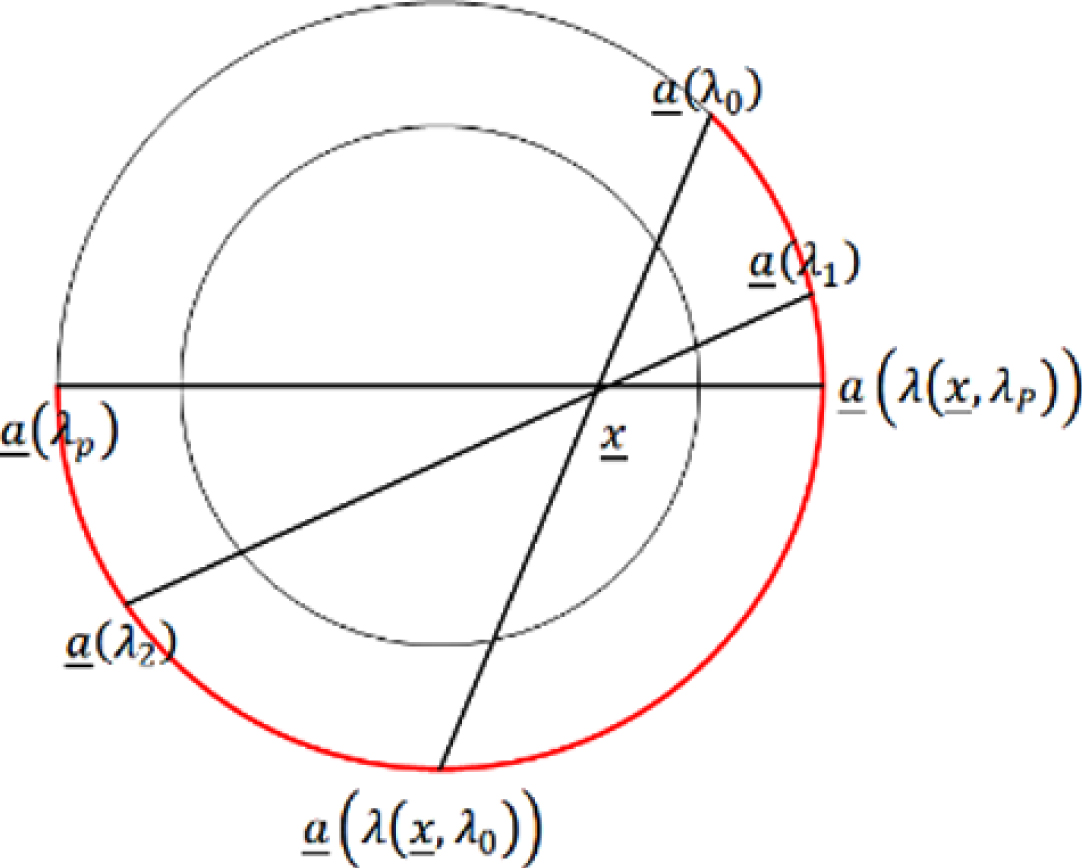
Demonstration that to reconstruct the density of pixel
Therefore, we propose the following formula for fan-beam reconstruction:
where λ0 < λ
P
correspond to the two endpoints of the scanning arcs,
is a weighting function, and
where
In this subsection, we describe how to implement (14) when the fan-beam projections are measured by using an equi-angular curved-line detector. Let
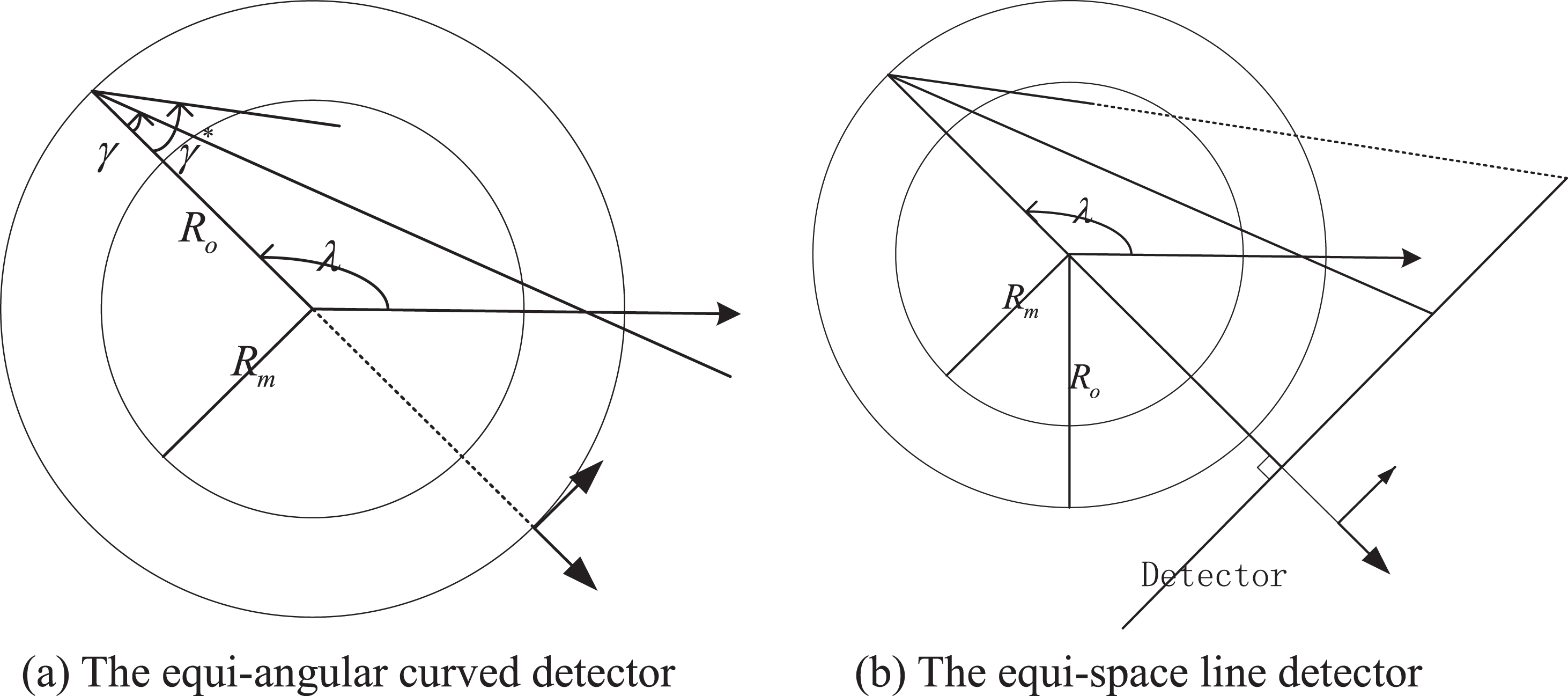
Geometries of data acquisition for 2D fan-beam CT.
Applying the changes of variable
Let
Compared to the classical FBP algorithm, (19) needs to calculate the extra weighting function
In this subsection, we show how to implement the algorithm for the fan-beam projections measured by using an equi-space straight-line detector. Let
Applying the changes of variables u = D tan(γ) and
where u
m
= D tan γ
m
, γ
m
= arcsin(R
m
/R
o
) and
Equation (14) can be extended for circle cone-beam CT reconstructions heuristically. In the following, we give the detailed circle cone-beam reconstruction algorithms for flat-plane and curve-plane detectors, respectively.
Implementation for flat-plane detectors
Let
and
where D is the distance between the detector plane and the X-ray source (See Fig. 3a). To make (14) effective for the circle cone-beam CT reconstruction, we need to modify
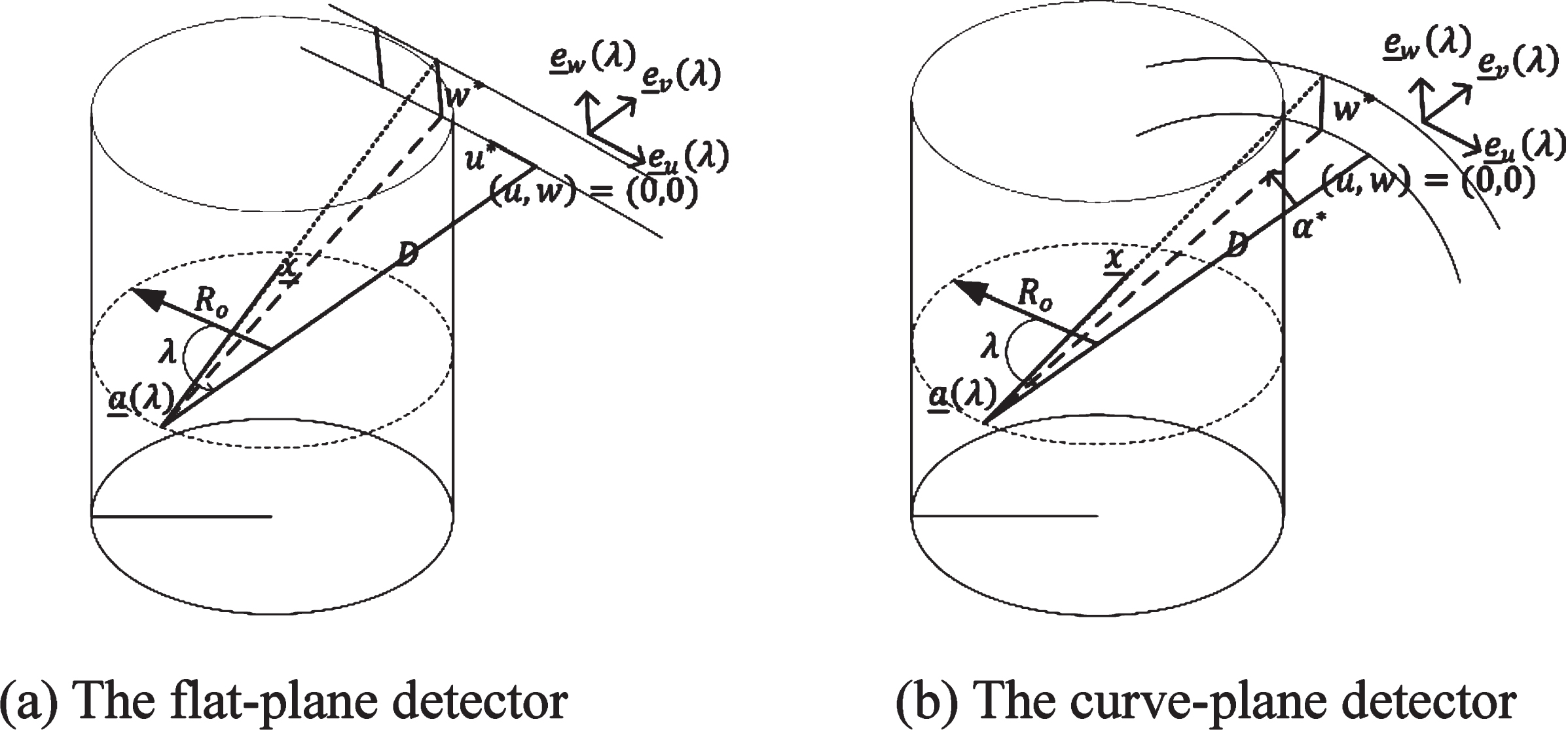
Geometries of data acquisition for 3D circle cone-beam CT.
In this paper, we heuristically set
where step1: derivative at constant direction
step2: convolution with Hilbert filter:
where u
m
= D tan γ
m
, γ
m
= arcsin(R
m
/R
o
). step3: backprojection
where
The curved-plane detector array consists of N row × N cols detectors. The detector columns are perpendicular to the trajectory circle of the X-ray source, while the detector rows form circle arcs parallel to each other and to the trajectory circle, where the center of the arc on the trajectory circle plane coincides with the X-ray source.
Let
where D is the distance between the detector plane and the X-ray source (See Fig. 3b). The curve-plane detector coordinates (α, v
c
, w
c
) can be converted to the flat detector coordinates (u, v
f
, w
f
) via
Applying the changes of variable in (32), we can obtain the circle cone-beam reconstruction algorithm for the curve-plane detector as follows. step1: derivative at constant direction
step2: convolution with Hilbert filter:
step3: back-projection
where
In order to implement our CT reconstruction algorithms, we need to give the discrete definitions of the derivatives
Let
The discrete definitions of the Hilbert filters are [26]:
For the weighting functions
Then, we set
where
In this section, we give some simulation results to verify the effectiveness of our algorithms. For 2D fan-beam CT reconstructions, we do the experiments on the simulated projection data measured by straight-line detectors while for 3D circle cone-beam, the simulated projection data measured by flat-plane detectors are used to reconstruct CT images. The codes for implementing our methods can be downloaded from https://github.com/wangwei-cmd/phantom.
Fan-beam with straight-line detectors
In this subsection, we present some CT images reconstructed from the fan-beam projection data measured by straight-line detectors and compare the results with those of the conventional fan-beam algorithm with Parker-extended weighting function (CFA) [16] and Noo’s algorithm (NOA) [17]. The CFA method is implemented by calling the “FBP-cuda” algorithm in the ASTRA Toolbox [27]. The codes for implementing the NOA and our method are almost the same except for the weighting functions. The hyper-parameter d in NOA [17] is set as d = 5π/180.
To estimate the performances of the three compared algorithms, the “astra_create_projector” function with parameter “line_fanflat” in the ASTRA Toolbox is used to generate the sinogram, where
In Fig. 4, we show the CT images reconstructed by CFA, NOA and ours, respectively. We can observe that the left-top part of the CT image reconstructed by CFA is a little dark due to suffering the inhomogeneous intensity. To better observe the differences of the three reconstructed images, we present the absolute error images |f - g| in Fig. 5, where f is the reconstructed image and g is the ground truth. We can see that the intensity error of the image reconstructed by NOA is large and the image reconstructed by NOA has more stripe error at the four corners compared to that of our method.
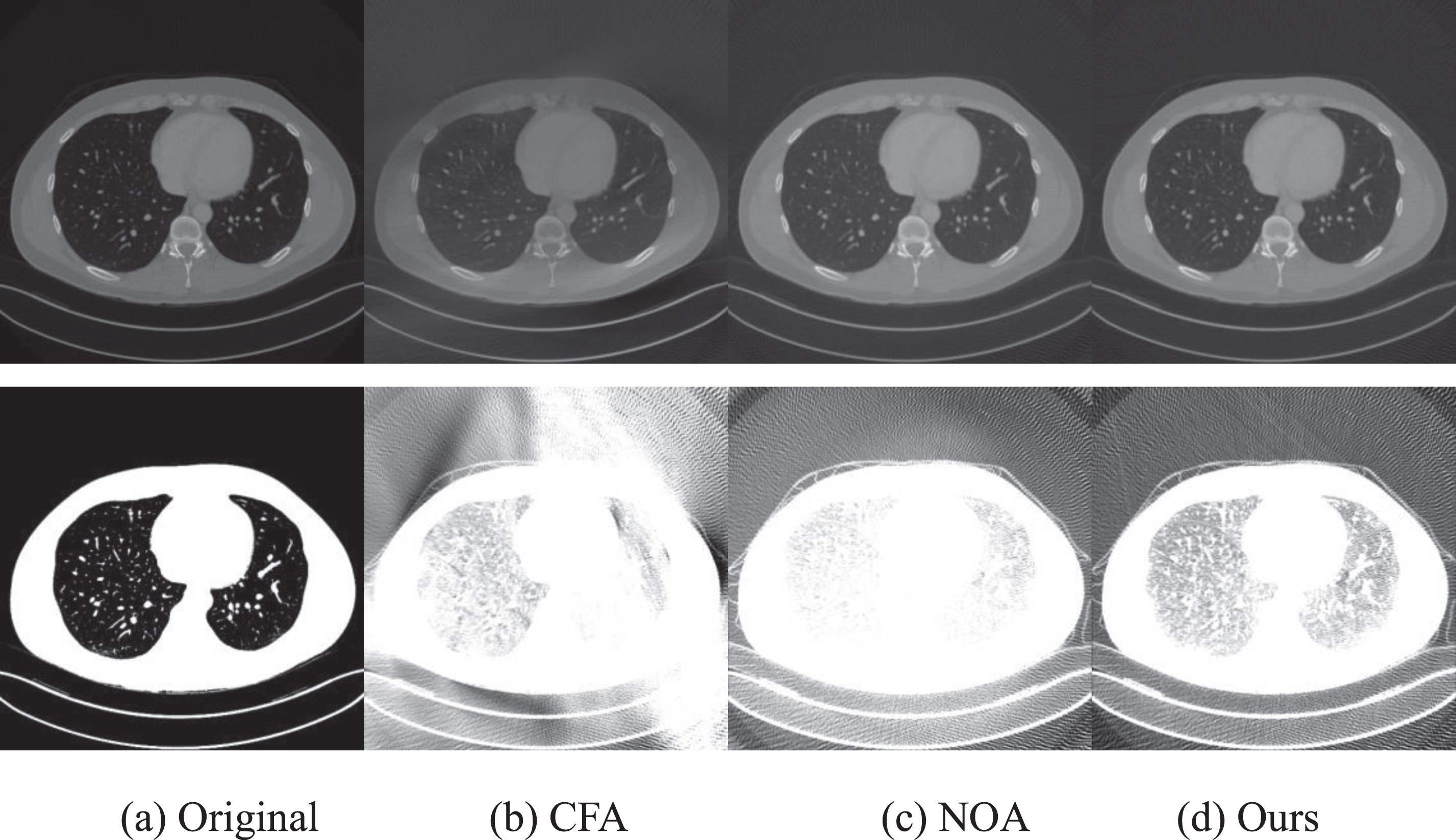
Reconstructed CT images from fan beam projections and their enhanced versions, where the intensities were linearly stretched in [0, 1] and the display widths of row 1 and row 2 are [0, 1] and [0.1, 0.2], respectively.
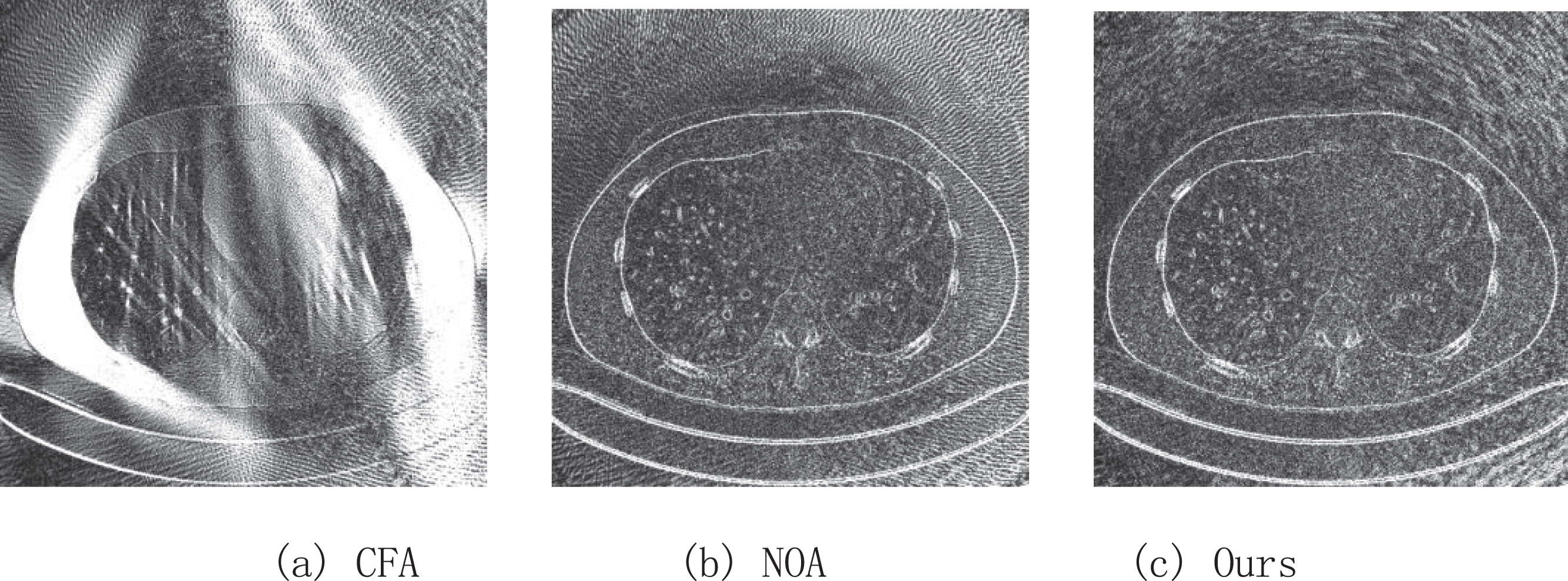
Absolute error images of Fig. 4, where the intensities were linearly stretched in [0, 1] and the display width is [0.1, 0.15].
To estimate the results of the methods objectively, the root-mean-square-error (RMSE) and the structural-similarity (SSIM) of the three reconstructed CT images in Fig. 4 are list in Table 1, where the RMSE and SSIM between the reconstructed CT image f and the referenced image g are, respectively, defined as
The RMSE and SSIM of CT Images in Fig. 4
In investigating the robustness of our method to noise, we add different level “Gaussian+Poisson” noises to the sinogram via the following formulas [28]:
where M is the maximal value of the projection data g, m = 0 and var are the mean and variance of the Gaussian noise, respectively, I 0 = 106 is the average photon count for the Poisson noise. Fig. 6 shows the reconstructed CT images from the noisy sinograms, where the corresponding variance parameters are var = 0.1, 1, 10, 100. From Fig. 6, we can observe that our method can reconstruct the CT images from the noisy sinograms.
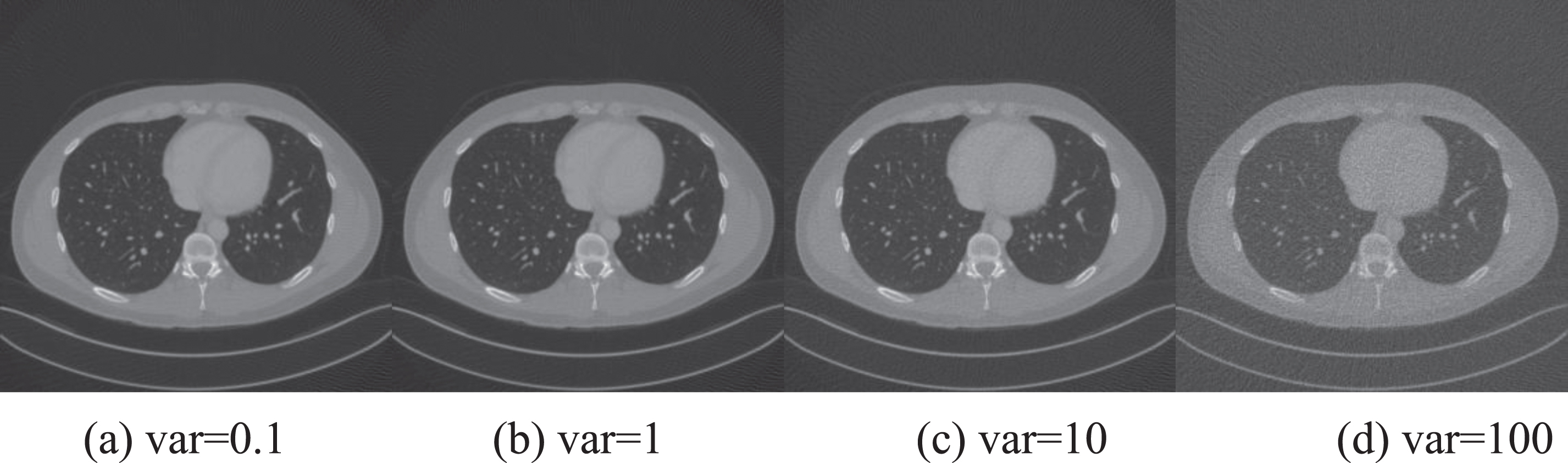
CT images reconstructed from noisy fan-beam projections with different variances.
To evaluate the spatial resolutions of the compared methods, a radial-stripe image is used as the test image and its corresponding sinogram is also generated by ASTRA Toolbox with the same parameters. In Fig. 7, the original radial-stripe image and the reconstructed images by the three methods are presented. We can see that the reconstructed images by NOA and ours have similar visual effects. Compared to NOA and ours, CFA have higher contrast, but it may over enhance the most center part of the test image. To better compare the three methods, two profile plots corresponding to the green circle and red circle in Fig. 7a are shown in Fig. 8. We can observe that the profile plots of Noo and ours almost coincide and the CFA tends to increase the intensity range of the reconstructed image. In Fig. 8a, the profile plot of CFA is more consistent with the original than those of Noo and ours but the opposite in Fig. 8b.
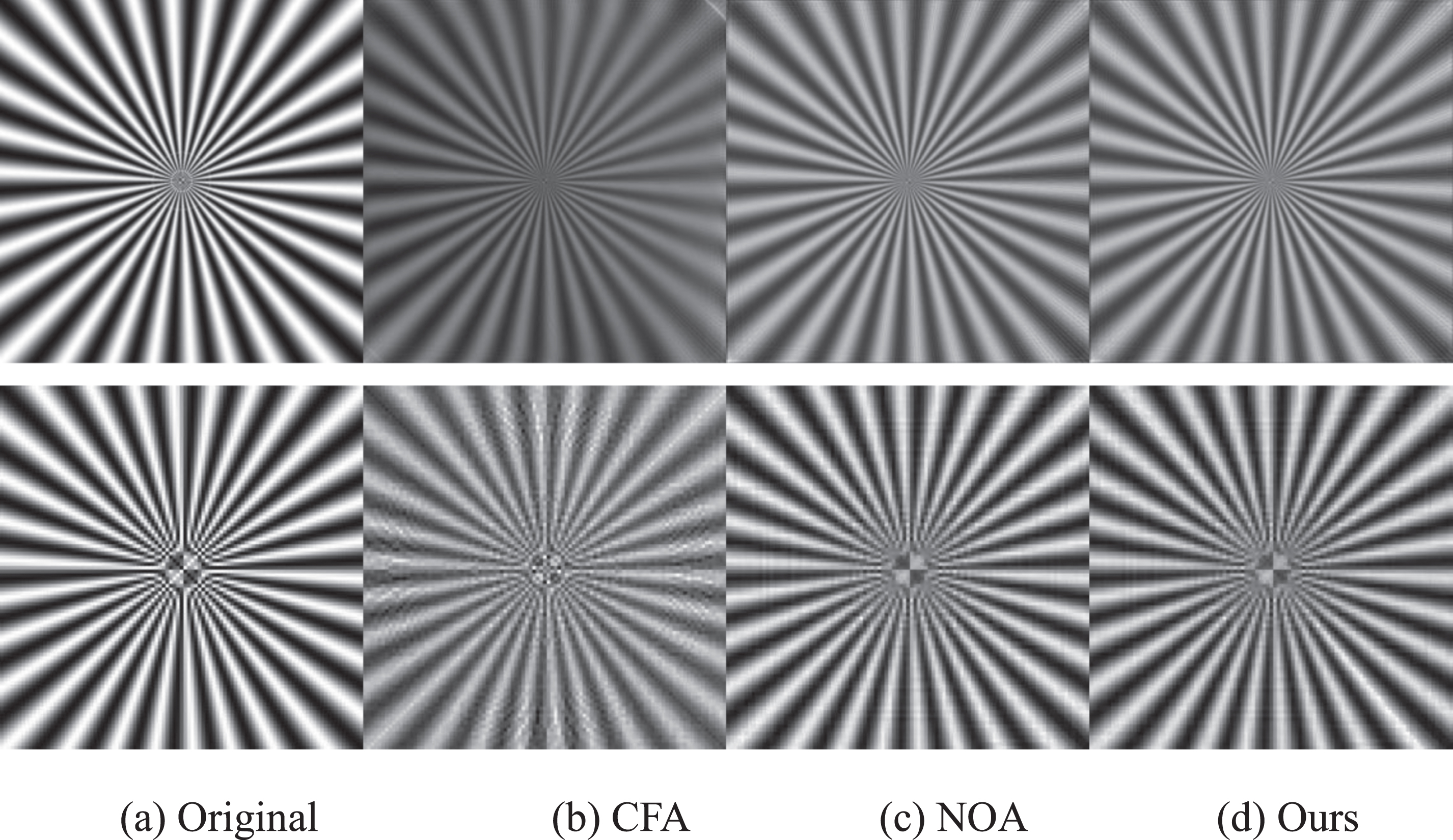
Radial-stripe images reconstructed by the three methods, where the images in second row are the enlargement of the center parts of images in the first row.
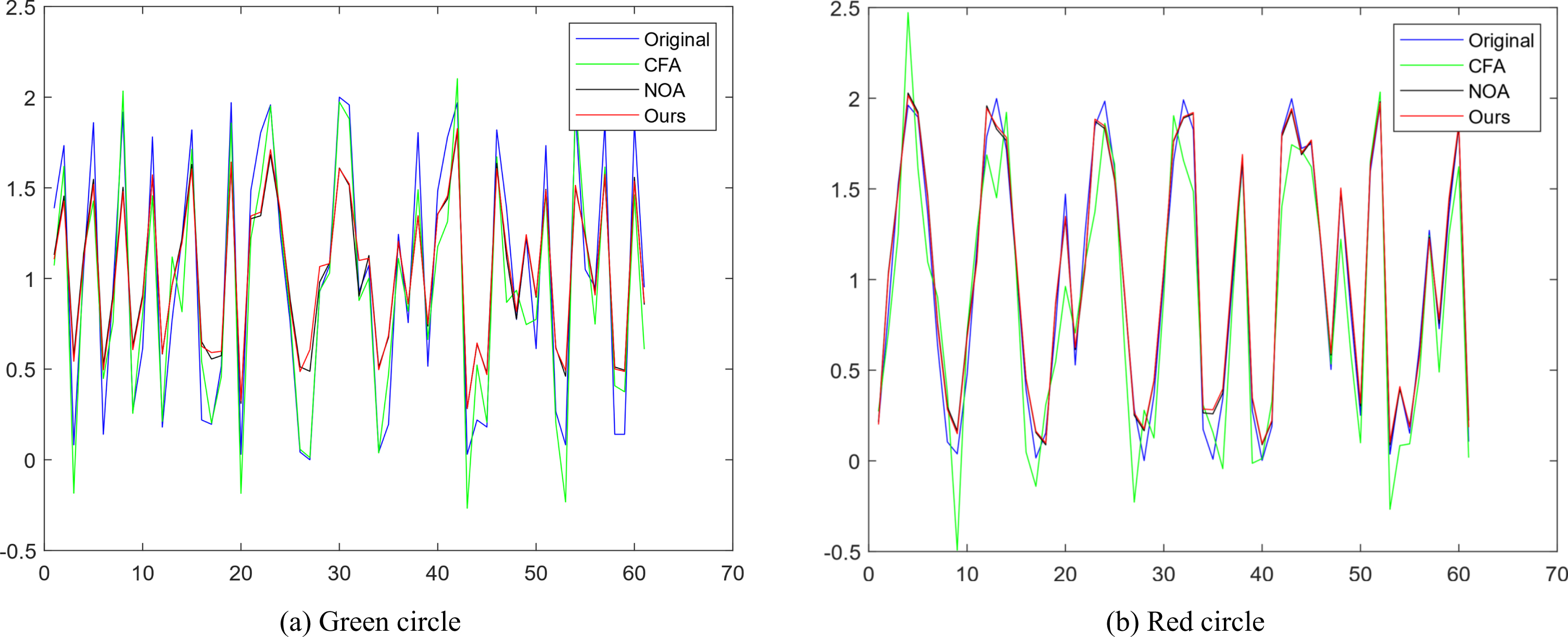
Profile plots corresponding to the green and red circles in Fig. 7a.
In this subsection, we give some CT images reconstructed from the circle cone-beam projection data measured by flat-plane detectors to verify the effectiveness of our method, and compare the results with those of the Feldkamp-Davis-Kress (FDK) algorithm [7] and Noo’s algorithm (NOA) [17], where we extend the weighting function of NOA such that it can be used to reconstruct circle cone-beam CT images.
The CFA method is implemented by calling the “FDK-CUDA” algorithm in the ASTRA Toolbox [27]. The codes for implementing the NOA and our method are also almost the same except for the weighting functions. The hyper-parameter d in NOA [17] is set as d = 8π/180.
We use 25 continuous CT images of size 512 × 512 from the “the 2016 NIH-AAPM-Mayo Clinic Low Dose CT Grand Challenge” [29] to resemble one test object. The parameters for the circle cone-beam CT with the flat-plane detector are set as follows: u = [-906 : 1 :906], v = [-76 : 1 :76], R o = 500, D = 863 and λ = [0 : 1 :274] × π/180. The 13th slice of the object is assumed to lie in the plane z = 0 (i.e. the plane formed by the trajectory of the X-ray source). The “astra_create_proj_geom” function with parameter “cone” in the ASTRA Toolbox is used to generate the sinogram.
In Fig. 9, the 8th sliced images of the test object reconstructed by FDK, NOA and ours are presented. From Fig. 9b, we can observe that there exist some artifacts in the CT images reconstructed by FDK. Some discretization errors can be observed from Fig. 9c reconstructed by NOA. Compared to Fig. 9b and Fig. 9c, the CT image reconstructed by our method has less artifacts and discretization errors as can be observed in Fig. 9d. To better observe the differences of each CT images, the absolute error images of Fig. 9 are shown in Fig. 10, where we can observe that NOA has more stripe errors than ours.
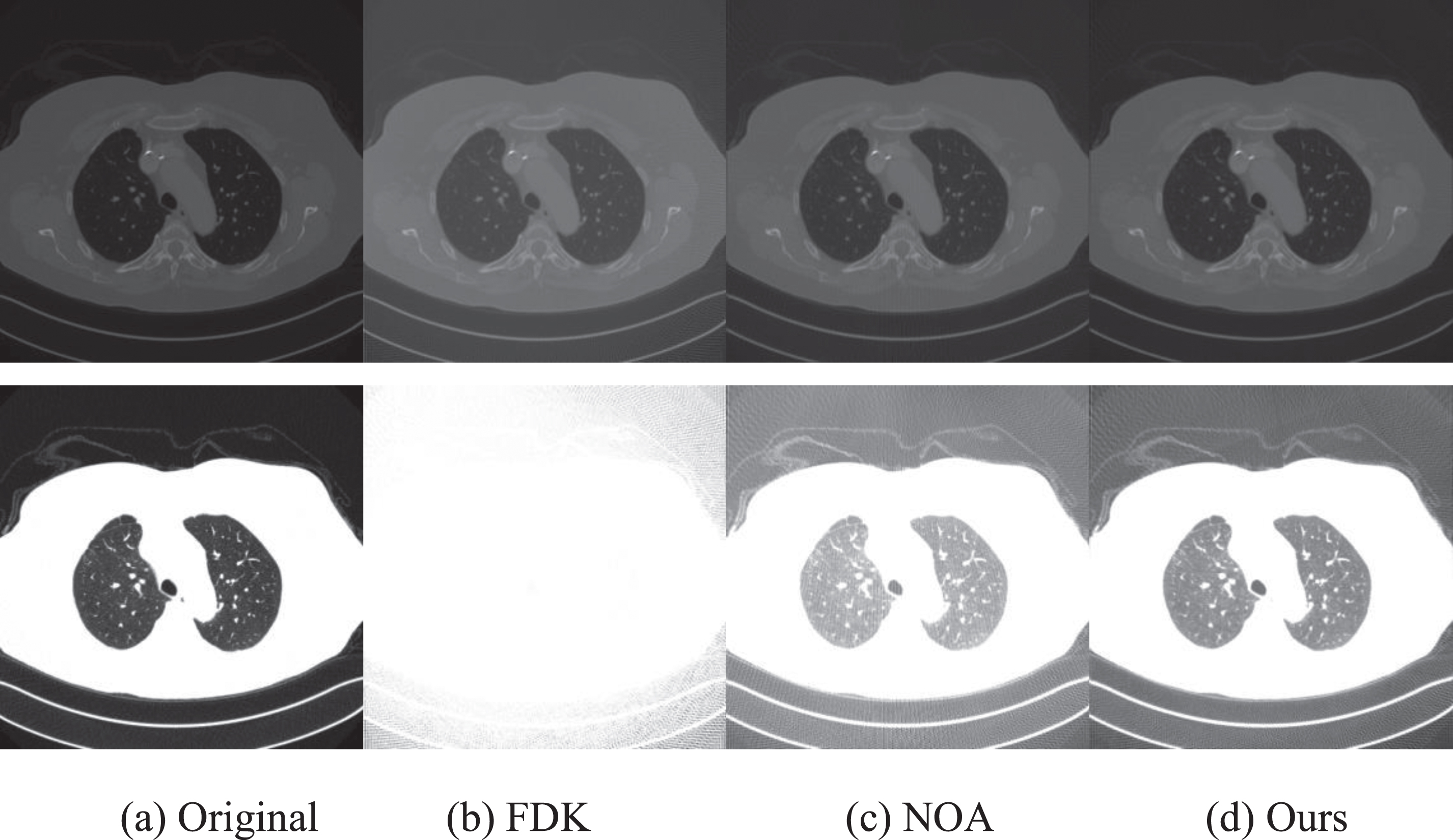
Sliced CT images reconstructed from circle cone-beam projection data and their enhanced versions, where the intensities were linearly stretched in [0, 1] and the display widths of row 1 and row 2 are [0, 1] and [0, 0.2], respectively.
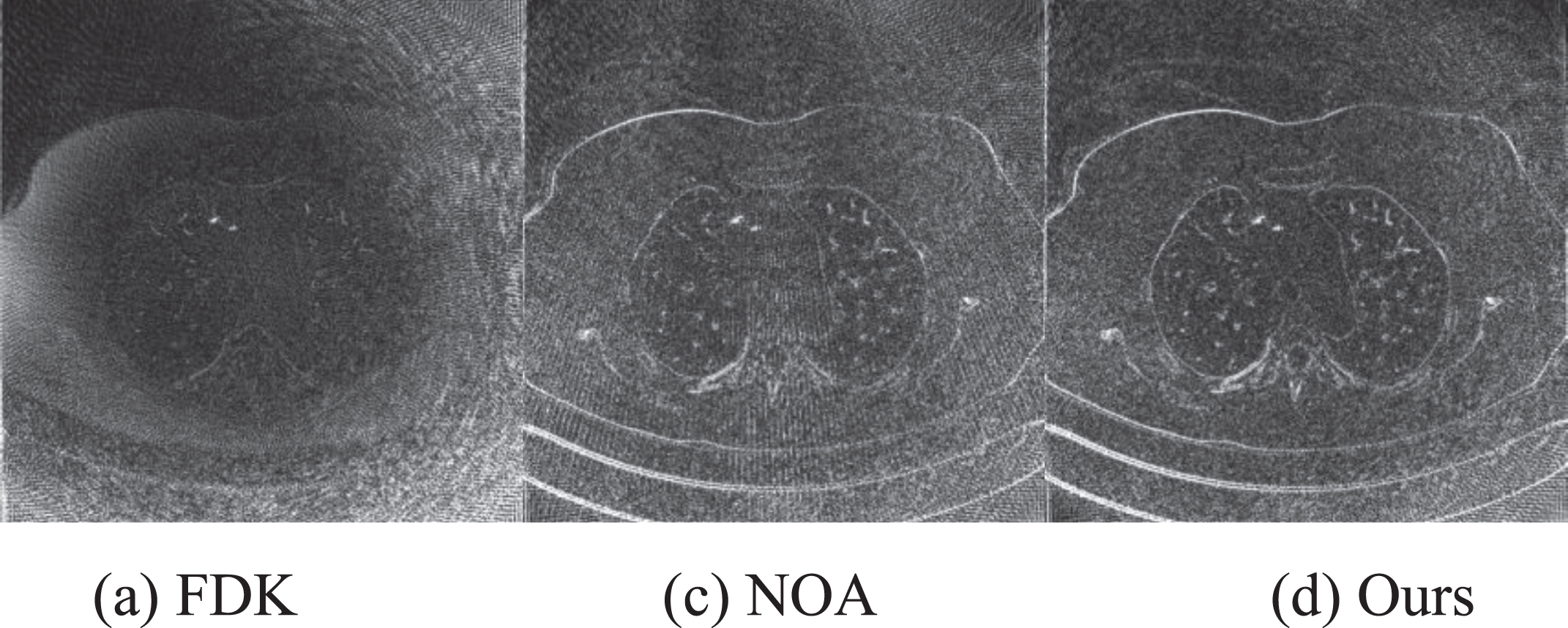
Absolute error images of Fig. 9, where the intensities were linearly stretched in [0, 1] and the display width is [0, 0.2].
In Table 2, we list the averaged RMSE and SSIM of the 25 reconstructed images by CFA, NOA and ours, respectively. We can observe that the CT images reconstructed by our method has the lowest RMSE and the largest SSIM in average.
The averaged RMSE and SSIM of CT Images reconstructed by FDK, NOA and ours
In this paper, we proposed a new weighting function to deal with the redundant projection data for the arc based fan-beam CT algorithm, which was obtained by applying Katsevich’s helical CT formula [21] to 2D fan-beam CT reconstruction. By extending the arc based algorithm to circle cone-beam geometry with the proposed weighting function, we also obtained a new algorithm for circle cone-beam CT reconstruction. Experiments showed that our methods outperform the related algorithms for fan-beam and circle cone-beam CT reconstructions.
The main differences between Noo’s algorithm [17] and ours are the weighting functions. One advantage of our weighting function over Noo’s is that ours has no super parameter while Noo’s has a super-parameter d, which greatly influences its performance. Moreover, for circle cone-beam CT, the optimal value of d for each slice may be different and so is somewhat hard to tune.
Our study performs experiments only on the simulated data. The main differences of simulated CT and real CT are the ways to obtain the sinograms. For simulated CT, sinograms are generated by discretizing the line integral equation (11). For real CT, sinograms are obtained by measuring the intensities of the X-ray beam passing through the object, in which the measurements may be impacted by many factors and so the obtained sinograms are not strictly consistent with equation (11). For example in [30], the X-ray beam consisting of photons at different energies may result in estimating the photon numbers inaccurately; the detectors and the X-ray source are not real dots and thus the measured photons are from a bundle of lines rather than a single line; the photons from the source may be scattered and can’t reach the detectors. Besides, due to the properties of photons, noise is inevitable during the measuring process. Though there exist a lot of differences between the simulated data and real data, experiments on simulated data are still meaningful since it can not only verify the effectiveness of the proposed algorithm, but also enable us to investigate individually the impact of these factors that can’t be identified in real data.
Footnotes
Acknowledgments
This work was supported partly by National Natural Science Foundation of China (Nos.12001381, 61871274 and 61801305), Peacock Plan (No. KQTD2016053112051497), Shenzhen Key Basic Research Project (Nos. JCYJ20180507184647636, JCYJ20170412104656685, JCYJ2017081809410 9846, and JCYJ20190808155618806), Chongqing Natural Science Foundation of China (No. cstc2019jcyj-msxmX0060), key project of science and technology research program of Chongqing Education Commission of China (KJZD-K202001503).
Appendix A. Algorithm for circle cone-beam CT with flat-plane detectors
As can be observed from Fig. A-1, we obtain the following equations.
We also have
By the Law of Sines, we have
Therefore,
Note that
From Fig. 3a, we can observe that
Substituting equation (A.6) into equation (12), we can get
Canceling the factors
Appendix B. Algorithm for calculating one endpoint of a chord
Let (R
o
cos λ0, R
o
sin λ0) and (R
o
cos λ1, R
o
sin λ1) be the two end-points of a chord on a circle with radius r = R
o
and (x
1, x
2) be a point on the chord. Then, we have
where t ∈ [0, 1]. Solving equation set (B.1), we have
Thus, we can get λ1 by λ1 = arccos(cos λ1), where λ1 needs to be changed by λ1 = 2π - λ1 when sin λ1 < 0.