



Abstract
Occupational therapy has a distinctive body of empirical and theoretical knowledge, and one primary repository of this knowledge is refereed journals. Several key occupational therapy journals publish quantitative and qualitative studies as well as differing article types (e.g., editorials, opinion pieces, letters to the editor, conference abstracts, book reviews). Examples of occupational therapy journals with long histories of publication are the American Journal of Occupational Therapy (AJOT), published 1947–present; Canadian Journal of Occupational Therapy (CJOT), 1933–present; British Journal of Occupational Therapy (BJOT), 1938–present; and Australian Occupational Therapy Journal (AOTJ), 1952–present. OTJR: Occupation, Participation and Health was first published in 1980. Occupational therapists also publish in related journals including JAMA, Stroke, Journal of Hand Therapy, Child Care Health and Development, International Journal of Rehabilitation Research, Archives of Physical Medicine and Rehabilitation, Clinical Rehabilitation, and Journal of Rehabilitation Research and Development (Potter, 2010; Rodger, McKenna, & Brown, 2007).
With the advent of electronic databases and greater publication access using Web-based search engines, a new field of study has evolved, bibliometrics, which involves the statistical analysis of publications (e.g., journals, books) to “measure the ‘output’ of individuals/research teams, institutions, and countries, to identify national and international networks, and to map the development of new (multidisciplinary) fields of science and technology” (Organisation for Economic Co-operation and Development, 2002, p. 204). Bibliometrics is also used to “uncover characteristics, patterns, and relationships to demonstrate individual investigator or research team productivity, quality, or impact” (Carpenter, Cone, & Sarli, 2014, p. 1161). Two frequently used bibliometric analytic approaches are content analysis and citation analysis. Bibliometrics are important for several reasons, including ascertaining areas of research strength and weaknesses in a specific discipline, classifying top-performing journals in a subject area, and identifying top researchers in a particular subject area. They also are a source of evidence of return on investment to funding bodies, industry, and the general public. All of these reasons are germane to the field of occupational therapy practice, education, and research.
The most widely known quantitative metric applied to peer-reviewed journals is the impact factor (IF). For an IF to be calculated, journals must be included in one of two Thomson Reuters databases: the Science Citation Index Expanded (SCI–Expanded) and the Social Sciences Citation Index (SSCI). Some occupational therapy–specific journals are included in SCI–Expanded and SSCI and have an IF (e.g., AJOT, CJOT, BJOT, AOTJ, OTJR, Physical and Occupational Therapy in Pediatrics [POTP], Occupational Therapy International [OTI], Hong Kong Journal of Occupational Therapy [HKJOT], and Scandinavian Journal of Occupational Therapy [SJOT]), whereas other peer-reviewed occupational therapy journals published in English are not included (e.g., Occupational Therapy in Health Care [OTHC]; Occupational Therapy in Mental Health [OTMH]; Open Journal of Occupational Therapy [OJOT]; Physical and Occupational Therapy in Geriatrics [POTG]; Journal of Occupational Therapy, Schools and Early Intervention; South African Journal of Occupational Therapy [SAJOT]; and Indian Journal of Occupational Therapy [IJOT]).
Highly cited articles (HCA) in a specific field are sometimes referred to as classic papers or top publications (Korevaar & Moed, 1996). The analysis of HCA in a profession provides a unique window into which specific authors, articles, and topics influence that sphere of knowledge and research. The purpose of this study is to present the bibliometric analysis of occupational therapy articles and authors published from 1991 to 2014, included in SCI–Expanded and SSCI, and cited >100 times. We examined the publication year, journals, authors, institutions, countries, life citation cycles, and traits of occupational therapy HCA.
Method
Data were obtained from the online databases SCI–Expanded and SSCI, accessible through the Thomson Reuters Web of Science Core Collection (WSCC; until March 5, 2016). Occupational therapy, occupational therapist, and occupational therapists were terms searched in publication titles, abstracts, and author key words of articles published from 1991 to 2014. KeyWords Plus, which substantially augments title-word and author–key word indexing, supplied additional search terms extracted from the titles of article references (Garfield, 1990). Only the document type article was considered in the search. Conference abstracts, book reviews, letters to the editor, and editorials were excluded because they did not report sufficient study details.
In total, 6,486 articles were found. Article yearly citations and journal IF (IF2014) were recorded from the 2014 Journal Citation Reports (JCR). Two additional filters, number of citations until 2014 (TCyear; Wang, Fu, & Ho, 2011) and front page text of each article (Fu, Wang, & Ho, 2012), were applied to retrieve HCA. Total citation number (from initial publication to December 2014) of each article was obtained from WSCC and recorded as the TC2014 metric for each article. Front page was used to identify articles with specific key words on their front page (e.g., in titles, abstracts, and author key words; Fu et al., 2012).
Sixty-three articles had a TC2014 ≥ 100 and were categorized as occupational therapy HCA. The total number of citations in 2014 alone is referred to as C2014, whereas CPPyear refers to citations per publication (CPP2014 = TC2014/publication; Chuang & Ho, 2015). The advantage of using TCyear, Cyear, and CPPyear is that they are invariable and ensure repeatability compared with the citation index from WSCC (Fu et al., 2012). To examine the publication performance of specific authors, five indicators were proposed by Ho and colleagues (Chiu & Ho, 2005; Ho, 2014a), including total publications (TP), collaborative publications (CP), first-authored publications (FP), and corresponding-authored publications (RP).
Although some articles used occupational therapy, occupational therapist, or occupational therapists in article titles, abstracts, or key words, they did not relate to the occupational therapy discipline. Thus, articles that could be found only through KeyWords Plus were excluded (n = 5), leaving 58 HCA. These 58 HCA were then manually reviewed by two of the authors independently. The two authors then came together and compared the articles that had been considered as not falling into the occupational therapy domain. When there was disagreement, the authors discussed the specific articles until a mutual decision was made whether to include or exclude them. If the article did not deal directly with occupational therapy practice or did not report the results of a study directly relevant to the discipline of occupational therapy, it was rejected. The Occupational Therapy Practice Framework: Domain and Process (3rd ed.; American Occupational Therapy Association, 2014) was also used as a reference point for which articles were included and excluded. The end result was 31 articles included in the study and 27 excluded. The 31 articles (0.48% of 6,486 total articles) were selected as HCA that were specifically relevant to occupational therapy.
Results
Publication Year
A total of 31 occupational therapy–specific HCA with a TC2014 ≥ 100 were published in SCI–Expanded and SSCI from 1991 to 2010 (Supplemental Table 1, available online at http://otjournal.net; navigate to this article, and click on “Supplemental”). The highest TC2014 retrieved was 512, and the average TC2014 was 162. Figure 1 illustrates the distribution of these 31 HCA over years of publication and citations per publication (CPP2014; Chuang & Ho, 2015). No HCA were published in 1995, 1996, 2003, and 2008.
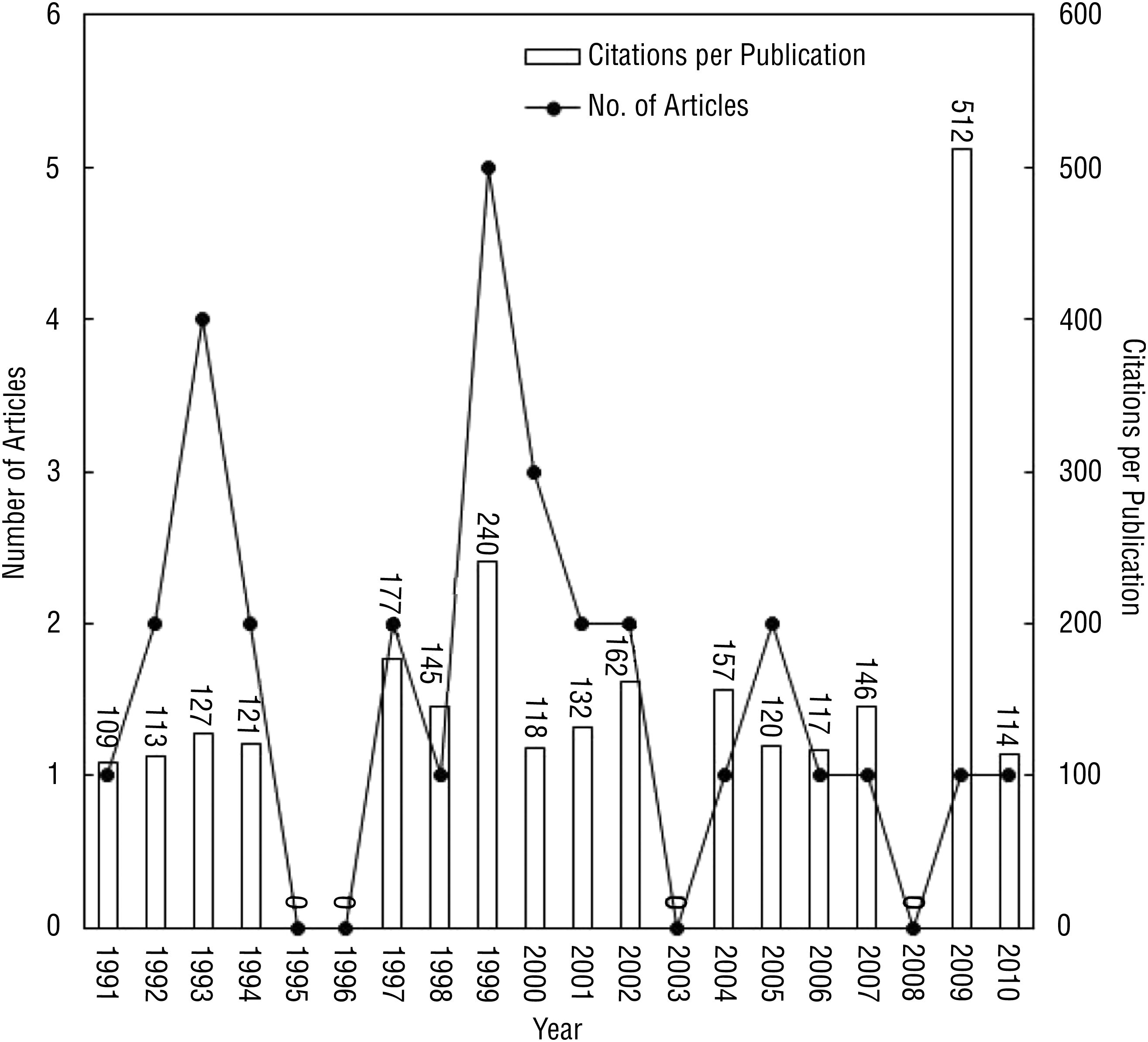
Number of occupational therapy highly cited articles and citations per publication, by year.
In 2009, only one article, “Early Physical and Occupational Therapy in Mechanically Ventilated, Critically Ill Patients: A Randomised Controlled Trial” (Schweickert et al., 2009), by 16 authors from the Universities of Pennsylvania, Chicago, and Iowa, had a CPP2014 ≥ 100 (TC2014 = 512). In 1999, 5 articles had a CPP2014 ≥ 100, including “Prevention of Falls in the Elderly Trial (PROFET): A Randomised Controlled Trial” (Close et al., 1999), by six authors from King’s College Hospital, United Kingdom (TC2014 = 456, second place), and “Rehabilitation of Persons With Traumatic Brain Injury” (Ragnarsson et al., 1999), by 16 authors from 18 American institutions (TC2013 = 300, third place).
The earliest HCA, published in 1991, was titled “Occupational Science: Academic Innovation in the Service of Occupational Therapy’s Future” (Clark et al., 1991), written by eight authors from the University of Southern California (USC; TC2014 = 108). The most recent HCA was published in 2010: “Early Physical Medicine and Rehabilitation for Patients With Acute Respiratory Failure: A Quality Improvement Project” (Needham et al., 2010), by eight authors from Johns Hopkins University (TC2014 = 145).
Journals and Web of Science Categories
JCR 2014 indexed 8,618 journals in 176 WSCC categories in SCI–Expanded and 3,143 journals in 56 WSCC categories in SSCI. The occupational therapy HCA were published in 16 journals listed in 12 WSCC categories. Of these 16 journals, 9 (56%) published only 1 HCA: American Journal of Psychiatry (IF2014 = 12.295), Schizophrenia Bulletin (IF2014 = 8.450), Neurology (IF2014 = 8.185), Journal of Pediatrics (IF2014 = 3.790), Journal of Autism and Developmental Disorders (IF2014 = 3.665), Age and Ageing (IF2014 = 3.642), Gerontologist (IF2014 = 3.231), Social Science and Medicine (IF2014 = 2.890), and Archives of Physical Medicine and Rehabilitation (IF2014 = 2.565). AJOT (IF2014 = 1.532) published the largest number of HCA, 8 articles (26% of 31 articles), followed by 3 articles (10%) in Journal of the American Geriatrics Society (JAGS; IF2014 = 4.572) and 2 articles (6%) each in Lancet (IF2014 = 45.217), JAMA (IF2014 = 35.289), BMJ (IF2014 = 17.445), Stroke (IF2014 = 5.761), and Clinical Rehabilitation (IF2014 = 2.239).
Publication Performance: Countries
The 31 HCA were distributed in seven countries: United States (20 articles), Canada (3), United Kingdom (3), Australia (2), Netherlands (1), New Zealand (1), and Sweden (1). None of the 31 articles were internationally collaborative.
Publication Performance: Institutions
The 31 HCA with a CPP2014 ≥ 100 were affiliated with a total of 65 institutions in seven countries. Fourteen (45%) were single-institution (SP) articles originating from a total of 13 institutions, and 17 (55%) were cross-institutional collaborative articles originating from a total of 56 organizations. The 65 institutions were in the United States (40), United Kingdom (7), Canada (6), Australia (4), New Zealand (4), the Netherlands (2), and Sweden (2).
The nine institutions that published at least 2 articles with a CPP2014 ≥ 100 are listed in Supplemental Table 2, available online. USC ranked at the top for publishing the largest number of occupational therapy HCA (TP = 3), single-institution articles (SP = 2), first-authored articles (FP = 3), and corresponding-authored articles (RP = 3); USC also ranked sixth in cross-institutional collaborative articles (CP = 1). Five institutions (University of Wisconsin, United States; University of Sydney, Australia; Concord Repatriation General Hospital, Australia; University of Iowa, United States; University of Maryland, United States) published 2 cross-institutional collaborative articles, whereas the other 51 institutions each published 1 only.
Publication Performance: Authors
Figure 2 reports the specific authors of the 31 occupational therapy HCA according year of publication. The total number of citations each HCA received as of 2014 is also reported in Figure 2.
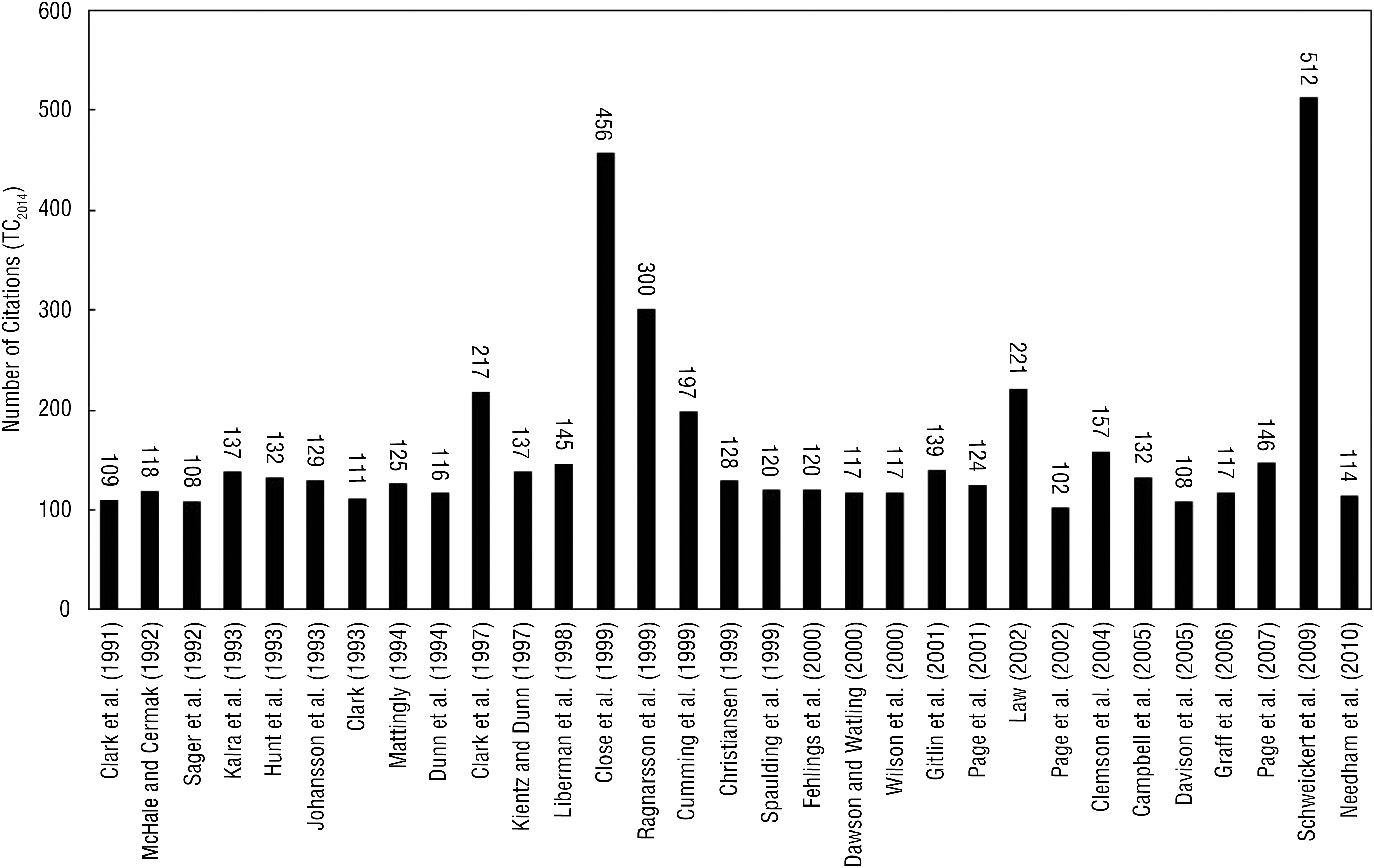
Number of citations until 2014 (TC2014) and authors of occupational therapy highly cited articles in order of publication year.
Ho (2014a) developed the Y-index as an indicator of publication intensity and characteristics of contributing authors, institutions, and countries. The Y-index provides insight into the features of contribution to journal article publication. The construction of the Y-index involves two parameters (j, h) to assess both publication intensity and contribution characteristics as a single index. It relates to numbers of first-author publications (FP) and corresponding-author publications (RP), defined as follows:


Authors with a high j have more publications as first or corresponding author (leadership roles); h differentiates the nature of the leadership role. An h > 0.7854 indicates more corresponding-author publications, h = 0.7854 shows the same number of first- and corresponding-author publications, and h < 0.7854 signifies more first-author publications. When h = 0, j is the number of first-author publications, and when h = π/2, j is the number of corresponding-author publications.
Using the Y-index, we analyzed the 31 articles by 156 authors in occupational therapy. Only 24 (15%) of the 156 authors were both first and corresponding authors of the HCA. Four (2.6%) of 156 authors had an h > 0.7854, and four (2.6%) had an h < 0.7854. Twenty-three (15%) authors had the same numbers of first- and corresponding-author articles (h = 0.7854), and 125 (80%) authors were located on the origin. Figure 3 displays the distribution of the 156 authors; j Cos h and j Sin h are the x and y coordinate axes. Each dot represents one value that could be one author or many authors when they had the same publication intensity and characteristics.
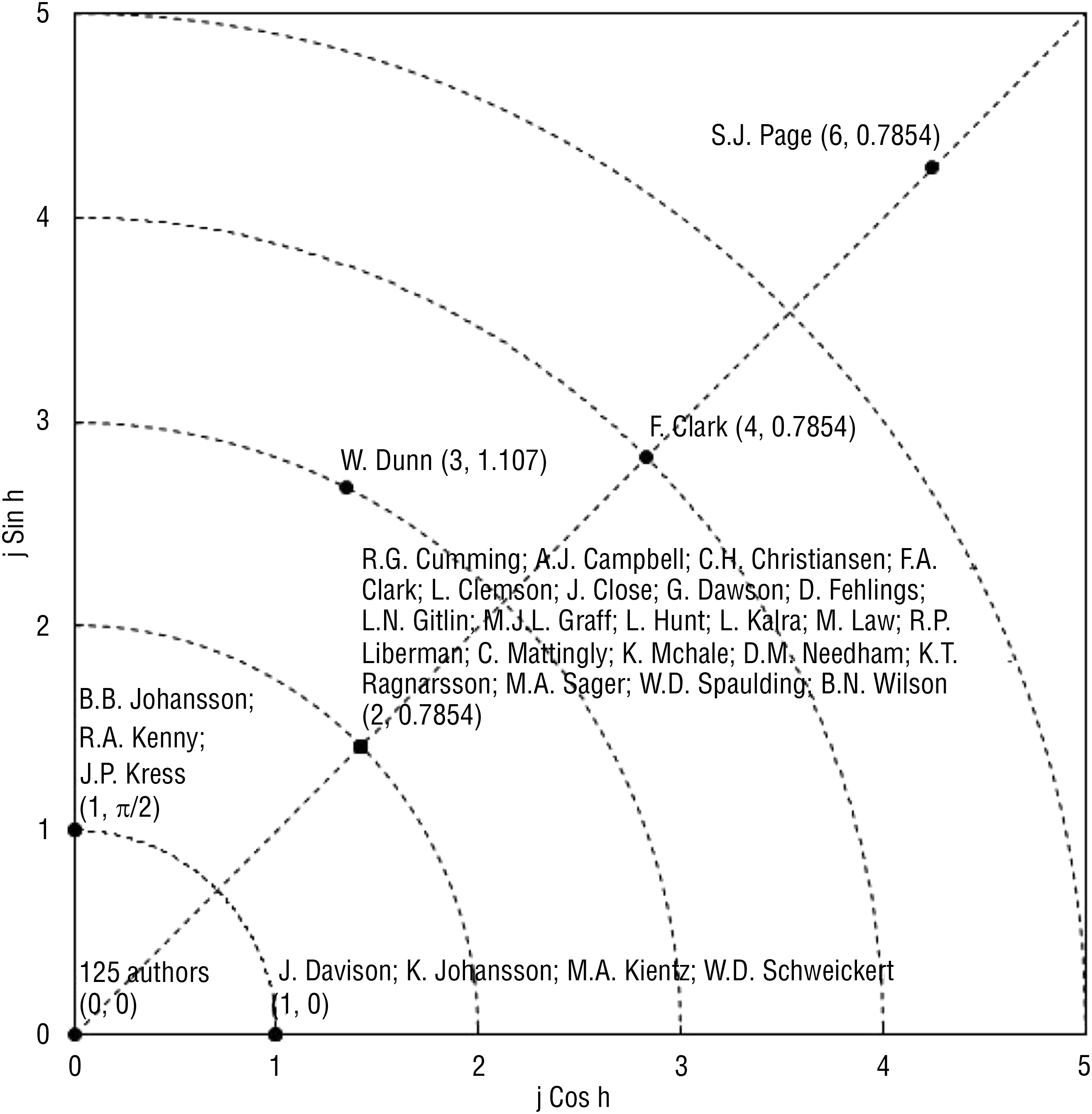
Distribution of 156 occupational therapy authors by Y-index.
The author with the highest publication intensity was S. J. Page, with a j of 6. Page published 3 articles as both first and corresponding author using the affiliations of Kessler Medical Rehabilitation Research and Education Corporation in 2001 and 2002 and University of Cincinnati in 2007. Publication characteristics constant, h, can help obtain the proportion of corresponding-author articles (RP) to first-author articles (FP), which can identify author performance differences, particularly when author j scores are the same. For example, the j scores of B. B. Johansson, R. A. Kenny, J. P. Kress, J. Davison, K. Johansson, M. A. Kientz, and W. D. Schweickert were the same, at 3, indicating that they had the same publication intensity. However, the h of Johansson, Kenny, and Kress was π/2, indicating that each published only corresponding-author articles. The h of Davison, Johansson, Kientz, and Schweickert was 1, suggesting that they published only first-author articles. Additionally, W. Dunn published both first- and corresponding-author articles, with an index of h > 0.7854.
Figure 4 graphically reports the yearly number of citations of the top seven most frequently cited occupational therapy articles and authors (TC2014 > 150). Examination of the citation patterns reveals an increase in the number of citations for articles starting around 2000 onward and another slight increase in the frequency of citations from 2010 onward. This finding could be attributable in part to the inclusion of a larger number of occupational therapy journals in the SCI–Expanded and SSCI databases. Schweickert et al. (2009) was by far the most frequently cited occupational therapy journal article, with a total of 512 citations as of 2014.
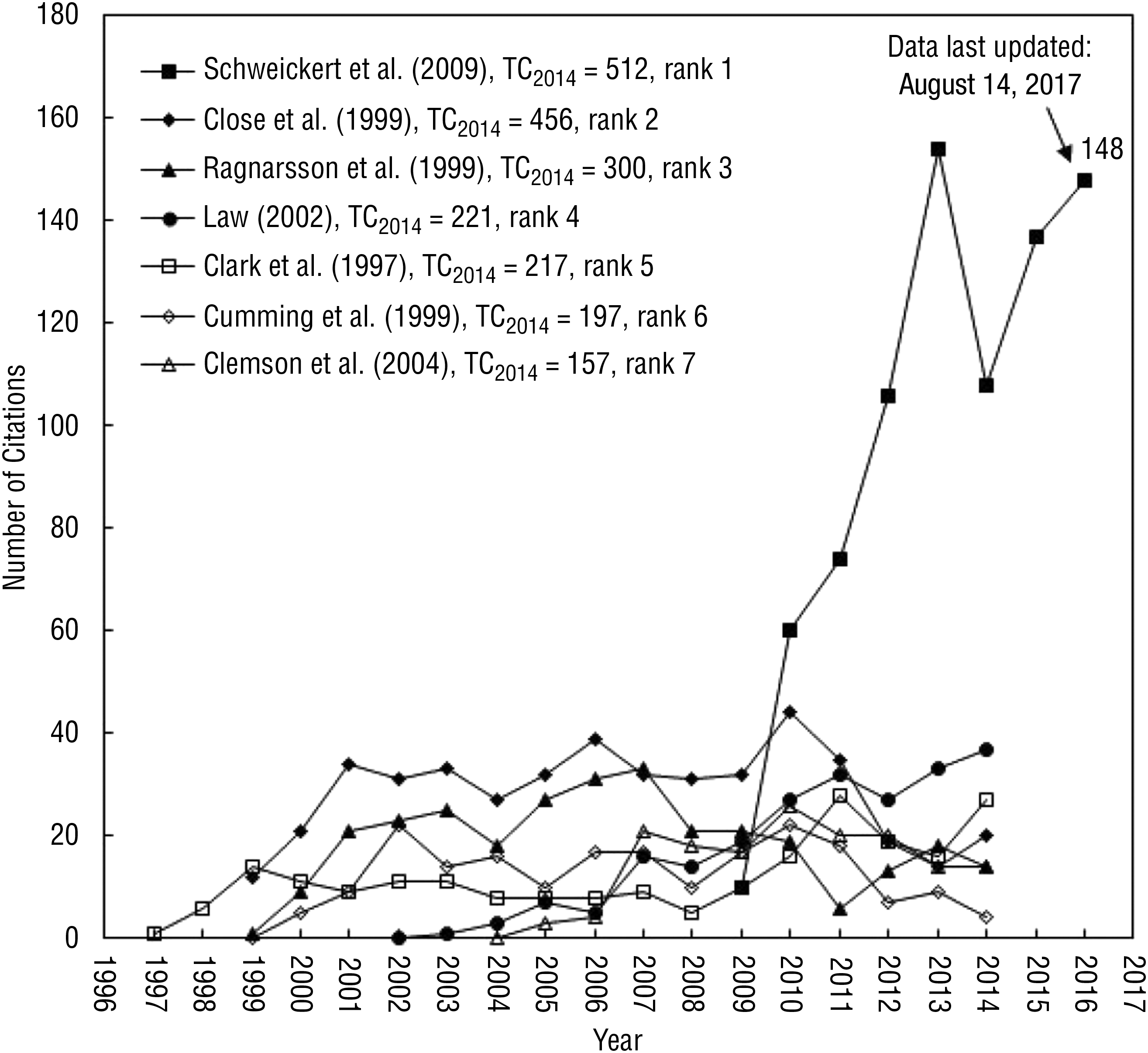
Yearly number of citations of the seven most frequently cited occupational therapy articles and authors (number of citations until 2014 [TC2014] > 150).
Discussion
Publication Year
Between 1991 and 2010, 31 occupational therapy–specific articles with >100 citations were published in journals indexed in SCI–Expanded and SSCI. No HCA were published during the most recent 4 years of the search (2011–2014). It is generally accepted that there is a time span after article publication for citations to accumulate (Solomon, Laakso, & Bjork, 2013). It appears to take a minimum of 4–5 years for an article to be published, read and integrated, and cited in other researchers’ work accepted for publication in peer-reviewed journals listed in SCI–Expanded and SSCI (Dašić, Moldovan, & Grama, 2015). Therefore, one could hypothesize that the older the article publication date, the better its potential for having a high number of citations (Björk & Solomon, 2012).
No occupational therapy HCA were published before 1991. One potential reason is that electronic versions of such articles were not common at that time or were not available for searching in electronic databases. Other health care professions, including medicine and nursing, have a longer tradition of publishing articles with high impact (Lefaivre, Shadgan, & O’Brien, 2011; Wong, Tam, Wong, & Cheung, 2013). Moreover, time since publication may not be the most significant reason an article is highly cited (Chen & Ho, 2015). The year with the most published occupational therapy articles cited >100 times was 1999, with 5 articles, followed by 1993 (4 articles) and 2000 (3 articles). No occupational therapy HCA were published in 1995, 1996, 2003, and 2008.
The reasons journal articles are highly cited may relate to article topic and type. For example, articles that address frequently used interventions would likely be cited more frequently. Similarly, review articles (e.g., scoping, integrative literature, and systematic reviews) are often more frequently cited than journal articles reporting original research in a subject area (Harzing & Alakangas, 2016). It has also been reported that articles with shorter titles (Paiva, Lima, & Paiva, 2012) and titles with colons and acronyms get more citations (Jacques & Sebire, 2010). Open access journal articles commonly have higher citation rates compared with subscription-based journal articles (Wohlrabe & Birkmeier, 2014).
Journals
Thirty-one occupational therapy HCA were published in 16 journals listed in SCI–Expanded and SSCI. AJOT published the largest number of HCA, with 8 articles (26% of 31 articles), followed by JAGS, with 3 (10%). Lancet, JAMA, BMJ, Stroke, and Clinical Rehabilitation each published 2 HCA (6%). Occupational therapy HCA were published in both high- and low-IF journals. A large number of HCA were published in non–occupational therapy–specific journals (Schroeder, 2008), highlighting the need for occupational therapy students, educators, clinicians, and researchers to search for relevant literature outside the sphere of occupational therapy–specific peer-reviewed journals to source empirical evidence (Bennett et al., 2007; Rodger et al., 2007). Apart from AJOT and OTJR, which traditionally have had an IF, most of the occupational therapy journals obtained an IF only in recent years: AOTJ in 2009, SJOT in 2009, HKJOT in 2009, POTP in 2012, OTI in 2012, CJOT in 2012, and BJOT in 2013.
Publication Performance: Countries
The 31 occupational therapy HCA were published in seven different countries: United States (20); Canada and the United Kingdom (3); Australia (2); and 1 each in the Netherlands, New Zealand, and Sweden. That 64% of HCA were published in the United States was not surprising, given that this country has the largest number of occupational therapy university programs, which employ many academic staff with doctoral degrees (Li, Shankar, & Tang, 2009). However, even with the much smaller number of education programs and occupational therapists with doctoral qualifications involved in research in Australia, Canada, and the United Kingdom compared with the United States, these three countries have been major contributors to the occupational therapy body of knowledge through journal publication. The journals published by the national associations of these countries (e.g., AJOT, CJOT, AOTJ, BJOT) are another factor influencing the high number of published articles, because they were well known to the membership of those organizations and were their flagship publications.
Publication Performance: Countries and Institutions
A total of 65 institutions in seven countries (United States, n = 40, 61.5%; United Kingdom, n = 7, 10.8%; Canada, n = 6, 9.2%; Australia, n = 4, 6.2%; New Zealand, n = 4, 6.2%; the Netherlands, n = 2, 3.1%; Sweden, n = 2, 3.1%) were affiliated with the 31 HCA. As an institution, USC in the United States dominated the publishing arena for high-ranking occupational therapy journal articles. USC ranked at the top for publishing the largest number of HCA, single-institution articles, first-authored articles, and corresponding-authored articles. Five institutions published 2 cross-institutional collaborative articles: University of Wisconsin, United States; University of Sydney, Australia; Concord Repatriation General Hospital, Australia; University of Iowa, United States; and University of Maryland, United States. Considering the much smaller number of occupational therapy education programs and practicing occupational therapists in Australia compared with the United States, the number of HCA published by Australian institutions was notable.
Publication Performance: Authors
Ho’s (2014a) Y-index metric of both publication intensity and characteristics of contributing authors, institutions, and countries has been applied in HCA in biomass research (Chen & Ho, 2015), materials science (Ho, 2014b), and health care sciences (Hsu & Ho, 2014). Three occupational therapy authors from the United States with >100 citations had the highest Y-index: (1) Page (Y-index = 6), Associate Professor, Division of Occupational Therapy, Ohio State University; (2) Clark (Y-index = 4), Associate Dean, Chair, and Professor, Division of Occupational Science and Occupational Therapy, USC; and (3) Dunn (Y-index = 3), Professor and Chair, Department of Occupational Therapy Education, University of Kansas Medical Center. Although the article written by Close et al. (1999) has a CPP2014 = 100, Close was not an occupational therapist by background, and this finding might imply that occupational therapists need to work in a team to produce high-impact articles.
Page published 3 journal articles that received >100 citations: Page, Levine, and Leonard (2007; TC2014 = 146); Page, Levine, Sisto, and Johnston (2001; TC2014 = 124); and Page, Levine, Sisto, Bond, and Johnston (2002; TC2014 = 102). All three articles by Page and colleagues were published in non–occupational therapy–specific journals. Clark also published 3 articles that received >100 citations: Clark et al. (1997; TC2014 = 217), Clark (1993; TC2014 = 109), and Clark et al. (1991; TC2014 = 108). It is notable that the study published by Clark et al. (1997) in JAMA received the largest number of citations of all occupational therapy publications. Dunn authored 2 publications with >100 citations: Kientz and Dunn (1997; TC2014 = 139) and Dunn, Brown, and McGuigan (1994; TC2014 = 116). Of all HCA published by the three authors with the highest Y-index, only 1 was a single-authored article: Clark (1993).
Limitations
Data for this bibliometric analysis were obtained only from the online databases of SCI–Expanded and SSCI. Based on the 2014 JCR, 8,618 journals in 176 WSCC categories in SCI–Expanded and 3,143 journals in 56 WSCC categories in SSCI were indexed. Therefore, only 36.5% of the journals in WSCC were included in the analysis for this study. In addition, journals not indexed in WSCC were excluded from this bibliometric analysis. It is estimated that WSCC has only 15% of all English-language indexed journals (Carpenter et al., 2014). It is thus possible that key occupational therapy journal articles were missed or excluded from this analysis.
Another limitation is that if an article was not published in an occupational therapy journal listed in the SCI–Expanded or SSCI database or the authors did not identify themselves as an occupational therapist, then the article was not included as part of the search output. Several occupational therapy–specific journals are not included in WSCC: OTHC, OTMH, SAJOT, IJOT, POTG, and OJOT. It is also acknowledged that occupational therapy–related high-impact research that was interdisciplinary and published in interdisciplinary journals was not included in this review.
Only the document type article in WSCC was included in this bibliometric analysis. Other document categories (e.g., conference abstracts, book reviews, letters to the editor, editorials) were excluded because they may not have yielded sufficient study details. An additional limitation relates to temporal coverage—occupational therapy articles published before 1991 and after 2014 were not included in the current bibliometric examination. Finally, it was not possible to exclude self-citations by authors; currently there is no method within the data extraction process for the Web of Science to separate self-citations.
Future Research
Future research could include the examination of occupational therapy HCA in individual countries to determine the most research-productive institutions and authors from a national perspective. This research would provide valuable information for national and international benchmarking purposes. It is also recommended that a bibliometric analysis of HCA specific to occupational therapy practice areas (e.g., neurology, pediatrics, mental health, geriatrics, rehabilitation, community-based care) or subject areas (e.g., health promotion, population health, activity participation, occupational performance, occupational science) be completed so that key journals, institutions, and authors in these areas can be identified.
Implications for Occupational Therapy Research
This bibliometric analysis has the following implications for occupational therapy research:
The number of occupational therapy HCA continues to grow.
The majority of HCA were published by U.S. authors in AJOT.
Notable numbers of HCA were also published by Australian, Canadian, and British authors.
Several HCA were published in non–occupational therapy journals with a high IF.
Ongoing tracking of high-impact occupational therapy publications is recommended to facilitate identification of research strengths and weaknesses of the discipline, recognition of top-performing journals that publish HCA relevant to the occupational therapy field, and identification of high-performing occupational therapy scholars. Such tracking is significant for occupational therapy education, research, education, and scholarly profiles.
Supplemental Material
Supplementary material for Highly Cited Occupational Therapy Articles in the Science Citation Index Expanded and Social Sciences Citation Index: A Bibliometric Analysis
Supplementary material, sj-pdf-1-aot-10.5014_ajot.2017.023747.pdf for Highly Cited Occupational Therapy Articles in the Science Citation Index Expanded and Social Sciences Citation Index: A Bibliometric Analysis by Ted Brown, Sharon A. Gutman, Yuh-Shan Ho and Kenneth N. K. Fong in The American Journal of Occupational Therapy
Footnotes
*
Indicates articles included in the bibliometric analysis.
References
Supplementary Material
Please find the following supplemental material available below.
For Open Access articles published under a Creative Commons License, all supplemental material carries the same license as the article it is associated with.
For non-Open Access articles published, all supplemental material carries a non-exclusive license, and permission requests for re-use of supplemental material or any part of supplemental material shall be sent directly to the copyright owner as specified in the copyright notice associated with the article.
