



Abstract
Participation in natural settings is a critical quality-of-life measure; it is used to classify function, disability, and health (World Health Organization [WHO], 2013) and is linked in research literature to overall well-being for people with and without disabilities (Law, 2002). Families with a child with sensory processing issues, however, face unique challenges to play, leisure, and social participation. In a systematic review of the literature, Koenig and Rudney (2010) found “evidence to suggest that children with difficulty processing and integrating sensory information showed decreased quality and quantity of play skills and social participation” (p. 432). In a 9-yr qualitative study of 275 parents, Cohn, Kramer, Schub, and May-Benson (2014) found that social participation for these children is a main concern among parents seeking sensory integration treatment for their child.
This concern is especially real for families with children having a diagnosis of autism spectrum disorder (ASD), because children with ASD may have accompanying sensory processing and participation challenges. Research has indicated that the prevalence of sensory processing problems in children with ASD is between 40% and >90% (Roley et al., 2015). Issues most frequently reported include difficulties with self-regulation, sensory reactivity, and praxis patterns affecting participation (Roley et al., 2015; Schaaf et al., 2015). The literature not only supports the existence of participation restrictions at the level of the child (Schaaf et al., 2015) but also shows that these restrictions affect family occupations—specifically, what a family chooses to do or not do; how they prepare; and the extent to which their experiences, meaning, and feelings are shared between family members both at home and in the community (Bagby, Dickie, & Baranek, 2012).
Given the established links between participation and well-being, it is essential to find ways to accommodate sensory processing differences and to support participation for these families. Accommodations, accessibility services, environmental changes, and universal design principles can generally serve as intervention and prevention methods to mediate participation restrictions, as outlined in the International Classification of Functioning, Disability and Health (ICF; WHO, 2013). Although social participation of children with sensory processing problems and ASD has become a more frequently examined construct in the literature, less is known about participation specific to community-based settings, especially as it affects the whole family. In particular, museum accessibility literature is limited, and the studies that have been conducted were geared toward the adult population (Langa et al., 2013).
Pilot data in the area of museum accessibility for children with ASD have indicated that their families are motivated to visit museums but face barriers to attendance, such as cost, the level of sensory stimuli in the environment, and negative attitudes toward the unpredictability of their children’s behavior (Langa et al., 2013; Lussenhop et al., 2016). This finding leads us to posit the following questions: Could community-based collaborations be developed that would help mediate participation restrictions for families by addressing the sensory aspects of the environment? Will the minimization of participation restrictions in a community setting thereby enhance well-being for families with children with disabilities such as ASD?
This qualitative study was part of an effort to develop and analyze a specialized sensory-friendly, community-based program geared to the needs of these families at a science museum and then determine its value and its effect on participation. The museum’s sensory-based programming emerged through a partnership between occupational therapists and museum staff. The sensory environment was a joint area of focus because of the overrepresentation of museum visitors with ASD, who typically have sensory processing issues affecting their participation (Schaaf et al., 2015).
People with autism are more likely than the general population to gravitate to the science, technology, engineering, and mathematics fields (Wei, Yu, Shattuck, McCracken, & Blackorby, 2013); therefore, it is not surprising that the museum, with a mission statement of “inspiring a passion for learning about science and technology” (Franklin Institute, 2016, para. 2), welcomes many visitors with ASD and sensory processing differences. The sensory features of the museum and its exhibits present these visitors with multiple challenges, including loud, unexpected sounds; unanticipated vestibular movements from interactive moving exhibits; a busy visual field; and the presence of many other people in close proximity in popular exhibit areas.
Qualitative research methods were chosen for this study to provide the rich narrative piece of clinical reasoning needed to understand the perspectives of families with children with sensory processing differences who visit the museum, complementing scientific and pragmatic considerations. The study’s overarching research question was, After an environmentally adapted museum visit designed specifically for families with children with sensory processing needs, how do parents describe their experience?
Method
Program
The desire of museum staff to help visitors with sensory processing needs have a more successful museum experience led to the creation of Sensory-Friendly Sunday (SFS) events as specialized programming. SFSs are ongoing bimonthly events when the museum opens only for families with children or young adults with sensory processing differences from 8:00 a.m. to 9:30 a.m., when it is typically closed. During this time, exhibit features are modified to reduce sensory stimulation; loud sounds and flashing lights in certain exhibits, for example, are temporarily turned off. Sensory accessibility maps, museum Social Stories, sunglasses, headphones, and therapy putty are available. A cool-down space is equipped with therapy balls, mats, and muted lighting. Trained occupational therapy students run special sensory activities, act as personal tour guides, and support visitor and exhibit interactions. Entrance costs are reduced or waived. During SFS exclusive hours, big crowds are absent, contributing to a less stimulating sensory environment. However, museum modifications and occupational therapy student support remain in place from 9:30 a.m. to 12 p.m. for SFS inclusive hours with the general visitor population.
Design
To help support the quality of the museum’s accessibility programming for visitors with sensory processing differences, occupational therapy faculty initiated a research study aimed at exploring their experience at SFS events. The researchers used a community-based, action research approach to both examine and enhance accessibility and inclusiveness at the museum.
Using principles of naturalistic inquiry, the researchers applied qualitative descriptive methods to facilitate understandings of a selected phenomenon by providing rich descriptive content from the participants’ perspective (Colorafi & Evans, 2016) at SFS events. Qualitative description is well-suited for research about environments because it can provide information about how people feel about a particular health (or community) space and the factors that support or hinder use of activities and services there (Colorafi & Evans, 2016). The features of the current study align with a qualitative descriptive approach, including a broad sampling for diversity, the use of interviews as a primary data collection method, and the inclusion of both descriptive statistical analysis and qualitative content analysis as data analysis techniques (Colorafi & Evans, 2016).
After institutional review board approval and participant consent were obtained, the researchers collected data from each of six separate cohorts of parents across a 1.5-yr period using a community-based action research approach. A major difference between traditional research and community-based action research is that although action research can have purely academic outcomes and may provide the basis for new research knowledge, its primary purpose is to make a difference in and produce some sort of change or development that enhances the lives of the people with whom it is engaged (Stringer, 2014). Its overarching goal is to understand the perspectives of others as the basis of action (Stringer, 2014). This study exemplifies action research because museum staff and researchers collaborated to develop survey and interview questions, and findings from visitor cohorts were regularly shared. The hope was for this process to better meet the needs of young visitors with sensory processing differences and their families by identifying program strengths and vulnerabilities and by guiding its growth and sustainability.
Participants
The researchers sought participants using convenience sampling strategies from a potential applicant pool of SFS museum visitors present during the exclusive SFS hours on six dates evenly dispersed across a 1.5-yr period, beginning with the museum’s first SFS event. Parents self-identified as being in this group. The researchers, who were at a designated table at the event, invited all parents entering the museum for SFS to join the study. Families who agreed to participate signed consent forms and were later thanked with a $10 museum gift card.
Researchers sought parents for the study who were accompanying a child or young adult with a sensory processing difference as evidenced by attendance at the exclusive event. Parents were excluded if they revealed that their child did not receive any special services or special education. Parents were also excluded if they had previously participated in the study or had attended an earlier SFS event.
Measures
Brief Survey.
A five-question written parent survey, administered after the consent form was signed, was intended to acquire factual descriptive data, such as the child’s school placement and contact information. However, only 3 parents of the first cohort of 17 parents were able to finish the survey onsite because of their child’s behaviors. Because encouraging these parents to complete the form onsite would clearly interfere with the quality of their museum visit, all remaining study participants were subsequently asked survey questions verbally during phone interviews.
Interviews.
All recruited participants were contacted for a semistructured, 30-min, in-depth phone interview about their museum experience within 2 wk of their museum visit. Questions were either open-ended, such as asking parents to describe their main reasons for attending, or had follow-up, open-ended probes. Of the 74 potential participants, 46 parents completed the phone interviews. Those who did not participate failed to respond to three contact attempts or did not qualify for the study. Interviews were conducted by pairs of faculty and graduate student researchers trained in research methods, with one member of each team conducting the interview and the other transcribing and contributing to member checks. Interview questions were created to best capture the rich narratives of the families and to minimize researcher bias. Construct validity of the survey and interview instruments used was enhanced by information gleaned from a careful review by content experts and an examination of archival data from other similar programs. Additionally, instrument questions were discussed with museum staff and adjusted to best meet their needs, aligning with an action framework lens.
Other Data Sources.
Stringer (2014) suggested that rigor in qualitative research can be enhanced through data triangulation (multiple sources) as well as peer and member checking to clarify meanings or misperceptions. To enhance this study’s rigor, interview and survey data were augmented with field notes and reflective memos—which served to capture voice intonation, pauses, and other nonlinguistic information during phone interviews and acknowledged potential researcher bias about parenting, disability, or related topics that could affect data collection or analysis.
Data Coding and Analysis
Data analysis of interviews occurred through the use of both open and axial coding, centering on the process of reducing, displaying, and interpreting the information gathered (Carpenter & Suto, 2008). Open coding was used first; this process involved examining parent quotes to identify and label categories, concepts, and properties. Next, axial coding was used to relate and connect codes to each other (Carpenter & Suto, 2008). Faculty researchers coded data independently, reading and rereading interviews to look for topics and words expressed as well as feelings emphasized, and then compared their analyses to enhance reliability of results. An inductive approach was used to identify emerging themes and categories, which were then interrelated through concept mapping (Stringer, 2014). Field notes and reflective memos were reviewed and connected to surveys and interviews as part of data analysis triangulation in an effort to confirm interpretations.
Results
A review of survey data showed that 46 parents participated in the study, representing 60.5% of the 76 parents who signed consent forms. All families were with at least one child or young adult with sensory processing needs. The surveys provided data on 13 children age 2–6 yr; 27 children age 6–12 yr; 9 children age 13–17 yr; and 3 young adults age 18, 21, and 26 yr, respectively. One-third of the participants had never been to any museum before their SFS experience.
The unexpectedly wide age range of offspring of study participants helped create a broader picture of the families motivated to attend this type of event. Most children were receiving or had received occupational therapy services (86%); other services frequently mentioned included speech and language pathology, learning support, applied behavioral analysis, and social skills groups. The number of families in each cohort ranged from 4 to 15 because of variables such as poor weather and competing community events.
Analysis of the interview data led to the emergence of one primary theme (positive family experiences enhanced well-being) and two supporting secondary themes that promoted participation (specific pragmatic considerations and an adjustment of the sensory environment). Eight subthemes were revealed, and a concept map was developed connecting primary and secondary themes (see Figure 1) that were based on information gathered. Quasi-statistics in this qualitative study, defined as “simple counts of things to make statements such as ‘some,’ ‘usually,’ and ‘most’ more precise” (Maxwell, 2010, p. 475), were also included to provide a supplementary form of support for study conclusions (Maxwell, 2010).
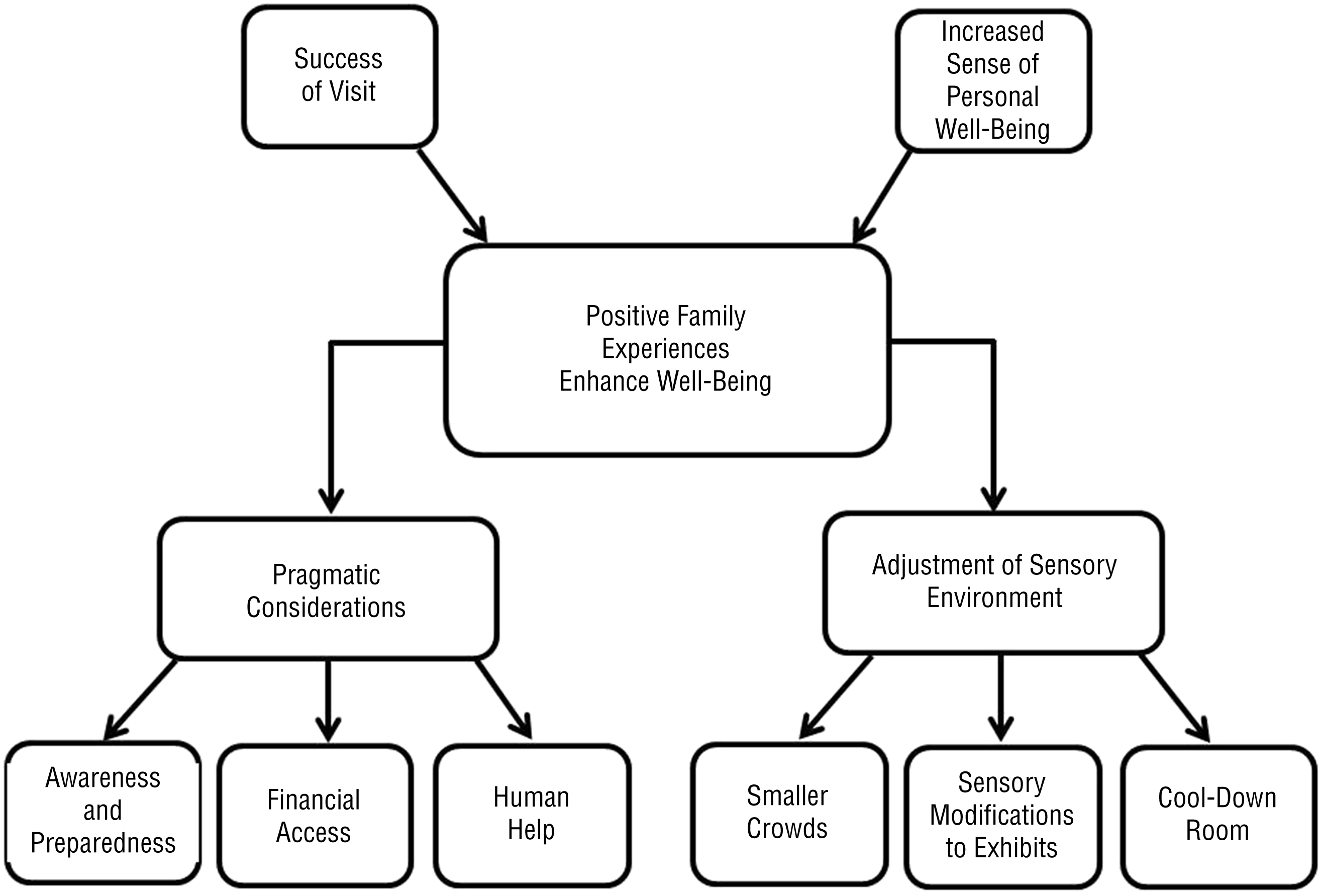
Primary and secondary themes.
Positive Family Experiences Enhanced a Sense of Well-Being
The primary theme suggested by the data was that the positive family experiences reported by parents after attending a SFS event led to an enhanced sense of well-being. This finding was evidenced by an expression of positive feelings by parents with regard to their perceived success of the visit and an increased sense of well-being both at the museum and when returning home.
Success of Visit.
Parents made multiple statements indicating the positive, successful feelings that they and their children had at the events along with their gratitude for the opportunity to attend and have a good day as a family. One mother commented, “We appreciated that the accommodations were there to make her first introduction to a museum a good one,” and another mother said, “We don’t have a lot of perfect days, but this definitely made it up there.” Another parent shared the following comment:
We had a really good time. It’s hard to find things we can all do. We can’t go to the zoo or the amusement park. My husband got welled up, ya know, it’s huge, what you are doing. This experience was great for both of us, and it was a big deal for his sibling too; the whole thing enriched both of my sons.
An additional mother summed it up by saying, “I can’t overstate [what] a good resource this is for parents with kids with disabilities. You want them to experience the world and have the same experiences as typical child[ren]. It’s hard to enjoy yourself. But here I did!”
Twelve parent participants said that they wished that other institutions or settings had similar events or sensory-friendly modifications in place. As one parent stated,
Our family went to a theme park recently with many unpredictable things like people dressed up in dragon costumes that upset my son. [I wish] every community place had days when things were not unpredictable, not loud, and everyone was on the same page.
Among the 32 families for whom this was not a first museum visit, many parents (11) expressed that their child was able to stay longer than when they visit during regular museum hours. One parent stated, “We were there 4 1/2 hours; I didn’t even think we would stay there that long. He loved it. We came home and all said that it was just such an enjoyable day!” Another parent commented, “We stayed for 2 hours. We never stay anywhere more than 45 minutes. It was a shock when you looked at your watch!” Researchers’ field notes uniformly described a sense of surprise and pleased pride among parents in their child’s ability to sustain the visit. A longer visit was associated with an improved visit quality; parents said that they often leave early from community settings.
An Increased Sense of Personal Well-Being.
Although it was not directly asked, 26 out of 46 parents spontaneously described an increased sense of personal well-being resulting from their experience at SFS events. Positive terms and phrases used to indicate a greater sense of well-being included feeling “welcomed,” “understood,” “comfortable,” “at ease,” “safe,” and “able to let my guard down and relax.” Parents also used words and phrases indicating fewer negative emotions at the events: “less stressed,” “didn’t have to be embarrassed,” “less bothered,” “less overwhelmed,” “less pressured,” “less frustrated,” “less annoyed,” “less scared,” “didn’t have to worry,” and “less anxious.” In the Occupational Therapy Practice Framework: Domain and Process (3rd ed.; American Occupational Therapy Association, 2014) and the ICF, many of these terms are associated with psychosocial well-being and mental health. Research has indicated that parents with children with autism have higher rates of depression, anxiety, and isolation (Rizk, Pizur-Barnekow & Darragh, 2011); therefore, an increased sense of well-being is a key finding.
Specific Pragmatic Considerations Are Essential to Support Participation
A secondary theme was the identification of specific pragmatic features at SFS events that were important for supporting participation. These features consisted of awareness and preparedness, financial access, and the availability of human help.
Awareness and Preparedness.
Data gathered suggested that a family’s awareness and preparedness for access helped set the tone for the visit, affecting the quality of the experience that followed. Families frequently spoke about using the website, social media, and advocacy organizations to learn about the SFS program. Twenty-two out of 46 families mentioned that they found information on the museum website before coming or took materials from the SFS tables in the atrium as they entered the museum to prepare for their visit.
Sample comments included, “We read the sensory stories ahead of time online to know how to use them and for him to know more about each exhibit,” and “The special activities near the entrance were great, it gave us a chance to get our bearings while the kids were occupied.” Another parent said, “The sensory map . . . let us know what to expect in each place and gave us the opportunity to warn our son if something might be loud, what it [would] sound like, and where the noise was coming from.” Families also mentioned easy parking and the ability to pack a special diet lunch as helpful in meeting their needs when preparing for a visit.
Financial Access.
Reduced cost was mentioned by 16 participants. As one parent pointed out, “The discount was so helpful . . . families with children with special needs usually have a lot of extra bills.” Enhanced financial access allowed the inclusion of more family members in the experience, as another parent explained, “The reduced cost was a big factor, usually when we do stuff like this it’s with just one parent because it’s so expensive . . . this was an opportunity for both of us to go with him, and be all together.”
The Value of Human Help.
Finally, 29 out of 46 parents described the value of human help as a pragmatic factor facilitating successful participation. Museum staff and occupational therapy students, all trained by occupational therapy faculty, were viewed as particularly helpful in the cool-down room as well as when orienting families as they entered, helping children engage with exhibits, and leading special activities.
For some families, the skilled volunteers enhanced the social environment for their child, as stated by a single father with a 21-yr-old daughter with a profound disability during her first museum visit: “The staff and [occupational therapy] students did a great job; my daughter loved interacting with them. She liked the people best over the exhibits!” For others, human help made the visit logistics more manageable: “Volunteers made it easier since I was trying to help my son through his fears and also make my daughter’s visit enjoyable.” Parents expressed the importance of being greeted and assisted by people who understood their needs, (e.g., “It was nice to be around people who get it [emphasis added].” “If my son had a meltdown, I wasn’t going to get ugly looks or [be] told I should parent differently.”). Parents also commented about how helpful it was that all the volunteers “understood” and were “on the same page,” creating “an environment with no judgment.”
Adjustment of the Sensory Environment: A Key Factor
The other secondary theme that emerged from the data was the importance of an adjustment of the sensory environment for a successful experience for families with children or young adults with sensory processing needs. Parents reported three variables relating to the museum’s sensory environment as having the greatest impact on the quality of their experience: (1) a reduction in crowds, (2) specific sensory features and modifications of exhibits, and (3) the cool-down space.
Smaller Crowds.
Thirty-five of 46 families mentioned the diminished crowds as a critical sensory variable at the events. A majority of these parents linked inappropriate behaviors by their child to the presence of crowds in a community environment.
Sensory Modifications to Exhibits.
Twenty-seven out of 46 parents described their appreciation for features of exhibits that were altered to make the museum more comfortable for their child during SFS hours:
Without the auditory and visual sensations, he was able to go in and really climb around for the first time . . . he did it over and over again. When the lights and sounds came back on at noon, he said, “No way!” So the modifications were really helpful!
In general, parents said that their children benefited from the reduced auditory and visual input at the exhibits because it let them enjoy the interactive proprioceptive and vestibular components.
Cool-Down Room.
Half of the parents (23 of 46) said that the cool-down space was an important SFS feature. One parent said, “The cool-down room was the reason we were able to stay so long; it was amazing, it allowed us to reboot [and return to the exhibits after a difficult moment].” Other parents made comments such as, “He didn’t use it this time, but glad to know it’s there; he might use it next time,” indicating that by merely knowing it was available, their comfort level increased.
Discussion
Literature supports that people with sensory processing needs or ASD may have participation restrictions and decreased health-related quality of life (Askari et al., 2015; Rizk et al., 2011). Pfeiffer, Piller, Giazzoni-Fialko, and Chainani (2017) examined meaningful outcomes for enhancing quality of life for this population, and they found themes related to community involvement, acceptance, and support as intervention priorities. Physical and social obstacles are described as factors limiting participation for this group in community venues (Askari et al., 2015; Rizk et al., 2011). Museums exemplify a community setting for family togetherness and leisure. Although parents of children with ASD are motivated to visit museums, they face attitudinal, sensory, and financial barriers (Langa et al., 2013; Lussenhop et al., 2016).
The primary theme that emerged from this study was that positive family experiences during an adapted museum visit increased feelings associated with well-being, as evidenced by use of words and phrases such as “less stressed,” “more relaxed,” “at ease,” and “welcomed.” These results build on emerging evidence supporting a link among participation, well-being, and intervention priorities for families of children with ASD and sensory processing differences. In research by Lussenhop et al. (2016), parents reported that their motivation for attending science museums with their children with ASD was to enjoy quality family time together, and they defined a successful visit as one that was nonstressful.
The first secondary theme relates to pragmatic support for participation (awareness and preparedness, financial access, human help). In previous studies, researchers found that financial constraints created participation barriers for families of children with ASD (Askari et al., 2015; Lussenhop et al., 2016); discounted museum admission and an ability to return free of charge if their visit is cut short can be vital accommodations. A modified pricing structure at SFS allowed families to participate as a whole or come more often. Families also spoke from the heart about the impact that welcoming and caring staff and student volunteers had on their visit. The results of the current study resonate with research supporting pragmatic family-centered strategies to promote participation in natural settings (Dunn, Cox, Foster, Mische-Lawson, & Tanquary, 2012). The results also confirm findings that have specifically suggested pragmatic strategies for successful museum participation, such as the use of Social Stories (Lussenhop et al., 2016) and Internet-based resources (Langa et al., 2013) to help children with ASD prepare for their museum visit.
Another secondary theme highlighted in this study was the need to adjust the sensory environment, especially crowd control, with most of the participants indicating that “fewer people,” “less crowds,” or “exclusive access” was critical to the success of their museum visit. Others noted the importance of adjusting the volume or lighting, the presence of kinesthetic or tactile exhibits, or the use of a cool-down space with sensory modalities that “allowed for a reboot” and extended the duration of their stay. These findings are consistent with research in which smaller crowds and the presence of a quiet space were identified as needs for families of children with ASD when visiting museums (Langa et al., 2013).
Limitations
Efforts were made in this study to increase trustworthiness of results, including multiple data sources; the use of rich descriptions to capture ample details accurately representing participant views (Carpenter & Suto, 2008); a robust sample size for a qualitative study; member checks; and reflective memos to confront potential researcher bias. Trustworthiness of results for 3 participants in the first cohort may be slightly compromised because of a small variation in study protocol; they completed written surveys onsite, whereas the other 43 participants answered the same questions by phone.
To compensate for the absence of interview tape recording, a second identified researcher listened to each phone interview and transcribed key quotes word for word, enhancing data accuracy. Discrepant data were addressed. In addition, both primary researchers participated in the data analysis process and provided a “decision” or “audit” trail (Carpenter & Suto, 2008) accounting for the methodological choices made. Although the results of this present study add to the qualitative literature examining community participation for families with children with sensory processing needs, future research could further advance this knowledge by using quantitative or mixed methods.
Implications for Occupational Therapy Practice
A scoping review by Askari et al. (2015) indicated that children with sensory processing needs and ASD, as well as their parents and siblings, participate in the community less than typical families and that this reduced participation can have an impact on their development and well-being. Askari et al. found that there is a “knowledge to practice gap” (para. 7) that exists in how to facilitate participation, with few researchers subjectively examining participation. The current study suggests an important role for occupational therapy practitioners in closing this gap.
The findings of this study have the following implications for occupational therapy practice:
Specialized community-based programs have value for families and can positively affect participation and well-being, which are both key occupational therapy intervention outcome measures. Occupational therapy practitioners can and should promote social participation in community settings for their clients.
A need exists for occupational therapy practitioners to identify community partners and to jointly develop similar programs at additional museums and other venues (such as zoos and theme parks).
Occupational therapy practitioners can use action research to collaborate with community organizations to enhance accessibility programming. During this 1.5-yr research project, researchers communicated both formally and informally with museum staff to provide feedback from each cohort, thereby promoting ongoing program improvements and sustainability.
Community-based partnerships offer opportunities for occupational therapy student volunteers to develop narrative, pragmatic, and scientific reasoning skills as they interact with consumers of services (both clients and community partners).
Conclusion
The action research design of this study served a dual purpose: (1) to facilitate sensory-friendly program development at a museum and (2) to examine factors that facilitate participation for children and young adults with sensory processing issues and their families in community settings. The primary theme identified was that positive community-based family experiences can increase well-being, which was supported by two secondary themes: (1) the importance of specific pragmatic considerations and (2) the adjustment of the sensory environment, both of which are needed to enhance participation. Similar results were found when examining the effectiveness of a modified program for children with ASD at a New Hampshire museum (Mulligan, Rais, Steele-Driscoll, & Townsend, 2013).
Findings from the current study suggest that occupational therapy practitioners can more fully meet the needs of young people with sensory processing differences by taking the lead in program initiatives that reduce pragmatic barriers and modify the sensory environment. These findings, along with those from similar studies, suggest that adapted community events that increase participation in context may be a promising occupational therapy intervention to support well-being for these clients and their families.
Footnotes
Acknowledgment
We thank the accessibility team at the Franklin Institute, the families who generously shared their perspectives, and the Philadelphia region occupational therapy students (especially the Salus Master of Science in Occupational Therapy research assistants) who volunteered their time at the SFS events. We also thank CJ Tyszka for his enthusiastic participation.
Note. Each issue of the 2017 volume of the American Journal of Occupational Therapy features a special Centennial Topics section containing several articles related to a specific theme; for this issue, the theme is occupational therapy’s role in health, well-being, and quality of life. The goal is to help occupational therapy professionals take stock of how far the profession has come and spark interest in the many exciting paths for the future. For more information, see the editorial in the January/February issue,  .
.