



Abstract
Objective
To investigate the association between susceptibility to colorectal cancer (CRC) and a 4-bp insertion/deletion polymorphism (rs10680577) in the proximal promoter of the EGLN2 gene.
Method
The first step in genotyping EGLN2 was PCR, then the PCR products were separated using 7% nondenaturing polyacrylamide gel electrophoresis and visualized by silver staining according to the final product band location and quantity to determine the genotype of the sample. The final count was done by two different pathologists.
Result
In the codominant model, compared with the ins/ins genotype, subjects with the heterozygous ins/del or homozygous del/del genotype had a significantly increased risk of CRC (adjusted OR = 1.45, p<0.0001 and OR = 2.44, p = 0.0001, respectively). Each additional copy of the 4-bp deletion allele conferred a significantly increased risk of CRC (OR = 1.47, 95% CI 1.28-1.66, p<0.0001). In the stratification analysis, we further proved that the association was more prominent in TNM stage III and IV cancer compared with stage I and II (adjusted OR = 1.43, 95% CI 1.07-1.93, p for heterogeneity = 0.02).
Conclusions
Our study provided initial evidence that the insertion/deletion polymorphism rs10680577 may play a functional role in the development of CRC in the Chinese population.
Introduction
Colorectal cancer (CRC) is the third most common cancer in men and the second in women, accounting for roughly 1.4 million cases and 693,900 deaths in 2012. Rates are higher in men than women in most parts of the world (1). Based on long-term incidence data from 51 cancer registries, the incidence rates of CRC increased conspicuously from 1983-1987 to 1998-2002. The increases were more significant for men than for women (2). The mortality rates of CRC have always been high among urban populations compared with rural populations in mainland China (3). The heritability of CRC was confirmed in twin and family studies. In the largest twin study the effect of heritable factors observed for CRC was 35% (95% confidence interval [CI] 10%-48%) (4). Using the nationwide Swedish Family-Cancer Database including 9.6 million subjects, statistical analysis estimated that the heritability of colon cancer was 13% (95% CI 12%-18%) and the heritability of rectal cancer 12% (95% CI 8%-13%) (4, 5). Genome-wide association studies (GWAS) have successfully identified many common single-nucleotide polymorphisms (SNPs) associated with CRC risk, and facilitated the notion that genetic variations contribute to colorectal carcinogenesis. According to the findings of the Genome-Wide Complex Trait Analysis in the Genetics and Epidemiology of Colorectal Cancer Consortium including 8,025 cases and 10,814 controls, the heritability of CRC was much larger when all common SNPs were considered together. Previous reports indicated that the known CRC SNPs only explain a small fraction of the heritability, and genetic variations such as more common SNPs, insertion/deletion polymorphisms (indels) and structural variants have yet to be identified (6).
Hypoxia is a major feature of solid tumors and plays an important role in tumor progression and metastasis. Hypoxic conditions induce molecular responses such as DNA damage and apoptosis that drive the activation of an important transcription factor, the hypoxia-inducible factor (HIF). It regulates many genes that are essential for cancer cell survival and resistance to treatment (7, 8). HIF plays a key role in the hypoxia response of solid tumors and contributes to tumor aggressiveness and invasiveness. It has been documented that HIF-1 α levels are increased in many solid tumors (9). Several lines of evidence suggest that HIF-1 α is involved in the development of CRC (10-12). The immunohistochemical expression of HIF-1 α in CRC shows a relationship to clinical outcome and prognosis (13). Under well-oxygenated conditions, HIF-1 α becomes hydroxylated at 1 (or both) of 2 highly conserved prolyl residues located near the N-terminal transactivation domain by members of the prolyl hydroxylase domain (PHD) family (also called EGLN family). Prolyl hydroxylase 1 (PHD1), also known as EGLN2, is 1 of the 3 enzymes capable of hydroxylating HIF-1 α and results in polyubiquitination and proteasomal degradation of HIF (9).
In recent years, a 4-bp indel (rs10680577) has been shown to be associated with the risk of hepatocelluar carcinoma, gastric cancer and non-small cell lung cancer (14-16), but its association with CRC is still unclear. Therefore, we hypothesized that rs10680577 was associated with altered EGLN2 expression and CRC risk. In this case-control study, by using PCR and genotyping, we evaluated the association between this indel and CRC susceptibility in the Chinese population.
Material and methods
Study participants
We included in the study 1,008 patients with sporadic CRC diagnosed by pathology between September 2014 and February 2016 at Xuzhou Medical University Affiliated Hospital. All cases were typed adenocarcinoma by histopathological judgment of 2 independent senior pathologists. At the same time, 1,240 individuals in whom the presence of malignant CRC lesions was excluded were selected as the control group. All study participants belonged to the Han population. The healthy controls were chosen from a community nutritional survey that was conducted in Xuzhou regions in the same period as the recruitment of the cancer patients. Study participants were considered smokers if they smoked more than 1 cigarette per day for more than 1 year until the time of the interview. The remaining participants were defined as nonsmokers. Study participants who consumed alcohol at least once per week for more than 1 year were classified as drinkers. Nondrinkers were those who either never drank or seldom did. Blood was collected from patients and control subjects before surgery, chemotherapy or radiotherapy. Tumor stages were determined according to a modified American Joint Committee on Cancer and International Union Against Cancer standard. The design of the study was approved by the Ethics Committee of Xuzhou Medical University. Informed consent was obtained from all individual participants included in the study.
DNA extraction and genotyping
Genomic DNA of blood samples and tissues was isolated using a genomic DNA purification kit (Qiagen). The method used for genotyping was polymerase chain reaction (PCR). DNA fragments containing rs10680577 were amplified with a pair of genotyping primers (forward primer: 5′-TGATTCCCACAATCGTCC-3′, reverse primer: 5′-ATGGCTACGCAGTTAGTTGA-3′). Then the PCR products were separated using 7% nondenaturing polyacrylamide gel electrophoresis and visualized by silver staining. The genotypes were determined by the location and numbers of the bands in the gels. To validate the genotyping method, we also analyzed 50 randomly selected DNA samples by direct sequencing (Fig. 1). The coincidence rate of these 2 methods was 100%, indicating that the PCR-based method was reliable. Approximately 10% of the case and control samples were randomly selected and tested in duplicate by independent technicians, with 100% concordance of results.
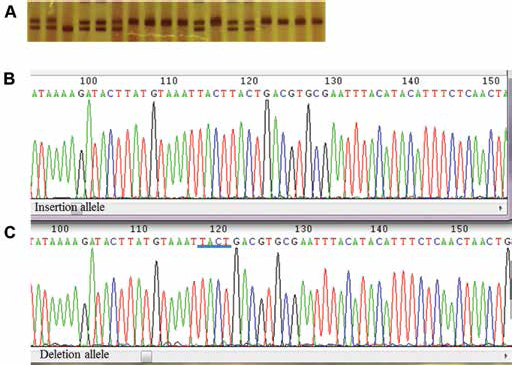
Example of sequencing and genotyping output for rs10680577 polymorphism. (A) An example of the genotyping assay results. Lanes 7, 8, 9, 10, 12, 15, 16, 17 and 18: ins/ins genotype; lane 3: del/del genotype; lanes 1, 2, 4, 5, 6, 11, 13 and 14: ins/del genotype. (B and C) Direct sequencing results of insertion allele (upper panel) and deletion allele (lower panel). The blue line indicates TACT or TTAC 4-bp deletion.
Statistical analysis
The genotype distribution was analyzed for Hardy-Weinberg equilibrium using the chi-square test. Logistic regression was used to analyze the association between rs10680577 and CRC risk adjusted by sex, age, smoking status and drinking status. In addition, stratified analyses by these common confounders were performed using the binary logistic regression model. Because of the limited number of del/del genotypes, these were integrated with the ins/del group when appropriate. The statistical analyses were implemented in the Statistical Analysis System software (version 8.0, SAS Institute). P<0.05 was the criterion for statistical significance. All statistical tests were 2-sided.
Results
The distribution of selected characteristics of the 1,008 CRC patients and 1,240 controls included in the analysis is listed in Table I. No significant differences were found between CRC patients and control subjects in terms of sex, age, smoking and drinking status, suggesting that the frequency matching was adequate.
Demographics of study participants
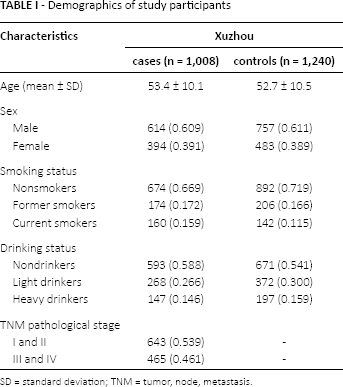
SD = standard deviation; TNM = tumor, node, metastasis.
An example output from sequencing and genotyping assays of rs10680577 is shown in Figure 1. Genotype distributions showed no deviation from the Hardy-Weinberg equilibrium in the case and control groups (p>0.05). Genotype frequencies, odds ratios (ORs) and 95% CIs for cases and controls are shown in Table II. Under the codominant model, compared with the ins/ins genotype, subjects with the heterozygous ins/del or homozygous del/del genotype had a significantly increased risk of CRC (adjusted OR = 1.45, p<0.0001 and OR = 2.44, p = 0.0001, respectively). Similar trends were observed in all other genetic models. Each additional copy of the deletion allele was associated with a 47% increased risk of CRC (OR = 1.47, 95% CI 1.28-1.65, p<0.0001).
Polymorphism and CRC risk analysis in four genetic models
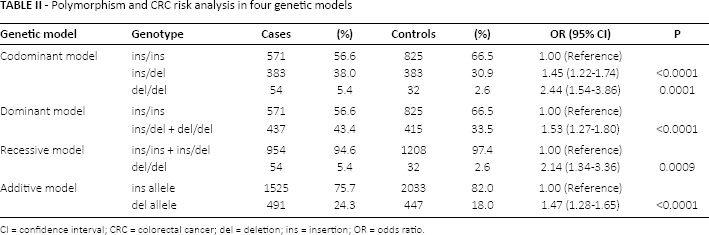
CI = confidence interval; CRC = colorectal cancer; del = deletion; ins = insertion; OR = odds ratio.
In the stratification analysis, we further proved that the association was more prominent in TNM stage III and IV cancer compared with stage I and II (adjusted OR = 1.43, 95% CI 1.07-1.93, p for heterogeneity = 0.02). However, there was no significant difference in the association between the deletion allele of rs10680577 and the risk of CRC among other subgroups (Tab. III).
Association between polymorphism and clinicopathological characteristics
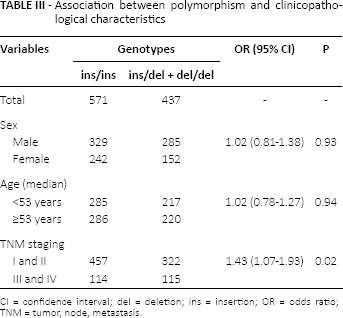
CI = confidence interval; del = deletion; ins = insertion; OR = odds ratio; TNM = tumor, node, metastasis.
Discussion
To our knowledge, this is the first case-control study evaluating the association between the 4-bp indel within EGLN2 and CRC susceptibility. We found that the variant deletion allele was significantly associated with an increased risk of CRC, particularly TNM stage III and IV, in the Chinese population.
It has been reported that there is a significant correlation of HIF-1 α with vascular endothelial growth factor (VEGF) expression, which plays a crucial role in carcinogenesis, tumor angiogenesis and cancer progression of CRC (13). According to the study by Zhu et al (14), the 4-bp indel (rs10680577) is is located at upstream of the EGLN2 gene on chromosome 19, that encodes a prolyl hydroxylase involved in the regulation of HIF-1 in response to hypoxia. Also addressing functional aspects, the study suggested that the deletion allele might affect EGLN2 expression by modifying the pairing structure of a so-called RAB4B-EGLN2 read-through long noncoding RNA (RERT-IncRNA) rather than by a direct effect on the function of the upstream EGLN2 regulatory region. Therefore, genetic variation and alterations of the EGLN2 gene may influence its expression, contributing to CRC tumorigenesis by affecting HIF-1 α (14). It can be speculated that such a regulatory derangement may also play a role in CRC.
Some limitations in the study should be addressed. The genotypes were determined by the location and numbers of the bands in the gels by using 7% nondenaturing polyacrylamide gel electrophoresis and visualized by silver staining. rs10680577 is described as ins/del SNP -/TTAC or -/TACT; the technical solution used is not capable of differentiating these. Although we observed a strong correlation between rs10680577 and CRC risk, further studies still need to fully elucidate how genetic variability at this locus can influence RERT-IncRNA and EGLN2 expression, both at the genetic and functional levels.
In summary, our study provided initial evidence that the rs10680577 polymorphism may play a functional role in the development of CRC in the Chinese population. Larger sample sizes, replication, and further functional analysis in other populations are required for a full understanding of the roles of the indel in the predisposition to CRC.
Footnotes
Financial support: This study was supported by grants from the Natural Science Foundation of China (No. 81502428), the Natural Science Foundation of Jiangsu Province (No. BK20140243, No. BK20140222, No. 15KJB310024 and No. BK20150220), and Xuzhou Medical University Scientific Research Fund for Talents (No. D2015018 to Zhansheng Zhu and No. D2015019 to Huiping Wang).
Conflict of interest: The authors declare that they have no conflict of interest.