Other
Select search scope: search across all journals or within the current journal

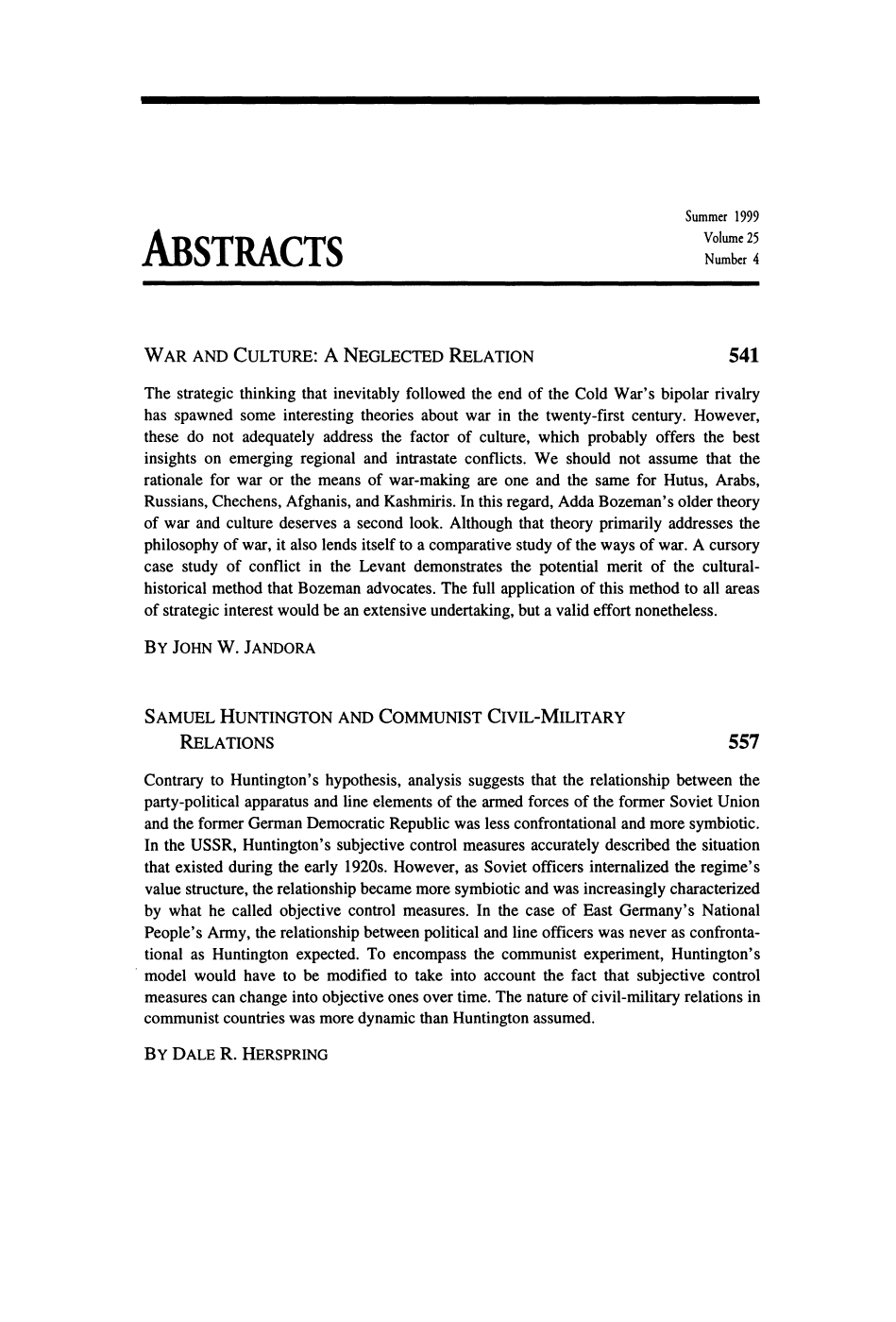
The strategic thinking that inevitably followed the end of the Cold War's bipolar rivalry has spawned some interesting theories about war in the twenty-first century. However, these do not adequately address the factor of culture, which probably offers the best insights on emerging regional and intrastate conflicts. We should not assume that the rationale for war or the means of war-making are one and the same for Hutus, Arabs, Russians, Chechens, Afghanis, and Kashmiris. In this regard, Adda Bozeman's older theory of war and culture deserves a second look. Although that theory primarily addresses the philosophy of war, it also lends itself to a comparative study of the ways of war. A cursory case study of conflict in the Levant demonstrates the potential merit of the cultural-historical method that Bozeman advocates. The full application of this method to all areas of strategic interest would be an extensive undertaking, but a valid effort nonetheless.
Contrary to Huntington's hypothesis, analysis suggests that the relationship between the party-political apparatus and line elements of the armed forces of the former Soviet Union and the former German Democratic Republic was less confrontational and more symbiotic. In the USSR, Huntington's subjective control measures accurately described the situation that existed during the early 1920s. However, as Soviet officers internalized the regime's value structure, the relationship became more symbiotic and was increasingly characterized by what he called objective control measures. In the case of East Germany's National People's Army, the relationship between political and line officers was never as confrontational as Huntington expected. To encompass the communist experiment, Huntington's model would have to be modified to take into account the fact that subjective control measures can change into objective ones over time. The nature of civil-military relations in communist countries was more dynamic than Huntington assumed.
Despite uncertainties in U.S.-Russian diplomatic relationships, military-to-military contact programs between the two states continued to flourish and were supported by senior military officers on both sides until the Spring 1999 bombing of Serbia put them on hold. This article argues that these programs in fact serve clear mission-related goals for both military organizations. Both sides value the training and military education the programs provide; the Russian side values the opportunity for expressing "voice," or influence, in international security arrangements despite a decline in state power; and, perhaps most important in an era of uncertainty, both sides value the "transparency," or information-sharing, opportunities provided, especially since stability is enhanced when each side's capabilities and intentions are showcased. After describing the current programs in depth and exploring senior officers' opinions about their benefits, the article concludes by showing that surprisingly similar benefits resulted from an earlier instance of military-to-military cooperation, that of secret Soviet German interactions in the 1920s, despite immense differences in the purposes and structures of the two eras.
This article compares results from the 1988 DoD Survey of Sex Roles and the 1995 Sexual Harassment Survey and assesses the impact of changes within the DoD and heightened awareness brought about by increased publicity surrounding sexual harassment. Responses are evaluated in terms of individual and environmental harassment. The first is defined as more personalized behavior that includes actual or attempted rape, assault, pressure for sexual favors or dates, sexual touching or cornering, and sexual letters or phone calls. Environmental harassment is more generalized and includes sexual teasing and jokes, suggestive looks and gestures, and sexual whistles, calls, and hoots. The data document a slight decline in the prevalence of perceived sexual harassment in the military since 1988. However, respondents, especially women, continue to indicate a substantial amount of harassment, which is still perpetrated primarily by other military members and coworkers, despite the 1995 survey results indicating that 98 percent of the military members "at least to some extent... know what sexual harassment is." The 1995 results also reinforce a key finding from the 1988 data: respondents reporting no environmental types of harassment are very unlikely to report individual harassment, and the vast majority of those reporting some environmental harassment are also likely to report individual harassment.
This article analyzes the effects of organizational support for families on the organizational commitment of male enlisted Army soldiers and their wives. Organizational support is measured as perceptions of the supportiveness of both formal Army level policies and informal unit leader practices towards families. Results of our path analysis indicate that perceptions of the supportiveness of both formal policies and informal practices have significant independent effects on the organizational commitment of soldiers. In addition, perceptions of the supportiveness of unit leader practices have significant effects on the organizational commitment of soldiers' wives. For both soldiers and wives, family support also has significant positive indirect effects on commitment, through reduced Army-family conflict. We suggest specific organizational policies and practices that can increase soldiers' and spouses' commitment to the military through support of families.
Because of military professional enthusiasm for a post-nuclear world dominated by high technology, conventional weapons may be misplaced. Nuclear deterrence remains highly relevant to the new world order because of residual great power nuclear arsenals and nuclear proliferation. In addition, the possible combination of information warfare and a failure of nuclear deterrence is one troublesome aspect of the future technology and policy environment. Stable nuclear deterrence depends upon an environment of mutual confidence and accurate information exchange between potential adversaries, especially during crises. Information warfare is intended to corrupt the information environment of potential-opponents before a war begins or during it. Infowarriors could increase the likelihood of accidental/inadvertent nuclear war or escalation.