In brief
Select search scope: search across all journals or within the current journal

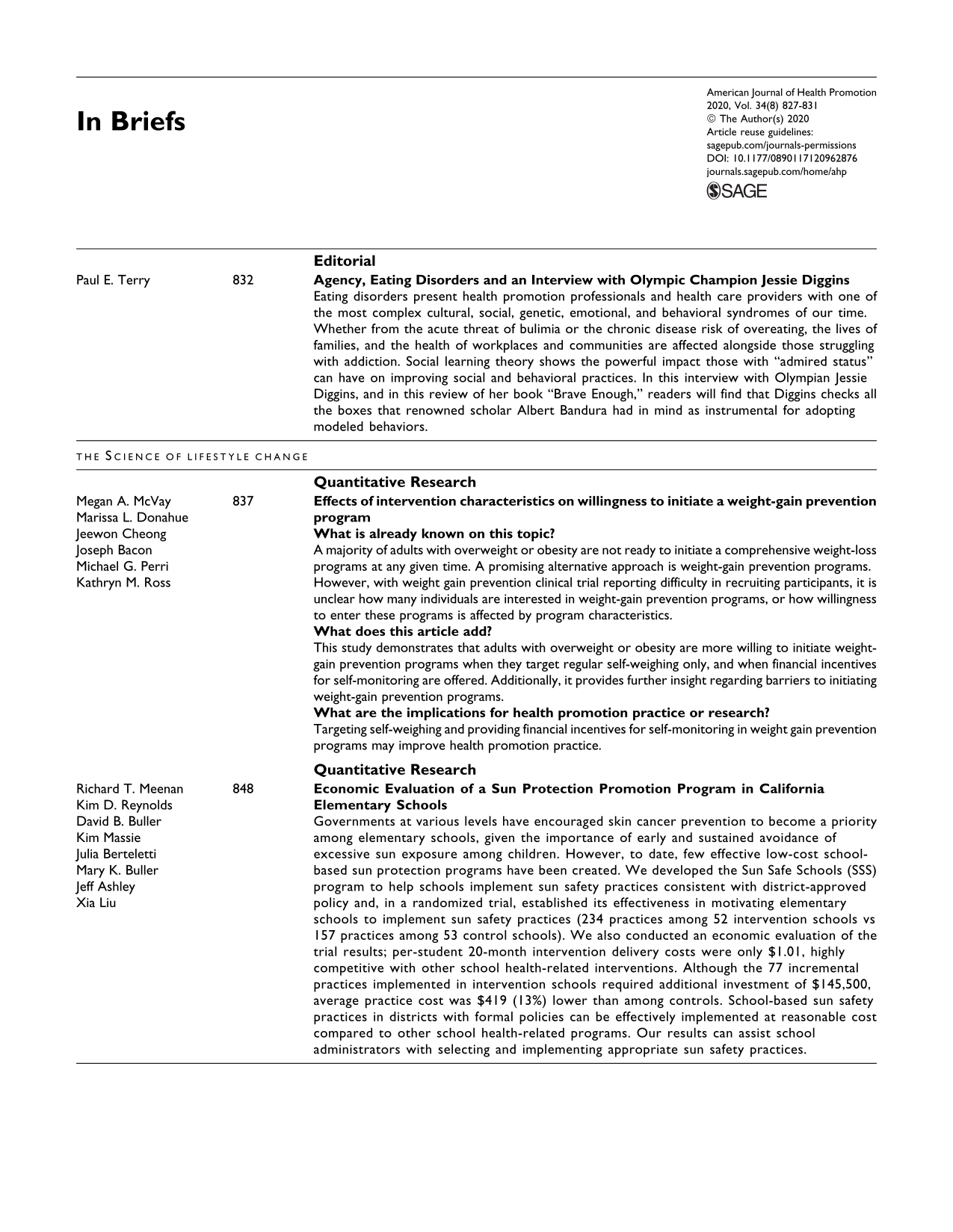
Eating disorders present health promotion professionals and health care providers with the most complex cultural, social, genetic, emotional, and behavioral syndromes of our time. Whether from the acute threat of bulimia or the chronic disease risk of overeating, the lives of families, and the health of workplaces and communities are affected alongside those struggling with addiction. Social learning theory shows the powerful impact those with “admired status” can have on improving social and behavioral practices. In this interview with Olympian Jessie Diggins, and in this review of her book “Brave Enough,” readers will find that Diggins checks all the boxes that renowned scholar Albert Bandura had in mind as instrumental for adopting modeled behaviors.
To determine characteristics of weight gain prevention programs that facilitate engagement.
Randomized factorial experiment (5 × 2).
Recruited nationally online.
Adults aged 18 to 75 with body mass index ≥25 who decline a behavioral weight loss intervention (n = 498).
Participants were randomly presented with one of 10 possible descriptions of hypothetical, free weight gain prevention programs that were all low dose and technology-based but differed in regard to 5 behavior change targets (self-weighing only; diet only; physical activity only; combined diet, physical activity, and self-weighing; or choice between diet, physical activity, and self-weighing targets) crossed with 2 financial incentive conditions (presence or absence of incentives for self-monitoring). Participants reported willingness to join the programs, perceived program effectiveness, and reasons for declining enrollment.
Logistic regression and linear regression to test effects of program characteristics offered on willingness to initiate programs and programs’ perceived effectiveness, respectively. Content analyses for open-ended text responses.
Participants offered the self-weighing-only programs were more willing to initiate than those offered the programs targeting all 3 behaviors combined (50% vs 36%; odds ratio [OR] = 1.79; 95% confidence interval [CI], 1.01-3.13). Participants offered the programs with financial incentives were more willing to initiate (50% vs 33%; OR = 2.08; 95% CI, 1.44-2.99) and anticipated greater intervention effectiveness (β = .34,
Targeting self-weighing and providing financial incentives for self-monitoring may result in greater uptake of weight gain prevention programs.
https://osf.io/b9zfh, June 19, 2018.
An economic evaluation of Sun Safe Schools intervention designed to aid California elementary schools with implementing sun safety practices consistent with local board–approved policy.
Program cost analysis: intervention delivery and practice implementation.
California elementary schools (58 interventions and 60 controls). Principals at 52 intervention and 53 control schools provided complete implementation data.
Principals completing pre-/postintervention surveys assessing practice implementation.
Phone-based 45-minute session with a project coach on practice implementation, follow-up e-mails/phone contacts, $500 mini-grant. Schools chose from a list of 10 practices for implementation: ultraviolet monitoring, clothing, hats, and/or sunscreen recommendations, outdoor shade, class education, staff training and/or modeling, parent outreach, and resource allocation. The duration of intervention was 20 months. Rolling recruitment/intervention: February 2014 to December 2017.
Intervention delivery and practice implementation costs. Correlations of school demographics and administrator beliefs with costs.
Intervention delivery activities micro-costed. Implemented practices assessed using costing template.
Intervention schools: 234 implemented practices, control schools: 157. Twenty-month delivery costs: $29 310; $16 653 (per school: $320) for project staff, mostly mini-grants and coaching time. Administrator costs: $12 657 (per school: $243). Per-student delivery costs: $1.01. Costs of implemented practices: $641 843 for intervention schools (per-school mean: $12 343, median: $6 969); $496 365 for controls (per-school mean: $9365, median: $3123). Delivery costs correlated with implemented practices (0.37,
Coaching of elementary school personnel can stimulate sun safety practice implementation at a reasonable cost. Findings can assist schools in implementing appropriate sun safety practices.
To investigate relationships of farm-to-school, school meal, and competitive food state laws with eating behaviors and weight status and to examine interaction between different types of state laws.
Observational cohort study.
US adolescents.
The NEXT study is a nationally representative sample of adolescents assessed annually for 7 years. Data (N = 2751) from students attending public schools from the first (W1) and third (W3) assessment waves (2010 and 2012), occurring during grades 10 and 12, respectively, of the NEXT study were included.
Eating behaviors and weight status of adolescents were linked with Classification of Laws Associated with School Students scoring for state laws.
Regression analyses examined associations of laws with intake and weight status, accounting for complex survey design and school-level clustering.
Adolescents in states with strong farm-to-school laws had greater W1 whole fruit, lower soda, and snack intakes versus those in states with no laws. Strong school meal laws were associated with lower W1 soda intake. Adolescents in states with strong competitive food laws had lower soda intake and overweight/obesity odds than those in states with no laws in W3. Strong farm-to-school laws were inversely associated with W3 overweight/obesity odds only in states with strong competitive food laws.
Stronger laws governing school nutrition were related to healthier eating behaviors and optimal weight status in this nationally representative sample of adolescents. Further, farm-to-school laws may be more effective in reducing obesity when combined with strong competitive food legislation.
To provide a nationally representative description on the prevalences of policies, practices, programs, and supports relating to worksite wellness in US hospitals.
Cross-sectional, self-report of hospitals participating in Workplace Health in America (WHA) survey from November 2016 through September 2017.
Hospitals across the United States.
Random sample of 338 eligible hospitals participating in the WHA survey.
We used previous items from the 2004 National Worksite Health Promotion survey. Key measures included presence of Worksite Health Promotion programs, evidence-based strategies, health screenings, disease management programs, incentives, work-life policies, barriers to health promotion program implementation, and occupational safety and health.
Independent variables included hospital characteristics (eg, size). Dependent characteristics included worksite health promotion components. Descriptive statistics and χ2 analyses were used.
Eighty-two percent of hospitals offered a wellness programs during the previous year with larger hospitals more likely than smaller hospitals to offer programs (
Most hospitals offer wellness programs. However, there remain hospitals that do not offer wellness programs. Among those that have wellness programs, most offer supports for nutrition, PA, and tobacco control. Few hospitals offered programs on healthy sleep or lactation support.
Examine the association between neighborhood poverty histories and physical activity, and the moderation effect of family poverty and the mediation effect of built environments in such association.
A cross-sectional study of the Geographic Research on Wellbeing (2012-2013), a follow-up survey of statewide-representative Maternal and Infant Health Assessment (2003-2007).
California.
A total of 2493 women with children.
Outcome measures are (1) daily leisure physical activity and (2) days of physical activity among children. An independent variable is poverty histories of census tract where the child resided. Mediators were mother-perceived social cohesion, mother-perceived neighborhood safety, distance to the closest park, and park acreage within 0.5 miles from the home. A moderator is family poverty.
Weighted regression analysis.
Family poverty was a significant moderator (
The combined effect of family financial strains and neighborhood economic resources might prevent poor children in neighborhoods with long-term low poverty and decreasing poverty from utilizing health-promoting resources in neighborhoods.
African Americans experience a high burden of chronic diseases and cancers that are prevented and ameliorated with physical activity (PA) and fruit and vegetable (FV) intake. The purpose of this study is to identify individual, social, and neighborhood variables associated with African Americans attaining high levels of both behaviors.
This study is a cross-sectional analysis.
Cohort of African Americans adults recruited from black churches in the Greater Houston area.
Self-administered questionnaires collected in 2012 assessed correlates and behavioral outcome variables (PA and FV consumption). A combined 4-category behavioral outcome was created: high PA/high FV, low PA/high FV, high PA/low FV, and low PA/low FV.
Standard and stepwise multinomial logistic regression examined the association between the various variables and the behavioral outcome.
This sample (n = 1009) had a mean age of 49 years, was mostly female, and obese. Compared to the low PA/low FV intake group, the high PA/high FV intake group had significantly lower odds of individual-level variables (worrying about getting cancer, perceived stress, loneliness, and financial strain) and higher odds of social-level variables (social status, social cohesion, social organization involvement, and social norms). Only social-level variables remained significantly associated with higher odds of high PA/high FV intake in stepwise regression.
These findings indicate that social influences may be most critical for high PA and FV intake in African Americans adults.
Adverse childhood experiences (ACEs) are related to unhealthy behaviors and poor self-rated health. Poor self-rated physical health (SRPH) is negatively associated with college students’ grades and overall academic achievement. This study examined the effects of ACEs on SRPH among undergraduate and graduate students (n = 568; 18-30 years) from a public university in the southeast.
Students completed a cross-sectional online survey in October 2018. We conducted unadjusted and adjusted logistic regressions to examine the relationship between ACEs and SRPH among US college students.
Most participants reported 1 to 4 ACEs; one-fourth reported poor SRPH. Higher ACE exposure increased the odds for poor SRPH in a curvilinear relationship. Unadjusted results indicate ACE exposure increased risk between 82% and 228%, and that higher levels of resilience and adherence to diet and physical activity guidelines reduced risk for poor SRPH. In adjusted models, moderate ACE exposure was associated with 2.46 times greater odds (95% CI = 1.28-9.34) of reporting poor SRPH. Graduate students (odds ratio [OR] = .52, 95% CI = .27-.99) and those who met healthy diet (OR = .12, 95% CI = .02-.93) and physical activity recommendations (OR = .36, 95% CI = .23-.58) had reduced odds of poor SRPH.
Students who have experienced ACEs are at a greater risk for poor health. Student health programs on campus should take a holistic approach by screening students for childhood adversity and promoting healthy behaviors to improve physical health.
To identify factors that influence Black women’s body size perceptions
Interviews (cognitive mapping exercise) with 25 women; focus group with 7 additional women
Mississippi Delta
Thirty-two black women
Influences on body size perceptions, body mass index, and body satisfaction
Interviewee maps were combined and condensed, using matrix addition and qualitative aggregation, to create a social map. The social map was presented to a focus group. A paired sample
The initial social map contained 27 variables. Male preferences (87.5%) and appearance (64%) were believed by most participants to influence perceptions of body size. The focus group identified lack of encouragement, stress, and substance use as factors worth adding to the map. A statistically significant proportion of interviewees possessed an inaccurate weight perception,
These findings provide practitioners with leverage points, beyond diet and physical activity, that may improve the efficacy of weight reduction interventions among black women. Considering the paucity of research regarding influences on body size perceptions, this study also provides researchers with participant-defined variables worthy of further examination.
As almost nine in ten pregnancies among women with opioid use disorder (OUD) are unintended, expanding access to contraception is an underutilized but potentially effective strategy in increasing reproductive agency and reducing the overall burden of neonatal abstinence syndrome. We aimed to identify where and how contraceptive services could be integrated into existing points-of-contact for women with OUD.
In-depth qualitative interviews.
Three diverse catchment areas in Missouri.
Women with OUD (n = 15) and professional stakeholders (n = 16) representing five types of existing OUD service points: syringe exchange programs, recovery support programs, substance use treatment programs, emergency departments, and Federally Qualified Health Centers.
Interviews were audio-recorded, transcribed, and thematically coded using Dedoose software.
Six themes emerged as essential components for integrating contraceptive services into existing points-of-contact for women with OUD: (1) reach women with unmet need; (2) provide free or affordable contraception; (3) maximize service accessibility; (4) provide patient-centered care; (5) employ willing, qualified contraceptive providers; and (6) utilize peer educators. Participants affirmed the overall potential benefit of contraceptive service integration and illuminated various opportunities and challenges relevant to each type of existing service point.
As health promotion initiatives look to increase access to contraception among women with OUD, these six’ participant-identified components offer essential guidance in selecting advantageous points-of-contact and addressing remaining gaps in services.
To determine whether participants in the Baby Talk prenatal education program were more likely to initiate breastfeeding than nonparticipants.
Retrospective cohort study comparing women with a singleton pregnancy who were enrolled in Baby Talk with matched controls based on zip code, maternal age, race, language spoken, and payer source.
Urban Midwest county.
Baby Talk participants enrolled between November 2015 and December 2016 (n = 299) and matched controls identified through vital statistics records who were not enrolled (n = 1190).
A 12-hour prenatal education curriculum with 2.5 hours of breastfeeding content.
The primary outcome was breastfeeding at hospital discharge as reported in vital statistics.
Likelihood-ratio χ2 and Fisher exact test were used to test the significant association between categorical variables.
Baby Talk participants were significantly more likely to initiate breastfeeding (93.65%) than matched nonparticipants (87.48%;
Prenatal education has the potential to increase breastfeeding initiation among low-income women, especially non-Hispanic white and black. This study is limited as participants were from a single community, though Baby Talk was offered at 5 separate locations, and potentially from information bias as it was reliant on the accuracy of vital statistics data.
Examine association of health literacy (HL) and menu-labeling (ML) usage with sugar-sweetened beverage (SSB) intake among adults in Mississippi.
Quantitative, cross-sectional study.
2016 Mississippi Behavioral Risk Factor Surveillance System data.
Adults living in Mississippi (n = 4549).
Outcome variable was SSB intake (regular soda, fruit drinks, sweet tea, and sports/energy drinks). Exposure variables were 3 HL questions (find information, understand oral information, and understand written information) and ML usage among adults who eat at fast-food/chain restaurants (user, nonuser, and do not notice ML).
Multinomial logistic regressions were used to estimate adjusted odds ratios (aOR) and 95% confidence intervals (CI) for SSB intake ≥1 time/d (reference: 0 times/d) associated with HL and ML.
In Mississippi, 46.8% of adults consumed SSB ≥1 time/d, and 26.9% consumed ≥2 times/d. The odds of consuming SSBs ≥1 time/d were higher among adults with lower HL (aOR = 1.7; 95% CI = 1.3-2.2) than those with higher HL. Among adults who ate at fast-food/chain restaurants, the odds of consuming SSBs ≥1 time/d were higher among nonusers of ML (aOR = 2.3; 95% CI = 1.7-3.1) and adults who did not notice ML (aOR = 1.8; 95% CI = 1.3-2.6) than ML users.
Adults with lower HL and adults who do not use or notice ML consumed more SSBs in Mississippi. Understanding why lower HL and no ML usage are linked to SSB intake could guide the design of interventions to reduce SSB intake in this population.
This systematic review focused on randomized controlled trials (RCTs) with physicians and nurses that tested interventions designed to improve their mental health, well-being, physical health, and lifestyle behaviors.
A systematic search of electronic databases from 2008 to May 2018 included PubMed, CINAHL, PsycINFO, SPORTDiscus, and the Cochrane Library.
Inclusion criteria included an RCT design, samples of physicians and/or nurses, and publication year 2008 or later with outcomes targeting mental health, well-being/resiliency, healthy lifestyle behaviors, and/or physical health. Exclusion criteria included studies with a focus on burnout without measures of mood, resiliency, mindfulness, or stress; primary focus on an area other than health promotion; and non-English papers.
Quantitative and qualitative data were extracted from each study by 2 independent researchers using a standardized template created in Covidence.
Although meta-analytic pooling across all studies was desired, a wide array of outcome measures made quantitative pooling unsuitable. Therefore, effect sizes were calculated and a mini meta-analysis was completed.
Twenty-nine studies (N = 2708 participants) met the inclusion criteria. Results indicated that mindfulness and cognitive-behavioral therapy-based interventions are effective in reducing stress, anxiety, and depression. Brief interventions that incorporate deep breathing and gratitude may be beneficial. Visual triggers, pedometers, and health coaching with texting increased physical activity.
Healthcare systems must promote the health and well-being of physicians and nurses with evidence-based interventions to improve population health and enhance the quality and safety of the care that is delivered.
Social capital provides a number of benefits during crisis scenarios, and high social capital communities respond more efficaciously than those with low social capital. With this in mind, we argue that the response to and recovery from the COVID-19 pandemic may be hampered in many American communities by deficiencies or disruptions in social capital brought about by physical distancing. Drawing on evidence from past crises, we recommend individuals, communities, and government institutions work to strengthen and expand social networks. A failure to do so will exact a toll in terms of human morbidity and mortality and exacerbate the current disaster.