Other
Select search scope: search across all journals or within the current journal

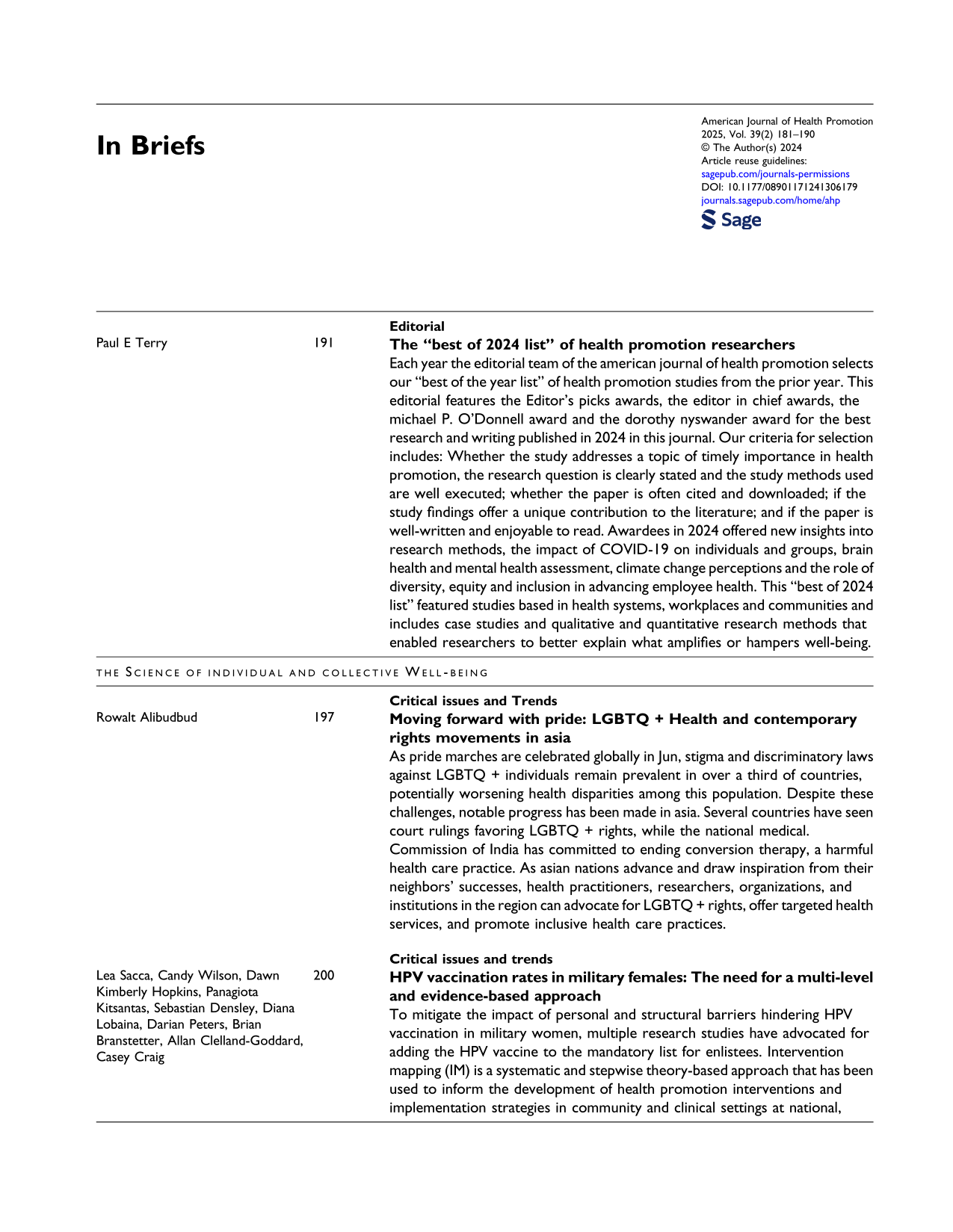
Each year the editorial team of the
As Pride marches are celebrated globally in June, stigma and discriminatory laws against LGBTQ+ individuals remain prevalent in over a third of countries, potentially worsening health disparities among this population. Despite these challenges, notable progress has been made in Asia. Several countries have seen court rulings favoring LGBTQ+ rights, while the National Medical Commission of India has committed to ending conversion therapy, a harmful healthcare practice. As Asian nations advance and draw inspiration from their neighbors’ successes, health practitioners, researchers, organizations, and institutions in the region can advocate for LGBTQ+ rights, offer targeted health services, and promote inclusive healthcare practices.
To mitigate the impact of personal and structural barriers hindering HPV vaccination in military women, multiple research studies have advocated for adding the HPV vaccine to the mandatory list for enlistees. Intervention Mapping (IM) is a systematic and stepwise theory-based approach that has been used to inform the development of health promotion interventions and implementation strategies in community and clinical settings at national, regional, and global levels. Development and evaluation of effective strategies and multi-level interventions using IM may increase the uptake of the HPV vaccine among military females who are at-risk of HPV infections and associated co-morbidities.
Healthcare professionals experience stressors that begin during training and persist into their careers that adversely impact their well-being. This study aims to identify students’ and professionals’ stress levels, satisfaction with wellness domains, barriers to wellness, and stress management practices.
This study was a cross-sectional self-reported survey study.
The study included students (N = 242) and professionals (N = 237) from medicine, nursing, pharmacy, physical therapy, social work, and counseling/psychology.
The Managing Health & Wellness in Health Professions Training and Practice survey was used to capture wellness practices and barriers among participants. Results: Students reported significantly higher perceived stress compared to professionals (
Healthcare professionals exhibit a variety of stress management practices, encounter barriers, and prioritize different wellness domains. Healthcare systems should incorporate self-care education into their curricula and implement systemic changes to foster a thriving healthcare workforce.
Understanding disease prevalence can inform treatment and resource needs across populations. This study aimed to identify the prevalence of sleep apnea (OSA) among veterans and nonveterans.
The national Comparative Health Assessment Interview Study, cross-sectional survey using probability-based sampling frames.
Surveys completed by Internet or phone.
15,166 veterans (40% response rate) and 4,654 nonveterans (57% response rate).
Self-report of healthcare provider-based diagnosis of OSA.
Calculation of prevalence of OSA using statistical weighting to allow for direct comparison between veterans and nonveterans. Secondary analyses evaluated OSA by deployment status among veterans and compared average age of OSA diagnosis and differences in OSA prevalence among veterans and nonveterans stratified by gender, marital status, race/ethnicity, and posttraumatic stress disorder diagnosis.
OSA diagnosis was more than twice as prevalent among veterans (21%, 95% CI 20%-22%) than nonveterans (9%, 95% CI 8%-10%; aOR: 2.56, 95% CI 2.22-2.95,
Veterans have a high prevalence rate of OSA, highlighting the importance of veterans’ access to treatment. OSA is likely underdiagnosed in nonveterans, particularly among racial/ethnic minoritized groups. Future research should investigate disparities in access to diagnostic testing for racial/ethnic minority nonveterans and/or risk factors for OSA among racial/ethnic minority veterans. The increased odds of OSA among those with PTSD highlights in the importance of early referral for OSA testing by providers as well as development of trauma-informed strategies to promote OSA treatment adherence. Limitations include a bias toward underestimation of true disease prevalence due to self-report of diagnosis.
To investigate longitudinal associations between the presence of early childhood routines– predictable and repeatable functional practices that promote healthy growth, development, and relationships – and adolescent health outcomes.
Secondary data analysis.
20 large U.S. cities.
2943 children with socioeconomic disadvantage from the Future of Families cohort.
Routines at age 3 (shared family meals, bedtime routine, daily reading); outcomes later in the same children at age 15 (healthy routines, overall health, psychological well-being).
Descriptive statistics, regression analyses.
We detected longitudinal associations between early childhood routines and later adolescent routines (increased count of shared family meals by parent report [IRR 1.13, 95% CI: 1.03, 1.24,
Early childhood routines predict adolescent routines, and may contribute to long term adolescent health outcomes. Future studies may promote childhood routines during critical developmental stages as a strength-based strategy to promote long-term health and well-being.
This study examined the use of behavioral design strategies to improve healthier food sales.
A quasi-experimental, one-group, repeated measures design examined changes in food sales following behavioral design adjustments.
United States military base hospital dining facility.
U.S. military service members, retirees, and civilian employees.
Behavioral design changes included placement, layout, messaging, default healthy bundling, a stoplight rating system, strategic positioning of healthy items on menu boards, and an increase in healthier snacks.
Food sales were assessed by point-of-sales data.
T-tests examined total sales of each food adjusted weekly between baseline and intervention and intervention and post-intervention. 16 food items targeted by the intervention were examined. Weekly food sales were calculated for the 18-week baseline, 18-week intervention, and 9-week post-intervention. Further, analysis estimated negative binomial models for food item sales.
The hospital dining facility served 600 to 900 meals per day. Weekly foods sales decreased during the intervention for desserts, cooked starches, hummus, and yogurt (
This study demonstrates that a mixture of behavioral design strategies can be operationalized with reasonable fidelity and can lead to increases in the sales of some healthy foods in military worksites.
This study examined whether the relationship between adverse childhood experiences (ACEs) and self-rated health among adults in a nationally representative population is modified by age, sex, or race/ethnicity.
Cross-sectional study.
United States.
Data from the 2020 and 2021 Behavioral Risk Factor Surveillance System were obtained from 185 731 (weighted N = 47 862 016) persons 18 years or older.
The ACE cumulative score (range: 0-11) was calculated using 11 questions about childhood emotional abuse, physical abuse, sexual abuse, and household dysfunction before age 18 and classified as 0 (reference), 1, 2, 3, or ≥4. Self-rated health was divided into (excellent/very good/good [reference]) and suboptimal (fair/poor) categories.
Multivariable-adjusted logistic regression was conducted to test for the interaction with age, sex, and race/ethnicity with ACEs. After adjustment for potential confounders, an increasing number of ACEs had statistically significantly higher odds of suboptimal self-rated health in a graded manner except for 1 ACE (1 ACE: aOR:1.09; 95% CI: 1.00-1.20, 2 ACEs: 1.16; 1.03-1.30, 3 ACEs: 1.17; 1.03-1.32 and ≥4 ACEs: 1.39; 1.26-1.53). There was a significant interaction between ACEs and age. Younger age (18-24 years) had the strongest association for ≥4 ACEs compared to the older age groups. There was no effect modification by sex or race.
ACEs should be considered when creating health-promoting interventions to improve health.
As pandemic-related mistrust of public health recommendations in rural communities may compound gaps in pediatric immunizations, our team explored parents’ perceptions of trustworthiness in messaging.
Qualitative study using 4 virtual focus groups.
Rural Wisconsin.
Participants (n = 25) were parents or guardians of children recruited through our contacts with community-based organizations serving rural communities.
Researchers used task-oriented elicitation techniques to initiate discussion on the trustworthiness of messengers and messages providing health recommendations. Participants were asked to (1) review existing public health messaging on a range of topics and from a range of sponsors; and (2) rank a list of potential messengers in terms of trustworthiness (eg, local health department, Centers for Disease Control). Discussions were recorded, and audio files transcribed, to facilitate a team-based, thematic analysis.
Competency in medical knowledge and parenting experience contributed to estimations of trustworthiness. Participants also responded well to messages and messengers that were able to project recognition of their children’s uniqueness and their experience as parents. Participants distrusted messengers who were seen as biased or “one-sided” in their perspectives.
For successful health promotion for rural-living parents, messengers must be recognized as “competent” to provide pediatric health advice and to avoid blanket recommendations that may undermine parents’ experience and feelings of being “understood” and affect perceptions of trustworthiness.
To comprehensively assess the quality of life (QoL) of Egyptian university students.
Cross-sectional online study.
Online settings of university students from August to October 2023.
University students aged 18-25 from various institutions in Egypt.
Physical, psychological, social, and environmental domains of the World Health Organization Quality of Life-BREF (WHOQOL-BREF) scale. Statistical analyses were performed using SPSS version 27.0. Mann-Whitney and Kruskal-Wallis tests were used to detect significant associations while Spearman correlation was used for correlation analysis.
A total of 1930 Egyptian university students were included. Students showed outperformance in the psychological health and social relationships domains, with medians of 58 ± 20.8 and 58 ± 25, respectively, compared to physical health with a median of 46 ± 17.8 and environmental health with a median score of 16.6 ± 21.9. Non-medical students reported higher QoL scores, particularly in physical, psychological, and social domains, compared to their medical counterparts (
This multi-center study sheds light on diverse aspects influencing QoL of Egyptian university students. The findings underscore the importance of addressing academic stressors, promoting health behaviors, and tailoring interventions based on students’ academic backgrounds with larger and more representative samples.
State and local public health departments (LHDs) are encouraged to collaborate with community-based organizations (CBOs) to enhance communication and promote protective practices with communities made vulnerable during emergencies, but there is little evidence-based understanding of practical approaches to fostering collaboration in this context. This research focuses on how collaboration enhances LHD capacity for effective communication for people with limited English proficiency (LEP) during infectious disease outbreaks specifically and strategies to facilitate productive LHD-CBO collaboration.
Qualitative, telephone interviews, conducted March-October 2021.
Rural and urban jurisdictions with Chinese-speaking or Spanish-speaking populations across the United States.
36 LHD and 31 CBO staff working on outreach to Chinese and Spanish speakers during COVID-19.
Interviews were audio-recorded, transcribed verbatim, and analyzed using a team-based, codebook approach to thematic analysis.
During COVID-19, CBOs extended LHD capacity to develop and disseminate effective communication, meaning communication that is rapidly in-language, culturally resonant, locally relevant, and trusted. Practical strategies to enable and sustain effective collaboration were needed to address operational dimensions (eg, material and administrative) and relational dimensions (eg, promoting trust and respect).
Policies and financing to support LHD-CBO collaborations are critical to improving communication with people with LEP and addressing long-standing inequities in outcomes during outbreaks.
To examine adolescents’ perspectives regarding external and internal influences of the e-cigarette initiation process.
Semi-structured, in-depth qualitative interviews.
California, remote videoconference.
Adolescents ages 13-17 who currently or previously used e-cigarettes (n = 47).
Interviews occurred from May 2020-February 2021. Two researchers coded transcripts based on a codebook developed inductively. Coded excerpts were reviewed to identify encompassing themes related to adolescent e-cigarette initiation.
Adolescents were often near e-cigarette use by peers, family members, and others, creating ample opportunities to try e-cigarettes in response to curiosity, peer pressure, and desires to cope with stress or belong to a group. Adverse first experiences were common (eg, throat irritation, nausea), but many adolescents vaped again or continued to use regularly in attempts to cement friendships or alleviate symptoms of stress and anxiety. Specific characteristics of e-cigarette devices, including low-cost, concealability, and variety in designs and flavors facilitated initiation, continued use, and nicotine dependence.
Adolescents progress to e-cigarette use via a multistage process, starting where social expectations and opportunity converge. While individual circumstances vary, many continue to vape as a perceived coping tool for emotional issues, to gain social belonging, or influenced by e-cigarette characteristics that contribute to ongoing use and dependence. Efforts to deter use should address the devices themselves and the social forces driving youth interest in them.
To explore the relationships between weight status, weight perceptions, and perceptions of the body positivity movement on social media.
Cross-sectional.
Online through the Qualtrics platform.
Participants (N = 521; mean 26.6 ± 5.1 years) were recruited using Qualtrics online panels.
The study survey included questions about participant demographics, weight status, and weight perception. Subjects rated 6 study-specific viewpoint questions about the body positivity movement on a 5pt Likert scale.
Multinomial logistic regression models adjusted for relevant confounders assessed the associations between objective weight status, perceived weight status, and perceptions of the body positivity movement.
Objective weight status was not associated with perceptions of the body positivity movement. Perceptions of weight status were associated with perceptions of the body positivity movement in young women, with those that perceived themselves as overweight more likely (OR = 1.67,
Weight perception, rather than objective weight status, may be a stronger predictor of weight bias and views of the body positivity movement.
To evaluate the impact of the Mindless to Mindful intervention on fat mass loss in adults.
This was a single-group case study.
A fitness center delivered by certified fitness professionals.
222 adults who participated in M2M as a team or as individuals, and 195 completed the entire intervention (attrition rate = 12.16%).
M2M was an 8-week behavior change intervention with tailored coaching, group moderate-to-vigorous exercise (MVE) and self-regulation techniques.
Participants completed a demographic questionnaire, the Jackson-Pollock 4-site body fat measure, brief self-control scale, self-compassion scale, and a daily exercise log.
Paired sample
Participants engaged in an average of 4.88 h (
Self-monitoring, group exercise, and individualized coaching can promote self-regulation and fat mass loss.
We conducted a systematic review of the literature on online health memes to (a) detect and describe the available research, (b) identify key findings, and (c) delineate future research needs/opportunities.
Databases, communication and public health journals, and ancestry search.
Empirical studies, in English, published in peer-reviewed academic journals, and focused on memes to discuss health-related topics.
We scrutinized 357 empirical articles and included 35.
Descriptive summary of the locations where studies were conducted, the health topics addressed, theories and methods used, features of memes analyzed, study outcomes, and researchers’ challenges.
Most studies were conducted in the USA (n = 14); focused on COVID-19 (n = 15); were a-theoretical (n = 19); and quantitative (n = 19). Most explored the themes and use of the memes available online (n = 19); compared meme variations (n = 12) by health issue, content, or participants’ group; examined meme’ effects on health outcomes (n = 1); or evaluated memes as part of a health campaign (n = 3). We summarized the studies’ limitations and key findings.
Memes are a promising message strategy for health promotion and education, but more research is necessary. Considering the information retrieved, we provide five specific recommendations for future research directions when studying health memes, including suggestions on the multiple health issues to address and promising theories to adopt and expand.
Identify commercial tobacco cessation interventions for American Indian and Alaska Native (AI/AN) communities, focusing on strategies used to advance health equity, including strategies to address social determinants of health (SDOH), community engagement, and cultural tailoring.
We searched Medline, Embase, PsycINFO, Cochrane Library, CINAHL, Scopus, ProQuest Central, Academic Search Complete, JSTOR, and Indigenous/Tribal health-related journals and databases.
We included peer-reviewed studies on commercial tobacco cessation for AI/AN persons published January 1998–April 2023 that reported quit rates/attempts. We excluded studies that only used pharmaceutical interventions.
Two reviewers independently assessed each study against our inclusion/exclusion criteria. A reviewer extracted data, and another checked for completeness.
Synthesis focused on reported intervention effectiveness and strategies used for addressing SDOH, community engagement, and cultural tailoring. We used a synthesis matrix which allowed for comparison across studies.
We screened 1116 articles and included 12 for synthesis. Of the 12, five engaged community health workers; four included SDOH elements; and six were reported effective. Of these six, five included early-stage community engagement and four were culturally tailored.
There are few commercial tobacco cessation interventions for AI/AN populations. Building capacity, including tribal capacity, to develop and test multi-level, culturally grounded cessation interventions that address relevant SDOH may advance commercial tobacco cessation efforts in these populations.