
Editorial
 Restricted accessEditorialFirst published December, 2004pp. 3-5

Select search scope: search across all journals or within the current journal


 Restricted accessEditorialFirst published December, 2004pp. 3-5Restricted accessOtherFirst published December, 2004pp. 6-6
 Restricted accessOtherFirst published December, 2004pp. 7-11
Trust in the media is beginning to occupy journalists more than it did, writes commentator and press critic Lloyd. For a long time - and even now - we have been more concerned about our independence. We should be concerned to maintain independence, but in settled, rich democracies it's not fundamentally at issue. We can have it if we want it: though it may entail some sacrifices. What is more urgent is the power of the media, and the effect of media on society. In the news business - the part of the media often seen as its moral and social edge - we haven't thought much about, or debated, that. There is growing in Europe, and there is already in the United States, a determination to examine the practices of the media by the practitioners themselves - in alliance with those outside the profession who are interested in its future. That will mean, I believe, the creation of institutes or departments which, rather than teach journalism in a normative way in order to fit students for a career in broadcasting or public relations, study and argue about the role of journalism in societies, and how it can fulfil that role.
Restricted accessOtherFirst published December, 2004pp. 12-16The problem isn't all rooted in principle, writes the former
Restricted accessOtherFirst published December, 2004pp. 17-21Journalists working in the British press need now to be part of the answer and not the cause of a continuing crisis, writes Marsh, editor of BBC Radio 4's
Restricted accessOtherFirst published December, 2004pp. 22-22 Restricted accessOtherFirst published December, 2004pp. 23-27
Journalists who could barely contain their excitement about the US elections now look ahead with almost universal gloom to the long British campaign ahead, writes the political editor of ITV News. While set and graphic designers gurgle with delight at their quadrennial licensed excess - election night sets that put the Pompidou Centre to shame, magical graphics that can fly you down the chimney of Number Ten right into Tony Blair's bedroom - reporters and producers are carping into their cappuccinos: "It's going to be so dull...I don't think I can bear it." Well, move aside for someone who understands that there is something special - magical even - about the moment the country makes its choice of who should lead it and, just as important, we all choose who should represent us where we live.
Robinson presents his propositions designed to allay those pre-election blues.
Restricted accessOtherFirst published December, 2004pp. 28-34There is a story unlikely to appear in print that has been doing the rounds among the few remaining religious affairs correspondents in Britain, writes the religion correspondent of
Restricted accessOtherFirst published December, 2004pp. 35-40There have been many developments in recent years in the admirable efforts made to mitigate the risks of war zones, or "hazardous environments", for those in the media industry who have to venture into them, writes this "manager of projects in hostile environments". Having worked as a consultant to a plethora of organisations that have sought the planning skills and common sense advice of an ex-soldier, I have observed these developments with interest in several of the world's current so-called "post-conflict" areas. These days you usually bump into other ex-military colleagues who are employed by the Western bureaus as safety advisers and, more recently, as "hired foreign guns" brought in to protect news crews. By my reckoning even the most conservative of Western TV operations in Iraq now have armed foreign minders as well as Iraqi national armed guards. In my view there is no question that to get their job done, journalists need minders and local fixers in nasty places. Apart from the safety question, such help is necessary to hitch a ride and/or negotiate a free passage with some or all of the factions in a war zone, as any war correspondent worth his or her flak jacket knows.
Restricted accessOtherFirst published December, 2004pp. 41-45"And don't bother coming back without an interview with Chirac - in English!" Those were the parting words of a former boss as I set off to cover the French elections in 1995. Lou Grant would have been proud, writes the foreign affairs editor of Sky News. It was an offer I couldn't refuse, and par for the course in the heated atmosphere of news. However, such emotional blackmail has no place when the "offered" story concerns danger. No is such a small word and yet sometimes so difficult to say, especially if it's your response to senior management upon being given a potentially hazardous assignment. These days in some conflict zones we are now the target and seen as the enemy. The new era has brought with it new dangers and new reasons to say no. Yet the "no" option does appear to be understood by senior management. They have also grasped that if you want to do safety properly you have to invest: invest in the kit, the training, the people and the attitude.
Restricted accessOtherFirst published December, 2004pp. 46-52Producing a daily national newspaper live at two centres - the operation conducted between London and Manchester over an 85-year period - assumes a modicum of cooperation, goodwill and mutual understanding. Or so one might have thought, writes author Waterhouse in his new book about national newspaper journalism in the north of England. In reality, the nightly struggle to meet deadlines was exacerbated by distrust, often dislike, permeating whole organisations from editors to messengers, via the composing room and the machine floor. At the heart of the misunderstandings lies a cultural divide. Londoners thought (and think) that Mancunians are thick; Mancunians thought (and think) that Londoners are wide-boys. Londoners assume that nothing outside the capital - and that includes northern editions of the nationals - matters. Mancunians assume that they are in fact superior because Londoners are indolent as well as arrogant. A Mancunian living in London is teased about his accent, which he either loses or hides away among other northern exiles; a Londoner living in Manchester always stands out, although he is usually accepted if he conforms to local rules.
Restricted accessOtherFirst published December, 2004pp. 53-58Eminent lawyer Bindman writes on how the Freedom of Information Act will come into force in January next. The Information Commissioner will then be able to demand production of information from government at any level, but his powers are circumscribed by the much criticised power of veto given to ministers over information which they consider should remain confidential in the public interest. In a speech to the Campaign for Freedom of Information in March of this year, Lord Falconer, the Lord Chancellor and Secretary of State for Constitutional Affairs, who has remained in charge of this legislation since he took it over as a minister in the Home Office, rejected the recommendation of a committee under Bob Phillis that ministers should renounce the use of the veto. In many areas, believes Bindman, it would be an intolerable abuse of power for the Government to use the veto that it has controversially maintained. It will surely have the sense not to do so.
Restricted accessOtherFirst published December, 2004pp. 59-64Just when the West Indies cricket Test team - once the best in the world - was experiencing its worst tour of England in living memory, the dire plight of the West Indian heritage press became manifest, writes this experienced Caribbean journalist.
Restricted accessOtherFirst published December, 2004pp. 65-70The media I read are increasingly swamped by endless lists of things I can't get excited about or can't afford; and, conversely, all editors seem to want from me is lists, listings, bites and blobs, writes freelance writer Moss. The "list" has been creeping into the pages of newspapers and magazines for years and I'm not sure when I finally realised that it had replaced the news report, the feature and the commentary as the definitive quintessential genre of our times. Perhaps it was when a list of 100 British public intellectuals appeared in the July 2004 issue of worthy, well-meaning
Restricted accessReview articleFirst published December, 2004pp. 71-73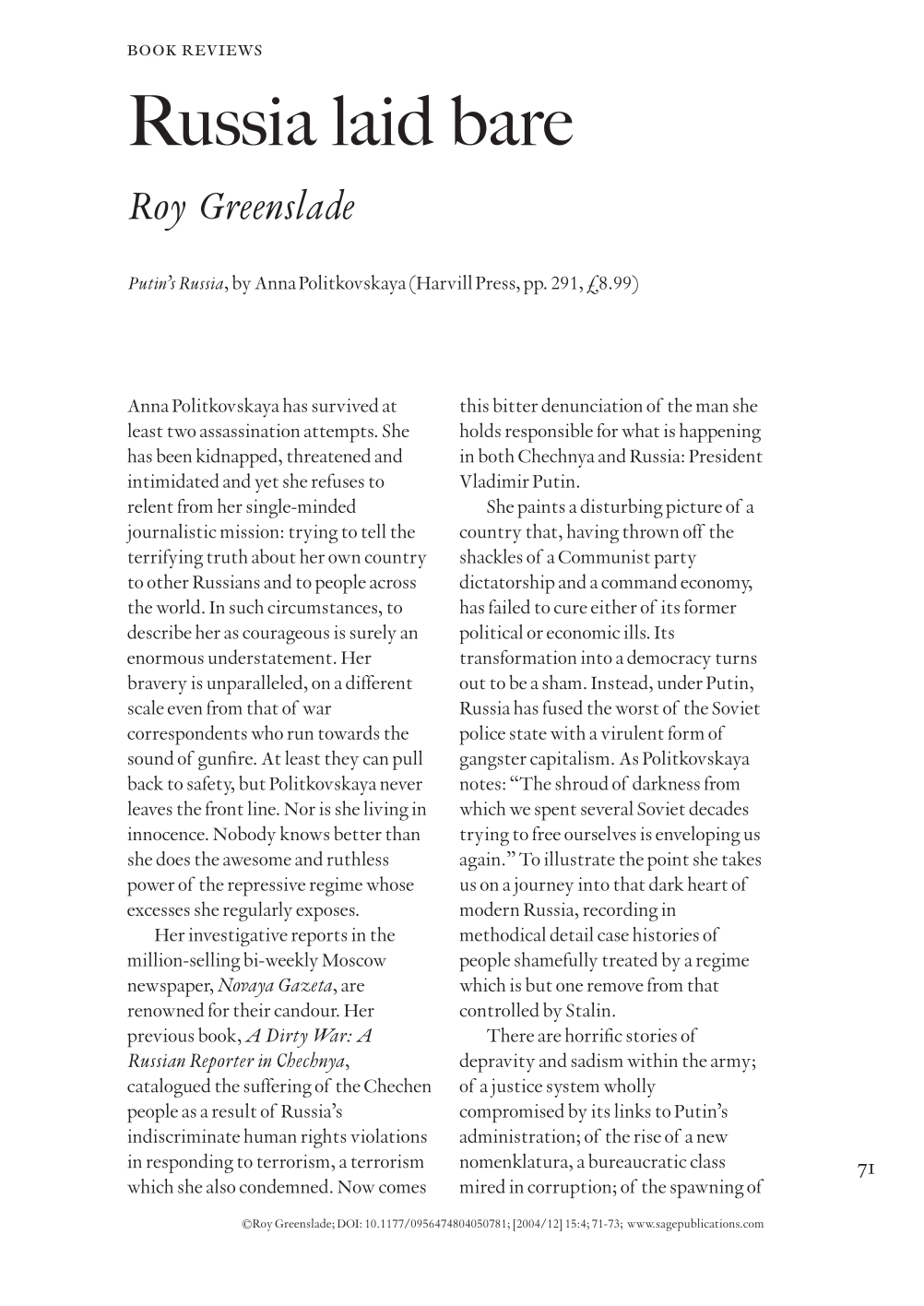 Restricted accessReview articleFirst published December, 2004pp. 73-75
 Restricted accessReview articleFirst published December, 2004pp. 76-78
 Restricted accessReview articleFirst published December, 2004pp. 78-80
 Restricted accessReview articleFirst published December, 2004pp. 81-83
 Restricted accessReview articleFirst published December, 2004pp. 83-85
 Restricted accessOtherFirst published December, 2004pp. 86-87