The research question addressed in the present study, with ARIMA time-series analyses, was the extent to which changes in economic and physical availability had an effect on sales of alcohol in four Canadian provinces during the second half of the 20th century. The annual sales, by type of beverage (spirits, wine and beer) as well as total sales, measured in pure alcohol per inhabitant age 15 and above in each province, were used as dependent variables in the analyses. The inhabitants' real disposable income, the real price of alcohol, and the number of on- and off-premise outlets per 100,000 inhabitants were used as independent variables. All the time-series were differenced to remove long-term trends. The main study period was 1951–2000. In some of the analyses the study periods were shorter, primarily due to lack of data. Changes in economic availability in general, and in price in particular, had larger effects on sales than physical availability. Among the beverages analyzed in the study, the demand for spirits was most sensitive to changes in availability. Economic availability had a greater effect on sales than the number of outlets. However, one might question to what extent the number of outlets really is a feasible measure of transaction costs associated with purchases of alcohol.
Research article
Restricted accessResearch articleFirst published September, 2005pp. 373-386
The protective effect of light to moderate drinking on all-cause mortality in general is well established, but there have been questions on its generalizability to women and non-smokers. The present study addresses these questions with a large cohort of Canadian middle-aged women. The key findings indicate that light to moderate drinkers have a markedly lower risk of mortality compared with current abstainers and that this effect is independent of smoking status. Part of this effect may be due to ex-drinkers who are part of the current abstainers group. Heavy drinkers have a higher mortality risk than light to moderate drinkers.
Research article
Restricted accessResearch articleFirst published September, 2005pp. 387-404
The purpose of the study was to map alcohol problems in relation to blood alcohol concentration in a large representative sample of male and female Swedish drivers suspected of drunk driving. Twenty-one hundred suspected DUI offenders (drivers suspected of driving under the influence of alcohol) were assessed with the Alcohol Use Disorders Identification Test (AUDIT). Information from the police regarding BAC, age, gender, and place and time of the stop was also collected. More than half (58%) of the suspected DUI offenders had alcohol problems, and among these 24% had high levels of alcohol problems. Of specific interest was the observation that almost half (46%) of the suspects with a BAC below the Swedish legal limit of 0.02% had alcohol problems, a prevalence that did not increase until a BAC of 0.10%–0.15%. It can be concluded that the mere suspicion of drunk driving indicates alcohol problems.
Research article
Restricted accessResearch articleFirst published September, 2005pp. 405-428
Data from the Survey of Inmates in Federal and State Correctional Facilities, 1997 are used to estimate the number of drug-law violators in U.S. prisons solely because of their drug use and not because of involvement in drug distribution or other offenses. The estimates (5,380 to 41,047) are much lower than would be implied by naively assuming that conviction for drug possession implies no involvement in drug distribution. Implied imprisonment risk per year of use is also low, perhaps an hour per year of use for marijuana, in part because expected time served is half that for those clearly involved in drug distribution.
Research article
Restricted accessResearch articleFirst published September, 2005pp. 429-455
In the United States, a trope of “deservingness” shapes policy related to public aid and substance abuse. In recent decades, poor people with substance use problems have increasingly been seen as “undeserving.” Federal welfare reform, passed in the mid-1990s, is an important exemplar of this trend. Welfare reform empowered line workers to directly and indirectly withhold aid from people with substance use problems. This paper uses in-depth interviews with workers to explore their views of these new policies. Workers generally applauded welfare reform's renewed attention to deservingness, including program emphases on client self-sufficiency and personal accountability and policies that time-limited cash aid and mandated working. They felt that these changes allowed them to stop “enabling” substance abuse and to encourage clients with alcohol and drug problems to bootstrap their way into jobs. Workers' embrace of these policy changes appears likely to shape how substance abuse problems are addressed within the welfare system.
Research article
Restricted accessResearch articleFirst published September, 2005pp. 457-465
John A. Cunningham, Jan Blomqvist, Joanne Cordingley , [...]
View All
Abstract
Aim: To assess what it means when respondents say they have received treatment on population surveys. Method: Former heavy drinkers recruited through a random digit dialing telephone survey were asked about the type, time, and amount of treatment they had received. Results: When respondents indicated that they had received treatment, it appeared that they had a specific treatment in mind, that they completed the treatment program, and that, for the majority, treatment occurred at roughly the same time as their successful change from heavy drinking. The congruence between age of change and age of treatment use appeared greater among respondents with abstinent versus reduced-drinking recoveries.
Research article
Restricted accessResearch articleFirst published September, 2005pp. 467-493
American films and television programs increasingly feature characters recovering from addiction. These representations are based on previous depictions and help create a cultural understanding of addicts. This study analyzes the depiction of addicts and addiction in three Hollywood films whose narratives are largely situated within a treatment center: Clean and Sober (1988), When a Man Loves a Woman (1994), and 28 Days (2000). It concludes that the films depict a stock experience of treatment that is surprisingly univocal, as well as unrealistic when compared with the availability and realities of real-life programs. In addition, the films limit their representations of successful recovery to white, upper-class individuals and offer only one conceptual framework for addiction.
Correction
Restricted accessCorrectionFirst published September, 2005pp. 495-496
M. Lawrence Schrad, Toward a comparative analysis of state alcohol-control systems: The triadic model, Contemporary Drug Problems 32, pp. 195–223, Summer 2005.
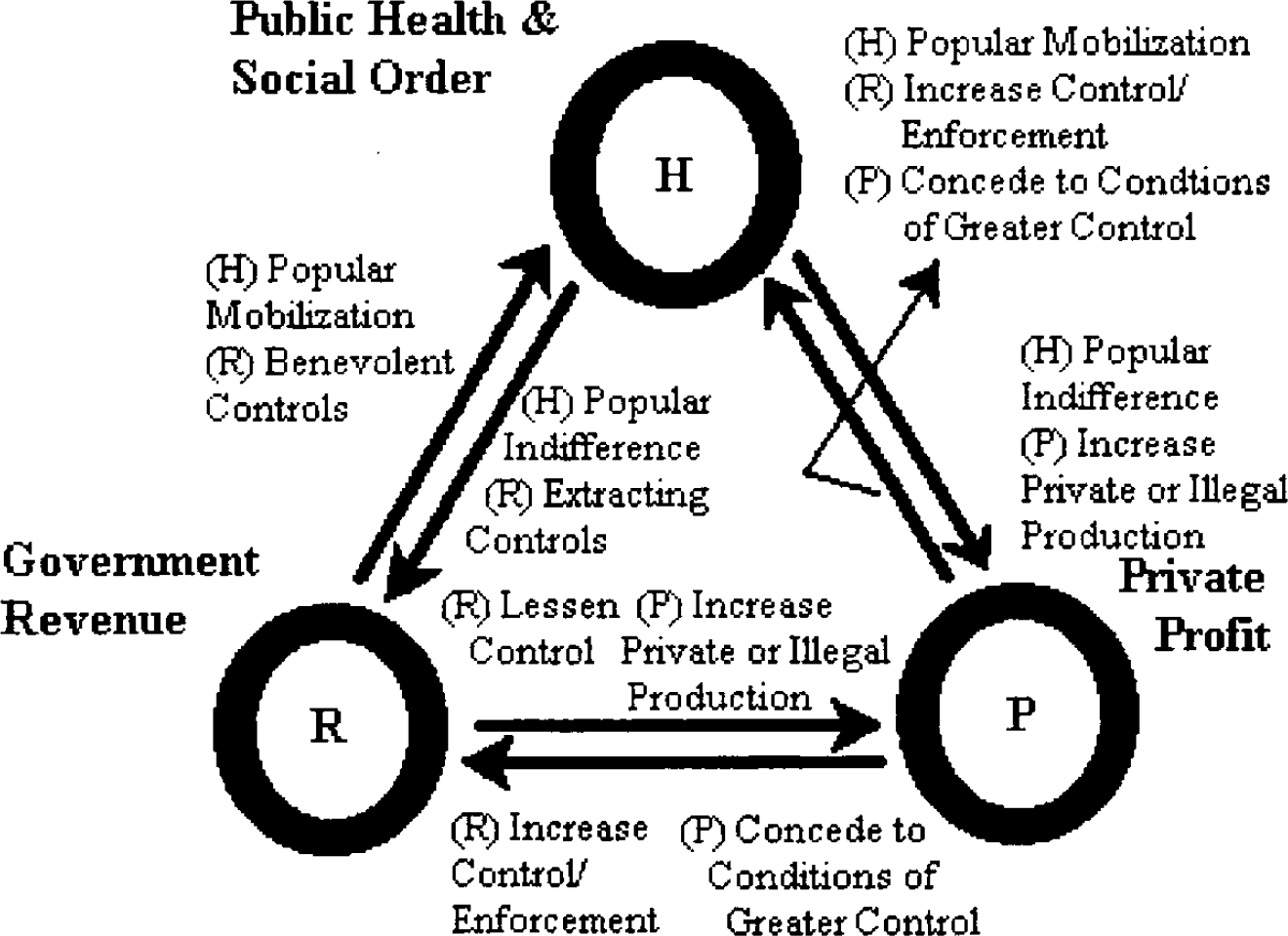
Unforeseen technical difficulties are frequently a part of the academic enterprise. Unfortunately, due to an error in the printing process, the nine separate grayscale figures that provide greater understanding of the analytical content of the article Toward a comparative analysis of state alcohol-control systems were transformed into unflattering black silhouettes. The figures were intended to illustrate the triadic relationship between three potential beneficiaries of the alcohol trade: public health and social order (H), government revenue (R), and private profit (P). The level of benefits accruing to each node of the triad can nevertheless be seen by comparing the relative size of the cylinder representing each public health (H) being the cylinder crowned with a graphic representation of five individuals, the government revenue (R) cylinder topped with a miniature treasury building, and private profit being capped by buildings and factories as graphic representations of private initiative. In the published article, a taller cylinder represents a greater amount of benefits accruing to the potential beneficiary, while a shorter cylinder represents little accrued benefit. Likewise, the arrows indicative of benefit flows are also easily viewed.
The only figure that requires greater clarification is the final one, Figure 9 on page 214, as all of the text boxes that contained explanations for the corresponding benefit flows to and from the various nodes were transformed into unsightly black blobs in the printing process. Therefore I have included below an earlier graphic representation of Figure 9. What it lacks in aesthetic appeal it makes up for in simplicity. Explanations are given in terms of mechanisms that can be enacted by the various players in the model, which could potentially cause benefits to flow from one node to another.
It is my hope that this explanation will suffice to give a clearer picture of a model that, for better or worse, relies heavily on a visual interpretation.

 Restricted accessOtherFirst published September, 2005pp. 341-342