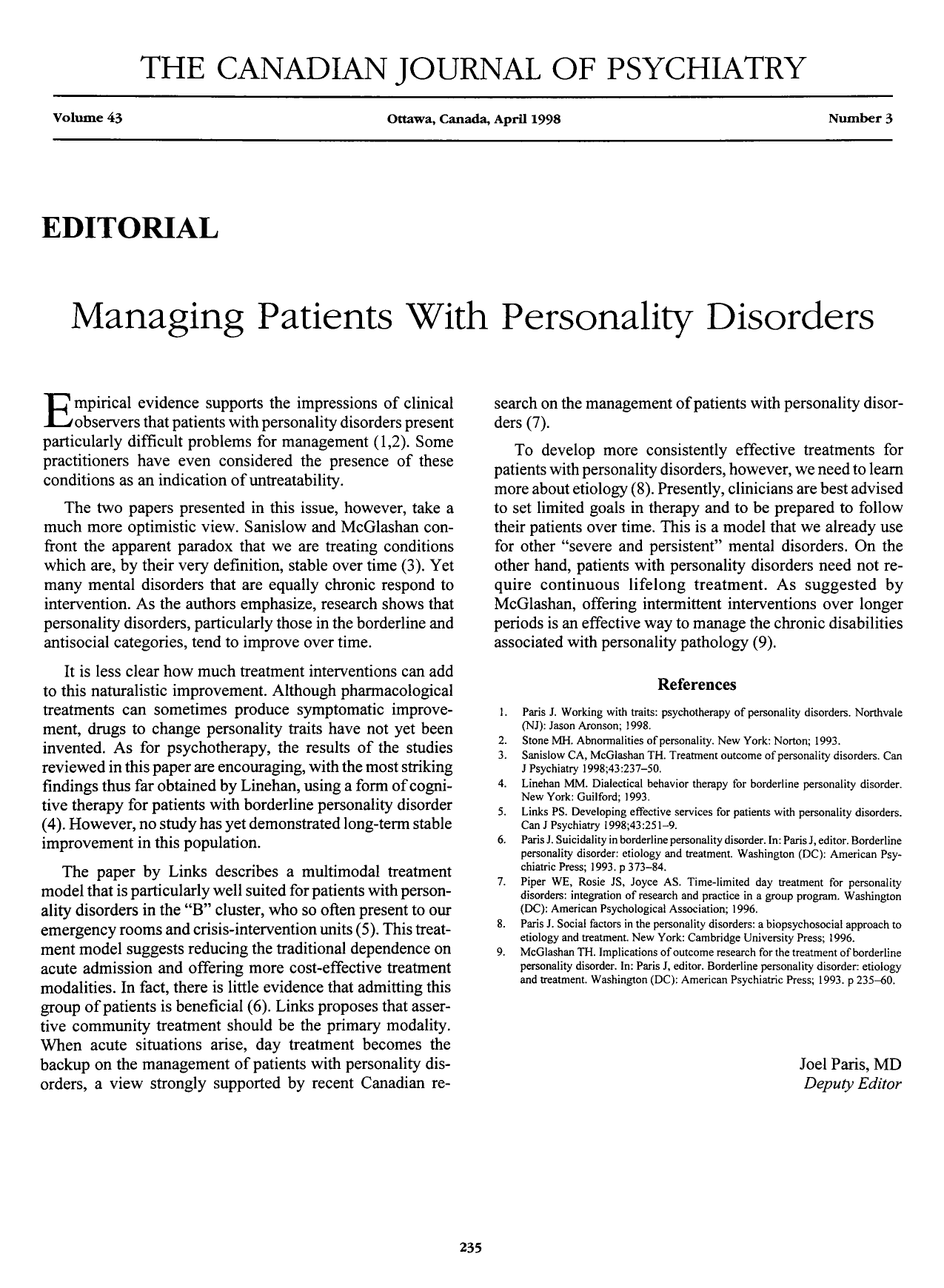
Editorial
Select search scope: search across all journals or within the current journal

To review the treatment outcome of personality disorders.
A literature search of studies pertaining to personality disorder and outcome was conducted, and studies that focused primarily on Axis II were retained. Of these, naturalistic outcome studies were distinguished from those that addressed treatment outcome specifically. The treatment outcome studies were examined in terms of type of treatment intervention, dependent variables, and outcome.
Contrary to contemporary assumptions about Axis II, a substantial number of treatment outcome studies were identified. Trends in the assumptions underlying psychosocial and pharmacologic approaches were identified on the basis of dependent variables.
There is evidence that effective treatments exist to alleviate symptoms and reduce symptomatic behaviours that accompany personality disorders. What these results hold for the idea of remission from personality disorder is considered.
This review focused on empirical research that addressed the effectiveness of service models for the care of patients with personality disorders.
Services discussed included those delivering acute care, such as crisis and emergency services and acute psychiatric hospitalization; continuing care, such as outpatient services, day hospital treatment, and assertive community treatment programs; and other community programming, such as integrated treatment for comorbid substance abuse and psychoeducational interventions for families of patients with personality disorders. The review focused on studies that included patients with personality disorders, and it measured outcomes relevant to patients with personality disorders. Evidence from randomized controlled trials was highlighted.
Few systematic studies of acute services were available. Community programming can decrease the risk of suicide attempts and reliance on inpatient admissions. Services must develop methods of ensuring compliance with treatment. Assertive community treatment for Axis II patients should be developed, implemented, and tested. Comprehensive programming for patients with personality disorders must include integrated treatment for substance abuse and family psychoeducational programs.
Promising new models of care for patients with personality disorders are ready for testing and wider application.
Humane treatment and care of mentally ill people can be viewed from a historical perspective. Intramural (the institution) and extramural (the community) initiatives are not mutually exclusive.
The evolution of the psychiatric institution in Canada as the primary method of care is presented from an historical perspective. A province-by-province review of provisions for mentally ill people prior to asylum construction reveals that humanitarian motives and a growing sensitivity to social and medical problems gave rise to institutional psychiatry. The influence of Great Britain, France, and, to a lesser extent, the United States in the construction of asylums in Canada is highlighted. The contemporary redirection of the Canadian mental health system toward “dehospitalization” is discussed and delineated.
Early promoters of asylums were genuinely concerned with alleviating human suffering, which led to the separation of mental health services from the community and from those proffered to the criminal and indigent populations. While the results of the past institutional era were mixed, it is hoped that the “care” cycle will not repeat itself in the form of undesireable community alternatives.
Severely psychiatrically disabled individuals can be cared for in the community if appropriate services exist.
To examine the rate of persistence of borderline personality disorder (BPD), the existence of concomitant personality disorders on follow-up, and the predictors of outcome in patients who met criteria for BPD compared with patients with borderline features who failed to meet all of the criteria.
This prospective cohort study reassessed subjects for BPD diagnosis and cooccurring personality pathology at 7 years follow-up. Initial measures of borderline and comorbid personality psychopathology were used to predict levels of borderline or other personality disorder psychopathology at follow-up.
Of the 5 7 subjects who initially met the criteria for BPD, 30 (52.6%) were found to have remitted BPD, and 27 (47.4%) were characterized as having persistent BPD. The remitted group met significantly fewer comorbid personality disorder diagnoses than the persistent group (mean = 0.8, mean = 3.5 respectively; P < 0.05). Results also indicated that the initial level of borderline psychopathology was predictive of borderline psychopathology at follow-up, which explained 17% of the variance.
This prospective follow-up study found that almost 50% of former inpatients with BPD continue to test positive for BPD at 7 years follow-up, and these persistent BPD patients also had significantly more comorbid personality psychopathology. Borderline psychopathology at follow-up was primarily predicted by the level of borderline psychopathology recorded at the initial assessment.
To explore semantic categorization strategies in patients with schizophrenia.
A short-term memory-recognition task that reveals the effects associated with categorization was created and applied to 2 groups of patients with schizophrenia and depression.
Only the schizophrenic subgroup with formal thought disorder (measured using Andreasen's Thought, Language, and Communication [TLC] scale) exhibited a deficiency in semantic categorization strategies during the task.
These results support the hypothesis of the impairment of the processes involved in the processing of contextual information inpatients with schizophrenia who suffer from formal thought disorder.
Patients with major depression frequently have high Cortisol levels and resistance to dexamethasone. We sought to determine to what extent major depression might be influenced by inhibitors of steroid biosynthesis and to study the endocrine changes produced.
After drug washout, 20 treatment-resistant patients with major depression were given aminoglutethimide, metyrapone, and/or ketoconazole, along with a small dose of cortisol for 8 weeks. Hamilton Depression Rating Scale (HDRS) ratings, 8:00 AM Cortisol, dehydroepiandrosterone sulfate (DHAS), adrenocorticotropin (ACTH), and testosterone levels were followed weekly or offener. A dexamethasone suppression test (DST) was conducted before and after treatment.
Seventeen patients (85%) completed the course of treatment, and a significant mean drop (P ≤ 0.0001) of 50% in the HDRS score occurred by 7 weeks of treatment. Cortisol levels fluctuated widely and were often still high after the patient had improved clinically. Dehydroepiandrosterone sulfate levels fell more uniformly and were found to be a useful indicator of compliance and, to some extent, efficacy with aminoglutethimide and ketoconazole therapy. The correlation between DHAS and HDRS (r = 0.94) was significant (P = 0.02). Testosterone levels in men fell with ketoconazole but returned promptly to normal at the end of treatment. Adrenocorticotropin levels were normal or elevated, depending on the assay used, and rose (P = 0.07; n = 13) in most subjects during therapy. Of the 6 responders who had nonsuppressor DSTs before starting therapy, 5 had reverted to normal 1 to 2 weeks following cessation of therapy (P = 0.0006).
Abnormal metabolism of adrenocortical steroids may perpetuate depression, and alterations of synthesis or metabolism of these steroids may lead to a remission.
To examine the characteristics of a sample of remands after the introduction of the 1992 Criminal Code amendments, to compare those deemed fit with those deemed unfit as the result of an institution-based evaluation of fitness, and to determine the impact of the Code changes on one's detention period by investigating the length of time that individuals were held on remand.
File information was collected and analyzed for 180 males who were remanded for inpatient evaluations of their fitness to stand trial between October 1994 and July 1995.
The results indicated that remanded defendants are more likely to be single, unemployed, and living alone and that unfit defendants are significantly more likely to have never been married. As well, individuals who were found to be unfit to stand trial were significantly less likely to have been diagnosed with a drug- or alcohol-use disorder and were 4 times more likely to have been diagnosed with a psychotic disorder. The results also indicated that while the 1992 Criminal Code revisions called for a 5-day evaluation period, it appears that this is rarely accomplished, and, in fact, the average length of time for an assessment of fitness is 23 days. Finally, the majority of remanded individuals are certified and treated with psychotropic medications while on remand.
The results of this study suggest that the fitness remand period is being used for purposes other than assessing fitness.
Lack of intimacy has been identified as an important provoking agent that increases the risk of depressive symptoms in women. This study precisely characterized lack of intimacy by assessing a woman's attachment style and investigated the specificity of association between depressive symptoms and an anxious attachment pattern.
Four hundred and twenty women participated in this cross-sectional study of depressive symptomatology and anxious attachment. All participants completed the following measures: a sociodemographic questionnaire, the Centre for Epidemiological Studies Depression Scale (CES-D), the Reciprocal Attachment Questionnaire, the Social Support Questionnaire, the Rosenberg Self-Esteem Scale, and the Global Assessment of Recent Stress Scale.
A score of 16 or above on the CES-D, which indicates the presence of depressive symptoms, was used to divide the sample into 2 groups: a depressed group (N = 129) and a nondepressed group (N = 291). We found that women in the depressive symptomatology group were more likely than women in the nondepressive symptomatology group to exhibit anxious attachment and adverse social and cognitive characteristics. Lower levels of self-esteem and higher levels of recent stress were also predictive of depressive symptomatology. Feared loss of the attachment figure and a lack of use of the attachment figure were independent predictors of depressive symptomatology in the same model.
The feared loss of security associated with an attachment figure seems to be related to an increased likelihood of depressive symptoms.