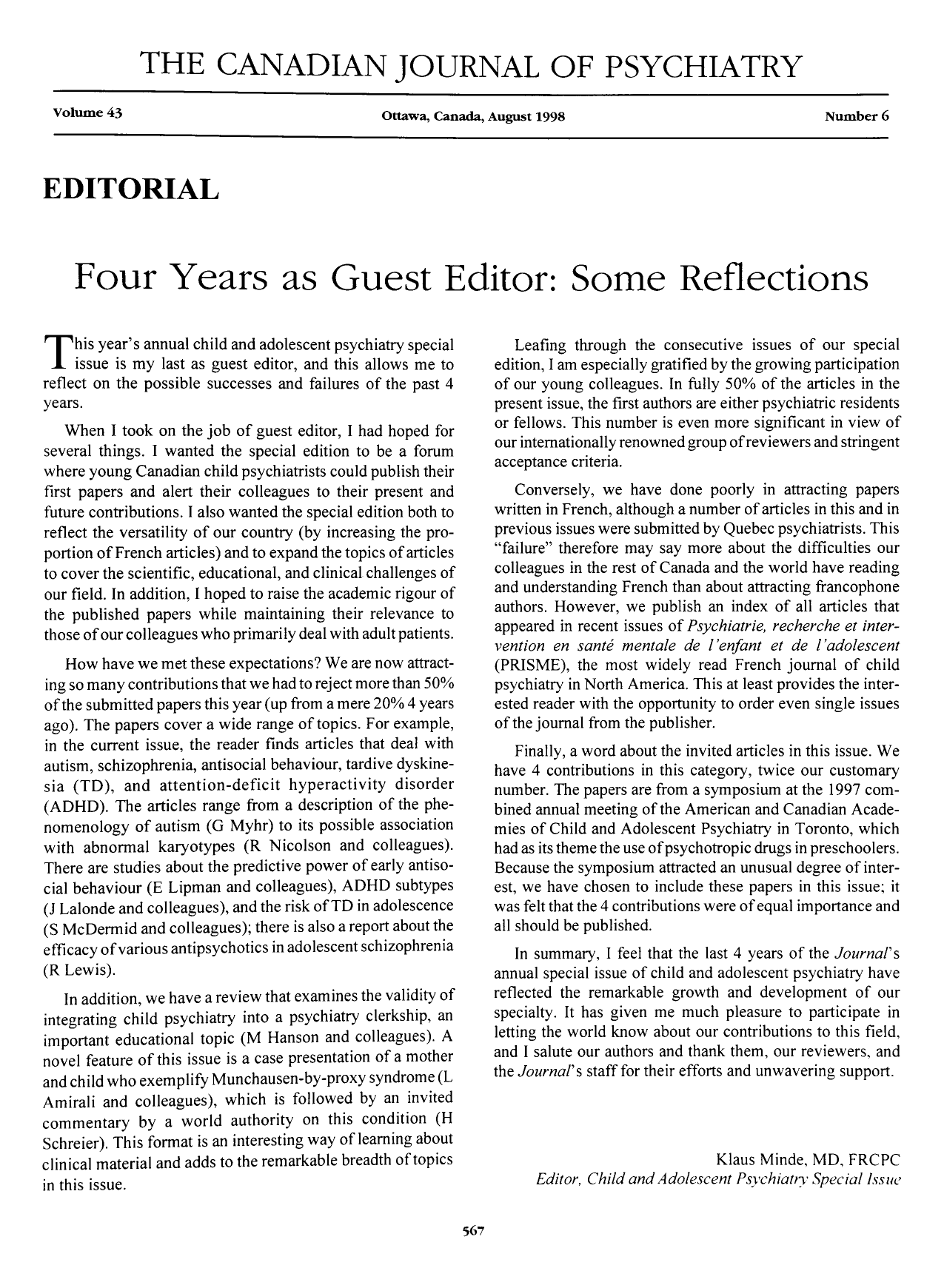
Editorial
Select search scope: search across all journals or within the current journal


To provide an overview of the use of psychotropic drugs in preschoolers.
Literature review.
Although controversy persists, the evidence suggests that preschool children are being given an increasing number of psychotropic drugs, especially by general practitioners and pediatricians.
There is an urgent need to formally evaluate the efficacy of psychotropic medication for young children.
To review the indications, safety, and efficacy of psychotropic medications used in preschoolers.
Proprietary prescription-use databases indicate that practitioners are prescribing psychotropic medications for preschool patients at an increasing rate. A Medline search was conducted using drug exposure for children below the age of 6 years to identify efficacy and safety reports of these agents in the preschool age-group.
The search yielded 22 reports that mention exposure to medications, including maternal exposure, accidental overdose, and adverse events in preschool children. Safety issues highlight the age-specific vulnerabilities of this age-group, including hepatotoxicity from valproic acid, among others. In addition, the prominence of adverse-event responses in this age group may be related to polypharmacy not seen in school-age children or adolescents. Less than a dozen controlled efficacy studies of psychotropic agents were identified for children in the preschool age-group. These are limited by the small numbers of subjects in the reports. Only 2 disorders described in the Diagnostic and Statistical Manual of Mental Disorders (DSM-IV), attention-deficit hyperactivity disorder (ADHD) and autistic disorder, are mentioned. The Food and Drug Administration (FDA) approved psychotropic medications for preschoolers but limited their use to medical purposes, not psychiatric, with the exception of use for ADHD.
Because data about psychotropic drug safety and efficacy in adults have not been extended to children, new psychopharmacological research is required before clinicians can use these agents to treat psychiatric disorders in the preschool age-group.
With increasing frequency, psychotropic medications are being prescribed to young children, often for long periods of time. The interaction between psychotropics and the developing brain has not been systematically investigated in humans. Data collected from animals suggest that developing neurotransmitter systems can be exquisitely sensitive to early inhibition or stimulation by pharmacological agents, which can lead to permanent changes in adult life. Most of these data are collected from rodents, and their extrapolation to humans is difficult. More relevant models could be developed, for instance using primates. In humans, the focus of research has traditionally been on the possible teratogenic effects of prenatal drug exposure. Recently introduced quantitative imaging techniques can offer new approaches to studying the effects of psychotropics on the developing brain. This research has clear implications for the safety and efficacy of psychopharmacologic drug use in children.
To provide an overview of the knowledge base concerning the prescribing of psychotropic agents in young children with mental disorders and related mental health problems.
Relevant information is reviewed concerning the knowledge base available to inform pediatric psychopharmacology prescribing practices.
Very few psychoactive medications have been adequately tested for safety and efficacy in young children, despite relatively high rates of prescribing.
Behavioural and psychotherapeutic strategies are often the wisest first therapeutic intervention for this age group. Psychotropic medications may be required, but should be used cautiously in young children, while additional studies are being conducted.
To examine empirical data on children with autistic disorder (AD), Asperger's disorder, and pervasive developmental disorder not otherwise specified (PDD-NOS) for continuities or distinguishing features between disorders and to see to what extent the Diagnostic and Statistical Manual of Mental Disorders (DSM-IV) diagnostic criteria reflect observed data.
Studies were identified in 4 ways. 1) A Medline search from 1976 to the present of articles with the key words autism, pervasive developmental disorder, autistic spectrum disorder, and Asperger; of these articles, those with mesh headings or textwords “cluster,” which identified cluster analyses deriving pervasive developmental disorder (PDD) subtypes, were retained. 2) The Journal of Autistic and Developmental Disorders
Eight cluster studies were retained for their relevance to diagnostic issues, as were 7 empirically derived studies delineating clinical characteristics of children with AD, Asperger's syndrome, or PDD-NOS. Data suggest that children with PDD may fit into 1 of 2 overlapping groups, including a lower-functioning group with greater developmental compromise, social aloofness, and a greater number of autistic symptoms and a higher-functioning group with higher IQ, fewer autistic symptoms, and more prosocial behaviour. The PDD subtypes resemble each other and can be seen as existing on a continuum, differing only by degree of impairment.
Children exhibiting the triad of autistic impairments can be seen as suffering from disorders on a PDD continuum. While the DSM-IV does identify a lower-functioning autistic group (AD), the higher-functioning group is less well served. Asperger's disorder as defined in the DSM-IV is not clearly distinguishable from AD and PDD-NOS, and the PDD-NOS subcategory is not operationalized. Further research is required to elaborate criteria for the higher-functioning PDD group, and measures related to etiology, outcome, and treatment response may help determine which diagnostic criteria can meaningfully separate one disorder from another.
To review the existing literature on the efficacy and tolerability of antipsychotics for adolescent psychosis. The review focuses in particular on literature regarding adverse effects that are thought to have an increased incidence in young patients and on the possible neurobiological bases for such differential sensitivity.
Pertinent studies were sought using Medline searches, supplemented by selected bibliographies, and reviewed.
There is a relative paucity of research in this area; in particular, well-controlled trials are lacking. The existing literature suggests fairly good efficacy of both typical and atypical antipsychotics in the treatment of psychotic disorders in children and adolescents. However, the incidence of certain side effects, particularly extrapyramidal symptoms (EPS), is found to be higher in young patients compared with adults. Positron emission tomography (PET) receptor studies in adults have demonstrated that the incidence of EPS is related to dose-dependent dopamine type-2 (D2) receptor occupancy and that there is a significant relationship between the number of these receptors and age.
Improved tolerability is leading to the increasing use of atypical antipsychotics for adolescent patients, though these new drugs do have specific adverse effects of their own. There is a need for more controlled studies of atypical antipsychotics in children and adolescents. In particular, dose-finding studies are needed to determine the optimal dose range to produce the greatest improvement with the least side effects for each of these new drugs.
To examine the predictive accuracy of antisocial behaviours among 4- and 5-year-old children for problem behaviours 4 years later (ages 8 and 9 years).
Data from the Ontario Child Health Study (1983) and Follow-Up (1987) are used. Predictive accuracy is conceptualized using positive predictive value (PPV) and sensitivity. The predictive accuracy of early antisocial behaviours for the 1987 outcomes is examined overall, by gender, by variable thresholds of predictor and outcome by gender, and by using contextual variables alone or in combination with antisocial behaviour recorded in 1983.
The predictive accuracy of 1983 antisocial behaviour for 1987 outcome is generally modest and differs by gender (better for boys for externalizing disorder [PPV = 41%, sensitivity = 57%]; better for girls for internalizing disorder [PPV = 13%, sensitivity = 80%]; better for boys for conduct problems [PPV = 54%, sensitivity = 21%]). Using either gender-specific thresholds or gender-neutral thresholds does not alter predictive accuracy in a consistent way, nor does the use of a single contextual variable. Use of a cumulative risk index increases PPV but decreases sensitivity.
The predictive accuracy of antisocial behaviour in 4-and 5-year-old children over 4 years in a nonclinical community population is limited. The clinical, research, and policy implications of this work are discussed.
To integrate child psychiatry into a psychiatry clerkship Objective Structured Clinical Examination (OSCE).
Child psychiatry OSCE stations were designed to evaluate clerks' skills in the identification of 4 common conditions. Child psychiatrists wrote case scenarios and checklists and supported standardized patient (SP) training for these stations. A bank of 4 child psychiatry OSCE stations is now available for use in the psychiatry OSCE. Child psychiatry faculty have been trained as examiners for ongoing administration of this OSCE.
This bank of child psychiatry OSCE stations has examined 402 clerks. Mean student scores for content were 68% to 86% and for process were 69% to 76%. Station reliability and examiner feedback were acceptable.
Child psychiatry has been successfully integrated into a psychiatry clerkship OSCE. Although the commitment in terms of monetary and faculty costs has been considerable, the accompanying educational benefits of such integration warranted this expense.
The presence of a 47,XYY karyotype in boys with pervasive developmental disorders (PDDs) has rarely been described in the past. Herein, 2 boys with PDDs and a supernumerary Y chromosome are presented.
The case histories of the 2 patients are described along with the results of associated testing. The literature on psychosocial development as well as brain morphology and physiology in males with 47,XYY karyotypes is reviewed.
Both boys had presentations typical of PDDs, one with autistic disorder and the other with PDD not otherwise specified.
The finding that, in a clinic for children with developmental disorders, 2 of 40 male referrals had 47,XYY karyotypes suggests that the rate of this sex chromosome anomaly may be increased in PDDs. An extra Y chromosome may be related to abnormal brain development, which may, in turn, predispose vulnerable males to PDDs.
To assess demographic characteristics and patterns of comorbid disruptive behaviour disorders (oppositional defiant disorder [ODD] or conduct disorder [CD]) in subtypes of attention-deficit hyperactivity disorder (ADHD).
One hundred youths consecutively referred to a community child and adolescent mental health clinic and subsequently diagnosed with ADHD by the Diagnostic and Statistical Manual of Mental Disorders (DSM-IV) criteria were evaluated. The diagnosis was made by a child psychiatrist and was based on information from physicians, parents, teachers, and diagnostic interviews with the youths and their parents.
The major findings were: 1) ADHD combined (C) type was diagnosed in 78% of the subjects, while 15% had inattentive (I) type and 7% had hyperactive—impulsive (HI) type; and 2) patterns of comorbid disruptive behavioural disorders significantly differed among subtypes. Specifically, subjects with the I type showed lower rates of comorbid ODD than those with the C type (33% and 85%; P < 0.001) and HI type (33% and 100%; P = 0.005); subjects with the HI type displayed a higher prevalence of CD than those with the I type (57% and 0%; P = 0.005) and C type (57% and 8%; P = 0.003). These results should be considered tentative because the reliability of the diagnostic procedures was not formally assessed and the number of subjects in the I and HI groups was small.
ADHD subtypes showed significant differences in the distribution of comorbid disruptive behaviour disorders. These results support the utility of ADHD subtypes but should be replicated with a larger sample of I and HI type subjects using more rigorous diagnostic methods.
To assess the incidence of tardive dyskinesia (TD) in a sample of adolescents treated with neuroleptic medication and to identify the presence of any risk factors for TD within the affected group.
A retrospective chart review was conducted for 40 cases. The Abnormal Involuntary Movement Scale (AIMS) was used to measure side effects from medication at 6-month intervals over 2 years. Drug exposure was converted to chlorpromazine (CPZ) equivalents and the presence of risk factors for TD, such as a diagnosis of affective disorder, medication noncompliance, early age of illness onset, and concomitant antiparkinsonian medication, was also noted.
Of the 40 cases reviewed, 2 patients (5%) met diagnostic criteria for TD, and another 5 patients (12.5%) showed symptoms of TD.
TD is a serious risk at any age. Medication noncompliance, early age of illness onset, and concomitant use of antiparkinsonian medication may increase susceptibility to TD and should be carefully monitored.
To discuss some of the challenges presented to the clinician who deals with a possible Munchausen-by-proxy (MBP) syndrome.
The case of an 11-year-old boy presenting with hyperactivity is discussed. Information from the initial assessment and the 9-month follow-up period is presented. We highlight some cultural considerations as they apply to this immigrant family. A commentary by Dr H Schrier follows the presentation.
The positive outcome is discussed in relation to the validation of the diagnosis as well as to cultural issues.
Cultural issues and dynamic factors may be important when we consider the diagnosis of MBP syndrome in an immigrant family with different expectations from our health care system.