Editorial
Select search scope: search across all journals or within the current journal

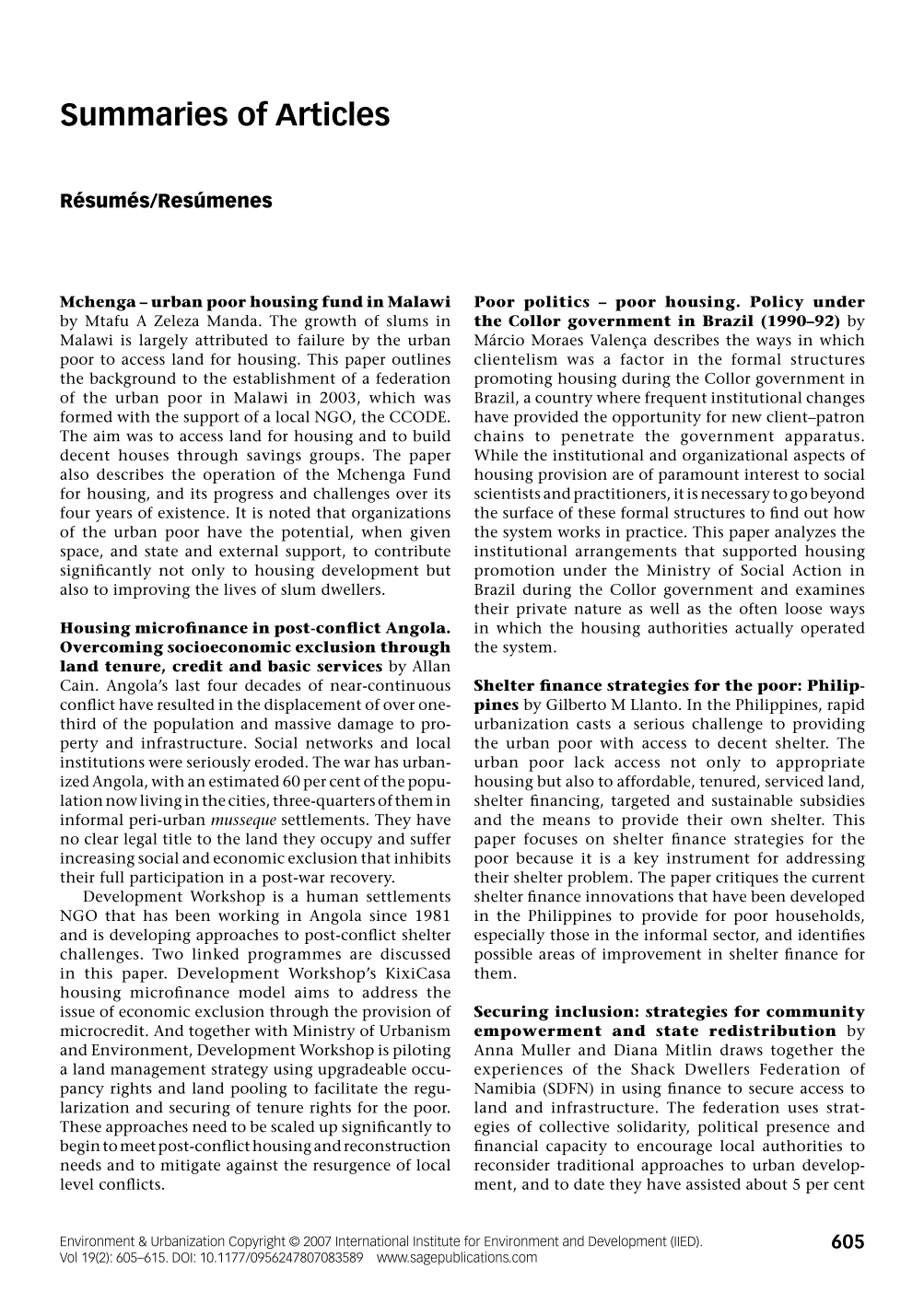
The growth of slums in Malawi is largely attributed to failure by the urban poor to access land for housing. This paper outlines the background to the establishment of a federation of the urban poor in Malawi in 2003, which was formed with the support of a local NGO, the CCODE. The aim was to access land for housing and to build decent houses through savings groups. The paper also describes the operation of the Mchenga Fund for housing, and its progress and challenges over its four years of existence. It is noted that organizations of the urban poor have the potential, when given space, and state and external support, to contribute significantly not only to housing development but also to improving the lives of slum dwellers.
Angola's last four decades of near-continuous conflict have resulted in the displacement of over one-third of the population and massive damage to property and infrastructure. Social networks and local institutions were seriously eroded. The war has urbanized Angola, with an estimated 60 per cent of the population now living in the cities, three-quarters of them in informal peri-urban
This paper(1) describes the ways in which clientelism was a factor in the formal structures promoting housing during the Collor government in Brazil, a country where frequent institutional changes have provided the opportunity for new client—patron chains to penetrate the government apparatus. While the institutional and organizational aspects of housing provision are of paramount interest to social scientists and practitioners, it is necessary to go beyond the surface of these formal structures to find out how the system works in practice. This paper analyzes the institutional arrangements that supported housing promotion under the Ministry of Social Action in Brazil during the Collor government and examines their private nature as well as the often loose ways in which the housing authorities actually operated the system.
In the Philippines, rapid urbanization casts a serious challenge to providing the urban poor with access to decent shelter. The urban poor lack access not only to appropriate housing but also to affordable, tenured, serviced land, shelter financing, targeted and sustainable subsidies and the means to provide their own shelter. This paper focuses on shelter finance strategies for the poor because it is a key instrument for addressing their shelter problem. The paper critiques the current shelter finance innovations that have been developed in the Philippines to provide for poor households, especially those in the informal sector, and identifies possible areas of improvement in shelter finance for them.
This study draws together the experiences of the Shack Dwellers Federation of Namibia (SDFN) in using finance to secure access to land and infrastructure. Thefederation uses strategies of collective solidarity, political presence and financial capacity to encourage local authorities to reconsider traditional approaches to urban development, and to date they have assisted about 5 per cent of urban dwellers in need in Namibia with housing improvements. The federation believes that local groups must define solutions that work for them, seeking to draw on the resources of the local authority to ensure affordability for all. These solutions need to build the power of the collective, enabling successive community actions to achieve additional development aspirations for the community. The community-driven process incorporates self-help as one of a number of strategies to achieve affordability but, more importantly, also to embed a social process across the community. Social movements strongly rooted in local neighbourhoods can secure the political advancement of the poor through effective political pressure on political decision makers. The grassroots location of the movement allows the shelter process to develop relevant tools and methods, which in turn are embedded within the negotiation processes towards the more egalitarian redistribution of state resources.(1)
Most urban dwellers in developing countries live in informal settlements in housing that is built incrementally. Low-income households most often have no access to formal housing finance institutions and largely depend on informal housing finance mechanisms in addition to the recently established shelter microfinance institutions. However, both formal and informal shelter-financing institutions have a requirement for savings. Based on empirical investigations in two informal settlements in Dar es Salaam, Tanzania, this paper explores the nature of savings in incremental housing development. The findings show that unpacking the concept of savings has the potential to uncover new opportunities for promoting housing finance in informal settlements, other than shelter microfinance.
This paper describes the Kuyasa Fund, a South African non-profit microfinance institution (MFI) that focuses solely on the provision of loans for use in housing. Launched in response to the shortfall in finance that is available to low-income state housing subsidy recipients, the Kuyasa Fund has grown rapidly over the past seven years and is poised for national expansion. This paper addresses the housing finance context and discusses some of the challenges facing housing microfinance in South Africa, and presents the Kuyasa methodology as a viable option for improving housing delivery.
For nearly 20 years, Homeless International has supported international partner organizations that work with slum communities to reduce poverty and improve living conditions. Its support has increasingly focused on partner organizations that are members of the Shack/Slum Dwellers International (SDI) network. The support has changed over time in response to the changing demands, but has increasingly been in the form of what Homeless International terms “financial services” — essentially, helping partners to access increased levels of capital to finance slum development projects on a growing scale. Homeless International now has a range of financial services that it provides to partners, depending on their stage of development and consequent needs. These include the Community-Led Infrastructure Finance Facility (CLIFF), which currently provides large-scale venture capital grants to partners in three locations; a guarantee facility that can encourage and persuade local banks to lend to partners for slum development; and a new mechanism that heralds the start of Homeless International lending directly to partners. This profile discusses only the financial services work of Homeless International and not the broader activities of the organization..
Official aid agencies and development banks are not set up to work with poor groups or to be directly accountable to them, even if their work is legitimized on the basis of these groups' needs. The bureaucracy of such agencies works primarily with and through national governments and is generally unable to catalyze or support the local social processes needed to make external finance effective in addressing many aspects of poverty. This paper describes an initiative to overcome these constraints — an international fund to support grassroots initiatives, managed by a transnational network of slum/shack/homeless people's federations and their support NGOs. This fund makes small grants available to savings groups that are members of these federations, to support them in securing land for housing and getting basic services. Over the last five years, more than 40 initiatives in 17 nations have received support. The fund demonstrates to international agencies what their monies could do if they were willing to relinquish more decision-making powers and more financial control to local organizations formed by and accountable to the urban poor.
The first part of this paper, by Sheela Patel, provides a backdrop to Jockin's letter about the current government plans to redevelop Dharavi, a large inner-city township within Mumbai with hundreds of thousands of inhabitants and tens of thousands of enterprises. The second part is the text of an open letter by Jockin Arputham from the National Slum Dwellers Federation to the government and private developers that was released to the press in June 2007 and that received widespread coverage in newspapers and other media around the world. This open letter is an offer of partnership in such redevelopments from the organizations and federations of slum dwellers in Mumbai and elsewhere to government agencies and developers. But it is also a warning of the disruptions that the slum dwellers will bring if they are not involved in the planning and implementation of such redevelopments.
There is a growing consensus in research that informal settlements are not as chaotic as often portrayed. The processes through which households in these settlements access housing land are not anarchic but are structured and regulated by some form of social ordering. This paper analyzes and explains the nature of the institutions that actually regulate and underpin land delivery processes in Kampala's informal settlements. Contemporary land access processes are examined in three case study settlements where institutions that are responsive to the local contexts have been developed and utilized. These non-state institutions are shown to be eclectic in nature, drawing on various normative orders including state law, rules of market exchange and customary practices. Their success in delivering large quantities of housing land is attributed to the social legitimacy they command, evidenced by the general acceptance and respect they enjoy from those whose relations they regulate.
This paper reports on patterns of household solid waste generation in the three distinct ecological zones that make up the city of Ogbomoso: the traditional core zone, the transitional zone developed under colonial rule and the suburban zone. It gives details of how total waste volumes and the components of waste varied over time in each of these zones — and there was considerable variation in these by day of the week and by month. For example, in the suburban zone, total waste generation for January was around half that for December; and although average incomes are higher in that zone, the per capita quantity of household waste (measured by weight) was not higher. Comparing household waste generation across the three zones showed that as education, income and social status increase, per capita waste generation declines, especially with regard to heavier organic waste products which account for more than three-quarters of the total waste generated in the study area. This is in part influenced by the differences in employment/livelihood patterns between the zones, and the study highlights how livelihood patterns and residents' possibilities for livestock raising influence the scale and composition of household waste. Finally, the paper highlights the importance for waste management of considering solid waste generated by enterprises in residential areas, including those run from home.
Flooding in unplanned settlements in Lusaka is expected, even in years of normal rainfall. There is always much discussion of needed action when flooding occurs but, as soon as the seasonal rains stop, the incidents are forgotten. Most of the households affected by flooding are poor and the flooding damages or destroys their homes and belongings, which might have taken years to accrue. Poorer groups may be faulted for settling on sites at risk from flooding, but this is usually because they can find no safer alternative. In addition, as this paper shows, reducing flood risks in one settlement can increase flood risks in others. Local authorities need to be vigilant in stopping settlement in unstable zones and they need to increase awareness of the need for action in settlements already built in flood-prone areas. Ways also need to be sought to provide low-income households with alternatives to informal settlements in flood-prone sites. It is hard to stop people from erecting houses where they see vacant land. Since rain in Zambia is seasonal, many marshy areas have been built on during dry periods only to be flooded when the rains come. In the end, it is the poor who lose and a solution needs to be found before more lives and property are lost.
This paper describes an initiative to develop responses to flooding in the city of Saint Louis that focused both on reducing risks and on better preparedness in a city with very limited investment capacity. The initiative was developed by ENDA—Tiers Monde, an international NGO whose headquarters are in Senegal. It focused on building responses that drew on local knowledge and on supporting the engagement of all stakeholders in identifying causes and local solutions both to reduce risks and to reduce people's vulnerability to them.
This paper describes the experience of an NGO, the Society for Participatory Research in Asia (PRIA), with participatory town planning in one small and one medium-sized urban centre in the state of Chhattisgarh in India. Taking on the challenging task of reforming urban governance within the framework of development where people matter, PRIA initiated a participatory process in each of the urban centres, bringing together civil society groups and local politicians and civil servants as well as officials from state-level institutions. This sought to strike a balance between inclusive town planning and working within the legal framework. This paper explains how the various stakeholders in urban planning, including state government, municipal staff, elected representatives and citizens and civil society groups drawn from all sections of society were brought together to decide on the future of their towns. There is also a discussion of the methodology that was adopted and the challenges that were faced. This is perhaps the first time in India that an NGO has sought to address issues of equitable and integrated urban development at city level, focusing on technical issues of town planning and backed by public participation. Similar initiatives have since been launched in other urban centres.