The term ‘
Research article
 Available accessResearch articleFirst published September, 2019pp. 431-450
Geographies of degrowth: Nowtopias,resurgences and the decolonization of imaginaries and places
Federico DemariaORCID


Select search scope: search across all journals or within the current journal


 Available accessResearch articleFirst published September, 2019pp. 431-450
 , Giorgos Kallis, Karen Bakker
The term ‘
Available accessResearch articleFirst published September, 2019pp. 451-464Degrowth imaginaries offer alternative ways of envisioning future societies. Those, predominantly working age and working class people, seeking to purposefully enact degrowth in the here and now are termed ‘nowtopians’. Based on empirical work undertaken along the River Adur valley in West Sussex, UK, this paper argues that dynamic examples of nowtopian initiatives can develop from alternative and overlooked demographics, such as rural community elders. Explored through a series of interlinking activist narratives, orientated around collective responses to changing riverbank environments, this paper argues that the genesis of this elder activism is a desire to re-assert agency in older age that can be linked to degrowth sensibilities. Contending with the new realities of living under ‘austerity localism’, many of these elders have undergone a personal, if not political, epiphany and have turned to forms of environmental activism to articulate their agency and demonstrate solidarity with fellow humans across generations. This paper argues that these elder nowtopians champion direct action, conviviality and living well. Ageing and place connectivity are the motivators which underpin one of the key nowtopian concepts: ‘redefining life's purpose’. Reflecting back, projecting forward, but operating in the ‘now’, these elders help us to consider a ‘politics’ of degrowth through grassroots activism along a rural river catchment.
Available accessResearch articleFirst published September, 2019pp. 465-492A growing coalition of degrowth scholar-activist(s) seeks to transform degrowth into an interdisciplinary and international field bridging a rising network of social and environmental justice movements. We offer constructive decolonial and feminist critiques to foster their productive alliances with multiple feminisms, Indigenous, post-development and pluriversal thought and design (Escobar, 2018), and people on the ground. Our suggested pathway of decolonial transition includes re-situating degrowth relative to the global south and to Indigenous and other resistance movements. We see this decolonial degrowth as a profoundly material strategy of recovery, renewal, and resistance (resurgence) through practices of re-rooting and re-commoning. To illustrate what we mean by resurgence we draw from two examples where people are engaged in ongoing struggles to protect their territories from the impacts of rampant growth—Zapatista and allied Indigenous groups in Mexico, and three Adivasi communities in the Attappady region of southern India. They are building economies and ecologies of resurgence and simultaneous resistance to
Available accessResearch articleFirst published September, 2019pp. 493-512The decolonization of the social imaginary has been proposed as an important dimension of the transition towards a degrowth society. However, although omnipresent in the degrowth literature, the terms “social imaginary” and “social imaginary significations” have not been adequately explained. This creates a level of mystification that limits the analytical value of the degrowth framework. In addition, there is very little theoretical work on
Available accessResearch articleFirst published September, 2019pp. 513-527Critical perspectives on economic growth have laid bare the fragility of the assumed link between material growth and socio-ecological wellbeing. The appeal of economic growth, however, goes beyond the economic sphere. As a societal goal, growth is often mobilized to pre-empt and/or co-opt opposition around issues of social justice and redistribution. Not only does the constitution of growth as a collective goal serve to unite the internally fragmented sphere of the social and brush aside (class-based) distributional conflicts, but it also enables the distribution of material concessions to subordinate classes for eliciting their consent. The degrowth proposal should thus more broadly tackle the material and discoursive ways in which growth enables the reproduction of contemporary political-economic systems. This paper argues that the notion of growth functions as a powerful ideal that shapes state–society relationships and social-collective imaginations. It demonstrates this by discussing the making of state in Turkey through a Gramscian perspective, where the notion of economic growth is deeply imprinted in the broader practices of the state to legitimize its existence and dominates the social imaginary in a way that cannot be easily dismissed. Against this backdrop, the possibility of not only effectuating, but also imagining and desiring degrowth would call for a radical reconfiguration of state–society relationships. Within this context, the Kurdish Freedom Movement’s project of Democratic Economy emerges as an alternative, both to the nation-state paradigm and to the imperative of economic growth.
Available accessResearch articleFirst published September, 2019pp. 528-547The call to transform the growth society lacks an analysis of the human will. Problematically for degrowth, the enactment of this so-called will to transform has undesired matter-energetic consequences. Every act of transformation requires matter–energy, adding to the cumulative throughput of societies. To revert the ecospherical metabolism from a state of overshoot to one of degrowth, a metamorphosis in
Available accessResearch articleFirst published September, 2019pp. 548-564This paper explores a new artificial political ecology through a novel digital methodology. The emotional impacts of the replacement of living turfgrass landscapes with synthetic simulacra are researched via a netnography of animated and polarised online discussion. We investigate how the cultural use of domestic lawns has extended into the creation of non-living artificial lawns and how the environmental values of these new landscapes are debated. Synthetic polymer (plastic) grasses are increasingly being used as alternatives to turfgrass in domestic gardens, changing urban ecologies. We examine the emotional landscapes that are reproduced in online discourse. Paul Robbins showed that a certain suite of behaviours constitutes ‘Lawn People’. Here we demonstrate that ‘Artificial Lawn People’ act in reference to cultural expectations of a ‘good’ lawn to produce non-living, homogeneous, green and tidy gardens, yet their actions spark fierce criticism from others who do not value this new synthetic nature. Our research involved analysis of 948 online discussion posts, and introduces a secondary notion of ‘artificial people’ as our subjects were anonymous contributors to virtual public debates on the environment: generating impassioned polyvocal contestation. Mumsnet.com is a space of heated discussion between proponents and opponents of artificial lawns. We identify three topics: (i) emotional responses: artificial grass is polarising, and its social value contested; (ii) bio-physical affects: plastic fibres impact human and non-human life and (iii) environmental values: turfgrass replacement influences local and global political ecologies. The conclusions shed light on the dynamic relationships between the emotional values of living and non-living landscapes.
Available accessResearch articleFirst published September, 2019pp. 565-589, Michael FlitnerThis paper analyses the emergence and fixing of scales in struggles over environmental issues. Using the example of watershed and coastal management in Java, we show how political framings of environmental matters and struggles over resources are linked to scalar regimes. We conceptualise these regimes as scalar fixes in which scales of intervention and scales of knowledge production are bound by environmental narratives and social–ecological processes to produce lock-in effects for prolonged periods of time. In our empirical case, particular scales were central in providing ‘problem closure’ and legitimising interventions while precluding other problematisations. Sedimentation of the Segara Anakan lagoon, first desired to support conversion into a rice bowl, was later framed as threat caused by upland peasants. The lock-in of interpretive framings and scales of observation and intervention, which was linked to politics of forest control, impeded debate on the various causes of sedimentation. With our newly defined concept of scalar fixes we contribute to understanding environmental narratives and related knowledge, providing a complement to the micro-perspectives on the stabilisation of knowledge claims currently discussed in cultural and political ecology. In doing so, we offer an approach to scalar analysis of environmental conflicts linking environmental narratives with the material social–ecological processes enrolled.
 Open accessResearch articleFirst published September, 2019pp. 590-616, Jason Chilvers, Tom Hargreaves
This paper develops a novel approach to mapping diverse forms of participation and public engagement, using the example of the UK energy system. It builds on emerging systemic accounts of participation, which go beyond a focus on individual instances of participation, to gain an understanding of broader patterns and connections. Our approach, which forms part of an emerging family of methods that seek to map across multiple forms of public involvement in issues and systems, draws on systematic review methodology and a relational co-productionist conception of participation. The findings of a systematic mapping of public participation related to the UK energy system 2010–2015 are presented, comprising 258 cases in total. The mapping analysis reveals patterns as to the what (energy objects and issues), how (procedural formats) and who (publics) of energy participation in the UK, which go far beyond the conventionally assumed forms and sites of public participation around energy. Implications for how the dynamics of ‘whole system’ energy participation are represented and the role of approaches to mapping participation in governing energy transitions are considered.
Available accessResearch articleFirst published September, 2019pp. 617-644, Helen RoskoAs climate adaptation gains international prominence as one means for addressing climate change, it remains critical that just and equitable outcomes are maintained as adaptation technologies are deployed across various target populations. In this vein, subjectivity has been problematized by climate change adaptation scholars as a concept that needs further attention to understand the political nature of climate change adaptation. Extending frameworks of environmentality to cases of climate change adaptation, we engage the term adaptation subjects to distinguish individuals whose interests and desires align with broader understandings and goals of climate change adaptation. In this research, we situate the co-production of livelihoods and climate change adaptation interventions as projects of rule to understand subject-formation. Such an analysis allows for a move beyond econocentric framings of livelihoods that privilege material outcomes to also engage with the socio-political realities of these livelihoods and climate change adaptation more broadly. We apply the Livelihoods as Intimate Government approach to a case study of the Ada Sea Defense System in the Ada East District of the Volta River Delta of Ghana as a climate change adaptation project of rule, in order to illustrate the ways this adaptation technology discursively constructs (or not) different residents as adaptation subjects. Understanding the Ada Sea Defense System as a technology of adaptation constituted through socio-political practices has the potential to promote justice and equity when designing, implementing and evaluating such technologies in the future.
Available accessResearch articleFirst published September, 2019pp. 645-664This article explores the case study of a coal mine that was first tunneled under Sydney Harbour in 1897 but closed in 1931. Specifically, it examines how the history of the mine intersects with aesthetics, race, colonialism, and Indigenous dispossession. Centered on the story of an English mining company that first sought a mine site in a pastoral area of the city, but under public pressure was forced to select instead a grimy working class suburb on the opposite harbor shore, the article argues that environmental aesthetics and tastes in beauty collaborated with extractivism. The argument emerges that economics, art, and aesthetics are inextricably linked in this history and further, that while the mine excited the industrial imagination through the aesthetic of the sublime, and associations with darkness and vastness, it conflicted with colonial settler tastes for the pastoral imagination defined by the aesthetics of the beautiful and its associations with light. The article discusses the context of a settler economy in lands stolen from Indigenous peoples, and how conceptualizations of the sublime and beautiful, as well as dark and light, were aligned with the racialization of the properties of coal and space above and below ground.
Available accessResearch articleFirst published September, 2019pp. 665-693, Chris ReaFailure has become an increasingly important theme of debate in the literature on neoliberal natures. In this article we take up this topic with respect to ecological offsetting, often regarded as an exemplar of market-oriented conservation. Comparing the case of species banking which emerged in California in the 1990s with frustrated efforts to implement a biodiversity offsetting programme in England beginning in 2010, we develop a novel analytical framework for explaining why this kind of environmental market-making may or may not be successful in different contexts. Drawing on work in geography on the neoliberalisation of nature and insights from economic sociology, we characterise ecological offsetting as ‘command-and-commodify’ regulation: a peculiar form of hybrid ecological regulation which depends on an institutional mix of ‘authoritative’ and ‘economic’ power to function. In California, these kinds of environmental markets initially emerged at a moment of compromise, contingent on an embrace of ‘market’ solutions to environmental problems on the one hand, and a somewhat paradoxical expansion of authoritative power to ecologically regulate land development, on the other. In England, by contrast, deep fiscal austerity and deregulatory zeal, combined with resistance from nearly every quarter, initially undermined the possibility of balancing economic and authoritative power, which we argue is necessary for the construction of viable ecological offsetting. Reflecting on themes in the wider literature, we conclude by questioning whether the English experience is indicative of sharpening tensions between economy and ecology in the late neoliberal era.
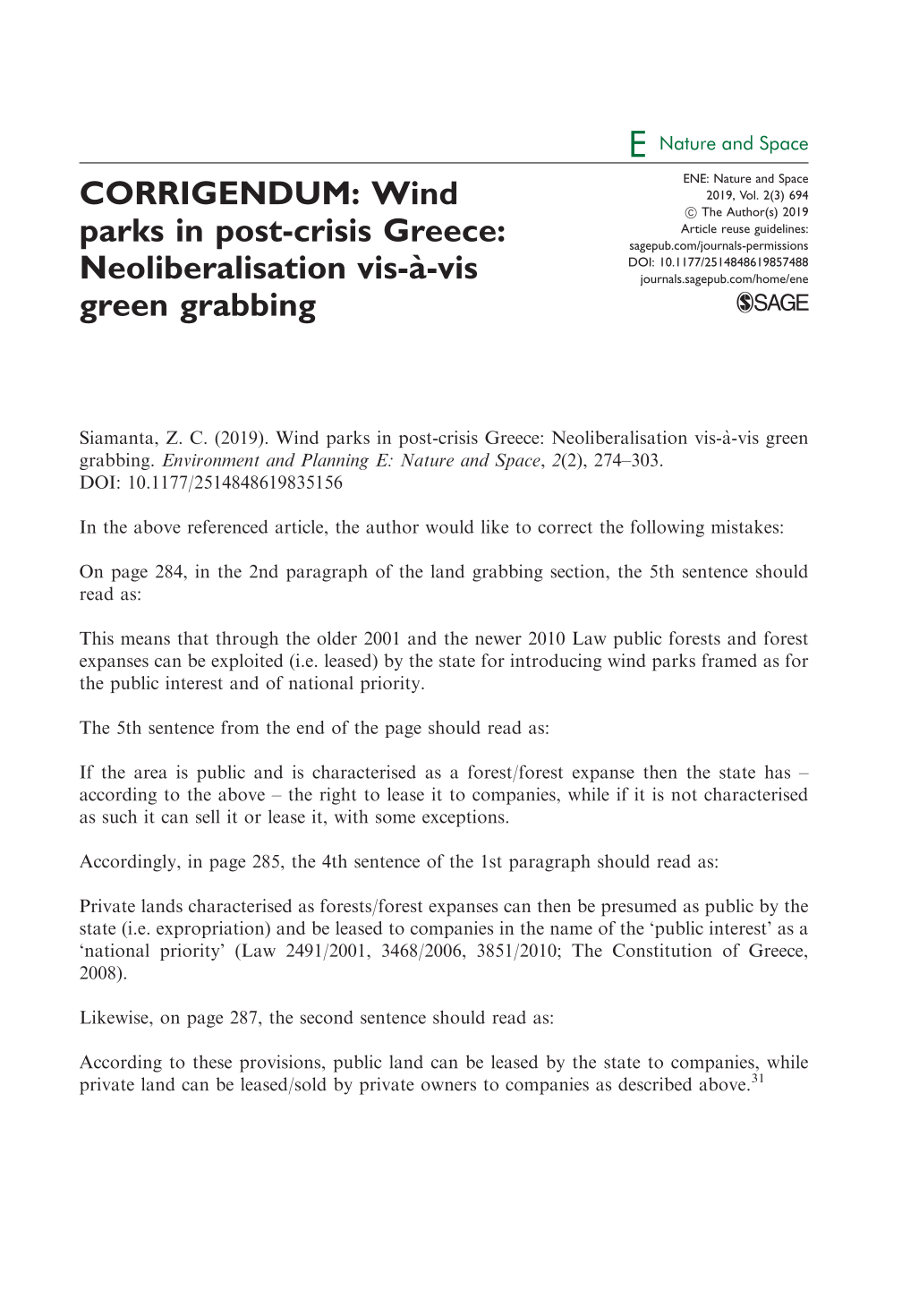
Available accessCorrectionFirst published September, 2019pp. 694-694