Editorial
 Restricted accessEditorialFirst published August, 2008pp. 1777-1778

Select search scope: search across all journals or within the current journal


 Restricted accessEditorialFirst published August, 2008pp. 1777-1778Restricted accessResearch articleFirst published August, 2008pp. 1779-1782
 Restricted accessResearch articleFirst published August, 2008pp. 1783-1795
This paper addresses the challenges of building pathways to Sustainability in the context of contested knowledge and power relations in environment and development. Drawing on two case studies concerning tropical forests in West Africa and the Caribbean, it explores clashes between the conceptions of social–ecological systems embedded in dominant scientific and policy practices, and the more dynamic, nonequilibrial perspectives that emerge from understandings of forest history and users' own experiences. Forest and conservation policy, I find, have persistently ignored these dynamics. Yet, as people and nature have ‘bitten back’, forest histories are revealed as mutually constituting interplays of ecological process, social practice, policy and intervention, and response. Policy makers often do not see this, and are thus surprised when their schemes fail. In this paper, I argue that alternative analytical approaches are needed that take seriously human-ecological dynamics, history, path dependency, and the ways in which different people frame or construct problems, linked with notions of Sustainability that respect diverse goals—including forest users’ own. This, in turn, suggests the need for alternative approaches to the governance of environment and development issues that are more adaptive, deliberative, and reflexive, and for politically engaged efforts to institute these in contexts where pervasive power–knowledge relations perpetuate less dynamic views.
Restricted accessResearch articleFirst published August, 2008pp. 1796-1810In this paper I argue that to inhabit the world is to live life in the open. Yet philosophical attempts to characterise the open lead to paradox. Do we follow Heidegger in treating the open as an enclosed space cleared from within, or Kant (and, following his lead, mainstream science) in placing the open all around on the outside? One possible solution is offered by Gibson in his ecological approach to perception. The Gibsonian perceiver is supported on the ground, with the sky above and the earth below. Yet in this view, only by being furnished with objects does the earth–sky world become habitable. To progress beyond the idea that life is played out upon the surface of a furnished world, we need to attend to those fluxes of the medium we call weather. To inhabit the open is to be immersed in these fluxes. Life is lived in a zone in which earthly substances and aerial media are brought together in the constitution of beings which, in their activity, participate in weaving the textures of the land. Here, organisms figure not as externally bounded entities but as bundles of interwoven lines of growth and movement, together constituting a meshwork in fluid space. The environment, then, comprises not the surroundings of the organism but a zone of entanglement. Life in the open, far from being contained within bounded places, threads its way along paths through the weather world. Despite human attempts to hard surface this world, and to block the intermingling of substance and medium that is essential to growth and habitation, the creeping entanglements of life will always and eventually gain the upper hand.
Restricted accessResearch articleFirst published August, 2008pp. 1811-1824This critique of inherent flaws in today's growth-driven natural capitalism argues its key contradictions and basic conflicts can be typified by the cultural politics and political economy found in the environmental advocacy of Al Gore Jr, especially in his Nobel Prize winning activities on global climate change in works like
Restricted accessResearch articleFirst published August, 2008pp. 1825-1842A number of scholars have criticized the ways in which property law simplifies nature. Such reductive simplifications are seen as being reliant upon a claim to mastery and dominion that is belied by the essential complexity and dynamism of the natural world. Drawing from a close reading of a property-boundary dispute involving the historical movements of the Missouri River, I supplement this account by revealing the ways in which legal simplication is itself complicated: that is, both dependent on considerable amounts of practical work, and subject to breakdown, ambiguity, and contradiction. Rather than a singular river, made legible through the unfolding of a unitary legal logic, I reveal several conflicting ‘rivers’ produced through property law. I conclude by trying to make sense of property as a set of practices that serve to produce the ‘effect’ of property. These practices, while often messy and contradictory, are, nevertheless, significant in the installation of property as a powerful organizing device through which the social world is made meaningful.
Restricted accessResearch articleFirst published August, 2008pp. 1843-1861The geographical subdiscipline of
 Open accessResearch articleFirst published August, 2008pp. 1862-1880
Recent claims that the environmentalist thinking and politics that dominated the last years of the past century were based on outmoded, ‘Modernist’ categories jibe with academic criticism of dualistic thinking about ‘culture’ and ‘nature’, and with attempts to acknowledge the roles of nonhuman agency in the coconstruction of social worlds. While acknowledging the salience of these arguments, the author claims that examination of pictorial images that have shaped and promoted modern environmentalism complicate them. Pictorial images are less prone to dualistic interpretation than scientific and theoretical argument, and the affective responses they generate are complex. An examination of iconic images of key 20th-century environmental crises—wilderness preservation, soil erosion, urban sprawl, nuclear testing, and global environmental change—reveals both continuities in image making and presentation, and the evolving roles of physical nature itself in shaping their composition and meanings. Globalization of environmental concerns and images has shifted nature's icons from landscape towards living species, and from a temperate to a tropical and polar geography.
Restricted accessResearch articleFirst published August, 2008pp. 1881-1900This paper develops a critical perspective on the ‘new’ governance of science and the environment which is increasingly evident in practical attempts to build more constructive relations between science and democracy through hybrid ‘analytic–deliberative’ processes. The focus is on recent institutional and participatory experiments in the governance of nuclear waste, specifically the work of the UK Committee on Radioactive Waste Management and the trialling of a novel participatory, multicriteria, options appraisal tool called Deliberative Mapping undertaken by the authors as part of this process. Drawing on these attempts to build relations and make connections between citizens, specialists, stakeholders and policy makers, radioactive wastes, and possible courses of action for their long-term management, the methodological performance of analytic–deliberative practices and the contextual influences that frame and govern them is evaluated. The paper demonstrates powerful framing effects operated at the level of specific participatory practices, procedural politics surrounding the design of ‘new’ governance institutions, and institutional behaviour linked to wider politics of environmental risk and energy futures which narrowed down and marginalised particular discourses, knowledges, meanings, and forms of expression. Unless these often tacit power relations are acknowledged, accounted for, and exposed by all involved, but especially vested interests, analytic–deliberative institutions may well undermine public trust, credibility, and legitimacy rather than promote these democratic virtues as is widely claimed.
Restricted accessResearch articleFirst published August, 2008pp. 1901-1920In many discussions of how cities in the global North are changing, the growing importance of urban design is emphasised: that is, the production of visually and spatially coherent urban buildings and spaces seems to be increasingly central to urban change. To date, most attention has focused on exploring the reasons for this shift. Much less attention has been paid to the experiences of the people inhabiting and using such designed spaces. Although many authors acknowledge that, in theory, such encounters between human subjects and designed urban environments are richly various and unpredictable, few studies have examined this empirically and learnt theoretically from these encounters. Drawing on fieldwork undertaken in the British city of Milton Keynes—the centre of which is a shopping mall, a designed environment par excellence—the authors argue that understanding experiences of contemporary urban change requires a relational and performative understanding of environmental encounters, and they suggest three intertwined implications for rethinking research on urban aesthetics: first, a multimodal and sensuously embedded understanding of vision; second, a practice-centred understanding of the environment; and third, a need for self-reflexive understanding of the researchers' position in the fieldwork.
Restricted accessResearch articleFirst published August, 2008pp. 1921-1943Public art in urban areas offers a window on a city's soul. Art in the form of sculptures, monuments, and other creative expressions can inform us of the ways artists think of the urban environment, the goals of policy makers in art installations, and the way members of the public interact with art and with each other in the city. Taking Singapore as a case study, I argue that contemporary public art has the power to inform place identity and inspire community aspirations. Unlike the hard power of industry, art offers a soft branding approach to imaging the city, its people, and their goals. However, such powers are not limitless, and concerns have also been raised about their publicness and artfulness. The power and powerlessness of public art in Singapore are not unlike those encountered in other cities where artful planning has taken centre stage in contemporary urban redevelopment.
Restricted accessResearch articleFirst published August, 2008pp. 1944-1965This analysis uses the case of a seemingly successful industry cluster (ie the film and TV industry in Munich) to demonstrate that deficits in the structure of social relations can impact a cluster's growth potential. In the period after World War II, Munich grew into a national centre of media industries in Germany due to the introduction of private/commercial TV, national entry barriers, and a supportive institutional infrastructure. The recent advertising crisis and the dissolution of the Kirch Group have, however, reinforced already existing internal dilemmas and contradictions. We suggest that the growth prospects of this industry are limited due to a lack of reflexive, interconnected communication and interaction patterns. In conceptual terms, we apply a model which emphasizes that local interaction or ‘buzz’ in clusters and interaction with external firms and markets through translocal or global ‘pipelines’ create reflexive dynamics. Based on this conception, participatory observation and semistructured interviews were conducted with sixty-five Munich firms, as well as with planners and media experts from the region. The results indicate that the regional, national, and occasional international project networks have had a smaller impact on the Munich film and TV industry than expected. Our investigation provides evidence that the cluster's structure of social relations is relatively weak. Internal networks which could drive creative recombination and innovation are underdeveloped, and linkages with external markets which could provide substantial growth impulses to the region are lacking. We argue that this structural weakness limits the potential for future growth.
Restricted accessResearch articleFirst published August, 2008pp. 1966-1986A good deal of research within the cultural turn in economic geography has sought to understand the relationship between economic activity and regional culture. This work encompasses an increasingly heterodox set of approaches to regional economic activity, from innovation studies to processes of embedding to accounts of regional learning and clustering, and an increasingly broad set of empirical cases through which these issues are regularly discussed. Only recently has the literature had much to say about the relationship between scientific knowledge and regional culture, however, or about the empirical experience of non-Western regional economic activity and forms of innovation within this. This paper seeks to further develop these two recent strands by bringing them together. Firstly it transposes the study of high-technology regional cultures to a developing world and socialist country context. I examine, as a case study, Cuba's Science Pole, a biomedical growth pole on the outskirts of Havana comprising some forty-two interlinked institutions and 14 000 scientists. I show how a space for biotechnology was created and maintained outside of the capitalist milieu with which the industry has come to be associated in the West. More specifically, I reveal how the formal demands made by the Cuban state of this biotechnology endeavour paradoxically encouraged the development of a suite of informal and innovative scientific practices. To account for how this very different approach nevertheless resulted in a similar ‘regional culture’ of innovation to that found in high-technology regions in the West, I suggest we need to consider not just the structural components of regional cultures (labour mobility, attitudes to risk, etc) but also the forms of rationality that underpin such factors themselves. In order to do this I turn to some of the insights of the science-studies literature as to the epistemological foundations of processes of innovation and knowledge production, to argue that regional cultures of innovation are never just economic spaces, they are also epistemic spaces.
Restricted accessResearch articleFirst published August, 2008pp. 1987-2005There has been a recent wave of political and theoretical interest in localism and relocalization as a political strategy in resistance to the hegemonic power of globalization. Some geographers and other observers of spatial politics have been skeptical of these efforts, questioning the effectiveness and the effects of relocalization movements. In response, DuPuis and Goodman have argued for a ‘reflexive localism’ that takes a more pragmatic approach, understanding the ways in which this form of politics can or cannot provide a powerful alternative to globalization. Building on current realist studies, this analysis seeks to build a more reflexive framework with which to understand the politics of localism. To do this the study draws upon the perspectives of political ecology and the politics of scale and uses a comparative historical methodology to look at one of the most effective forms of localized governance in US agriculture: the milk-market-order system. The analysis shows that market orders created economic enclaves that enabled particular agroecological practices, or ‘farming styles’. Market orders functioned as mesolevel institutions that both territorially fixed local agroecologies and mediated with institutions at other spatial scales, a process in which ‘local’, ‘state’, and ‘national’ were coproduced.
Restricted accessResearch articleFirst published August, 2008pp. 2006-2025The authors investigate how the intermodal freight-transportation network affects the ability of regions to position themselves more effectively in the national space economy. The case of domestic containerized freight traffic is examined because it is closely associated with contemporary forms of integration between rail shipping and trucking. With the help of a geographic information system, the potential impact of intermodalism in the United States is analyzed by mapping integral place accessibility measures of five-digit zip-code areas. The performance of the intermodal freight network is evaluated by comparing accessibility measures based on the highway network and on the intermodal network, respectively. Geographically weighted regressions are also performed to identify the variables that contribute to the improvement of accessibility due to intermodalism, while accounting for the spatial nonstationarity of relationships.
Restricted accessCorrectionFirst published August, 2008pp. 2026-2027
Due to the vigilance of one of our readers, an error was found in a paper recently published in this journal by Robert Cervero: “Transit-oriented development's ridership bonus” (
The corrected upper-nest model has a slightly different specification than originally shown in table 3 of the paper in order to satisfy the condition that the θ values lie between 0 and 1. None of the text about the upper-nest model that appears in the first paragraph of page 2078 and on page 2080 of the paper changes nor do any of the substantive findings or conclusions of the research. The additional variables added to the upper-nest model reveal that low automobile ownership levels tended to be associated with transit-oriented living. Cervero acknowledges that automobile ownership likely both influences and is influenced by transit-oriented living; thus the coefficient on the automobile ownership variables could be subject to endogeneity bias. The revised equation also shows that, controlling for other variables in the equation, having individuals 55 years of age and above in a household reduced the likelihood of living near transit. Lastly, discussions in the last paragraph of section 6.3 regarding the θ values should now be in the plural, indicating that both θnear and θaway are within the 0–1 interval.
It is also noted that the estimated coefficients in the lower-nest binomial logit models for predicting rail commuting (shown in the right-hand panel of table 3) are unchanged from the original table 3. The
The editors of
Nested logit model results for upper nest (rail location choice) and lower nest (rail commute choice). Significant at 0.10 level significant at 0.05 level significant at 0.01 level.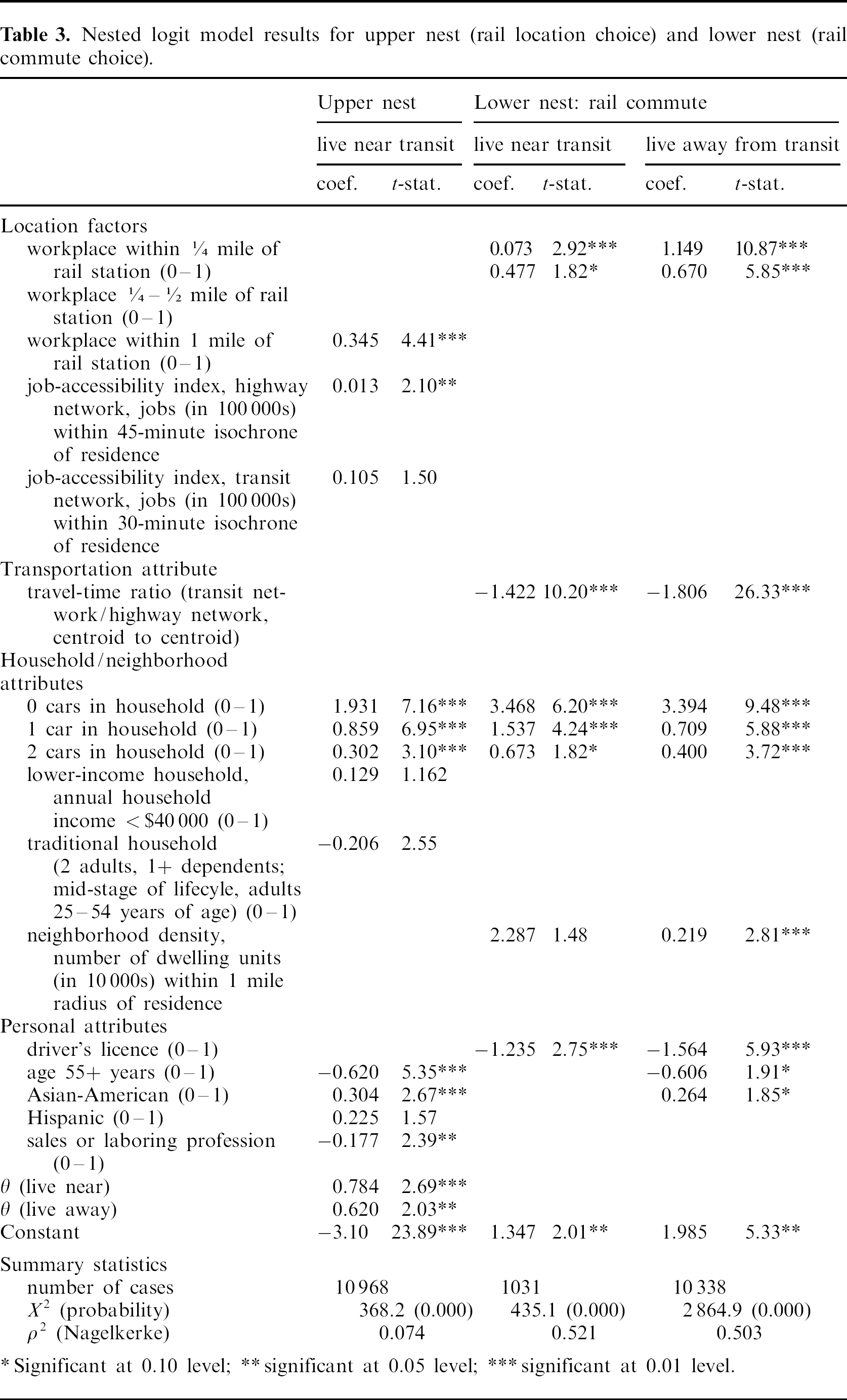
Upper nest live near transit
Lower nest: rail commute
live near transit
live away
from transit
coef.
coef.
coef.
Location factors
workplace within ¼ mile of
0.073
2.92***
1.149
10.87***
rail station (0–1)
0.477
1.82*
0.670
5.85***
workplace ¼-½ mile of rail
station (0–1)
workplace within 1 mile of
0.345
4 41***
rail station (0–1)
job-accessibility index, highway
0.013
2.10**
network, jobs (in 100 000s)
within 45-minute isochrone
of residence
job-accessibility index, transit
0.105
1.50
network, jobs (in 100 000s)
within 30-minute isochrone
of residence
Transportation attribute
travel-time ratio (transit net-
−1.422
10.20***
−1.806
26.33***
work/highway network,
centroid to centroid)
Household/neighborhood
attributes
0 cars in household (0–1)
1.931
7.16***
3.468
6.20***
3.394
9.48***
1 car in household (0–1)
0.859
6.95***
1.537
4.24***
0.709
5.88***
2 cars in household (0–1)
0.302
3.10***
0.673
1.82*
0.400
3.72***
lower-income household,
0.129
1.162
annual household
income < $40 000 (0–1)
traditional household
−0.206
2.55
(2 adults, 1+ dependents;
mid-stage of lifecyle, adults
25–54 years of age) (0–1)
neighborhood density,
2.287
1.48
0.219
2.81***
number of dwelling units
(in 10000s) within 1 mile
radius of residence
Personal attributes
driver's licence (0–1)
−1.235
2.75***
−1.564
5.93***
age 55+ years (0–1)
−0.620
5.35***
−0.606
1.91*
Asian-American (0–1)
0.304
2.67***
0.264
1.85*
Hispanic (0–1)
0.225
1.57
sales or laboring profession
−0.177
2.39**
(0–1)
0.784
2.69***
0.620
2.03**
Constant
−3.10
23.89***
1.347
2.01**
1.985
5.33**
Summary statistics
number of cases
10 968
1031
10338
368.2 (0.000)
435.1 (0.000)
2 864.9 (0.000)
0.074
0.521
0.503
Restricted accessBook reviewFirst published August, 2008pp. 2028-2030