Other
Select search scope: search across all journals or within the current journal


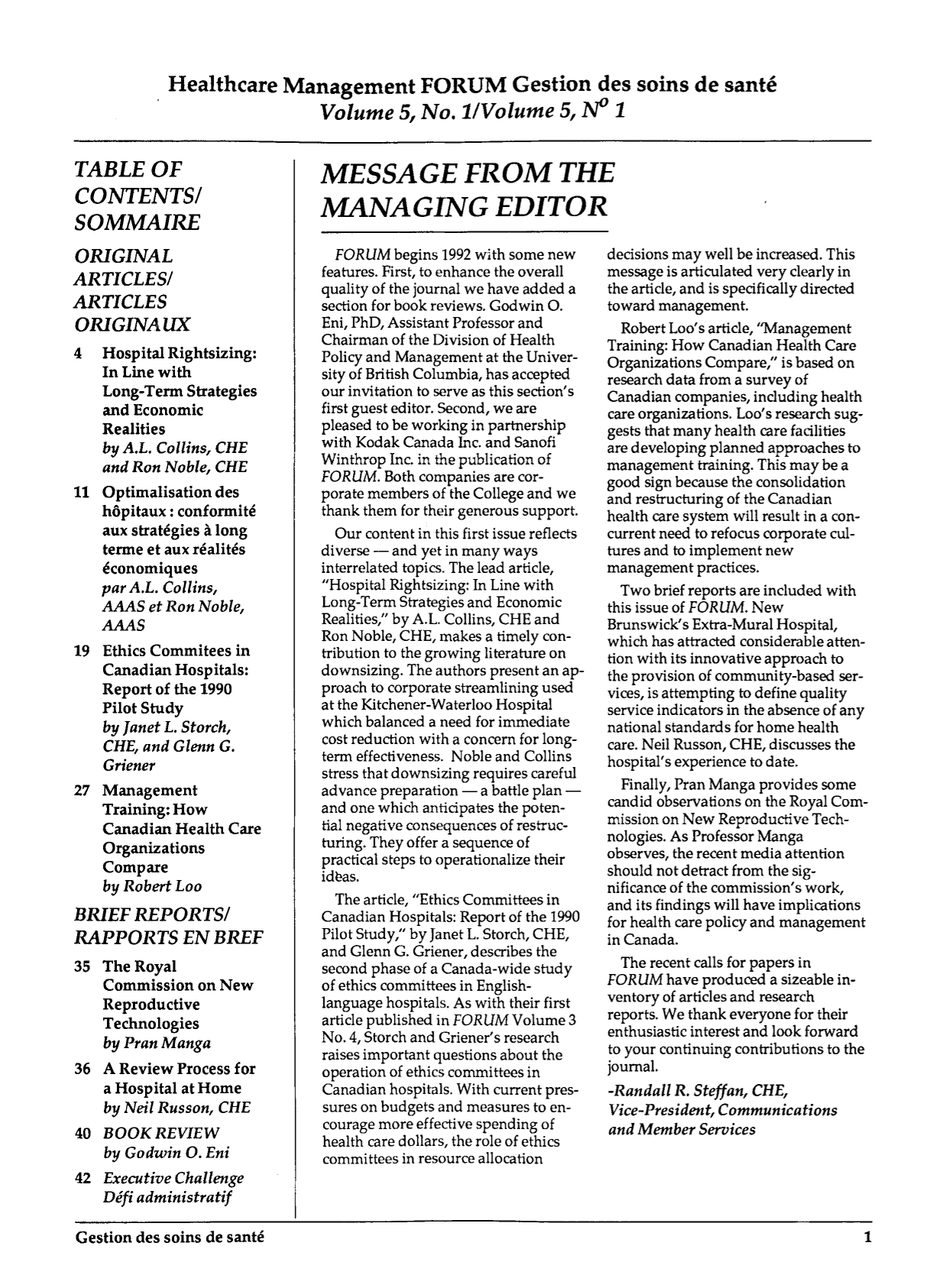
After two years of difficult financial times, the Kitchener-Waterloo Hospital was faced with another upcoming year of tight fiscal constraint. In February 1991, the hospital implemented a program review process to align its services with the hospital's long-term strategy and economic realities.
The authors present a thorough review of the literature pertaining to downsizing decisions. From a practical perspective they demonstrate a downsizing process, its implications and lessons to be learned so that a “rightsizing” exercise can be implemented to minimize the effects of the program and staff reductions while focusing on the positive long-term benefits of strategic planning.
Although downsizing is a difficult process, the Kitchener-Waterloo Hospital was able to develop and implement a plan that minimized the impact on the hospital services and its staff. A reduction in expenses of over $2 million was achieved without having to lay off any permanent hospital staff. This was achieved by streamlining programs, reducing management supervisory positions and eliminating 50 full-time equivalent positions through attrition.
Ultimately, the hospital's board, senior management, medical staff and employees felt that a rightsizing decision had been made, one which minimized the negative impact of restructuring on service delivery, hospital employees and the community served.
Après deux ans de difficultés financières, l'hôpital Kitchener-Waterloo entamait une autre année de sévères restrictions budgétaires. En février 1991, l'hôpital a mis en oeuvre un processus d'examen des programmes pour aligner ses services sur la stratégie à long terme de l'hôpital et les réalités économiques.
Les auteurs présentent une étude exhaustive de la littérature traitant des décisions de compression. D'un point de vue pratique, ils illustrent un processus de compression, ses conséquences et les leçons à en tirer pour qu'un exercice d'«optimalisation» puisse être mis en oeuvre afin de minimiser les effets du programme et les réductions d'effectif, tout en mettant l'accent sur les avantages à long terme de la planification stratégique.
Bien que la compression soit un processus difficile, l'hôpital Kitchener-Waterloo a réussi à élaborer et mettre en oeuvre un plan qui minimise son incidence sur les services hospitaliers et l'effectif. Sans avoir à mettre en disponibilité un seul employé permanent de l'hôpital, on a réussi à réduire les dépenses de plus de 2 millions de dollars. Grâce à des programmes de rationalisation, on a réussi à réduire les postes de cadres subalternes et éliminer 50 postes équivalents à plein temps au moyen de l'attrition.
En définitive, le Conseil d'administration de l'hôpital, la haute direction, le personnel médical et les employés ont estimé qu'on avait pris une décision d'optimalisation qui minimisait les conséquences de la restructuration sur la prestation des services, sur les employés de l'hôpital et la collectivité desservie.
The second phase of a Canada-wide study of ethics committees in English-language hospitals in Canada involved site visits to five selected hospitals to assess the effectiveness of the ethics committee. In this article the findings of this pilot study are reported, including the perspectives of physicians, nurses and hospital administrators on the ethics committee of the various hospitals. The results of the study, albeit limited by being a pilot study, raise a series of questions for hospital administrators, medical administrators and nursing administrators.
Management training has been receiving increasing attention over the past decade. The present study reports on a survey of 1,000 randomly selected Canadian organizations having at least 500 employees. Analysis of returns from 56 health care organizations and 169 other Canadian organizations yielded many notable findings. Only 36 percent of health care and 37 percent of other organizations report formal policies and procedures for management training. Fortunately, many health care organizations are evolving toward a more articulated and comprehensive approach to management training; however, the constraint of limited funds for training is frequently cited. Overall, both health care and other Canadian organizations recognize the importance of management training for achieving organizational goals and they are striving to improve such training.

The field of home health care is the focus of much attention as alternatives to institutionalization are sought. As a result, many types of organizations are now providing home care, health or otherwise, without the guidance of national standards similar to those found in accreditation models for care in an institutional setting. So that stakeholders in New Brunswick can be assured of the quality of the service it provides, the Extra-Mural Hospital has embarked upon the development of a review process which will, to some extent, follow established accreditation models.