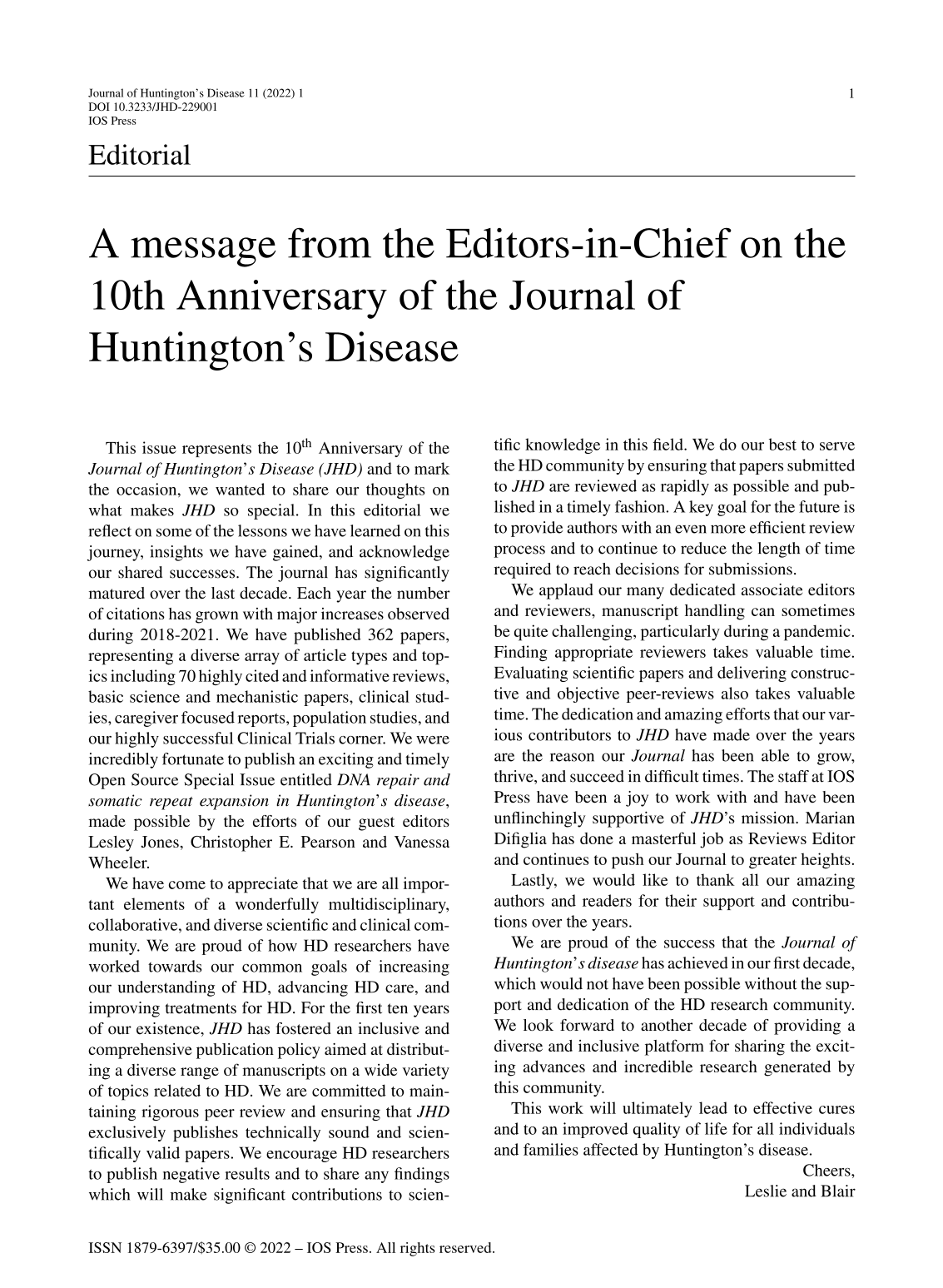
Editorial
 Free accessEditorialFirst published March 1, 2022pp. 1-1

Select search scope: search across all journals or within the current journal


 Free accessEditorialFirst published March 1, 2022pp. 1-1
 Open accessReview articleFirst published March 1, 2022pp. 3-15
Due to large increases in the elderly populations across the world, age-related diseases are expected to expand dramatically in the coming years. Among these, neurodegenerative diseases will be among the most devastating in terms of their emotional and economic impact on patients, their families, and associated subsidized health costs. There is no currently available cure or rescue for dying brain cells. Viable therapeutics for any of these disorders would be a breakthrough and provide relief for the large number of affected patients and their families. Neurodegeneration is accompanied by elevated oxidative damage and inflammation. While natural antioxidants have largely failed in clinical trials, preclinical phenotyping of the unnatural, mitochondrial targeted nitroxide, XJB-5-131, bodes well for further translational development in advanced animal models or in humans. Here we consider the usefulness of synthetic antioxidants for the treatment of Huntington’s disease. The mitochondrial targeting properties of XJB-5-131 have great promise. It is both an electron scavenger and an antioxidant, reducing both somatic expansion and toxicity simultaneously through the same redox mechanism. By quenching reactive oxygen species, XJB-5-131 breaks the cycle between the rise in oxidative damage during disease progression and the somatic growth of the CAG repeat which depends on oxidation.
Open accessReview articleFirst published March 1, 2022pp. 17-24Huntington’s disease (HD) commonly presents with impaired social functioning. Specifically, many patients exhibit social withdrawal, or decreased engagement in social activities. Despite the frequency of social withdrawal in HD, no review has been previously published on this subject.
The aim of this study was to conduct a scoping review of social withdrawal in HD.
Two searches were conducted to identify relevant literature. The articles were screened by title and abstract, followed by full text review for all remaining articles. Consistent with scoping review methodology, data extraction focused on identification of broad themes and knowledge gaps.
Eight articles were identified that described social withdrawal in HD. Social withdrawal was exhibited by individuals with varying disease severity, and it occurred both within and outside of the home. Social withdrawal was associated with increased caregiver burden, behavioral issues, and psychiatric, cognitive, and physiological changes. Only one case study described an intervention that increased social participation in a previously withdrawn patient.
Although social withdrawal is commonly encountered in clinical settings, this review highlights the need for prospective studies to systematically evaluate social withdrawal in HD. These studies should be designed to consider disease stage and associated HD features as well as caregiver burden and potential interventions. Additionally, objective measures of social withdrawal should be used when possible, as existing instruments measure perceptions of participation levels rather than actual withdrawal behavior. Such studies will lay the groundwork to improve social functioning and quality of life for people with HD.
Open accessResearch articleFirst published March 1, 2022pp. 25-33In recent years the functions of astrocytes have shifted from conventional supportive roles to also include active roles in altering synapses and engulfment of cellular debris. Recent studies have implicated astrocytes in both protective and pathogenic roles impacting Huntington’s disease (HD) progression.
The goal of this study is to determine if phagocytosis of cellular debris is compromised in HD striatal astrocytes.
Primary adult astrocytes were derived from two HD mouse models; the fast-progressing R6/2 and slower progressing Q175. With the use of laser nanosurgery, a single astrocyte was lysed within an astrocyte network. The phagocytic response of astrocytes was observed with phase contrast and by fluorescence microscopy for GFP-LC3 transiently transfected cells.
Astrocyte phagocytosis was significantly diminished in primary astrocytes, consistent with the progression of HD in R6/2 and Q175 mouse models. This was defined by the number of astrocytes responding via phagocytosis and by the average number of vesicles formed per cell. GFP-LC3 was found to increasingly localize to phagocytic vesicles over a 20-min imaging period, but not in HD mice, suggesting the involvement of LC3 in astrocyte phagocytosis.
We demonstrate a progressive decrease in LC3-associated phagocytosis in HD mouse striatal astrocytes.
Open accessResearch articleFirst published March 1, 2022pp. 35-57Mouse models bearing genetic disease mutations are instrumental in the development of therapies for genetic disorders. Huntington’s disease (HD) is a late-onset lethal dominant genetic disorder due to a CAG repeat within exon 1 of the Huntingtin (
The objective of this study is to advise on the best behavioral tests to assess disease progression in three HD mouse models.
We tested N171-82Q transgenic mice, zQ175 knock-in mice, and BACHD full-length mice in a comprehensive behavior test battery in early, mid-, and late disease stages.
We contrast and compare the models and the emerging phenotypes with the available literature. These results suggest the most effective behavioral tests and appropriate sample sizes to detect treatment efficacy in each model at the different ages. We provide options for early detection of motor deficits while minimizing testing time and training.
This information will inform researchers in the HD field as to which mouse model, tests and sample sizes can accurately and sensitively detect treatment efficacy in preclinical HD research.
Free accessResearch articleFirst published March 1, 2022pp. 59-69Biomarkers are needed to monitor disease progression, target engagement and efficacy in Huntington’s disease (HD). Cerebrospinal fluid (CSF) is an ideal medium to research such biomarkers due to its proximity to the brain.
To investigate the safety and feasibility of research lumbar punctures (LP) in HD.
HDClarity is an ongoing international biofluid collection initiative built on the Enroll-HD platform, where clinical assessments are recorded. It aims to recruit 1,200 participants. Biosamples are collected following an overnight fast: blood via venipuncture and CSF via LP. Participants are healthy controls and HD gene expansion carriers across the disease spectrum. We report on monitored data from February 2016 to September 2019.
Of 448 participants screened, 398 underwent at least 1 sampling visit, of which 98.24% were successful (i.e., CSF was collected), amounting to 10,610 mL of CSF and 8,200 mL of plasma. In the total 572 sampling visits, adverse events were reported in 24.13%, and headaches of any kind and post-LP headaches in 14.86% and 12.24%, respectively. Frequencies were less in manifest HD; gender, age, body mass index and disease burden score were not associated with the occurrence of the events in gene expansion carriers. Headaches and back pain were the most frequent adverse events.
HDClarity is the largest CSF collection initiative to support scientific research into HD and is now stablished as a leading resource for HD research. Our data confirm that research LP in HD are feasible and acceptable to the community, and have a manageable safety profile.
Free accessResearch articleFirst published March 1, 2022pp. 71-79Subtle progressive changes in speech motor function and cognition begin prior to diagnosis of Huntington’s disease (HD).
To determine the nature of listener-rated speech differences in premanifest and early-stage HD (i.e., PreHD and EarlyHD), compared to neurologically healthy controls.
We administered a speech battery to 60 adults (16 people with PreHD, 14 with EarlyHD, and 30 neurologically healthy controls), and conducted a cognitive test of processing speed/visual attention, the Symbol Digit Modalities Test (SDMT) on participants with HD. Voice recordings were rated by expert listeners and analyzed for acoustic and perceptual speech features.
Listeners perceived subtle differences in the speech of PreHD compared to controls, including abnormal pitch level and speech rate, reduced loudness and loudness inflection, altered voice quality, hypernasality, imprecise articulation, and reduced naturalness of speech. Listeners detected abnormal speech rate in PreHD compared to healthy speakers on a reading task, which correlated with slower speech rate from acoustic analysis and a lower cognitive performance score. In early-stage HD, continuous speech was characterized by longer pauses, a higher proportion of silence, and slower rate.
Differences in speech and voice acoustic features are detectable in PreHD by expert listeners and align with some acoustically-derived objective speech measures. Slower speech rate in PreHD suggests altered oral motor control and/or subtle cognitive deficits that begin prior to diagnosis. Speakers with EarlyHD exhibited more silences compared to the PreHD and control groups, raising the likelihood of a link between speech and cognition that is not yet well characterized in HD.
Free accessResearch articleFirst published March 1, 2022pp. 81-89Huntington’s Disease Society of America Centers of Excellence (HDSA COEs) are primary hubs for Huntington’s disease (HD) research opportunities and accessing new treatments. Data on the extent to which HDSA COEs are accessible to individuals with HD, particularly those older or disabled, are lacking.
To describe persons with HD in the U.S. Medicare program and characterize this population by proximity to an HDSA COE.
We conducted a cross-sectional study of Medicare beneficiaries ages ≥65 with HD in 2017. We analyzed data on benefit entitlement, demographics, and comorbidities. QGis software and Google Maps Interface were employed to estimate the distance from each patient to the nearest HDSA COE, and the proportion of individuals residing within 100 miles of these COEs at the state level.
Among 9,056 Medicare beneficiaries with HD, 54.5% were female, 83.0% were white; 48.5% were ≥65 years, but 64.9% originally qualified for Medicare due to disability. Common comorbidities were dementia (32.4%) and depression (35.9%), and these were more common in HD vs. non-HD patients. Overall, 5,144 (57.1%) lived within 100 miles of a COE. Race/ethnicity, sex, age, and poverty markers were not associated with below-average proximity to HDSA COEs. The proportion of patients living within 100 miles of a center varied from < 10% (16 states) to > 90% (7 states). Most underserved states were in the Mountain and West Central divisions.
Older Medicare beneficiaries with HD are frequently disabled and have a distinct comorbidity profile. Geographical, rather than sociodemographic factors, define the HD population with limited access to HDSA COEs.
Free accessBrief reportFirst published March 1, 2022pp. 91-95Huntington’s disease (HD) is an inherited neurodegenerative disease characterized by motor, cognitive and behavioral deficits. Some evidence suggests that the endocannabinoid system participates in the pathophysiology of HD. We conducted a cross-sectional study comparing plasma levels of anandamide and 2-arachidonoylglycerol in manifest HD gene-expansion carriers (HDGEC) and healthy controls, finding no difference in endocannabinoid levels between the groups. Correlations between endocannabinoid levels and clinical scales (Mini-Mental State Examination, Hospital Anxiety and Depression Scale, Unified Huntington Disease Rating Scale) were non-significant. We found a significant association between body mass index and anandamide levels in healthy controls but not in HDGEC.