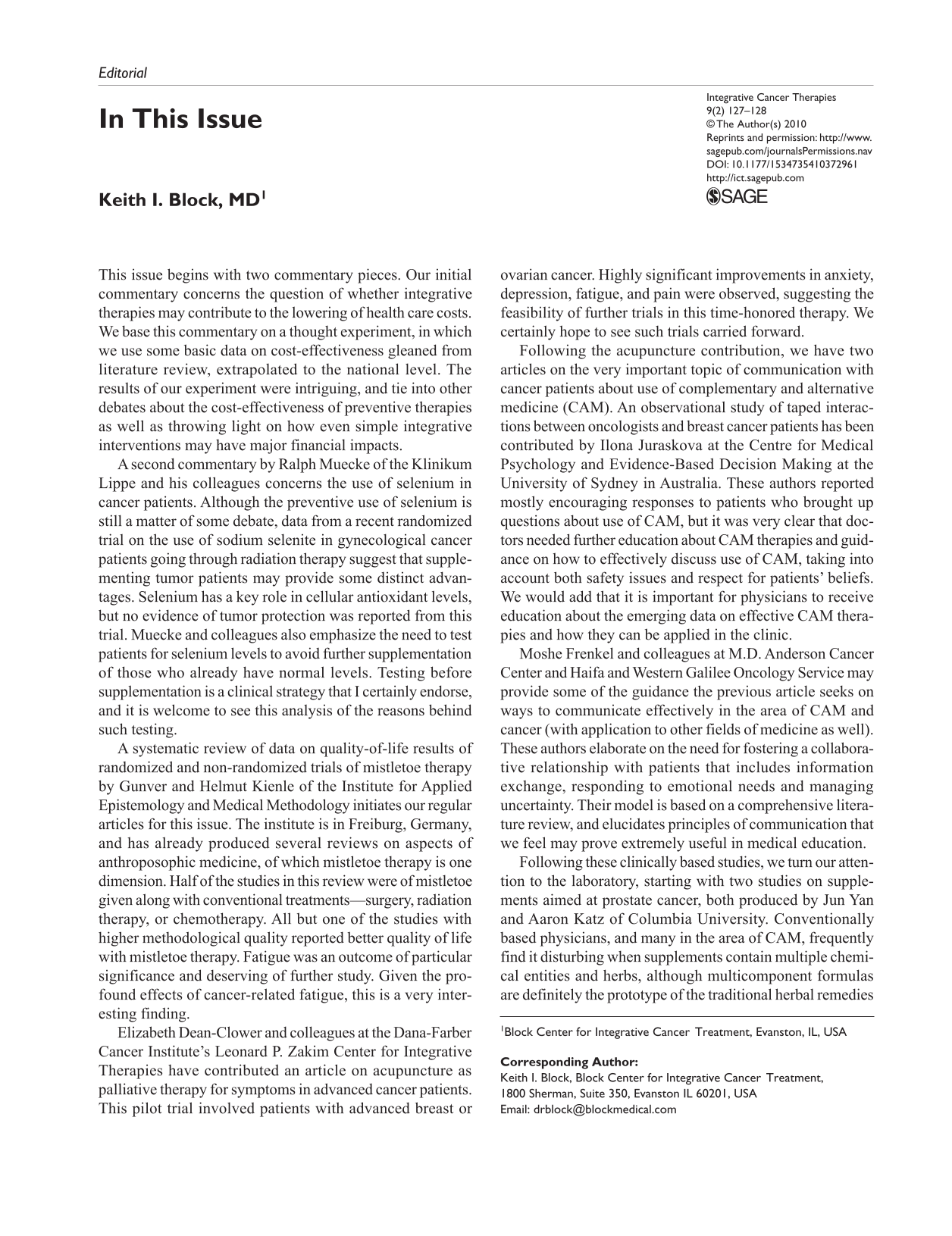
Editorial
 Free accessEditorialFirst published June, 2010pp. 127-128

Select search scope: search across all journals or within the current journal


 Free accessEditorialFirst published June, 2010pp. 127-128Free accessOtherFirst published June, 2010pp. 129-135
 Free accessResearch articleFirst published June, 2010pp. 136-141
The essential trace element selenium, which is a crucial cofactor in the most important endogenous antioxidative systems of the human body, is attracting more attention from both laypersons and expert groups. The interest of oncologists mainly focuses on the following clinical aspects: protection of normal tissues, sensitizing in malignant tumors, antiedematous effect, prognostic impact of selenium, and effects in primary and secondary cancer prevention. Selenium is a constituent of the small group of selenocysteine-containing selenoproteins and elicits important structural and enzymatic functions. Selenium deficiency has been linked to increased infection risk and adverse mood states. It has been shown to possess cancer-preventive and cytoprotective activities in both animal models and humans. It is well established that it has a key role in redox regulation and antioxidant function, and hence in membrane integrity, energy metabolism, and protection against DNA damage. Recent clinical trials have shown the importance of selenium in clinical oncology. In 2009, a significant benefit of sodium selenite supplementation—with no protection of tumor cells, which is often suspected by oncologists— was shown in a prospective randomized trial in gynecologic cancer patients undergoing radiation therapy. More recently, concerns arose from 2 large clinical prevention trials (NPC, SELECT) that selenium may increase the risk of developing type 2 diabetes. Despite obvious flaws in both studies and good counterarguments, controversy remains on the possible advantages and risks of selenium in cancer prevention. However, in the light of the recent clinical trials the potential benefits of selenium supplementation in tumor patients are becoming obvious, even though further research is needed.
 Open accessReview articleFirst published June, 2010pp. 142-157
 Free accessOtherFirst published June, 2010pp. 158-167
Free accessResearch articleFirst published June, 2010pp. 168-176
Free accessResearch articleFirst published June, 2010pp. 177-185In recent years, there has been an increased interest in complementary and alternative medicine (CAM) use among people with cancer. Many are looking for informed advice and desire communication with their physicians about CAM use. Communication is crucial in establishing trust with patients, gathering information, addressing patient emotions, and assisting patients in decisions about care. The quality of communication in cancer care has been shown to affect patient satisfaction, decision making, patient distress and well-being, compliance, and even malpractice litigation. Communication is now recognized as a core clinical skill in medicine, including cancer care, and is important to the delivery of high-quality care. A communication approach that fosters a collaborative relationship that includes adequate information exchange, responds to emotional needs, and manages uncertainty can lead to informed decisions about CAM use. This type of communication can help facilitate an open discussion with cancer patients and their families about integrating CAM use into their care and help physicians fulfill their roles in caring, comforting, and healing, even when cure is not possible. In this article, the authors discuss a possible model of effective patient—physician communication about CAM use in cancer care based on a comprehensive overview of the literature.
Free accessResearch articleFirst published June, 2010pp. 186-196The anticancer effects of ProstaCaid, a novel integrative blend of vitamins, minerals, multiherb extracts, and derivatives, were tested in human and mouse androgen—dependent (AD) and —independent (AI) prostate cancer cell lines. ProstaCaid shows growth inhibitory effects on both human and mouse AD prostate cancer cells (LNCaP and CASP 2.1) and AI prostate cancer cells (PC3 and CASP 1.1) in a dose-/time-dependent manner. Consistently, long-term treatment with ProstaCaid also reduced colony formation capacities of prostate cancer cells. Flow cytometry assays revealed that ProstaCaid induces G2/M arrest and apoptosis in LNCaP and PC3 cells after 72 hours of treatment. Immunoblotting assay demonstrated that 25 µg/mL of ProstaCaid treatment resulted in (1) the reduction of cyclin D1, cyclin B1, and Cdc2 expression in a time-dependent way; (2) increase in p21WAF1/Cip1 as early as 12 hours after the treatments in PC3 cells and reduction to base line at the 72-hour time point; and (3) repression of Bcl-2, BclxL, and induction of Bim as well as the cleavages of caspase-3 and poly(ADP-ribose) polymerase (PARP) at 72 hours of treatment, suggesting caspase-3-dependent apoptosis. Moreover, ProstaCaid suppressed activation of AKT and MAPK signaling pathways in PC3 and LNCaP cells by reducing phosphorylation levels of AKT, its downstream target S6 ribosomal protein and GSK3β, and ERK1/2, respectively. In summary, these findings strongly suggest that ProstaCaid may be a potential chemopreventive and therapeutic agent for both AD and, more importantly, AI prostate cancer.
Free accessResearch articleFirst published June, 2010pp. 197-203
Free accessResearch articleFirst published June, 2010pp. 204-212The traditional Chinese medicine,
Free accessResearch articleFirst published June, 2010pp. 213-218The effect of oxymatrine on the development of tolerance to the antinociceptive effects of morphine was investigated in rats. The degree of tolerance was assessed using the tail-flick test before and after 6 days of twice daily administration of oxymatrine premorphine (10/20/30 mg/kg). High doses of oxymatrine inhibited the development of morphine tolerance (resembling the effect of 7.5 mg/kg of the NMDA receptor antagonist memantine) while also increasing the antinociceptive effects. A high dose of oxymatrine (30 mg/kg) also significantly inhibited the dramatic increase in expression of morphine-induced P-glycoprotein (P-gp), an ATP-dependent efflux pump acting at the blood—brain barrier, by Western blot analysis. Furthermore, these studies suggest that P-gp modulates the development of morphine tolerance while not affecting the magnitude of the analgesic effect of morphine. These results imply that oxymatrine prevention of the development of tolerance of morphine may be related to a considerable inhibition of P-gp expression. In contrast, the authors’ data suggest that the mechanism of oxymatrine enhancement of morphine’s analgesic effects is not associated with increase in the level of expression of P-gp. However, they believe that their findings can be used by researchers to develop therapies that will allow patients to take morphine without becoming tolerant of its benefits.
Free accessResearch articleFirst published June, 2010pp. 219-223The preventive effective of
Free accessResearch articleFirst published June, 2010pp. 224-235Angiogenesis, the formation of new capillaries from preexisting vessels, is essential for tumor progression. Ursolic acid inhibited the tumor-associated capillary formation in C57BL/6 mice induced by highly metastatic B16F-10 melanoma cells. The levels of serum vascular endothelial growth factor (VEGF), NO, and proinflammatory cytokines were significantly reduced in ursolic acid—treated animals compared with those in control animals. The diminished expressions of
Free accessResearch articleFirst published June, 2010pp. 236-245
Free accessCorrectionFirst published June, 2010pp. 246-246The affiliations of the authors were incorrectly published in this article. SAGE regrets this error. The correct affiliations are listed below.
Free accessCorrectionFirst published June, 2010pp. 247-247