Editorial
Select search scope: search across all journals or within the current journal


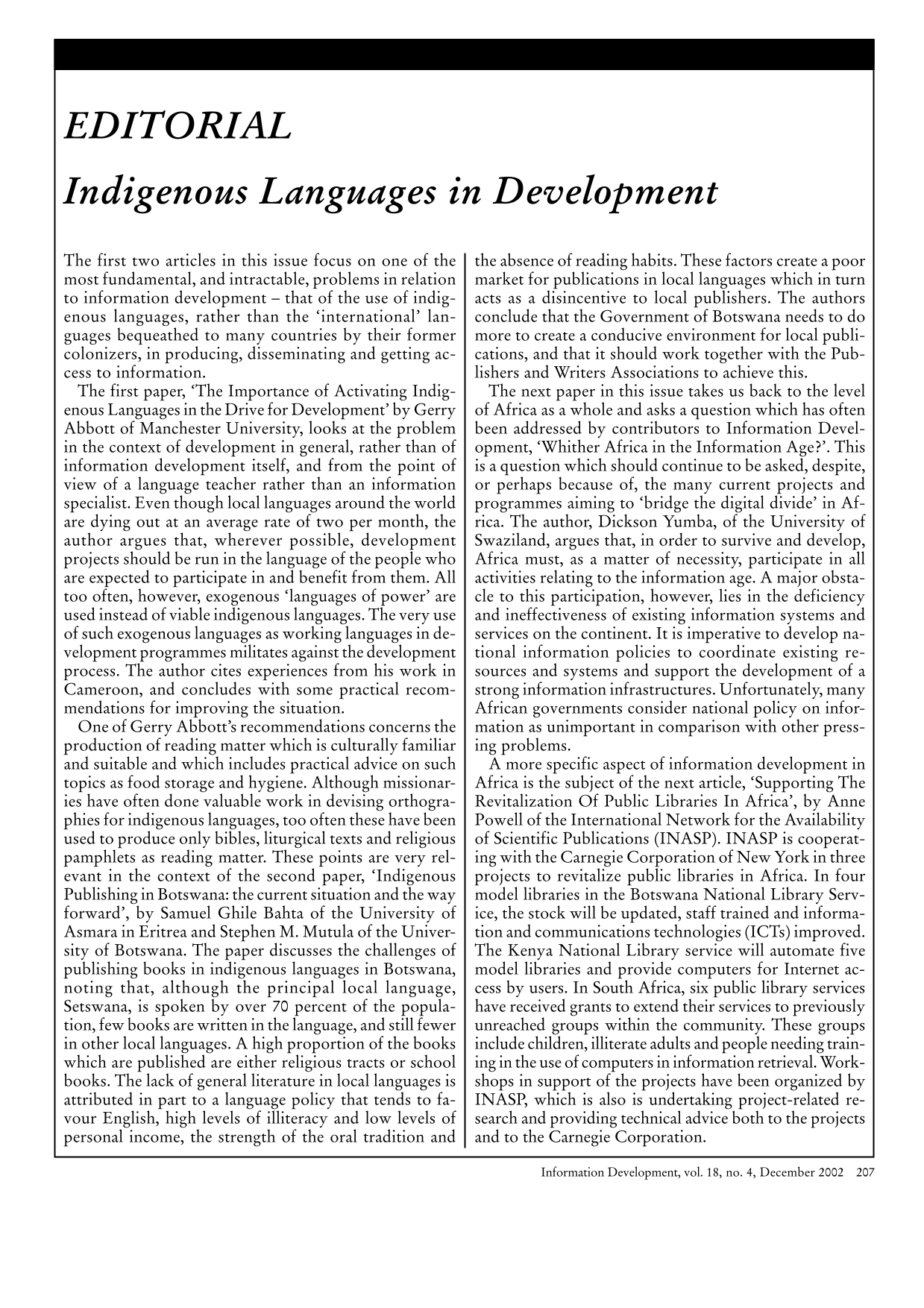
It is generally accepted that true societal development is a people-centred, bottom-up process. It should therefore follow that the working language of any development programme ought wherever possible to be the language of the target community. Occasionally it will be found that the language of an impoverished group is too moribund for such use – languages are dying out at an average rate of two per month. However, all too often an exogenous ‘language of power’ is used instead of a viable indigenous tongue. The author contends that, in the day-to-day running of development programmes, the very use of an exogenous tongue as a working language militates against the development process. Two instances from experience in Cameroon are described, and some practical recommendations are offered.
Book publications in indigenous languages within Botswana have a long tradition, despite the fact that the general patterns of publications in indigenous languages remain at its lowest ebb. Although the Setswana language is spoken by over 70 percent of the population in Botswana, few books are written in the language. This paper discusses the challenges of publishing books in indigenous languages in Botswana. Problems include low readership, low sales volume, absence of necessary incentives, illiteracy, lack of subsistence income, a culture of oral tradition, a language policy that tends to favour English and the absence of reading habits. Considers the prospects for the development of local language publications in the country.
Outlines a general overview of the information situation in Sub-Saharan Africa and argues that to survive and develop, Africa, must as a matter of necessity participate in all activities relating to the information age. Given the deficiency and ineffectiveness of existing information systems and services on the continent it becomes imperative to develop information policies at national level that could co-ordinate existing resources and systems and support development of an appropriate strong information infra-structure.
The Carnegie Corporation of New York, with advice and technical support from the International Network for the Availability of Scientific Publications (INASP), has launched three projects to revitalize public libraries in Africa. Botswana National Library service has identified four model libraries in which stock will be updated, staff trained and ICT improved. Kenya National Library service will automate five model libraries and provide computers for clients use in Internet functions. Access to information will be improved through stock editing and there is an ongoing public relations programme. In South Africa three provincial library services and three municipal library services have received grants to extend their services to previously unreached groups within the community. Some systems selected children as their target groups, others illiterate adults or those needing training in the use of computers in information retrieval. INASP has organized workshops in support of the projects, and is undertaking research to strengthen the projects, as well as providing technical advice to the projects and to Carnegie Corporation.
Presents the experience of the University of Dar es Salaam Library in developing a library research agenda. It examines the need for conducting research on focused areas that are relevant to the profession and national development. The paper reviews the research and publishing situation at the University of Dar es Salaam library and outlines the processes involved in developing its research agenda, including criteria for the selection of topics for inclusion and the actual priority areas selected for research. Concludes with recommendations and lessons for other libraries.
Examines the results of a survey of the availability and use of information technology in the libraries of the University of Mysore, Karnatak University, Bangalore University, Gulbarga University, Mangalore University and Kuvempu University in Karnataka State, India. Attempts to reflect how the use of IT has impacted on the overall use of the library collections by users. Covers the use of computers, networks, electronic mail, online information retrieval, CD-ROM, facsimile transmission, personal computers (PCs) and the Internet.