Research article
Select search scope: search across all journals or within the current journal


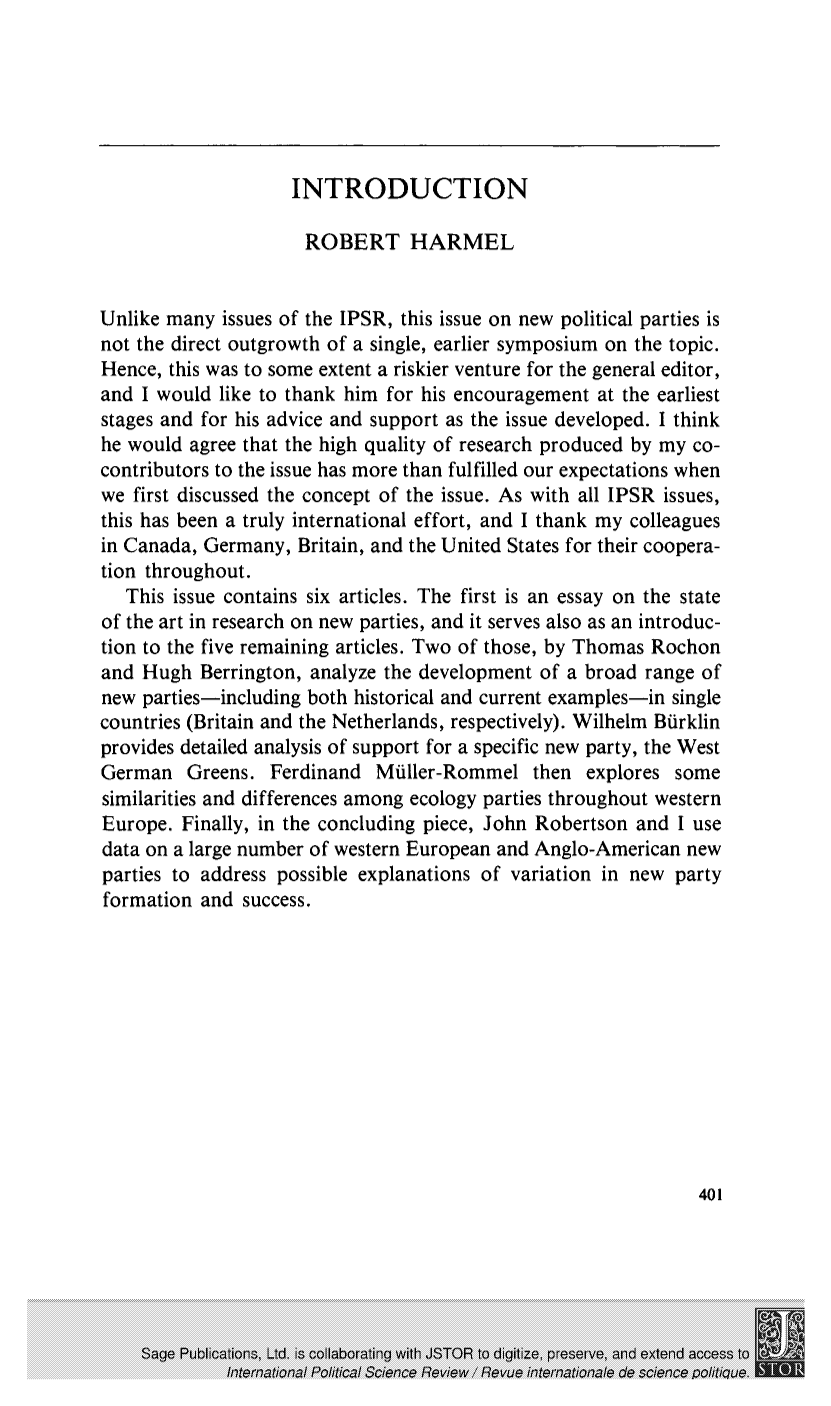
The large number of new parties appearing in western democracies and their actual and potential impacts offer important avenues of research on parties in general. This paper reviews work on the definition and enumeration of new parties, their variability, classification and distinctiveness, and the development and testing of theory concern ing new parties. It suggests areas of research that, in the author's view, will provide evidence of the need to integrate an understanding of new-party phenomena in the broader spectrum of political studies.
Since 1918, thirty-one new parties have entered the Dutch Parliament including nine of the twelve parties currently represented. Although the low threshold of the Dutch electoral system makes it relatively easy for new parties to enter Parliament, it does not guarantee their continued success. New party success is here explained by distinguishing between challenging parties, which contest with one or more established parties for an already-mobilized part of the electorate, and mobilizing parties, which attempt to define political issues that generate support on the basis of a new cleavage. The article evaluates key elements of the programs of new parties and, for recent entrants into Parliament, uses survey data to show that mobilizing parties develop stronger attachments among the electorate and enjoy greater longevity in Parliament than do challenging parties.
The two-party system is sometimes thought of as being "natural" to Britain. In fact, many new parties have been formed, but few have survived as politically significant independent bodies. New parties in Britain face severe obstacles, of which the elec toral system is the greatest. Despite these difficulties, opportunities favorable for new parties do sometimes arise; new parties may also be founded by minorities that feel there is no longer a place for them in one of the established parties. A distinctive political group has a choice of either starting a new party or of trying to infiltrate one of the older parties and so capturing it from within. The success of a new party may have profound medium-term consequences for the country's political alignment. Major social changes, however, are more likely to have an effect through the existing parties than through the rise of a new party.
This article focuses on the process of partisan realignment in the West German party system of the 1980s by analyzing electoral support for the new party, the Greens. On the basis of quantitative analyses of 1980 and 1983 electoral data, a spatial analysis of the German party system was conducted. This analysis reveals the existence of two distinct dimensions of political conflict, one dividing established oppositions and the corresponding parties from left to right, and a second dividing established from non- established groups and the corresponding parties, especially the Greens. Analysis reveals that the traditional cleavages do not explain conflict over the second dimension. The explanation lies with those variables that correspond to secularized, post-industrial conflicts. The finding that the younger, the better-educated of the new left form the core group of the Greens is interpreted in relation to the economic and ideological deprivation of these groups; this electoral reaction, it is argued, must be explained with reference to the intervening effect of loosening social-structural and ideological attachments of voters in the post-industrial society.
This study is an initial comparative exploration of the green party phenomenon. The principal objective of this article is to provide a general overview of the historical development, the electoral results, and the nature of the electorate of green parties in western Europe. A preliminary classification on green parties is offered, and it is demonstrated that the value orientation and ideological composition, as well as socio- demographic composition, of green parties' electorates differ across countries and party types.
After describing the universe of 233 new parties formed in 19 West European and Anglo-American democracies from 1960 through 1980, the authors use data on those parties to address several hypotheses concerning system-level causes and conditions for new party formation and electoral success. It is found that although the propensi ty for forming new parties is not associated with structural variables, new party suc cess is related to the type of electoral system.