Other
Select search scope: search across all journals or within the current journal


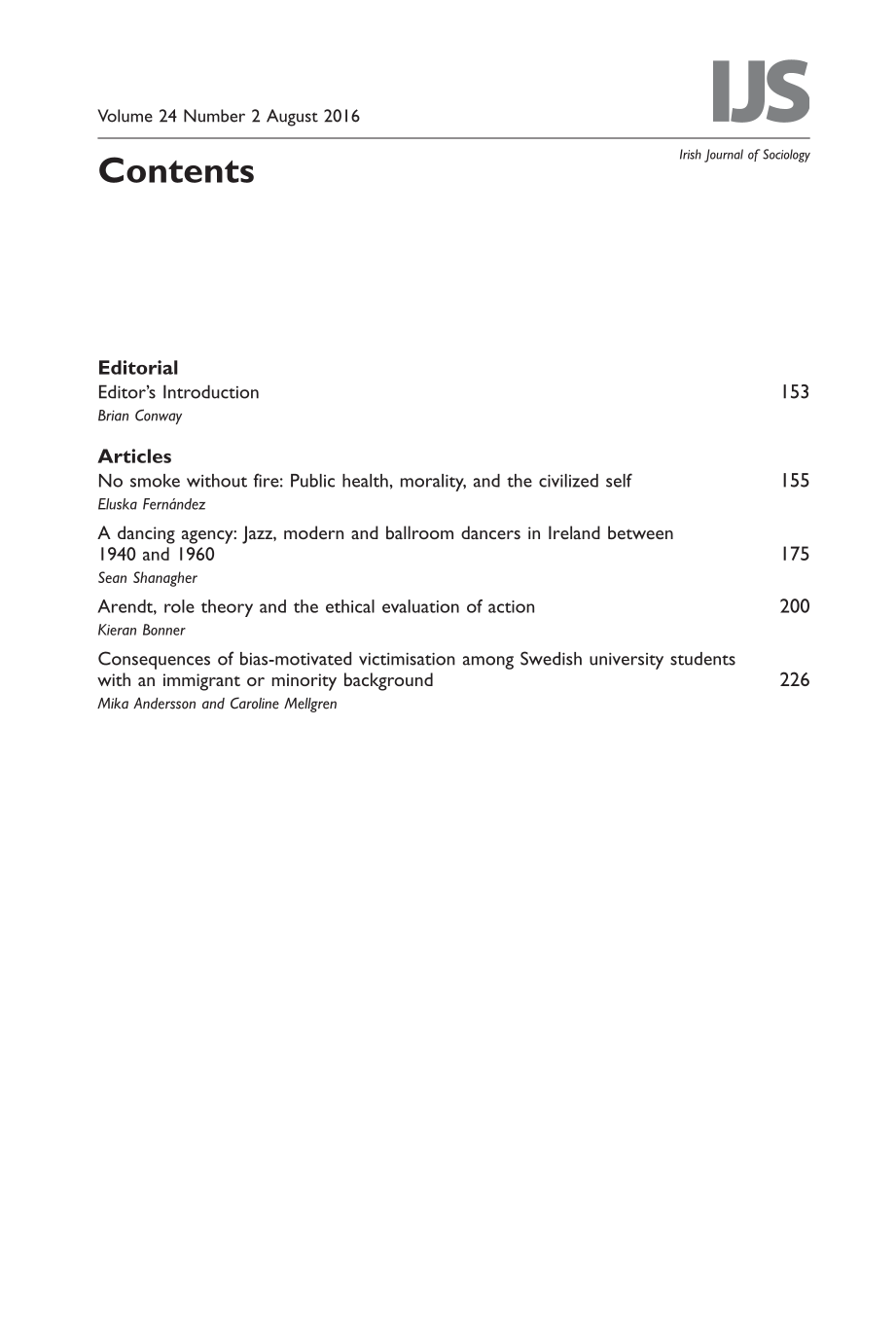
The implementation of the smoking ban in Ireland has been championed as one of the major achievements of public health policy. Studies on the smoking ban have predominantly been undertaken from a public health perspective and have pointed out the associated health benefits of the ban, especially in terms of the reduction of second-hand smoking. While the rationale for the smoking ban was founded on health and medical reasons, this paper contends that going beyond health concerns, a collective process which drew upon notions of progress, purity and order was central to the introduction and successful implementation of the smoking ban. The relevance of discourses around the “civilized self” in tobacco control is also discussed in the context of recent debates over the use and regulation of electronic cigarettes in public spaces.
Studies of social dance in Ireland between the 1930s and 1950s have generally focused on either the disciplined body of ‘Irish dance’ or on the process of disciplining those who favoured non-traditional dance forms. As a result, important aspects of social dance have been obscured. This article assesses the importance of non-traditional forms such as jazz by foregrounding the agency of its participants. It draws primarily on an ethnography of dance culture in Co. Roscommon. The approach has also been inflected by a reflexive dimension that positions the researcher within the research frame. Drawing on developments in dance anthropology, such reflexivity can operate as a useful epistemological tool that problematises the notion of objective research. The main research findings are (1) that dancers during the period, in the face of considerable opposition from cultural nationalists, participated in the construction of a vibrant, cosmopolitan and transgressive dance culture and (2) that dancing pleasures related to music, ‘communitas’ and ‘flow’ formed a central element of these dancing experiences. By according the voices of dance participants – including that of the researcher – a central place, this article places the emphasis squarely on ‘a dancing agency’.
In what way can social action be simultaneously inquired into and ethically evaluated by social theory? This paper explores the responsibility sociology has with regard to the political and ethical implications of its knowledge production and does so through a case study examination of the sociological concept of role. It compares and evaluates the different orientations that ground the concept of role and Arendt’s concept of action, which is then expanded to address the critique of the social sciences by theorists like Arendt and Foucault. The paper engages a particular tradition of reflexive sociology in the context of the danger of banal evil (Eichmann) and in the context of modern structures of domination that makes that danger more prevalent. Arguing that a theoretical non-empirical reflexivity is called for, and drawing on the phenomenological reflexivity of Berger and the constitutive reflexivity of Blum and McHugh, the paper seeks to demonstrate the need for a reflexive awareness of the actor’s responsibility for action and the theorist’s responsibility for formulating action that can make conceptual space for reasoned evaluation oriented by and to principle.
The present article examines the impact of racist and xenophobic victimisation among students with a minority and/or immigrant background in a Swedish context. We examine if racist and/or xenophobic victimisation result in 1) behavioral strategies applied to reduce victimisation risk, 2) a heightened level of fear and 3) if the motive in itself has an independent effect on the level of fear among victims. The study design combines survey data with interviews. The findings suggest that experiences of racist and/or xenophobic victimisation lead to higher levels of fear and that the motive in itself influences this relationship independently. We also found that certain behavioural strategies are developed in order to avoid victimisation.