Obituary
 Free accessObituaryFirst published April, 2009pp. 103-103
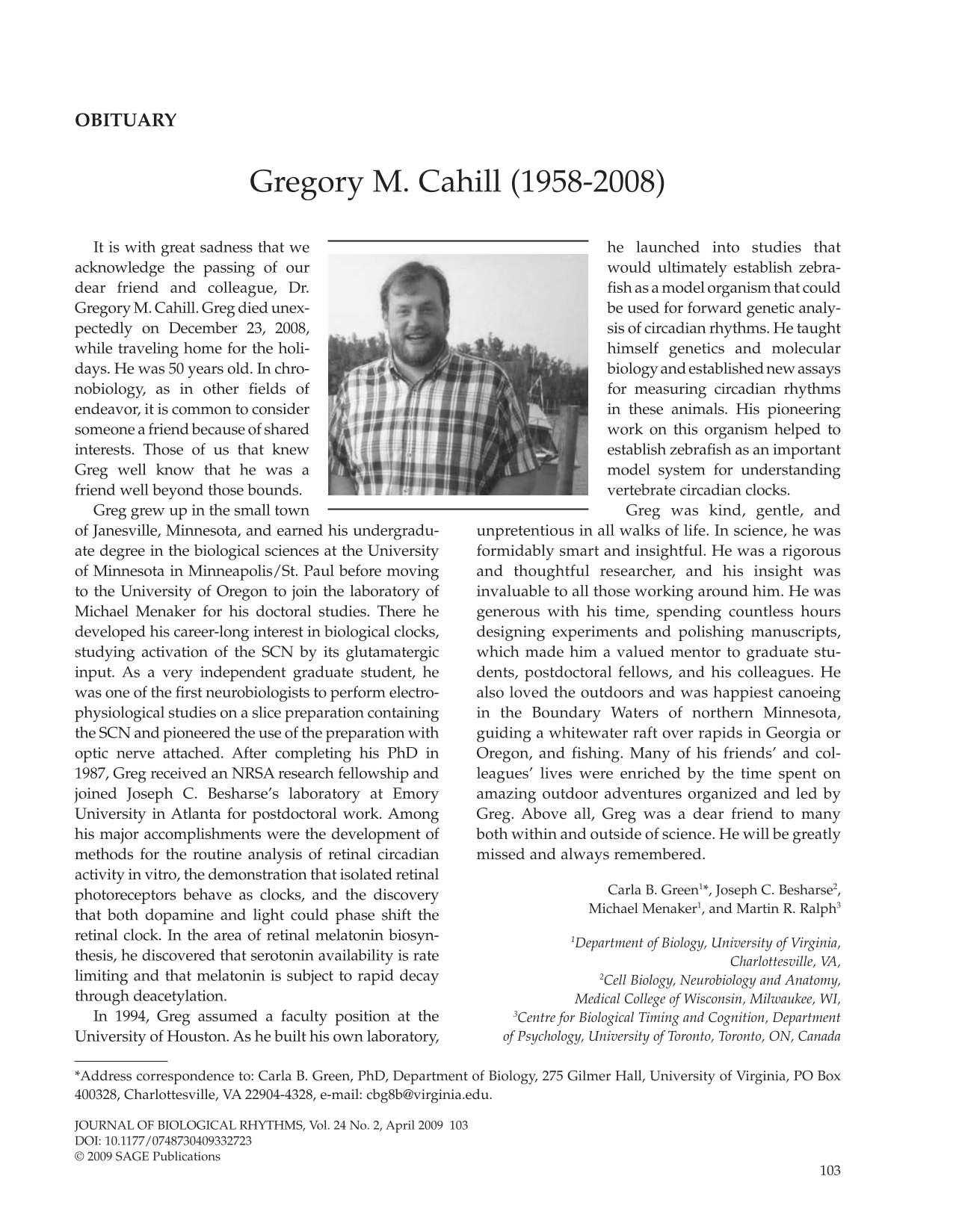
Gregory M. Cahill (1958-2008)
View All


Select search scope: search across all journals or within the current journal

 Free accessObituaryFirst published April, 2009pp. 103-103Free accessResearch articleFirst published April, 2009pp. 104-113
Clock genes are known to be the molecular core of biological clocks of vertebrates. They are expressed not only in those tissues considered central pacemakers, but also in peripheral tissues. In the present study, partial cDNAs for 6 of the principal clock genes (
Free accessResearch articleFirst published April, 2009pp. 114-125Spermatogenesis is an essential precursor for successful sexual reproduction. Recently, there has been an expansion in the knowledge of the genes associated with particular stages of normal, physiological testicular development and pubertal activation. What has been lacking, however, is an understanding of those genes that are involved in specifically regulating sperm production, rather than in maturation and elaboration of the testis as an organ. By using the reversible (seasonal) fertility of the Syrian hamster as a model system, the authors sought to discover genes that are specifically involved in turning off sperm production and not involved in tissue specification and/or maturation. Using gene expression microarrays and in situ hybridization in hamsters and genetically infertile mice, the authors have identified a variety of known and novel factors involved in reversible, transcriptional, translational, and posttranslational control of testicular function, as well those involved in cell division and macromolecular metabolism. The novel genes uncovered could be potential targets for therapies against fertility disorders.
Free accessResearch articleFirst published April, 2009pp. 126-134Circadian rhythms in physiology and behavior are temporally synchronized to the day/night cycle through the action of light on the circadian clock. In mammals, transduction of the photic signal reaching the circadian oscillator in the suprachiasmatic nucleus (SCN) occurs through the release of glutamate and pituitary adenylate cyclase-activating peptide (PACAP). The authors' study aimed at clarifying the role played by PACAP in photic resetting and entrainment. They investigated the circadian response to light of PACAP-null mice lacking the 5th exon of the PACAP coding sequence. Specifically, they examined free-running rhythms, entrainment to 12-h light:12-h dark (LD) cycles, the phase-response curve (PRC) to single light pulses, entrainment to a 23-h T-cycle, re-entrainment to 6-h phase shifts in LD cycles, and light-induced c-Fos expression. PACAP-null and wild-type mice show similar free-running periods and similar entrainment to 12:12 LD cycles. However, the PRC of PACAP-null mice lacks a phase-advance portion. Surprisingly, despite the absence of phase advance to single light pulses, PACAP-null mice are able to entrain to a 23-h T-cycle, but with a significantly longer phase angle of entrainment than wild types. In addition, PACAP-null mice re-entrain more slowly to a 6-h phase advance of the LD cycle. Nevertheless, induction of c-Fos by light in late night is normal. In all experiments, PACAP-null mice show specific behavioral impairments in response to phase-advancing photic stimuli. These results suggest that PACAP is required for the normal integration of the phase-advancing light signal by the SCN.
Free accessResearch articleFirst published April, 2009pp. 135-143Many mammalian cell types show daily rhythms in gene expression driven by a circadian pacemaker. For example, cultured astrocytes display circadian rhythms in
Free accessResearch articleFirst published April, 2009pp. 144-152In the cockroach, olfactory sensitivity as measured by the amplitude of the electroantennogram (EAG) is regulated by the circadian system. We wished to determine how this rhythm in antennal response was reflected in the activity of individual olfactory receptor neurons. The amplitude of the EAG and the activity of olfactory receptor neurons (ORNs) in single olfactory sensilla were recorded simultaneously for 3 to 5 days in constant darkness from an antenna of the cockroach
Free accessResearch articleFirst published April, 2009pp. 153-160Studies in humans and mice revealed that circadian phase shifting effects of light are larger at the beginning of a light exposure interval than during subsequent exposure. Little is known about the dynamics of this response reduction phenomenon. Here the authors propose a method to obtain information on the progression of phase during light exposure. Phase response curves to intervals of light exposure over a wide range in duration are available for flesh flies, mice, and humans. By comparing the phase shifts induced by pulses of various durations but starting at the same circadian phase, the progression of phase during a long interval (hours) of light exposure is reconstructed for each of these 3 species. For flies, the phase progression curves show that light pulses—if long enough— eventually make the pacemaker stabilize around InT18 (near subjective dusk), as is typical for strong resetting. The progression of phase toward the final value never shows advances larger than 7 h, while delays can be as large as 18 h. By applying the phase progression curve method presented in this study, differences between advances and delays in type-0 phase response curves can be distinguished clearly. In flesh flies (
Free accessResearch articleFirst published April, 2009pp. 161-172Scheduled bright light and darkness can phase shift the circadian clocks of night workers for complete adaptation to a night work, day sleep schedule, but few night workers would want this because it would leave them out of phase with the diurnal world on days off. This is the final study in a series designed to produce a compromise circadian phase position for permanent night shift work in which the sleepiest circadian time is delayed out of the night work period and into the first half of the day sleep episode. The target compromise phase position was a dim light melatonin onset (DLMO) of 3:00, which puts the sleepiest circadian time at ~10:00. This was predicted to improve night shift alertness and performance while permitting sufficient daytime sleep after work as well as late-night sleep on days off. In a between-subjects design, 19 healthy subjects underwent 3 simulated night shifts (23:00-7:00), 2 days off, 4 more night shifts, and 2 more days off. Subjects “worked” in the lab and slept at home. Experimental subjects received four 15-min bright light pulses during each night shift, wore dark sunglasses when outside, slept in dark bedrooms at scheduled times, and received outdoor afternoon light exposure (“light brake”) to keep their rhythms from delaying too far. Control subjects remained in normal room light during night shifts, wore lighter sunglasses, and had unrestricted sleep and outdoor light exposure. The final DLMO of the experimental group was 3:22 ± 2.0 h, close to the target of 3:00, and later than the control group at 23:24 ± 3.8 h. Experimental subjects slept for nearly all the permitted time in bed. Some control subjects who slept late on weekends also reached the compromise phase position and obtained more daytime sleep. Subjects who phase delayed (whether in the experimental or control group) close to the target phase performed better during night shifts. A compromise circadian phase position improved performance during night shifts, allowed sufficient sleep during the daytime after night shifts and during the late nighttime on days off, and can be produced by inexpensive and feasible interventions.