
Editorial
 Restricted accessEditorialFirst published June, 2026pp. 697-700

Select search scope: search across all journals or within the current journal


 Restricted accessEditorialFirst published June, 2026pp. 697-700Restricted accessResearch articleFirst published June, 2026pp. 701-706
Optical coherence tomography (OCT) is a noninvasive imaging technology that provides high-resolution, cross-sectional views of biological tissues using near-infrared light. Since its introduction in the early 1990s, OCT has expanded from ophthalmology into dentistry. With micrometer-level resolution and no ionizing radiation, dental OCT offers significant advantages over conventional x-ray–based imaging modalities such as intraoral radiography and cone beam computed tomography, particularly for detecting early or subtle changes in hard and soft tissues. In this article, we review the evolution of OCT in periodontology and share 3 novel applications: assessment of postorthodontic fenestrations, preoperative planning for periapical lesions, and gingival revascularization after gingivectomy. These advances go beyond the reach of standard imaging tools and support the adoption of OCT for improving diagnosis, guiding treatment, and monitoring treatment response. As imaging protocols become increasingly sophisticated and targeted, OCT promises great advances in periodontal diagnostics and patient care.
 Open accessResearch articleFirst published June, 2026pp. 707-716
Periodontitis is a complex, multifactorial inflammatory condition characterized by progressive destruction of the periodontal supporting structures. It profoundly affects oral health, esthetics, and masticatory function and is increasingly recognized as a contributing risk factor for systemic disorders. Deep periodontal pockets establish a severely hypoxic microenvironment induced by periodontal pathogens, increased oxygen consumption of infiltrated inflammatory cells, and accompanying periodontal vascular changes. The cellular response to hypoxia is centrally regulated by hypoxia-inducible factor 1 alpha (HIF-1α), which is also recognized as a critical factor driving the progression of periodontal tissue destruction. In vivo and in vitro studies have shown the upregulation of HIF-1α in both animal periodontitis models and clinical samples from individuals with periodontitis, where its expression correlates positively with deteriorating clinical periodontal parameters. Experimental and clinical studies using mouse conditional knockout models, selective small-molecule inhibitors, and human-derived materials have demonstrated clear causal roles for hypoxia-driven HIF-1α signaling in the progression of periodontitis. This conclusion is supported by mechanistic evidence demonstrating that HIF-1α induces aberrant neovascularization, enhances osteoclastogenesis leading to subsequent alveolar bone resorption, and promotes M1 macrophage polarization along with proinflammatory cytokine production. Hypoxia, via HIF-1α, synergistically acts with periodontal pathogens to amplify periodontal inflammation and oxidative stress, driving persistent extracellular matrix destruction in periodontal tissues. This critical review summarizes recent findings, using in vitro and in vivo approaches using animal and human-derived materials, on the role of hypoxia, primarily through the HIF-1α pathway, in periodontitis pathogenesis as well as the potential of hypoxia-based strategies and targeted modulation of HIF-1α signaling through HIF-1α stabilizers for managing periodontitis and promoting periodontal regeneration, while highlighting the existing gaps in our understanding and the limitations of current research, which can serve as a foundation for guiding future studies in this area.
Restricted accessResearch articleFirst published June, 2026pp. 717-726 , J.H. Lee, Q.-S. Auh , [...]
Temporomandibular disorders (TMDs) encompass a heterogeneous group of musculoskeletal conditions involving the temporomandibular joint (TMJ), masticatory muscles, and associated structures. Diagnosis remains challenging due to overlapping symptoms, multifactorial etiology, and variability across clinical settings. To address these limitations, we developed the Gated Attention Tabular Transformer (GATT), a novel deep-learning model that uses masked self-supervised learning and gated attention mechanisms, to classify TMD subgroups based on the diagnostic criteria for TMD (DC/TMD). A total of 4,644 structured clinical records from a university-based registry were analyzed, comprising 3,524 female and 1,120 male patients (mean age 36.9 ± 14.7 y), across 12 core TMD subgroups. GATT achieved robust diagnostic performance with area under the receiver-operating characteristic curve values ranging from 0.815 to 1.000, sensitivity from 0.652 to 1.000, and specificity from 0.773 to 1.000. The model significantly outperformed conventional machine-learning methods including logistic regression, random forest, support vector machine, and XGBoost as well as advanced tabular deep-learning models such as TabNet, TabTransformer, AutoGluon Tabular Predictor, and FT-Transformer. Shapley additive explanations (SHAP) analysis revealed “pain-free opening” (SHAP = 6.78,
Restricted accessResearch articleFirst published June, 2026pp. 727-736, H. Wang, A.W.I. Lo , [...]Oral cancer often develops from oral potentially malignant disorders. Oral leukoplakia (OL) is the most common oral potentially malignant disorder. However, not all patients with OL develop oral cancer in their lifetimes, and cancer risk assessment is challenging. This study developed a time-to-event artificial intelligence–based model (termed
Open accessResearch articleFirst published June, 2026pp. 737-745Accurate clinical records are fundamental to dental practice. Automatic speech recognition (ASR) has the capacity to convert spoken clinical language into written text within the electronic health record; however, the accuracy of ASR in natural language processing for clinical dentistry remains uncertain. The aim of this study was to investigate the transcriptional accuracy of ASR systems using orthodontic clinical records as the experimental model. Specifically, we used 4 commercial ASR systems (Heidi Health, DigitalTCO, Dragon Medical One, Dragon Professional Anywhere), 5 application programming interfaces (Amazon, Google, Speechmatics, Whisper, GPT4oTranscribe), and a 2-stage pipeline coupling GPT4oTranscribe with the GPT4o large language model (LLM) for generative error correction (GPT4oTranscribeCorrected). Orthodontic diagnostic and treatment planning summaries (
Restricted accessResearch articleFirst published June, 2026pp. 746-755, S.S. Dong, Y. Chen , [...]Dental caries is closely associated with microbiome dysbiosis. Incorporating antimicrobial agents can enhance the efficacy of fluoride toothpaste. Our previous studies showed that caffeic acid phenethyl ester (CAPE), derived from propolis, effectively inhibited cariogenic bacteria. To formulate a novel CAPE-containing fluoridated toothpaste and establish a multistage evaluation system assessing its caries-controlling efficacy. The CAPE toothpaste’s physicochemical properties were characterized. Its in vitro antimicrobial activity against
Restricted accessResearch articleFirst published June, 2026pp. 756-766Enhancing the durability of dentin bonding remains a significant challenge in dental restoration. This study introduces an innovative approach using aldehyde-grafted polyaspartate (PACA) to achieve spatiotemporal regulation of biomimetic mineralization through collagen cross-linking. The collagen cross-linking capability of PACA was confirmed by sodium dodecyl sulfate–polyacrylamide gel electrophoresis analysis. Its ability to induce intrafibrillar mineralization of collagen fibrils was investigated using a rat tail collagen model through dynamic light scattering, zeta potential measurements, and transmission electron microscopy. In addition, the remineralization efficacy of PACA on demineralized dentin collagen was evaluated using scanning electron microscopy, energy dispersive X-ray spectroscopy, and atomic force microscopy. These analyses revealed that PACA facilitates intrafibrillar mineralization by creating an amorphous calcium phosphate–rich microenvironment in the cross-linked region. Subsequently, the mineralization encapsulates the covalently cross-linked polymer and collagen fibrils within a mineralized matrix, forming an organized crystalline structure. Furthermore, PACA was used as a single-component primer in a dentin bonding model, and its impact on bonding durability was assessed through micro-tensile bond strength testing, nanoleakage analysis, and in situ zymography. These assessments demonstrate that PACA could simultaneously achieve collagen cross-linking, matrix metalloproteinase inhibition, and enhanced adhesive penetration while facilitating temporally regulated mineralization. Due to this multifunctionality, the PACA primer significantly improves micro-tensile bond strength and exhibits favorable durability after the aging experiment. This innovative approach provides a promising solution to the durability limitations of conventional adhesive systems.
Restricted accessResearch articleFirst published June, 2026pp. 767-775Resin–dentin bonding technology is the primary method for tooth restoration in clinical practice. However, the formation of a defect zone at the bonding interface due to inadequate moisture control at the interface remains a major challenge. Inspired by mussel wet-adhesion mechanisms, this study functionalized phosphoric acid etchants with catechol–lysine–methacrylate (CLM), a polymerizable small-molecule monomer. During dentin demineralization, catechol binding to demineralized dentin was confirmed using an incubation-rinsing technique, while lysine’s role in facilitating rapid water release at the bonding interface was validated by freeze-drying mass loss, surface charge distribution, and thermogravimetric analysis. Confocal laser scanning microscopy revealed increased resin tag lengths in the CLM-treated groups, indicating enhanced resin infiltration. Ultimate tensile strength, dry mass loss, sodium dodecyl sulfate–polyacrylamide gel electrophoresis, and in situ zymography demonstrated catechol-enabled collagen stabilization via Schiff base/ester bonds and endogenous enzyme inhibition. Micro-tensile testing revealed that the 4- to 5-mg/mL CLM groups maintained bond strength after 10,000 thermal cycles. Thus, CLM-functionalized etchants may enhance bonding durability in vitro by improving moisture control and collagen stability.
Restricted accessResearch articleFirst published June, 2026pp. 776-789, S. Thangamurugan, C. Fecher-Trost , [...]The dental pellicle is a continuously forming layer present at the interface between oral surfaces and saliva. It protects the dental surfaces by shielding against chemical and mechanical damages. The pellicle represents the basis for further biofilm development, and its formation starts after oral hygiene through the adsorption of mostly salivary proteins to all exposed oral surfaces. In spite of its important physiologic role, its formation process and composition are not yet revealed in all details. The objective of the current study was 1) to visualize and elucidate the individual proteomic composition of the very early (only a few seconds) formed in situ pellicle, named
Restricted accessResearch articleFirst published June, 2026pp. 790-799Dental pulp stem cells (DPSCs) are neural crest–derived stem cells endowed with multipotency and self-renewal. While processes orchestrating DPSC differentiation have been studied extensively, mechanisms underpinning the differentiation of human DPSCs
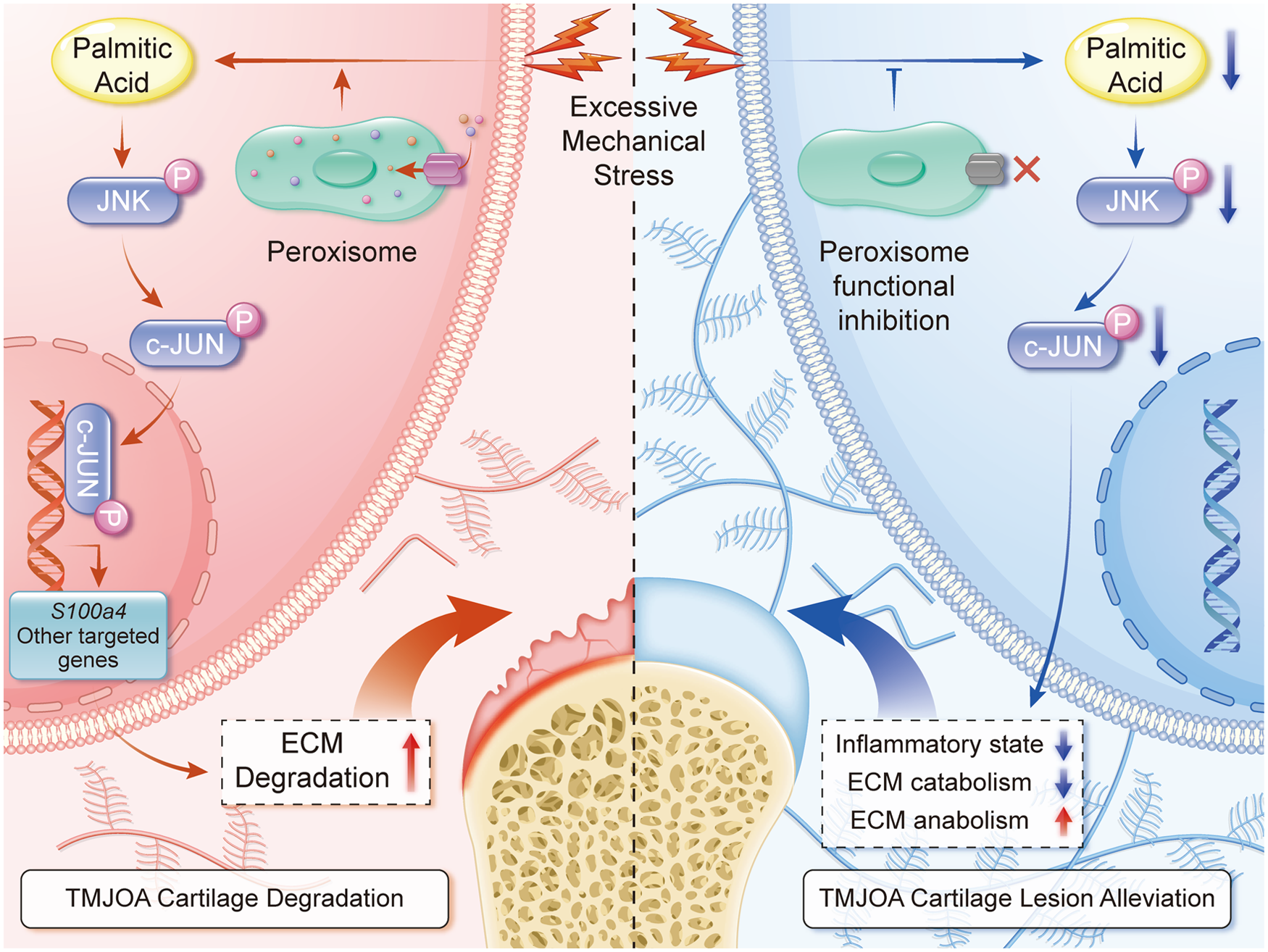
Restricted accessResearch articleFirst published June, 2026pp. 800-811Temporomandibular joint osteoarthritis (TMJOA) is a progressive and debilitating degenerative joint disorder characterized by cartilage degradation. Its pathogenesis remains poorly understood, and current treatment strategies are insufficient to restore normal joint structure. Lipid metabolism disorders in condylar chondrocytes have been identified as key contributors to TMJOA development, with peroxisomes playing an essential regulatory role in this metabolic process. Although previous studies have suggested a role for peroxisomes in chondrocyte biology, their specific involvement in TMJOA pathogenesis remains unclear. This study is the first to demonstrate the involvement of peroxisomes in TMJOA and to elucidate the associated molecular mechanisms. A TMJOA mouse model was established via unilateral anterior crossbite surgery, revealing abnormal peroxisome quantity and function. In vitro experiments demonstrated that inhibiting peroxisome function alleviated mechanical stress-induced OA-like damage to chondrocytes. In
Restricted accessResearch articleFirst published June, 2026pp. 812-822Immune alterations, such as neutrophil dysfunction, significantly affect the progression and outcome of periodontitis, a prevalent inflammatory disease. Despite this, the molecular mechanisms driving neutrophil dysregulation in periodontitis remain poorly understood. In this study, we demonstrate that CD300lf, a critical immune regulator, is markedly downregulated in neutrophils from a periodontitis mouse model and human patients. The loss of CD300lf accelerates neutrophil aging, as evidenced by increased reactive oxygen species production, the senescence-associated secretory phenotype with elevated IL-1β and S100A8/A9 levels, and heightened neutrophil extracellular trap formation. Mechanistically, CD300lf deficiency leads to MyD88 upregulation, indicating a shift toward a proinflammatory state. Inhibition of MyD88 effectively reduces periodontal inflammation in CD300lf-deficient mice. Furthermore, targeting CD300lf with its known ligand ceramide alleviates periodontitis and mitigates the aging phenotype of neutrophils. These findings underscore the critical role of the CD300lf/MyD88 axis in neutrophil homeostasis and suggest that modulation of CD300lf through ceramide presents a promising therapeutic strategy for periodontitis.
Restricted accessLetterFirst published June, 2026pp. 823-823 Open accessLetterFirst published June, 2026pp. 824-825