Editorial
Select search scope: search across all journals or within the current journal


In the World Health Organization/United Nations Children’s Fund document

In 2005, the Level III neonatal intensive care unit (NICU) at Rush University Medical Center initiated a demonstration project employing breastfeeding peer counselors, former parents of NICU infants, as direct lactation care providers who worked collaboratively with the NICU nurses. This article describes the conceptualization, implementation, and evaluation of this program and provides templates for other NICUs that wish to incorporate breastfeeding peer counselors with the goal of providing quality, evidence-based lactation care.
When an infant is medically compromised or requires surgery shortly after birth, traditional breastfeeding is interrupted. In the United States, mothers of these medically complex infants often spend many hours using a breast pump to express their breast milk and store it for their baby to receive via a feeding tube or bottle until breastfeeding can be introduced. Often, additional calories, minerals, or modifications are made to mother’s milk to meet the infant’s needs. Many acute care pediatric facilities and neonatal intensive care units lack appropriate physical space for the preparation of fortified breast milk feedings, and the preparation of these feedings by nursing staff requires a significant investment of time. At Boston Children’s Hospital, the innovative role of a mother’s milk technician was created to provide preparation of breast milk utilizing standardized measurement of fortifiers by weight, prepared using an aseptic technique with standard operating procedures. The creative use of a “mobile” milk cart was implemented due to limited space allocated for formula lab and nutrition rooms. The development of this essential role has ensured optimal quality control of the storage and preparation of expressed human milk. Nursing compliance with breast milk identification procedures increases when time required for feeding preparation is minimized, preventing breast milk administration errors and reallocating valuable nursing time back to the patient.
Milk expression is a normal part of breastfeeding, but in developed countries in particular, the focus tends to center on mechanical expression. In Russia, there is a long tradition of hands-on techniques that continues in the present day and includes mothers turning to providers trained in hand expression and breast massage techniques to resolve breastfeeding complications including engorgement, plugged ducts, and mastitis. As observed over the course of several trips to Russia, Russian clinicians routinely combine hand expression with breast massage for the treatment of milk stasis, engorgement, and plugged ducts. A better understanding of these hands-on techniques to assist in resolution of complications may provide additional treatment options for the lactation community.
The practice of kangaroo mother care (KMC) is steadily increasing in high-tech settings due to its proven benefits for both infants and parents. In spite of that, clear guidelines about how to implement this method of care are lacking, and as a consequence, some restrictions are applied in many neonatal intensive care units (NICUs), preventing its practice. Based on recommendations from the Expert Group of the International Network on Kangaroo Mother Care, we developed a hospital protocol in the neonatal unit of the Institute for Maternal and Child Health in Trieste, Italy, a level 3 unit, aimed to facilitate and promote KMC implementation in high-tech settings. Our guideline is therefore proposed, based both on current scientific literature and on practical considerations and experience. Future adjustments and improvements would be considered based on increasing clinical KMC use and further knowledge.

Donor human milk is critical for the fragile preterm infant who does not have access to his or her mother’s milk, improving survival rates and quality of survival and decreasing hospital stay. Despite the opening of donor milk banks around the world, shortages continue as demand for donor milk exceeds supply. One potential means of increasing supply is by reducing exclusion criteria that prohibit mothers from donating milk based on duration of lactation. Minimal research has been done on the composition of human milk during the second year of lactation, with most research focusing on the nutritive compounds and not the immunoprotective compounds. Several immunoprotective compounds, including lysozyme, lactoferrin, secretory immunoglobulin A, and oligosaccharides, are abundant in human milk compared to bovine-based infant formula and are partially or fully retained during Holder pasteurization, making them an important differentiating feature of donor milk. A PubMed search was conducted to review studies in human milk composition during the second year of lactation. Limitations of existing research include sample collection protocols, small study sizes, and use of populations that may have been at risk for nutritional deficiencies. Stable concentrations of several components were reported including protein, lactose, iron, copper, lactoferrin, and secretory immunoglobulin A. Lysozyme concentration increased during extended lactation, while zinc and calcium concentrations declined into the second year. Conflicting findings were reported on fat content, and no information was available regarding oligosaccharide content. More research is needed to create evidence-based guidelines regarding the nutritive and immunoprotective value of donor milk throughout the course of lactation.
The immune modulator TNF-related apoptosis-inducing ligand (TRAIL) has been found at extremely high levels in human milk of women with normal gestation at day 5 after delivery.
To investigate the presence and the levels of soluble TRAIL in human milk of women with preterm delivery at different time points post-partum (32, 34, and 36 weeks from conception).
The levels of soluble TRAIL were analyzed by ELISA in the breast milk of a group of 25 women with preterm delivery at different gestational ages.
Soluble TRAIL was present at high levels in human milk since early post-conceptional ages (32 weeks). No significant differences in TRAIL levels were noticed with respect to different gestational ages, or with respect to time of collection when comparing, in a selected group of patients, samples obtained between 15 and 26 days with those obtained 27 and 40 days after birth.
Due to the key immunoregulatory role of human soluble TRAIL, the presence of high levels of TRAIL in the milk of women with preterm delivery and its maintenance at high levels up to 72 days after birth support the importance of breastfeeding the preterm newborn.
Mothers of preterm and sick infants admitted to the neonatal intensive care unit (NICU) often encounter more difficulties with breastfeeding than mothers of healthy term newborns. The extent to which Baby-Friendly designation is associated with breastfeeding rates for NICU infants over time is unknown.
This study aimed to determine the rate of breastfeeding initiation and continuation in a US, inner-city, level 3 NICU 10 years after Baby-Friendly designation.
We compared the rate of breastfeeding initiation and continuation among breastfeeding-eligible mothers with infants admitted to the Boston Medical Center NICU in 1999 and 2009, using chi-square tests.
Breastfeeding initiation increased from 74% in 1999 to 85% in 2009 (
Improvement in breastfeeding initiation and any breastfeeding at 2 weeks of age continued 10 years after Baby-Friendly designation among mothers with NICU infants in a US, inner-city, level 3 NICU.
Mothers who deliver a premature infant often choose to provide milk because it is the “one thing that only the mother can do” to optimize her infant’s outcome, helps mothers feel a connection with their infants, and helps relieve the guilt associated with the preterm birth.
The purpose of this study was to describe the meaning of milk for mothers who are providing milk for their very low birth weight (VLBW; < 1500 g) infants hospitalized in the neonatal intensive care unit (NICU).
Using a qualitative descriptive design, in-depth semistructured interviews were conducted with 23 mothers of VLBW infants hospitalized in a level III NICU. Mothers were asked to share their perceptions about what providing milk meant to them.
Mothers had faith in the healing properties of their milk and equated providing milk with “giving life” to their infants, mitigating the effects of complications, keeping their infants healthy and stable, and helping themselves address the feelings of failure and guilt associated with the premature birth. Mothers’ faith in their milk to achieve these outcomes was a maternal motivator to continue pumping, even for mothers who had not intended to provide milk or who experienced the paradox of disliking pumping but wanting to provide their milk.
The experiences of these mothers reflect the importance of acknowledging mothers’ faith in the healing properties of their milk as a motivating factor for sustaining lactation while coping with the stress and anxiety inherent during the infant’s NICU hospitalization.
Mothers of very preterm infants continue to face challenges related to providing their expressed breast milk in the neonatal intensive care unit (NICU).
This qualitative study sought to understand the experience of mothers of hospitalized very preterm infants related to their daily pumping routine during the NICU stay.
Fourteen women who were pumping breast milk for their hospitalized infants were interviewed. Sequential, semistructured, audiotaped individual interviews were conducted at 2 different time points: within 2 weeks following delivery when the mothers were pumping only, and 4 to 6 weeks once breastfeeding had been initiated.
The central themes found were: becoming a “mother–interrupted” and negotiating a paradoxical experience of separation and connection. Unique to these findings were the paradoxical view of the pump as both a wedge and a link to their infants, the intense dislike the mothers had for the tasks required to provide their expressed breast milk, and diversionary tactics used during pumping sessions.
The complexity of thoughts, actions, and behaviors revealed in the mothers’ narrative accounts provides a guide to direct future breastfeeding interventions and management.
Human milk is the optimal form of nutrition for infants, especially sick or compromised infants, yet international data suggest that breastfeeding (feeding at the breast) and the use of expressed human milk (mother’s and donor’s milk) are limited in patients cared for in the neonatal intensive care unit (NICU).
The goal of this study was to examine feeding status at hospital discharge among high risk infants.
We used the 1991 World Health Organization infant feeding definitions, applied to the 72 hour period preceding discharge from the NICU. The study sample consisted of all high risk infants discharged from July 1, 2005, to June 30, 2006 from 13 Italian NICUs. Data on infant feeding in the last 72 hours were collected at discharge from the medical records.
We recorded data from 2948 subjects with a median gestational age of 35 weeks (IQR, 32-38), a median birth weight of 2200 g (IQR, 1630-2920) and a median length of stay of 16 days (IQR, 8-33). At discharge, 28% of all infants were fed exclusively with human milk: 31%, 25%, 22% and 33% respectively in the <1500 g, 1500-2000 g, 2000-2499 g and ≥ 2500 g birth weight categories. The proportion of infants not fed with human milk varied from 6 to 82% across different centers.
Our study found limited breastfeeding and use of human milk among the NICU infants at discharge. At discharge, infants with a birth weight 1500-2499 g were fed exclusively with human milk less than those in higher or lower birth weight categories.
Pasteurized human donor milk (DM) is recommended by the World Health Organization and American Academy of Pediatrics for preterm infants when mother’s own milk is unavailable, yet the extent and predictors of use and criteria for use in US neonatal intensive care units (NICUs) are unknown.
This study aimed to evaluate current DM use in US level 3 NICUs and predictors and criteria of use.
We sent mail surveys to 302 US level 3 NICU directors. We used multivariable logistic regression to analyze predictors of DM use.
Survey response rate was 60%, and 76 of 182 (42%) directors reported DM use. Among DM users, 30% have used DM < 2 years and 55% for 2 to 5 years. Among nonusers, 63% were uncertain of turnaround time when ordering DM, 36% were unclear what guidelines milk banks followed, and 31% were unsure of parent receptiveness. In multivariate analyses, > 800 annual admissions (odds ratio [OR], 4.11; 95% confidence interval [CI], 1.43-11.82; reference ≤ 400 admissions) and location in the Midwest (OR, 3.02; 95% CI, 1.17-7.76) and West (OR, 6.33; 95% CI, 2.28-15.57; reference Northeast) were positively associated with DM use; safety-net hospitals (> 75% Medicaid insurance) were negatively associated (OR, 0.35; 95% CI, 0.14-0.89).
Pasteurized human donor milk use is rapidly emerging among US level 3 NICUs. Larger NICUs and those in the West and Midwest were more likely to use DM, while safety-net hospitals were less likely to use DM. Lack of knowledge by medical directors of accessibility, safety, and parental receptiveness may be barriers to DM use.
Human milk from the biologic mother (HM) reduces disease burden and associated costs of care during and after neonatal intensive care unit (NICU) hospitalization for very low birth weight (VLBW; birth weight < 1500 g) infants, when compared to feedings of donor human milk (DHM) or commercial formula (CF). However, compared to DHM and CF, little is known about the institutional cost to acquire HM from the biologic mother.
This study aimed to determine the institutional cost of acquiring HM for VLBW infant feedings during the NICU hospitalization.
This analysis examined 157 maternal pumping records from a prospective cohort study evaluating health outcomes and cost of HM feedings for VLBW infants. The costs for the breast pump rental fee, 1-time pump kit purchase, and disposable food-grade containers for storing expressed HM were evaluated using standard cost analysis techniques.
The median cost of acquiring 100 mL of HM varied from $0.51 when mothers pumped ≥ 700 mL daily to $7.93 for those who pumped < 100 mL daily. Mothers who pumped ≥ 100 mL daily had lower acquisition cost compared to both DHM ($14.84/100 mL) and CF ($3.18/100 mL). For mothers who pumped > 100 mL daily, the exact day of pumping where the cost of HM was less expensive than DHM or CF was 4 to 7 days and 6 to 19 days, respectively.
Human milk from the biologic mother has lower acquisition cost than DHM and CF when mothers provided ≥ 100 mL daily and pumped for a sufficient number of days (range, 4-19). Neonatal intensive care units should prioritize resources to ensure that mothers achieve this daily milk volume.
Fortification of human milk (HM) is a common clinical practice to adapt breast milk to the nutritional needs of very low birth weight (VLBW) infants. The optimal method for HM fortification remains to be determined, and a variety of protocols are currently used in neonatal intensive care units.
It is believed that standard fortification is insufficient to meet the needs of VLBW infants. Therefore, we designed a randomized prospective study that investigated the effects of varying levels of blind fortification on short-term growth and metabolic responses of preterm infants.
Eligible infants were randomized into 3 groups: standard fortification (SF), moderate fortification (MF), and aggressive fortification (AF). Short-term growth, feeding intolerance, and urea, calcium, phosphorus, and alkaline phosphatase levels were assessed.
There were 26, 29, and 29 infants in the SF, MF, and AF groups, respectively. The baseline characteristics of the groups were similar. Daily weight gain and length at discharge did not differ among the groups; however, head circumference was significantly higher in the MF and AF groups compared with the SF group. Urea, calcium, phosphorus, and alkaline phosphatase levels were similar between the groups.
We demonstrated that blind fortification of HM, even with higher amounts than recommended by manufacturers, did not cause any measured adverse effects on the metabolic response of preterm infants. Anthropometric measurements (except head circumference) were not different between the different dosages of fortification.
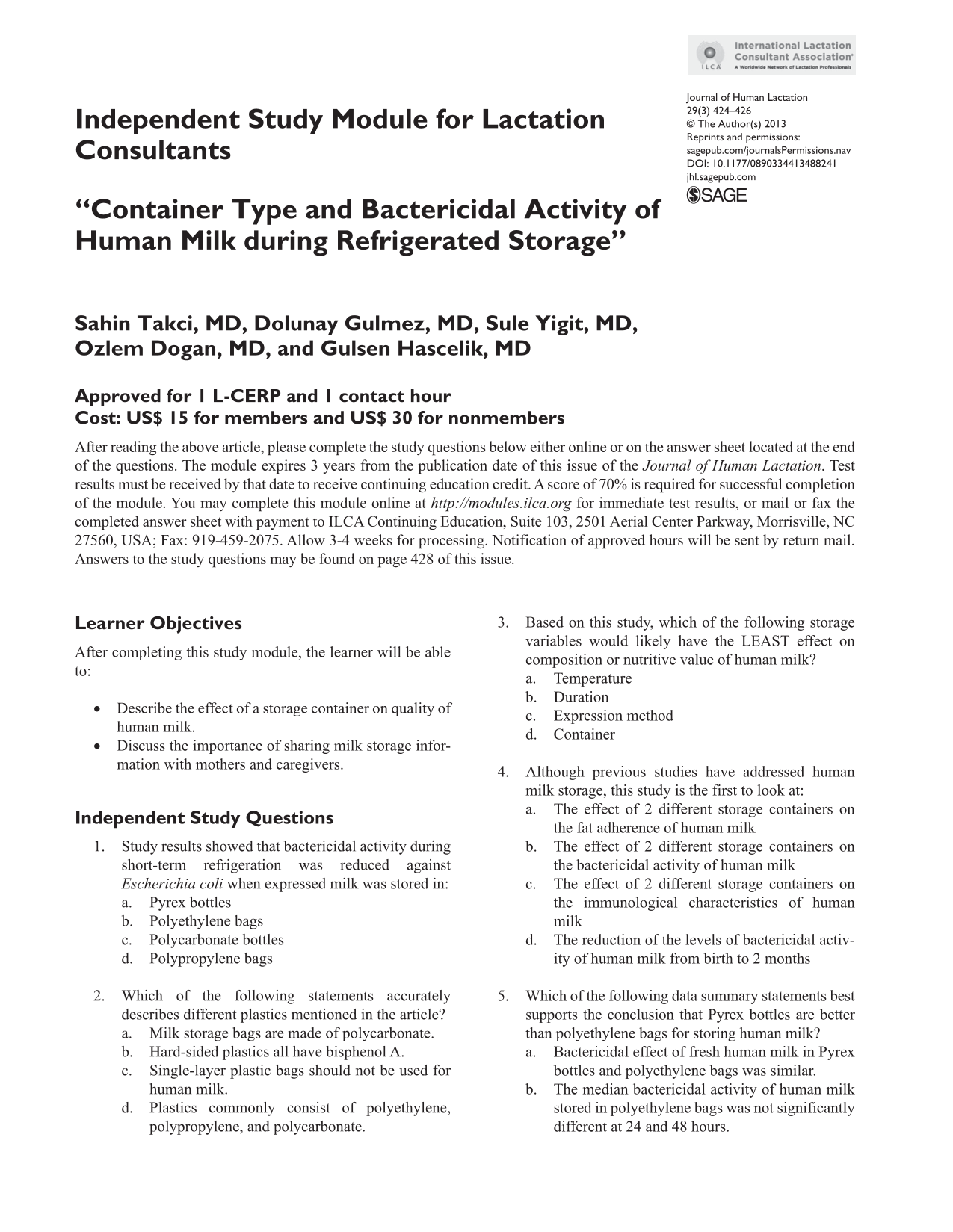
Refrigeration of human milk has been recommended for its short-term storage. It has been shown that some nutritional, immunological, and bioactive properties and bactericidal activity of human milk can be altered during refrigeration. Pyrex bottles and polyethylene bags are 2 commonly used containers for human milk storage.
The aim of this study was to compare the association between storage container type on the bactericidal activity of human milk for different durations of refrigeration (fresh, and at 24 and 48 hours).
Forty-four samples of human milk were collected from 22 lactating mothers. Two samples of breast milk (approximately 10 mL each) were obtained by manual expression from each mother. One was collected directly into sterile Pyrex bottles and the other into polyethylene bags. One mL of human milk from each container was processed immediately after arrival to the laboratory. The remaining human milk was kept in the Pyrex and polyethylene containers at 4°C until analysis at 24 and 48 hours. The bactericidal activity of each sample was studied. A strain of
Bactericidal activity was significantly reduced in milk samples stored in polyethylene bags compared to those stored in Pyrex bottles when milk samples were stored at 4°C for 24 and 48 hours (
Short-term storage of human milk in Pyrex bottles is more appropriate than polyethylene bags for preserving its bactericidal activity against
Mothers with preterm infants may need to express milk for considerable periods. Research to improve breast pump design has focused on compression stimuli, frequencies, and vacuums.
This study aimed to compare the effectiveness of 2 electric pumps: Medela Symphony (pump S) and a novel pump (Philips AVENT Twin electronic pump; pump A). Both offer flexibility of rate and suction; pump A also incorporates petal compression cushions. Primary outcomes were (1) milk weight expressed during 10-day study period and (2) weight of milk expressed in a 15-minute test.
Seventy-one mothers with preterm infants < 34 weeks were randomized. Mothers completed 10-day diaries including weight of milk expressed. Milk weight expressed during a single 15-minute test period and data on pumping mode, skin-to-skin contact, breastfeeding at infant discharge, and mothers’ opinions of the pump were recorded.
There was no significant difference in milk expressed during the first 10 days between groups. Pump S mothers expressed significantly more milk during a fixed 15-minute period. Mothers using pump A awarded higher scores for certain characteristics of the pump, notably location of control button and ease of use. Similar proportions of infants received breast milk at discharge, but pump A mothers were more likely to be directly breastfeeding (odds ratio, 4.27 [95% confidence interval, 1.29, 14.1]).
The breast pumps showed similar effectiveness in terms of milk expression and maternal opinions. The finding that breast pump design may influence breastfeeding at infant discharge merits further investigation.