Introduction
Select search scope: search across all journals or within the current journal

In 2006, two large, international, randomized trials comparing high-intensity to low-intensity treatment with epoetin alfa were published. Both trials demonstrated that low-intensity treatment—with goal serum hemoglobin values of 11.3 or 10.5 to 11.5 g/dL, respectively—was associated with improved outcomes in patients with anemia and nondialysis-dependent chronic kidney disease. Over the following 6 to 12 months, regulatory agencies, insurers, and hospital systems would react, sometimes dramatically, as further literature became available that caused a rethinking of the appropriate use of these valuable agents. This article will summarize the response to recent literature regarding the administration of erythropoietic stimulating agents.
Anemia in critically ill patients has been described as an acute form of anemia of inflammatory disease and is characterized by a blunted erythropoietic response due in part to proinflammatory mediators. Management of anemia in critically ill patients is a complex issue and is best approached via a multiprofessional team regarding the use of allogenic blood, iron, nutritional therapy, and erythropoietic agents. Indiscriminant, ``routine'' red blood cell transfusions may not only be unnecessary, but may pose unnecessary risk to the intensive care unit patient. Most intensive care unit patients can tolerate lower hemoglobin/hematocrit concentrations than the typically accepted ``10/30 rule.'' Lower transfusion triggers with an overall transfusion strategy is warranted in the intensive care unit patient. The use of recombinant human erythropoietic agents may not be necessary with appropriate transfusion practices.
Iron is an essential micronutrient that is indispensable for erythropoesis. Correct assessment of iron stores is needed both for the diagnosis of iron deficiency and to direct iron replacement therapies. Serum ferritin is a commonly employed measure to assess iron stores, yet there are caveats that influence its accuracy as a diagnostic tool. While low ferritin levels are specific for iron deficiency, high levels can be the result of inflammation, liver disease, or malignancies and could be independent of iron stores. Optimal anemia management involves administration of adequate amounts of iron. The right dose of iron that allows optimal erythropoesis yet avoids oxidative stress is a matter of ongoing debate, especially when using imperfect diagnostic tools such as serum ferritin to direct therapy. Data from hemodialysis patients are presented to illustrate the challenges one faces when trying to achieve the best possible therapeutic benefit from iron-replacement therapy.
Patients with congestive heart failure (CHF) who are also anemic have more severe CHF and a higher mortality, morbidity, and hospitalization rate than those who are not anemic. However, it is not known if the anemia is actually contributing to the CHF or if it is merely comorbidity (ie a marker of increased inflammation or chronic kidney disease [CKD]). The only way to demonstrate that anemia is a causative factor is to correct it, independent of other CHF factors. In this paper we review the results of the published papers about correction of anemia in patients with CHF. Taken in sum, these reports show a quite consistent positive effect of erythropoietic stimulating agents (ESAs) along with oral or intravenous (IV) iron or even of IV alone on clinical indicators and clinical outcomes of patients with CHF. More work is needed to clarify the important relationship between anemia, CHF, and CKD.
Erythropoiesis stimulating agents have been used for more than a decade in patients with chronic kidney disease, malignancy, and other disease states where anemia is common. Recently, several clinical trials have questioned the safety and efficacy of these agents. Thrombosis and increase in tumor progression as well as a potential increase in mortality have been noted in some trials and have generated growing concern regarding whether these agents should remain on the US market. Subsequently, reimbursement from some payers for erythropoiesis stimulating agent administration has become somewhat restrictive. We address the pharmacology, pharmacokinetics, pharmacodynamics, safety, efficacy, and pharmacoeconomics of erythropoiesis stimulating agents as well as emerging regulatory issues pertaining to the administration of erythropoiesis stimulating agents.
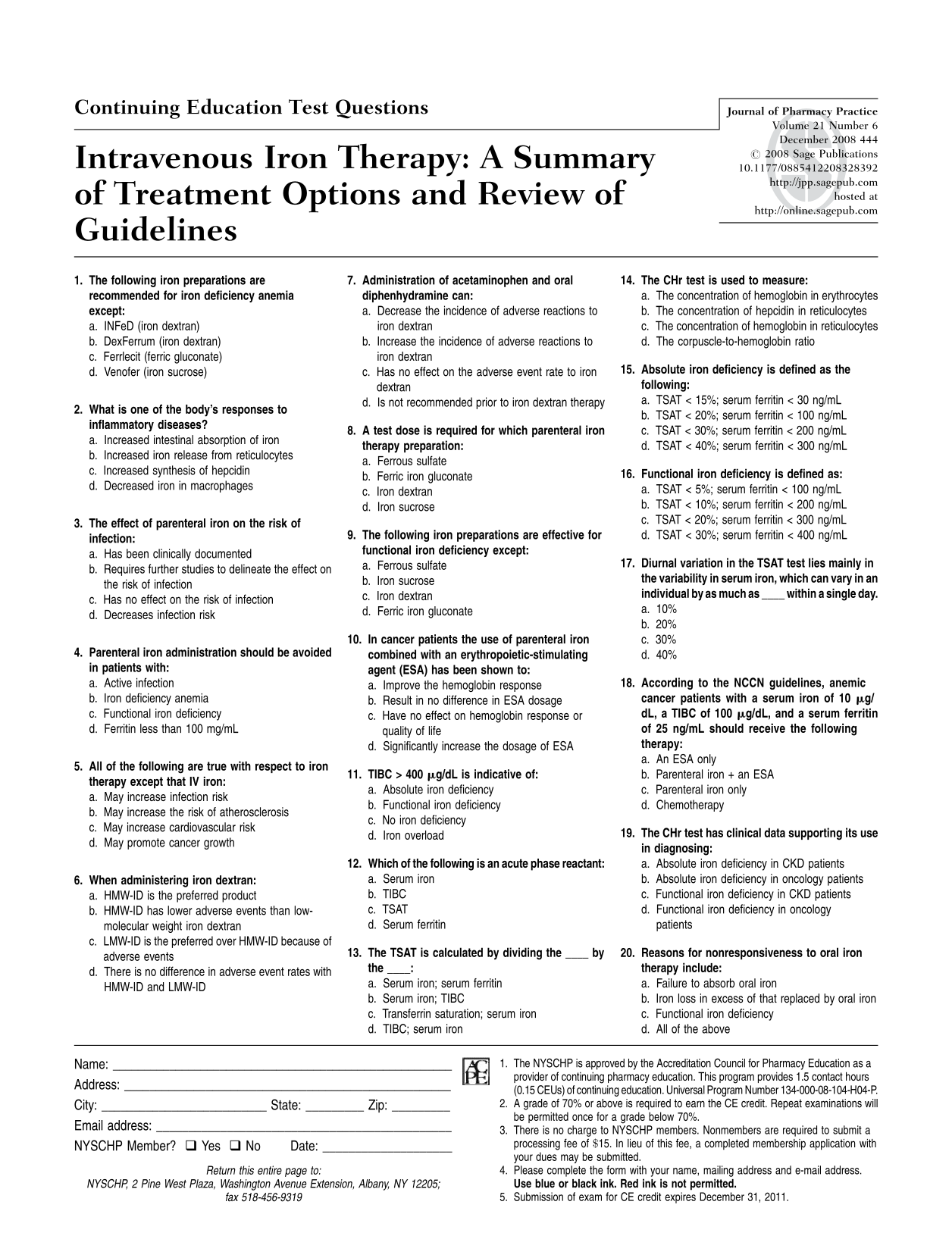
Iron replacement for iron-deficiency anemia has historically been accomplished with the use of oral iron therapy. Although oral iron is appropriate for most iron-deficiency anemia patients, many patients do not respond to or may be intolerant of oral iron, or may experience bleeding of sufficient magnitude to require higher iron doses than that achievable with oral iron. Intravenous iron therapy is a useful option for these latter patients. Three intravenous iron products are recommended: low-molecular weight iron dextran (INFeD), ferric gluconate (Ferrlecit), and iron sucrose (Venofer). These intravenous iron products have superior safety profiles compared to high-molecular weight iron dextran. The Food and Drug Administration's approval of erythropoietic-stimulating agents to treat certain types of anemia has increased usage of intravenous iron for functional iron deficiency. This review summarizes the current status of intravenous iron products and discusses their advantages and disadvantages in treating both absolute and functional iron deficiency.